
South Africa Grapes Harvesters Market Size and Share
Market Overview
| Study Period | 2021 - 2031 |
|---|---|
| Forecast Data Period | 2026 - 2031 |
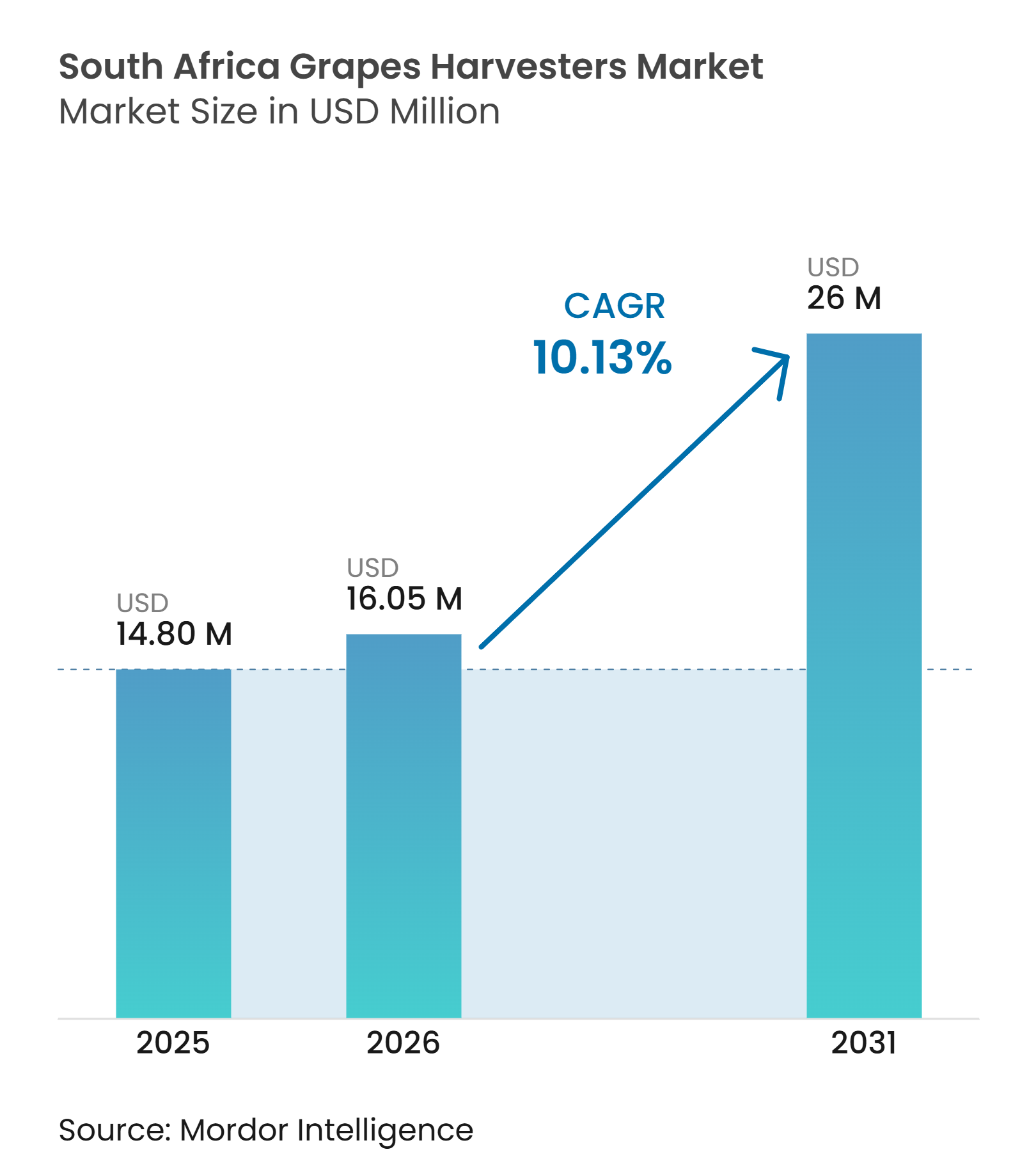
| Base Year Market Size (2025) | USD 14.80 Million |
| Market Size (2026) | USD 16.05 Million |
| Market Size (2031) | USD 26 Million |
| Growth Rate (2026 - 2031) | 10.13 % |
| Market Concentration | High |
Major Players *Disclaimer: Major Players sorted in no particular order Image © Mordor Intelligence. Reuse requires attribution under CC BY 4.0. | |
South Africa Grapes Harvesters Market Analysis by Mordor Intelligence
The South Africa grapes harvesters market was valued at USD 14.80 million in 2025 and is projected to grow from USD 16.05 million in 2026 to USD 26.00 million by 2031, representing a 10.13% CAGR during the forecast period 2026-2031. Rising farm labor costs and difficulties in securing seasonal workers are encouraging commercial vineyards to evaluate mechanical harvesting as a means of improving harvesting efficiency and reducing dependence on manual labor. A strong wine-grape harvest and the importance of South Africa's wine exports further increase the need to complete harvesting within defined maturity and winery-processing windows. Mechanized harvesting also provides opportunities to improve operational consistency and increase vineyard throughput during peak periods. Equipment suppliers are responding through localized dealer networks, after-sales service, warranty support, and harvesting machines capable of performing multiple vineyard operations. The market remains concentrated around established equipment suppliers with the technical and service infrastructure required to support capital-intensive machinery. Adoption is anticipated to be strongest among larger commercial vineyards and operators that can spread equipment utilization across multiple vineyards or generate additional revenue through contract-harvesting services, improving machine economics and shortening the investment payback period.
Key Report Takeaways
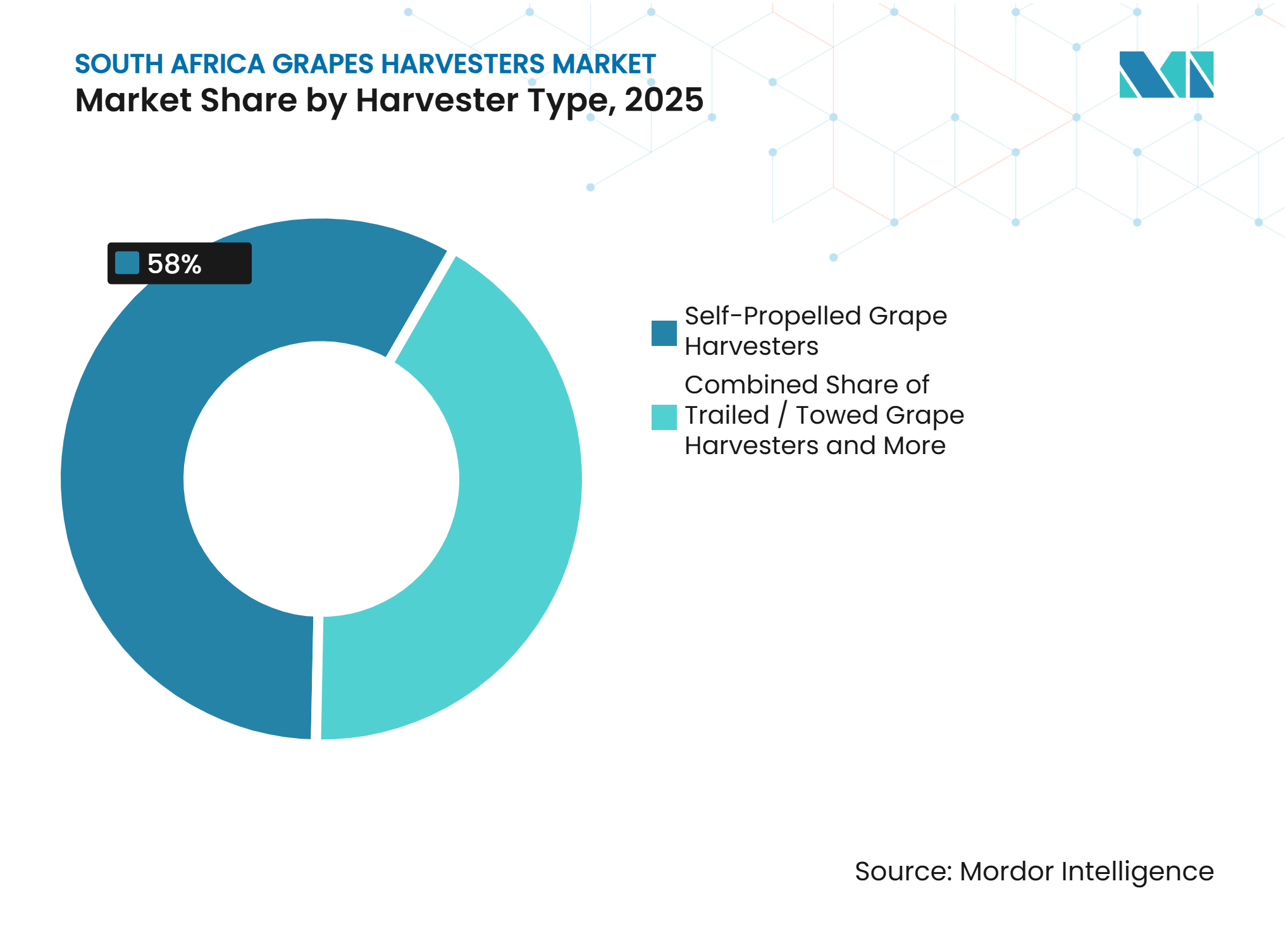
- By harvester type, self-propelled grape harvesters were the largest segment and held 58.0% of the South Africa grapes harvesters market share in 2025, while tractor-mounted grape harvesters are the fastest-growing segment and are anticipated to expand at 12.6% CAGR between 2026 and 2031.
- By mode of operation, assisted/ precision-guided operation was the largest segment and held 61.0% of the South Africa grapes harvester market size in 2025, while autonomous and semi-autonomous operation is the fastest-growing segment and is anticipated to expand at 15.0% CAGR between 2026 and 2031.
- By power source, diesel-powered harvesters were the largest segment and held 90.0% of the market share in 2025, while electric harvesters are the fastest-growing segment and are anticipated to expand at 18.0% CAGR between 2026 and 2031.
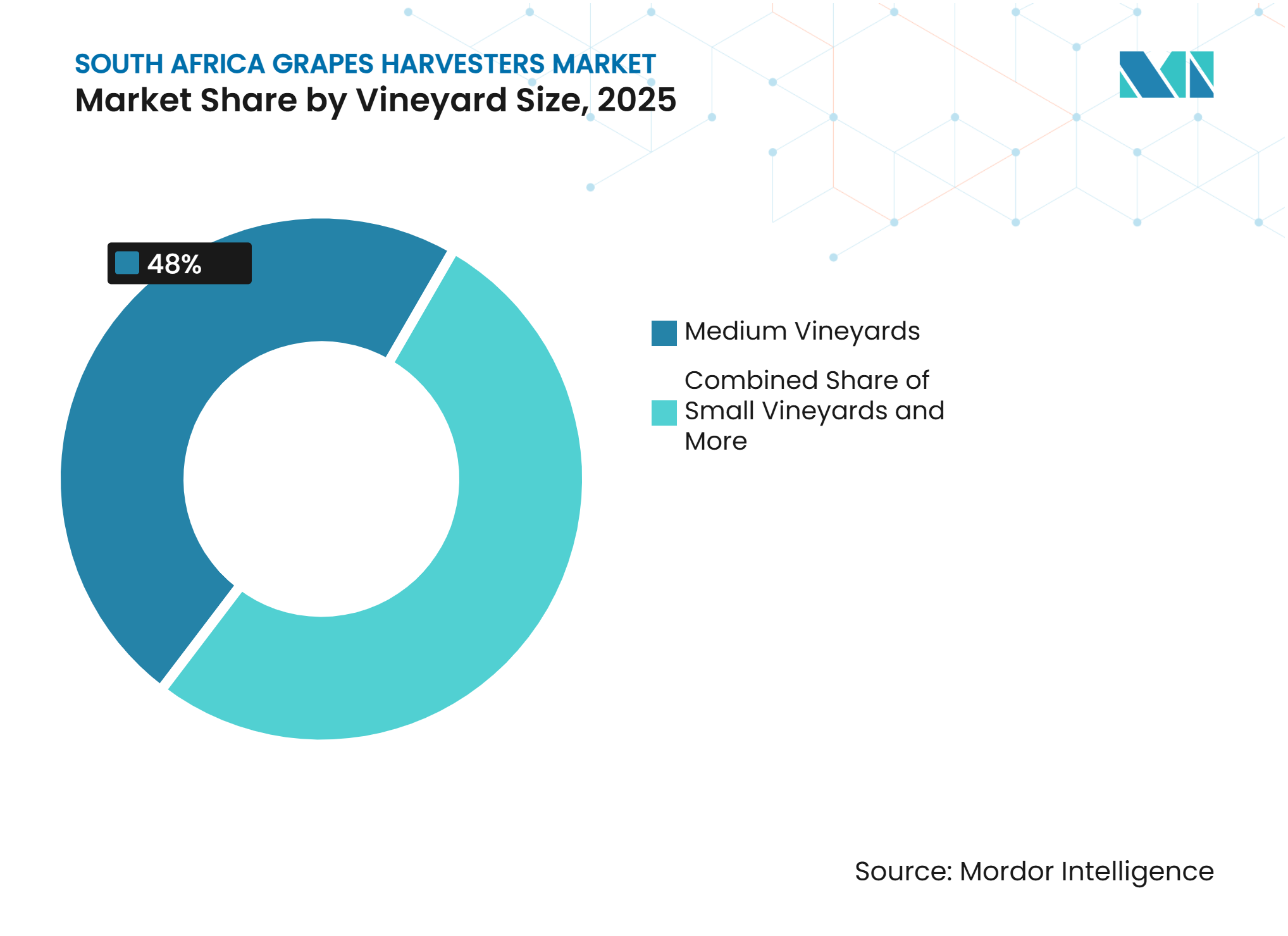
- By vineyard size, medium vineyards (51 to 200 hectares) were the largest segment and held 48.0% of the market share in 2025, while small vineyards below 50 hectares are the fastest-growing segment and are anticipated to expand at a forecasted 13.5% CAGR between 2026 and 2031.
Note: Market size and forecast figures in this report are generated using Mordor Intelligence’s proprietary estimation framework, updated with the latest available data and insights as of January 2026.
Market Trends and Insights
Drivers Impact Analysis of South Africa Grapes Harvesters Market*
| Driver | (~) % Impact on CAGR Forecast | Geographic Relevance | Impact Timeline |
|---|---|---|---|
| Rising vineyard labor costs and seasonal labor scarcity | +2.5% | Western Cape and Northern Cape, with relevance for Olifants River | Short term (≤ 2 years) |
| Expansion of mechanically harvested wine grapes | +1.8% | Western Cape, including Breedekloof, Worcester, and Robertson | Medium term (2-4 years) |
| Export-quality and harvest-window compliance | +1.5% | Western Cape and Northern Cape | Medium term (2-4 years) |
| Multi-use harvester economics across vineyard tasks | +0.9% | Large Western Cape estates | Long term (≥ 4 years) |
| Concentration of table-grape growth in Orange River and Hex River | +1% | Northern Cape and Western Cape | Short term (≤ 2 years) |
| Local dealer and aftermarket capability improving purchase confidence | +0.7% | National, led by Robertson, Worcester, and Paarl | Medium term (2-4 years) |
| Source: Mordor Intelligence | |||
Rising Vineyard Labor Costs and Seasonal Labor Scarcity
South Africa's National Minimum Wage increased from ZAR 28.79 (USD 1.67) to ZAR 30.23 (USD 1.75) per hour from 1 March 2026, bringing farm workers into line with the national rate[1]. The adjustment increases the statutory cost floor for agricultural employers and adds to the financial pressure associated with labor-intensive vineyard operations. Vinpro's industry reporting continues to identify labor, production costs, and the economic sustainability of wine-grape production as important considerations for South African wine producers. Its 2025 Production Plan Survey reported an average producer return on investment of 7.05%, the highest level recorded in its study group since 2004, but described the industry's recovery as fragile. Additional employer costs such as the Unemployment Insurance Fund (UIF) and the Skills Development Levy further increase the total cost of employing manual workers. These conditions strengthen the economic rationale for mechanization, where grape harvesters can reduce dependence on seasonal labor and increase harvesting productivity.
Expansion of Mechanically Harvested Wine Grapes
According to data from the South African Wine Industry Information and Systems (SAWIS), South Africa’s wine grape harvest reached 1.244 million metric tons in 2025, 13.2% higher than the 1.099 million metric tons recorded in 2024. The increase in production, combined with cultivar-specific ripening periods, increases the need for growers to complete harvesting efficiently within optimal harvest windows. This supports the use of mechanical harvesting equipment, which can cover larger vineyard areas within shorter periods while reducing dependence on seasonal labor. Vineyard configurations that facilitate mechanization are also gaining adoption, including high-wire hedge systems in regions such as the Orange River. As more vineyards become compatible with mechanical harvesting, the expanding area suitable for machine harvesting is anticipated to support demand for self-propelled grape harvesters and associated equipment.
Export-Quality and Harvest-Window Compliance
South Africa's export-oriented wine industry places increasing importance on harvesting grapes efficiently while maintaining fruit quality and ensuring timely delivery to cellars. Vinpro's 2025 Production Plan Survey found that 64.4% of South Africa's wine grape crop was mechanically harvested, compared with 63.6% in the previous year, indicating continued adoption of mechanical harvesting[2]. Mechanical harvesting enables producers to cover large vineyard areas rapidly and can support harvesting during cooler periods when required. Technology developments are further improving quality and processing efficiency. At SITEVI 2025, New Holland introduced the OptiLeaf™ system on its Braud 9.50L, 9.70L, and 9.70M harvesters, using a roller table and fan to remove leaves during hopper unloading, thereby reducing cleaning downtime and supporting juice retention and quality. These developments strengthen the value proposition of modern grape harvesters by combining faster harvesting with improved crop separation and handling, particularly for producers operating under tight harvest windows and quality requirements.
Multi-Use Harvester Economics Across Vineyard Tasks
The ability to use self-propelled vineyard machines for multiple operations can improve equipment utilization and strengthen the economic case for mechanization beyond the grape-harvesting season. Pellenc's multifunction carriers can perform harvesting, spraying, soil maintenance, pruning, leaf removal, spreading, and other vineyard activities through interchangeable implements, with the company positioning the machines for year-round vineyard use. This multi-use capability can help producers spread equipment costs across recurring vineyard operations rather than relying solely on seasonal harvesting activity. The trend is also extending toward autonomous vineyard equipment. New Holland previewed its R4 autonomous robot at Agritechnica 2025, with the vineyard version designed for repetitive tasks including mowing, tillage and spraying. As South African growers seek to improve machinery utilization and reduce labor requirements across vineyard operations, multifunction harvesting platforms and complementary autonomous technologies can support broader investment in mechanized vineyard equipment.
Restraints Impact Analysis of South Africa Grapes Harvesters Market*
| Restraint | (~) % Impact on CAGR Forecast | Geographic Relevance | Impact Timeline |
|---|---|---|---|
| High Capital Cost for Small and Mid-Sized Vineyards | -1.5% | National, particularly Stellenbosch and smaller Western Cape areas | Short term (≤ 2 years) |
| Insufficient Annual Machine Utilization | -1% | National, particularly single-estate operations below 100 hectares | Medium term (2-4 years) |
| Vineyard Age, Trellis, and Row Geometry Incompatibility | -0.8% | Legacy Western Cape areas, including Stellenbosch, Paarl, and Franschhoek | Long term (≥ 4 years) |
| Weather, Slope, and Soil Trafficability Disruption | -0.6% | Cape Winelands slopes and Orange River in wet periods | Short term (≤ 2 years) |
| Source: Mordor Intelligence | |||
High Capital Cost Relative to Small and Mid-Sized Vineyards
The high upfront investment required for self-propelled grape harvesters can limit adoption among small and mid-sized wine-grape producers, particularly where the vineyard area is insufficient to spread fixed machinery costs over a large harvested area. A 2020 University of the Free State study of 91 Western Cape wine-grape producers found that mechanical harvesting was economically more attractive for farms with approximately 100 hectares under wine grapes than for those with 40 hectares, using cost-benefit analysis based on measures including NPV and IRR. Larger farms in the Breede Valley, where vineyard holdings averaged approximately 75–100 hectares, were therefore better positioned to adopt mechanical harvesting than smaller Stellenbosch properties. South African viticulture research also documents alternative models that help spread the capital burden, including contract harvesting, joint ownership of harvesters, and equipment-sharing among producers. Import VAT adds to the upfront cash requirement for imported machinery, with South African Revenue Service (SARS) applying a 15% Value-Added Tax (VAT) rate to the applicable Added Tax Value, although VAT-registered businesses may generally recover input VAT subject to the relevant requirements. These economics favor larger vineyard operations and shared or contractor-based harvesting models, which can improve machine utilization and reduce the capital burden on individual producers.
Insufficient Annual Machine Utilization for Economical Ownership
Wine-grape harvesting in South Africa is concentrated within a relatively short seasonal window. SAWIS reported that the 2023 harvest began in early January, with the main intake occurring from late January through February and later cultivars continuing into March, illustrating the limited period during which grape harvesters generate direct harvesting revenue. Outside this period, self-propelled harvesters have limited opportunities for productive use unless operators serve multiple vineyards or operate through contractor and equipment-sharing arrangements. Low annual operating hours can increase the fixed machinery cost allocated to each tonne harvested, making individual ownership less attractive for smaller and mid-sized vineyards. South African viticulture has therefore identified contract harvesting, joint ownership and machinery-sharing as mechanisms for improving harvester utilization and spreading capital costs across multiple producers. The opportunity to move equipment between regions can further extend utilization, although transporting large specialized machinery between production areas may require abnormal-load permits and appropriate logistics planning. These utilization constraints can encourage smaller growers to rely on professional harvesting contractors rather than purchase self-propelled machines outright.
*Our forecasts treat driver/restraint impacts as directional, not additive. The impact forecasts reflect baseline growth, mix effects, and variable interactions.
South Africa Grapes Harvesters Market Segment Analysis
By Harvester Type:
Self-Propelled Harvesters Support Commercial Wine Grape MechanizationSelf-propelled grape harvesters accounted for 58.0% of the South Africa grapes harvesters market share in 2025, supported by their higher harvesting capacity, operator efficiency, and suitability for large commercial vineyards. Their ability to operate independently of a tractor also provides greater flexibility during compressed harvesting windows and enables harvesting during cooler nighttime periods. New Holland showcased the Braud 8.50L at Nampo Cape in Bredasdorp in September 2025, featuring a 3,600-liter hopper, 35-degree slope capability, and automatic height and tilt correction, capabilities suited to variable vineyard terrain and harvesting conditions. The combination of high throughput, terrain adaptability, and reduced dependence on separate tractor units supports continued preference for self-propelled machines among larger wine-grape producers.
The tractor-mounted grapes harvesters segment is forecast to expand at a 12.6% CAGR from 2026 to 2031, making it the faster-growing propulsion segment. These systems provide a lower-capital pathway to mechanization because growers can utilize existing tractors rather than investing in a dedicated self-propelled machine. They can therefore be more suitable for small and mid-sized vineyards where harvesting volumes may not justify the fixed cost of a self-propelled harvester. Trailed and tractor-mounted solutions also allow producers to match harvesting capacity with existing farm equipment and operating requirements. Pellenc's vineyard equipment portfolio includes trailed harvesting solutions, supporting the availability of lower-investment mechanization options for South African growers. As producers seek to mechanize while controlling capital expenditure, demand for tractor-mounted and trailed harvesting equipment is anticipated to increase, particularly among vineyards with smaller planted areas or existing compatible tractor fleets.



By Mode of Operation:
Precision-Guided Systems Anchor Commercial AdoptionAssisted/ precision-guided operation accounted for 61.0% of the South Africa grapes harvesters market in 2025, reflecting the importance of operator-assisted technologies in commercial vineyard harvesting. GPS-based guidance, automated row following, and hydraulic or lateral correction systems can reduce steering effort and improve machine positioning along vineyard rows, particularly during extended harvesting periods and nighttime operations. New Holland's grape-harvester guidance technology, for example, uses canopy detection to automatically adjust the harvesting head and maintain alignment with vine rows, while South African agricultural equipment suppliers also offer automatic steering systems for tractors and grape harvesters that reduce operator steering effort. The continued use of older vineyards also supports demand for operator-assisted systems that can improve consistency without requiring fully autonomous operation. A 2025 analysis published in researchgate found that 35.7% of South African wine-grape vines were more than 20 years old in 2023, reflecting the country's aging vineyard base[3].
Autonomous and semi-autonomous operation is forecast to expand at a 15.0% CAGR from 2026 to 2031, making it the fastest-growing operation segment. The development of autonomous specialty-crop machinery is expanding the technological pathway beyond conventional operator-assisted harvesting. New Holland previewed its R4 autonomous robot at Agritechnica in November 2025, with the vineyard-specific version combining GPS, LiDAR, and vision cameras to perform repetitive operations such as inter-row mowing, tillage, and spraying. As these technologies mature and labor availability remains a consideration, autonomous and semi-autonomous systems are anticipated to gain adoption in applications where vineyard layouts and operating conditions are compatible with automated navigation.
By Power Source:
Diesel Retains Its Lead as Electric Equipment DevelopsDiesel-powered harvesters accounted for 90.0% of the South Africa grapes harvesters market share in 2025, reflecting their established position in commercial vineyard operations. Diesel machines provide high energy density, rapid refueling, and established servicing and fuel-supply infrastructure, which are advantageous during concentrated harvesting periods when equipment must operate for extended hours with minimal interruption. The continued availability of diesel-powered models from established manufacturers also supports adoption. ERO GmBH's Grapeliner 8000 uses a Tier V four-cylinder engine and Poclain hydrostatic drive motors, with up to 35% gradeability and a 40 km/h travel speed. ERO grape harvesters are also distributed in South Africa through Beveratech, which provides equipment and servicing for vineyard operations. These characteristics support continued dominance of diesel-powered harvesters, particularly among commercial producers that prioritize proven operating performance and rapid refueling during short harvesting windows
Electric harvesters are forecast to expand at an 18.0% CAGR from 2026 to 2031, supported by increasing development of battery-powered agricultural equipment and growing interest in lower-emission vineyard operations. Pellenc has established a broad battery-powered vineyard equipment portfolio covering pruning, tying and soil-maintenance applications, demonstrating the expansion of electrification across vineyard operations. For grape harvesters, adoption of fully electric systems will depend on battery endurance, charging infrastructure, machine power requirements, and the ability to complete intensive harvesting operations without significant downtime.
By Vineyard Size:
Medium Vineyards Lead and Small Operations Build AccessMedium vineyards (51 to 200 hectares) accounted for 48.0% of the South Africa grapes harvesters market revenue in 2025, reflecting the importance of commercially operated vineyards with sufficient acreage to support mechanized harvesting. Larger vineyard areas allow machinery costs to be distributed across greater harvested volumes, improving the economics of dedicated harvesting equipment. The University of the Free State analysis of Western Cape wine-grape producers found that mechanical harvesting was economically more attractive for farms with approximately 100 hectares under wine grapes than for smaller 40-hectare farms, with larger Breede Valley properties better positioned for mechanization. These conditions support demand for harvesting equipment among medium-sized commercial vineyards, particularly where producers seek to improve harvesting capacity while maintaining manageable equipment costs.
Small vineyards below 50 hectares are forecast to expand at a 13.5% CAGR from 2026 to 2031, making them the fastest-growing vineyard-size segment. Lower vineyard area can limit annual machine utilization and make individual ownership of self-propelled harvesters less economical. Shared ownership, contractor-based harvesting, and tractor-mounted or trailed equipment can provide lower-capital pathways to mechanization for these growers. According to South African Wine Industry Information and Systems (SAWIS) data, the total area planted to wine-grape vineyards declined from 102,146 hectares in 2006 to 86,544 hectares in 2024, further increases the importance of efficient equipment-utilization models. As smaller producers seek access to mechanization without assuming the full cost of dedicated machinery, contractor services and shared-equipment models are anticipated to remain important routes to adoption.

Geography Analysis
Western Cape accounted for 78.0% of regional segment revenue in 2025. Breedekloof, Worcester, Robertson, Stellenbosch, and Paarl form the country's most concentrated commercial viticulture base. This density supports dealers, workshops, and parts suppliers. Export-oriented wine estates in the province place a high value on precise harvest timing. Vine area declined to 86,544 hectares in 2024, the lowest level in two decades. Older trellis systems can limit machine compatibility, but vineyard renewal can support modern row geometry. The established network also gives growers clearer access to parts, training, and seasonal maintenance.
Northern Cape is forecast to expand at a 12.0% CAGR between 2026 and 2031. The Orange River's flat, irrigated terrain supports machinery movement and table grape production. New-generation varieties have contributed to the region's export carton outlook. The Orange River and Hex River areas provide a sequence that can support contractor deployment. Olifants River, Berg River, and smaller Eastern Cape producing areas remain incremental opportunities. Cooperative mechanization can widen access in these locations.
Pellenc's Robertson technician provides localized harvest-period support in the Western Cape. New Holland's Nampo Cape display in September 2025 also gave growers a local opportunity to assess the Braud range. Import duty treatment is nationally consistent across major equipment origins. Regional demand in the South Africa Grapes Harvesters market depends on vineyard density, terrain, crop mix, and local service access. These factors favor mature wine areas and concentrated table grape corridors. The South Africa Grapes Harvesters market is consequently centered on regions that can keep machines active and supported during harvest.
Competitive Landscape
Market Concentration
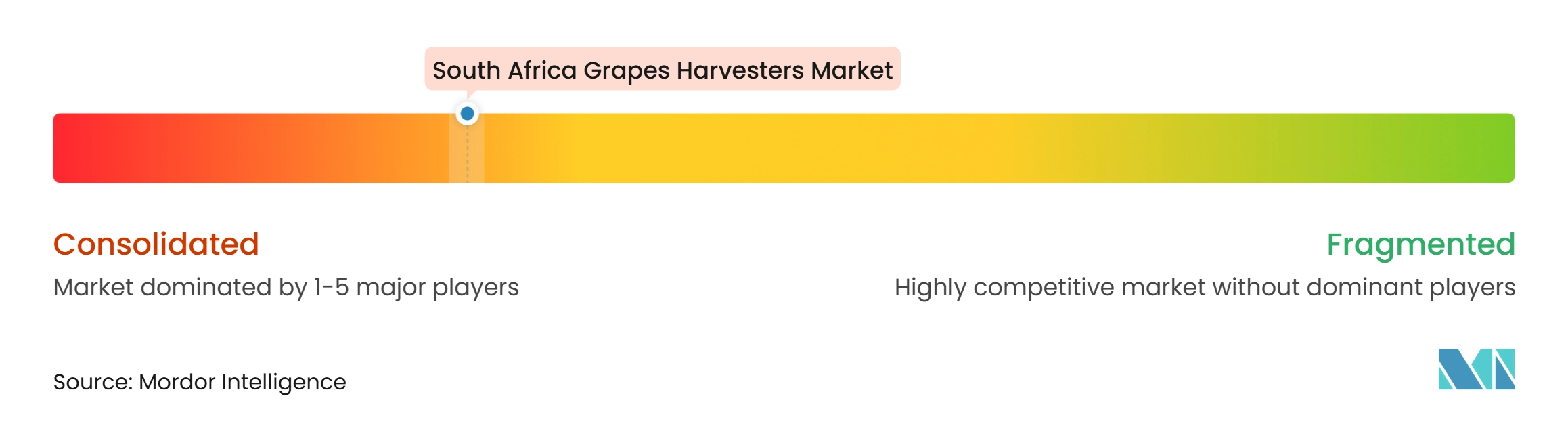
The South Africa grapes harvesters market is concentrated among a limited group of specialized players in 2025, with competition centered on harvesting performance, machine technology, after-sales service, warranty coverage, financing, and local parts availability. CNH Industrial N.V. (New Holland Agriculture/Braud) competes through its Braud grape-harvester range and established South African presence, with its product portfolio supported by local dealer and service infrastructure. The Braud range incorporates harvesting automation, sensing, and operator-assistance technologies designed to improve harvesting efficiency and machine control. PELLENC SOUTH AFRICA (PTY) LTD, the local subsidiary/distributor of PELLENC maintains an office and workshop in Windmeul, Northern Paarl, supported by an agent network and trained technicians. It distributes and services PELLENC grape harvesters and other vineyard equipment in South Africa, providing a direct local after-sales capability.
SDF S.p.A. competes through its Grégoire grape-harvester portfolio and strengthened its South African presence in 2026 through the establishment of SDF South Africa (Pty) Ltd. in Paarl. The subsidiary manages Grégoire, SAME, and Deutz-Fahr brands through existing South African importer and dealer partnerships, increasing the company's direct market presence and ability to support local partners. Beveratech (Pty) Ltd. represents ERO in South Africa and markets ERO Grapeliner grape harvesters, supported by local sales, spare-parts, and service contacts. Nairn Harvesters Ltd. also forms part of the established player group, particularly in specialized grape-harvesting equipment. Competition among these players is differentiated by machine capacity, harvesting technology, dealer coverage, technical support, and the ability to minimize downtime during the concentrated harvest period.
Competition also extends to the used-equipment channel, which provides a lower-capital route to mechanization for smaller and mid-sized vineyards. AFGRI Equipment currently markets used Grégoire grape harvesters in South Africa, creating an alternative to purchasing new self-propelled machines. This channel increases competitive pressure on new-equipment players while providing smaller growers and contractors with more accessible mechanization options. Consequently, players with established local service networks, spare-parts availability, financing options, operator support, and access to both new and used equipment are better positioned to address the varying capital and utilization requirements of South African grape producers.
South Africa Grapes Harvesters Industry Leaders
-
CNH Industrial SA (Pty) Ltd (CNH Industrial N.V.)
-
Pellenc South Africa (Pty) Ltd (Pellenc S.A.S.)
-
SDF S.p.A.
-
Oxbo International Corporation (Ploeger Oxbo Group B.V.)
-
ERO GmbH
- *Disclaimer: Major Players sorted in no particular order
South Africa Grapes Harvesters Market Companies Covered in this Report
- Pellenc South Africa (Pty) Ltd (Pellenc S.A.S.)
- CNH Industrial SA (Pty) Ltd (CNH Industrial N.V.)
- Oxbo International Corporation (Ploeger Oxbo Group B.V.)
- SDF S.p.A.
- ERO GmbH
- Nairn Harvesters Ltd
- Orchard Agrimek (Pty) Ltd
- Orchard Agri Equipment (Pty) Ltd
- Beveratech (Pty) Ltd
- Heidelquip (Pty) Ltd
- Kaap Agri Limited
- AFGRI Equipment (Pty) Ltd (AFGRI Operations (Pty) Ltd)
Recent Industry Developments in South Africa Grapes Harvesters Market
- May 2026: PELLENC SOUTH AFRICA (PTY) LTD partnered with Vinpro for the Robertson and Klein Karoo Regional Information Day, at Robertson Wynmakery Landboukoöperatief. The partnership provided PELLENC with a direct platform to engage wine-grape producers in the Robertson and Klein Karoo regions, supporting the company's commercial presence in key South African wine-producing areas. Vinpro and PELLENC South Africa both publicly confirmed the partnership.
- September 2025: CNH Industrial N.V. (New Holland Agriculture) showcased the Braud 8.50L compact grape harvester at NAMPO Cape 2025 in Bredasdorp, Western Cape.
- May 2025: SDF S.p.A. relaunched and consolidated its South African presence through partnerships involving Kempston Agri for SAME and Smith Power Equipment for DEUTZ-FAHR. The strategy covers SDF's portfolio of specialised vineyard and orchard machinery, including GRÉGOIRE grape harvesters, and subsequently culminated in SDF establishing its own commercial subsidiary in Paarl in 2026.
South Africa Grapes Harvesters Market Report Scope
A grape harvesting machine is a mechanized device used in vineyards to detach grapes from vines and collect them efficiently during harvest, reducing manual labor and increasing harvesting speed. The South Africa grapes harvesters market report is segmented by harvester type (self-propelled, trailed or towed, and tractor mounted), by mode of operation (manual steering, assisted or precision-guided, and autonomous or semi autonomous), by power source (diesel, hybrid, and electric), and by vineyard size (small vineyards (below 50 hectares), medium vineyards (51-200 hectares), and large vineyards (above 200 hectares)). The market forecasts are provided in USD (value).
Segmentation Overview
| Self-Propelled Grape Harvesters |
| Trailed/ Towed Grape Harvesters |
| Tractor-Mounted Grape Harvesters |
| Manual Steering and Operation |
| Assisted/ Precision-Guided Operation |
| Autonomous and Semi-Autonomous Operation |
| Diesel-Powered Harvesters |
| Hybrid Harvesters |
| Electric Harvesters |
| Small Vineyards Below 50 Hectares |
| Medium Vineyards 51 to 200 Hectares |
| Large Vineyards Above 200 Hectares |
| By Harvester Type | Self-Propelled Grape Harvesters |
| Trailed/ Towed Grape Harvesters | |
| Tractor-Mounted Grape Harvesters | |
| By Mode of Operation | Manual Steering and Operation |
| Assisted/ Precision-Guided Operation | |
| Autonomous and Semi-Autonomous Operation | |
| By Power Source | Diesel-Powered Harvesters |
| Hybrid Harvesters | |
| Electric Harvesters | |
| By Vineyard Size | Small Vineyards Below 50 Hectares |
| Medium Vineyards 51 to 200 Hectares | |
| Large Vineyards Above 200 Hectares |
Key Questions Answered in the Report
What is the South Africa grapes harvesters market size?
The South Africa Grapes Harvesters market is forecasted to reach USD 26.00 million by 2031, from USD 16.05 million in 2026, at a 10.13% CAGR between 2026 and 2031.
Which grape harvester type leads sales in South Africa?
Self-Propelled grapes harvesters led with 58.0% share in 2025, supported by demand from large commercial wine estates.
Why are grape growers considering mechanical harvesting?
Higher labor costs, narrow harvest windows, and the need to preserve fruit quality are supporting adoption among commercial growers.
Who are the leading players of grape harvesters in South Africa?
CNH Industrial SA, Pellenc South Africa, SDF, Oxbo International, and ERO collectively held a major share in 2025.