
South Africa Hydroponics Market Size and Share
Market Overview
| Study Period | 2021 - 2031 |
|---|---|
| Forecast Data Period | 2026 - 2031 |
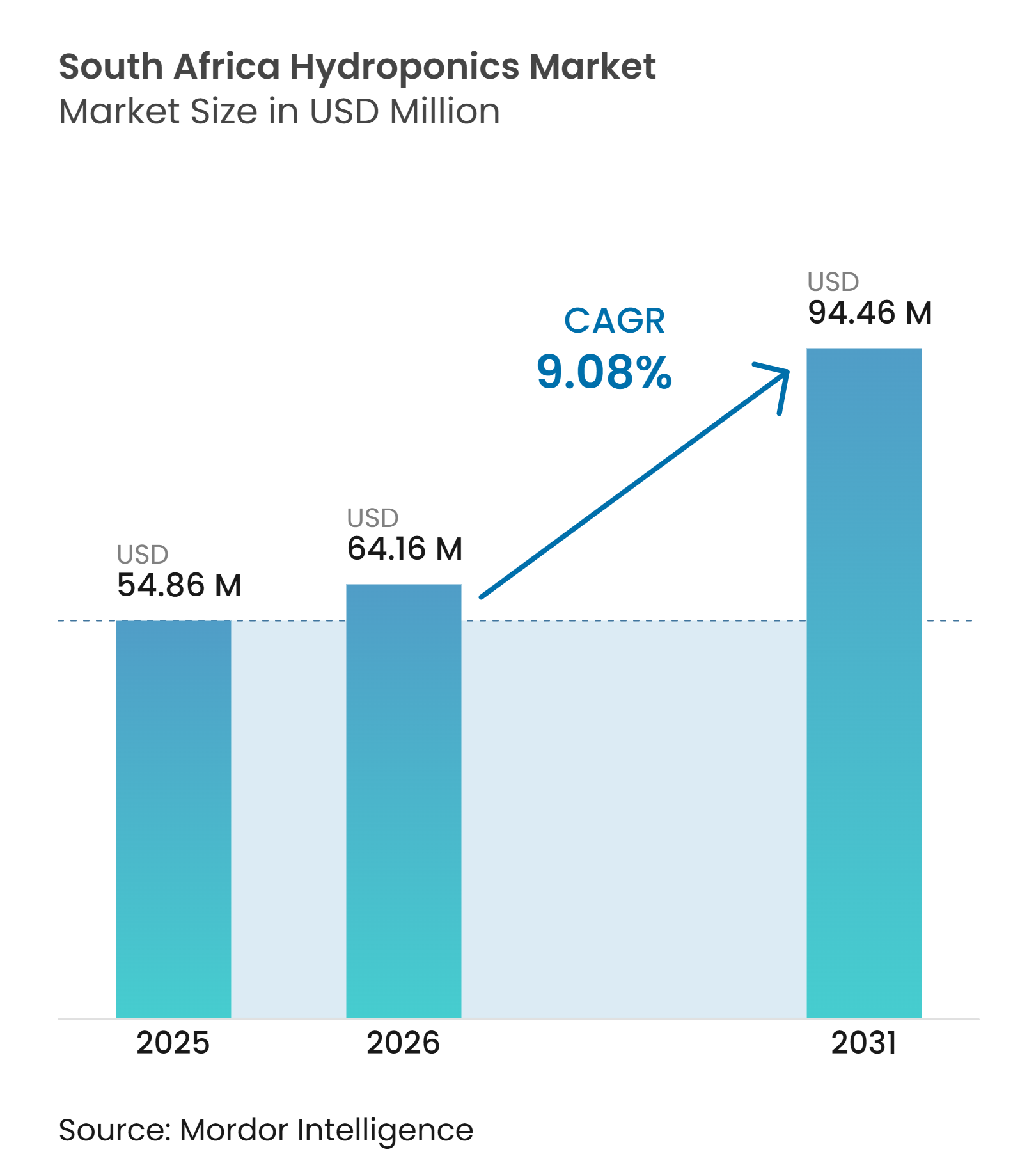
| Base Year Market Size (2025) | USD 54.86 Million |
| Market Size (2026) | USD 64.16 Million |
| Market Size (2031) | USD 94.46 Million |
| Growth Rate (2026 - 2031) | 9.08 % |
| Market Concentration | Low |
Major Players *Disclaimer: Major Players sorted in no particular order Image © Mordor Intelligence. Reuse requires attribution under CC BY 4.0. | |
South Africa Hydroponics Market Analysis by Mordor Intelligence
The South Africa hydroponics market size is estimated to be USD 54.86 million in 2025 and USD 61.16 million in 2026, projected to reach USD 94.46 million by 2031, at a CAGR of 9.08% during the forecast period (2026-2031). South Africa’s structural water scarcity is increasing the relevance of water-efficient cultivation systems for commercial agriculture. The country receives roughly 500 mm of rainfall annually, well below the global average of 860 mm in 2025, with precipitation distributed unevenly across provinces and seasons[1]. This uneven availability, combined with growing demand and climate-related variability, increases the need for efficient water management. Hydroponic systems can address these constraints through recirculating water and controlled production, although high electricity costs, financing requirements, and imported inputs remain adoption barriers.
Key Report Takeaways
- By production system, greenhouse hydroponics held 62.1% of the South Africa hydroponics market share in 2025, while indoor vertical farms are projected to grow at the fastest CAGR of 11.4% from 2026 to 2031.
- By crop type, leafy greens held 44.3% of the South Africa hydroponics market size in 2025, while herbs and microgreens are projected to grow at the fastest CAGR of 12.9% from 2026 to 2031.
- By equipment, irrigation components and pumps held 31.5% of the South Africa hydroponics market share in 2025, while climate systems are projected to grow at the fastest CAGR of 10.4% from 2026 to 2031.
- By production scale, large operations held 49.1% of the South Africa hydroponics market share in 2025, while small operations are projected to grow at the fastest CAGR of 10.8% from 2026 to 2031.
Note: Market size and forecast figures in this report are generated using Mordor Intelligence’s proprietary estimation framework, updated with the latest available data and insights as of January 2026.
Market Trends and Insights
Drivers Impact Analysis of South Africa Hydroponics Market*
| Driver | (~) % Impact on CAGR Forecast | Geographic Relevance | Impact Timeline |
|---|---|---|---|
| Water scarcity and drought resilience | +2.50% | National, most acute in Western Cape, Northern Cape, Limpopo, and Eastern Cape | Short term (≤ 2 years) |
| Year-round production and supply consistency | +1.80% | National, with strongest pull in Gauteng, Western Cape, and KwaZulu-Natal metro areas | Medium term (2-4 years) |
| Retail demand for locally produced fresh produce | +1.50% | National, with early gains in Gauteng and Western Cape formal retail zones | Medium term (2-4 years) |
| Controlled-environment agriculture for food security | +1.20% | National, most acute in Gauteng, KwaZulu-Natal, and Eastern Cape urban centers | Long term (≥ 4 years) |
| Carbon-credit and resource-efficiency revenue stacking | +0.80% | Global eligibility, with early activity in Western Cape and Free State agricultural regions | Long term (≥ 4 years) |
| Hybrid energy design to reduce load-shedding exposure | +0.70% | National, with highest urgency in Gauteng, Eastern Cape, and Limpopo | Short term (≤ 2 years) |
| Source: Mordor Intelligence | |||
Water Scarcity and Drought Resilience
South Africa faces structural water stress, receiving roughly 500 mm of rainfall annually, well below the global average of 860 mm, with precipitation distributed unevenly across provinces and seasons. The study on Resilient Food Systems in Water-Stressed Regions, published in 2025, highlights the close link between water availability and food production. Similarly, the 2025 study on Tackling Rural Water Scarcity in South Africa documents recurring drought conditions in Limpopo and the Eastern Cape[2]. Hydroponic systems recirculate water and reduce dependence on field irrigation, supporting more consistent output under constrained water conditions and strengthening their relevance to the South Africa hydroponics market. This creates opportunities for controlled-environment growers to improve resource efficiency while maintaining production amid increasing water availability risks.
Year-Round Production and Supply Consistency
Controlled-environment production enables growers to maintain harvesting during seasonal disruptions, supporting more reliable supply where buyers require consistent weekly deliveries. Greater production stability allows growers to plan harvesting, packing, and transportation more efficiently while reducing exposure to weather-related disruptions associated with field cultivation. This reliability can strengthen supplier relationships and support longer-term arrangements with retailers and foodservice operators. As consistent volumes and produce quality become more important purchasing criteria, the South Africa hydroponics market can benefit, particularly near major demand centers where frequent deliveries and predictable supply influence supplier selection and investment in greenhouse infrastructure.
Retail Demand for Locally Produced Fresh Produce
Local retail demand supports hydroponic growers capable of supplying fresh produce through short and reliable supply chains. Formal retailers increasingly require consistent product quality, traceability, and dependable delivery schedules, favoring producers that can meet defined procurement and logistics requirements. Direct supply arrangements can also reduce reliance on intermediaries where growers have the necessary certifications and distribution capabilities. This supports the South Africa hydroponics market by creating opportunities for established operators to expand capacity and secure recurring orders, while raising entry requirements for new commercial growers. As retailers consolidate sourcing among reliable suppliers, operational discipline, traceability, and consistent delivery performance become increasingly important for market participation.
Controlled-Environment Agriculture for Food Security
Urban food access increases the relevance of production close to consumers. The 2025 study Towards Urban Food System Transformation in South Africa reported that 67% of the population lived in urban areas and that 58 million people faced food insecurity[3]. A 2026 study on Sustainable Food Systems found that controlled-environment systems can reduce water waste by 90%. Local production can also reduce transport needs for perishable crops. This gives the South Africa hydroponics market a role in urban food planning. The same operating model can appeal to municipal and development finance programs. Urban projects still need reliable power, appropriate sites, and viable customer contracts, because proximity to consumers cannot offset weak operating controls or insufficient demand. Strong local logistics remain necessary for fresh produce to reach buyers on time.
Restraints Impact Analysis of South Africa Hydroponics Market*
| Restraint | (~) % Impact on CAGR Forecast | Geographic Relevance | Impact Timeline |
|---|---|---|---|
| High capital requirements for commercial systems | -2.20% | National, most acute for new entrants outside Gauteng and Western Cape | Short term (≤ 2 years) |
| Energy-cost sensitivity of artificial lighting and climate control | -1.50% | National, most severe in enclosed indoor vertical farms and container farms | Medium term (2-4 years) |
| Municipal water-quality and nutrient-discharge compliance | -0.90% | Urban municipalities, particularly Gauteng and KwaZulu-Natal metro areas | Medium term (2-4 years) |
| Dependence on imported seed genetics and growing media | -0.60% | National, with import exposure across all growing regions | Long term (≥ 4 years) |
| Source: Mordor Intelligence | |||
High Capital Requirements for Commercial Systems
Local retail demand supports hydroponic growers capable of supplying fresh produce through short and reliable supply chains. Formal retailers increasingly require consistent product quality, traceability, and dependable delivery schedules, favoring producers that meet defined procurement and logistics requirements. Direct supply arrangements can reduce reliance on intermediaries where growers have the necessary certifications and distribution capabilities. This supports the South Africa hydroponics market by creating opportunities for established operators to expand capacity and secure recurring orders, while raising entry requirements for new commercial growers. As retailers increasingly consolidate sourcing among reliable suppliers, operational discipline, traceability, and consistent delivery performance become important factors in supplier selection.
Energy Cost Sensitivity of Artificial Lighting and Climate Control
Rising electricity costs create direct cost pressure for hydroponic farms using supplemental lighting, pumping, and active climate-control systems. Indoor vertical and container farms are particularly exposed because their production relies heavily on electricity for continuous environmental management. Higher energy costs can compress crop margins and influence investment decisions, encouraging growers to adopt energy-efficient equipment, renewable energy solutions, and hybrid power systems. However, these measures require additional capital and cannot eliminate grid dependence. Energy management therefore remains a critical operating capability for commercial hydroponic producers, particularly for facilities requiring continuous environmental control to maintain crop quality and yields.
*Our forecasts treat driver/restraint impacts as directional, not additive. The impact forecasts reflect baseline growth, mix effects, and variable interactions.
South Africa Hydroponics Market Segment Analysis
By Production System:
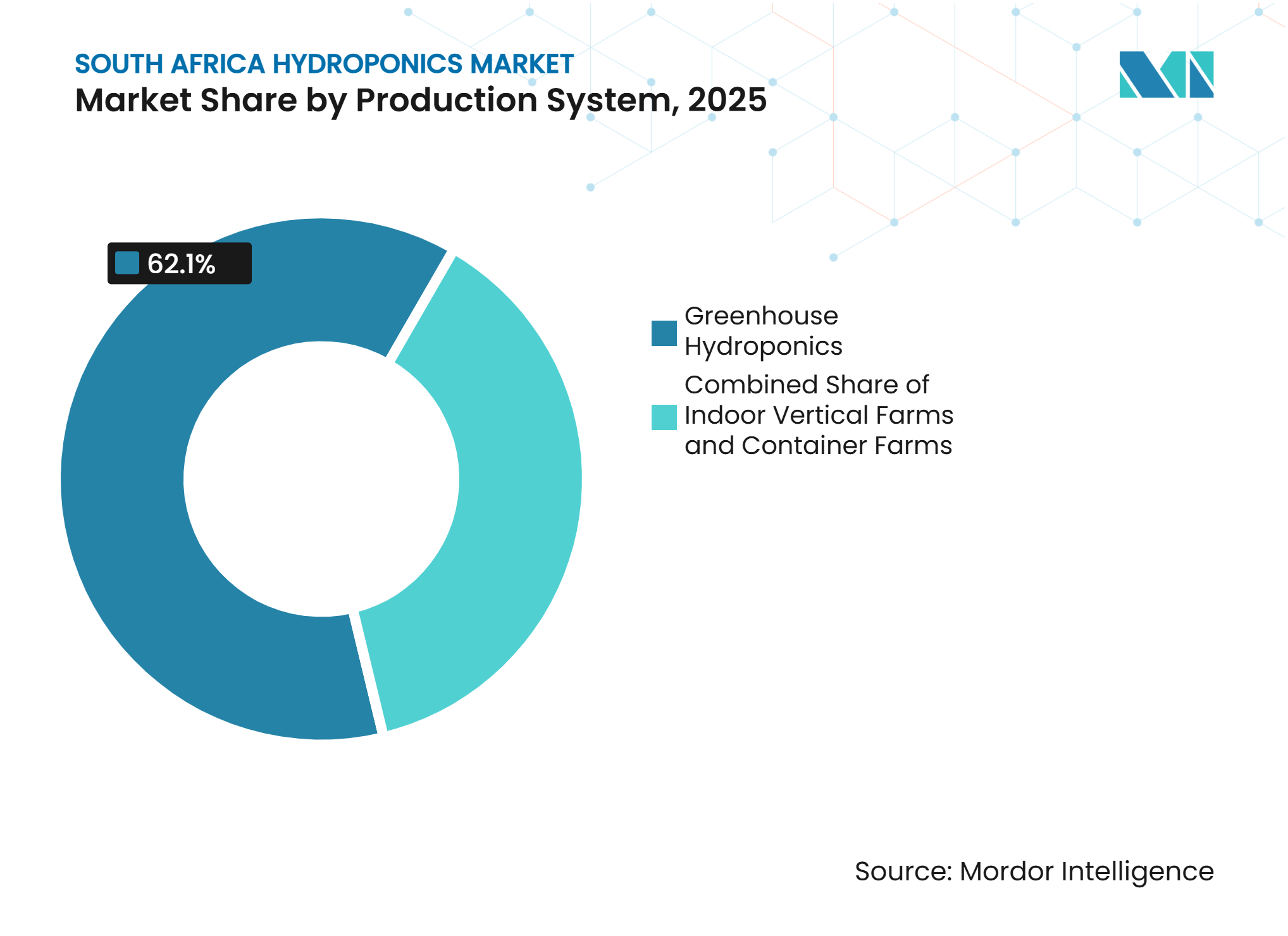
Greenhouse Systems Lead and Vertical Farms AccelerateGreenhouse hydroponics accounted for 62.1% of 2025 production-system value, making it the largest format in the South Africa hydroponics market. Its established commercial model supports large-scale cultivation of leafy greens, tomatoes, peppers, and cucumbers while leveraging existing distribution networks. Greenhouses also provide greater scope to spread fixed infrastructure costs across higher production volumes, although profitability remains dependent on reliable water access, labor availability, energy costs, and retail demand. This established operating model underpins the format’s leading position in the market.
Indoor vertical farms are projected to register the fastest CAGR of 11.4% from 2026 to 2031, supported by their modular design and suitability for production closer to urban consumers. Their compact footprint enables cultivation of herbs, leafy greens, and specialty crops where land availability is limited. Container farms offer similar proximity advantages through smaller installations. However, both formats face higher requirements for lighting, cooling, and electricity management, making committed off-take agreements with retailers and foodservice operators important for improving project economics. Greenhouses are therefore expected to remain central to commercial-scale production, while vertical and container systems expand in applications where proximity, land efficiency, and controlled production provide stronger economic advantages.



By Crop Type:
Leafy Greens Lead and Herbs and Microgreens AdvanceLeafy greens accounted for 44.3% of 2025 crop-type value, making them the leading crop category in the South Africa hydroponics market. Their short production cycles and frequent harvesting support regular replenishment for retail and foodservice buyers. Tomatoes, peppers, and cucumbers represent other established commercial crops, while strawberries offer opportunities where controlled production enables more consistent quality and off-season availability. Specialty vegetables and beans remain more fragmented among smaller operators. Crop selection is primarily influenced by consumer demand, production expertise, climate-control requirements, and distribution access.
Herbs and microgreens are projected to register the fastest CAGR of 12.9% from 2026 to 2031, supported by short production cycles that can enable rapid crop rotation in compact urban systems. Their positioning as fresh, specialized products also creates opportunities among restaurants, chefs, and premium foodservice buyers. Meanwhile, tomatoes, peppers, cucumbers, and strawberries can support larger-scale operations where established buyers provide predictable demand. As a result, growers may increasingly adopt diversified crop portfolios to balance high-frequency products with higher-value specialty crops and reduce dependence on individual demand channels.
By Equipment:
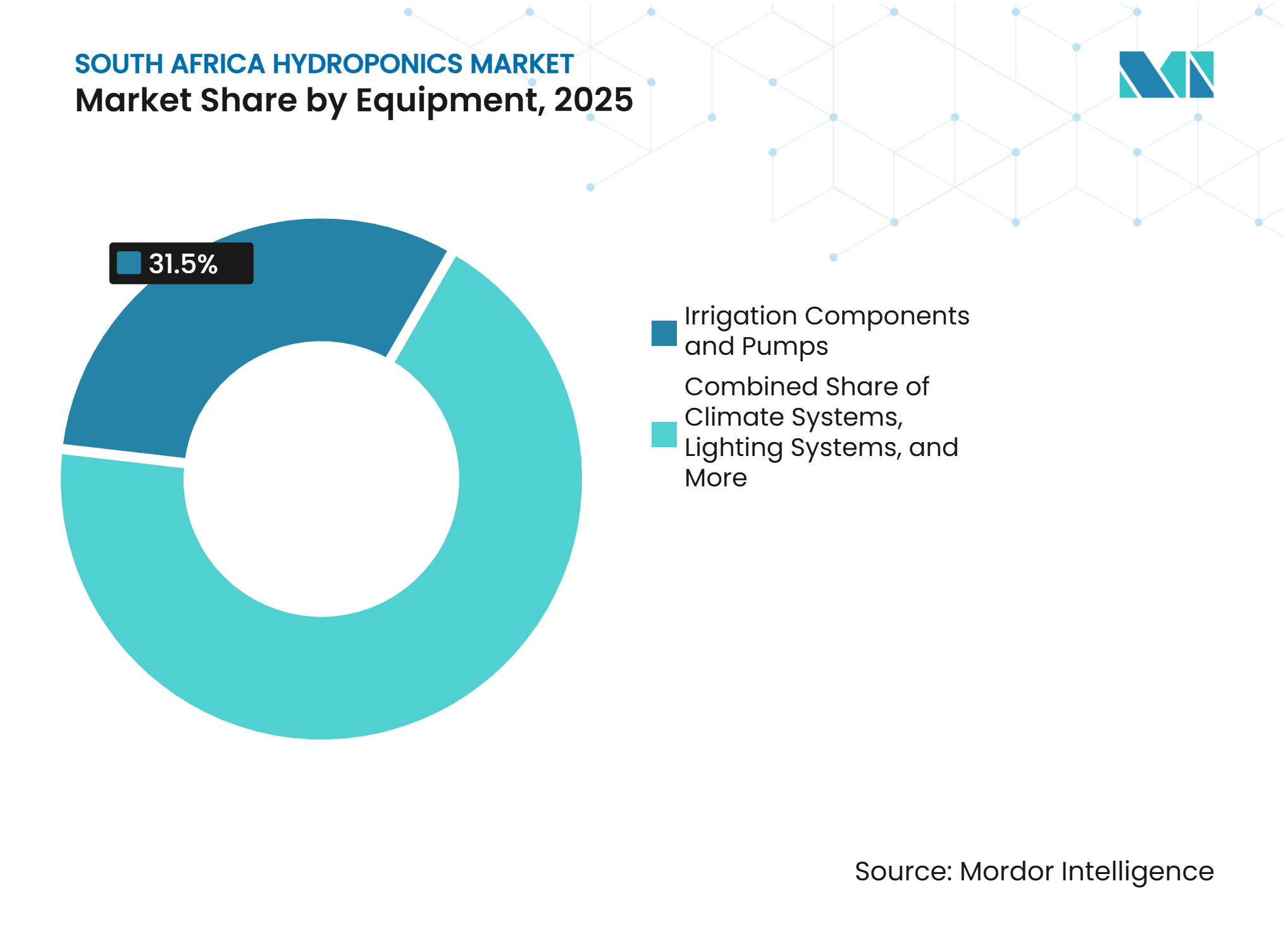
Irrigation Components and Pumps Lead and Climate Systems Grow FastestIrrigation components and pumps accounted for 31.5% of 2025 equipment value, making them the largest equipment category in the South Africa hydroponics market. Pumps, filtration systems, pipes, and dosing equipment are fundamental to water and nutrient management across recirculating and run-to-waste systems and are used across greenhouse, container, and vertical formats. Equipment requirements vary by crop, production design, and level of environmental control. Reliable irrigation infrastructure is therefore a critical foundation for maintaining crop health, while regular maintenance helps minimize downtime and protect system performance.
Climate systems are projected to register the fastest CAGR of 10.4% from 2026 to 2031, driven by the greater environmental-control requirements of indoor vertical and container farms. Temperature, humidity, and airflow management are essential for maintaining stable growing conditions and consistent crop quality, particularly when serving buyers with defined appearance and shelf-life requirements. However, cooling, ventilation, and dehumidification increase electricity consumption and operating costs. This makes energy efficiency an important consideration when investing in climate-control equipment, while lighting, automation, and structural systems remain complementary investments supporting productivity and controlled production.

By Production Scale:
Large Farms Lead and Small Farms Expand FastestLarge operations accounted for 49.1% of 2025 value, forming the main revenue base of the South Africa hydroponics market. Their scale enables larger production volumes, bulk input purchasing, dedicated packing capabilities, and greater distribution reach, while allowing fixed infrastructure costs to be spread across higher output. These advantages are particularly relevant when retailers require consistent volumes, quality standards, and delivery schedules. Medium-sized operations occupy an intermediate position, balancing expansion with specialized local production, while small farms remain relevant for localized supply, specialty crops, and urban installations.
Small operations are projected to register the fastest CAGR of 10.8% from 2026 to 2031, supported by the flexibility of container farms, rooftop systems, and modular vertical installations. Their smaller footprint can facilitate production closer to urban consumers, while direct sales to restaurants and nearby retailers can support specialized products such as herbs, microgreens, and niche vegetables. However, expansion remains constrained by access to capital, certification requirements, energy costs, and technical expertise. Large farms retain advantages in national retail supply, while medium and small operators can compete effectively in localized and specialized markets with defined customer relationships.
Geography Analysis
Gauteng represents the leading regional hub for hydroponics in South Africa, supported by its proximity to major urban consumers and established fresh-produce distribution networks. The 2025 study, The Johannesburg Fresh Produce Market, highlights the importance of fresh produce across Gauteng and surrounding areas[4]. This concentration of retail, foodservice, and wholesale demand supports frequent delivery cycles and creates opportunities for commercial hydroponic growers. The Western Cape is another important production center, supported by its established greenhouse base, relatively mild winter conditions, and coastal logistics.
KwaZulu-Natal offers opportunities for hydroponic production due to its warm climate, which can reduce heating requirements in some growing environments. However, higher humidity can increase the need for ventilation, disease prevention, and pest management. The Eastern Cape, Northern Cape, and Free State also offer opportunities where growers can address localized demand and resource constraints. Regional investment will depend on water availability, reliable electricity, infrastructure, customer proximity, and access to finance. These factors can influence the suitability and economics of different hydroponic production models across provinces.
Limpopo presents an emerging opportunity for hydroponic development as recurring drought conditions increase pressure on agricultural water resources. The 2025 study Tackling Rural Water Scarcity in South Africa documents declining dam levels, erratic rainfall, and persistent water-system vulnerabilities, reinforcing the need for more resilient production approaches. Similarly, a 2025 study in Discover Sustainability reports significant household exposure to severe drought and associated crop failures. These conditions can encourage interest in resource-efficient cultivation, while the University of the Western Cape’s planned 2026 agri-photovoltaic training course, covering solar-powered hydroponics and controlled-environment agriculture, indicates growing attention to integrated water- and energy-efficient production models.
Competitive Landscape
Market Concentration
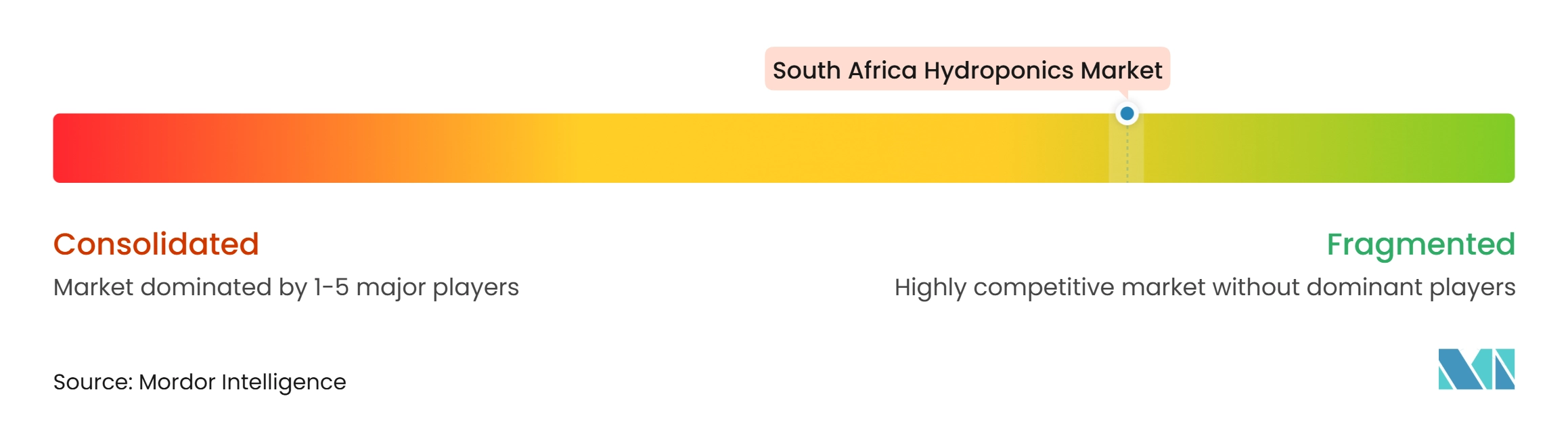
The South Africa hydroponics market is fragmented across commercial greenhouses, rooftop farms, container farms, and specialty producers, with competition shaped by differences in production scale, crop specialization, and operating models. Established producers benefit from greater production capacity and the ability to spread fixed infrastructure costs across higher output volumes, while smaller operators compete through proximity to local buyers, flexible production, and specialty crop offerings. Secured retail demand, reliable production, certification, and effective energy management remain important factors influencing competitive positioning.
Energy resilience is becoming an increasingly important consideration for commercial hydroponic producers. For instance, Cultura Fresh installed a 66-kilowatt-peak solar array and battery energy storage system in August 2024 to reduce reliance on grid electricity and diesel backup. Such investments demonstrate how producers are responding to electricity cost pressures and supply disruptions through on-site energy infrastructure. Data-based production management and modular vertical systems can further improve resource control, production planning, and continuity, particularly for operators seeking to produce closer to urban demand centers.
Certification can also influence access to formal retail and foodservice channels, as buyers increasingly require consistent quality, traceability, and defined production standards. Good Agricultural Practices certification, Hazard Analysis and Critical Control Points compliance, and the Sustainability Initiative of South Africa framework can strengthen supplier credibility and support access to structured procurement channels. Secondary cities such as Gqeberha, Bloemfontein, and Polokwane provide opportunities for certified mid-scale operators, while high-value herbs and specialty peppers can support foodservice and selected export channels. Producers unable to invest in energy resilience, technology, or buyer-required certifications may face increasing competitive pressure. Overall, the market remains diverse, with different production formats enabling operators to compete across crops, locations, and customer segments.
South Africa Hydroponics Industry Leaders
-
Eldorado
-
Madron Farming
-
Blueberry Hill Farm Pty Ltd
-
Green Terrace
-
Cultura Fresh
- *Disclaimer: Major Players sorted in no particular order
South Africa Hydroponics Market Companies Covered in this Report
- Eldorado
- Madron Farming
- Blueberry Hill Farm Pty Ltd
- Green Terrace
- Vusi's Farm
- Arable Grow
- The DELTA Group
- HyHarvest
- Neighbour Roots
- Kalliergo Farming
- Sampada Agri
- MI Crop
- Yumm Farm
- Cultura Fresh
- Dew Crisp
Recent Industry Developments in South Africa Hydroponics Market
- July 2026: Pelican Park High School in the Western Cape partnered with the University of the Western Cape to establish a solar-powered hydroponic agriculture hub. The first of 12 hydroponic units has been installed and is expected to use up to 90% less water than conventional farming and increase production by an estimated 600 additional crops.
- August 2025: Fedgroup financed a hydroponic greenhouse operated by Clean Air Nurseries Agri Global (CAN-Agri) in Pretoria, South Africa. The investment supported the expansion of technology-enabled controlled-environment agriculture and year-round production of fresh produce.
- August 2024: Cultura Fresh completed a 66-kilowatt peak ground-mounted solar system with a 250-kilowatt and 243-kilowatt-hour containerized battery energy storage system at its Klapmutz site.
South Africa Hydroponics Market Report Scope
The South Africa hydroponics market covers the value of soilless crop cultivation systems where plants are grown using nutrient solutions, with or without an inert medium, across commercial and smaller-scale controlled environments.
Scope exclusions: We exclude aquaponics and soil-based greenhouse or open-field cultivation, even if similar crops are produced.
The South Africa hydroponics market report is segmented by production system (greenhouse hydroponics, indoor vertical farms, and container farms), by crop type (leafy greens, tomatoes, cucumbers, peppers, herbs and microgreens, and strawberries and other soft fruit), by equipment (lighting systems, irrigation components and pumps, climate systems, automation and control systems, and structural components), and by production scale (large operations, medium operations, and small operations). The market forecasts are provided in terms of value (USD).
Segmentation Overview
| Greenhouse Hydroponics |
| Indoor Vertical Farms |
| Container Farms |
| Leafy Greens |
| Tomatoes |
| Cucumbers |
| Peppers |
| Herbs and Microgreens |
| Strawberries |
| Other Crops |
| Lighting Systems |
| Irrigation Components and Pumps |
| Climate Systems |
| Automation and Control Systems |
| Structural Components |
| Large Operations |
| Medium Operations |
| Small Operations |
| By Production System | Greenhouse Hydroponics |
| Indoor Vertical Farms | |
| Container Farms | |
| By Crop Type | Leafy Greens |
| Tomatoes | |
| Cucumbers | |
| Peppers | |
| Herbs and Microgreens | |
| Strawberries | |
| Other Crops | |
| By Equipment | Lighting Systems |
| Irrigation Components and Pumps | |
| Climate Systems | |
| Automation and Control Systems | |
| Structural Components | |
| By Production Scale | Large Operations |
| Medium Operations | |
| Small Operations |
Key Questions Answered in the Report
What is the size of the South Africa hydroponics market?
The South Africa hydroponics market size is estimated to be USD 54.86 million in 2025 and USD 61.16 million in 2026.
Which production system leads hydroponic cultivation in South Africa?
Greenhouse hydroponics led with 62.1% of 2025 production-system value.
Which crops are most important for hydroponic growers in South Africa?
Leafy greens held 44.3% of the South Africa hydroponics market size in 2025, while herbs and microgreens are projected to grow at the fastest CAGR of 12.9% from 2026 to 2031 leafy greens held 44.3% of the South Africa hydroponics market size in 2025, while herbs and microgreens are projected to grow at the fastest CAGR of 12.9% from 2026 to 2031.
What limits hydroponic investment in South Africa?
High capital needs, electricity costs, discharge compliance, and dependence on imported inputs can constrain expansion.