
Soil Fertility Testing Market Size and Share
Market Overview
| Study Period | 2022 - 2032 |
|---|---|
| Market Size (2027) | USD 1.53 Billion |
| Market Size (2032) | USD 2.13 Billion |
| Growth Rate (2027 - 2032) | 6.84 % |
| Fastest Growing Market | Asia-Pacific |
| Largest Market | Europe |
| Market Concentration | Low |
Major Players *Disclaimer: Major Players sorted in no particular order Image © Mordor Intelligence. Reuse requires attribution under CC BY 4.0. | |
Soil Fertility Testing Market Analysis by Mordor Intelligence
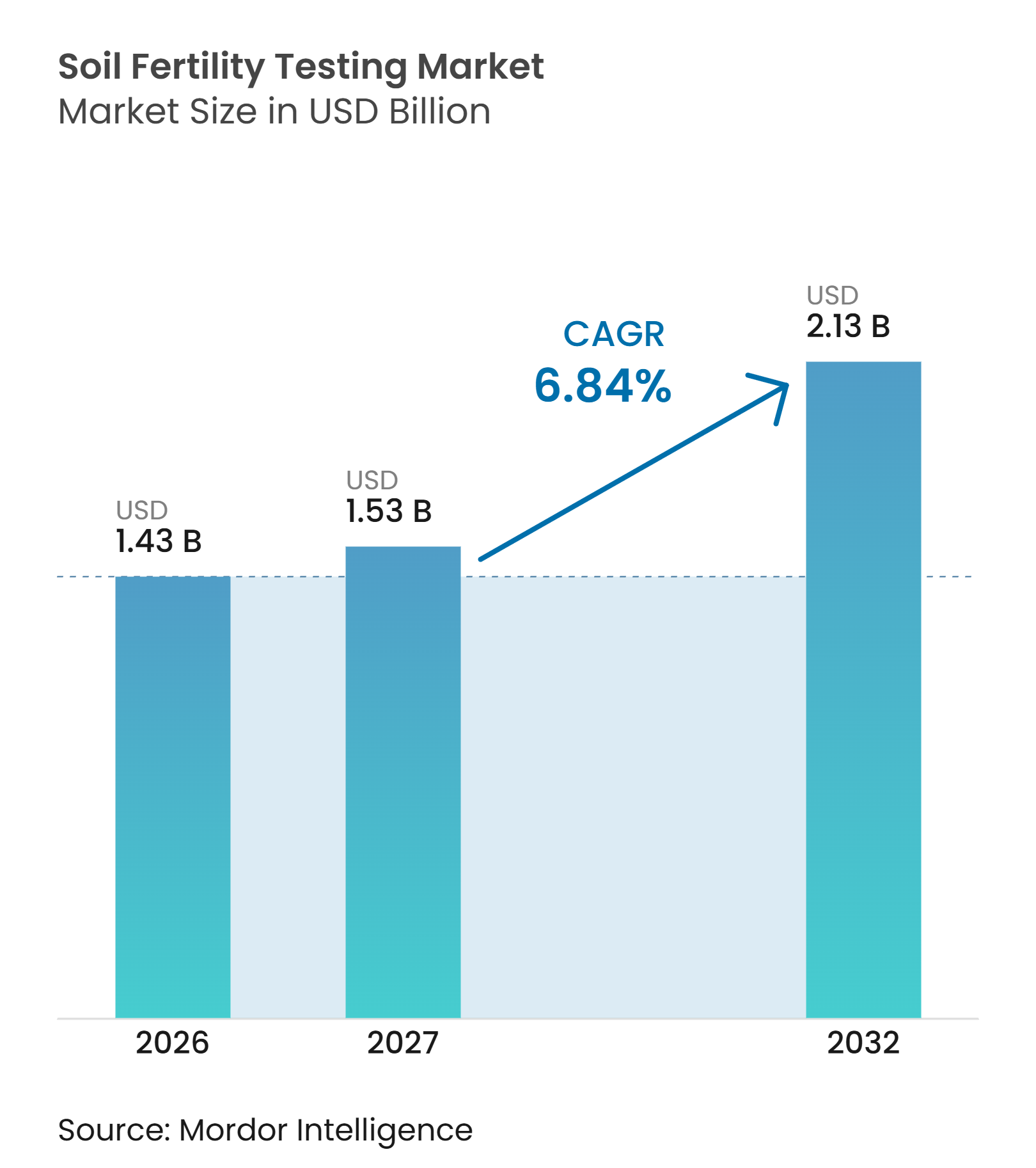
The soil fertility testing market size was valued at USD 1.43 billion in 2026 and is forecast to grow from USD 1.53 billion in 2027 to USD 2.13 billion by 2032, at a CAGR of 6.84% from 2027 to 2032. Soil fertility testing is becoming a regular agricultural service as soil degradation reduces yields across many farming areas. In 2025, the Food and Agriculture Organization of the United Nations (FAO) reported that approximately 1.7 billion people worldwide live in areas where crop yields are 10% lower due to human-induced land degradation [1]. Rising fertilizer costs are also increasing the value of nutrient mapping and variable-rate application, both of which depend on reliable soil baselines. Carbon credit programs are creating additional requirements for soil data collection and analysis. Verra, Inc.'s VM0042 Improved Agricultural Land Management methodology establishes sampling and measurement requirements to quantify changes in soil organic carbon stocks, thereby supporting demand for soil assessment services in agricultural carbon projects [2]. Demand from farm productivity, compliance, and carbon measurement programs is therefore driving the soil fertility testing market, reducing its reliance on any single farm management practice.
Key Report Takeaways
- By test type, chemical testing accounted for 64.7% of the soil fertility testing market share in 2026, while biological testing is forecast to grow at a CAGR of 8.1% from 2027 to 2032.
- By testing method, off-site or laboratory testing accounted for 77% of the soil fertility testing market size in 2026, while on-site testing is forecast to grow at a CAGR of 8.3% from 2027 to 2032.
- By application, chemical fertility of soil accounted for 44% of the market share in 2026, while structure of soil is forecast to grow at a CAGR of 7.1% from 2027 to 2032.
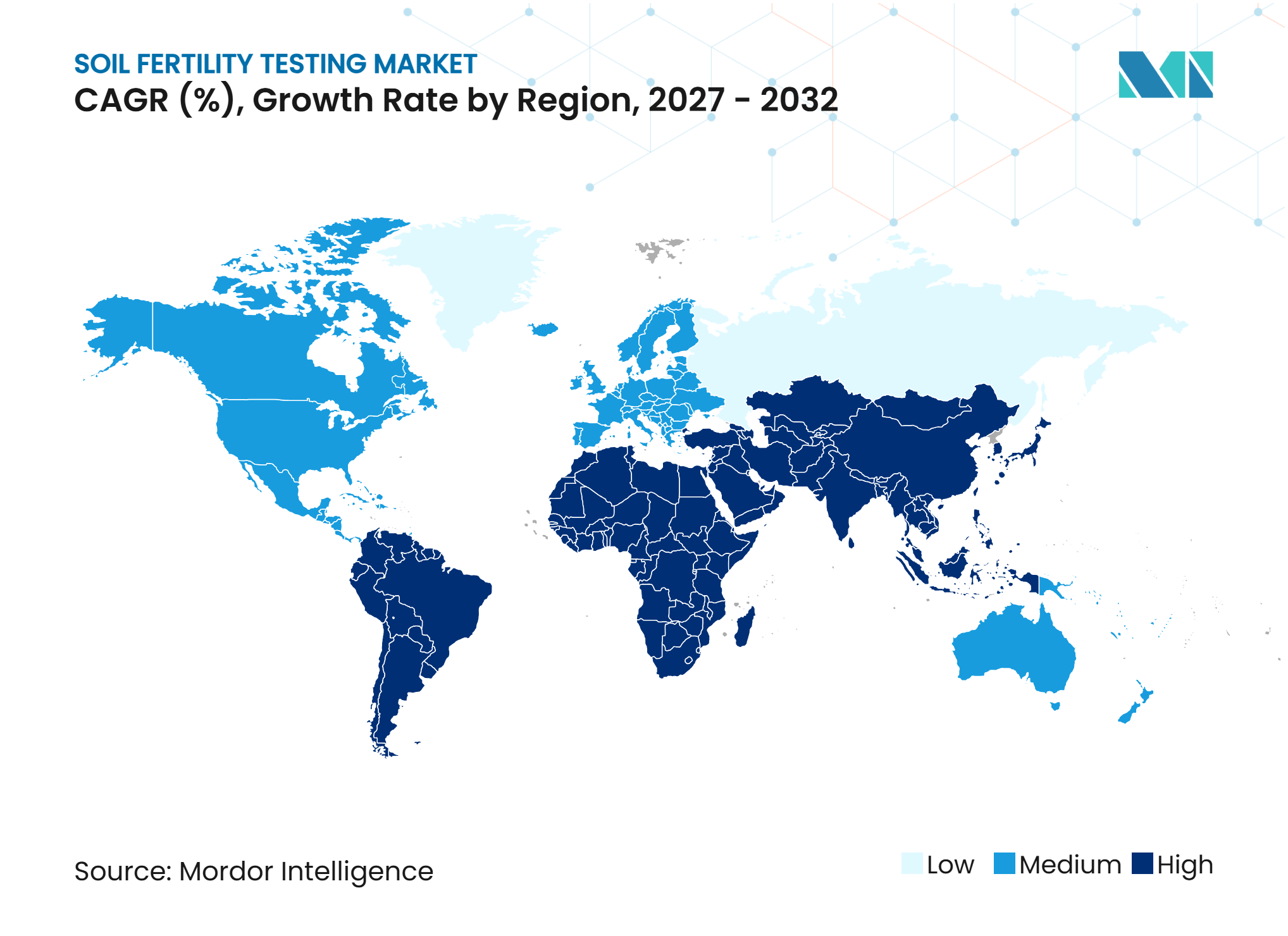
- By geography, Europe accounted for 38% of the market share in 2026, while Asia-Pacific is forecast to grow at a CAGR of 8.6% from 2027 to 2032.
Note: Market numbers in this report are based on Mordor Intelligence's proprietary estimation framework, which combines nine months of actuals with Q4 projections for base year 2026.
Market Trends and Insights
Drivers Impact Analysis of Soil Fertility Testing Market*
| Driver | (~) % Impact on CAGR Forecast | Geographic Relevance | Impact Timeline |
|---|---|---|---|
| Nutrient Depletion and Soil Degradation | +1.5% | Global, with highest intensity in Asia-Pacific, Africa, and South America | Short term (≤ 2 years) |
| Precision Nutrient Management Adoption | +1.4% | North America and South America, with expansion into Asia-Pacific | Medium term (2-4 years) |
| Regenerative Agriculture and Soil Health Monitoring | +1.1% | Europe and North America, with early gains in South America | Medium term (2-4 years) |
| Organic Certification and Traceability Requirements | +1.0% | Europe, North America, and Asia-Pacific | Short term (≤ 2 years) |
| Growing Demand for Soil Carbon Baseline and Verification Testing | +0.9% | North America, Europe, and South America | Long term (≥ 4 years) |
| Expansion of Portable and Smartphone-Connected Soil Testing | +0.7% | Asia-Pacific, Africa, and South America | Long term (≥ 4 years) |
| Source: Mordor Intelligence | |||
Nutrient Depletion and Soil Degradation
Declining soil organic matter, salinity, acidification, compaction, and nutrient imbalances are increasing the need for regular soil assessment across major agricultural regions. The European Environment Agency (EEA) reported that 62% of European soils showed signs of degradation, while 24% were affected by unsustainable erosion rates in 2025 [3]. The Food and Agriculture Organization of the United Nations (FAO) reported a global cropland nitrogen surplus of 85 million metric tons in 2023, while African cropland recorded per-hectare deficits in phosphorus and potassium. These contrasting conditions highlight the need to identify nutrient deficiencies and excesses, enabling farmers to make informed fertilizer decisions and improve nutrient-use efficiency. Consequently, demand in the soil fertility testing market is supported by the need for regular nutrient assessments that guide corrective input management, prevent excessive fertilizer application, and maintain soil productivity.
Precision Nutrient Management Adoption
Variable-rate fertilizer programs require georeferenced soil maps covering pH, phosphorus, potassium, and micronutrient levels before agronomists can prepare application prescription maps. This increases the need for soil testing among farms adopting precision application equipment, as field-level nutrient data supports accurate input allocation. The adoption of variable-rate application can also help farmers reduce fertilizer costs and improve crop productivity by limiting excess input use and addressing nutrient deficiencies across different field zones. These operational benefits can encourage repeat soil testing as farmers update nutrient prescriptions in response to changing soil conditions. Consequently, soil diagnostics and precision application equipment are increasingly complementary components of farm nutrient management, supporting demand for recurring testing services and multi-year laboratory arrangements in the soil fertility testing market.
Regenerative Agriculture and Soil Health Monitoring
Regenerative agriculture programs are increasing the need for systematic soil health assessments by incorporating testing into participation and monitoring requirements. In December 2025, the United States Department of Agriculture (USDA) launched its USD 700 million Regenerative Pilot Program. Participating producers must conduct soil health evaluations in the first and last years of contracts lasting at least five years to establish baseline conditions and measure subsequent changes. The program specifies Conservation Evaluation and Monitoring Activity (CEMA)-216 soil health testing for cropland and allows CEMA-216 or CEMA-215 assessments for range, pasture, and forest land. In the European Union, Directive (EU) 2025/2360 on soil monitoring and resilience was adopted on November 12, 2025, and entered into force on December 16, 2025. The directive establishes a common framework for monitoring and assessing soil health across member states. These initiatives strengthen demand for baseline assessments and repeat soil health measurements, supporting the role of providers in the soil fertility testing market and broader soil monitoring activities.
Organic Certification and Traceability Requirements
Organic certification standards require documented soil fertility management, approved nutrient inputs, and records of agricultural practices. The USDA National Organic Program requires producers to maintain soil fertility through crop rotations, cover crops, and permitted plant and animal materials. Before applying certain permitted synthetic micronutrients, including soluble boron products and specified zinc and copper compounds, producers must document deficiencies through soil or tissue testing or another documented, verifiable method approved by the certifying agent. Similarly, European Union Regulation 2018/848 requires organic producers to maintain soil fertility through crop rotations, green manure crops, and applications of organic matter. Where these practices cannot meet plant nutrient requirements, only authorized fertilizers and soil conditioners may be used, and operators must maintain records of their application. These provisions support the use of documented soil assessments to guide nutrient management and the selection of permitted inputs, sustaining demand in the soil fertility testing market.
Restraints Impact Analysis of Soil Fertility Testing Market*
| Restraint | (~) % Impact on CAGR Forecast | Geographic Relevance | Impact Timeline |
|---|---|---|---|
| High Cost of Comprehensive Soil Testing Panels | -1.2% | Global, most acute for smallholders in Africa, Asia-Pacific, and South America | Short term (≤ 2 years) |
| Shortage of Agronomic Interpretation Expertise | -0.9% | Africa and Asia-Pacific, with effects in rural South America | Medium term (2-4 years) |
| Calibration Transfer Risk for Spectroscopy and Artificial Intelligence Models | -0.8% | Asia-Pacific, Africa, and South America | Long term (≥ 4 years) |
| Inconsistent Sampling Depth and Laboratory Protocols | -0.6% | North America, Europe, and China | Long term (≥ 4 years) |
| Source: Mordor Intelligence | |||
High Cost of Comprehensive Soil Testing Panels
Comprehensive soil testing panels that assess chemical, physical, biological, and contaminant parameters can be costly for smallholder and mid-sized farms, particularly in sub-Saharan Africa and South Asia. A market assessment conducted under the Climate Smart Jobs (CSJ) project identified the cost of routine soil analysis, at approximately USD 11.50 per test, as a significant barrier for farmers in northern Uganda. India's government-supported Soil Health Card scheme has expanded access to soil analysis through a network of soil-testing laboratories. However, testing costs, challenges in transporting samples, and limited access to trained professionals to interpret results continue to constrain adoption, particularly in remote farming areas. As a result, cost and service-access constraints can lead farmers to rely on basic soil tests rather than broader diagnostic panels, limiting the adoption of comprehensive soil fertility testing.
Shortage of Agronomic Interpretation Expertise
Soil test results require trained personnel to translate laboratory findings into practical nutrient-management recommendations. Limited availability of trained laboratory staff, soil samplers, and agricultural extension workers can constrain the effective delivery of soil testing services. The Food and Agriculture Organization of the United Nations (FAO), through its Global Soil Laboratory Assessment, identified staff training needs and technical capacity gaps in soil laboratories across Africa, Asia, and South America. Similarly, an assessment by IDinsight, titled Addressing Fertiliser Imbalance in India, identified a shortage of trained manpower and overburdened agricultural extension services as constraints affecting soil testing quality and the communication of Soil Health Card recommendations to farmers. Digital decision-support tools can help address these gaps, but their effectiveness depends on reliable local data and appropriate calibration. These constraints can reduce farmer confidence in test results and limit the adoption of soil fertility testing.
*Our forecasts treat driver/restraint impacts as directional, not additive. The impact forecasts reflect baseline growth, mix effects, and variable interactions.
Soil Fertility Testing Market Segment Analysis
By Test Type:
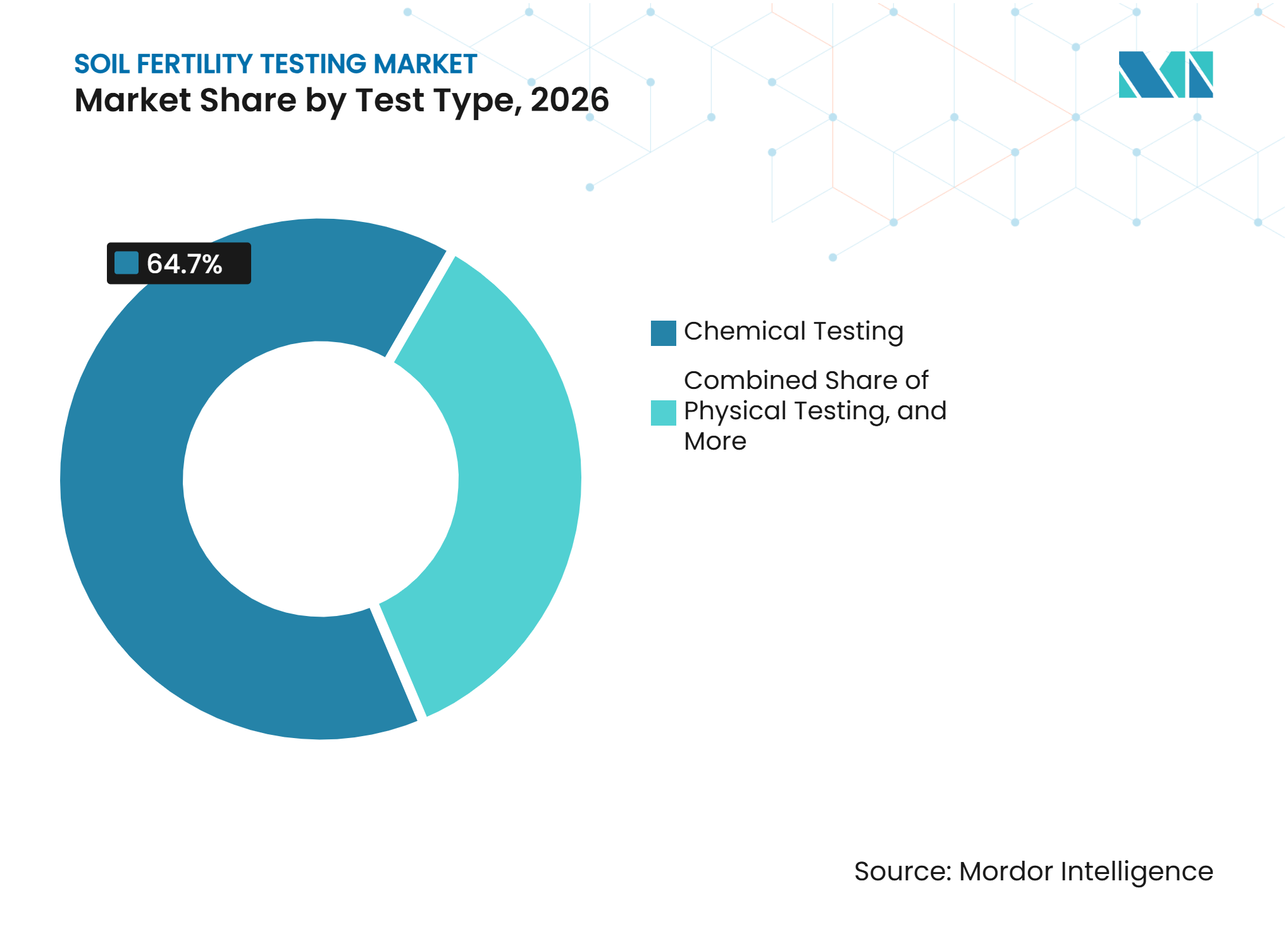
Chemical Testing Leads While Biological Testing Grows FastestChemical testing accounted for 64.7% of the soil fertility testing market share in 2026, supported by its widespread use in assessing soil nutrient availability, pH levels, and nutrient deficiencies. It remains essential for conventional, organic, and regenerative farming practices, as growers rely on chemical analysis to guide fertilizer applications and nutrient management. Physical testing complements these assessments by evaluating soil structure, compaction, and water-retention characteristics, which influence root development and overall soil conditions. These measurements are also relevant to regenerative agriculture and soil carbon verification, where soil condition is an important consideration.
Biological testing is forecast to grow at a CAGR of 8.1% from 2027 to 2032, driven by increasing adoption of microbiome diagnostics and biological soil analysis. In August 2025, Biome Makers partnered with Midwest Laboratories to expand access to its BeCrop Test, which uses next-generation DNA sequencing to provide insights into soil microbial activity and function for growers across the United States. Through this partnership, Midwest Laboratories added the BeCrop Test to its service offering for agricultural customers. Biological testing is also gaining relevance in regenerative agriculture programs. The USDA's Conservation Evaluation and Monitoring Activity (CEMA) 216 soil-health testing protocol includes soil respiration as an indicator of microbial activity, while advanced testing can also assess microbial communities and soil enzyme activity. These measurements form part of the soil-health assessments required under the Regenerative Pilot Program. This is broadening soil testing services beyond conventional chemical analysis, as growers increasingly combine nutrient assessments with biological measurements to obtain a more comprehensive understanding of soil conditions.



By Testing Method:
Off-Site or Laboratory Testing Leads While On-Site Testing Grows FastestOff-site or laboratory testing accounted for 77% of the soil fertility testing market share in 2026, supported by its established role in organic certification, carbon verification, and government soil health programs, where analytical depth and traceability are important. ISO/IEC 17025 accreditation further strengthens confidence in laboratory results by establishing requirements for testing competence. Laboratory analysis also provides confirmation for high-value or uncertain decisions, making it an important part of testing workflows even as field-based technologies advance. Combining rapid field screening with laboratory confirmation can reduce turnaround time without compromising analytical confidence.
On-site testing is forecast to grow at a CAGR of 8.3% from 2027 to 2032, driven by handheld near-infrared spectroscopy devices and electrochemical sensors that deliver field results within minutes. AgroCares B.V. offers SoilCares licensing options, including Bronze and Silver, for its portable soil scanner. The Bronze license provides analysis of pH, organic matter, total nitrogen, phosphorus, potassium, clay, and cation exchange capacity, with results available through its mobile application. This model supports on-site soil assessment and can reduce reliance on sample transportation to centralized laboratories. A 2025 peer-reviewed study published in Discover Sensors found that advances in microelectromechanical systems (MEMS), nanotechnology, and polymer-based sensors have improved sensitivity and cost-effectiveness, enabling rapid, in-situ detection of soil nutrients, including nitrogen, phosphorus, and potassium. However, soil-specific calibration requirements, high costs, and limited connectivity in remote areas continue to constrain adoption. Laboratories that integrate sampling, field screening, confirmation, and reporting can strengthen their service offering by shortening the time between sample collection and an actionable prescription.
By Application:
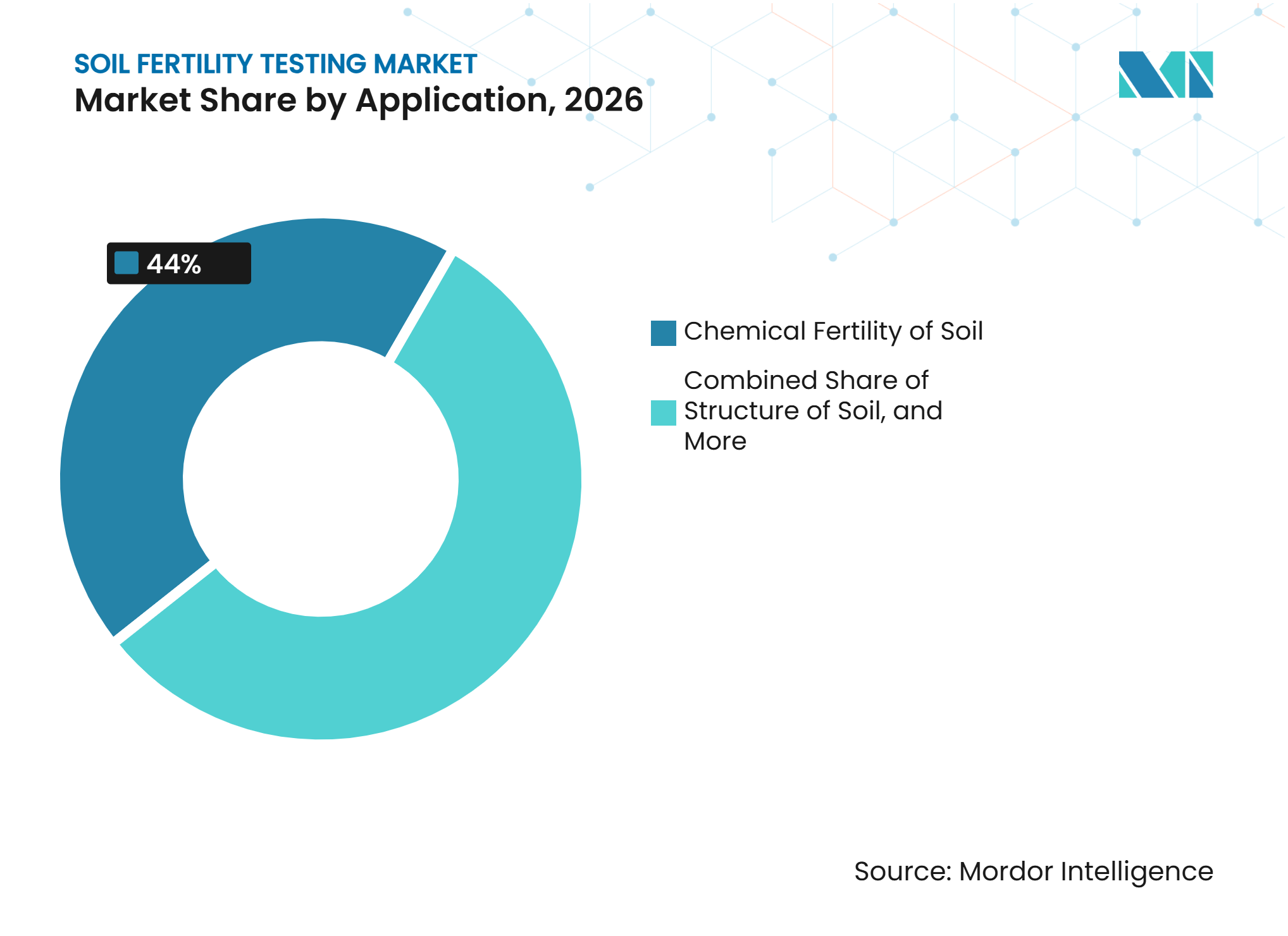
Chemical Fertility Leads While Structure of Soil Grows FastestChemical fertility of soil accounted for 44% of the soil fertility testing market share in 2026, supported by the need to assess nutrient availability, pH, electrical conductivity, and organic carbon concentration for fertilizer recommendations and compliance records. These measurements provide the basis for nutrient management across different farming systems. Soil aeration and drainage also inform agricultural decisions, particularly for salinity management under irrigated conditions and waterlogging remediation in high-rainfall areas. Together, these applications support the assessment of soil conditions beyond nutrient availability, as changing weather patterns increase the need for broader soil diagnostics.
Soil structure is forecast to grow at a CAGR of 7.1% from 2027 to 2032, driven by increasing attention to aggregate stability, compaction depth, and water infiltration in regenerative agriculture and soil carbon verification programs. Testing purchasers increasingly require repeated measurements that demonstrate changes in soil function over time rather than relying on a single nutrient assessment. Verra, Inc.'s VM0042 Improved Agricultural Land Management methodology also supports integrating soil fertility assessment into agricultural land management projects. Consequently, soil fertility testing services are increasingly incorporating nutrient, physical, and biological parameters to support broader soil assessment requirements.

Geography Analysis
Europe, Regulatory Architecture Supports the Largest Regional Position
Europe accounted for 38% of the soil fertility testing market share in 2026. Its position reflects accredited agricultural laboratories, established organic and sustainable farming programs, and nutrient-management obligations under the EU Nitrates Directive. The EU Soil Monitoring and Resilience Directive, signed in November 2025 and effective from December 2025, established a legally binding framework requiring all 27 member states to monitor and assess soil health using common indicators. SGS SA secured a European Commission contract under the LUCAS Soils Survey to conduct laboratory analyses of more than 35,000 soil samples collected across the European Union. The analyses cover soil chemical and physical properties, environmental DNA (e-DNA) metabarcoding to assess soil biodiversity, metagenomic DNA analysis in selected regions, and screening for plant protection product residues. Germany, France, and the United Kingdom remain active commercial testing locations, while Spain and Italy are expanding through precision agriculture and water-efficiency programs. Eurofins Scientific SE completed a new Agro testing laboratory in Jena, Germany, in December 2025, followed by a new environmental testing facility in Amersfoort, the Netherlands, in the first half of 2026. These investments expanded its laboratory capacity and strengthened its testing infrastructure across Europe.
Asia-Pacific, Public Programs Drive the Fastest Regional Growth
Asia-Pacific is forecast to grow at a CAGR of 8.6% from 2027 to 2032, supported by food security policies, concerns about soil degradation, and the expansion of commercial laboratory networks. Demand across China, India, Japan, South Korea, and Australia is shaped by public soil-monitoring initiatives and the adoption of precision agriculture. China's Ministry of Agriculture and Rural Affairs issued guidelines in February 2025 calling for the development of rapid soil-testing technologies, a digital soil information system, and a multidimensional soil-monitoring network. These initiatives could support demand for soil testing, laboratory analysis, and digital data services. Under the Soil Health and Fertility component of the Rashtriya Krishi Vikas Yojana (RKVY), Maharashtra planned to establish 15 village-level soil-testing laboratories in Nashik district during the 2025–2026 program year, according to the District Superintendent Agriculture Officer. Australia has additional demand drivers in carbon farming and high-resolution soil organic carbon measurement. FarmLab acquired Ziltek in September 2025, combining its portable soil scanner with satellite mapping and digital soil analysis tools to expand its in-field testing capabilities.
Regional Diversification Broadens Emerging Demand
South America has growing demand, particularly in Brazil and Argentina, where soybean, corn, and sugarcane farms use variable-rate input programs that require detailed soil fertility maps. Brazil's export-oriented agricultural supply chains are also incorporating soil documentation into supplier qualification processes for European and Asian buyers. This supports the use of soil fertility testing for both input planning and export assurance. North America has established laboratory networks and institutional adoption of precision agriculture, while the United States Department of Agriculture (USDA) Regenerative Pilot Program supports regional efforts to advance regenerative agriculture and soil health monitoring. The Middle East is seeing growing demand for food-security programs, controlled-environment agriculture, and salinity monitoring in irrigated systems. Africa has relatively low current penetration, but substantial soil-testing needs due to land degradation and the emergence of mobile testing services in Nigeria, South Africa, and Egypt. Across these regions, the commercial opportunity depends on connecting accessible local sampling services with reliable interpretation and affordable follow-up testing.
Competitive Landscape
Market Concentration
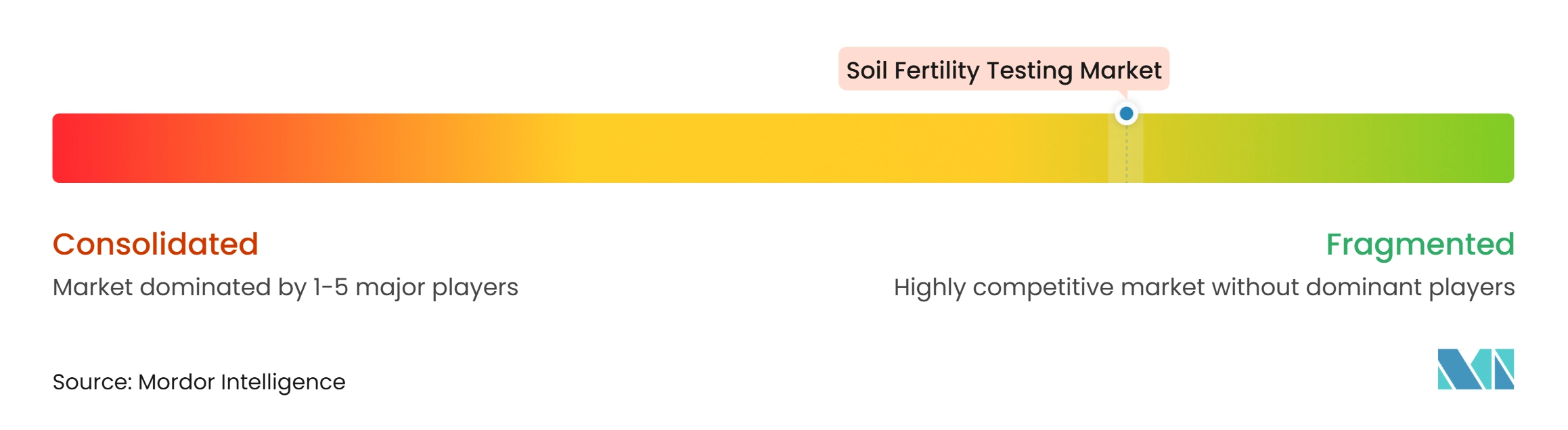
The soil fertility testing market was fragmented in 2026, as agricultural conditions, testing regulations, and laboratory networks vary across countries. Eurofins Scientific SE, SGS SA, Intertek Group plc, Activation Laboratories Ltd., and Deveron Corp. are among the established participants. Global networks are positioned to serve multinational, premium, and regulatory contracts, while regional laboratories and agronomy platforms cater to domestic farm demand. Large providers are expanding laboratory coverage, digital reporting, and multi-parameter testing panels. Eurofins Scientific SE acquired CSR Laboratorio in Spain in April 2026, expanding its agricultural testing capabilities and market coverage. Investments in its laboratories in Jena, Germany, and Amersfoort, Netherlands, further strengthened its European testing network.
Specialty providers are developing service models in which scanners and mapping solutions serve as entry products, while licenses generate recurring revenue. AgroCares B.V. expanded access to its soil-testing solutions through a global webshop launched in May 2026, offering scanners, application licenses, and testing packages for online purchase. Eurofins Scientific SE has also positioned its Soil Health Indicator as a standardized score based on near-infrared spectroscopy and inductively coupled plasma mass spectrometry (ICP-MS) multi-nutrient extraction. These offerings highlight the importance of data quality and interpretation in customer retention. Biological testing, affordable on-site tools for smallholders, and carbon-outcome verification remain areas of opportunity. Providers that combine instruments, recognized methods, and laboratory confirmation can address these requirements through integrated testing services.
Sensor development is changing the competitive position of portable testing providers, though it does not eliminate laboratories' role. A 2025 scientific review published in the journal Discover Sensors identified advances in the sensitivity of in-situ nutrient sensing while highlighting soil-specific calibration requirements and connectivity limitations as adoption challenges. These constraints make local validation and recognized reporting practices important competitive factors. Rock River Laboratory agreed to acquire Deveron Corp.'s agronomic and environmental assets in November 2025, combining laboratory testing capabilities with precision field imagery and digital agronomy services. This illustrates how mid-sized competitors can integrate sampling logistics, analytical capacity, and digital agronomy. Such service models can reduce handoffs between field collection, laboratory analysis, and farm recommendations while supporting repeat sampling across multiple seasons. Regional specialists can continue to serve customers through local soil expertise and field service coverage, while larger networks can address cross-border contracts and compliance requirements.
Soil Fertility Testing Industry Leaders
-
Eurofins Scientific SE
-
SGS SA
-
Intertek Group plc
-
Activation Laboratories Ltd.
-
Deveron Corp.
- *Disclaimer: Major Players sorted in no particular order
Soil Fertility Testing Market Companies Covered in this Report
- SGS SA
- Eurofins Scientific SE
- Intertek Group plc
- Waypoint Analytical, LLC
- Deveron Corp.
- AgroLab, Inc.
- Activation Laboratories Ltd.
- AgroCares B.V.
- Midwest Laboratories, Inc.
- Waters Agricultural Laboratories, Inc.
- Agvise Laboratories, Inc.
- Spectrum Analytic Inc.
- Ward Laboratories, Inc.
- Brookside Laboratories, Inc.
- A&L Great Lakes Laboratories, Inc.
Recent Industry Developments in Soil Fertility Testing Market
- April 2026: Eurofins Scientific SE, through its Eurofins Agro Testing division in Spain, completed the acquisition of CSR Laboratorio, an agricultural testing laboratory based in Úbeda, Jaén, with 20 years of experience providing soil, water, plant, and fertilizer analysis services to agricultural producers across Spain. The acquisition strengthens Eurofins Agro Testing’s service offering and market coverage in Spain.
- November 2025: Rock River Laboratory, Inc. entered into an agreement to acquire all assets of Deveron Corp., including its soil and environmental testing operations, and integrate the assets of A&L Canada Laboratories Inc. Aqua Capital will provide equity financing and oversee the combined group, bringing together agronomic and environmental testing capabilities across North America.
- August 2025: Biome Makers partnered with Midwest Laboratories, Inc. to make its BeCrop Test available to growers across the United States. The test uses next-generation DNA sequencing to analyze soil microbial activity and function, complementing conventional soil fertility analysis with biological assessments.
Global Soil Fertility Testing Market Report Scope
The soil fertility testing market comprises services and solutions that evaluate the chemical, physical, and biological properties of soil to determine its nutrient status and fertility levels. These services include on-site and laboratory-based testing methods to assess soil nutrient availability, structure, aeration, and drainage, supporting soil fertility assessment and management.
The soil fertility testing report is segmented by test type (chemical testing, physical testing, and biological testing), by testing method (on-site testing and off-site or laboratory testing), by application (chemical fertility of soil, structure of soil, aeration in soil, and drainage in soil), and by Geography (North America, South America, Europe, Asia-Pacific, Middle East, and Africa). The market forecasts are provided in terms of value (USD).
Segmentation Overview
| Chemical Testing |
| Physical Testing |
| Biological Testing |
| On-Site Testing |
| Off-Site or Laboratory Testing |
| Chemical Fertility of Soil |
| Structure of Soil |
| Aeration in Soil |
| Drainage in Soil |
| North America | United States |
| Canada | |
| Mexico | |
| Rest of North America | |
| South America | Brazil |
| Argentina | |
| Rest of South America | |
| Europe | Germany |
| United Kingdom | |
| France | |
| Italy | |
| Spain | |
| Russia | |
| Rest of Europe | |
| Asia-Pacific | China |
| India | |
| Japan | |
| South Korea | |
| Australia | |
| Rest of Asia-Pacific | |
| Middle East | Saudi Arabia |
| United Arab Emirates | |
| Turkey | |
| Israel | |
| Rest of Middle East | |
| Africa | South Africa |
| Nigeria | |
| Egypt | |
| Rest of Africa |
| By Test Type | Chemical Testing | |
| Physical Testing | ||
| Biological Testing | ||
| By Testing Method | On-Site Testing | |
| Off-Site or Laboratory Testing | ||
| By Application | Chemical Fertility of Soil | |
| Structure of Soil | ||
| Aeration in Soil | ||
| Drainage in Soil | ||
| By Geography | North America | United States |
| Canada | ||
| Mexico | ||
| Rest of North America | ||
| South America | Brazil | |
| Argentina | ||
| Rest of South America | ||
| Europe | Germany | |
| United Kingdom | ||
| France | ||
| Italy | ||
| Spain | ||
| Russia | ||
| Rest of Europe | ||
| Asia-Pacific | China | |
| India | ||
| Japan | ||
| South Korea | ||
| Australia | ||
| Rest of Asia-Pacific | ||
| Middle East | Saudi Arabia | |
| United Arab Emirates | ||
| Turkey | ||
| Israel | ||
| Rest of Middle East | ||
| Africa | South Africa | |
| Nigeria | ||
| Egypt | ||
| Rest of Africa | ||
Key Questions Answered in the Report
What is the forecast growth rate of the soil fertility testing market?
The soil fertility testing market is forecast to grow at a CAGR of 6.84% from 2027 to 2032, reaching USD 2.13 billion by 2032.
What factors are driving the soil fertility testing market?
Soil degradation, precision nutrient management, regenerative agriculture, organic certification, and soil carbon verification are supporting demand for soil fertility testing.
Which test type accounts for the largest share of the soil fertility testing market?
Chemical testing accounted for 64.7% of the market share in 2026, supported by its widespread use in assessing soil nutrient availability and pH levels for fertilizer management.
Which testing method is forecast to grow fastest?
On-site testing is forecast to grow at a CAGR of 8.3% from 2027 to 2032, supported by the adoption of portable sensors and field-based soil analysis technologies.
Which region accounts for the largest share of the soil fertility testing market?
Europe accounted for 38% of the market share in 2026, supported by established laboratory networks and regulatory initiatives promoting soil monitoring and assessment.