
Sodium Methylate Market Size and Share
Market Overview
| Study Period | 2022 - 2032 |
|---|---|
| Market Size (2027) | USD 519.72 Million |
| Market Size (2032) | USD 649.53 Million |
| Growth Rate (2027 - 2032) | 4.56 % |
| Fastest Growing Market | Asia-Pacific |
| Largest Market | Asia-Pacific |
| Market Concentration | Medium |
Major Players *Disclaimer: Major Players sorted in no particular order Image © Mordor Intelligence. Reuse requires attribution under CC BY 4.0. | |
Sodium Methylate Market Analysis by Mordor Intelligence
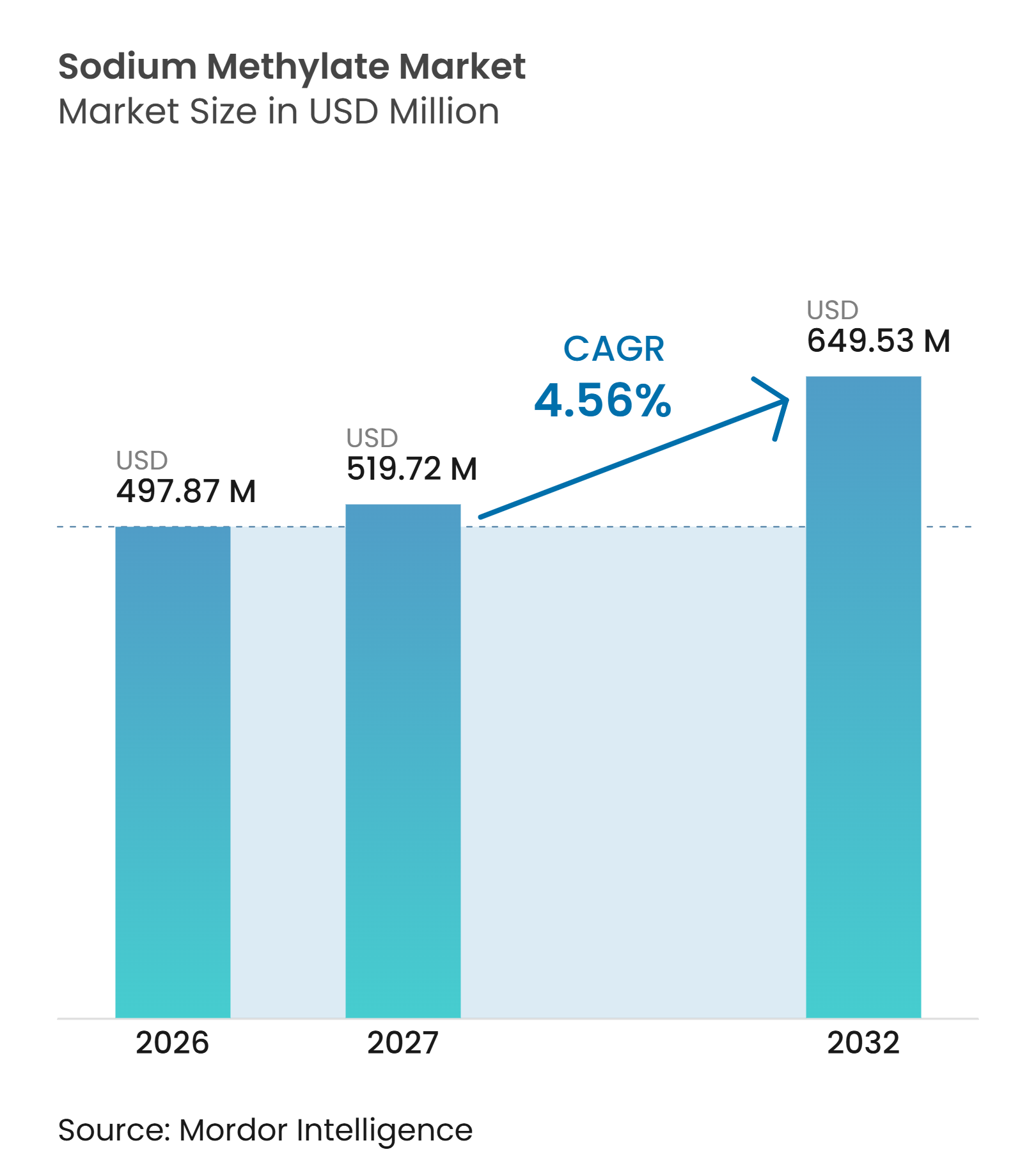
The Sodium Methylate Market size was valued at USD 497.87 million in 2026 and is estimated to grow from USD 519.72 million in 2027 to reach USD 649.53 million by 2032, at a CAGR of 4.56% during the forecast period (2027-2032). Biodiesel blending policies support demand because sodium methylate is used as a catalyst in fatty acid methyl ester production. Active pharmaceutical ingredient production also supports demand for dry, high-purity grades, particularly where moisture control is essential. The sodium methylate market is also being shaped by investment in continuous production equipment, which requires consistent catalyst quality and delivery. Producers with reliable access to methanol and metallic sodium are better placed to manage input cost exposure. The sodium methylate market therefore favors companies that can serve both large biodiesel plants and specialized chemical customers.
Key Report Takeaways
- By type, solid held 60.13% of the sodium methylate market share in 2026, while liquid is projected to advance at a 5.34% CAGR through 2032.
- By application, biodiesel held 55.35% of the sodium methylate market share in 2026, while pharmaceuticals are projected to advance at a 5.68% CAGR through 2032.
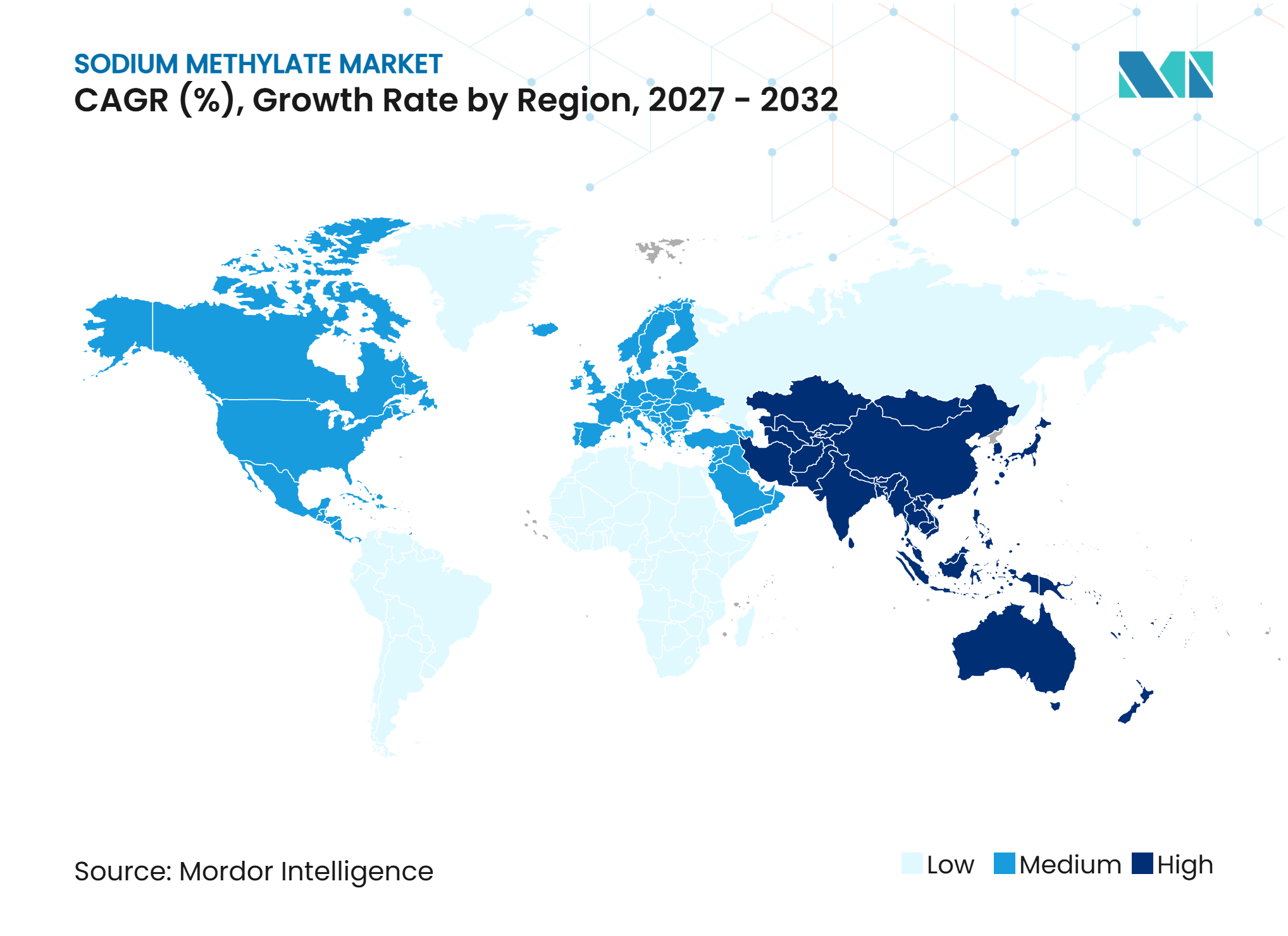
- By geography, Asia-Pacific held 38.71% of the sodium methylate market share in 2026 and is projected to advance at a 5.55% CAGR through 2032.
Note: Market numbers in this report are based on Mordor Intelligence's proprietary estimation framework, which combines nine months of actuals with Q4 projections for base year 2026.
Market Trends and Insights
Drivers Impact Analysis of Sodium Methylate Market*
| Driver | (~) % Impact on CAGR Forecast | Geographic Relevance | Impact Timeline |
|---|---|---|---|
| Biodiesel Blending Mandates and Renewable-Fuel Policies | +2.0% | Global, with concentrated near-term gains in North America, EU, India, and China | Short term (≤ 2 years) |
| Pharmaceutical API and Fine-Chemical Synthesis Growth | +1.2% | APAC core (China, India), spillover to EU and North America | Medium term (2–4 years) |
| Continuous-Flow Transesterification and Automated Catalyst Dosing | +0.6% | Global, led by large-scale biodiesel producers in Europe and Southeast Asia | Medium term (2–4 years) |
| Expansion of Pharmaceutical and Agrochemical Manufacturing in Asia | +0.4% | China, India, South Korea, ASEAN | Long term (≥ 4 years) |
| Mercury-Free Capacity Replacement and Regional Supply Localization | +0.3% | EU core, with secondary effects on North America and APAC as regional supply tightens | Short term (≤ 2 years) |
| Source: Mordor Intelligence | |||
Biodiesel Blending Mandates and Renewable-Fuel Policies
Biodiesel policy is a primary source of demand for the sodium methylate market because alkaline transesterification requires a homogeneous catalyst. The U.S. Environmental Protection Agency (EPA) finalized Renewable Fuel Standard volumes for 2026 and 2027 that include biomass-based diesel volumes of 5.61 billion gallons and 5.86 billion gallons, respectively[1]. These requirements establish a cleaner operating environment for U.S. biodiesel production and for catalyst suppliers. The European Union requires member states to implement sectoral targets under the Renewable Energy Directive, including either a 14.5% greenhouse gas intensity reduction or a 29% renewable-energy share in transport by 2030. China also placed biodiesel within its policy agenda through national work on green liquid fuel pilots and biofuel circulation management. These measures support the sodium methylate market by tying a major end use to renewable-fuel implementation.
API and Fine-Chemical Synthesis Growth
Active pharmaceutical ingredient production supports the sodium methylate market because solid grades can be used in moisture-sensitive chemical reactions. Sodium methylate functions as a base or catalyst in deprotonation, Claisen condensation, Dieckmann cyclization, and methylation steps. High-purity, methanol-free material is important where water content can affect product quality or process control. BASF stated that demand from life science customers was one reason for its investment in a new alcoholates plant at Ludwigshafen. This investment shows that the sodium methylate market is not defined only by biodiesel volume. It also reflects demand for specialized grades that meet the process needs of pharmaceutical and fine-chemical producers.
Continuous-Flow Transesterification and Automated Catalyst Dosing
Continuous biodiesel processing supports stable consumption in the sodium methylate market because the process requires controlled catalyst addition. Continuous systems use consistent dosing to maintain reaction conditions and manage separation performance. A 2025 review identified optimization and control as central factors in continuous biodiesel production processes. Liquid sodium methylate is suited to this setting because it can be delivered as a ready-to-use methanolic solution. The shift toward automated dosing can increase the importance of supply reliability, storage capability, and product consistency. It also encourages longer supply arrangements between catalyst suppliers and biodiesel producers.
Expansion of Pharmaceutical and Agrochemical Manufacturing in Asia
Pharmaceutical and agrochemical production adds a second demand base to the sodium methylate market in Asia. Sodium methylate is used in chemical pathways for active pharmaceutical ingredients, herbicide intermediates, and insecticide intermediates. China and India are especially relevant because they combine large chemical manufacturing bases with growing demand for regulated inputs. The sodium methylate market can benefit when these manufacturers require high-purity reagents and documented handling practices. Domestic sourcing initiatives may also increase interest in regional suppliers that can provide consistent material and local technical support. This demand base gives producers another outlet beyond biodiesel catalyst sales.
Restraints Impact Analysis of Sodium Methylate Market*
| Restraint | (~) % Impact on CAGR Forecast | Geographic Relevance | Impact Timeline |
|---|---|---|---|
| Methanol and Sodium Feedstock Price Volatility | -1.0% | Global, most acute in Europe and North America where natural-gas-linked methanol costs are highest | Short term (≤ 2 years) |
| Moisture Sensitivity and Hazardous-Material Compliance Costs | -0.5% | Global; regulatory influence most pronounced in EU (REACH/CLP) and North America (DOT/IATA) | Medium term (2–4 years) |
| Dependence on Specialized Packaging and Controlled Logistics | -0.4% | Global, most limiting in emerging markets with nascent hazardous-goods logistics infrastructure | Long term (≥ 4 years) |
| Source: Mordor Intelligence | |||
Methanol and Sodium Feedstock Price Volatility
Methanol and metallic sodium remain important cost inputs for sodium methylate production. Methanol costs are influenced by natural gas economics, particularly in regions where gas is a major feedstock. Metallic sodium production is energy intensive, which introduces a separate exposure to electricity costs. These conditions can affect margins for suppliers that do not have long-term supply arrangements or integrated feedstock access. The sodium metal process can produce anhydrous material for high-purity uses, while other processes may not offer the same suitability for dry synthesis. The sodium methylate market therefore places pressure on smaller producers when input prices move quickly.
Moisture Sensitivity and Hazardous-Material Compliance Costs
Sodium methylate reacts with water and requires dry storage, controlled packaging, and specialized transport practices. These requirements can raise operating costs across production, warehousing, and delivery. Solid material often needs sealed small-format packaging, while liquid material can be distributed in bulk under controlled conditions. Documentation and safety procedures are especially important when material is supplied into regulated pharmaceutical or export markets. The sodium methylate market can therefore have higher entry requirements than commodity chemical markets. Suppliers with established storage systems and hazardous-material procedures are better able to manage these requirements.
*Our forecasts treat driver/restraint impacts as directional, not additive. The impact forecasts reflect baseline growth, mix effects, and variable interactions.
Sodium Methylate Market Segment Analysis
By Type:
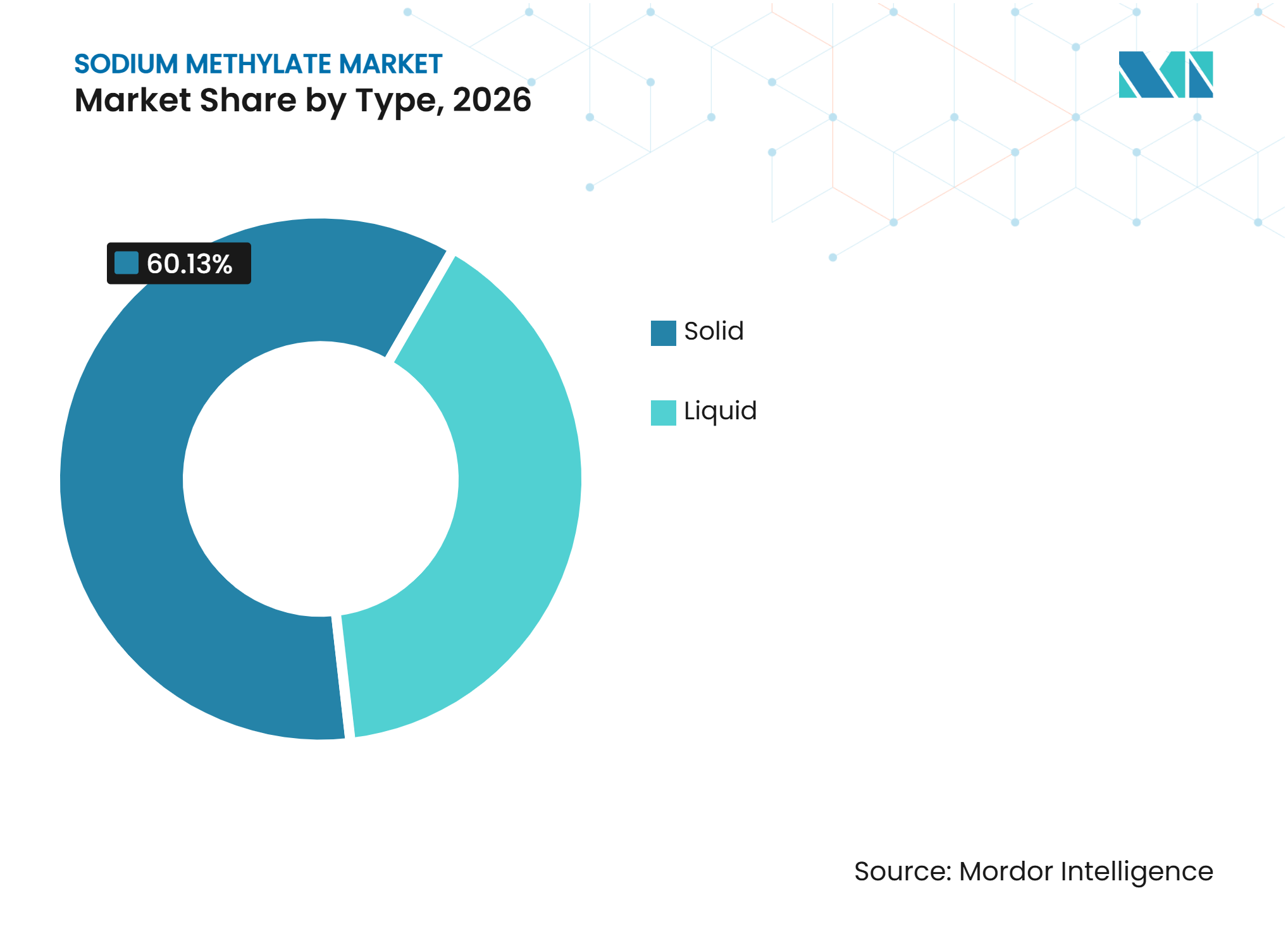
Solid Leads, While Liquid ExpandsThe solid segment held 60.13% of the sodium methylate market size in 2026. Its position reflects demand for anhydrous, methanol-free material in pharmaceutical and fine-chemical synthesis. These customers use the material where moisture can affect reaction performance, product specifications, and reagent purity. BASF offers sodium and potassium methylate for life science and chemical applications, showing the relevance of specialized alcoholate supply. The solid product therefore remains linked to value-added applications that require traceability, controlled storage, and strict process conditions.
The liquid segment is projected to advance at a 5.34% CAGR through 2032. It is widely used in commercial biodiesel plants because it can be supplied as a methanolic solution and transferred into process equipment. The liquid form supports continuous transesterification systems that require stable catalyst dosing and properly managed bulk delivery. It can also reduce handling steps when on-site storage and delivery procedures are in place. The sodium methylate industry uses liquid material where throughput, dosing consistency, biodiesel blending programs, and automated production systems are major priorities.


By Application:
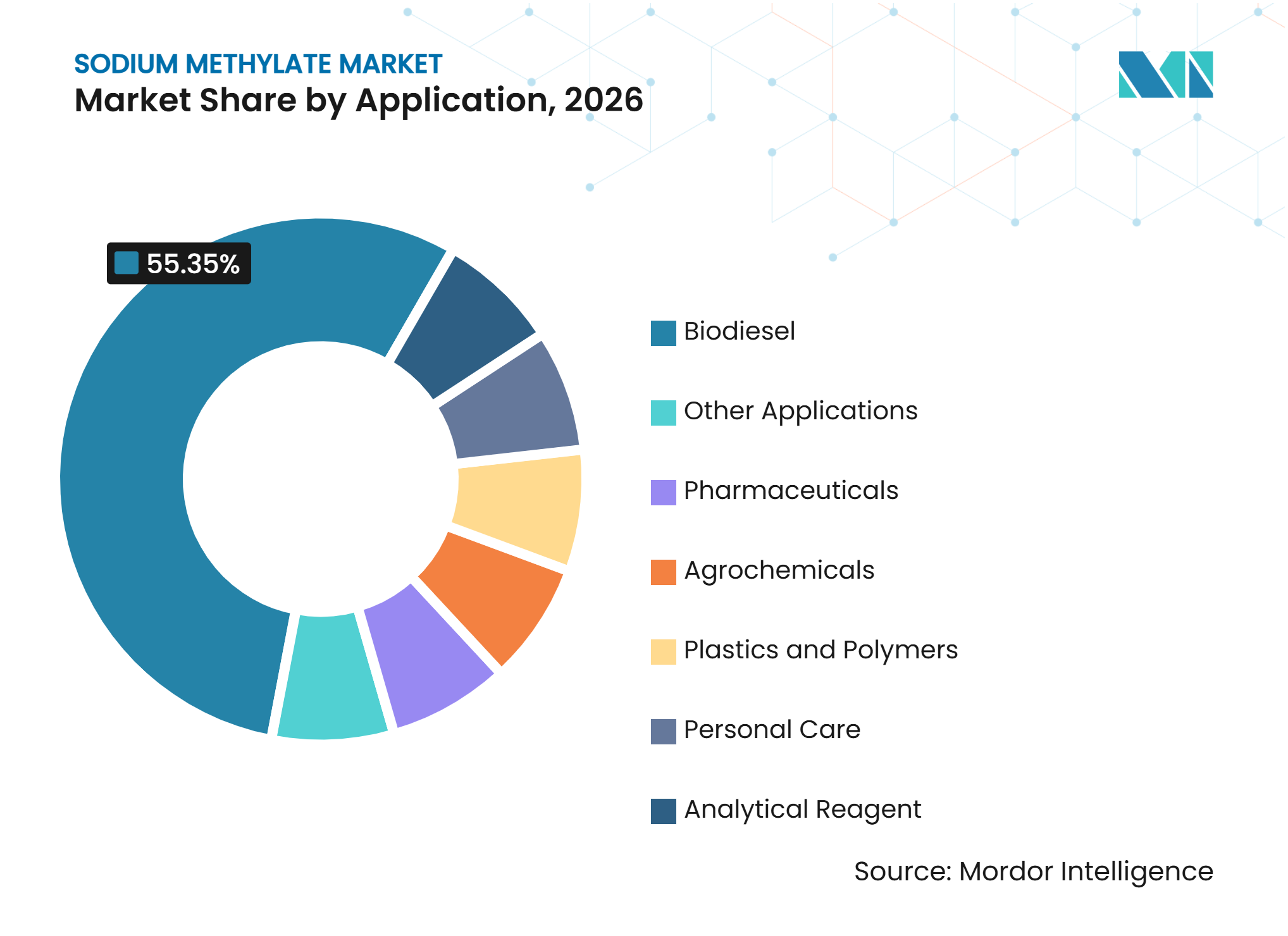
Biodiesel Remains Dominant, While Pharmaceuticals Accelerate FasterBiodiesel held 55.35% of the sodium methylate market size in 2026. Sodium methylate acts as a catalyst in transesterification, which converts oils or fats into fatty acid methyl ester biodiesel. This application is closely connected to renewable-fuel programs in North America, Europe, and Asia. U.S. biomass-based diesel volumes for 2026 and 2027 provide a policy base for this use. European transport targets also preserve a policy role for renewable fuels.
Pharmaceuticals are projected to advance at a 5.68% CAGR through 2032. The application uses high-purity sodium methylate in reactions that support active pharmaceutical ingredient and intermediate manufacturing. It has a different demand pattern from biodiesel because purchasing depends on pharmaceutical production and qualification needs. BASF identified life sciences as a demand driver for its new alcoholates capacity, alongside biodiesel customers. Agrochemicals, plastics and polymers, personal care, analytical reagents, and other applications provide additional uses that broaden the customer base.


Geography Analysis
Asia-Pacific: Biodiesel and Chemical Manufacturing Support Regional Demand
Asia-Pacific held a 38.71% share in 2026 and is projected to advance at a 5.55% CAGR through 2032. China supports demand through measures covering biofuel circulation and green liquid fuel pilot work. The National Energy Administration has also issued a notice covering the first batch of green liquid fuel technology research and industrial pilot work[2]. These measures create a more formal basis for biodiesel-related investment and supply-chain development. Pharmaceutical and agrochemical manufacturing provide additional demand for higher-purity material. Suppliers in the sodium methylate market can address this region through local storage, consistent specifications, and documented handling practices.
North America: Renewable Fuel Requirements Support Biodiesel Use
The United States provides a policy base for sodium methylate demand through its Renewable Fuel Standard. The final 2026 and 2027 rule set biomass-based diesel volumes of 5.61 billion gallons and 5.86 billion gallons, respectively. These volumes support biodiesel output that uses sodium methylate as a transesterification catalyst. The region has established transport, storage, and production infrastructure for renewable fuels. This structure favors suppliers that can provide consistent liquid catalyst to industrial biodiesel facilities.
Europe, South America, and Emerging Markets: Regulation and Supply Development Shape Opportunities
European policy continues to support renewable transport energy through the Renewable Energy Directive. BASF is investing in a new alcoholates plant at Ludwigshafen that is expected to support biodiesel and life science customers. This investment indicates continued interest in regional supply for specialized alcoholates. South America offers a biodiesel-related demand base, particularly where local production and transport infrastructure can support liquid catalyst use. The Middle East and Africa remain smaller areas of demand. Biofuel pilots and pharmaceutical manufacturing could support future demand where hazardous-material logistics and local storage systems develop. The sodium methylate market across these geographies depends on regulatory implementation, regional supply availability, and the ability to deliver material under controlled conditions.
Competitive Landscape
Market Concentration
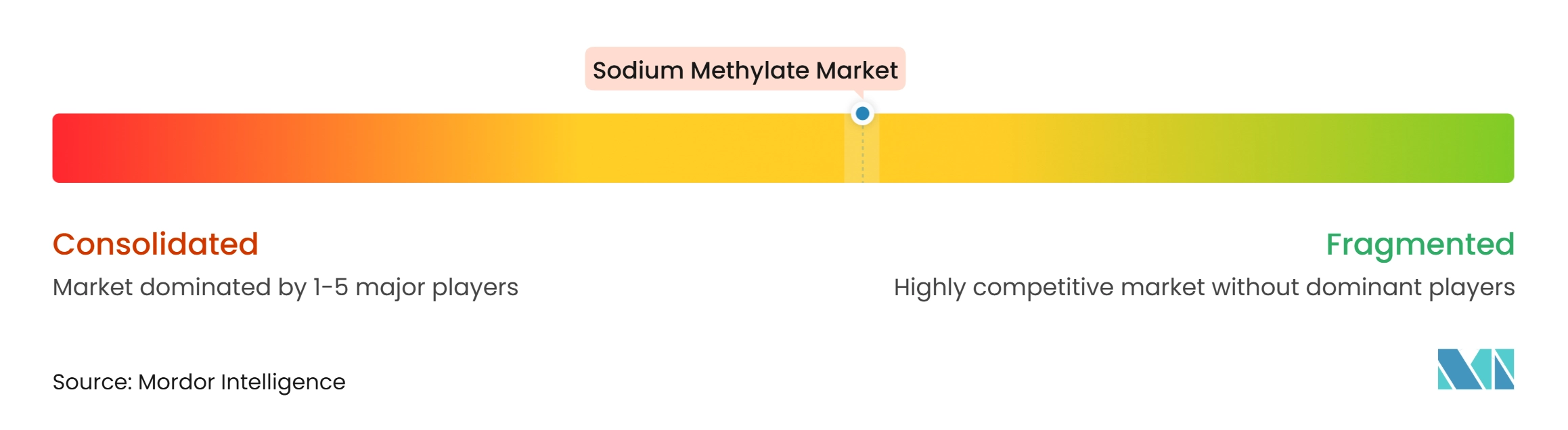
The sodium methylate market is moderately concentrated, with top players including Evonik Industries AG, BASF, DESATEC GmbH, Anhui Jinbang Medicine Chemical Co., Ltd., and DuPont. BASF has a material presence in alcoholates and announced a new Ludwigshafen plant investment in February 2025. BASF also has a 2025 patent filing for a mixed alkoxide catalyst relevant to biodiesel production from high-free-fatty-acid feedstocks. Evonik Industries AG serves the biodiesel value chain through its sodium methylate activities in Argentina. Competition is influenced by product purity, local delivery capability, feedstock access, and safety systems. The sodium methylate market gives an advantage to suppliers that can support both bulk biodiesel use and higher-purity chemical applications.
BASF announced its alcoholates investment at Ludwigshafen as a facility intended to replace an existing plant and support biodiesel and life science customers. This move aligns capacity planning with two separate demand channels. BASF’s patent filing also shows an effort to address biodiesel processing using challenging feedstocks. Evonik Industries AG’s sodium methylate activity in Argentina reflects a strategy of serving regional biodiesel production close to the customer base. These company actions show that proximity to demand and application-specific product performance remain important competitive factors.
Companies can compete through product quality, regulatory documentation, delivery reliability, and feedstock security. Solid-grade suppliers must manage dry handling and quality controls for pharmaceutical and fine-chemical customers. Liquid-grade suppliers must manage bulk storage and dependable delivery to biodiesel facilities. The sodium methylate market remains sensitive to the ability of producers to meet these different operating requirements.
Sodium Methylate Industry Leaders
-
Evonik Industries AG
-
BASF
-
DESATEC GmbH
-
Anhui Jinbang Medicine Chemical Co., Ltd.
-
DuPont
- *Disclaimer: Major Players sorted in no particular order
Sodium Methylate Market Companies Covered in this Report
- American Elements
- Anhui Jinbang Medicine Chemical Co., Ltd.
- BASF
- DESATEC GmbH
- Dezhou Longteng Chemical Co., Ltd.
- DuPont
- Evonik Industries AG
- Gelsenchem Chemical Products GmbH
- Inner Mongolia Lantai Industrial Co., Ltd.
- Lian Chemical Development Co.
- New Heaven Chemicals
- Shandong Seesuns New Material Technology Co., Ltd.
- Supracombines
- Zhengzhou Saihang Chemical Technology Co., Ltd.
- Zibo Xusheng Chemical Co., Ltd.
Recent Industry Developments in Sodium Methylate Market
- August 2025: Evonik Industries AG inaugurated a new alkoxide production facility on Jurong Island, Singapore, following a multi-million-euro investment. The plant has an annual production capacity of up to 100,000 metric tons and produces sodium methylate, among other alkoxides, serving biodiesel, pharmaceutical, and chemical recycling applications across the Asia-Pacific region, expanding the sodium methylate supply in the region.
- May 2025: MSSA announced an expansion of its sodium methylate production facility in La Rochelle, France, through the addition of a second production line. The project was expected to double annual capacity from 20,000 to 40,000 metric tons, strengthening European supply of sodium methylate produced through mercury-free processes.
Global Sodium Methylate Market Report Scope
Sodium methylate is an alkoxide compound widely used as a strong base and catalyst in chemical synthesis and industrial manufacturing. It is commonly produced in solid and liquid forms and facilitates transesterification, esterification, and other chemical reactions.
The Sodium Methylate Market is segmented by type, application, and geography. By type, the market is segmented into solid and liquid. By application, the market is segmented into biodiesel, pharmaceuticals, agrochemicals, plastics and polymers, personal care, analytical reagent, and other applications. The report also covers the market size and forecasts for sodium methylate in 15 countries across major regions. For each segment, the market sizing and forecasts have been done on the basis of value (USD).
Segmentation Overview
| Solid |
| Liquid |
| Biodiesel |
| Pharmaceuticals |
| Agrochemicals |
| Plastics and Polymers |
| Personal Care |
| Analytical Reagent |
| Other Applications |
| Asia-Pacific | China |
| India | |
| Japan | |
| South Korea | |
| ASEAN Countries | |
| Rest of Asia-Pacific | |
| North America | United States |
| Canada | |
| Mexico | |
| Europe | Germany |
| United Kingdom | |
| France | |
| Italy | |
| NORDIC Countries | |
| Rest of Europe | |
| South America | Brazil |
| Argentina | |
| Rest of South America | |
| Middle East and Africa | Saudi Arabia |
| South Africa | |
| Rest of Middle East and Africa |
| By Type | Solid | |
| Liquid | ||
| By Application | Biodiesel | |
| Pharmaceuticals | ||
| Agrochemicals | ||
| Plastics and Polymers | ||
| Personal Care | ||
| Analytical Reagent | ||
| Other Applications | ||
| By Geography | Asia-Pacific | China |
| India | ||
| Japan | ||
| South Korea | ||
| ASEAN Countries | ||
| Rest of Asia-Pacific | ||
| North America | United States | |
| Canada | ||
| Mexico | ||
| Europe | Germany | |
| United Kingdom | ||
| France | ||
| Italy | ||
| NORDIC Countries | ||
| Rest of Europe | ||
| South America | Brazil | |
| Argentina | ||
| Rest of South America | ||
| Middle East and Africa | Saudi Arabia | |
| South Africa | ||
| Rest of Middle East and Africa | ||
Key Questions Answered in the Report
What is the size of the sodium methylate market?
The sodium methylate market size was valued at USD 497.87 million in 2026 and is estimated to grow from USD 519.72 million in 2027 to reach USD 649.53 million by 2032, at a CAGR of 4.56% during the forecast period (2027-2032).
What is driving sodium methylate demand?
Biodiesel blending policies, pharmaceutical active ingredient production, and continuous biodiesel processing support demand for sodium methylate.
Which type held the largest share in 2026?
Solid type held 60.13% in 2026 because pharmaceutical and fine-chemical processes require dry, high-purity material.
Which application is projected to grow fastest through 2032?
Pharmaceuticals are projected to advance at a 5.68% CAGR through 2032, supported by demand for high-purity reagents used in active pharmaceutical ingredient synthesis.