
Sodium-Ion Battery-Grade Hard Carbon Market Size and Share
Market Overview
| Study Period | 2021 - 2031 |
|---|---|
| Market Size (2026) | USD 107.62 Million |
| Market Size (2031) | USD 440.5 Million |
| Growth Rate (2026 - 2031) | 32.56 % |
| Fastest Growing Market | Asia-Pacific |
| Largest Market | Asia-Pacific |
| Market Concentration | Medium |
Major Players *Disclaimer: Major Players sorted in no particular order Image © Mordor Intelligence. Reuse requires attribution under CC BY 4.0. | |
Sodium-Ion Battery-Grade Hard Carbon Market Analysis by Mordor Intelligence
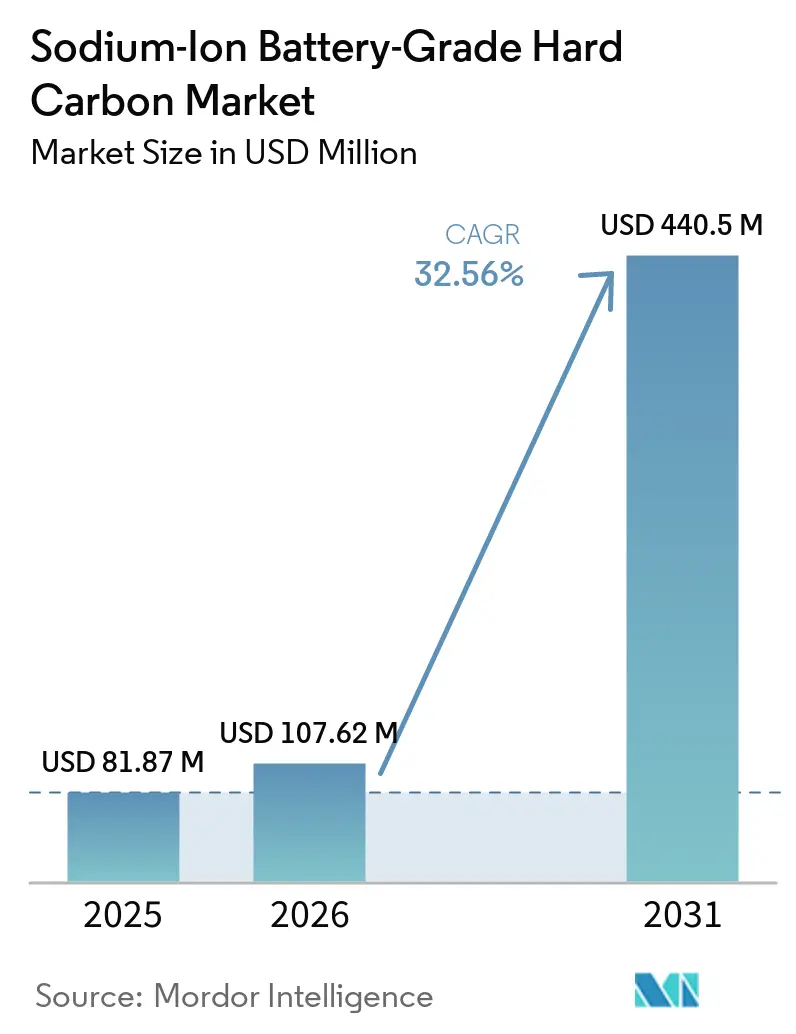
The sodium-ion battery-grade hard carbon market size was valued at USD 81.87 million in 2025 and is estimated to grow from USD 107.62 million in 2026 to reach USD 440.50 million by 2031, at a CAGR of 32.56% during the forecast period (2026-2031). Hard carbon remains the commercially viable anode material for sodium-ion cells because graphite has insufficient interlayer spacing for sodium ions. The growing commercial deployment of sodium-ion batteries is increasing demand for anode materials with stable electrochemical performance and consistent batch-to-batch quality. Hard carbon can be processed at lower temperatures than graphite, which reduces energy use in anode production. Biomass and resin precursors offer distinct cost, supply, and quality characteristics. The sodium-ion battery-grade hard carbon market is shaped by cell-maker qualification requirements, supply-chain diversification, and demand from stationary storage and cost-sensitive electric mobility applications. Suppliers that combine traceable feedstocks with consistent material performance are positioned to meet both cost and compliance requirements.
Key Report Takeaways
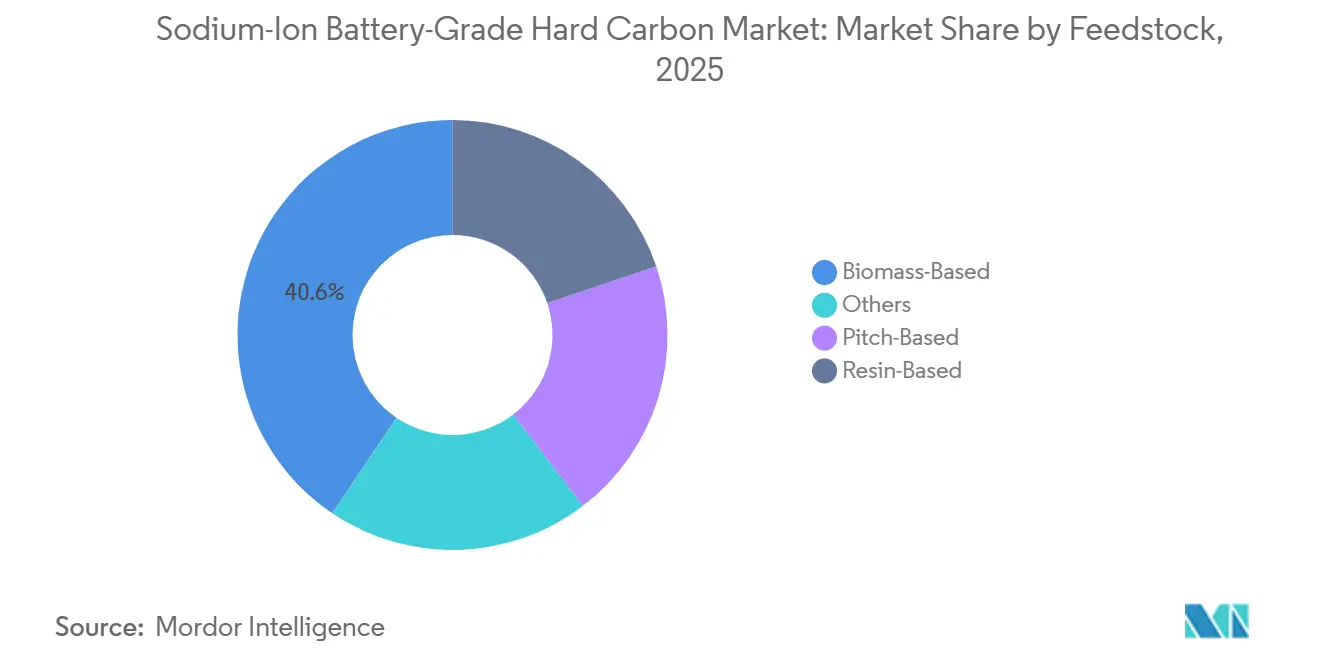
- By feedstock, biomass-based hard carbon held 40.56% of the sodium-ion battery-grade hard carbon market share in 2025, while the same segment is forecast to grow at a 34.27% CAGR through 2031.
- By process type, carbonization and pyrolysis accounted for 56.41% of the sodium-ion battery-grade hard carbon market share in 2025, while surface modification is forecast to grow at a CAGR of 33.51% through 2031.
- By grade, energy-oriented material held 42.67% of the sodium-ion battery-grade hard carbon market share in 2025, while long-cycle grade is forecast to expand at a 32.95% CAGR through 2031.
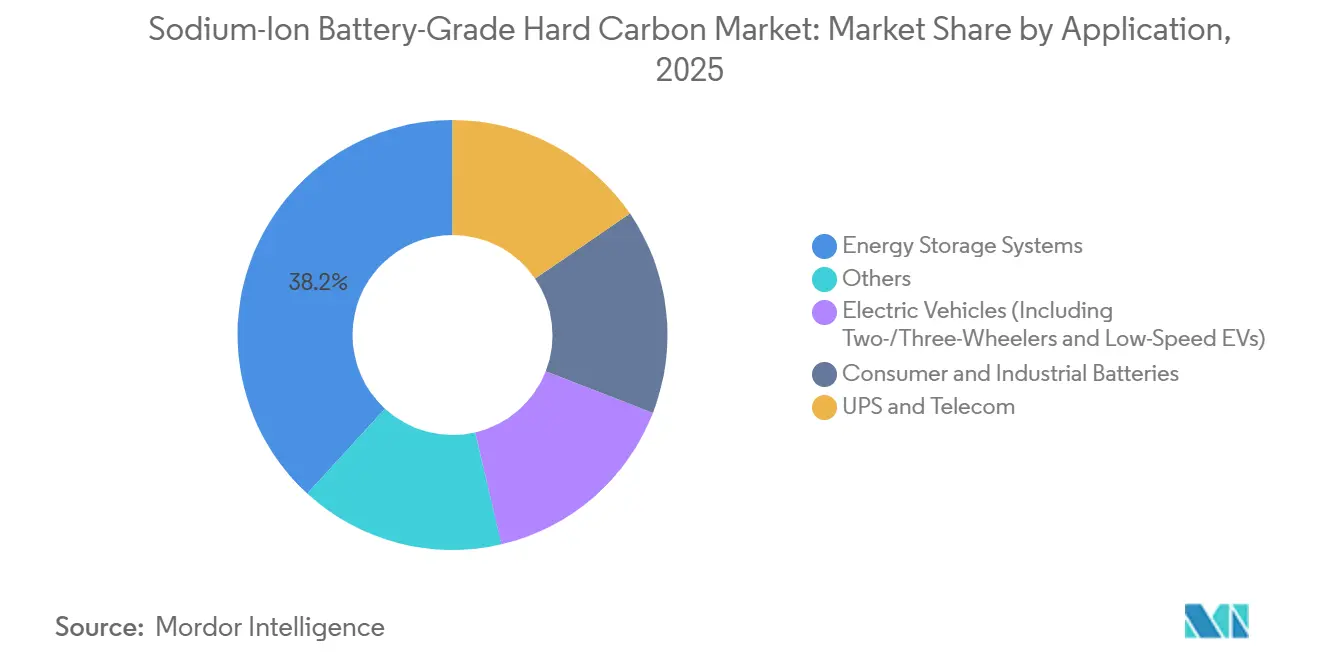
- By application, energy storage systems accounted for 38.19% of the sodium-ion battery-grade hard carbon market share in 2025, while electric vehicles are forecast to advance at a 33.48% CAGR through 2031.
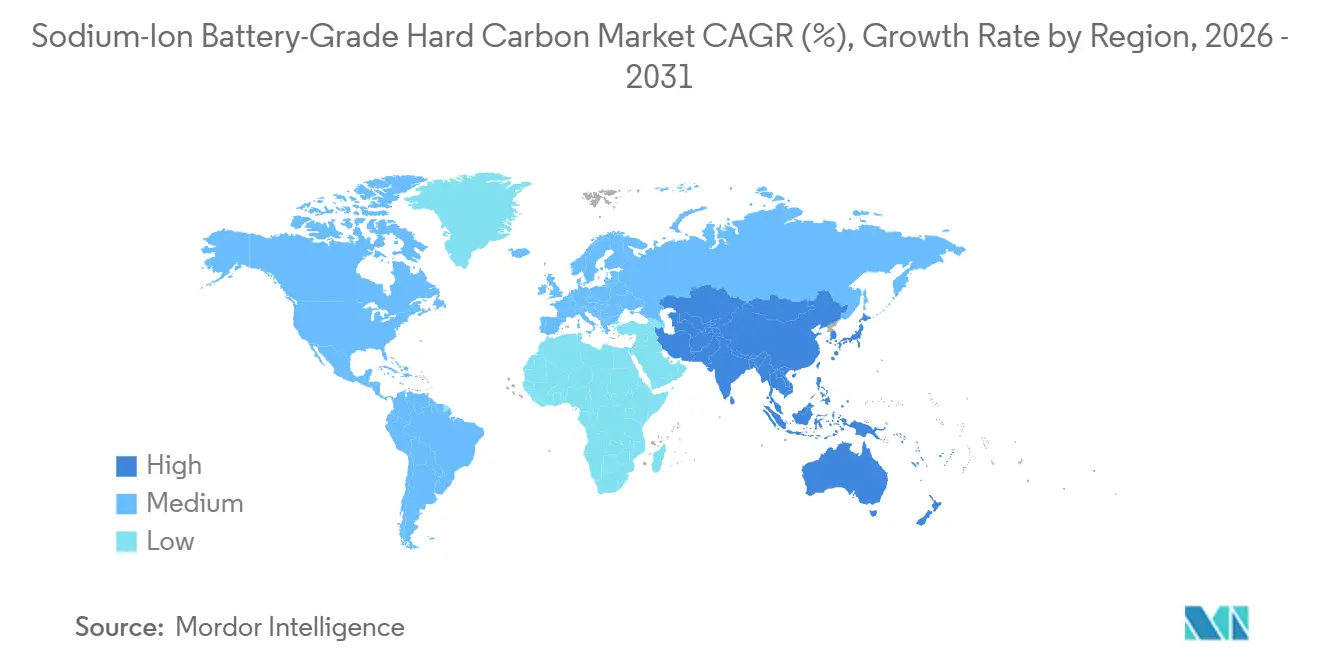
- By geography, Asia-Pacific held 47.34% of the sodium-ion battery-grade hard carbon market share in 2025 and is forecast to grow at a 34.11% CAGR through 2031.
Note: Market size and forecast figures in this report are generated using Mordor Intelligence’s proprietary estimation framework, updated with the latest available data and insights as of January 2026.
Market Trends and Insights
Drivers Impact Analysis of Sodium-Ion Battery-Grade Hard Carbon Market*
| Drivers | (~) % Impact on CAGR Forecast | Geographic Relevance | Impact Timeline |
|---|---|---|---|
| Commercialization of Sodium-Ion Batteries | +9.5% | Global, concentrated in China, South Korea, and India | Short term (≤ 2 years) |
| Demand for Lower-Cost Stationary Energy Storage | +7.2% | APAC core, with growing influence in North America and the EU | Medium term (2-4 years) |
| Abundant and Diversified Sodium-Ion Battery Supply Chains | +5.8% | Global, most immediate in China, with spillover to India and Europe | Medium term (2-4 years) |
| Growth of Cost-Sensitive Electric Mobility | +5.5% | APAC core, including China, India, and ASEAN, with spillover to the Middle-East and Africa (MEA) | Short term (≤ 2 years) |
| Carbon-Footprint Reduction in Anode Material Supply Chains | +3.2% | EU and North America through regulation, Asia through voluntary action | Long term (≥ 4 years) |
| Qualification Advantage of Consistent Hard Carbon Batch Quality | +2.8% | Global, most acute in South Korea and Japan | Medium term (2-4 years) |
| Source: Mordor Intelligence | |||
Commercialization of Sodium-Ion Batteries
The commercialization of sodium-ion batteries is a direct driver of demand for the sodium-ion battery-grade hard carbon market. The International Energy Agency has identified growing momentum in sodium-ion batteries, while noting that the technology still faces manufacturing and performance challenges. CATL introduced its second-generation Naxtra battery in April 2025, raising expectations for materials with more consistent batch quality and improved rate capability. Cell producers increasingly require hard carbon suppliers to meet tighter specifications before material can enter qualified production lines. Approval by a large cell manufacturer can shorten procurement discussions with other buyers, as the supplier has already demonstrated performance under demanding conditions. As sodium-ion batteries move from pilot projects to larger vehicle and stationary storage deployments, the market will require a substantial increase in hard carbon output.
Demand for Lower-Cost Stationary Energy Storage
Stationary energy storage supports demand in the sodium-ion battery-grade hard carbon market, as buyers seek alternatives amid lithium-related price and supply risks. Sodium-ion technology can provide a supply chain option for storage developers that need long-duration assets and want to reduce reliance on critical minerals. Peak Energy delivered a grid-scale sodium-ion battery storage system in the United States in July 2025 and announced commercial activity with utility and independent power producer partners. Storage projects require different anode performance levels depending on expected dispatch patterns and operating life. Energy-oriented grades suit applications that prioritize capacity, while long-cycle grades suit frequent cycling requirements. This distinction is expanding the role of application-specific specifications within hard carbon procurement.
Growth of Cost-Sensitive Electric Mobility
Cost-sensitive electric mobility is widening the addressable demand base for the sodium-ion battery-grade hard carbon market. Two-wheelers, three-wheelers, low-speed vehicles, and selected delivery platforms place greater weight on battery affordability than premium passenger-car segments. Sodium-ion cells can offer a viable alternative when battery cost represents a major portion of the vehicle price. Hard carbon processing temperatures of 1,000°C to 1,500°C are well below graphite processing temperatures of 2,800°C to 3,000°C, supporting lower production energy requirements[1]Council on Energy, Environment and Water, “Are Sodium-Ion Batteries Shaping the Future of Clean Energy in India?,” Council on Energy, Environment and Water, ceew.in. Research on sodium-ion electric vehicle applications found that the chemistry can improve the cost-and-range proposition in selected use cases. These conditions support demand for hard carbon in vehicle platforms where value, local supply, and practical operating range are central purchasing criteria.
Abundant and Diversified Sodium-Ion Battery Supply Chains
The sodium-ion battery supply chain offers material diversity that supports the sodium-ion battery-grade hard carbon market. Sodium can be sourced from salt, seawater, and sedimentary deposits across multiple regions, reducing the concentration risks present in some lithium-based supply chains. Hard carbon can also be produced from biomass, pitch, resins, coal-derived materials, and mixed precursor routes. This flexibility reduces dependence on a single feedstock, although each route has different quality, scale, and qualification characteristics. The International Renewable Energy Agency (IRENA) identified the scale-up of hard carbon manufacturing as a key requirement for sodium-ion batteries. Resin-derived material can offer stronger batch consistency, while biomass routes can support feedstock diversification and lower-carbon sourcing.
Restraints Impact Analysis of Sodium-Ion Battery-Grade Hard Carbon Market*
| Restraints | (~) % Impact on CAGR Forecast | Geographic Relevance | Impact Timeline |
|---|---|---|---|
| Low Initial Coulombic Efficiency and Pre-Sodiation Requirements | -1.8% | Global, most acute in South Korea and Japan, where cell makers apply strict performance thresholds | Medium term (2-4 years) |
| Feedstock Variability in Biomass-Derived Hard Carbon | -1.4% | Global, most impactful in China, where biomass routes dominate production | Short term (≤ 2 years) |
| Limited Commercial-Scale Qualification Capacity | -0.8% | North America and the EU, where approved supplier lists remain thin | Medium term (2-4 years) |
| Competition for Improving Lithium-Ion Anode Materials | -0.6% | Global | Long term (≥ 4 years) |
| Source: Mordor Intelligence | |||
Low Initial Coulombic Efficiency and Pre-Sodiation Requirements
Initial Coulombic efficiency remains a material constraint for the sodium-ion battery-grade hard carbon market. Early commercial hard carbon materials showed initial Coulombic efficiency as low as 17%, while interface modification methods have raised performance to 82% in laboratory work[2]Authors, “Improved Hard Carbon Anodes for Na-Ion Batteries by Interface Modification,” ECS Meeting Abstracts, iopscience.iop.org. Research on aryl-sodium pre-sodiation has reported pathways toward near-100% initial Coulombic efficiency within 60 seconds, but maintaining accurate pre-sodiation at industrial throughput remains difficult. Chemical vapor deposition, pre-sodiation, and heteroatom doping can improve performance but increase process control requirements. These steps can raise manufacturing costs and reduce part of the price advantage available from sodium-ion chemistry. Cost-focused applications may accept lower efficiency, while demanding storage and vehicle applications require premium grades with stronger first-cycle performance.
Feedstock Variability in Biomass-Derived Hard Carbon
Feedstock variability constrains the sodium-ion battery-grade hard carbon market because reproducibility is essential for cell qualification. Biomass composition varies by crop type, region, season, and post-harvest handling, which can affect the resulting carbon structure. Carbonization conditions must be carefully controlled because changes in temperature, porosity, defect concentration, and interlayer spacing affect electrochemical behavior. A 2024 life-cycle assessment found that production at an industrial scale introduced methane emissions and acid use that were less prominent at the laboratory scale. These scale-up factors affect both cost and environmental compliance. Cell manufacturers may need to repeat validation when commercial-scale material differs from the development-stage batches used during initial testing.
*Our forecasts treat driver/restraint impacts as directional, not additive. The impact forecasts reflect baseline growth, mix effects, and variable interactions.
Sodium-Ion Battery-Grade Hard Carbon Market Segment Analysis
By Feedstock:
Biomass Feedstocks Lead on Both Share and Growth RateBiomass-based hard carbon held 40.56% of the sodium-ion battery-grade hard carbon market share in 2025 and is forecast to grow at a 34.27% CAGR through 2031. Bamboo, coconut shells, rice husks, and crop residues offer geographically distributed precursor options and can support localized sourcing where agricultural residues are already collected at scale. These feedstocks align with procurement programs aimed at reducing life-cycle carbon emissions, although their composition requires careful process management. A 2026 Green Chemistry study reported that cellulose-based hard carbon produced via carbonization and graphitization exhibited a reversible capacity of 320.38 mAh/g and retained 88.15% of its capacity after 1,000 cycles at high current density. These results indicate that biomass-derived materials can meet demanding performance requirements when precursor treatment and processing are controlled.
Pitch-based materials offer tighter microstructural consistency, while resin-based routes can provide high carbonization yields and particle shapes suited to automated electrode coating. Chinese producers initially relied on imported coconut shells but have since considered domestic alternatives, as tropical biomass alone cannot meet the required scale. A 2025 Science China Chemistry study found that optimized phenolic resin hard carbon achieved 92.2% initial coulombic efficiency and a reversible capacity of 324.4 mAh/g. Petroleum coke, biochar, and mixed-precursor composites remain smaller routes but offer additional options where industrial supply is more reliable. The sodium-ion battery-grade hard carbon market is not moving toward a single universal precursor, as supply security, quality, and carbon characteristics vary by route.



By Process Type:
Carbonization Leads by Output While Surface Modification Commands Premium PricingCarbonization and pyrolysis accounted for 56.41% of the sodium-ion battery-grade hard carbon market share in 2025. This position reflects established industrial infrastructure and the relative simplicity of converting organic precursors into turbostratic carbon. Processing generally occurs between 1,000°C and 1,500°C, with heating rate, dwell time, and atmosphere influencing pore structure and interlayer spacing. These parameters govern sodium storage behavior, while activation creates additional surface sites for applications that prioritize discharge rate over capacity. The process remains central to production because it accommodates a broad range of precursor materials.
Surface modification is forecast to grow at a 33.51% CAGR through 2031, making it the fastest-growing process segment in the sodium-ion battery-grade hard carbon market. Coating, doping, and pre-sodiation-compatible processing address higher initial coulombic efficiency and lower irreversible capacity loss. A 2025 RSC Advances study reported that nitrogen-doped hard carbon produced via ammonia-modified carbonization achieved an initial coulombic efficiency of 81.81% and a first-cycle discharge capacity of 373.3 mAh/g. The study described sodium storage through adsorption, intercalation, and pore filling. Modified material can command premiums over standard carbonized grades when cell makers require specific performance profiles.
By Grade:
Energy-Oriented Grade Anchors Revenues While Long-Cycle Demand Reflects Grid Storage MaturityEnergy-oriented material held 42.67% of the sodium-ion battery-grade hard carbon market share in 2025. The grade supports energy storage systems and standard electric vehicle platforms that prioritize capacity per unit of anode material. It can meet broad use requirements without the narrower specification limits of specialty grades, and buyers can procure it at a commercial scale with repeatable quality. This breadth of application explains its leading revenue position in the sodium-ion battery-grade hard carbon market.
Long-cycle grade is forecast to grow at a 32.95% CAGR through 2031. Utility-scale storage operators require materials capable of supporting 6,000 or more charge-discharge cycles over a 15- to 20-year service period. The International Renewable Energy Agency (IRENA) noted that the maturity of hard carbon production and manufacturing remains a key constraint on sodium-ion batteries, particularly for higher-performance grades. Power-oriented material is used for high-discharge applications, while other grades include low-temperature products for cold-climate applications. Portfolio breadth will increasingly shape supplier positioning, as no single performance profile meets every application requirement.
By Application:
Energy Storage Systems Drive Demand While EV Adoption Reshapes ProjectionsEnergy storage systems held 38.19% of the sodium-ion battery-grade hard carbon market share in 2025. Grid storage applications value material cost, supply security, cycle life, and safety, and sodium-ion batteries offer a lithium-independent sourcing option. Large installations can prioritize energy-oriented material, while high-frequency sites require long-cycle performance. Consumer and industrial batteries, uninterruptible power supplies, and telecom backup equipment represent smaller but steadier purchasing patterns. These applications can support hard carbon factory utilization during uneven storage or vehicle ordering cycles.
Electric vehicles are forecast to grow at a 33.48% CAGR through 2031, making them the fastest-growing application segment in the sodium-ion battery-grade hard carbon market. The main opportunity lies in two- and three-wheelers, low-speed vehicles, and delivery fleets, where battery prices are a significant barrier to adoption. Research published in the Journal of Cleaner Production identified useful sodium-ion applications in electric vehicles, particularly in settings where cost and operating range are key considerations. Each GWh of vehicle cell capacity requires a substantial quantity of anode material, creating a direct link between cell manufacturing and hard carbon demand. Growth will depend on cell cost, charging performance, and the availability of qualified materials.
Geography Analysis
APAC Sodium-Ion Battery-Grade Hard Carbon Market
Asia-Pacific held 47.34% of the sodium-ion battery-grade hard carbon market share in 2025 and is forecast to grow at a 34.11% CAGR through 2031. China integrates battery manufacturing, carbonization capacity, precursor processing, and cell assembly within a single supply chain. This structure supports lower logistics costs, faster supplier collaboration, and strong demand from stationary storage and cost-sensitive electric mobility applications. Japan contributes technical capability in consistent microstructural quality and established qualification relationships with cell manufacturers. South Korea is also developing its materials base to address sodium-ion battery opportunities.
India and APAC Sodium-Ion Battery-Grade Hard Carbon Market
Asia-Pacific's position is supported by its ability to utilize biomass, coal-derived materials, and synthetic resins as feedstocks. The sodium-ion battery-grade hard carbon market in the region benefits from established battery infrastructure and policy support for local supply chains. India holds agricultural residues, including rice husks, crop stubble, and bamboo, that could help meet domestic demand for precursors. Lower processing temperatures compared to graphite are relevant where energy costs affect anode economics. Feedstock collection, material consistency, and qualification capacity will determine how quickly new regional suppliers can scale.
The Americas and EMEA Sodium-Ion Battery-Grade Hard Carbon Market
North America and Europe currently represent lower output but may develop into higher-value markets for traceable and lower-carbon hard carbon. Peak Energy's 2025 delivery of grid-scale systems in the United States demonstrated commercial interest in sodium-ion storage. European buyers face carbon-footprint disclosure requirements that favor documented data on precursor origins and lifecycles. South America, the Middle-East, and Africa represent early-stage demand, though agricultural residues, renewable energy deployment, and energy-transition programs could support future stationary-storage applications.

Competitive Landscape
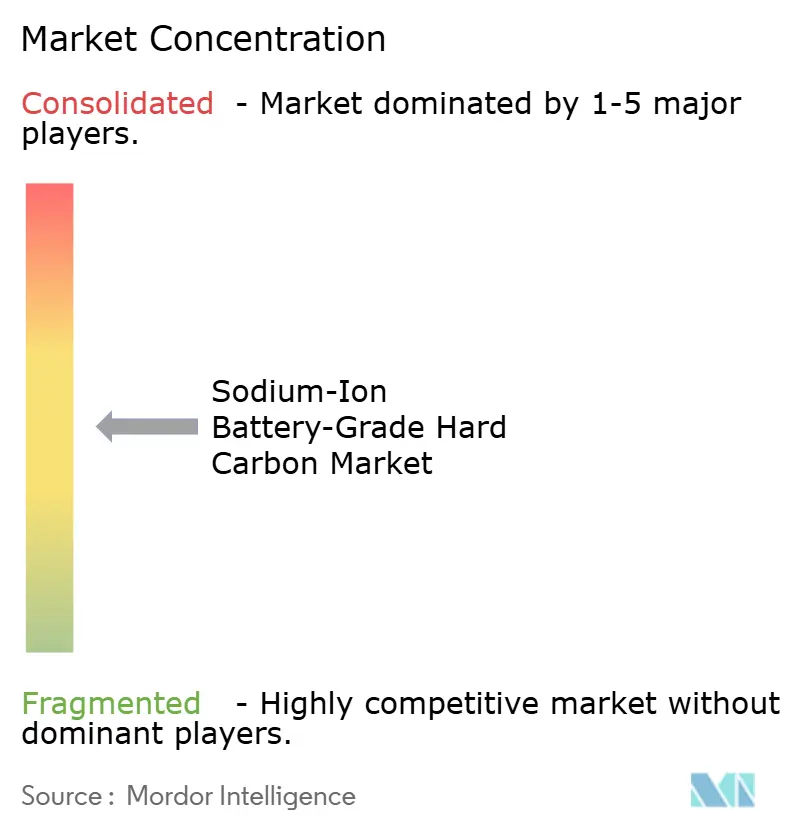
The sodium-ion battery-grade hard carbon market is moderately fragmented. Chinese suppliers, including BTR New Material Group, Putailai New Materials Technology, and Shengquan Group, compete on production scale, process capacity, feedstock diversification, and proximity to cell manufacturers. Japanese suppliers KURARAY and KUREHA maintain consistent microstructural quality and established cell-maker qualification relationships. The market remains difficult for new suppliers to enter, as material approval can require 12 to 24 months of cell- and pack-level testing. This qualification timeline protects incumbent suppliers even when new producers offer competitive costs.
Technology competition centers on surface modification, presodiation compatibility, and closed-pore engineering. Interface modification has improved hard carbon performance in laboratory settings, including initial coulombic efficiency and stable sodium storage capacity. KURARAY's biomass-derived KURANODE material and KUREHA's pitch-based routes represent differentiated precursor and processing approaches. CATL's second-generation Naxtra battery, introduced in 2025, increased demand for material consistency and rate capability across the supplier base. Peak Energy's July 2025 grid-scale deployment provided a commercial reference point for sodium-ion storage in the United States.
European and North American supply chains present an opportunity for producers that can supply traceable, biomass-derived material with verified lifecycle data. Documentation and batch traceability are increasingly relevant alongside cost and electrochemical performance. Resin suppliers may have a route into the value chain, as resin-based precursors can provide more consistent material than variable biomass inputs. The sodium-ion battery-grade hard carbon market will remain differentiated by cost position, feedstock security, qualification status, and ability to deliver commercial-scale consistency.
Sodium-Ion Battery-Grade Hard Carbon Industry Leaders
KURARAY CO., LTD.
JFE Chemical Corporation
KUREHA CORPORATION
HiNa Battery Technology Co., Ltd
BTR New Material Group Co., Ltd.
- *Disclaimer: Major Players sorted in no particular order
Sodium-Ion Battery-Grade Hard Carbon Market Companies Covered in this Report
- Aekyung Chemical Co., Ltd.
- BTR New Material Group Co., Ltd.
- Fujian Yuanli Active Carbon Co., Ltd.
- HiNa Battery Technology Co., Ltd
- Hunan Zhongke Shinzoom Technology Co., Ltd.
- JFE Chemical Corporation
- Jiangxi Zeto New Energy Technology Co., Ltd.
- KURARAY CO., LTD.
- KUREHA CORPORATION
- Ningbo Ronbay New Energy Technology Co., Ltd.
- Putailai New Materials Technology Co., Ltd.
- Shanghai PTL New Energy Technology Co.,Ltd.
- SHENGQUAN GROUP
- Shenzhen XFH Technology Co., Ltd.
- Sumitomo Bakelite Co., Ltd.

Recent Industry Developments in Sodium-Ion Battery-Grade Hard Carbon Market
- September 2025: Phenogy (Switzerland) commissioned a 400 kW/1 MWh sodium-ion battery installation near Bremen Airport. The deployment marked the company's entry into the European energy storage market and served as a proof point for sodium-ion technology in European commercial and industrial applications. The system operated in island mode paired with a 50 kW solar array.
- May 2025: Shengquan Group (China, 605589.SH) completed construction of a 10,000 mt-scale bio-based hard carbon anode production line, with its porous carbon for silicon carbon anodes reaching 2,000 mt per year. Separately, the company announced a 100,000 mt per year hard carbon production project, the largest single disclosed investment in hard carbon anode capacity globally.


Global Sodium-Ion Battery-Grade Hard Carbon Market Report Scope
Battery-grade hard carbon for sodium-ion batteries is a specially processed, high-purity, structurally disordered form of carbon used as the anode (negative electrode). Its expanded, disordered microscopic layers allow large sodium ions to intercalate and de-intercalate efficiently, making it suitable for use in sodium-ion batteries.
The sodium-ion battery-grade hard carbon market is segmented by feedstock, process type, grade, application, and geography. By feedstock, the market is segmented into biomass-based, pitch-based, resin-based, and others. By process type, the market is segmented into carbonization/pyrolysis, activation, surface modification (coating, doping, pre-sodiation compatible processing), and others. By grade, the market is segmented into energy-oriented grade, power-oriented grade, long-cycle grade, and others (low-temperature and specialty grades). By application, the market is segmented into energy storage systems, electric vehicles (including two-/three-wheelers and low-speed EVs), consumer and industrial batteries, UPS and telecom, and others. The report also covers market size and forecasts for sodium-ion battery-grade hard carbon across 15 countries in major regions. The market sizes and forecasts are provided in terms of value (USD).
| Biomass-Based |
| Pitch-Based |
| Resin-Based |
| Others |
| Carbonization/Pyrolysis |
| Activation |
| Surface Modification (Coating, Doping, Pre-sodiation Compatible Processing) |
| Others |
| Energy-Oriented Grade |
| Power-Oriented Grade |
| Long-Cycle Grade |
| Others (Low-Temperature and Specialty Grades) |
| Energy Storage Systems |
| Electric Vehicles (Including Two-/Three-Wheelers and Low-Speed EVs) |
| Consumer and Industrial Batteries |
| UPS and Telecom |
| Others |
| Asia-Pacific | China |
| India | |
| Japan | |
| South Korea | |
| ASEAN Countries | |
| Rest of Asia-Pacific | |
| North America | United States |
| Canada | |
| Mexico | |
| Europe | Germany |
| United Kingdom | |
| France | |
| Italy | |
| NORDIC Countries | |
| Rest of Europe | |
| South America | Brazil |
| Argentina | |
| Rest of South America | |
| Middle-East and Africa | Saudi Arabia |
| South Africa | |
| Rest of Middle-East and Africa |
| By Feedstock | Biomass-Based | |
| Pitch-Based | ||
| Resin-Based | ||
| Others | ||
| By Process Type | Carbonization/Pyrolysis | |
| Activation | ||
| Surface Modification (Coating, Doping, Pre-sodiation Compatible Processing) | ||
| Others | ||
| By Grade | Energy-Oriented Grade | |
| Power-Oriented Grade | ||
| Long-Cycle Grade | ||
| Others (Low-Temperature and Specialty Grades) | ||
| By Application | Energy Storage Systems | |
| Electric Vehicles (Including Two-/Three-Wheelers and Low-Speed EVs) | ||
| Consumer and Industrial Batteries | ||
| UPS and Telecom | ||
| Others | ||
| By Geography | Asia-Pacific | China |
| India | ||
| Japan | ||
| South Korea | ||
| ASEAN Countries | ||
| Rest of Asia-Pacific | ||
| North America | United States | |
| Canada | ||
| Mexico | ||
| Europe | Germany | |
| United Kingdom | ||
| France | ||
| Italy | ||
| NORDIC Countries | ||
| Rest of Europe | ||
| South America | Brazil | |
| Argentina | ||
| Rest of South America | ||
| Middle-East and Africa | Saudi Arabia | |
| South Africa | ||
| Rest of Middle-East and Africa | ||


Key Questions Answered in the Report
What is current market size of Sodium-Ion Battery-Grade Hard Carbon Market?
The sodium-ion battery-grade hard carbon market size was valued at USD 81.87 million in 2025 and is estimated to grow from USD 107.62 million in 2026 to reach USD 440.50 million by 2031, at a CAGR of 32.56% during the forecast period (2026-2031).
Why is hard carbon used in sodium-ion batteries?
Hard carbon is commercially viable because graphite lacks sufficient interlayer spacing to accommodate sodium ions.
Which feedstock leads to demand for sodium-ion battery-grade hard carbon?
Biomass-based material led with a 40.56% share in 2025 and is forecast to grow at a 34.27% CAGR through 2031.
Which application is growing fast for hard carbon anodes?
Electric vehicles are the fastest-growing application, with a forecast CAGR of 33.48% through 2031.
Page last updated on:


 Your data is secure and never sold or shared.


