
Sodium Chlorite Market Size and Share
Market Overview
| Study Period | 2022 - 2032 |
|---|---|
| Market Size (2027) | USD 330.70 Million |
| Market Size (2032) | USD 428.95 Million |
| Growth Rate (2027 - 2032) | 5.34 % |
| Fastest Growing Market | Asia-Pacific |
| Largest Market | Asia-Pacific |
| Market Concentration | Medium |
Major Players *Disclaimer: Major Players sorted in no particular order Image © Mordor Intelligence. Reuse requires attribution under CC BY 4.0. | |
Sodium Chlorite Market Analysis by Mordor Intelligence
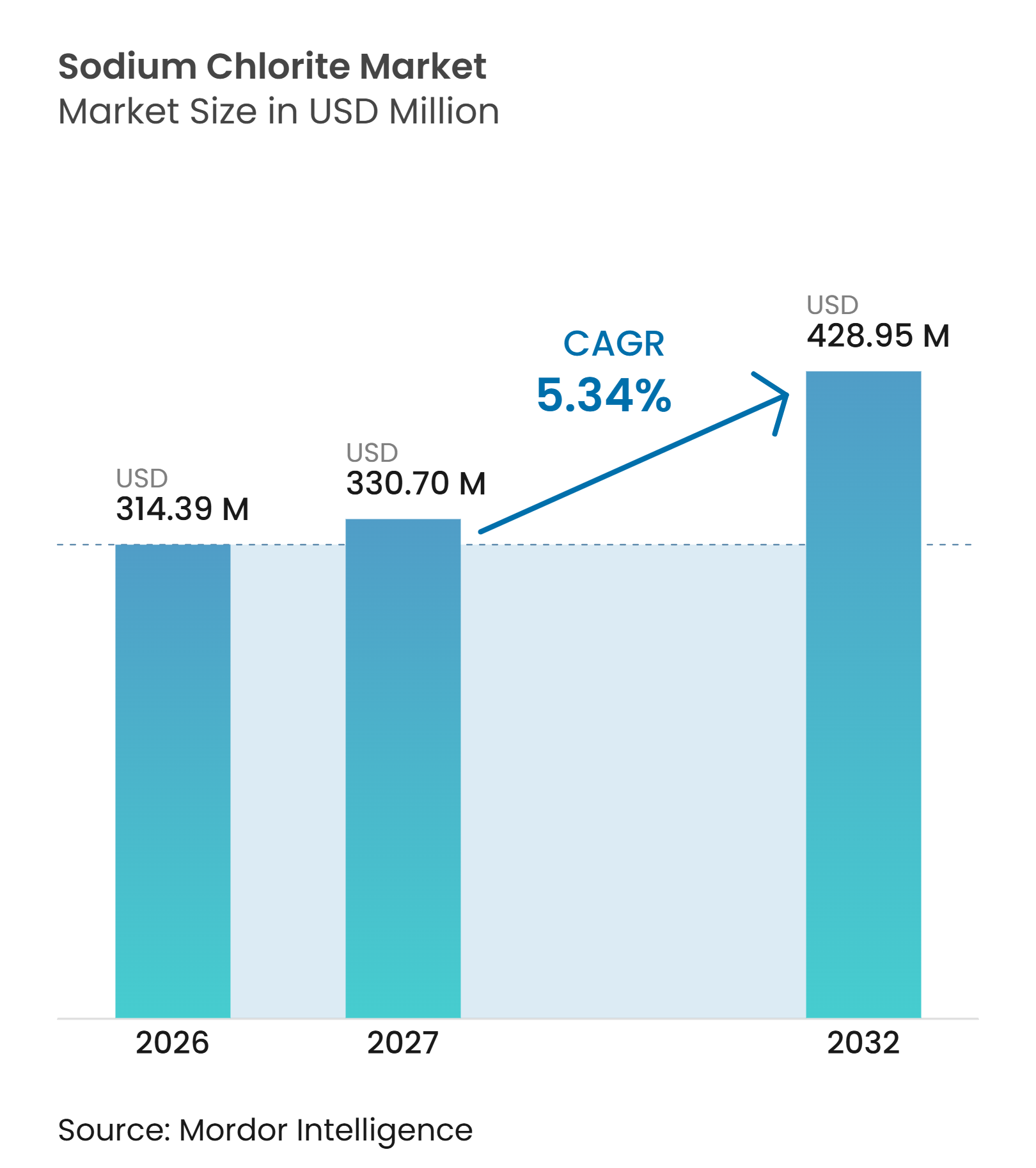
The sodium chlorite market size was valued at USD 314.39 million in 2026 and is estimated to grow from USD 330.70 million in 2027 to reach USD 428.95 million by 2032, at a CAGR of 5.34% during the forecast period (2027-2032). The sodium chlorite market benefits from its role as a transportable precursor for on-site chlorine dioxide generation in water treatment and food processing. This approach avoids transporting chlorine gas and supports facilities that need to manage disinfection requirements at the point of use. Municipal investment, healthcare disinfection requirements, and elemental chlorine-free pulp production support demand across the sodium chlorite market. Certified suppliers have an advantage in regulated applications because buyers need documented purity, traceability, and compliance with drinking-water or biocidal rules. Feedstock availability is also important because sodium chlorate supply disruptions can raise conversion costs for smaller producers.
Key Report Takeaways
- By grade, industrial and technical grade held 59.51% of the sodium chlorite market share in 2026, while pharmaceutical grade is projected to advance at a 6.97% CAGR through 2032.
- By application, disinfectant held 42.34% of the sodium chlorite market share in 2026, while bleaching agent is projected to advance at a 6.29% CAGR through 2032.
- By end-use, water treatment held 54.78% of the sodium chlorite market share in 2026, while pulp and paper is projected to advance at a 7.12% CAGR through 2032.
- By geography, Asia-Pacific held 43.17% of the sodium chlorite market share in 2026 and is projected to advance at a 6.89% CAGR through 2032.
Note: Market numbers in this report are based on Mordor Intelligence's proprietary estimation framework, which combines nine months of actuals with Q4 projections for base year 2026.
Market Trends and Insights
Drivers Impact Analysis of Sodium Chlorite Market*
| Driver | (~) % Impact on CAGR Forecast | Geographic Relevance | Impact Timeline |
|---|---|---|---|
| Municipal Water Disinfection and Reuse Investment | +2.1% | Global, led by APAC and North America | Medium term (2-4 years) |
| Disinfection-By-Product Compliance and Chlorine Dioxide Conversion | +1.3% | North America and EU | Short term (≤ 2 years) |
| Healthcare Reprocessing and High-Purity Disinfection Demand | +0.8% | Global, led by APAC and North America | Long term (≥ 4 years) |
| Elemental Chlorine-Free Pulp and Paper Processes | +0.6% | South America and Southeast Asia | Medium term (2-4 years) |
| On-Site Generation and Automated Dosing Adoption | +0.4% | Global | Short term (≤ 2 years) |
| Source: Mordor Intelligence | |||
Municipal Water Disinfection and Reuse Investment
Investment in potable-water treatment supports the sodium chlorite market because the material is used to generate chlorine dioxide on site. Chlorine dioxide can be selected where utilities need an alternative to free chlorine in water with elevated natural organic matter. Occidental Chemical Corporation states that its technical sodium chlorite meets NSF/ANSI Standard 60 at a maximum use level of 22 mg/L for chlorine dioxide production. Modular on-site systems can be added without extensive plant redesign, which allows utilities to expand capacity in smaller increments. Sodium chlorite solutions can also be transported to locations that lack chlorine pipelines or bulk-gas infrastructure. These conditions support longer supply relationships with certified producers in municipal and industrial water treatment.
Disinfection-By-Product Compliance and Chlorine Dioxide Conversion
Compliance requirements encourage utilities to consider chlorine dioxide systems that use sodium chlorite as a feedstock. The U.S. Environmental Protection Agency sets a maximum contaminant level of 1.0 mg/L for chlorite and a maximum residual disinfectant level of 0.8 mg/L for chlorine dioxide under the drinking-water framework[1]. Utilities changing their primary disinfection process must control chlorite and chlorate formation while maintaining treatment performance. The World Health Organization sets a provisional chlorite guideline of 0.7 mg/L and states that difficulty in meeting this value should not compromise adequate disinfection. Suppliers that provide batch records and consistent feedstock quality can be more closely specified in utility procurement. This favors documented, higher-purity supply over unverified commodity material in the sodium chlorite market.
Elemental Chlorine-Free Pulp and Paper Processes
The sodium chlorite market also receives support from elemental chlorine-free pulp processes and smaller chlorine dioxide generation units. Pulp and paper is projected to advance at a 7.12% CAGR through 2032, the highest rate among the reported end-use categories. Nouryon agreed in August 2025 to supply sodium chlorate and chlorine dioxide solutions for Arauco’s new USD 4.6 billion pulp mill in Mato Grosso do Sul, Brazil[2]. The planned integrated facility is expected to increase Nouryon’s South American sodium chlorate capacity by 20% and its global capacity by nearly 10%. Kemira Oyj introduced a digital chlorine dioxide optimization platform for pulp mills and gained initial customers in North America, Poland, and Finland during 2025. Digital dosing support adds a service component to chemical supply and can strengthen supplier relationships with pulp customers in the sodium chlorite market.
Healthcare Reprocessing and High-Purity Disinfection Demand
Healthcare reprocessing supports demand for pharmaceutical-grade sodium chlorite used in chlorine dioxide systems. Pharmaceutical grade is projected to advance at a 6.97% CAGR through 2032, the fastest rate among the listed grades. Endoscope reprocessing, surgical instrument disinfection, and central sterile-processing operations require consistent chemical performance and documented product quality. OSAKA SODA produces sodium chlorite in industrial and food-additive grades through an integrated manufacturing chain, and its fact book identifies the company as the leading global supplier. Healthcare procurement places value on certificates of analysis and validated manufacturing systems. These requirements limit the role of suppliers that cannot provide traceability or compliance documentation in the sodium chlorite market.
Restraints Impact Analysis of Sodium Chlorite Market*
| Restraint | (~) % Impact on CAGR Forecast | Geographic Relevance | Impact Timeline |
|---|---|---|---|
| Hazardous-Material Handling, Storage, and Transport Requirements | -1.5% | Global | Long term (≥ 4 years) |
| Sodium Chlorate Competition in Large Kraft Mills | -0.8% | North America, Brazil, Nordics | Medium term (2-4 years) |
| Chlorite and Chlorate By-Product Control Burden | -0.5% | North America and EU | Medium term (2-4 years) |
| Source: Mordor Intelligence | |||
Hazardous-Material Handling, Storage, and Transport Requirements
Hazardous-material handling requirements can increase the delivered cost of sodium chlorite for smaller buyers. The product requires controlled packaging, documentation, and trained handling during storage and transport. These requirements can be particularly significant where customers cannot purchase at bulk-tanker volumes. The resulting logistics cost can make hydrogen peroxide or sodium hypochlorite more attractive for applications that do not require chlorine dioxide chemistry. Cost-sensitive distributors may therefore limit their sodium chlorite offering to established customers with predictable demand. The restraint is strongest in applications where the technical benefit does not offset the compliance and logistics burden.
Sodium Chlorate Competition in Large Kraft Mills
Sodium chlorate-based chlorine dioxide generation remains more economical for large kraft mills than sodium chlorite activation. Chemtrade Logistics Inc. reported 273,000 metric tons of sodium chlorate shipments in 2025 from its Brandon facility, which it identifies as the largest single sodium chlorate plant in North America. The company reported USD 507.4 million in adjusted earnings before interest, taxes, depreciation, and amortization for 2025, supported in part by stronger sodium chlorate prices and volumes. Large mills favor lower reagent costs where chemical and energy expenses have a material effect on operations. This limits sodium chlorite use in the largest pulp facilities and directs demand toward smaller mills, municipal systems, and specialty applications. The sodium chlorite market therefore faces a structural limit in the largest elemental chlorine-free bleaching operations.
*Our forecasts treat driver/restraint impacts as directional, not additive. The impact forecasts reflect baseline growth, mix effects, and variable interactions.
Sodium Chlorite Market Segment Analysis
By Grade:
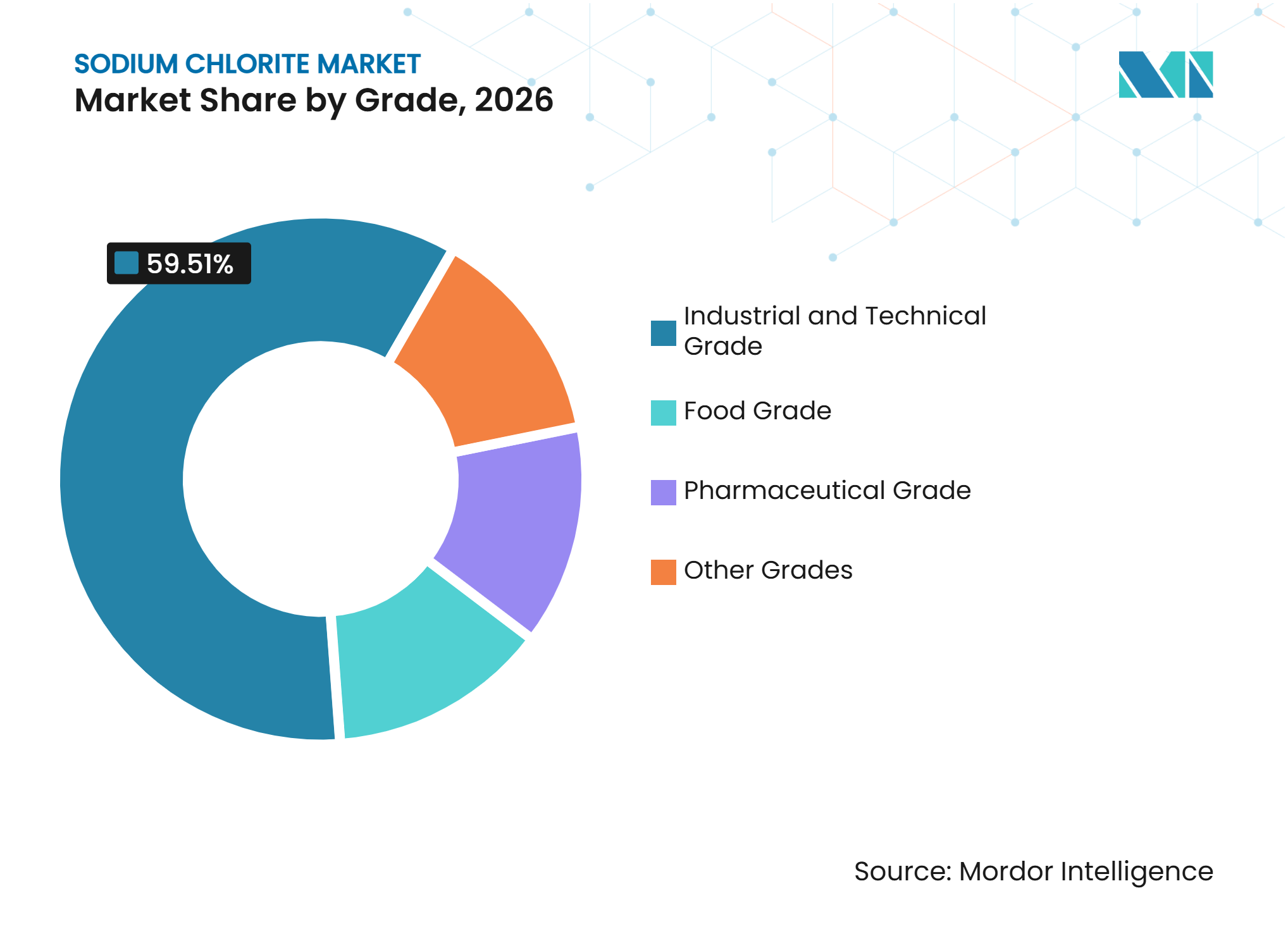
Industrial and Technical Grade Anchor Revenue, Pharmaceutical Grade Leads Value GrowthIndustrial and technical grade held 59.51% of the market share in 2026. This portion of the sodium chlorite industry serves bulk water treatment, textile bleaching, and industrial disinfection uses. Buyers in these applications typically require dependable supply and competitive delivered costs rather than the highest purity profile. Municipal utilities and textile manufacturers often purchase high volumes under supply agreements with domestic producers or export-focused manufacturers. Food grade sits between industrial and pharmaceutical material because it serves applications governed by food-contact requirements. The U.S. Food and Drug Administration permits acidified sodium chlorite for specified uses on meat, poultry, seafood, and produce. This pathway gives food-grade suppliers defined application requirements that are less relevant to industrial grade. Other grades, including laboratory and electronics material, contribute smaller but stable demand through certified reagent suppliers.
Pharmaceutical grade is projected to advance at a 6.97% CAGR through 2032 as healthcare and medical-device reprocessing facilities seek material with validated purity. These buyers need robust documentation, including certificates of analysis and quality-system records. This grade has an entry barrier because suppliers must support pharmacopeia-related specifications and validated production processes. Thermo Fisher Scientific lists sodium chlorite products for laboratory and analytical uses and provides batch-specific documentation. The higher specification requirement can support a premium over material used in large-volume industrial uses. It also makes the grade less exposed to direct price competition from basic industrial supply. Healthcare procurement and laboratory research create demand for controlled quality rather than simple volume availability.



By Application:
Disinfectant Demand Remains the Largest Use, While Bleaching Agent AcceleratesDisinfectant accounted for 42.34% of the market share in 2026. Sodium chlorite is used to generate chlorine dioxide for potable-water treatment, food-processing sanitation, and healthcare surface disinfection. ERCO WORLDWIDE combines chemical supply with on-site generation capabilities through its sodium chlorite business and International Dioxcide platform. This type of arrangement places the chemical inside a broader treatment program rather than selling it as a standalone input. Food and poultry processors also use chlorine dioxide systems where sanitation programs require controlled antimicrobial performance. The U.S. Food and Drug Administration regulates acidified sodium chlorite under specific food-use conditions. These rules make product specification and application guidance important parts of supplier selection.
The bleaching agent market is projected to grow at a 6.29% CAGR through 2032. Growth reflects elemental chlorine-free pulp capacity additions in Brazil and Southeast Asia, where smaller chlorine dioxide generation systems require chemical supply. Airedale Chemical Company Limited supplies sodium chlorite solutions in the United Kingdom and Europe for functional chemical uses. In Europe, the Biocidal Products Regulation affects sodium chlorite formulations sold for disinfectant uses. Compliance requirements make it harder for unregistered material to serve regulated disinfection applications. Antimicrobial uses in food processing, aquaculture, and agriculture add to the application base where chlorine dioxide chemistry is appropriate. Supplier differentiation depends on registration, technical support, and the ability to manage varied end-use requirements.
By End-Use:
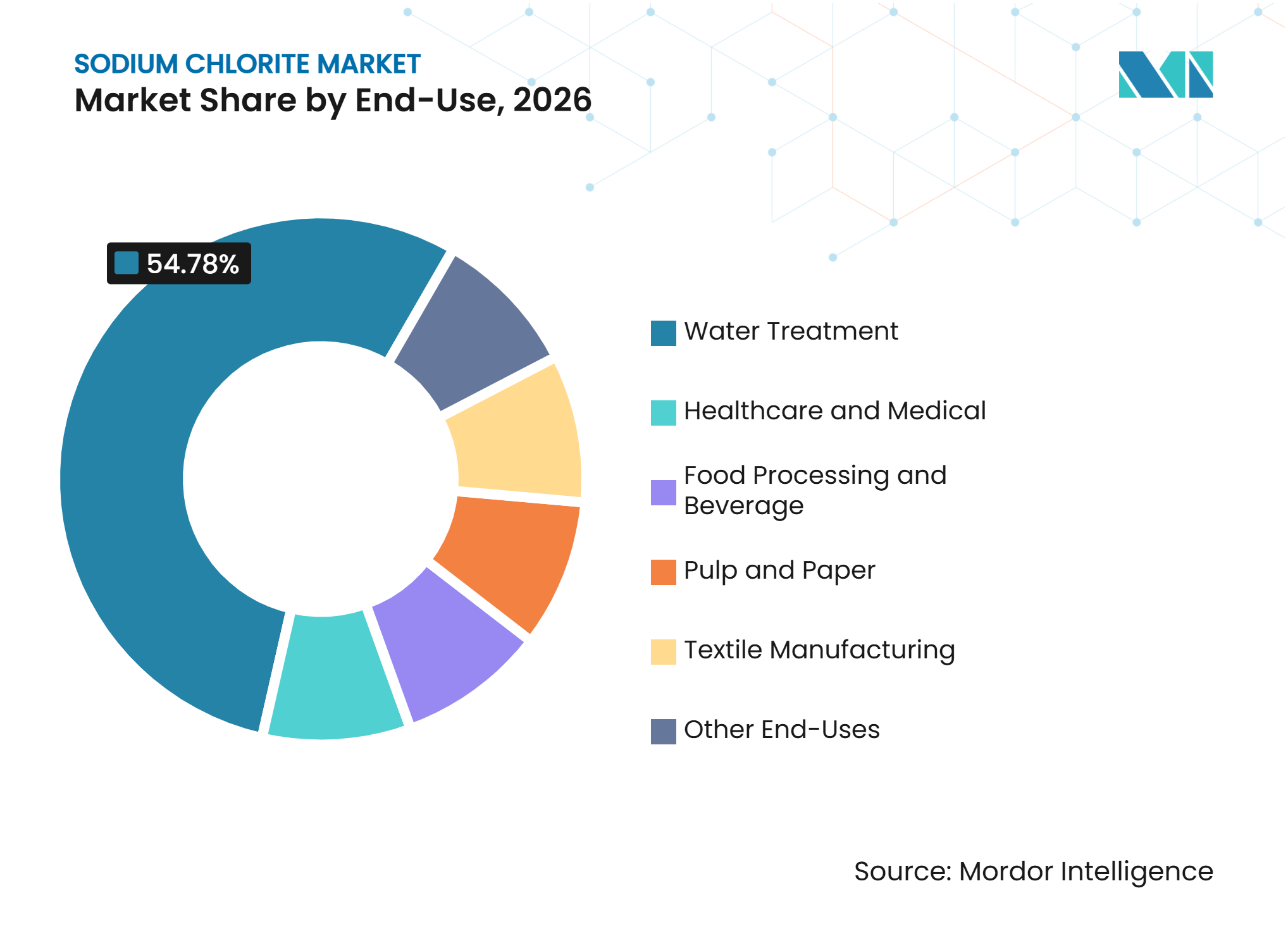
Water Treatment Provides the Largest Revenue Base, While Pulp and Paper ExpandsWater treatment held 54.78% of the market share in 2026. Public water systems use sodium chlorite as a precursor for chlorine dioxide where the treatment program requires this disinfection approach. The U.S. Environmental Protection Agency identifies sodium chlorite as a chemical used in drinking-water treatment and notes the role of certified supply chains in this application. National Sanitation Foundation/American National Standards Institute (NSF/ANSI) Standard 60 certification is relevant to chemical products supplied for drinking-water treatment. Water utilities favor stable supply, quality records, and dosing support because residual control affects daily plant operation. Textile manufacturing also uses sodium chlorite where bright whitening and fiber protection are required for specific fabric finishing processes. Food processing and beverage uses remain steady because food-contact rules define the permitted operating conditions.
Pulp and paper is projected to advance at a 7.12% CAGR through 2032, supported by new elemental chlorine-free capacity in Brazil and Southeast Asia. Nouryon opened an integrated manufacturing site in Ribas do Rio Pardo, Brazil, in February 2025 to supply hydrogen peroxide, sodium chlorate, and chlorine dioxide from a single location. Healthcare and medical uses also expand as facilities strengthen infection-control procedures and require consistent material quality. Relevant equipment standards include International Organization for Standardization (ISO) 14971 for medical-device risk management and ISO 15883 for washer-disinfectors. Smaller point-of-use water-treatment systems offer another route to demand in emerging economies as dosing equipment becomes more accessible. These use cases reinforce the importance of compact generation systems and distributor support. The sodium chlorite market combines a stable water-treatment base with faster demand from pulp, healthcare, and specialized disinfection programs.

Geography Analysis
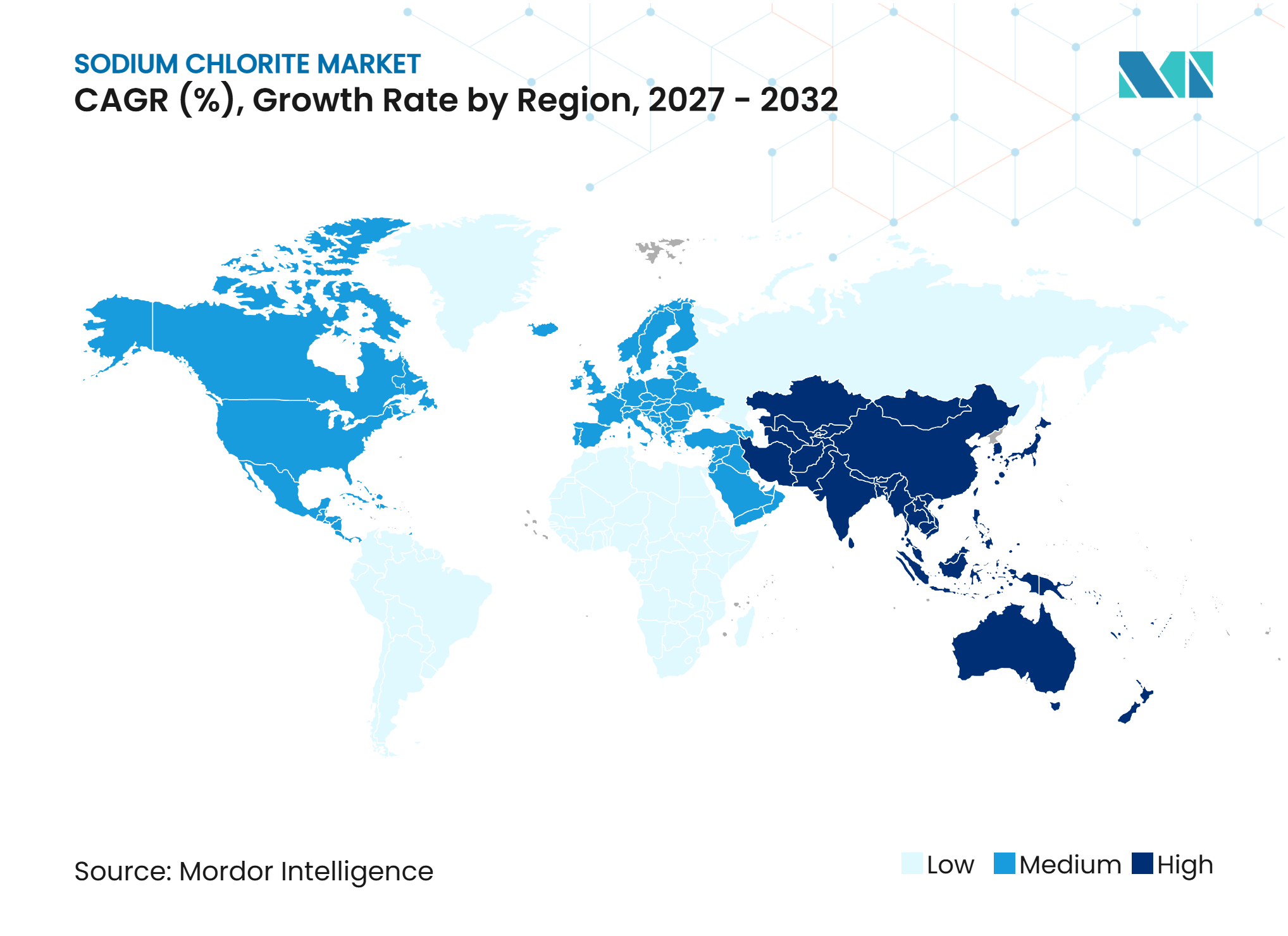
Asia-Pacific: Combined Scale and Growth Support Regional Demand
Asia-Pacific held 43.17% of the market share in 2026 and is projected to advance at a 6.89% CAGR through 2032. Shandong Gaomi Gaoyuan Chemical Industry Co., Ltd. reports 85,000 metric tons of annual sodium chlorite capacity, including 10,000 metric tons of solid material and 75,000 metric tons of liquid material. OSAKA SODA supplies sodium chlorite through its basic chemicals business and identifies the product as part of its integrated chlor-alkali portfolio. Water-infrastructure investment, healthcare disinfection requirements, and pulp capacity additions support the sodium chlorite market across China, India, Southeast Asia, and Japan.
North America: Drinking-Water Requirements Support Certified Supply
North America relies on compliance-focused demand from water utilities, food processors, and industrial treatment providers. The U.S. Environmental Protection Agency requires utilities that use chlorine dioxide to comply with the chlorite maximum contaminant level of 1.0 mg/L. Occidental Chemical Corporation identifies sodium chlorite as a product of its Wichita, Kansas operation and supplies certified material for water-treatment uses. ERCO WORLDWIDE’s December 2025 closure of its Hargrave sodium chlorate operation tightened the regional feedstock picture for the North American sodium chlorite market.
Europe, South America, and Middle East and Africa: Regulation and Pulp Investment Shape Demand
Europe has mature demand in regulated disinfection and specialty pulp bleaching. Ercros S.A confirmed sodium chlorite production within its chlorine derivatives business in its 2025 annual report. The European Union’s Biocidal Products Regulation remains a key compliance factor for disinfectant formulations. Brazil’s pulp investment supports South American demand, while water scarcity and municipal modernization offer longer-term opportunities for the sodium chlorite market in the Middle East and Africa. South America, and Middle East and Africa depend on local distribution, regulation, and the pace of water or pulp investments.
Competitive Landscape
Market Concentration
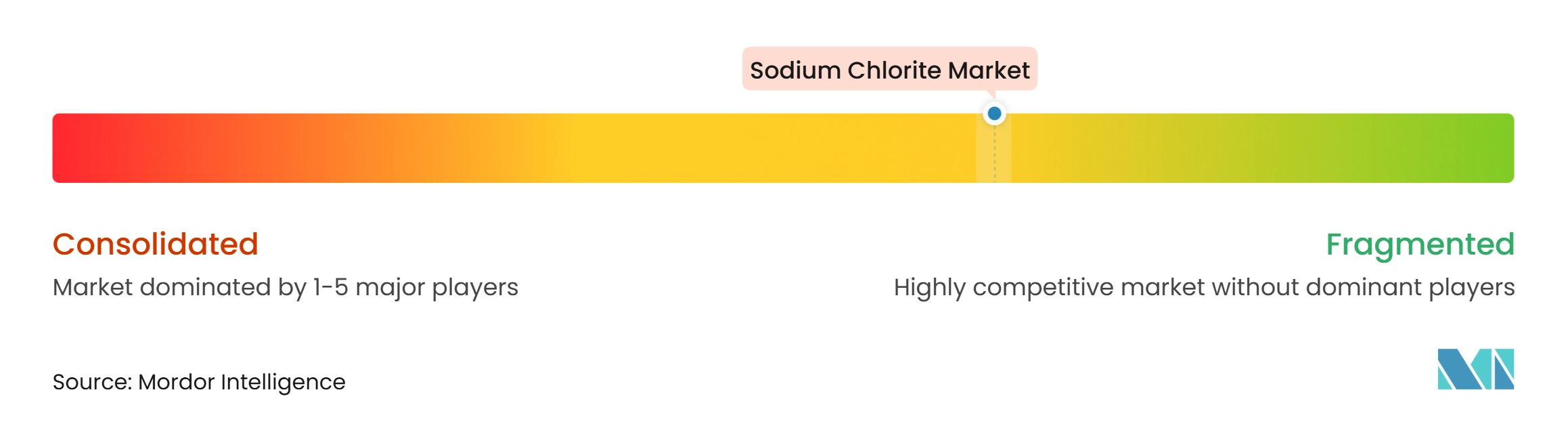
The sodium chlorite market is moderately concentrated, with top players including ERCO Worldwide, Occidental Chemical Corporation, Ercros S.A., Arkema, and OSAKA SODA. OSAKA SODA identifies sodium chlorite as a basic chemical product and reports a leading global position in its fact book. ERCO WORLDWIDE differentiates through chlorine dioxide generation technology and service capability.
Asian manufacturers compete through capacity, export capability, and price for industrial and textile applications. Dongying Shengya Chemical Co., Ltd. lists sodium chlorite solutions within its chemical product portfolio, while Shandong Gaomi Gaoyuan Chemical Industry Co., Ltd. reports production infrastructure that supports large-scale supply. Shree Chlorates offers sodium chlorite and sodium chlorate products for domestic and export customers. These suppliers are positioned in price-sensitive uses, while regulated end uses require specification and documentation review. This distinction shapes supplier selection across the sodium chlorite market.
Consolidation in chlorine derivatives can affect the competitive structure even when transactions involve broader chemical portfolios. Bondalti’s approved acquisition of Ercros S.A adds scale to an Iberian chlorine derivatives platform. Nouryon’s agreement with Arauco expands sodium chlorate capacity in Brazil, and Kemira Oyj’s digital chlorine dioxide platform adds process-optimization services to chemical supply. Airedale Chemical Company Limited and Thermo Fisher Scientific serve specialized distribution and laboratory requirements within their respective channels. The sodium chlorite market remains differentiated by certification status, product grade, regional supply access, and technical support.
Sodium Chlorite Industry Leaders
-
ERCO WORLDWIDE
-
Occidental Chemical Corporation
-
Ercros S.A
-
Arkema
-
OSAKA SODA
- *Disclaimer: Major Players sorted in no particular order
Sodium Chlorite Market Companies Covered in this Report
- Airedale Chemical Company Limited
- Arkema
- Chemtrade Logistics Inc.
- Dongying Shengya Chemical Co., Ltd.
- Ecolab Inc.
- ERCO WORLDWIDE
- Ercros S.A
- Kemira Oyj
- Nouryon
- Occidental Chemical Corporation
- OSAKA SODA
- Shandong Gaomi Gaoyuan Chemical Industry Co., Ltd.
- Shree Chlorates
- Solvay
- Thermo Fisher Scientific
Recent Industry Developments in Sodium Chlorite Market
- August 2026: Mangalore Refinery and Petrochemicals Limited awarded a sodium chlorite procurement contract covering 90,000 kg of material to Chempure Technologies Private Limited. The procurement demonstrates industrial demand for sodium chlorite from India's petroleum and refinery-related sector.
- April 2026: Kutch Chemical Industries Limited outlined an investment program through its subsidiary, Kutch Specialities Private Limited, to establish a 40-metric-ton-per-day sodium chlorite plant alongside a 60-metric-ton-per-day sodium chlorate facility. The approximately INR 250 crore project is scheduled to commence commercial operations in April 2027, adding domestic sodium chlorite manufacturing capacity in India.
Global Sodium Chlorite Market Report Scope
Sodium chlorite is an inorganic chemical compound primarily used as an oxidizing agent and a precursor for generating chlorine dioxide. It offers strong bleaching, disinfecting, and antimicrobial properties, making it suitable for applications requiring effective microbial control and chemical treatment.
The Sodium Chlorite Market is segmented by grade, application, end-use, and geography. By grade, the market is segmented into industrial and technical grade, food grade, pharmaceutical grade, and other grades. By application, the market is segmented into disinfectant, antimicrobial agent, bleaching agent, and other applications. By end-use, the market is segmented into water treatment, pulp and paper, textile manufacturing, healthcare and medical, food processing and beverage, and other end-uses. The report also covers the market size and forecasts for sodium chlorite in 15 countries across major regions. For each segment, the market sizing and forecasts have been done on the basis of value (USD).
Segmentation Overview
| Industrial and Technical Grade |
| Food Grade |
| Pharmaceutical Grade |
| Other Grades |
| Disinfectant |
| Antimicrobial Agent |
| Bleaching Agent |
| Other Applications |
| Water Treatment |
| Pulp and Paper |
| Textile Manufacturing |
| Healthcare and Medical |
| Food Processing and Beverage |
| Other End-Uses |
| Asia-Pacific | China |
| India | |
| Japan | |
| South Korea | |
| ASEAN Countries | |
| Rest of Asia-Pacific | |
| North America | United States |
| Canada | |
| Mexico | |
| Europe | Germany |
| United Kingdom | |
| France | |
| Italy | |
| NORDIC Countries | |
| Rest of Europe | |
| South America | Brazil |
| Argentina | |
| Rest of South America | |
| Middle East and Africa | Saudi Arabia |
| South Africa | |
| Rest of Middle East and Africa |
| By Grade | Industrial and Technical Grade | |
| Food Grade | ||
| Pharmaceutical Grade | ||
| Other Grades | ||
| By Application | Disinfectant | |
| Antimicrobial Agent | ||
| Bleaching Agent | ||
| Other Applications | ||
| By End-Use | Water Treatment | |
| Pulp and Paper | ||
| Textile Manufacturing | ||
| Healthcare and Medical | ||
| Food Processing and Beverage | ||
| Other End-Uses | ||
| By Geography | Asia-Pacific | China |
| India | ||
| Japan | ||
| South Korea | ||
| ASEAN Countries | ||
| Rest of Asia-Pacific | ||
| North America | United States | |
| Canada | ||
| Mexico | ||
| Europe | Germany | |
| United Kingdom | ||
| France | ||
| Italy | ||
| NORDIC Countries | ||
| Rest of Europe | ||
| South America | Brazil | |
| Argentina | ||
| Rest of South America | ||
| Middle East and Africa | Saudi Arabia | |
| South Africa | ||
| Rest of Middle East and Africa | ||
Key Questions Answered in the Report
What is the size of the sodium chlorite market?
The sodium chlorite market size was valued at USD 314.39 million in 2026 and is estimated to grow from USD 330.70 million in 2027 to reach USD 428.95 million by 2032, at a CAGR of 5.34% during the forecast period (2027-2032).
What is driving sodium chlorite demand?
Municipal water disinfection, chlorine dioxide conversion, healthcare reprocessing, pulp bleaching, and on-site dosing systems support demand.
Which grade is projected to grow fastest through 2032?
Pharmaceutical grade is projected to advance at a 6.97% CAGR through 2032, supported by healthcare and laboratory requirements for documented quality.
Which application held the largest share in 2026?
Disinfectant accounted for 42.34% of the market share in 2026 because sodium chlorite is used to generate chlorine dioxide for treatment and sanitation.