
Smoked Cheese Market Size and Share
Market Overview
| Study Period | 2022 - 2032 |
|---|---|
| Market Size (2027) | USD 23.71 Billion |
| Market Size (2032) | USD 31.12 Billion |
| Growth Rate (2027 - 2032) | 5.59 % |
| Fastest Growing Market | Asia-Pacific |
| Largest Market | Europe |
| Market Concentration | Low |
Major Players *Disclaimer: Major Players sorted in no particular order Image © Mordor Intelligence. Reuse requires attribution under CC BY 4.0. | |
Smoked Cheese Market Analysis by Mordor Intelligence
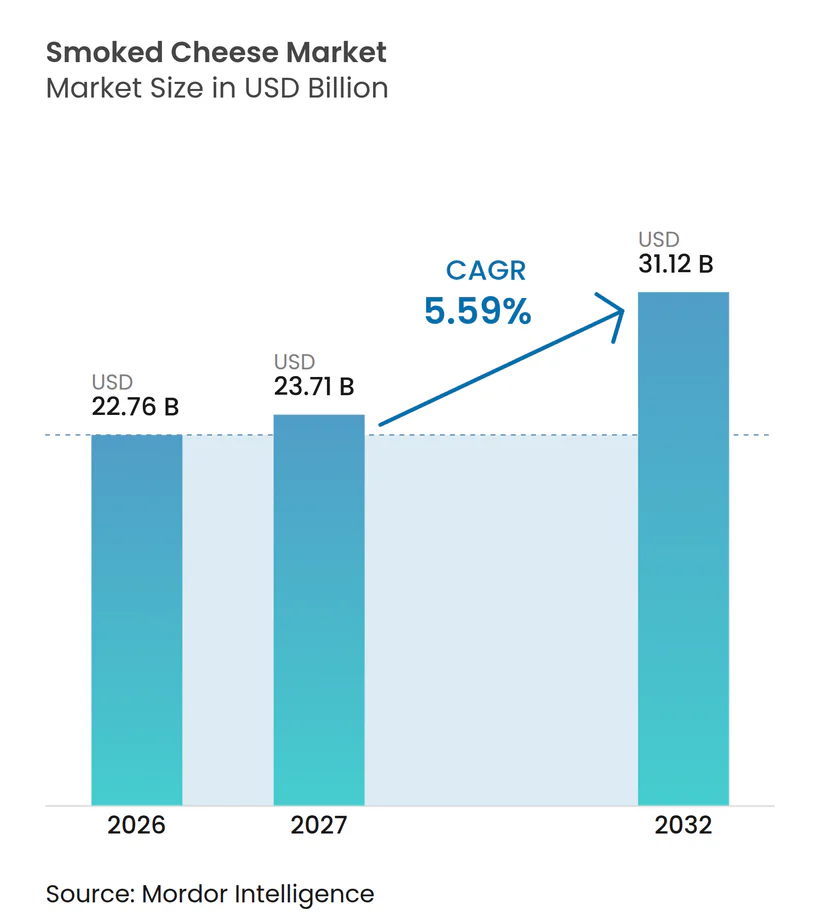
The smoked cheese market size is expected to grow from USD 22.76 billion in 2026 to USD 23.71 billion in 2027 and is forecast to reach USD 31.12 billion by 2032 at a 5.59% CAGR over 2027-2032. The market is driven by growing consumer interest in distinctive flavors, premium dairy products, and versatile cheese varieties for everyday consumption and foodservice applications. Evolving food preferences and greater interest in culinary experimentation are encouraging the use of smoked cheese to enhance the flavor and appeal of various dishes. Product innovation in cheese varieties, milk sources, formats, and smoking methods is further broadening consumer choice and creating opportunities for product differentiation. The market also benefits from the versatility of smoked cheese across home cooking, prepared foods, snacks, and restaurant menus. Growing interest in convenient meal solutions and premium food experiences continues to support demand across retail and foodservice settings. Manufacturers are focusing on product quality, flavor consistency, and varied product offerings to address changing consumer preferences.
Key Report Takeaways
- By cheese type, smoked cheddar held 26.43% of the smoked cheese market share in 2026, while smoked cream cheese is forecast to grow at a 7.12% CAGR from 2027 to 2032.
- By smoking type, naturally smoked cheese held 64.13% share of the smoked cheese market in 2026, while processed smoked cheese is forecast to grow at a 6.54% CAGR from 2027 to 2032.
- By milk source, cow milk held 78.26% share of the smoked cheese market in 2026, while goat milk-based smoked cheese is forecast to grow at a 7.03% CAGR from 2027 to 2032.
- By format, blocks/wheels held 38.47% share of the smoked cheese market in 2026, while slices are forecast to grow at a 6.88% CAGR from 2027 to 2032.
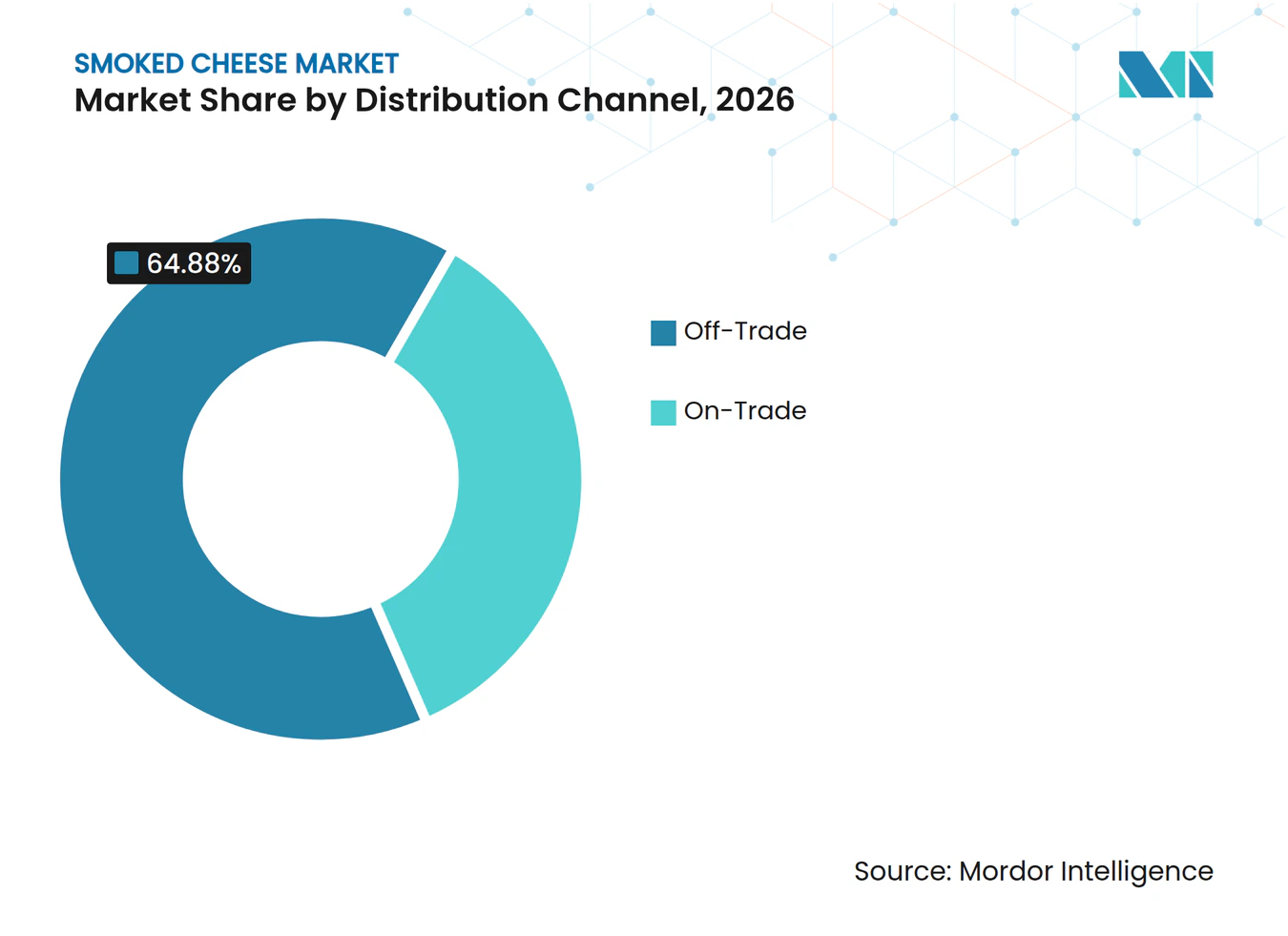
- By distribution channel, off-trade held 64.88% of the smoked cheese market share in 2026, while on-trade is forecast to grow at a 6.71% CAGR from 2027 to 2032.
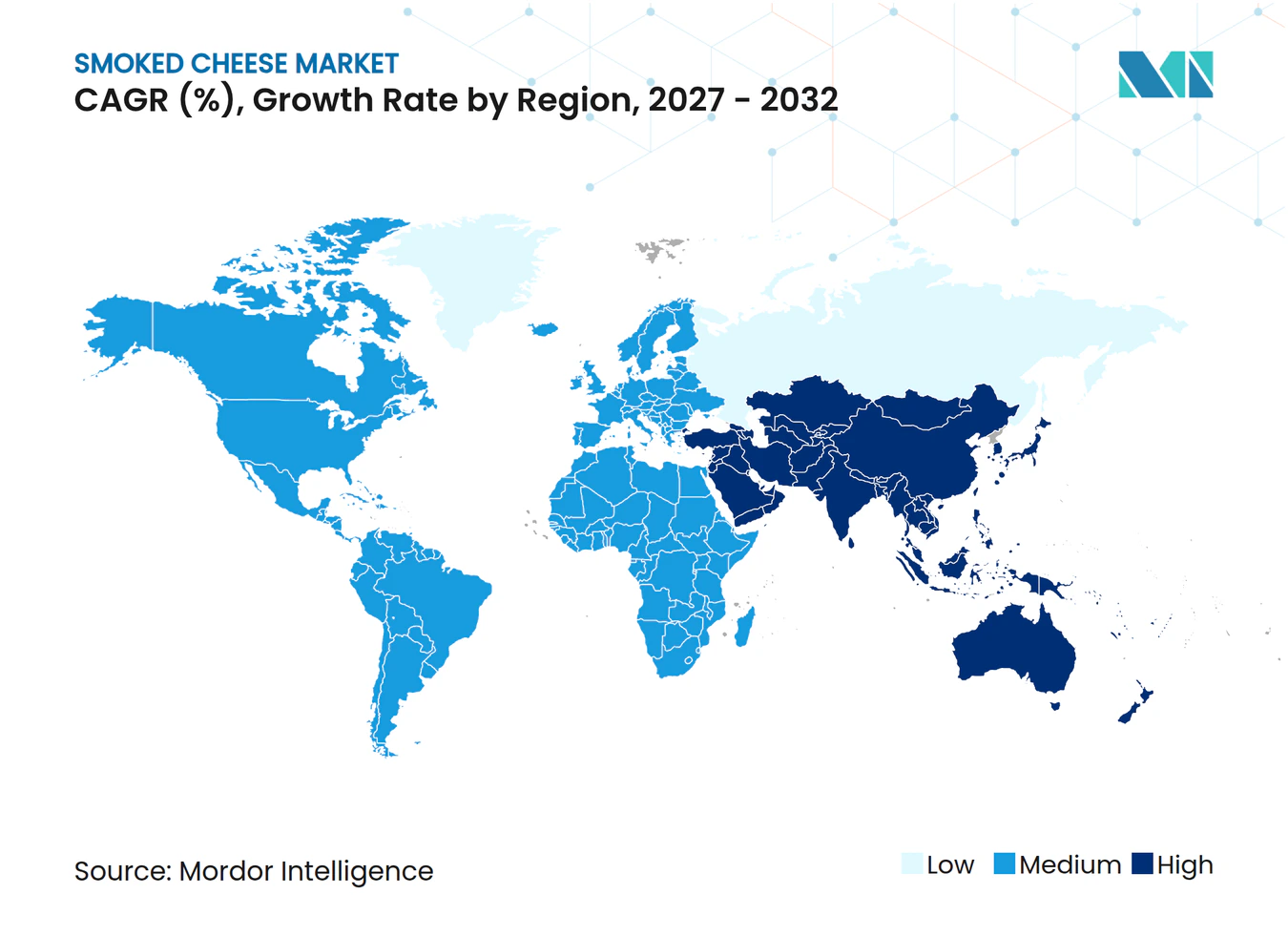
- By geography, Europe held 34.16% share of the smoked cheese market in 2026, while Asia-Pacific is forecast to grow at a 6.93% CAGR from 2027 to 2032.
Note: Market numbers in this report are based on Mordor Intelligence's proprietary estimation framework, which combines nine months of actuals with Q4 projections for base year 2026.
Market Trends and Insights
Drivers Impact Analysis of Smoked Cheese Market*
| Driver | (~) % Impact on CAGR Forecast | Geographic Relevance | Impact Timeline |
|---|---|---|---|
| Growing consumption of cheese and demand for specialty varieties | +1.3% | Global | Short term (≤ 2 years) |
| Expansion of gourmet foodservice and restaurant applications | +1.1% | Global, led by North America and Europe | Medium term (2–4 years) |
| Growing demand for natural, protein-rich cheese products | +0.9% | North America and Europe, spill-over to Asia-Pacific | Short term (≤ 2 years) |
| Innovation in smoking techniques and smoked cheese product development | +0.8% | Global | Medium term (2–4 years) |
| Demand for convenient, ready-to-serve cheese formats | +0.6% | North America, Asia-Pacific urban centres | Short term (≤ 2 years) |
| Growing importance of cheese provenance and traditional production methods | +0.4% | Europe | Long term (≥ 4 years) |
| Source: Mordor Intelligence | |||
Growing Consumption of Cheese and Demand for Specialty Varieties
Growing cheese consumption and evolving preferences for diverse flavors create opportunities for smoked cheese by encouraging interest in differentiated dairy products. According to the United States Department of Agriculture’s Foreign Agricultural Service, total cheese consumption across the markets covered in its December 2024 report reached 21.172 million metric tons in 2024[1]. This substantial consumption base provides opportunities for specialty varieties to attract consumers seeking alternatives to conventional cheese offerings. Smoked cheese can capitalize on this demand by offering a distinctive flavor profile and versatility across cooking, snacking, sandwiches, and foodservice applications. Its characteristic smoky taste also provides manufacturers and foodservice operators with opportunities to differentiate products and menu offerings.
Expansion of Gourmet Foodservice and Restaurant Applications
The expansion of gourmet foodservice and restaurant applications is creating opportunities for smoked cheese as operators seek distinctive ingredients to enhance menu appeal and differentiate their offerings. According to the National Restaurant Association, United States restaurant and foodservice sales are projected to reach USD 1.55 trillion by the end of 2026, with inflation-adjusted sales expected to grow by 1.3%[2]. This projected expansion provides a favorable backdrop for specialty ingredients used in premium dining and innovative menu development. Smoked cheese can benefit from its incorporation into gourmet pizzas, burgers, sandwiches, sauces, and other restaurant dishes, where its distinctive smoky flavor complements diverse ingredients and elevates familiar menu items. As foodservice operators continue to develop differentiated dining experiences, smoked cheese offers opportunities to introduce more distinctive flavor profiles across gourmet menus.
Growing Demand for Natural, Protein-Rich Cheese Products
Growing consumer emphasis on protein intake and nutrient-rich foods is supporting demand for cheese products that combine nutritional value with everyday versatility. According to the International Food Information Council’s 2026 Food & Health Survey, 70% of Americans actively try to include protein in their diets, while 27% followed a high-protein diet in 2026, up from 23% in 2025[3]. These preferences create opportunities for natural cheese varieties that provide protein alongside familiar taste and culinary versatility. Smoked cheese can appeal to this demand by combining the nutritional attributes of cheese with distinctive flavors, offering consumers a flavorful option for protein-containing meals, snacks, and foodservice dishes. This combination of nutritional value and differentiated taste can help smoked cheese attract consumers seeking variety within their everyday cheese choices.
Innovation in Smoking Techniques and Smoked Cheese Product Development
Innovation in smoking techniques and product development is supporting the evolution of the smoked cheese market by enabling manufacturers to diversify flavor profiles, textures, and product applications. Improvements in smoking processes allow producers to achieve greater control over smoke intensity, flavor consistency, and product characteristics while catering to varied consumer preferences. Experimentation with different wood types, smoking durations, and processing methods also creates opportunities to develop distinctive cheese varieties for premium retail and foodservice applications. In parallel, product development across cheese styles, formats, and flavor combinations is broadening the use of smoked cheese in snacks, prepared foods, sandwiches, and gourmet dishes. These innovations help manufacturers differentiate their offerings and respond to demand for versatile cheese products with distinctive sensory attributes.
Restraints Impact Analysis of Smoked Cheese Market*
| Restraint | (~) % Impact on CAGR Forecast | Geographic Relevance | Impact Timeline |
|---|---|---|---|
| Food safety risks and contaminant control in smoked cheese | -0.8% | Global; most acute in Europe | Medium term (2–4 years) |
| High production costs and refrigeration requirements | -0.7% | Global | Short term (≤ 2 years) |
| Regulatory compliance for smoke flavourings and smoking methods | -0.5% | Europe | Medium term (2–4 years) |
| Maintaining consistent smoking processes and product quality | -0.3% | Global | Medium term (2–4 years) |
| Source: Mordor Intelligence | |||
Food Safety Risks and Contaminant Control in Smoked Cheese
Food safety risks and contaminant control present challenges for smoked cheese manufacturers, as smoking processes must be carefully managed to maintain product safety and quality. Exposure to smoke can introduce undesirable compounds, including polycyclic aromatic hydrocarbons, depending on the smoking method, fuel source, temperature, and duration of exposure. Inadequate control of processing conditions may also affect product consistency and increase the risk of contamination during manufacturing and handling. Producers must therefore maintain appropriate smoking parameters, hygienic processing environments, and routine quality checks to ensure compliance with applicable food safety requirements. These controls can increase production complexity and operating costs, particularly for manufacturers seeking to balance distinctive smoky flavors with consistent product quality and safety.
High Production Costs and Refrigeration Requirements
High production costs and refrigeration requirements can constrain the profitability and distribution of smoked cheese, particularly for manufacturers operating with limited production scale or storage capacity. Cheese production involves expenses related to raw milk, processing equipment, smoking facilities, packaging, and quality control, while maintaining consistent smoking conditions adds further operational complexity. Refrigerated storage and transportation are essential for preserving product quality, managing shelf life, and maintaining food safety throughout the supply chain. These requirements contribute to ongoing energy, logistics, and inventory management costs, particularly when products are distributed across wider geographic markets. Manufacturers must therefore balance production efficiency, effective cold-chain management, and consistent product quality to maintain competitiveness while meeting food safety and storage requirements.
*Our forecasts treat driver/restraint impacts as directional, not additive. The impact forecasts reflect baseline growth, mix effects, and variable interactions.
Smoked Cheese Market Segment Analysis
By Cheese Type:
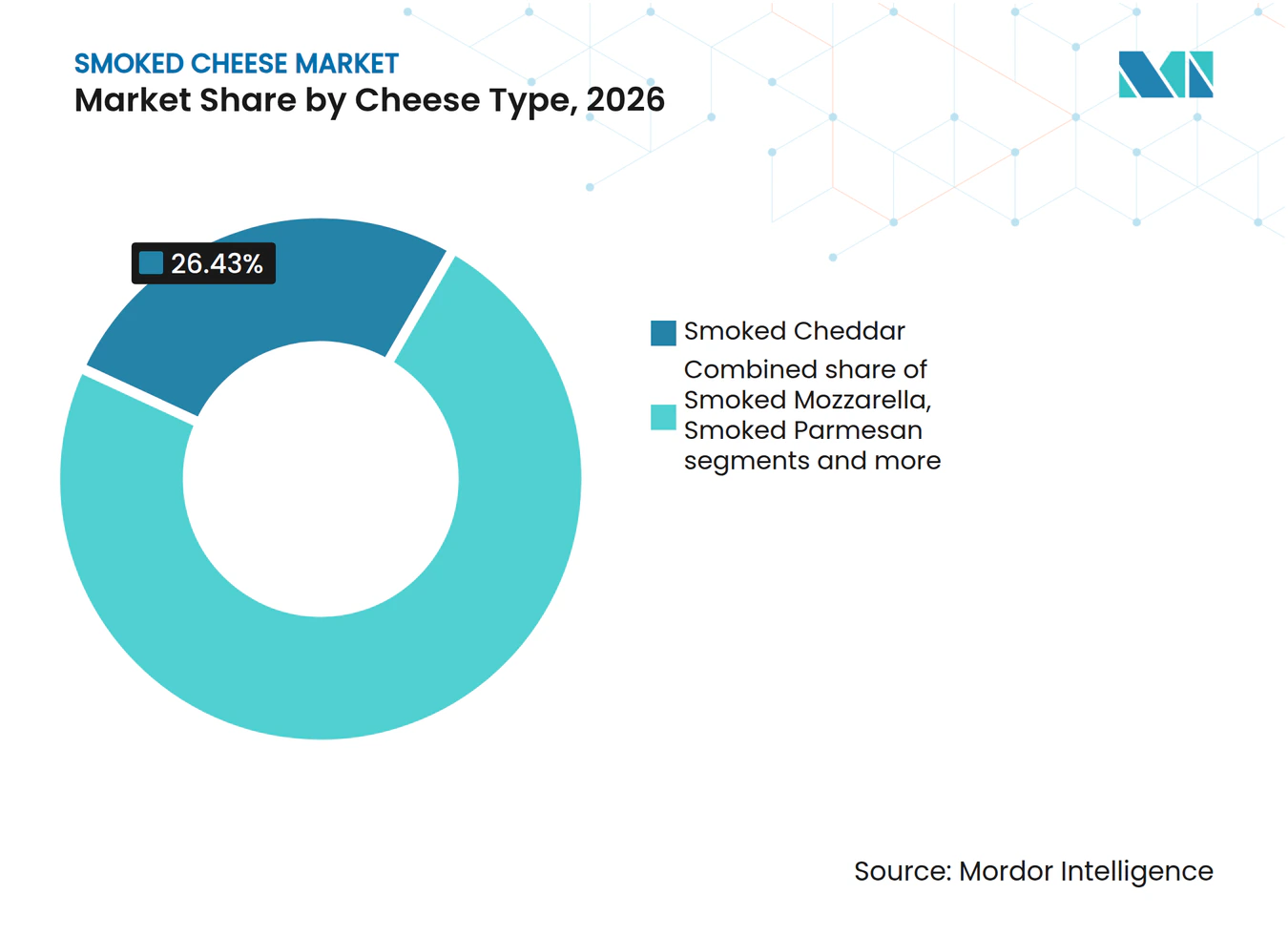
Cheddar Anchors Value, Cream Formats Redefine Premium OccasionsSmoked cheddar leads the cheese type segment with a 26.43% share in 2026, supported by its established consumer familiarity and ability to retain a distinctive flavor through smoking. Its versatility across retail and foodservice applications supports its use in snacks, sandwiches, burgers, and prepared dishes. Smoked mozzarella benefits from demand for cheese-based meals, particularly pizza, while smoked parmesan maintains a premium position in applications emphasizing distinctive flavor. Other varieties, including gouda, havarti, and provolone, provide opportunities for product differentiation through varied flavor profiles and smoking methods. This combination of familiarity and culinary versatility reinforces smoked cheddar’s leading position within the segment.
Smoked cream cheese is the fastest-growing cheese type, projected to expand at a 7.12% compound annual growth rate (CAGR) from 2027 to 2032, driven by its adaptability across retail and foodservice applications. Its smooth texture and spreadability support use in dips, sauces, bagel spreads, and bakery fillings, while its distinctive smoky flavor creates opportunities for differentiated snack and meal offerings. Foodservice adoption can complement retail demand by extending usage across restaurant menus and prepared foods. Product innovation in flavored cream cheese and convenient formats further supports its potential across varied eating occasions. Together, these applications position smoked cream cheese for growth as consumers and foodservice operators seek versatile products with distinctive flavor profiles.



By Smoking Type:
Natural Smoke Leads on HeritageNaturally smoked cheese leads the smoking type segment with a 64.13% share in 2026, supported by consumer interest in traditional smoking methods and authentic smoky flavor profiles. Direct exposure to smoke allows manufacturers to develop distinctive sensory characteristics, including variations in aroma, flavor intensity, and appearance. Consumer perceptions of traditional smoking methods also support the positioning of naturally smoked varieties within specialty cheese offerings. These products can cater to consumers seeking distinctive flavors and established cheese-making techniques across retail and foodservice applications. Continued emphasis on flavor consistency and controlled smoking processes further supports the segment’s leading position.
Processed smoked cheese is the fastest-growing smoking type, projected to expand at a 6.54% compound annual growth rate (CAGR) from 2027 to 2032, driven by demand for consistent flavor, product uniformity, and manufacturing efficiency. Processing techniques allow producers to incorporate smoky flavor into cheese products while maintaining greater control over formulation and product characteristics. These attributes support applications in prepared foods, sandwiches, sauces, and other products requiring consistent performance. Processed varieties can also provide manufacturers with flexibility in developing different formats and flavor intensities to meet varied application requirements. Ongoing improvements in processing technology and formulation are expected to support further product development across the segment.
By Milk Source:
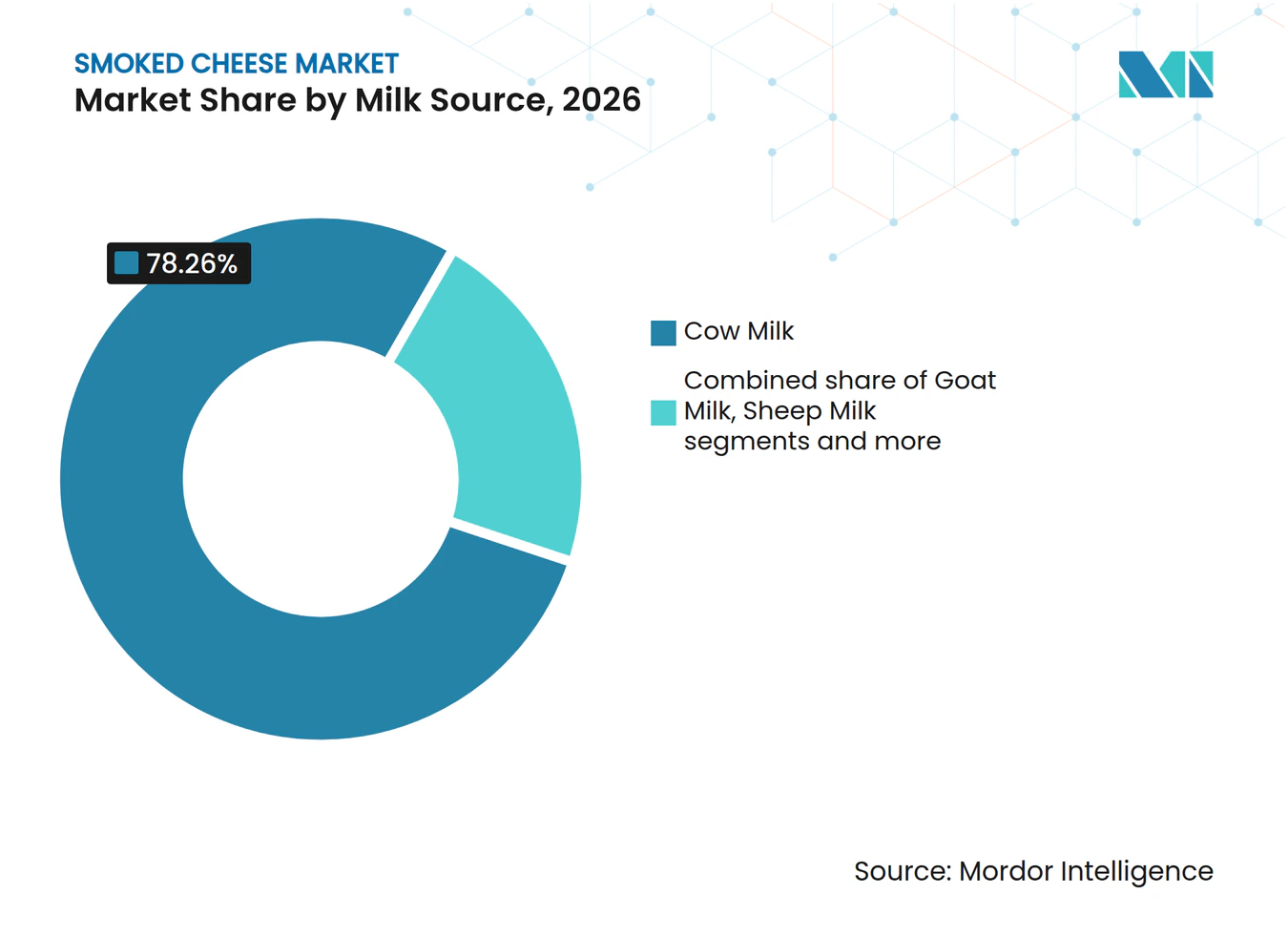
Cow Milk Underpins Scale, Alternative Milks Unlock MarginCow milk leads the milk source segment with a 78.26% share in 2026, supported by its widespread availability, established processing infrastructure, and suitability for large-scale cheese production. Its consistent supply and familiar flavor profile enable manufacturers to produce smoked cheese across a broad range of formats and price points. Cow milk-based varieties also benefit from established consumer acceptance and versatility across retail and foodservice applications. These factors support their continued prominence in the market. Other milk sources, including goat, sheep, and buffalo milk, provide opportunities for manufacturers to diversify product offerings and cater to specialized consumer preferences.
Goat milk-based smoked cheese is the fastest-growing milk source segment, projected to expand at a 7.03% compound annual growth rate (CAGR) from 2027 to 2032, supported by interest in specialty dairy products and differentiated flavor profiles. Goat and sheep milk varieties can appeal to consumers seeking alternatives to conventional cow milk cheese, particularly within premium and artisanal product ranges. Their distinctive sensory characteristics create opportunities for product differentiation, while specialized retail positioning can support higher-value offerings. Mixed-milk smoked cheeses also allow manufacturers to combine different milk characteristics and develop varied flavor profiles. These approaches support innovation across specialty cheese products and broaden the appeal of smoked cheese to consumers seeking greater variety.

By Format:
Blocks and Wheels Hold Institutional ShareBlocks and wheels lead the format segment with a 38.47% share in 2026, supported by their versatility across retail and foodservice applications. These formats allow flexible portioning and slicing, making them suitable for restaurant kitchens, prepared foods, and household consumption. Their adaptability to different serving sizes and packaging requirements also supports their use across a range of distribution channels. Cubes and spreadable formats cater to snacking, entertaining, dips, and appetizers, while shredded and pre-portioned products offer convenience for cooking and meal preparation. This versatility supports the continued prominence of blocks and wheels within the smoked cheese market.
Slices are the fastest-growing format, projected to expand at a 6.88% compound annual growth rate (CAGR) from 2027 to 2032, driven by demand for convenient, ready-to-use cheese products. Pre-sliced smoked cheese reduces preparation requirements and allows consumers and foodservice operators to incorporate distinctive smoky flavors into sandwiches, burgers, and other everyday meals. Wider retail availability also helps position smoked cheese as a practical alternative to conventional sliced cheese rather than an occasional specialty purchase. Manufacturers can further expand this format through different slice thicknesses, pack sizes, and cheese varieties suited to varied consumption occasions. These advantages support the growing adoption of sliced smoked cheese across retail and foodservice settings.
By Distribution Channel:
Off-Trade Anchors Revenue, On-Trade Accelerates DiscoveryOff-trade channels lead the distribution channel segment with a 64.88% share in 2026, supported by the broad availability of smoked cheese through supermarkets, specialty stores, convenience stores, online retail, and wholesale networks. These channels provide consumers with access to different cheese varieties, formats, and price points for household consumption and entertaining. Specialty stores offer opportunities to discover differentiated and artisanal products, while online retail enables producers to reach consumers beyond their immediate geographic markets. Supermarkets and convenience stores further support product accessibility through established retail networks. This combination of reach, product variety, and purchasing convenience reinforces the leading position of off-trade channels.
On-trade channels are the fastest-growing distribution channel, projected to expand at a 6.71% compound annual growth rate (CAGR) from 2027 to 2032, supported by the use of distinctive cheese varieties in restaurant menus and foodservice offerings. Smoked cheese can enhance the flavor profiles of burgers, sandwiches, pizzas, appetizers, and specialty dishes, giving operators opportunities to differentiate familiar menu items. Promotions and limited-time menu offerings can also introduce consumers to smoked cheese and encourage subsequent purchases through retail channels. Hotels and catering establishments provide additional opportunities to incorporate smoked cheese into cheese boards, buffets, and premium dining experiences. These applications support wider foodservice adoption as operators seek to diversify menus and offer distinctive dining experiences.
Geography Analysis
Europe Smoked Cheese Market
Europe holds the largest share of the smoked cheese market at 34.16% in 2026, supported by established cheese production infrastructure and the longstanding presence of specialty cheese varieties. Germany, France, the Netherlands, and Poland contribute to the region’s cheese production base, while traditional varieties such as Rauchkäse reflect the integration of smoked cheese into regional food cultures. Established retail and foodservice channels provide opportunities for smoked cheese across household consumption, restaurant menus, and specialty food applications. Product innovation and interest in distinctive flavors further support the category’s presence across European markets. Food safety requirements and evolving regulations on smoke flavourings also encourage producers to maintain controlled processing methods and appropriate product documentation.
APAC Smoked Cheese Market
Asia-Pacific is the fastest-growing region, projected to expand at a compound annual growth rate (CAGR) of 6.93% from 2027 to 2032, supported by expanding cheese consumption and growing use of cheese in foodservice and prepared foods. China’s developing cheese market provides opportunities for smoked varieties in quick-service restaurants, bakery products, and other prepared applications. In Thailand, demand for imported cheese and specialty products creates opportunities for differentiated varieties, including smoked cheese, in urban retail and foodservice settings. South Korea’s established cheese import market also provides a foundation for broader product adoption. Growing familiarity with cheese-based meals and demand for varied flavors are creating opportunities for smoked cheese producers across the region.
The Americas and MEA Smoked Cheese Market
North America represents another important market, supported by demand for specialty cheese and its established use in restaurant menus and prepared foods. The United States provides opportunities for smoked cheese across retail and foodservice applications, including burgers, sandwiches, pizzas, and specialty dishes, while Mexico’s expanding pizza market creates potential for smoked mozzarella in foodservice. Canada also offers opportunities for specialty smoked cheese varieties through established cheese distribution channels. In South America, Brazil, Argentina, Colombia, and Chile present opportunities as smoked cheese gains exposure through urban foodservice and specialty food applications. Meanwhile, the Middle East and Africa market is supported by premium hospitality and quick-service restaurant demand in countries such as the United Arab Emirates, Saudi Arabia, and South Africa, with further opportunities for gradual adoption in other regional markets.
Competitive Landscape
Market Concentration
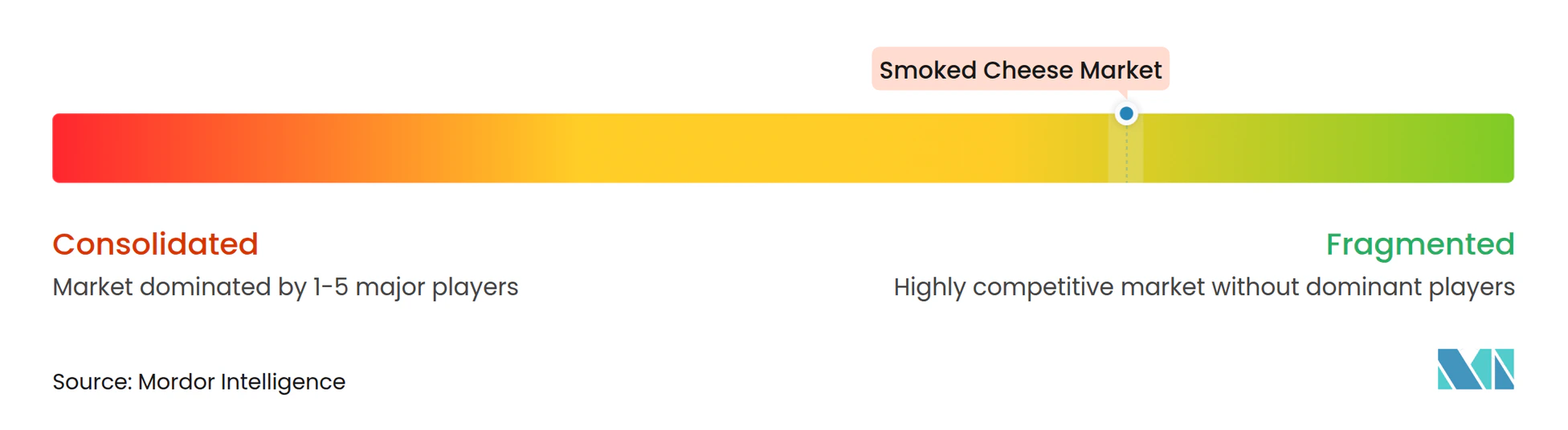
The smoked cheese market is fragmented, with established dairy companies competing alongside regional manufacturers and specialty cheese producers across different product categories and price points. Major players considered in the competitive landscape include Groupe Lactalis SA, Saputo Inc., Arla Foods amba, Bel Group, Tillamook County Creamery Association, FrieslandCampina NV, Fonterra Co-operative Group Limited, Savencia, and Emmi Group. Competition is shaped by product differentiation, flavor profiles, manufacturing capabilities, brand recognition, and access to retail and foodservice distribution channels. Smaller producers also contribute to market diversity by focusing on specialty varieties and differentiated cheese-making approaches.
Leading players can strengthen their market positions through product innovation, portfolio diversification, and broader distribution across retail and foodservice channels. Groupe Lactalis SA, Saputo Inc., Arla Foods amba, Bel Group, Savencia, and Emmi Group represent established competitors within the broader cheese industry. Smoked cheese provides opportunities to diversify existing cheese portfolios through distinctive flavor profiles, different cheese varieties, and formats suited to multiple applications. Established manufacturing capabilities and distribution networks can support product development and market access.
Emerging competition comes from specialty and regional producers such as Belton Farm, Cabot Creamery Cooperative, Carr Valley Cheese Company, Dewlay Cheesemakers, Joseph Heler Ltd., and Beehive Cheese Company. These companies can differentiate their offerings through specialized cheese varieties, distinctive flavor profiles, and product positioning focused on particular consumer preferences. Other companies in the competitive landscape, including Hochland SE, Ornua Co-operative Limited, Sargento Foods Incorporated, Hilmar Cheese Company, Inc., and Leprino Foods Company, contribute to the broader competitive environment through their cheese-related product and manufacturing capabilities. Product development, consistent quality, efficient production, and access to distribution channels remain important considerations for companies seeking to expand their presence in the smoked cheese market.
Smoked Cheese Industry Leaders
-
Groupe Lactalis SA
-
Saputo Inc.
-
Arla Foods amba
-
Emmi Group
-
Savencia
- *Disclaimer: Major Players sorted in no particular order
Smoked Cheese Market Companies Covered in this Report
- Groupe Lactalis SA
- Saputo Inc.
- Arla Foods amba
- Bel Group
- Tillamook County Creamery Association
- FrieslandCampina NV
- Fonterra Co-operative Group Limited
- Savencia
- Emmi Group
- Hochland SE
- Belton Farm
- Ornua Co-operative Limited
- Cabot Creamery Cooperative
- Sargento Foods Incorporated
- Hilmar Cheese Company, Inc.
- Leprino Foods Company
- Carr Valley Cheese Company
- Dewlay Cheesemakers
- Joseph Heler Ltd.
- Beehive Cheese Company
Recent Industry Developments in Smoked Cheese Market
- March 2026: Saputo Inc. introduced a mozzarella and smoked Gouda cheese blend designed for chefs and foodservice professionals. The product combines smoky, buttery flavor with the creamy texture, stretch, and coverage associated with mozzarella, targeting applications such as pizzas, paninis, grilled cheese sandwiches, pasta, and sauces. The launch extends smoked cheese applications into blended products for commercial food preparation.
- November 2025: Arla Foods amba extended its Castello cheese portfolio with Hickory Smoked Havarti in the United States. The cheese is cold-smoked over natural hickory wood chips for up to 48 hours, retaining a creamy texture and buttery flavor alongside smoky notes. Distributed in an 8-ounce chunk format, the product was introduced through selected retailers, including Albertsons, Safeway, and select Walmart locations, expanding the availability of smoked specialty cheese.
- June 2025: Saputo USA introduced Treasure Cave Smoked Blue Cheese alongside new dips and spreads at the Summer Fancy Food Show. Naturally smoked with applewood, the cheese combines smoky notes with the characteristic sharp and salty flavor of blue cheese. It was presented in a 4.4-ounce wedge, a 4-ounce deli cup, and a 6-pound wheel, giving the product multiple formats for retail and foodservice applications.
- May 2025: Tillamook introduced Smoked Medium Cheddar Slices as part of a new range of cheese flavors. Made with real, natural wood smoke, the product offers a hickory flavor in a convenient sliced format suited to burgers and other grilled meals. The launch broadened the cooperative's cheese selection with a smoked variety designed for everyday use, connecting distinctive flavor with a ready-to-use format.
Global Smoked Cheese Market Report Scope
The smoked cheese market comprises cheese products that undergo smoking to develop distinctive flavors, aromas, and sensory characteristics. The market is segmented by cheese type into smoked cheddar, smoked mozzarella, smoked parmesan, smoked cream cheese, and other smoked cheese types. By smoking type, the market is divided into naturally smoked cheese and processed smoked cheese. By milk source, it is categorized into cow milk, goat milk, sheep milk, and other milk sources. By format, the market includes blocks and wheels, slices, cubes, spreads, and other formats. By distribution channel, the market is divided into on-trade and off-trade. By geography, the market covers North America, Europe, Asia-Pacific, South America, and the Middle East and Africa. The market forecasts are provided in terms of value in USD and volume in tons.
Segmentation Overview
| Smoked Cheddar |
| Smoked Mozzarella |
| Smoked Parmesan |
| Smoked Cream Cheese |
| Other Smoked Cheese Types |
| Naturally Smoked Cheese |
| Processed Smoked Cheese |
| Cow Milk |
| Goat Milk |
| Sheep Milk |
| Other Milk Sources |
| Blocks/Wheels |
| Slices |
| Cubes |
| Spreads |
| Other Formats |
| On-trade | Foodservice outlets/restaurants |
| Hotels/catering establishments | |
| Other on-trade outlets | |
| Off-trade | Supermarkets/Hypermarkets |
| Specialty Stores | |
| Convenience Stores | |
| Online Retail | |
| Wholesalers/Other Channels |
| North America | United States |
| Canada | |
| Mexico | |
| Rest of North America | |
| Europe | Germany |
| United Kingdom | |
| Italy | |
| France | |
| Spain | |
| Netherlands | |
| Poland | |
| Belgium | |
| Sweden | |
| Rest of Europe | |
| Asia-Pacific | China |
| India | |
| Japan | |
| Australia | |
| Indonesia | |
| South Korea | |
| Thailand | |
| Singapore | |
| Rest of Asia-Pacific | |
| South America | Brazil |
| Argentina | |
| Colombia | |
| Chile | |
| Peru | |
| Rest of South America | |
| Middle East and Africa | South Africa |
| Saudi Arabia | |
| United Arab Emirates | |
| Nigeria | |
| Egypt | |
| Morocco | |
| Turkey | |
| Rest of Middle East and Africa |
| By Cheese Type | Smoked Cheddar | |
| Smoked Mozzarella | ||
| Smoked Parmesan | ||
| Smoked Cream Cheese | ||
| Other Smoked Cheese Types | ||
| By Smoking Type | Naturally Smoked Cheese | |
| Processed Smoked Cheese | ||
| By Milk Source | Cow Milk | |
| Goat Milk | ||
| Sheep Milk | ||
| Other Milk Sources | ||
| By Format | Blocks/Wheels | |
| Slices | ||
| Cubes | ||
| Spreads | ||
| Other Formats | ||
| By Distribution Channel | On-trade | Foodservice outlets/restaurants |
| Hotels/catering establishments | ||
| Other on-trade outlets | ||
| Off-trade | Supermarkets/Hypermarkets | |
| Specialty Stores | ||
| Convenience Stores | ||
| Online Retail | ||
| Wholesalers/Other Channels | ||
| By Geography | North America | United States |
| Canada | ||
| Mexico | ||
| Rest of North America | ||
| Europe | Germany | |
| United Kingdom | ||
| Italy | ||
| France | ||
| Spain | ||
| Netherlands | ||
| Poland | ||
| Belgium | ||
| Sweden | ||
| Rest of Europe | ||
| Asia-Pacific | China | |
| India | ||
| Japan | ||
| Australia | ||
| Indonesia | ||
| South Korea | ||
| Thailand | ||
| Singapore | ||
| Rest of Asia-Pacific | ||
| South America | Brazil | |
| Argentina | ||
| Colombia | ||
| Chile | ||
| Peru | ||
| Rest of South America | ||
| Middle East and Africa | South Africa | |
| Saudi Arabia | ||
| United Arab Emirates | ||
| Nigeria | ||
| Egypt | ||
| Morocco | ||
| Turkey | ||
| Rest of Middle East and Africa | ||
Key Questions Answered in the Report
What is the forecast growth rate for smoked cheese?
The category is projected to grow at a 5.59% CAGR from 2027 to 2032, increasing from USD 22.76 billion in 2026 to USD 31.12 billion by 2032.
Which cheese type has the largest share?
Smoked cheddar leads the cheese type segment with a 26.43% share in 2026.
Which smoked cheese format is growing fastest?
Slices are forecast to grow at a 6.88% CAGR from 2027 to 2032.
Which region is expected to grow the fastest?
Asia-Pacific is forecast to record the highest regional CAGR at 6.93% from 2027 to 2032.