
Smart Irrigation Controllers Market Size and Share
Market Overview
| Study Period | 2022 - 2032 |
|---|---|
| Market Size (2027) | USD 0.73 Billion |
| Market Size (2032) | USD 1.24 Billion |
| Growth Rate (2027 - 2032) | 11.18 % |
| Fastest Growing Market | Asia-Pacific |
| Largest Market | North America |
| Market Concentration | Low |
Major Players *Disclaimer: Major Players sorted in no particular order Image © Mordor Intelligence. Reuse requires attribution under CC BY 4.0. | |
Smart Irrigation Controllers Market Analysis by Mordor Intelligence
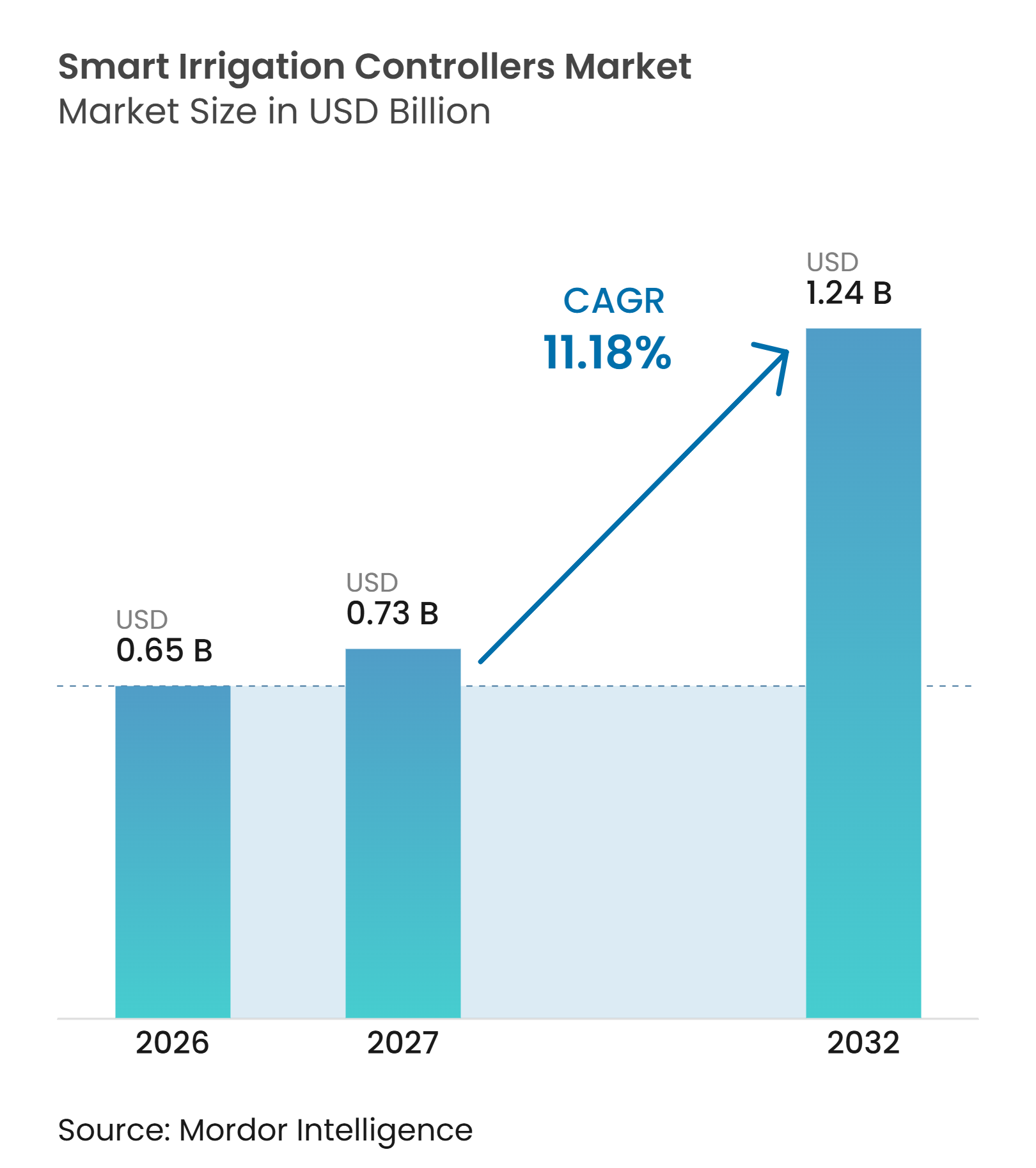
The smart irrigation controllers market size was valued at USD 0.65 billion in 2026 and is forecast to grow from USD 0.73 billion in 2027 to USD 1.24 billion by 2032, at a CAGR of 11.18% from 2027 to 2032. The market is shaped by water governance policies, the adoption of digital agriculture, and connectivity infrastructure. Agriculture accounts for approximately 72% of global freshwater withdrawals, with irrigation representing the primary driver of agricultural water use. This places greater emphasis on improving water-use efficiency across farming operations and supports demand for technologies that enable more precise irrigation management. The U.S. Environmental Protection Agency's (EPA) WaterSense program provides an efficiency and performance benchmark for weather-based and soil moisture-based irrigation controllers that meet its certification requirements. The integration of weather data, field sensing, and remote-control capabilities is enabling controllers to move beyond fixed schedules. As a result, the market presents opportunities in retrofit projects, connected farm systems, and large landscapes that require documented water management.
Key Report Takeaways
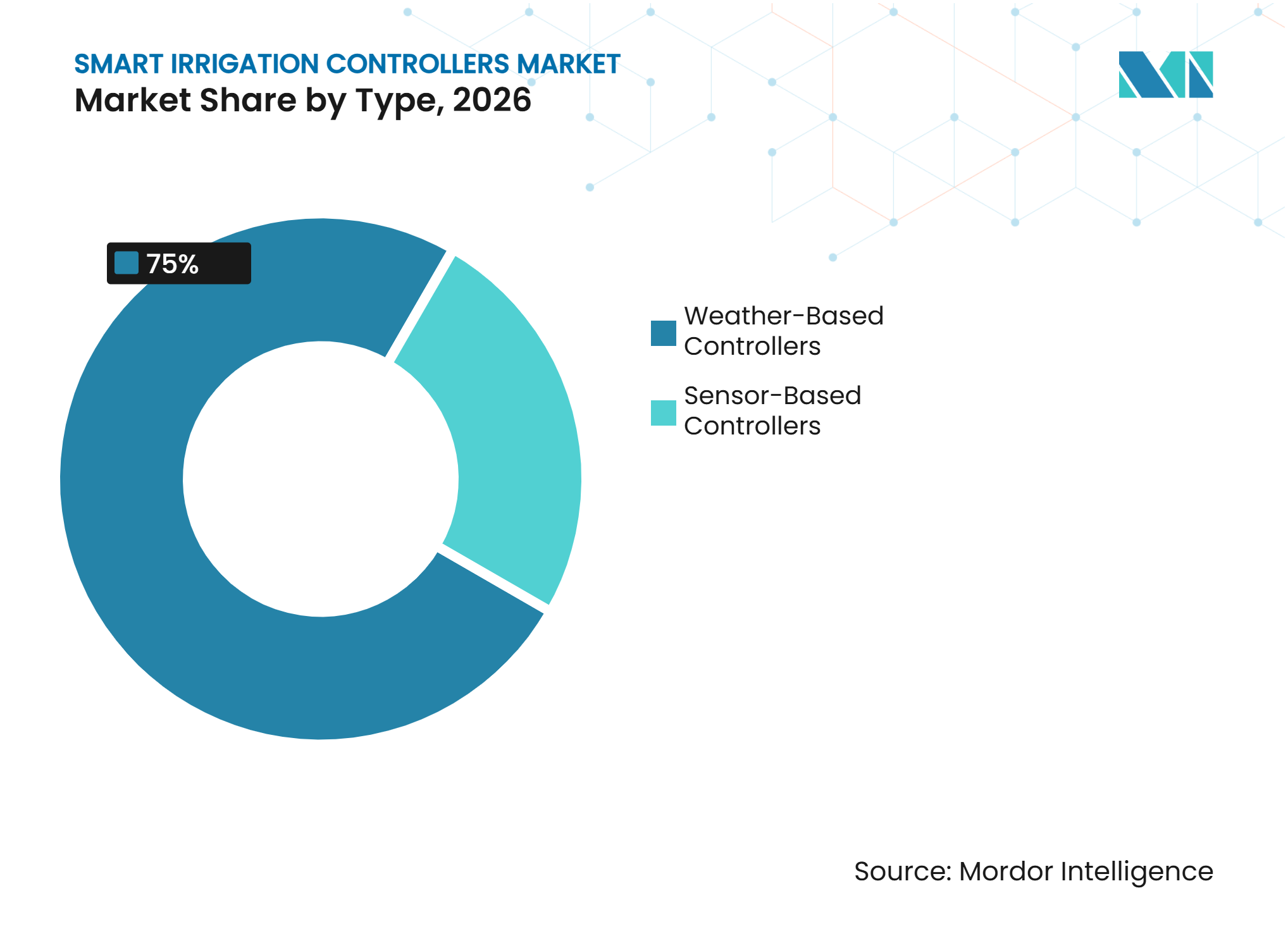
- By type, weather-based controllers accounted for 75% of the smart irrigation controllers market share in 2026 and are forecast to grow at a CAGR of 12.3% from 2027 to 2032.
- By connectivity, wireless controllers accounted for 65% of the smart irrigation controllers market size in 2026 and are forecast to grow at a CAGR of 12.1% from 2027 to 2032.
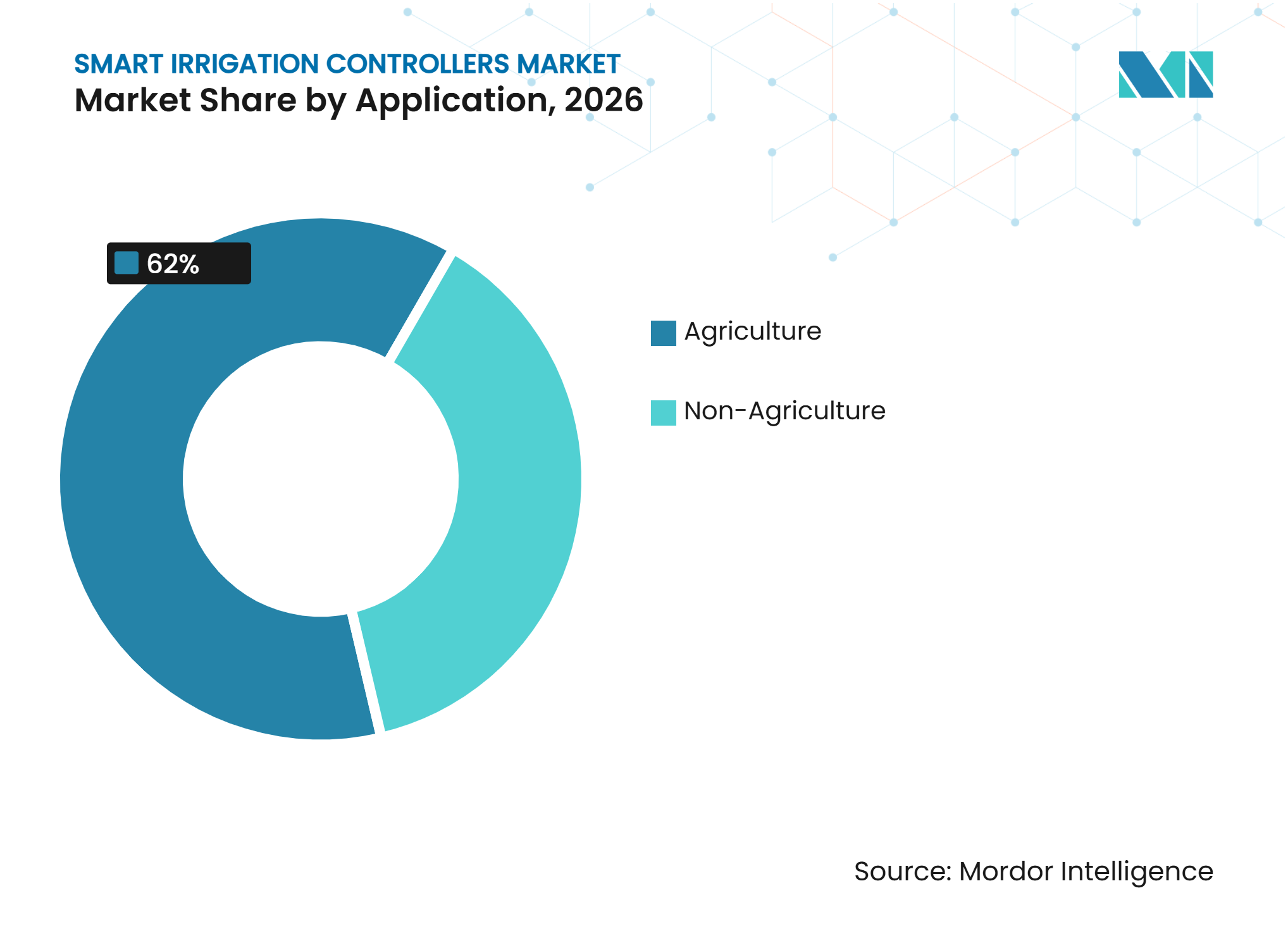
- By application, agriculture accounted for 62% of the market share in 2026 and is forecast to grow at a CAGR of 13.1% from 2027 to 2032.
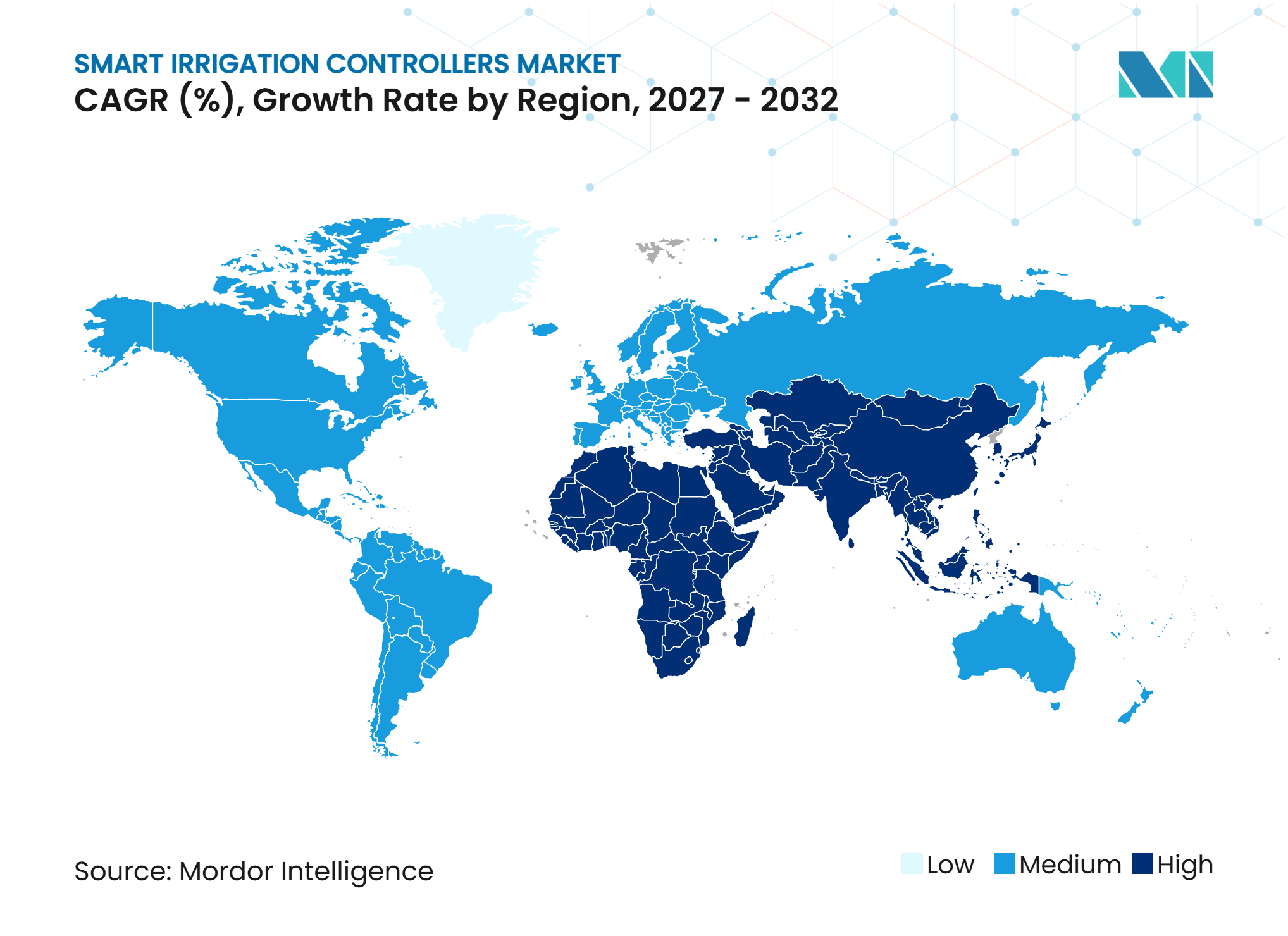
- By geography, North America accounted for 35% of the market share in 2026, while Asia-Pacific is forecast to grow at a CAGR of 14.9% from 2027 to 2032.
Note: Market numbers in this report are based on Mordor Intelligence's proprietary estimation framework, which combines nine months of actuals with Q4 projections for base year 2026.
Market Trends and Insights
Drivers Impact Analysis of Smart Irrigation Controllers Market*
| Driver | (~) % Impact on CAGR Forecast | Geographic Relevance | Impact Timeline |
|---|---|---|---|
| Water Scarcity and Water Conservation Mandates | +2.8% | Global, with highest intensity in North America, Middle East, and Africa | Short term (≤ 2 years) |
| Expansion of Weather-Responsive Irrigation in Agriculture and Landscapes | +2.3% | Global, particularly North America, Europe, and Asia-Pacific | Medium term (2-4 years) |
| Growing Adoption of Cellular Controllers Among Smallholder Farmers | +1.9% | Asia-Pacific, with relevance for South America and Africa | Medium term (2-4 years) |
| Integration of Artificial Intelligence in Irrigation Scheduling and Fault Detection | +1.6% | Global, with early adoption in North America and Europe | Long term (≥ 4 years) |
| Government Subsidies and Rebate Programs | +1.5% | Mainly North America and Europe | Short term (≤ 2 years) |
| Increasing IoT and Cloud Connectivity in Smart Agriculture | +1.4% | Global, with strongest potential in Asia-Pacific | Medium term (2-4 years) |
| Source: Mordor Intelligence | |||
Water Scarcity and Water Conservation Mandates
Water scarcity is a key driver of demand in the smart irrigation controllers market, as it is shifting irrigation from a routine operating activity to more closely monitored water use. Agriculture accounts for a significant share of global freshwater withdrawals, underscoring the need for efficient water-use practices in both agricultural and landscape irrigation. Regulatory initiatives and voluntary efficiency programs also support the adoption of water-efficient irrigation equipment. In the United States, WaterSense certification provides a recognized efficiency benchmark for irrigation controllers, while state-level water-efficiency initiatives and utility rebate programs can influence equipment selection. California is considering efficiency standards and performance-testing requirements for landscape irrigation controllers through the California Energy Commission, reinforcing the focus on water-efficient controller technologies [1]. Separately, the U.S. Environmental Protection Agency’s voluntary WaterSense program uses the American National Standards Institute (ANSI)/American Society of Agricultural and Biological Engineers (ASABE) S627 as a performance-testing standard for weather-based irrigation controllers, providing buyers with an established benchmark for evaluating product efficiency and performance.
Expansion of Weather-Responsive Irrigation in Agriculture and Landscapes
Weather-responsive irrigation is supporting demand in the smart irrigation controllers market by replacing fixed timer settings with schedules that adapt to local weather and soil conditions. A 2025 review published in the journal Discover Computing reported that intelligent irrigation controllers integrated with IoT-based sensing networks can reduce water use by 20% to 40% while improving crop yields. Weather-based controllers use evapotranspiration estimates and weather data to adjust irrigation schedules according to crop water requirements and prevailing environmental conditions. These capabilities support more precise irrigation management across agricultural operations and managed landscapes. A 2025 study published in the journal Sensors demonstrated an edge-computing irrigation system that processed soil-moisture and meteorological data locally, enabling real-time irrigation decisions and continued operation in areas with limited internet connectivity [2]. Independent performance certification, including the U.S. Environmental Protection Agency’s voluntary WaterSense labeling program, provides property owners with a basis for evaluating and selecting irrigation controllers that meet established water-efficiency and performance criteria.
Growing Adoption of Cellular Controllers Among Smallholder Farmers
Cellular-enabled irrigation controllers are expanding the addressable market for smart irrigation controllers by serving farms with limited fixed broadband or wired infrastructure. In August 2026, Netafim Ltd. launched GrowSphere FLEX, a smart irrigation and fertigation controller with built-in cellular connectivity, enabling smallholder and mid-sized farmers to remotely manage irrigation and fertigation through GrowSphere Workspace [3]. The system eliminates the need for an on-site screen, reducing equipment requirements for farms adopting digital irrigation management. Research on deep learning for irrigation, published in the journal Agricultural Water Management in 2025, indicates that edge-cloud architectures can reduce communication volumes and shorten response times from minutes to seconds, helping to overcome connectivity limitations in rural agricultural areas. Together, these developments support wider adoption of remote irrigation management across emerging agricultural markets, particularly in Asia-Pacific, South America, and Africa.
Integration of Artificial Intelligence in Irrigation Scheduling and Fault Detection
Artificial intelligence is expanding the role of smart irrigation controllers beyond remote monitoring to predictive scheduling and automated fault detection. A 2025 review published in the journal Smart Agricultural Technology reported that AI-driven irrigation systems achieved water savings of 30% to 50% and yield improvements of 20% to 30%, based on a meta-analysis of previous studies. In August 2025, the University of Nebraska–Lincoln introduced SPADE AI in its ACREE app, a tool that identifies irrigation and rainfall events, estimates net water gains, and detects and classifies anomalies using soil-moisture sensor data [4]. These capabilities can help users detect leaks and irregular field conditions before they result in significant water losses. Commercial and municipal operators can also use automated fault alerts to improve oversight across dispersed irrigation sites. As AI-based analytics become more integrated into irrigation management, demand for controllers with predictive scheduling and diagnostic capabilities is likely to increase.
Restraints Impact Analysis of Smart Irrigation Controllers Market*
| Restraint | (~) % Impact on CAGR Forecast | Geographic Relevance | Impact Timeline |
|---|---|---|---|
| High Upfront Cost and Installation Complexity | -1.8% | Global, especially Asia-Pacific, Middle East, and Africa | Short term (≤ 2 years) |
| Fragmented Connectivity and Interoperability Challenges | -1.4% | North America and Europe, where multi-vendor installations are common | Medium term (2-4 years) |
| Cybersecurity and Data Privacy Concerns | -0.9% | Global, especially the European Union and North America | Medium term (2-4 years) |
| Limited Technical Awareness and Workforce Skills | -0.7% | Asia-Pacific, South America, and Africa | Long term (≥ 4 years) |
| Source: Mordor Intelligence | |||
High Upfront Cost and Installation Complexity
High equipment and installation costs constrain the adoption of smart irrigation controllers, particularly among small farms and low-value crop operations. A complete installation may require sensors, communication modules, valves, wiring or decoder infrastructure, and professional commissioning, with costs increasing as the number of irrigation zones and site complexity rise. The California Energy Commission's March 2026 evaluation of proposed landscape irrigation controller standards estimated an incremental equipment cost of USD 32.87 per unit and a five-month payback period based on projected water-cost savings, highlighting the importance of assessing potential efficiency gains against upfront investment costs. Although wireless designs can reduce wiring requirements, they do not eliminate the need for system configuration and site-specific commissioning. These upfront expenses can make adoption difficult in water-stressed regions where farmers also face limited access to capital for agricultural technology.
Fragmented Connectivity and Interoperability Challenges
Fragmented connectivity and limited interoperability constrain the smart irrigation controllers market by making it difficult for users operating equipment from multiple vendors to integrate controller data across platforms. In February 2025, Weathermatic Industries, Inc. launched SmartLink Connect for Hunter 2-wire controllers, a plug-in adapter that enables remote management of existing third-party irrigation equipment through its SmartLink cloud-connected platform without requiring controller replacement. HydroPoint Data Systems, Inc. introduced its Multi-Carrier Modem in March 2026, enabling Baseline irrigation controllers to connect to multiple long-term evolution (LTE) networks and automatically switch between available carriers, improving connectivity reliability across different site conditions. However, network redundancy does not resolve data-exchange limitations between competing cloud platforms. These challenges can complicate system integration and restrict access to consolidated operational records, particularly for municipal users managing irrigation assets from multiple suppliers.
*Our forecasts treat driver/restraint impacts as directional, not additive. The impact forecasts reflect baseline growth, mix effects, and variable interactions.
Smart Irrigation Controllers Market Segment Analysis
By Type:
Weather-Based Controllers Lead and Grow FastestWeather-based controllers accounted for 75% of the smart irrigation controllers market share in 2026 and are forecast to grow at a CAGR of 12.3% from 2027 to 2032. These controllers use evapotranspiration calculations and weather forecasts to adjust irrigation schedules, reducing the risk of applying water based on fixed timers when weather conditions have changed. The U.S. Environmental Protection Agency's (EPA) WaterSense program identifies weather-based irrigation controllers as systems that use local weather data and landscape conditions to adjust watering schedules according to site-specific requirements. Hunter Industries, Inc.'s Hydrawise X2 with WAND offers weather-based scheduling and cloud-enabled remote management, while HydroPoint Data Systems, Inc.'s WeatherTRAK OptiFlow XR combines weather-responsive scheduling with advanced flow monitoring and cloud management.
Sensor-based controllers account for the remaining share and are most valuable where soil and field conditions require closer monitoring. In 2025, Plantae, a precision agriculture start-up supported by the Science Park of Universidad Carlos III de Madrid, developed AI-based predictive models that use approximately 10 million sensor data points per month to provide irrigation recommendations up to 10 days in advance. These systems use inputs such as soil moisture, electrical conductivity, and temperature. Weather-based and sensor-based functions are converging in hybrid products, reducing the relevance of a strict hardware distinction for some buyers. Competition increasingly depends on how well a platform converts field data into usable scheduling decisions.



By Connectivity:
Wireless Systems Lead and Grow FastestWireless controllers accounted for 65% of the market share in 2026 and are forecast to grow at a CAGR of 12.1% from 2027 to 2032. Cellular technologies reduce the need for wired communication infrastructure in irrigation system installations and retrofits. HydroPoint Data Systems, Inc. introduced its Multi-Carrier Modem in March 2026 for WeatherTRAK and Baseline controllers, enabling automatic switching among available Long Term Evolution networks to improve connectivity reliability. Hunter Industries, Inc.'s Wireless Valve Link uses license-free LoRa radio technology to connect irrigation controllers with field valves without requiring copper field wiring, simplifying installations and system expansion. These designs lower installation barriers for large, multi-zone sites.
Wired systems retain a role where operators prefer direct network control or where wireless service is unreliable. Large vineyards and orchards can use 2-wire decoder systems to monitor flow at the station level across many zones. SmartLink Connect provides a hybrid connectivity solution by adding cellular-based cloud access to compatible 2-wire irrigation systems without requiring controller replacement or modifications to existing underground decoder infrastructure. The smart irrigation controllers market includes both new wireless installations and upgrades of established wired systems. Data residency and cybersecurity requirements can also influence which configuration a buyer selects. Product providers need to support practical transitions between wired equipment and remote management tools.
By Application:
Agriculture Leads and Grows FastestAgriculture accounted for 62% of the smart irrigation controllers market share in 2026 and is forecast to grow at a CAGR of 13.1% from 2027 to 2032. Irrigated farmland gives growers a direct reason to automate water and nutrient delivery across crop zones. Drip and micro-spray infrastructure provides a suitable basis for controller deployment, as each zone requires a consistent operating schedule. Netafim Ltd. launched GrowSphere FLEX in August 2026 for smallholder and mid-sized farms, combining built-in cellular connectivity, remote irrigation and fertigation management, and crop-stage-based recommendations through Crop Advisor. The U.S. Department of Agriculture’s (USDA) Environmental Quality Incentives Program (EQIP) provides financial and technical assistance to agricultural producers implementing conservation practices, including water-conservation measures, which can help reduce the upfront cost of adopting efficient irrigation technologies. The agricultural application segment benefits from integrating irrigation management with broader crop management practices.
Non-agricultural applications include golf courses, municipal parks, school campuses, and commercial real estate. These users require reliable irrigation for large landscapes while meeting water budgets and internal environmental reporting needs. Hunter Industries, Inc.'s integration of POGO sensors and Visual Insights with its pilot network provides golf course managers with real-time soil moisture, salinity, and temperature data to support more precise irrigation scheduling. Facilities managers can treat controllers as managed infrastructure rather than simple operational equipment, supporting continued interest in remote oversight and water-use reporting.

Geography Analysis
North America
North America accounted for 35% of the market share in 2026. The region has established distribution channels and a regulatory environment that supports the adoption of water-efficient irrigation technologies. California's proposed landscape irrigation controller standards further highlight the focus on measurable water-efficiency performance. The United States accounts for most regional demand, while Canadian municipalities and Mexican agricultural users create additional opportunities. Retrofit demand across multifamily housing and secondary commercial properties continues to support adoption in the region. The U.S. Environmental Protection Agency's (EPA) voluntary WaterSense labeling program provides an efficiency benchmark for landscape irrigation controllers.
Asia-Pacific
Asia-Pacific is forecast to grow at a CAGR of 14.9% from 2027 to 2032. Water scarcity, large agricultural areas, and improving cellular coverage support demand for connected controls. India's Pradhan Mantri Krishi Sinchayee Yojana (PMKSY) promotes precision irrigation and on-farm water-use efficiency, supporting the adoption of water-management technologies. China’s digital agriculture investment focuses on controller-sensor combinations that support both water management and crop decisions. Netafim Ltd. conducted a year-long, multi-region beta trial of GrowSphere FLEX before its 2026 commercial launch, validating its performance across different climates and irrigation conditions. Australia also remains a premium regional market because drought exposure and the adoption of farm technology encourage precision irrigation. Cellular-native systems can be especially useful where fixed broadband does not reach farm sites.
Europe, Middle East, South America, and Africa
Demand across Europe, the Middle East, South America, and Africa is supported by water-efficiency initiatives, agricultural modernization, and growing interest in precision irrigation. In Europe, the European Union (EU) Water Framework Directive and national drought management measures promote sustainable water use across agricultural and municipal applications. Simpliciti announced its acquisition of Urbasense in December 2025, strengthening its capabilities in smart irrigation and agronomic management for public green spaces. The Middle East's water-scarcity challenges and food-security priorities support investment in water-efficient irrigation technologies, while Hunter continues to serve the region through its distributor network. South America's large agricultural base supports demand for precision irrigation, while WiseConn Engineering S.L.'s DropControl integrates with CropX to provide irrigation and fertilization data and support dynamic irrigation scheduling. Africa remains at an earlier stage, with Egypt and South Africa providing the most established entry points, and development-supported irrigation projects creating greenfield demand.
Competitive Landscape
Market Concentration
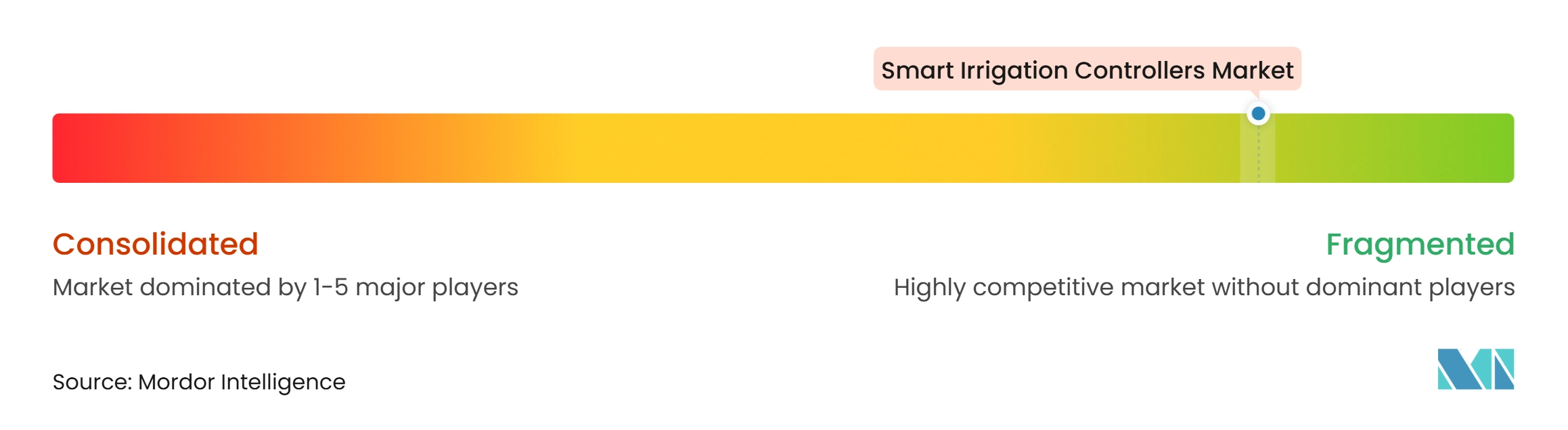
The smart irrigation controllers market was fragmented in 2026. Hunter Industries, Inc., Rain Bird Corporation, The Toro Company, Netafim Ltd., and Valmont Industries, Inc. are among the established participants. Their positions vary across residential, commercial, golf, and agricultural uses, which limits the value of a single, broad-product approach. Rain Bird Corporation acquired Rachio in October 2025, making it a wholly owned subsidiary while retaining it as an independent division. The acquisition expanded Rain Bird Corporation's portfolio with cloud-connected residential irrigation controllers and smart hose-end timers.
Valley Irrigation, a Valmont company, consolidated AgSense, Valley 365, PrecisionKing, and PivoTrac into the AgSense 365 application, providing growers with a unified interface for remote irrigation monitoring and control. Weathermatic Industries, Inc.'s SmartLink Connect extends cloud-based management to compatible third-party 2-wire controllers. Connectivity and platform access are becoming important sources of differentiation because buyers seek longer usable lives for installed equipment. Suppliers can also compete through retrofit cellular access and multi-vendor data tools.
Specialist companies continue to compete by integrating data and improving irrigation precision. WiseConn Engineering S.L.'s DropControl integration with CropX combines irrigation records and agronomic insights to support data-driven irrigation scheduling. The U.S. Environmental Protection Agency's (EPA) WaterSense certification establishes efficiency and performance benchmarks for eligible landscape irrigation controllers, while allowing manufacturers to differentiate their products through additional features and specialized applications. Product quality, installation support, and data management will continue to matter across individual customer groups.
Smart Irrigation Controllers Industry Leaders
-
Hunter Industries, Inc.
-
Rain Bird Corporation
-
The Toro Company
-
Netafim Ltd.
-
Valmont Industries, Inc.
- *Disclaimer: Major Players sorted in no particular order
Smart Irrigation Controllers Market Companies Covered in this Report
- California Sensor Corporation (Calsense)
- Galcon Ltd.
- Hunter Industries, Inc.
- HydroPoint Data Systems, Inc.
- INKBIRD
- Netafim Ltd.
- Orbit Irrigation Products, LLC
- Rain Bird Corporation
- Smart Rain Systems, LLC
- The Toro Company
- Valmont Industries, Inc.
- Weathermatic Industries, Inc. (Telsco Industries, Inc.)
- WiseConn Engineering S.L.
- BERMAD CS Ltd.
- AGAM Control
Recent Industry Developments in Smart Irrigation Controllers Market
- June 2026: The Toro Company introduced the RXC residential irrigation controller, which pairs with its Oasis irrigation management software. The system supports remote setup, irrigation scheduling, and management through desktop and mobile devices. Additional features include seasonal adjustments, spatial mapping, real-time alerts, and flow monitoring with compatible Toro or Irritrol flow sensors.
- October 2025: Rain Bird Corporation acquired Rachio, Inc., which continues to operate as a wholly owned subsidiary under its existing brand and leadership. The acquisition added Rachio's cloud-connected residential irrigation controllers and smart hose-end timers to Rain Bird Corporation's product portfolio.
- January 2025: Valmont Industries, Inc. consolidated its four irrigation management platforms, AgSense, Valley 365, PrecisionKing, and PivoTrac, into the AgSense 365 application. The unified platform provides growers and dealers with a single interface for remote irrigation monitoring and control while reducing development and operational redundancies.
Global Smart Irrigation Controllers Market Report Scope
Smart irrigation controllers are automated devices that regulate irrigation schedules using weather data, evapotranspiration estimates, soil moisture readings, and other environmental inputs. They help agricultural and non-agricultural users optimize water application, improve irrigation efficiency, and manage water distribution across multiple zones.
The smart irrigation controllers market report is segmented by type (weather-based controllers and sensor-based controllers), by connectivity (wired and wireless), by application (agriculture and non-agriculture), and by geography (North America, South America, Europe, Asia-Pacific, Middle East, and Africa). The market forecasts are provided in terms of value (USD).
Segmentation Overview
| Weather-Based Controllers |
| Sensor-Based Controllers |
| Wired |
| Wireless |
| Agriculture |
| Non-Agriculture |
| North America | United States |
| Canada | |
| Mexico | |
| Rest of North America | |
| South America | Brazil |
| Argentina | |
| Rest of South America | |
| Europe | Germany |
| United Kingdom | |
| France | |
| Russia | |
| Spain | |
| Rest of Europe | |
| Asia-Pacific | China |
| India | |
| Japan | |
| Australia | |
| South Korea | |
| Rest of Asia-Pacific | |
| Middle East | Saudi Arabia |
| United Arab Emirates | |
| Turkey | |
| Jordan | |
| Rest of Middle East | |
| Africa | South Africa |
| Egypt | |
| Rest of Africa |
| By Type | Weather-Based Controllers | |
| Sensor-Based Controllers | ||
| By Connectivity | Wired | |
| Wireless | ||
| By Application | Agriculture | |
| Non-Agriculture | ||
| By Geography | North America | United States |
| Canada | ||
| Mexico | ||
| Rest of North America | ||
| South America | Brazil | |
| Argentina | ||
| Rest of South America | ||
| Europe | Germany | |
| United Kingdom | ||
| France | ||
| Russia | ||
| Spain | ||
| Rest of Europe | ||
| Asia-Pacific | China | |
| India | ||
| Japan | ||
| Australia | ||
| South Korea | ||
| Rest of Asia-Pacific | ||
| Middle East | Saudi Arabia | |
| United Arab Emirates | ||
| Turkey | ||
| Jordan | ||
| Rest of Middle East | ||
| Africa | South Africa | |
| Egypt | ||
| Rest of Africa | ||
Key Questions Answered in the Report
What is the forecast growth rate of the smart irrigation controllers market?
The smart irrigation controllers market is valued at USD 0.65 billion in 2026 and is forecast to reach USD 1.24 billion by 2032, at a CAGR of 11.18% from 2027 to 2032.
Which controller type accounts for the largest market share?
Weather-based controllers accounted for 75% of the market share in 2026, supported by their use of weather data and evapotranspiration to adjust irrigation schedules.
Why are wireless irrigation controllers gaining adoption?
Wireless controllers are forecast to grow at a 12.1% CAGR from 2027 to 2032, supported by cellular and LoRa connectivity options that reduce the need for extensive field wiring in retrofit installations.
Which region is forecast to grow fastest in the smart irrigation controllers market?
Asia-Pacific is forecast to grow at a 14.9% CAGR from 2027 to 2032, supported by water scarcity, farm digitalization, and expanding cellular connectivity.
What factors limit the adoption of smart irrigation controllers?
High initial installation costs, fragmented technology platforms, cybersecurity concerns, and limited technical expertise can constrain the wider adoption of smart irrigation controllers.