
Smart Doorbells Market Size and Share
Market Overview
| Study Period | 2020 - 2031 |
|---|---|
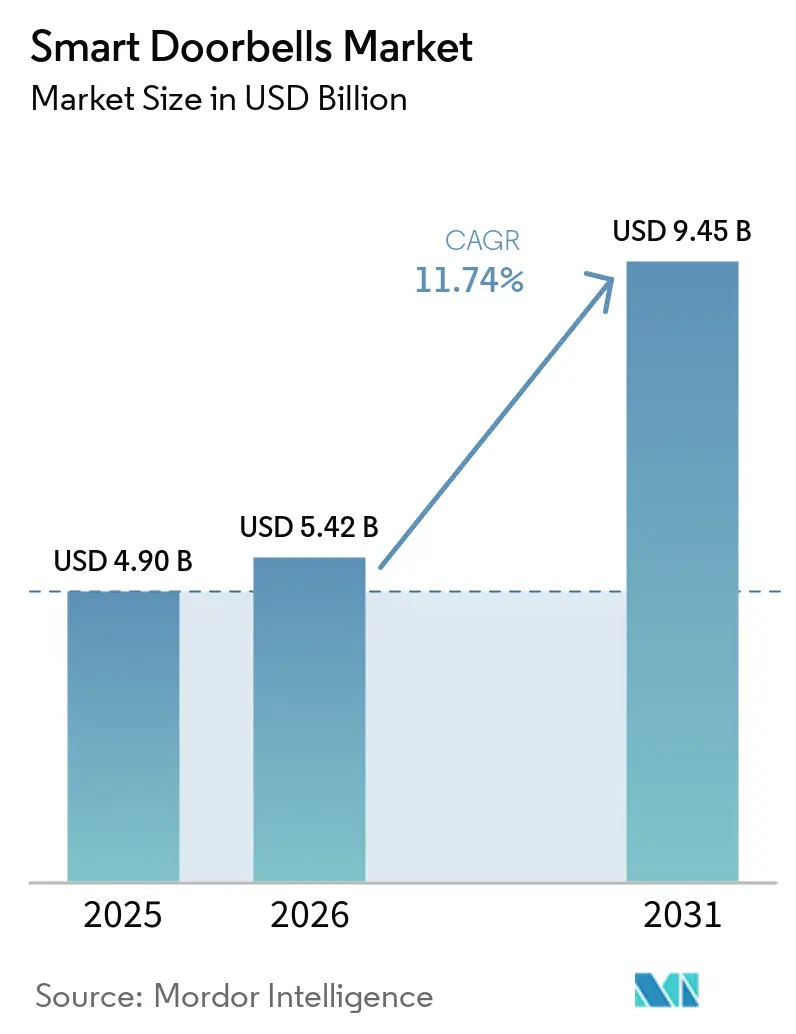
| Market Size (2026) | USD 5.42 Billion |
| Market Size (2031) | USD 9.45 Billion |
| Growth Rate (2026 - 2031) | 11.74% CAGR |
| Fastest Growing Market | Asia-Pacific |
| Largest Market | North America |
| Market Concentration | Medium |
Major Players *Disclaimer: Major Players sorted in no particular order Image © Mordor Intelligence. Reuse requires attribution under CC BY 4.0. | |
Smart Doorbells Market Analysis by Mordor Intelligence
The smart doorbells market size was valued at USD 4.9 billion in 2025 and is estimated to expand from USD 5.42 billion in 2026 to USD 9.45 billion by 2031, at a CAGR of 11.74% during the forecast period (2026-2031). Package theft has made front-door monitoring a practical household need rather than a discretionary smart-home purchase. The U.S. Postal Service Office of Inspector General documented the operational and financial burden that package theft places on consumers, retailers, carriers, and law enforcement, which supports recurring demand for visible front-door surveillance. AI-based visitor recognition, package alerts, and context-aware notifications are expanding the role of smart doorbells from a camera into a connected access point. Manufacturers are also competing through local processing, flexible installation, and compatibility with major home automation systems. These capabilities create opportunities with insurers, property managers, and emergency-response services, while privacy rules, subscription costs, and device reliability remain material constraints.
Key Report Takeaways
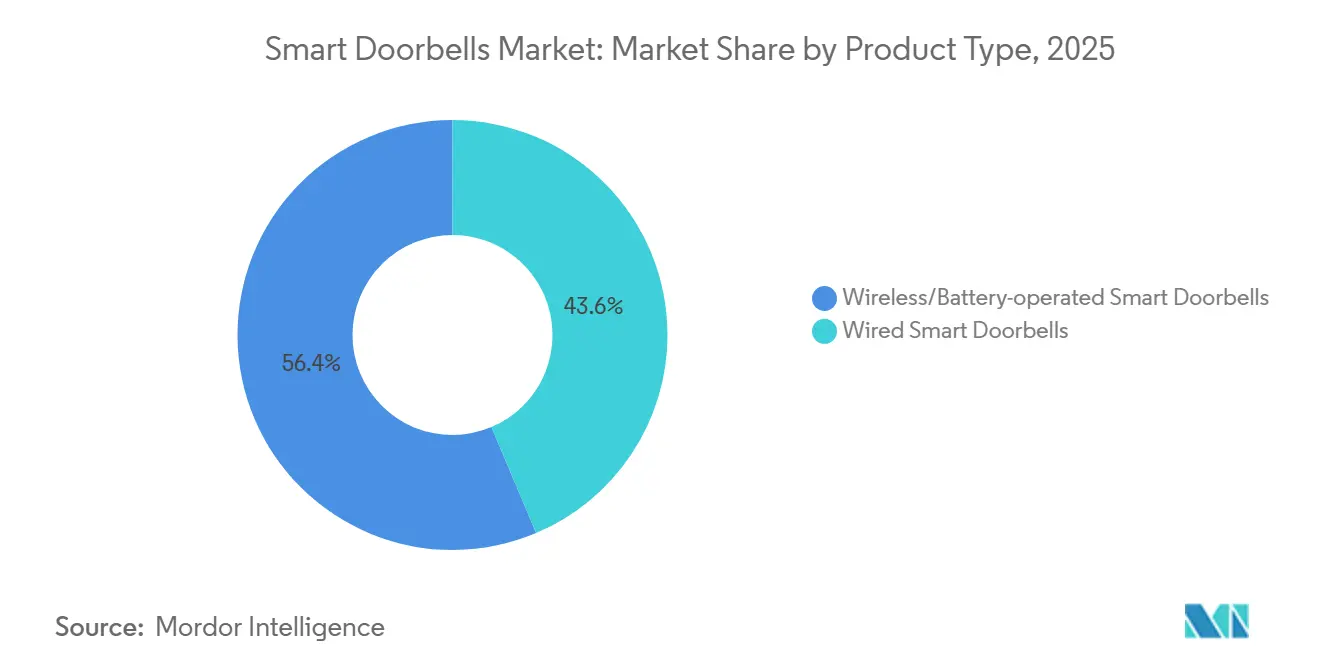
- By product type, wireless/battery-operated models held 56.36% share of the smart doorbells market in 2025 and are projected to expand at a 13.81% CAGR through 2031.
- By connectivity, Wi-Fi held 71.32% share of the smart doorbells market in 2025 and is expected to expand at a 12.97% CAGR through 2031.
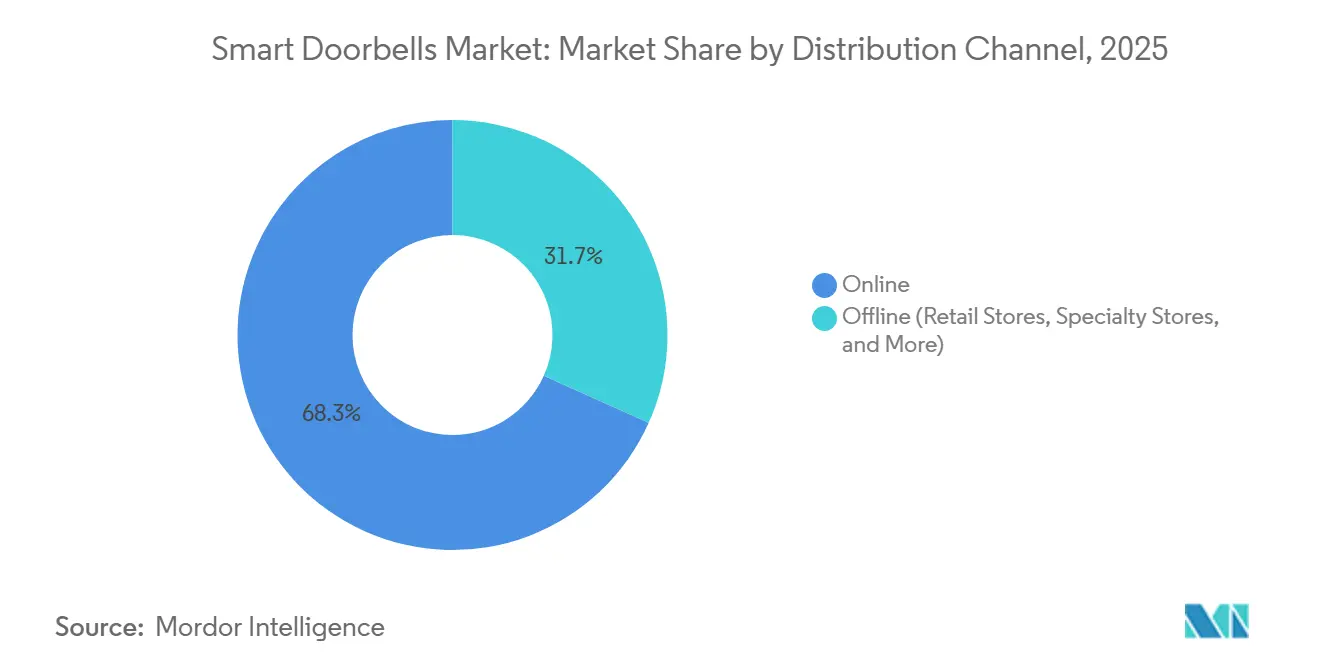
- By distribution channel, online channels accounted for 68.25% share of the smart doorbells market in 2025 and are projected to advance at a 12.63% CAGR through 2031.
- By end-user industry, residential users captured 81.21% share of the smart doorbells market in 2025, while commercial users are expected to record the highest CAGR of 13.72% through 2031.
- By geography, North America accounted for 41.23% share of the smart doorbells market in 2025, while Asia-Pacific is projected to post the highest CAGR of 14.03% through 2031.
Note: Market size and forecast figures in this report are generated using Mordor Intelligence’s proprietary estimation framework, updated with the latest available data and insights as of January 2026.
Global Smart Doorbells Market Trends and Insights
Drivers Impact Analysis*
| Driver | (~) % Impact on CAGR Forecast | Geographic Relevance | Impact Timeline |
|---|---|---|---|
| Rising Home Security and Package Theft Concerns | +2.8% | Global, with acute concentration in North America and Western Europe | Short term (≤ 2 years) |
| AI-Based Person, Package, and Facial Recognition | +2.2% | North America and Asia-Pacific core, spillover to Europe | Medium term (2-4 years) |
| Smart Home Ecosystem Integration | +1.8% | North America, Europe, South Korea, and Japan | Medium term (2-4 years) |
| Edge Processing and Privacy-Preserving Local Storage | +1.3% | Global, with strong pull in EU privacy-regulated markets | Long term (≥ 4 years) |
| DIY Installation and Battery-Powered Flexibility | +1% | North America, United Kingdom, and Australia | Short term (≤ 2 years) |
| Video Doorbells as Multifamily and Property Management Infrastructure | +0.7% | North America urban core and Asia-Pacific dense-city markets | Medium term (2-4 years) |
| Source: Mordor Intelligence | |||
Rising Home Security and Package Theft Concerns
Package theft has become a widespread household concern, driving demand for front-door monitoring devices in the smart doorbell market. The U.S. Postal Service Office of Inspector General stated that package theft creates financial losses and operating disruptions across the e-commerce ecosystem, not only for individual households.[1]U.S. Postal Service Office of Inspector General, “Package Theft in the United States,” U.S. Postal Service Office of Inspector General, uspsoig.gov Doorbell cameras are increasingly used to document delivery activity and provide footage that can support local investigations. Same-day and next-day deliveries have extended this need beyond the traditional holiday buying period. Households that have experienced theft have a clear reason to prioritize a device that records activity at the point of delivery. This recurring concern drives replacement demand in the smart doorbell market, as users seek improved video quality, alerts, and storage options.
AI-Based Person, Package, and Facial Recognition
AI capabilities have become a core product requirement in the smart doorbells market, rather than a feature limited to premium models. Ring introduced Familiar Faces in September 2025, providing personalized visitor alerts by distinguishing known people from unfamiliar visitors. Ring also presented Alexa+ Greetings, which can respond to visitors, provide delivery instructions, and screen solicitors without requiring the owner to intervene. Eufy's Video Doorbell S4 added a 3K 9 MP camera, a 180° field of view, and on-device facial recognition, bringing advanced functions into a device with both battery and wired options. On-device processing can reduce the delay associated with cloud-dependent notifications, which matters when users evaluate the reliability of a security alert. The wider adoption of AI features in the smart doorbell market also broadens the price range and creates a clearer distinction between basic recording products and higher-value access devices.
Smart Home Ecosystem Integration
Cross-platform compatibility is becoming more important as households use multiple connected devices from different brands. The Connectivity Standards Alliance released Matter 1.5 in November 2025, adding video doorbells and security cameras to the specification. Matter 1.5.1, released on March 31, 2026, improved multi-stream video efficiency, HEIC snapshot support, and doorbell interoperability. Matter 1.6, released on June 22, 2026, added joint-fabric coordination, allowing a device to work across Apple Home, Amazon Alexa, and Google Home without an additional authorization step. The Wi-Fi Alliance also introduced Wi-Fi for Matter certification in September 2025 to reduce friction between access-point setup and Matter requirements. These standards reduce the historical advantage of closed ecosystems and give challengers in the smart doorbell market a more credible route into multi-brand homes.
Edge Processing and Privacy-Preserving Local Storage
Local processing is gaining importance among buyers who do not want a cloud-first security system. Aqara released the Doorbell Camera G400 in March 2026 at USD 100 with Power over Ethernet, dual-band Wi-Fi 6, on-device person recognition, and continuous local recording to microSD cards up to 512 GB. Reolink released the Video Doorbell 2nd Gen in July 2026 with Qualcomm QCC730 technology, on-device detection for people, vehicles, animals, and packages, and no cloud subscription required. Reolink stated that the micro-power Wi-Fi design can provide up to 50% longer battery life than standard Wi-Fi cameras. Local inference can reduce notification delays, lower long-term subscription spending, and limit external access to video data. These features support the smart doorbells market demand for wired and PoE products among buyers who value continuous recording, dependable power, and greater control over their footage.
Restraints Impact Analysis*
| Restraint | (~) % Impact on CAGR Forecast | Geographic Relevance | Impact Timeline |
|---|---|---|---|
| Privacy, Facial Recognition, and Video Recording Restrictions | -1.4% | North America state-level, EU GDPR, and United Kingdom UK GDPR/Data Use and Access Act 2025 | Short term (≤ 2 years) |
| Cybersecurity Breaches and Cloud Data Exposure | -1.1% | Global | Medium term (2-4 years) |
| Subscription Fatigue and Total Cost of Ownership | -0.7% | North America and Western Europe | Short term (≤ 2 years) |
| Wi-Fi Reliability and Battery Performance Constraints in Multifamily Buildings | -0.4% | North America multifamily properties and dense-city Asia-Pacific | Medium term (2-4 years) |
| Source: Mordor Intelligence | |||
Privacy, Facial Recognition, and Video Recording Restrictions
Privacy rules are a significant near-term constraint on deploying AI features in the smart doorbell market. A June 2026 federal lawsuit in Washington state alleged that Ring's Familiar Faces feature scanned and stored bystanders' biometric identifiers without their consent. Senator Ed Markey stated in a February 2026 letter that Ring's privacy protections applied to owners who opted in, without an equivalent consent path for people whose devices may be scanned.[2]Edward J. Markey, “Follow-Up Letter to Amazon CEO Andy Jassy on Ring Familiar Faces Facial Recognition,” U.S. Senate, markey.senate.gov The Information Commissioner's Office states that commercial users of smart doorbells processing facial recognition data must identify a lawful basis and conduct a data protection impact assessment. Ring disabled Familiar Faces in Illinois, Texas, and Portland, Oregon, showing how feature availability can vary by jurisdiction. Maintaining separate feature settings across U.S. states, the European Union, and the United Kingdom raises product development costs across the smart doorbell market and can make higher-tier services harder to explain to customers.
Cybersecurity Breaches and Cloud Data Exposure
Firmware weaknesses can expose home networks and video streams, creating risks for users and the reputation of the smart doorbell market. The National Vulnerability Database recorded CVE-2025-64983 for SwitchBot's Smart Video Doorbell in November 2025, identifying an active debug code issue that could grant an attacker full Telnet access on firmware versions before 2.01.078. The same database published CVE-2025-55637 for Reolink's Smart 2K+ plug-in Wi-Fi video doorbell, identifying a command-injection vulnerability with a CVSS score of 9.8. It also documented CVE-2025-55627, an improper privilege-management weakness that could allow the creation of elevated accounts on the affected Reolink product. These disclosures show why timely firmware updates, secured credentials, and transparent vulnerability management are essential for manufacturers. The risk is particularly important for value-tier devices in the smart doorbell market that rely on shared cloud relay infrastructure, because a single exposed credential can affect multiple customers.
*Our forecasts treat driver/restraint impacts as directional, not additive. The impact forecasts reflect baseline growth, mix effects, and variable interactions.
Segment Analysis
By Product Type: Wireless Models Lead While Wired Configurations Defend Premium Niches
Wireless and battery-operated devices accounted for 56.36% of 2025 revenue and are projected to grow at a 13.81% CAGR through 2031. Their leading position reflects the limited ability of renters and many multifamily residents to make permanent wiring changes. This condition makes battery-powered devices the practical choice for many first-time buyers. Wyze released a battery video doorbell in October 2025 at USD 66, with a stated battery life of 3-6 months and a 150° × 150° field of view. The product shows that feature availability in entry-level wireless smart doorbells has improved. Wireless devices also support easy relocation when residents move, which is useful in rental housing.
Wired configurations continue to serve premium residential and commercial use cases in the smart doorbells market. Aqara's G400 pairs Power over Ethernet with continuous recording, serving property managers who need uninterrupted operation and do not want to manage battery replacement. Ring introduced a battery-powered 4K Doorbell Pro 2nd Gen in March 2026 with 10x zoom, color night vision, and a USD 250 price point, showing that premium features are moving into wireless formats. The model also supports a USD 50 solar charger, which can reduce charging needs. Building codes in multifamily sites can still require professionally installed hard-wired intercom and access-control systems. These requirements preserve a role for wired models where uptime, centralized maintenance, and access compliance matter.


By Connectivity: Wi-Fi Dominance Deepens as Matter Extends Cross-Platform Reach
Wi-Fi accounted for 71.32% of revenue in 2025 and is expected to grow at a 12.97% CAGR through 2031, the highest rate among connectivity categories. Most homes already have router coverage, making Wi-Fi a convenient option in the smart doorbell market. Matter's Wi-Fi-native commissioning path also supports simpler setup across compatible systems. The Wi-Fi Alliance and the Connectivity Standards Alliance introduced Wi-Fi for Matter certification in September 2025, creating a joint certification path for qualifying access points. This effort addresses setup failures that have historically affected first-time device activation. Reliable home network performance remains vital because doorbell locations may be at the outer edge of router coverage.
Ethernet and PoE represent a smaller but strategically important share of the smart doorbell market for commercial and premium homes. This connection provides stable power and supports uninterrupted video recording. Aqara positioned the G400 for this need by combining PoE support with dual-band Wi-Fi 6 and local storage. Cellular connectivity plays a limited role but remains relevant for remote properties and mobile security applications. Bluetooth is mainly used for onboarding and short-range device communication rather than for primary video streaming. Matter 1.5.1 improved multi-stream video efficiency, allowing devices to better support archival and mobile viewing needs across connected systems.
By Distribution Channel: Online Channels Consolidate Their Lead Through Digital Discovery
Online channels accounted for 68.25% of revenue in 2025 and are projected to advance at a 12.63% CAGR through 2031. This lead reflects consumer comfort with comparing camera resolution, field of view, installation requirements, and cloud-plan terms online. Direct-to-consumer websites and digital marketplaces also give manufacturers of smart doorbells greater control over product education and accessory sales. Strong customer reviews can improve product discovery for devices that are easy to compare through specifications. Prime Day promotions and Alexa hardware bundles give Ring and related Amazon brands significant online visibility. Eufy and Reolink have also benefited from online review ecosystems that can lower their reliance on paid customer acquisition.
Offline distribution remains relevant in the smart doorbell market, where buyers require advice, installation, or broader security system integration. Specialty security dealers, electrical retailers, and home-improvement stores help commercial users evaluate system design before purchase. Professionally monitored brands have historically relied more heavily on these channels. ADT launched ADT Blu in May 2026 as a self-installed, contract-free system with a doorbell camera, sold through Amazon.[3]ADT Inc., “ADT ‘Moves In’ to the DIY Security Market with ADT Blu, Bringing 150 Years of Trusted Protection to the Self-Install Era,” ADT, adt.com The move combines a traditional security brand with a direct online route to customers. This hybrid approach narrows the divide between digital self-install sales and professional security distribution.
By End-User Industry : Residential Demand Anchors Volume While Commercial Use Changes the Revenue Mix
Residential users held 81.21% of revenue in 2025, reflecting the consumer-led origin of video doorbell adoption. Homeowners and renters use these devices to check visitors, deliveries, and activity near the entrance. Bundled home-security offerings helped establish this use case early in the category's development. The commercial segment is projected to expand at a 13.72% CAGR through 2031, supported by multifamily properties, short-term rentals, retail sites, and managed premises. These users need scalable access management and video monitoring. Their requirements often include centralized administration and reliable support across many locations.
Commercial adoption is expanding the smart doorbells market beyond a single-household hardware sale. Amazon introduced its Key Access Control System for multifamily properties in June 2025, allowing residents to admit visitors, approved delivery drivers to obtain access, and managers to use an online management portal. Property managers may require centralized firmware management, multi-unit licenses, and service-level commitments. These needs can provide manufacturers with recurring service revenue in addition to consumer subscriptions. Ring opened its app store in March 2026 to support services in elder care, rental management, workforce analytics, and other fields. This approach seeks to extend the value of a device network into managed-property and care applications.
Geography Analysis
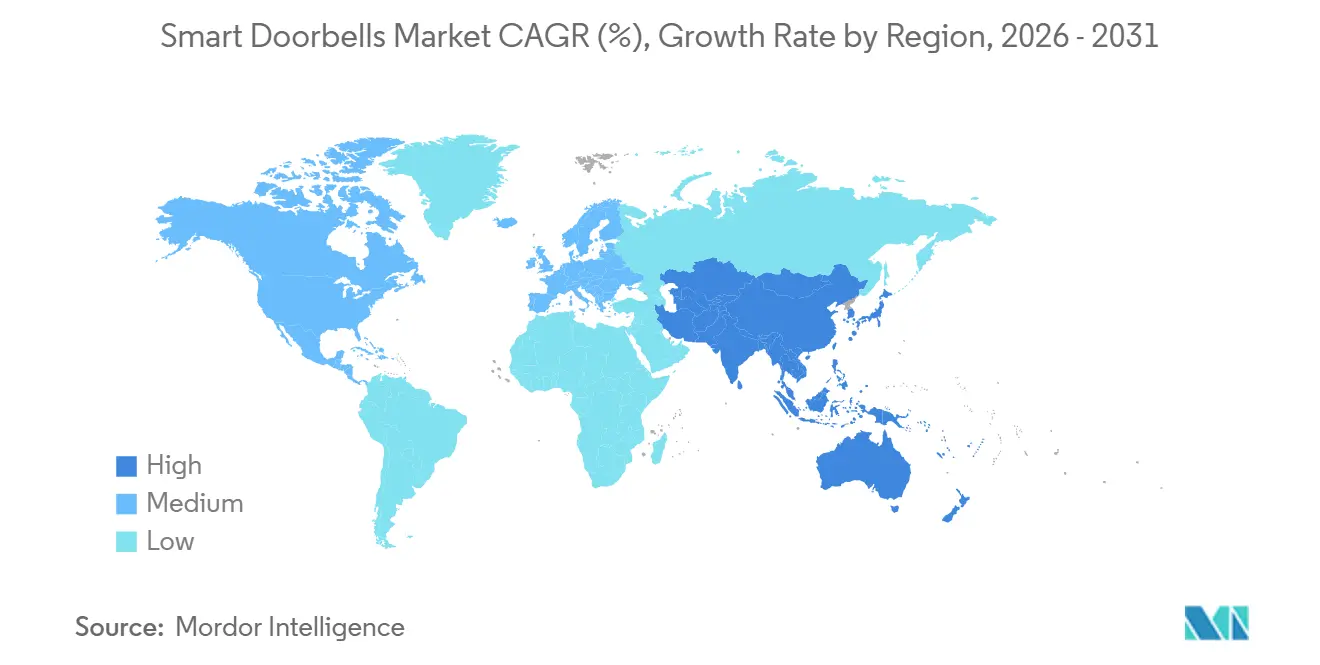
North America accounted for 41.23% of 2025 revenue, the highest share of the smart doorbells market among regions. High household broadband use, strong consumer purchasing power, and insurance programs that support home security adoption have reinforced demand. Security and surveillance systems represented the largest product category in North American smart-home revenue in 2025. The United States remains the regional anchor, with demand centered on AI-enabled monitoring and connected-home compatibility. Canada follows similar patterns at a smaller scale. Mexico has stronger momentum in metropolitan areas, where property security concerns bolster purchase intent.
Asia-Pacific is projected to record the highest regional CAGR of 14.03% through 2031. India is building a larger connected-home base, while China provides a large manufacturing platform that supports lower price points and export activity. As per Mordor's study findings for India smart home market report, India's smart-home sector was valued at USD 5.2 billion in 2025 and is estimated at USD 6.71 billion in 2026, with a projected CAGR of 29.12% through 2031. Security products are among the most widely adopted categories in this setting. South Korea and Japan have dense apartment housing, where installation restrictions can favor wired or PoE models. Southeast Asian countries offer additional potential as e-commerce activity and urban household formation expand.
Europe, South America, the Middle East, and Africa accounted for the balance of 2025 revenue. Germany, the United Kingdom, France, Italy, and Spain are Europe's main demand centers, but privacy obligations can limit some AI features. The United Kingdom's data-protection guidance requires commercial smart doorbell users to assess lawful processing and related safeguards for video and biometric information.[4]Information Commissioner’s Office, “Smart Doorbells (Commercial Use),” Information Commissioner’s Office, ico.org.uk This environment supports interest in local storage that reduces cloud data retention. Brazil is a notable South American opportunity where demand for urban property security is underserved. In the Middle East and Africa, Saudi Arabia and the UAE benefit from smart-city investment, while infrastructure availability and affordability constrain adoption in Nigeria and South Africa.

Competitive Landscape
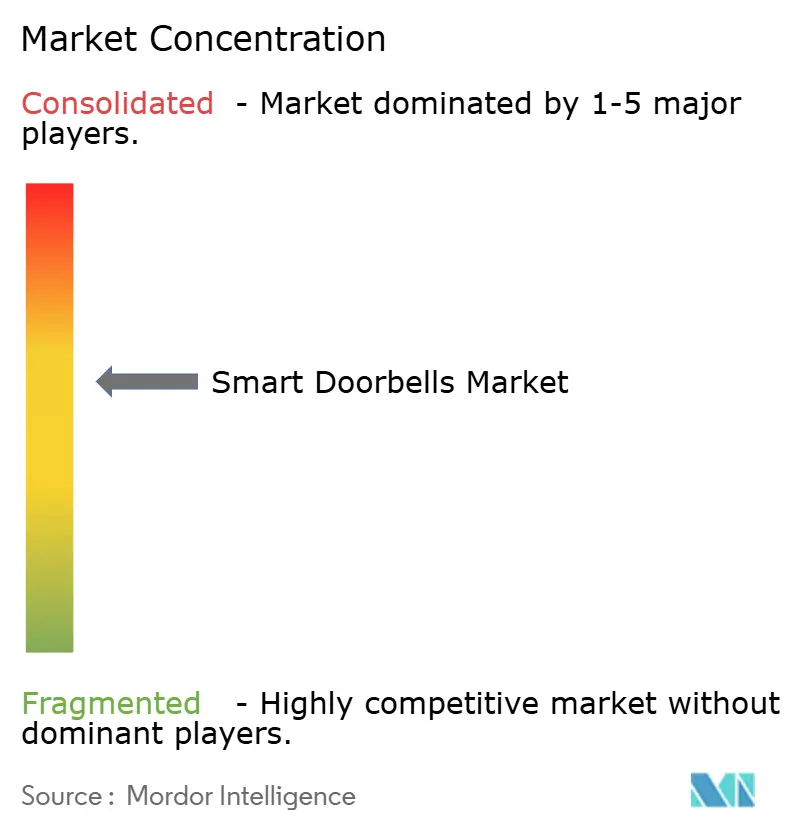
The smart doorbells market is moderately consolidated at the premium tier, where Ring and Google benefit from deeply integrated home platforms. Ring uses Alexa integration, while Google uses Google Home automation, to make their devices part of a larger connected-home experience. Eufy, Wyze, Arlo, Reolink, and Aqara compete in mid-tier and value positions through feature sets, lower prices, and subscription alternatives. This competition makes detection quality, local storage, and installation flexibility important purchasing factors. Ring's 100-million-device installed base gives it a sizable platform from which to introduce additional services. Its March 2026 app store applies a 10% developer commission and opens services for elder care, rental management, retail analytics, and environmental monitoring.
Partnerships are becoming more important than standalone hardware sales in the smart doorbells market. Arlo is embedding its security software services into Samsung SmartThings and plans to integrate with Comcast Xfinity, targeting 31 million broadband subscribers for a 2026-2027 launch. This model gives a security provider access to broad platform distribution without relying only on direct device sales. Arlo also acquired Aloe Care Health in April 2026 to extend its software platform into aging-in-place and wellness care.[5]Arlo Technologies, Inc., “Arlo Acquires Aloe Care Health, Expanding Arlo SaaS Platform to Support Aging in Place and Wellness Care,” Arlo Technologies, arlo.com The company reported USD 357 million in annualized recurring revenue in the first quarter of 2026. This strategy moves competition toward service bundles that address security, care, and property management.
Aqara and Reolink are differentiated challengers because they emphasize local processing and subscription-free storage. Aqara released the Matter-certified Camera Hub G350 and the Doorbell Camera G400 in March 2026, offering products that do not require a cloud subscription. Reolink's July 2026 product release combines local smart detection with a stated USD 130 price and no required cloud plan. Privacy concerns drive demand for products that process footage locally and reduce exposure of cloud data. Large commercial brands have not fully served this preference across all price bands. Competition will therefore continue to depend on ecosystem access, privacy controls, and whether companies can turn installed hardware into recurring service relationships.
Smart Doorbells Industry Leaders
Ring LLC (Amazon.com, Inc.)
Google LLC
Arlo Technologies, Inc.
Anker Innovations Limited (Eufy)
SimpliSafe, Inc.
- *Disclaimer: Major Players sorted in no particular order

Recent Industry Developments
- July 2026: Reolink Innovation Limited released the Video Doorbell 2nd Gen, incorporating the Qualcomm QCC730 micro-power Wi-Fi solution and delivering up to 50% longer battery life than standard Wi-Fi cameras, with on-device smart detection for people, vehicles, animals, and packages, at USD 129.99. The device positions itself as a subscription-free challenger to mid-tier cloud-dependent models.
- March 2026: Ring launched its app store, opening its 100-million-device camera network to third-party developers across the elder care, retail analytics, rental management, and environmental monitoring verticals, with 15 apps available at launch and a target of hundreds by year-end.
- March 2026: Aqara released the Doorbell Camera G400, its first wired doorbell to support Power over Ethernet and dual-band Wi-Fi 6, at USD 100, with on-device person recognition, 2K resolution, and local microSD storage up to 512 GB, reinforcing Aqara's subscription-free and privacy-focused positioning.
- March 2026: Alarm.com Holdings, Inc. launched the ADC-VDB775 Video Doorbell, which integrates AI Video Event Search, onboard microSD recording, and Perimeter Guard alerts for residential and commercial properties within its managed-security platform.


Global Smart Doorbells Market Report Scope
The smart doorbells market encompasses connected doorbell devices equipped with video, audio, motion detection, and communication capabilities, enabling users to remotely monitor, interact with, and manage visitors via smartphones, tablets, or other connected devices. The market includes wired and wireless/battery-operated smart doorbells utilizing connectivity technologies such as Wi-Fi, Ethernet/Power over Ethernet (PoE), cellular, Bluetooth, and other supported technologies. These devices are deployed across residential and commercial premises for entrance monitoring, visitor communication, package monitoring, security surveillance, and integration with broader smart home or building security ecosystems.
The Smart Doorbells Market Report is Segmented by Product Type (Wired Smart Doorbells, and Wireless/Battery-Operated Smart Doorbells), Connectivity (Ethernet/PoE, Wi-Fi, Cellular, Bluetooth, and Other Technologies), Distribution Channel (Online, and Offline (Retail Stores, Specialty Stores, and More)), End-User Industry (Residential, and Commercial), and Geography (North America, South America, Europe, Asia-Pacific, and Middle East and Africa). The Market Forecasts are Provided in Terms of Value (USD).
| Wired Smart Doorbells |
| Wireless/Battery-operated Smart Doorbells |
| Ethernet/Power over Ethernet (PoE) |
| Wi-Fi |
| Cellular |
| Bluetooth |
| Other Connectivity Technologies |
| Online |
| Offline (Retail Stores, Specialty Stores, and More) |
| Residential |
| Commercial |
| North America | United States | |
| Canada | ||
| Mexico | ||
| South America | Brazil | |
| Argentina | ||
| Rest of South America | ||
| Europe | Germany | |
| United Kingdom | ||
| France | ||
| Italy | ||
| Spain | ||
| Rest of Europe | ||
| Asia-Pacific | China | |
| Japan | ||
| India | ||
| South Korea | ||
| Rest of Asia-Pacific | ||
| Middle East and Africa | Middle East | Saudi Arabia |
| United Arab Emirates | ||
| Turkey | ||
| Rest of the Middle East | ||
| Africa | South Africa | |
| Nigeria | ||
| Rest of Africa | ||
| By Product Type | Wired Smart Doorbells | ||
| Wireless/Battery-operated Smart Doorbells | |||
| By Connectivity Technology | Ethernet/Power over Ethernet (PoE) | ||
| Wi-Fi | |||
| Cellular | |||
| Bluetooth | |||
| Other Connectivity Technologies | |||
| By Distribution Channel | Online | ||
| Offline (Retail Stores, Specialty Stores, and More) | |||
| By End-User Industry | Residential | ||
| Commercial | |||
| By Geography | North America | United States | |
| Canada | |||
| Mexico | |||
| South America | Brazil | ||
| Argentina | |||
| Rest of South America | |||
| Europe | Germany | ||
| United Kingdom | |||
| France | |||
| Italy | |||
| Spain | |||
| Rest of Europe | |||
| Asia-Pacific | China | ||
| Japan | |||
| India | |||
| South Korea | |||
| Rest of Asia-Pacific | |||
| Middle East and Africa | Middle East | Saudi Arabia | |
| United Arab Emirates | |||
| Turkey | |||
| Rest of the Middle East | |||
| Africa | South Africa | ||
| Nigeria | |||
| Rest of Africa | |||


Key Questions Answered in the Report
What is the smart doorbells market size?
The sector was valued at USD 4.90 billion in 2025, is estimated at USD 5.42 billion in 2026, and is projected to reach USD 9.45 billion by 2031 at an 11.74% CAGR.
What is driving adoption of smart doorbells?
Package theft concerns, AI-based visitor and package detection, smart-home compatibility, and easier battery-powered installation are supporting demand.
Which smart doorbell product type leads demand?
Wireless and battery-operated devices led with 56.36% of 2025 revenue and are projected to advance at a 13.81% CAGR through 2031.
Why is Wi-Fi the leading connectivity option?
Wi-Fi held 71.32% of 2025 revenue because it uses existing home networks and is supported by Matter-related interoperability improvements.
Which region is expanding fastest for smart doorbells?
Asia-Pacific is projected to record the highest regional CAGR of 14.03% through 2031, supported by India, China, South Korea, Japan, and Southeast Asia.
What issues can limit use of video doorbells?
Privacy restrictions, cybersecurity vulnerabilities, recurring cloud-plan costs, limited Wi-Fi coverage, and cold-weather battery performance can affect adoption and use.
Page last updated on:






