
Small Marine Engines Market Size and Share
Market Overview
| Study Period | 2020 - 2032 |
|---|---|
| Market Size (2027) | USD 9.85 Billion |
| Market Size (2032) | USD 12.69 Billion |
| Growth Rate (2027 - 2032) | 5.21 % |
| Fastest Growing Market | Asia-Pacific |
| Largest Market | North America |
| Market Concentration | Medium |
Major Players *Disclaimer: Major Players sorted in no particular order Image © Mordor Intelligence. Reuse requires attribution under CC BY 4.0. | |
Small Marine Engines Market Analysis by Mordor Intelligence
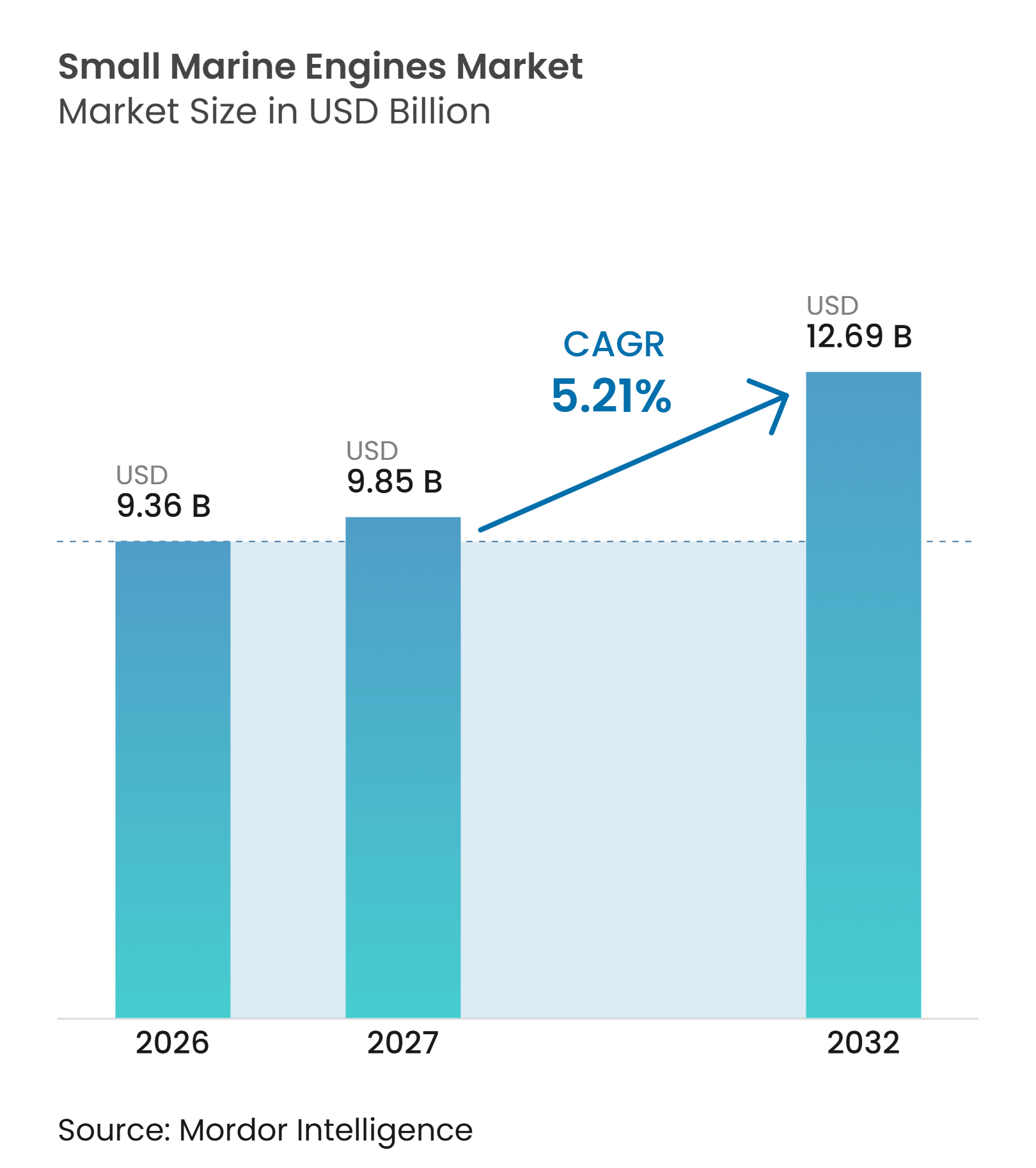
The small marine engines market size was valued at USD 9.36 billion in 2026 and is estimated to grow from USD 9.85 billion in 2027 to reach USD 12.69 billion by 2032, at a CAGR of 5.21% during the forecast period (2027-2032). The small marine engines market is supported by new-boat deliveries, replacement demand from aging engines, and rising interest in higher-power propulsion packages. U.S. new powerboat sales reached 220,397 units in 2025, while fishing boats led the category with 77,434 units, which supports demand for engines across recreational and fishing uses. Growth is also shaped by the move toward center consoles, walkaround cabins, commercial workboats, and other hulls that often use higher-horsepower outboards or multiple engines. This raises engine value per boat even when boat-unit growth slows. Patrol vessels, aquaculture boats, and ferry services also create demand that is less linked to consumer spending patterns.
Key Report Takeaways
-
By placement, outboard engines held 62.38% of the small marine engines market share in 2026, while others, including jet drives and pod drives, are forecast to grow at a 6.38% CAGR through 2032.
-
By fuel type, gasoline held 78.26% of the small marine engines market share in 2026, while electric propulsion is forecast to grow at a 14.27% CAGR through 2032.
-
By power rating, 51 to 150 hp held 34.17% of the small marine engines market in 2026, while 301 to 600 hp is forecast to grow at a 6.84% CAGR through 2032.
-
By application, recreational boats held 64.42% of the market in 2026, while commercial and workboats are forecast to grow at a 6.12% CAGR through 2032.
-
By sales channel, OEM boat builders held 71.36% of the market in 2026, while aftermarket and repower sales are forecast to grow at a 5.73% CAGR through 2032.
-
By geography, North America held 41.27% of the market in 2026, while Asia-Pacific is forecast to grow at a 6.46% CAGR through 2032.
Note: Market numbers in this report are based on Mordor Intelligence's proprietary estimation framework, which combines nine months of actuals with Q4 projections for base year 2026.
Market Trends and Insights
Drivers Impact Analysis of Small Marine Engines Market*
| Driver | (~) % Impact on CAGR Forecast | Geographic Relevance | Impact Timeline |
|---|---|---|---|
| Growth in Recreational and Small Commercial Boat Deliveries | +1.8% | North America and Europe core, spill-over to APAC | Medium term (2-4 years) |
| Rising Repower Demand from Aging Installed Engines | +1.4% | North America, Europe, APAC coastal markets | Medium term (2-4 years) |
| Higher-Horsepower Outboard Adoption and Multi-Engine Rigging | +0.8% | North America, Europe, Australia | Short term (≤ 2 years) |
| Emission Compliance Driving New-Engine Replacement | +0.6% | North America, EU, China | Short term (≤ 2 years) |
| Expansion Of Electric Propulsion in Protected and Short-Range Waterways | +0.5% | EU, North America, APAC urban waterways | Long term (≥ 4 years) |
| Expansion of Small-Vessel Fishing, Patrol and Workboat Fleets | +0.4% | APAC, South America, MEA | Medium term (2-4 years) |
| Source: Mordor Intelligence | |||
Growth in Recreational and Small Commercial Boat Deliveries
New-boat deliveries create direct engine demand because every completed hull requires a propulsion package. In 2025, pontoon boats accounted for 33.6% of new U.S. powerboat sales, and outboard-powered boats remained important in core sales volumes[1]. The small marine engines market also benefits because growing hull categories often require more valuable engine configurations. Center consoles and aluminum workboats commonly use higher-horsepower installations, and some use multiple engines. Aquaculture operators, harbor patrol agencies, and coastal ferry services buy vessels through fleet-renewal programs that follow operating needs rather than household spending. This mix allows engine revenue to rise faster than boat-unit sales when each new boat requires greater installed power.
Rising Repower Demand from Aging Installed Engines
The large installed engine base provides replacement demand that is less exposed to changing interest rates than new boat purchases. The aftermarket and repower channel is forecast to grow at a 5.73% CAGR from 2027 to 2032. Owners replacing older engines often select more horsepower and updated digital controls rather than choosing a direct equivalent. Mercury Marine presented its Single Engine Joystick with Thruster at the 2025 Miami International Boat Show, illustrating the control features available to owners moving from older propulsion systems. Certified service networks and compatible digital systems give established suppliers an advantage when boat owners compare replacement options. The small marine engines market therefore gains a steadier source of demand from repower decisions as well as from new vessel orders.
Higher-Horsepower Outboard Adoption and Multi-Engine Rigging
The 301–600 hp category is forecast to grow at a 6.84% CAGR from 2027 to 2032. Center-console and offshore hulls increasingly use triple- or quad-outboard arrangements, which increase the number of engines installed on each vessel. Mercury Marine introduced the V10 425 hp Verado in July 2025, and Honda presented the BF300 V8 in January 2025 before its commercial rollout in Japan later that year[2]. A multi-engine repower generates several engine sales within a single vessel transaction. It also makes the connected controls, displays, and synchronization capability part of the purchase decision. Suppliers with compatible systems across multiple engines are better positioned in this premium segment of the small marine engine market.
Emission Compliance Driving New-Engine Replacement
Emissions rules influence replacement choices by defining the engine certifications needed for market access. U.S. regulations cover marine spark-ignition engines under 40 CFR Part 1045 and marine diesel engines under 40 CFR Part 1042[3]. In Europe, Directive 2013/53/EU requires CE certification and Stage II exhaust emission limits for propulsion engines placed on the market[4]. China applies GB 15097 to domestic marine engine emissions. Meeting several standards requires engineering, certification, and product testing, which increases the difficulty for smaller, new suppliers to enter the small marine engine market.
Restraints Impact Analysis of Small Marine Engines Market*
| Restraint | (~) % Impact on CAGR Forecast | Geographic Relevance | Impact Timeline |
|---|---|---|---|
| High Battery Cost and Limited Charging Infrastructure for Electric Engines | -0.7% | Global, most acute in APAC and MEA | Long term (≥ 4 years) |
| Marine Corrosion, Infrequent Use and Harsh Duty-Cycle Reliability Requirements | -0.4% | Global | Medium term (2-4 years) |
| Fragmented Dealer and Service Coverage in Emerging Marine Markets | -0.3% | APAC, South America, MEA | Medium term (2-4 years) |
| Engine-Boat Integration Complexity and Certification Cost | -0.2% | Global, acute in EU and North America | Short term (≤ 2 years) |
| Source: Mordor Intelligence | |||
High Battery Cost and Limited Charging Infrastructure for Electric Engines
Electric propulsion has the highest fuel-type growth rate, but it remains constrained by battery costs and limited access to charging. Marine battery packs cost more upfront than gasoline systems, while charging remains limited at many marinas, fishing harbors, and commercial ports. California support for Photon Marine and Silverback Marine workboats through the CARB Clean Off-Road Equipment Voucher Program further shows the role of public incentives in early commercial adoption. Electric engines are more practical for short routes, protected waterways, and noise-sensitive uses than for long offshore trips. Broader use will depend on battery economics and charging availability across normal operating cycles.
Marine Corrosion, Infrequent Use and Harsh Duty-Cycle Reliability Requirements
Saltwater exposure places severe demands on engine materials, electrical connections, and protective coatings. Recreational engines may sit idle for long periods and then experience high-load cold starts, which can shorten effective service intervals and increase warranty exposure. Electric and hybrid systems include battery management systems, high-voltage connectors, and power electronics that have less long-term field experience than established gasoline platforms. Existing manufacturers have built corrosion protection into anodes, paint systems, and internal components over many years. Cox Marine has tested its V8 diesel outboard under Doha's heat conditions, underscoring the importance of validating engines beyond temperate environments. These reliability requirements slow adoption of newer propulsion systems in the small marine engines market.
*Our forecasts treat driver/restraint impacts as directional, not additive. The impact forecasts reflect baseline growth, mix effects, and variable interactions.
Small Marine Engines Market Segment Analysis
By Placement:
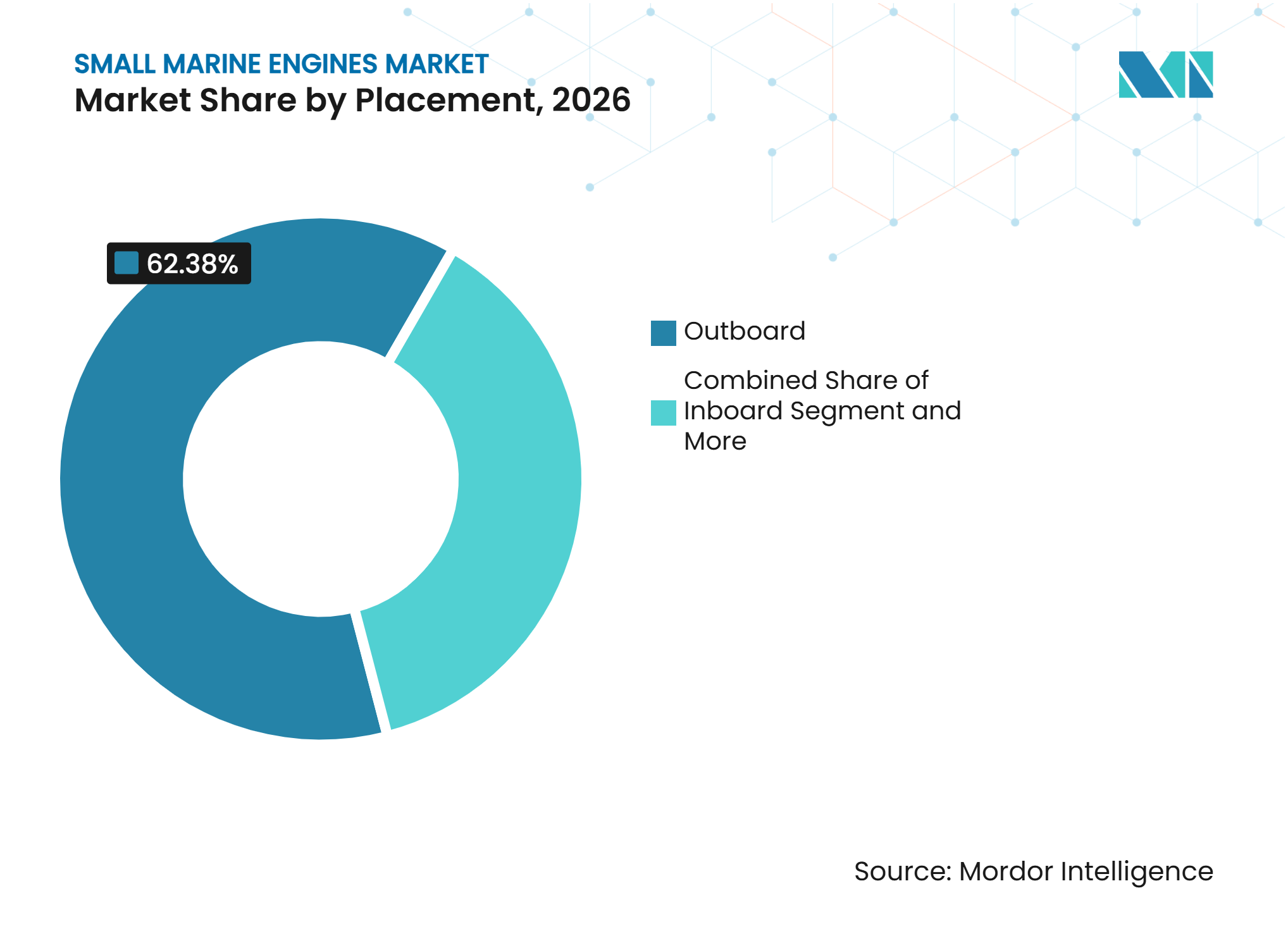
Outboard Configuration Anchors Market VolumeOutboard engines accounted for 62.38% of the small marine engine market in 2026. Their position reflects use across fishing boats, utility craft, pontoons, and many recreational hull types, allowing a common product format to serve owners whose boating patterns, water conditions, and operating priorities differ substantially. An outboard can be replaced without dry-docking the boat or changing the hull, which suits the repower channel and reduces disruption for owners who want to keep an otherwise serviceable boat in use. Lower-power outboards serve fishing and utility needs across Asia, Africa, and South America. Higher-power models support leisure boats in North America and Europe, where center-console designs and offshore use are important. Inboard engines retain a role in ski and wake-sport boats, where through-hull propulsion supports the water conditions required for wake performance.
Others, including jet drives and pod drives, are forecast to grow at a 6.38% CAGR through 2032. Jet drives are used in applications where shallow-water capability or propeller protection is important, giving them a defined role in situations where exposed propellers can be vulnerable to underwater obstacles or unsuitable operating conditions. Pod drives have a long record in premium yacht use, although their role is more specialized than conventional outboards. Sterndrives remain relevant in European cruiser categories, but outboards continue to take volume from them across several use cases.



By Fuel Type:
Gasoline Holds Dominance Despite Electric AccelerationGasoline held 78.26% of the small marine engines market size in 2026. Its lead is based on established fuel access, familiar maintenance practices, and broad acceptance across recreational boat categories, especially where owners expect to refuel quickly and operate beyond the range practical for early electric systems. Four-stroke gasoline engines continue to incorporate direct injection, digital throttle-and-shift systems, and oxygen-sensor air-fuel feedback. These improvements help maintain the appeal of gasoline engines for operators who need range and easy refueling, while also giving manufacturers room to improve control response and onboard operating information. Diesel remains important in patrol, workboat, and fishing uses, where low-RPM torque and operating range influence the decision. Diesel can also suit operators that value compatibility with hydrotreated vegetable oil.
Electric propulsion is forecast to grow at a 14.27% CAGR through 2032. Yamaha introduced the HARMO electric outboard in January 2025 as a rim-drive unit with 9.9 hp-equivalent output and Helm Master EX compatibility. Such products are positioned for harbor maneuvering, angling, and waterways where quiet operation matters, rather than as a replacement for the sustained range and higher output expected in offshore recreational activity. LPG and hybrid propulsion remain smaller technical categories within the small marine engines industry. Certification requirements in Europe also favor compliant four-stroke, hybrid, and electric alternatives over older carbureted two-stroke products.
By Power Rating:
Mid-Power Leads, High-Horsepower Drives Value GrowthThe 51 to 150 hp range held 34.17% of the small marine engines market in 2026. This band serves fishing boats in Asia and South America, pontoon and bay boats in North America, and day cruisers in Europe. It is broad enough to cover both practical utility boats and many family leisure vessels, so suppliers can address several common boating uses without asking customers to move into a specialized high-power engine range. Honda refreshed its BF115–BF150 L4 range at the 2025 Miami International Boat Show and launched it in Europe in September 2025. The up-to-50 hp category remains an entry point for small tenders and emerging-market operators. Suzuki expanded access to eight outboard models ranging from 2.5 hp to 30 hp through West Marine in May 2025.
The 301 to 600 hp range is forecast to grow at a 6.84% CAGR through 2032. Demand comes from premium center consoles, multi-engine installations, and patrol vessels that need speed and redundancy, where multiple engines can support continued operation if 1 engine needs service or loses power. Mercury Racing introduced the 200R and 300R competition outboards in August 2025 with 3.4L V6 and 4.6L V8 engine architectures. These launches show the continued product focus on the upper end of the outboard range. The 151 to 300 hp segment bridges mid-power boats and higher-output offshore installations, giving buyers a practical progression path when their boating habits change, vessel size increases, or they want more capability than a mid-power engine can provide without moving to a multi-engine layout.
By Application:
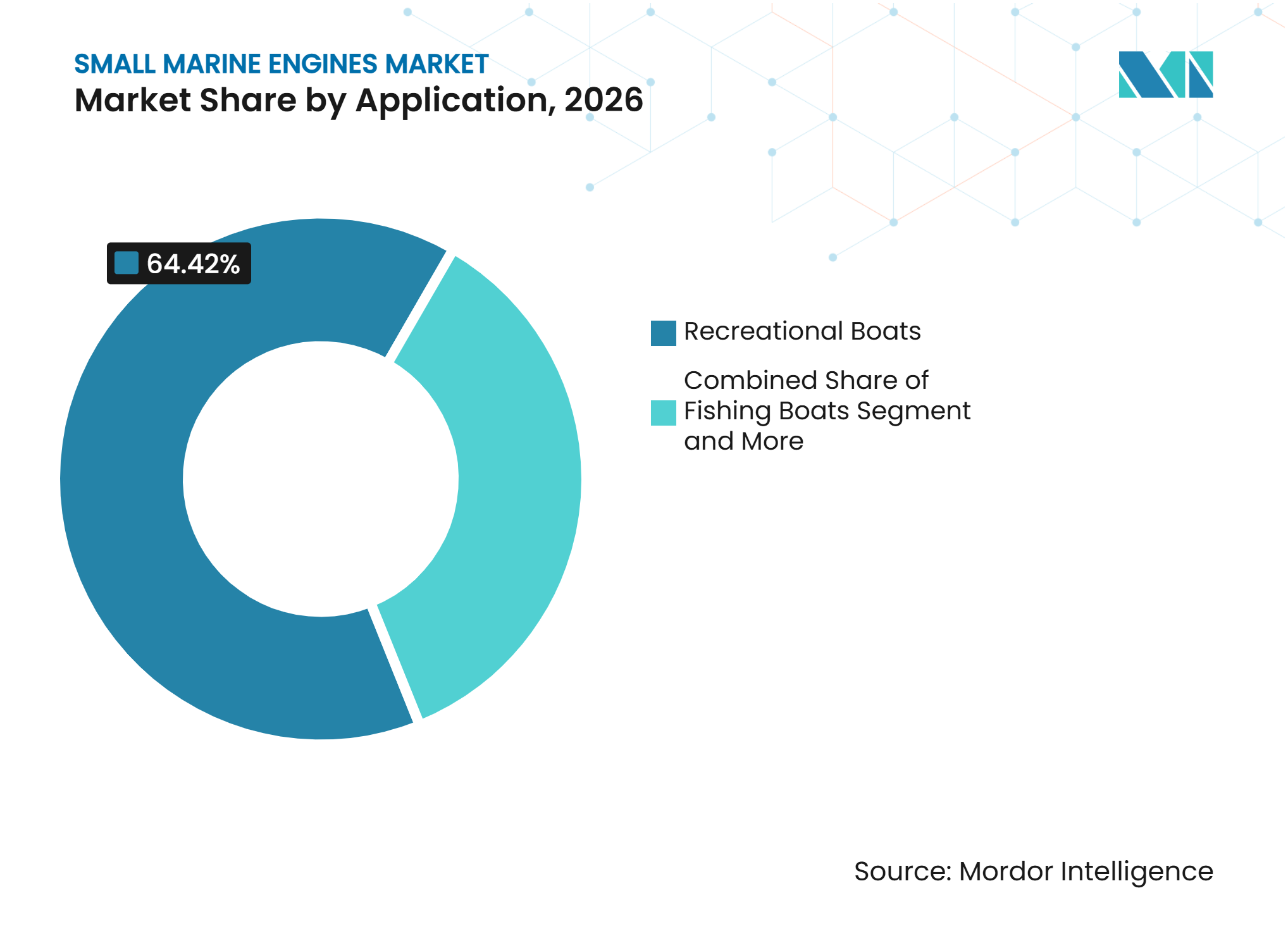
Recreational Core, Commercial Gains MomentumRecreational boats held 64.42% of the small marine engines market in 2026. North American boating culture and Australia’s leisure-marine activity provide a substantial base for this application. Recreation includes family boating, water sports, angling, and coastal cruising, each with different engine requirements related to acceleration, range, quiet operation, reliability, and the carrying capacity of the boat. Fishing boats remain a major part of demand because they are used in leisure and commercial settings. NMMA reported that fishing boats led U.S. new powerboat categories in 2025. This overlap supports continued demand for engines designed for dependable operation and varied use, because the same boat may need to accommodate family recreation, angling equipment, and regular operation in changing weather conditions.
Commercial and workboats are forecast to grow at a 6.12% CAGR through 2032. The category includes patrol vessels, ferries, support craft, and vessels used by aquaculture operators. Government procurement creates a demand stream that is distinct from leisure boat cycles because fleet operators normally buy against mission needs, replacement schedules, and operating requirements rather than personal recreation plans. FAO reports that Indonesia, the Philippines, China, and India account for half of the global fishing fleet. This concentration supports a large replacement base for small-vessel propulsion in Asia-Pacific, where engine decisions can be tied closely to fishing activity, day-to-day vessel availability, and the economic life of working boats.

By Sales Channel:
OEM Integration Dominates, Repower Segment RisingOEM boat builders held 71.36% of the small marine engines market in 2026. Engine choice is often fixed early in hull development because it affects weight balance, controls, fuel systems, and the helm layout, making it difficult to separate the propulsion decision from the broader engineering of the boat. This gives engine suppliers an important role in the original boat design process, since performance expectations, steering arrangements, electrical integration, fuel capacity, and intended passenger use must all work together before production begins. Mercury Marine renewed 5-year exclusive supply agreements with Axopar Boats and Saxdor Yachts in December 2025. Such agreements can connect the engine with the boat’s controls, displays, remote diagnostics, and service support.
Aftermarket and repower is forecast to grow at a 5.73% CAGR through 2032. Boat owners may choose a direct replacement, but some opt for a repower to switch brands, increase horsepower, or add digital features. That creates both a retention challenge and an opportunity for established engine manufacturers. Suppliers with broad horsepower coverage can serve more replacement situations without forcing owners to change their boat use. Certified technicians and readily available parts also matter because downtime can disrupt recreational plans and commercial operations, particularly when a vessel is relied on for fishing, patrol duties, passenger transport, or regular coastal transport.
Geography Analysis
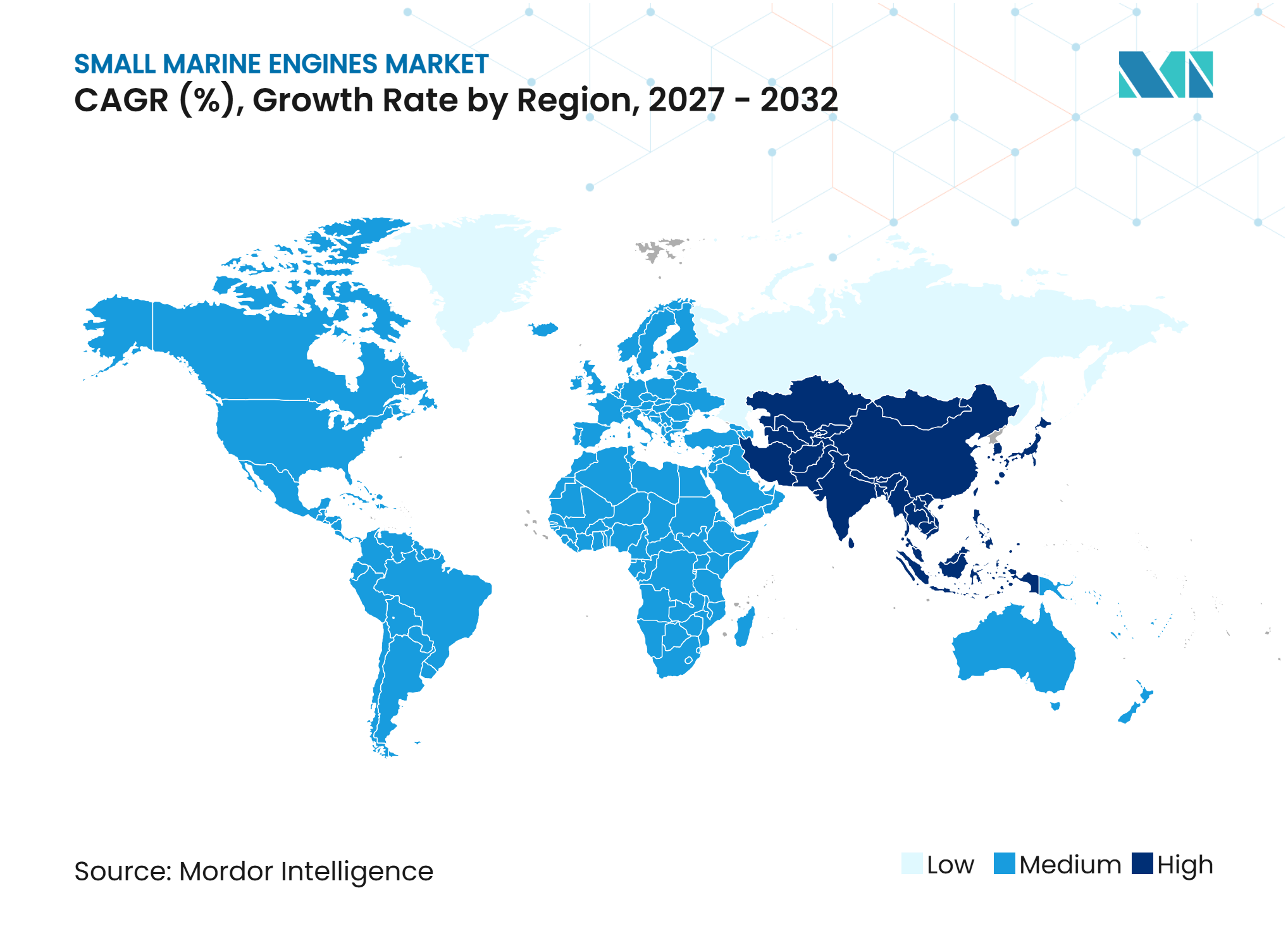
North America held 41.27% of the small marine engines market in 2026. High boat ownership and a dense dealer-and-service network support both original engine sales and repower activity, giving customers access to equipment selection, installation capability, routine maintenance, and replacement parts close to where they use boats. Florida, Texas, Michigan, North Carolina, and New York led U.S. recreational marine spending in 2025. Freshwater access in the Midwest and saltwater fishing along the Gulf and Atlantic coasts create separate but complementary demand bases, so the regional small marine engines market does not depend on a single type of boating activity or water environment. The region has a large installed outboard population entering replacement cycles. This makes repower demand more stable than new-boat demand when financing conditions affect consumer purchases.
Europe maintains medium growth, shaped in part by harmonized compliance requirements for propulsion equipment. Norway, the Netherlands, Germany, and the UK generate demand beyond their population size because marine activity and coastal use are well established. Diesel and hybrid systems are relevant for customers focused on coastal passage-making, where range, low-speed operating characteristics, and the ability to meet local operating restrictions may matter alongside purchase cost. Yamaha made V MAX SHO 250 hp and 200 hp outboards available for European orders from the fourth quarter of 2025. Russia and Turkey remain distinct markets because local supply conditions and import patterns differ from mainstream EU requirements.
Asia-Pacific is forecast to grow at a 6.46% CAGR through 2032. The region combines a large small-vessel fishing base with commercial expansion and developing recreational boating demand, which spreads demand across basic workboat propulsion, replacement engines, and higher-specification leisure equipment. FAO identifies Indonesia, the Philippines, China, and India as home to half of the world’s fishing fleet. South America shows medium growth through Brazil’s freshwater fishing tradition. Middle East and Africa are supported by Gulf patrol procurement and artisanal fishing activity in West Africa.
Competitive Landscape
Market Concentration
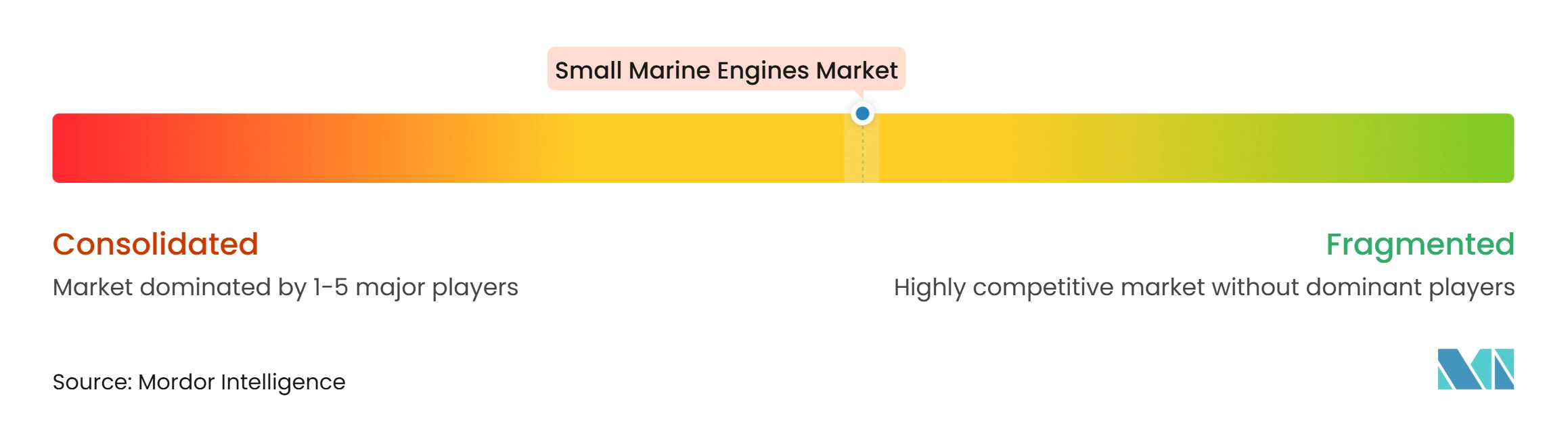
The small marine engines market is moderately concentrated, with Yamaha, Mercury Marine, Suzuki, Honda, and Volvo Penta holding most volume and brand recognition, while specialist manufacturers remain active in selected applications and regions. The leading suppliers compete through product coverage, dealer support, digital controls, and boat-builder relationships, which together shape the purchase decision before the engine is installed and throughout its maintenance and replacement cycle. The small marine engines market therefore presents meaningful barriers for firms lacking comparable engineering, service, and supply capabilities, because a new product must earn the confidence of boat builders, dealers, service technicians, and end users simultaneously.
The major companies are also investing across more than 1 propulsion path. Yamaha has tested hydrogen outboards, while Volvo Penta has moved forward with electric IPS propulsion. Mercury Marine’s exclusive supply agreements with boat builders show how OEM relationships can secure access to important hull platforms. These arrangements can make switching less convenient because propulsion, helm controls, and service planning are linked, and owners may place value on retaining familiar operating systems and established local service support. Honda and Suzuki continue to update ranges that address both mid-power leisure boats and broader retail access. This combination of established combustion products and newer propulsion work allows large suppliers to address several customer needs without relying on a single engine format.
Specialist manufacturers have more accessible openings in diesel outboards and safety-critical commercial applications, where a focused product can meet a defined operating need even when the supplier lacks the broad lineup of a major incumbent. Cox Marine and OXE Marine have early positions in diesel outboards, while larger government procurement is still in its early stages. The certification stack for EPA Tier 3, RCD Stage II, and IMO Tier II can favor suppliers that have completed the required validation. Competition is therefore strongest where companies can pair a suitable product with local distribution, dependable service, and certification support, since buyers in specialized uses often place more weight on reliable assistance than on a product specification alone.
Small Marine Engines Industry Leaders
-
Yamaha Motor Co., Ltd.
-
Brunswick Corporation
-
Suzuki Motor Corporation
-
Honda Motor Co., Ltd.
-
Volvo Penta
- *Disclaimer: Major Players sorted in no particular order
Small Marine Engines Market Companies Covered in this Report
- Yamaha Motor Co., Ltd.
- Brunswick Corporation
- Suzuki Motor Corporation
- Honda Motor Co., Ltd.
- Tohatsu Corporation
- Volvo Penta
- Yanmar Holdings Co., Ltd.
- Cummins Inc.
- Rolls-Royce Holdings plc
- Deutz AG
- Greaves Cotton Limited
- Selva S.p.A.
- Parsun Power Machine Co., Ltd.
- Hidea Power Machinery Co., Ltd.
- Cox Powertrain Ltd.
- Indmar Products Co., Inc.
- Nanni Industries S.A.S.
- Vision Marine Technologies Inc.
- Kubota Corporation
- Beta Marine Limited
- OXE Marine AB
- ePropulsion Technology Limited
- SOLÉ, S.A.
Recent Industry Developments in Small Marine Engines Market
- October 2026: TEMO launched the T700, a 700 W repairable electric outboard priced at EUR 1,390 (approximately USD 1,530).
- October 2026: RAD Propulsion raised EUR 4.4 million (approximately USD 5.6 million), signed a French distributor (KENT Group), and launched leasing for the RAD 40 at EUR 995 (approximately USD 1,270) per month.
- September 2026: Mercury and BlueNav trialed a hybrid RIB with 16 kW of electric drive alongside a petrol engine.
- October 2025: Mercury Marine launched a new 6 hp electronic fuel-injected outboard built on its 209 cc 8/9.9 hp platform, offered in tiller and remote-control versions for small boats, after debuting it at the Grand Pavois show in La Rochelle, France.
Global Small Marine Engines Market Report Scope
The Small Marine Engines Market is Segmented by Placement, Fuel Type, Power Rating, Application, Sales Channel, and Geography. By Placement, the market is segmented into Outboard, Inboard, Sterndrive, and Others (Jet Drive, Pod Drive). By Fuel Type, the market is segmented into Gasoline, Diesel, Electric, and Others (LPG, Hybrid). By Power Rating, the market is segmented into Up to 50 hp, 51 to 150 hp, 151 to 300 hp, and 301 to 600 hp. By Application, the market is segmented into Recreational Boats, Fishing Boats, Commercial and Workboats (Patrol, Ferry, Support Vessels), and Others. By Sales Channel, the market is segmented into OEM Boat Builders and Aftermarket/Repower. By Geography, the market is segmented into North America (United States, Canada, and Mexico), Europe (Germany, France, United Kingdom, Italy, Spain, Netherlands, Norway, Russia, Turkey, and Rest of Europe), Asia-Pacific (China, Japan, India, South Korea, Indonesia, Thailand, Vietnam, Australia, New Zealand, and Rest of Asia-Pacific), South America (Brazil, Argentina, Chile, Colombia, Peru, and Rest of South America), and Middle East and Africa (Saudi Arabia, United Arab Emirates, Israel, Qatar, Egypt, South Africa, Nigeria, Kenya, Morocco, and Rest of Middle East and Africa). Market Forecasts are Provided in Terms of Value (USD) and Volume (Units).
Segmentation Overview
| Outboard |
| Inboard |
| Sterndrive |
| Others (Jet Drive, Pod Drive) |
| Gasoline |
| Diesel |
| Electric |
| Others (LPG, Hybrid) |
| Up to 50 hp |
| 51 to 150 hp |
| 151 to 300 hp |
| 301 to 600 hp |
| Recreational Boats |
| Fishing Boats |
| Commercial and Workboats (Patrol, Ferry, Support Vessels) |
| Others |
| OEM Boat Builders |
| Aftermarket/Repower |
| North America | United States |
| Canada | |
| Mexico | |
| Europe | Germany |
| France | |
| United Kingdom | |
| Italy | |
| Spain | |
| Netherlands | |
| Norway | |
| Russia | |
| Turkey | |
| Rest of Europe | |
| Asia-Pacific | China |
| Japan | |
| India | |
| South Korea | |
| Indonesia | |
| Thailand | |
| Vietnam | |
| Australia | |
| New Zealand | |
| Rest of Asia-Pacific | |
| South America | Brazil |
| Argentina | |
| Chile | |
| Colombia | |
| Peru | |
| Rest of South America | |
| Middle East and Africa | Saudi Arabia |
| United Arab Emirates | |
| Israel | |
| Qatar | |
| Egypt | |
| South Africa | |
| Nigeria | |
| Kenya | |
| Morocco | |
| Rest of Middle East and Africa |
| By Placement | Outboard | |
| Inboard | ||
| Sterndrive | ||
| Others (Jet Drive, Pod Drive) | ||
| By Fuel Type | Gasoline | |
| Diesel | ||
| Electric | ||
| Others (LPG, Hybrid) | ||
| By Power Rating | Up to 50 hp | |
| 51 to 150 hp | ||
| 151 to 300 hp | ||
| 301 to 600 hp | ||
| By Application | Recreational Boats | |
| Fishing Boats | ||
| Commercial and Workboats (Patrol, Ferry, Support Vessels) | ||
| Others | ||
| By Sales Channel | OEM Boat Builders | |
| Aftermarket/Repower | ||
| By Geography | North America | United States |
| Canada | ||
| Mexico | ||
| Europe | Germany | |
| France | ||
| United Kingdom | ||
| Italy | ||
| Spain | ||
| Netherlands | ||
| Norway | ||
| Russia | ||
| Turkey | ||
| Rest of Europe | ||
| Asia-Pacific | China | |
| Japan | ||
| India | ||
| South Korea | ||
| Indonesia | ||
| Thailand | ||
| Vietnam | ||
| Australia | ||
| New Zealand | ||
| Rest of Asia-Pacific | ||
| South America | Brazil | |
| Argentina | ||
| Chile | ||
| Colombia | ||
| Peru | ||
| Rest of South America | ||
| Middle East and Africa | Saudi Arabia | |
| United Arab Emirates | ||
| Israel | ||
| Qatar | ||
| Egypt | ||
| South Africa | ||
| Nigeria | ||
| Kenya | ||
| Morocco | ||
| Rest of Middle East and Africa | ||
Key Questions Answered in the Report
What is the projected size of the small marine engines market by 2032?
The small marine engines market is projected to reach USD 12.69 billion by 2032, growing at a 5.21% CAGR from 2027.
Which engine placement leads small marine engine demand?
Outboard engines lead demand with a 62.38% share in 2026 because they serve many boat types and are well suited to repower work.
Why are electric small marine engines growing quickly?
Electric propulsion is forecast to grow at a 14.27% CAGR through 2032, supported by protected-waterway and low-noise uses, although battery cost and charging access remain constraints.
Which customer application is expanding fastest?
Commercial and workboats are forecast to grow at a 6.12% CAGR through 2032, supported by patrol, ferry, support-vessel, and aquaculture requirements.