
Small Bulldozer Market Size and Share
Market Overview
| Study Period | 2020 - 2032 |
|---|---|
| Market Size (2027) | USD 1.53 Billion |
| Market Size (2032) | USD 1.88 Billion |
| Growth Rate (2027 - 2032) | 4.21 % |
| Fastest Growing Market | Asia-Pacific |
| Largest Market | North America |
| Market Concentration | Medium |
Major Players *Disclaimer: Major Players sorted in no particular order Image © Mordor Intelligence. Reuse requires attribution under CC BY 4.0. | |
Small Bulldozer Market Analysis by Mordor Intelligence
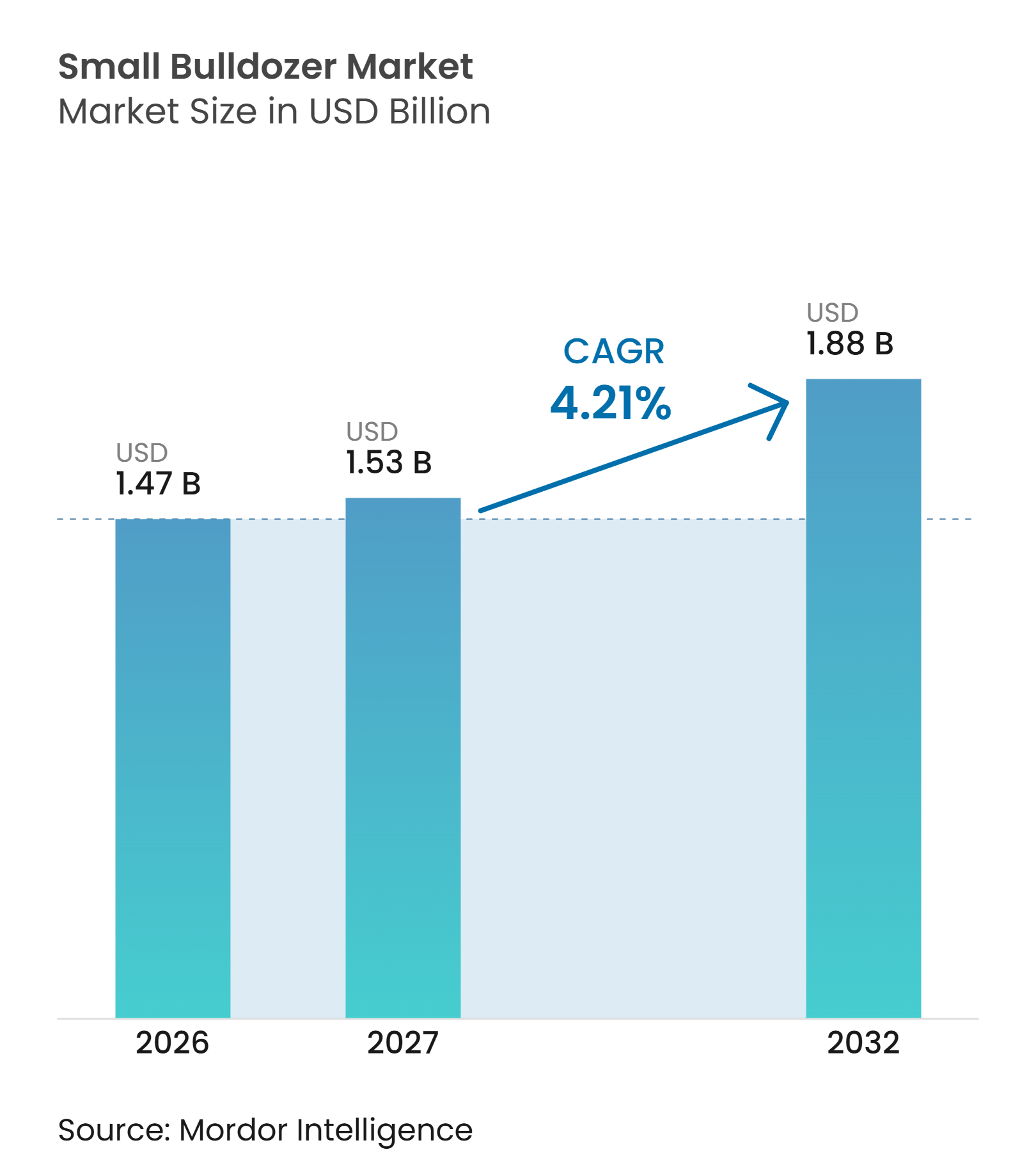
The small bulldozer market size was valued at USD 1.47 billion in 2026 and estimated to grow from USD 1.53 billion in 2027 to reach USD 1.88 billion by 2032, at a CAGR of 4.21% during the forecast period (2027-2032). Crawler machines remain central to demand because they maintain traction and blade control on soft, sloped, and debris-covered ground. Public infrastructure work and residential site preparation support equipment use where maneuverability matters more than high production capacity. Contractors are also placing greater value on machine control, visibility, and rental access because these features reduce setup time on constrained sites. Alternative propulsion is gaining attention in locations where equipment access is shaped by emissions rules, although diesel remains the operating standard for long shifts. The small bulldozer market also faces competition from compact track loaders and mini excavators where a contractor needs grading, lifting, and excavation from one machine.
Key Report Takeaways
-
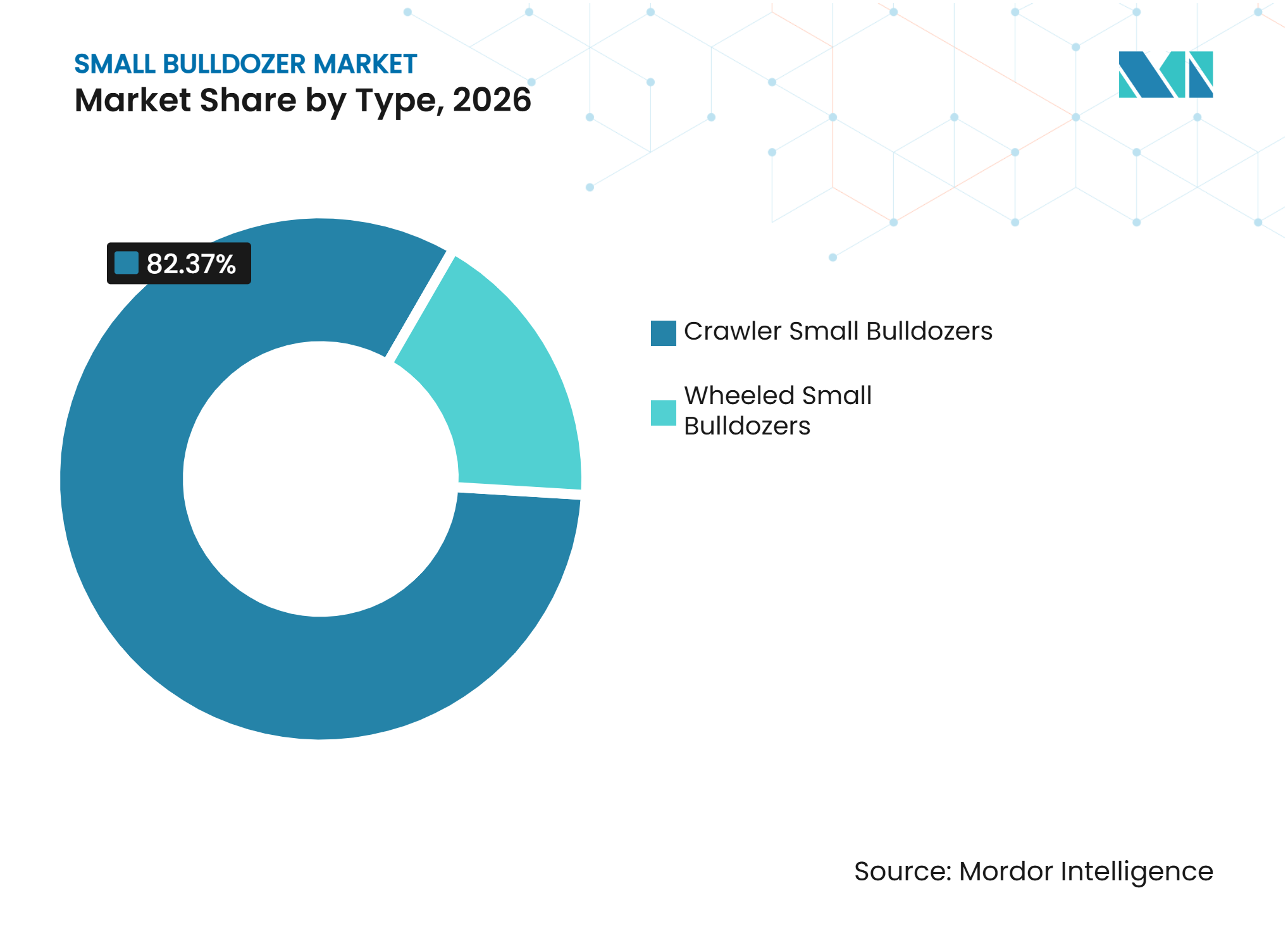
By type, crawler small bulldozers held 82.37% of the small bulldozer market share in 2026, while wheeled small bulldozers are forecast to grow at a 4.83% CAGR through 2032.
-
By engine power, 50 to 100 HP machines held 46.28% of revenue in 2026, while the below-50 HP category is forecast to grow at a 5.12% CAGR through 2032.
-
By blade type, Power-Angle-Tilt (PAT/6-Way) blades held 41.36% of revenue in 2026 and are forecast to grow at a 4.94% CAGR through 2032.
-
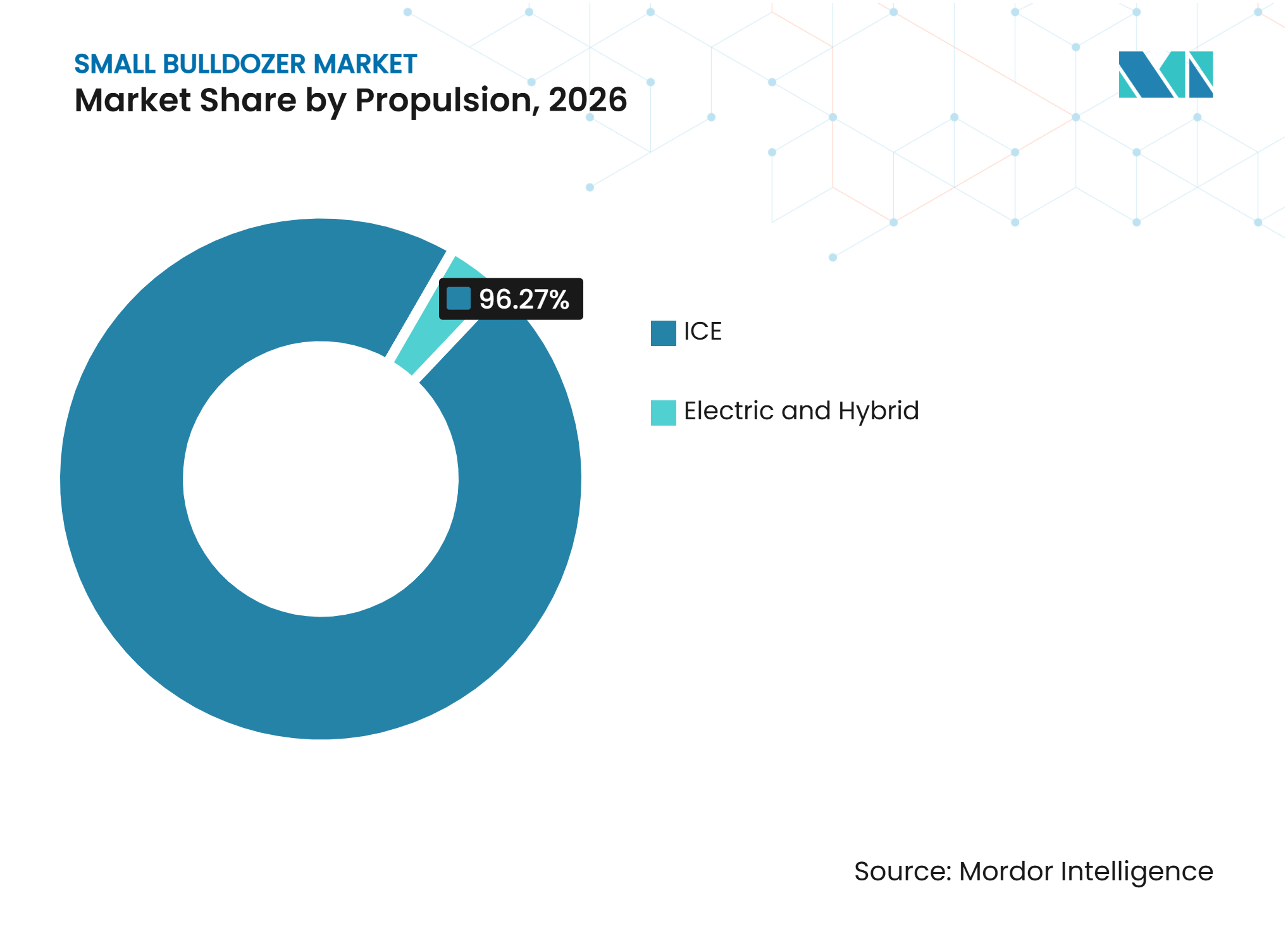
By propulsion, diesel machines held 96.27% of revenue in 2026, while electric and hybrid machines are forecast to grow at a 13.47% CAGR through 2032.
-
By application, residential and commercial construction held 38.42% of revenue in 2026, while landscaping and site preparation are forecast to grow at a 5.06% CAGR through 2032.
-
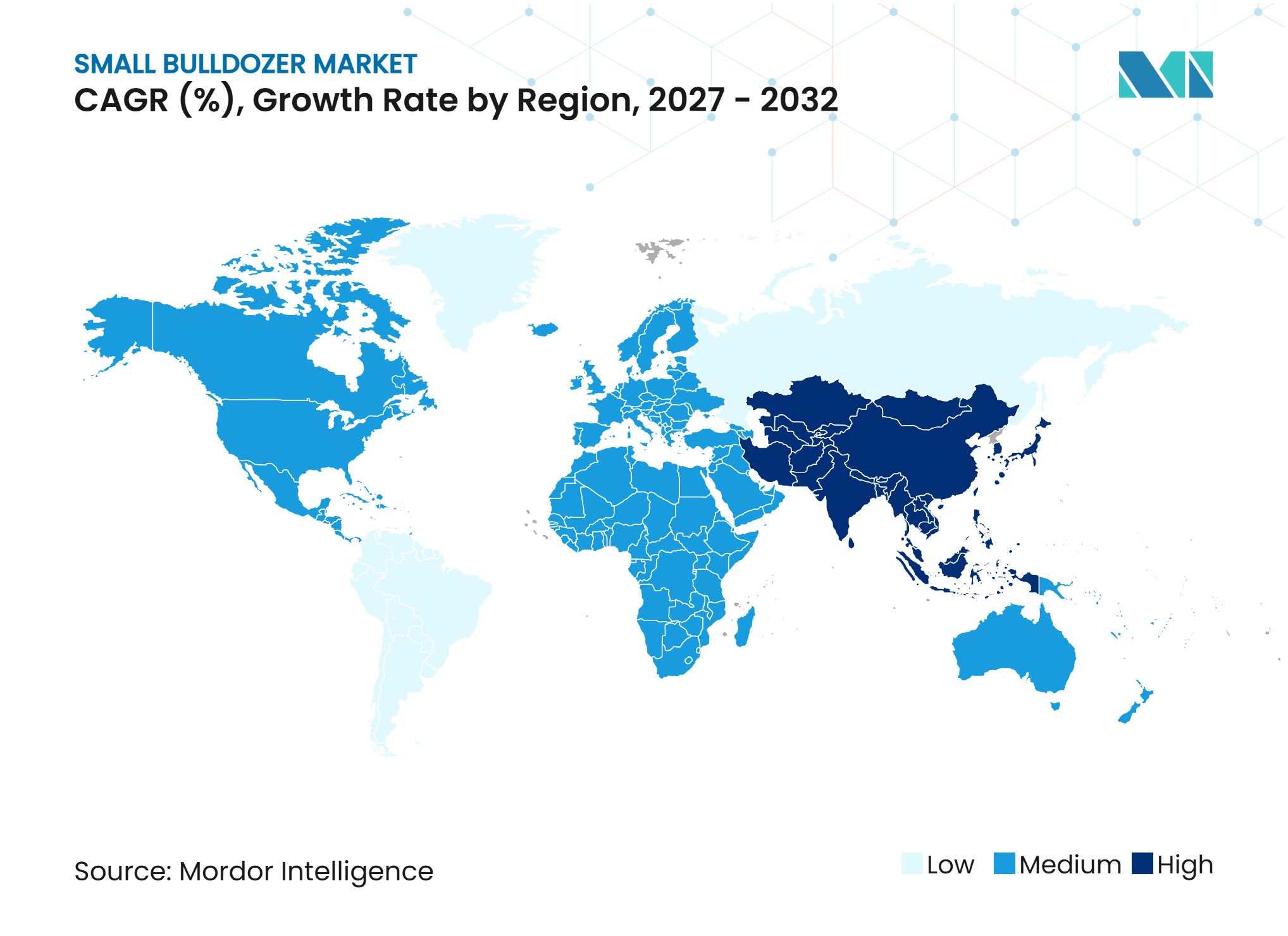
By geography, North America held 36.18% of revenue in 2026, while Asia-Pacific is forecast to grow at a 5.38% CAGR through 2032.
Note: Market numbers in this report are based on Mordor Intelligence's proprietary estimation framework, which combines nine months of actuals with Q4 projections for base year 2026.
Market Trends and Insights
Drivers Impact Analysis of Small Bulldozer Market*
| Driver | (~) % Impact on CAGR Forecast | Geographic Relevance | Impact Timeline |
|---|---|---|---|
| Infrastructure and Residential Site Preparation | +1.2% | Global, strongest in North America and Europe | Medium term (2-4 years) |
| Compact Equipment Demand for Confined Urban Worksites | +0.9% | Global, urban centers in North America, Europe, and East Asia | Medium term (2-4 years) |
| Fleet Replacement and Rental Network Availability | +0.7% | North America and Europe | Short term (≤ 2 years) |
| Agricultural and Forestry Mechanization | +0.5% | Asia-Pacific, South America, and Africa | Long term (≥ 4 years) |
| 3D Grade Control for Small Contractors | +0.4% | North America, Europe, Japan, and Australia | Medium term (2-4 years) |
| Low-Ground-Pressure Access to Utility Corridors and Soft Ground | +0.3% | Global, temperate and wet-season regions | Short term (≤ 2 years) |
| Source: Mordor Intelligence | |||
Infrastructure and Residential Site Preparation
Public infrastructure spending provides a direct source of demand for the Small Bulldozer industry because many funded jobs require grading rather than large-scale bulk earthmoving. Bridge approaches, local road resurfacing, utility relocation, drainage work, and surface restoration often require compact machines capable of working around existing assets. The Infrastructure Investment and Jobs Act continues to support highway-related spending and project delivery across the United States[1]. Site preparation is also necessary before foundation work, drainage installation, driveway construction, access improvements, and landscaping can begin. Small dozers are well-suited to these jobs because they can move through residential lots and make controlled passes near structures, property boundaries, and finished surfaces. This work supports equipment use even when larger greenfield projects are delayed, phased, or dependent on longer planning approvals.
Compact Equipment Demand for Confined Urban Worksites
Urban construction sites often have narrow access routes, nearby structures, pedestrian controls, underground services, and limited room for material storage. These conditions favor machines that can grade precisely without needing the footprint, turning area, or transport support associated with a larger dozer. The small bulldozer market benefits when contractors need to complete finish work in short operating windows between other site activities. Better forward visibility helps operators work near curbs, trench edges, building lines, parked equipment, and temporary barriers. Grade-control functions can reduce repeat passes where a site plan requires close elevation control, drainage fall, or a carefully finished surface. Compact dimensions do not remove the need for blade force, so buyers continue to favor models that balance access, stability, visibility, and useful pushing capacity.
Fleet Replacement and Rental Network Availability
Rental fleets make small dozers available to contractors that cannot justify a full ownership commitment for occasional or short-duration assignments, supporting equipment demand across the Small Bulldozer industry. This channel matters most where utility work, residential development, municipal projects, and restoration jobs create variable equipment needs. Fleet owners tend to replace high-use units sooner than owner-operators because downtime affects rental availability, service costs, customer confidence, and resale value. Newer machines also give rental providers a way to offer grade-control-ready specifications to customers with different levels of operator experience. The small bulldozer market therefore gains from replacement activity that is not entirely tied to new project starts or major civil awards. A broad dealer network supports this model by making parts, service, inspections, operator familiarization, and field support easier to obtain.
Agricultural and Forestry Mechanization
Land preparation, irrigation shaping, terracing, drainage channels, plantation access roads, and watershed work create a distinct role for compact dozers in agriculture and forestry. The need is especially relevant where small plots, wet ground, broken terrain, or established crops limit the use of larger equipment. The Food and Agriculture Organization identifies access to suitable machinery as an important part of sustainable agricultural mechanization in Asia and the Pacific[2]. Small crawler machines can work along waterlogged margins while placing less pressure on the ground than heavier equipment and avoiding unnecessary disturbance. They can shape channels and terraces without requiring the transport, operating space, or blade capacity of a production dozer. These conditions broaden the small-bulldozer market beyond construction activities and link demand to land-improvement and farm-productivity programs.
Restraints Impact Analysis of Small Bulldozer Market*
| Restraint | (~) % Impact on CAGR Forecast | Geographic Relevance | Impact Timeline |
|---|---|---|---|
| High Acquisition and Lifecycle Cost for Small Contractors | -1.1% | Global, most acute in developing markets | Long term (≥ 4 years) |
| Substitution by Compact Track Loaders and Mini Excavators | -0.9% | North America and Europe | Medium term (2-4 years) |
| Undercarriage Wear Under Abrasive Small-Site Operating Cycles | -0.4% | Global | Short term (≤ 2 years) |
| Charging and Residual-Value Uncertainty for Electric and Hybrid Dozers | -0.3% | North America and Europe | Medium term (2-4 years) |
| Source: Mordor Intelligence | |||
High Acquisition and Lifecycle Cost for Small Contractors
The purchase cost of a new dozer remains difficult for independent contractors with limited credit capacity and irregular project pipelines. Ownership also includes insurance, financing, service, transport, planned maintenance, and eventual undercarriage work that must be paid for between jobs. Abrasive ground conditions can shorten component life and raise the effective cost of operating the machine over its useful service period. These costs encourage many small contractors to retain older equipment, use a mixed fleet, or rely on rental providers for major assignments. The result can limit new-unit demand in locations where credit access is weak, used equipment is readily available, and project margins are thin. The small bulldozer market must therefore rely on finance programs, dealer support, transparent service plans, and rental access to reach cost-sensitive buyers.
Substitution by Compact Track Loaders and Mini Excavators
Compact track loaders and mini excavators compete where contractors need several tasks completed by one machine during the same visit. A compact track loader can grade, spread, lift, carry materials, and use attachments on the same residential, landscaping, or land-clearing site. Mini excavators add trenching, narrow access, blade backfilling, and full-slew working capability to their value proposition. These alternatives are attractive when grading is only one part of the contractor's work, and the crew must reduce equipment moves. Their growing capability can reduce demand for a dedicated dozer in mature compact-equipment markets with deep dealer and rental support. The small bulldozer market remains more defensible where sustained blade work, reliable traction, controlled surface finish, and repeated grading passes are the main operating requirements.
*Our forecasts treat driver/restraint impacts as directional, not additive. The impact forecasts reflect baseline growth, mix effects, and variable interactions.
Small Bulldozer Market Segment Analysis
By Type:
Crawlers Lead Ground Engagement While Wheeled Units Gain Use CasesCrawler configurations held 82.37% of the small bulldozer revenue share in 2026. Their principal advantage is steady traction on soft, sloped, mixed, and debris-covered surfaces encountered before a site has been fully prepared. Steel tracks spread machine weight across a broader contact area, helping control sinkage and limiting loss of traction on wet ground. That ground contact gives operators more consistent blade response through clay, loose fill, uneven subgrades, and material left after demolition. Crawler machines remain preferred where controlled grading, reliable traction, and careful surface restoration are more important than rapid road travel between sites.
Wheeled small bulldozers are forecast to grow at a 4.83% CAGR through 2032. Their appeal is strongest where paved travel, stable ground, lower undercarriage maintenance, and quicker movement between nearby jobs matter to the operator. Road-maintenance crews can relocate along firm surfaces with less concern about track wear or damage to finished pavement. Agricultural users working on dry, firm terrain may also value their mobility, straightforward handling, and lower ownership burden over time. The choice between configurations depends on soil conditions, travel requirements, available transport, blade workload, and how frequently a machine must work away from the prepared site.


By Engine Power:
Mid-Range Machines Anchor Demand and Smaller Units Expand AccessThe 50 to 100 HP category accounted for 46.28% of small bulldozer revenue in 2026. This output range provides sufficient pushing capacity for cut-and-fill work, backfilling, shallow compaction, drainage shaping, and aggregate spreading on typical contractor jobs. It also fits the transport and access limits that affect many residential subdivisions, infill projects, utility repairs, and light commercial sites. Machines in this class can complete several grading tasks without bringing the operating cost, trailer requirements, and site logistics associated with a larger dozer. That practical balance makes the category a regular choice for rental fleets, independent contractors, and construction firms with varied local work.
The below-50 HP category is forecast to grow at a 5.12% CAGR through 2032. Smaller machines can enter utility corridors, landscaping plots, indoor renovation areas, and narrow access routes where larger equipment cannot safely operate. Their reduced dimensions help crews work close to existing structures, services, vegetation, and pedestrian areas without giving up controlled blade movement. They are well suited to jobs where precise adjustment, low ground disturbance, and easy transport matter more than sustained heavy pushing. Improved operator-assist functions can make these models more capable on sites that previously required separate compact machines to complete similar work.
By Blade Type:
PAT Blades Combine Versatility With PrecisionPower-Angle-Tilt (PAT/6-Way) blades held 41.36% of the small bulldozer revenue share in 2026. Their tilt, angle, and pitch functions help the operator manage contouring, backfilling, ditch shaping, and fine grading without having to fit a different blade. This flexibility suits varied work on constrained construction sites where a contractor needs one machine to complete several finishing tasks. It also supports drainage work and surface restoration where slope direction and final elevation must be managed closely. The blade design is therefore strongly aligned with compact dozers used for detail-oriented grading rather than for repetitive bulk-material pushing.
PAT/6-Way blades are forecast to grow at a 4.94% CAGR through 2032. The design works well with grade-control systems because the blade can respond to a planned surface in several directions during a pass. Straight blades retain a role when material capacity and efficient forward pushing take priority over surface versatility. Semi-Universal blades remain useful for land clearing and forestry preparation where users need a compromise between material retention and maneuverability. Other blade variants continue to serve specialized utility, agricultural, drainage, and maintenance tasks where a conventional configuration may not be appropriate.
By Propulsion:
Diesel Leads Current Use While Alternatives DevelopDiesel machines held 96.27% of the small bulldozer revenue share in 2026. They remain suited to extended operating shifts because fuel can be replenished quickly while the machine retains practical blade capacity and predictable performance. This operating pattern is important on infrastructure, land clearing, drainage, utility restoration, and site preparation work where the machine may run continuously. Diesel also benefits from established repair knowledge, widespread fuel access, and service practices familiar to contractors and rental providers. For these reasons, it remains the primary option for buyers that need reliable operation across different locations and working conditions.
Electric and hybrid machines are forecast to grow at a 13.47% CAGR through 2032. Growth begins from a small base and is linked to urban access requirements, emissions compliance, fleet trials, and noise-sensitive work areas. Hybrid systems offer a transitional option because they can improve efficiency while maintaining a familiar refueling pattern for the contractor. Battery-electric equipment is most relevant where local emissions and machine noise determine whether equipment can enter the site. The small bulldozer market will need more consistent evidence on charging, operating duration, service access, and residual values before alternative propulsion replaces diesel on demanding shifts.

By Application:
Construction Provides Volume While Finish Work Broadens DemandResidential and commercial construction held 38.42% of the small bulldozer revenue share in 2026. Compact dozers support foundation pads, driveways, drainage lines, access routes, lot grading, and backfilling where space around structures is limited. Their maneuverability helps contractors work around active crews, installed utilities, completed curbs, and other elements that restrict machine movement. These jobs often require repeated measured passes and a clean finished surface rather than the large-scale movement of soil. This makes small machines a consistent fit for infill housing, neighborhood projects, retail sites, and light commercial development.
Landscaping and site preparation are forecast to grow at a 5.06% CAGR through 2032. These jobs require finish grading for parks, campuses, corridor improvements, drainage areas, and site restoration after construction activity ends. Agricultural and forestry users also need compact machines for plantation preparation, access routes, terracing, watershed work, and water-management improvements. Utilities and road-maintenance crews use small dozers to restore profiles after excavation, pipe installation, cable work, and other underground service activity. Each application favors quick mobilization, precise blade work, dependable traction, and the ability to reach a restricted work area without disrupting adjacent assets.
Geography Analysis
North America held 36.18% of the small bulldozer market share in 2026. The region benefits from an established dealer and rental network that makes equipment accessible to independent contractors. Highway, utility, and residential work provide recurring uses for compact grading equipment. Federal infrastructure programs continue to direct resources toward transport projects that need site preparation and restoration. The United States is the main source of regional demand, while Canada adds residential and resource-linked work and Mexico benefits from industrial development near its northern border.
European demand is shaped by dense urban construction, infrastructure renewal, and equipment compliance requirements. The small bulldozer market size in the region is supported by work that requires machines to operate around buildings, utilities, and restricted access points. Regulation (EU) 2016/1628 sets emission requirements for non-road mobile machinery engines, which encourages fleet modernization in locations with strict site-access rules. Germany and France remain important demand centers, while parts of Eastern Europe benefit from infrastructure and municipal utility activity. Russia remains a lower-growth area because access to equipment, logistics, and parts support is more difficult.
Asia-Pacific is forecast to grow at a 5.38% CAGR through 2032. Infrastructure investment, the expansion of rental fleets, and agricultural mechanization create several demand channels across the region. China remains a major production and consumption center, with domestic suppliers serving both local and export customers. India, Indonesia, Vietnam, and Australia contribute through construction, public procurement, land preparation, and resource-linked work. The Food and Agriculture Organization identifies access to suitable compact machinery as a priority for sustainable mechanization in Asia and the Pacific. South America, the Middle East, and Africa add targeted demand from agriculture, mining, energy, logistics, real estate, and public works, although financing and service coverage can limit faster adoption outside their larger markets.
Competitive Landscape
Market Concentration
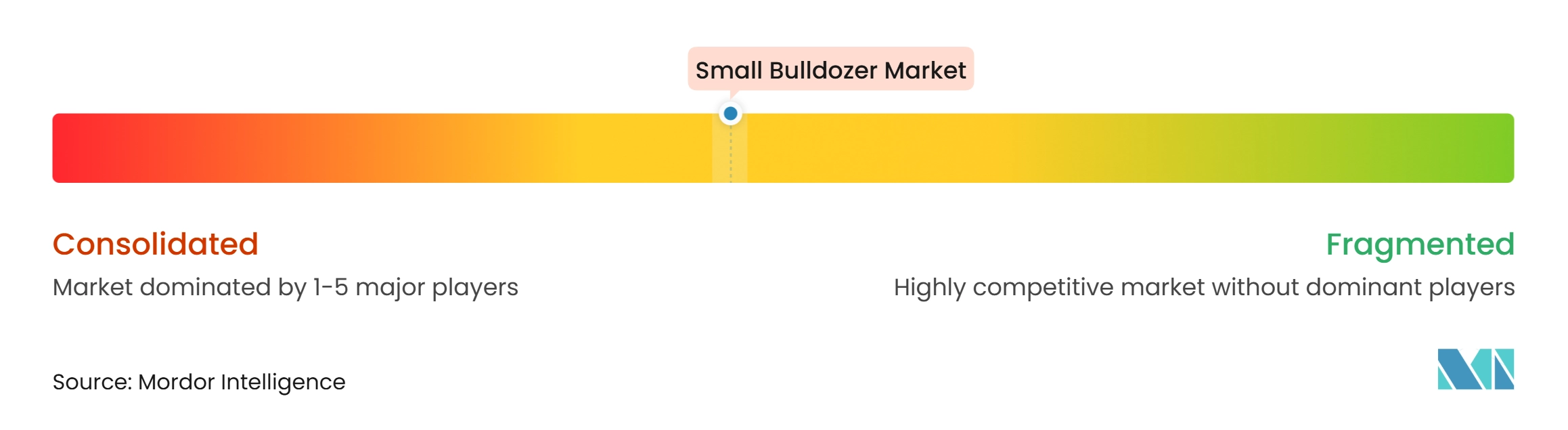
The small bulldozer market is moderately concentrated, with established equipment manufacturers competing alongside a growing group of price-oriented competitors across regional markets. Caterpillar, Komatsu, and Deere & Company have advantages in dealer coverage, aftermarket support, factory-integrated grade-control systems, trained service personnel, and established customer relationships. Their equipment platforms can create switching costs because contractors often rely on the same machine-control tools, telematics, operator practices, local service relationships, and data processes across fleet replacements. This position is strongest in North America, Japan, and Australia, where technology adoption, rental coverage, financing options, and dealer support are well developed.
Chinese manufacturers, including Shantui and XCMG, are expanding their position in Asia, Africa, and the Middle East through pricing, dealer agreements, regional references, and improving machine specifications. Their progress is supported by demonstrations of remote-control and unmanned operation, which help establish confidence in the technology offered by newer entrants seeking broader customer acceptance. CASE Construction Equipment competes through a broader compact-equipment offering and rental relationships that overlap with several small-dozer applications, particularly on constrained and mixed-task sites. Competition is therefore not limited to direct dozer producers, because buyers may compare the full cost and usefulness of several compact equipment choices.
The main product opportunity remains a compact, low-emission dozer with factory-integrated grade control for urban, indoor, landscaping, and noise-sensitive work. Such a machine would address emissions-related access, surface-finish needs, contractor visibility requirements, and some earthmoving tasks where conventional equipment may face operating restrictions. However, the commercial case depends on dependable charging, acceptable residual value, useful duty cycles, service readiness, and a price that smaller contractors can support. Leading suppliers are responding through better visibility, grade control, digital machine support, operator-assist functions, and more flexible system compatibility across construction workflows. The small bulldozer market will continue to reward companies that make technology understandable, available, and economically useful for smaller contractors rather than limiting it to large civil projects.
Small Bulldozer Industry Leaders
-
Caterpillar Inc.
-
Komatsu Ltd.
-
Deere & Company
-
CNH Industrial N.V.
-
Shantui Construction Machinery Co., Ltd.
- *Disclaimer: Major Players sorted in no particular order
Small Bulldozer Market Companies Covered in this Report
- Caterpillar Inc.
- Komatsu Ltd.
- Deere & Company
- CNH Industrial N.V.
- Liebherr Group
- HD Hyundai Infracore Co., Ltd.
- Shantui Construction Machinery Co., Ltd.
- SANY Heavy Industry Co., Ltd.
- XCMG Construction Machinery Co., Ltd.
- Zoomlion Heavy Industry Science & Technology Co., Ltd.
- Guangxi LiuGong Machinery Co., Ltd.
- China SINOMACH Heavy Industry Corporation
- HBIS Xuanhua Construction Machinery Co., Ltd.
- Shanghai Pengpu Machinery Co., Ltd.
- BEML Limited
- The Struck Corporation
- Kubota Corporation
- Shandong Lingong Engineering Machinery Co., Ltd.
Recent Industry Developments in Small Bulldozer Market
- September 2026: Caterpillar launched the D5 dozer in India, featuring a Cat C7.1 engine and a fully automatic transmission, for mining and infrastructure applications.
- June 2026: Develon won a Polish Army tender for 50 DD130 crawler dozers, with an option for 20 more, to be supplied through MW Rail.
- April 2026: CASE previewed its N Series small dozers ahead of a 2026 launch: the 650N (74 hp), 750N (96 hp), and 850N (120 hp), replacing the M Series.
- March 2023: John Deere introduced its P-Tier 450, 550, and 650 small dozers at CONEXPO-CON/AGG 2023, featuring a cab about 14% larger, a lowered hood for better forward visibility, and an 8-inch touchscreen, with the 450 model eliminating its DEF system.
Global Small Bulldozer Market Report Scope
Segmentation Overview
| Crawler Small Bulldozers |
| Wheeled Small Bulldozers |
| Below 50 HP |
| 50 to 100 HP |
| 101 to 130 HP |
| Straight (S) Blade |
| Power-Angle-Tilt (PAT/6-Way) Blade |
| Semi-Universal (SU) Blade |
| Other Blade Types |
| Diesel |
| Electric and Hybrid |
| Residential and Commercial Construction |
| Landscaping and Site Preparation |
| Agriculture and Forestry |
| Utilities and Road Maintenance |
| Other Applications |
| North America | United States |
| Canada | |
| Mexico | |
| Europe | Germany |
| France | |
| United Kingdom | |
| Italy | |
| Spain | |
| Russia | |
| Poland | |
| Netherlands | |
| Rest of Europe | |
| Asia-Pacific | China |
| Japan | |
| India | |
| South Korea | |
| Australia | |
| Indonesia | |
| Thailand | |
| Vietnam | |
| Rest of Asia-Pacific | |
| South America | Brazil |
| Argentina | |
| Chile | |
| Colombia | |
| Peru | |
| Rest of South America | |
| Middle East and Africa | Saudi Arabia |
| United Arab Emirates | |
| Qatar | |
| Turkey | |
| South Africa | |
| Egypt | |
| Morocco | |
| Nigeria | |
| Rest of Middle East and Africa |
| By Type | Crawler Small Bulldozers | |
| Wheeled Small Bulldozers | ||
| By Engine Power | Below 50 HP | |
| 50 to 100 HP | ||
| 101 to 130 HP | ||
| By Blade Type | Straight (S) Blade | |
| Power-Angle-Tilt (PAT/6-Way) Blade | ||
| Semi-Universal (SU) Blade | ||
| Other Blade Types | ||
| By Propulsion | Diesel | |
| Electric and Hybrid | ||
| By Application | Residential and Commercial Construction | |
| Landscaping and Site Preparation | ||
| Agriculture and Forestry | ||
| Utilities and Road Maintenance | ||
| Other Applications | ||
| By Geography | North America | United States |
| Canada | ||
| Mexico | ||
| Europe | Germany | |
| France | ||
| United Kingdom | ||
| Italy | ||
| Spain | ||
| Russia | ||
| Poland | ||
| Netherlands | ||
| Rest of Europe | ||
| Asia-Pacific | China | |
| Japan | ||
| India | ||
| South Korea | ||
| Australia | ||
| Indonesia | ||
| Thailand | ||
| Vietnam | ||
| Rest of Asia-Pacific | ||
| South America | Brazil | |
| Argentina | ||
| Chile | ||
| Colombia | ||
| Peru | ||
| Rest of South America | ||
| Middle East and Africa | Saudi Arabia | |
| United Arab Emirates | ||
| Qatar | ||
| Turkey | ||
| South Africa | ||
| Egypt | ||
| Morocco | ||
| Nigeria | ||
| Rest of Middle East and Africa | ||
Key Questions Answered in the Report
What is the projected size of the small bulldozer market by 2032?
The small bulldozer market is forecast to reach USD 1.88 billion by 2032, growing from USD 1.53 billion in 2027. This outlook reflects continued use of compact dozers in site preparation, public works, and controlled grading assignments.
Which small bulldozer type holds the largest share?
Crawler small bulldozers hold the largest share, with 82.37% of 2026 revenue, because they maintain traction on soft and uneven ground. Their ground contact makes them particularly useful on sites with mixed fill, wet soil, slopes, and debris.
What is driving demand for small bulldozers?
Infrastructure work, residential site preparation, urban construction, rental availability, and agricultural mechanization support demand. Contractors also value compact machines that can reach restricted work areas and complete precise surface finishing.
Which engine-power category is growing fastest?
The below-50 HP category is forecast to grow at a 5.12% CAGR through 2032 as access restrictions increase demand for compact equipment. These models are useful where height, width, transport, and site-disturbance limits rule out larger machines.