
Singapore Wire and Cable Market Size and Share
Market Overview
| Study Period | 2020 - 2031 |
|---|---|
| Forecast Data Period | 2026 - 2031 |
| Base Year Market Size (2025) | USD 1.01 Billion |
| Market Size (2026) | USD 1.08 Billion |
| Market Size (2031) | USD 1.52 Billion |
| Growth Rate (2026 - 2031) | 7.07 % |
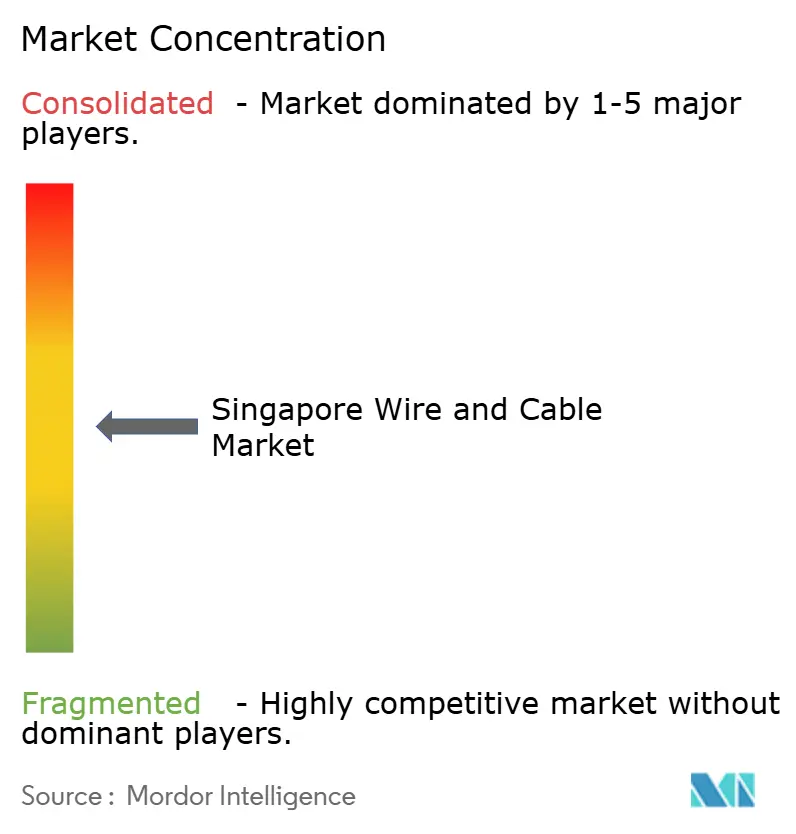
| Market Concentration | Medium |
Major Players *Disclaimer: Major Players sorted in no particular order Image © Mordor Intelligence. Reuse requires attribution under CC BY 4.0. | |
Singapore Wire and Cable Market Analysis by Mordor Intelligence
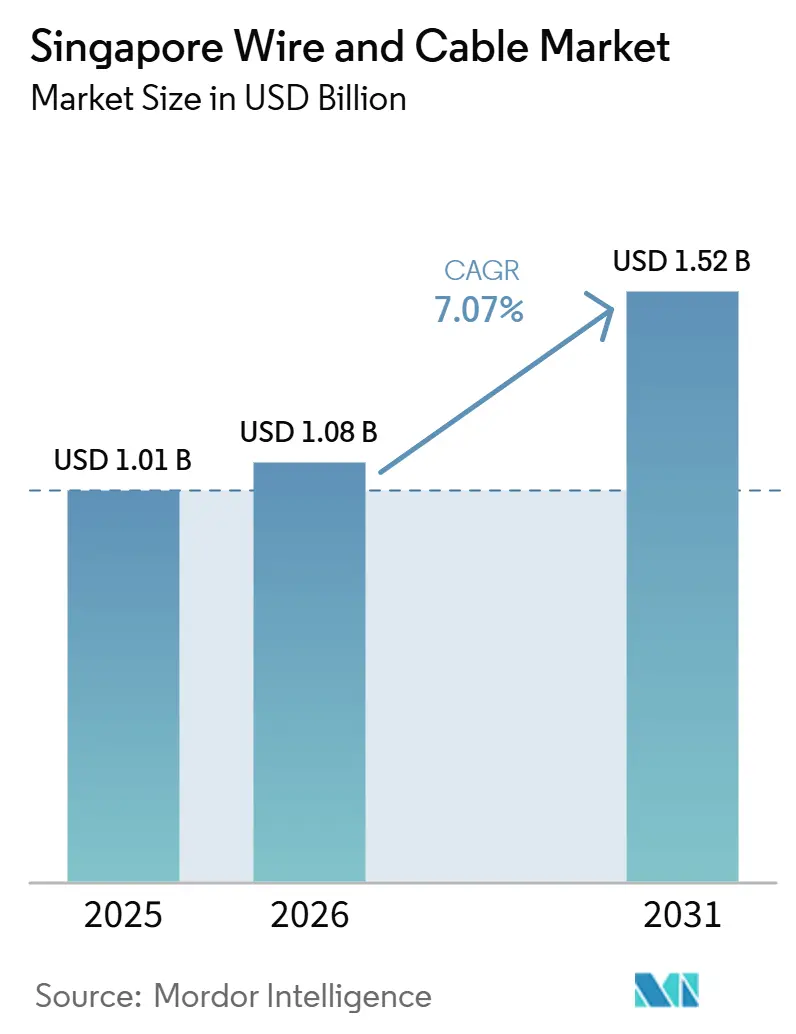
The Singapore Wire and Cable Market size was valued at USD 1.01 billion in 2025 and estimated to grow from USD 1.08 billion in 2026 to reach USD 1.52 billion by 2031, at a CAGR of 7.07% during the forecast period (2026-2031). Demand is supported by data center construction, underground transmission upgrades, and cross-border renewable electricity projects that require cable systems at different voltage levels. Singapore's limited land area makes underground routes the standard choice for new high-voltage infrastructure, underscoring the importance of careful route planning. Renewable electricity imports also require new submarine cables, onshore termination systems, and grid-connection equipment. Suppliers are responding with turnkey offerings that combine cable supply, installation, testing, system integration, and responsibility for complex project interfaces. These conditions support demand for specialized products while increasing the importance of qualified suppliers, dependable project execution, and materials that meet demanding technical and environmental specifications, as well as companies that coordinate engineering, construction access, testing schedules, delivery commitments, specialized labor, and regulatory approvals across complex infrastructure projects where several linked activities must proceed in sequence and meet defined performance requirements.
Key Report Takeaways
- By voltage, low-voltage cables held 45.88% share in 2025, while extra- and high-voltage cables are projected to expand at an 8.99% CAGR through 2031 in the Singapore wire and cable market.
- By cable type, power cables accounted for 39.98% of the market share in 2025, while fiber-optic cables are projected to grow at a 9.02% CAGR through 2031 in the Singapore wire and cable market.
- By conductor material, copper held 33.12% share in 2025, while aluminum is projected to expand at an 8.12% CAGR through 2031 in the Singapore wire and cable market.
- By installation type, underground accounted for 40.12% in 2025, while submarine installations are projected to grow at a 9.11% CAGR through 2031 in the Singapore wire and cable market.
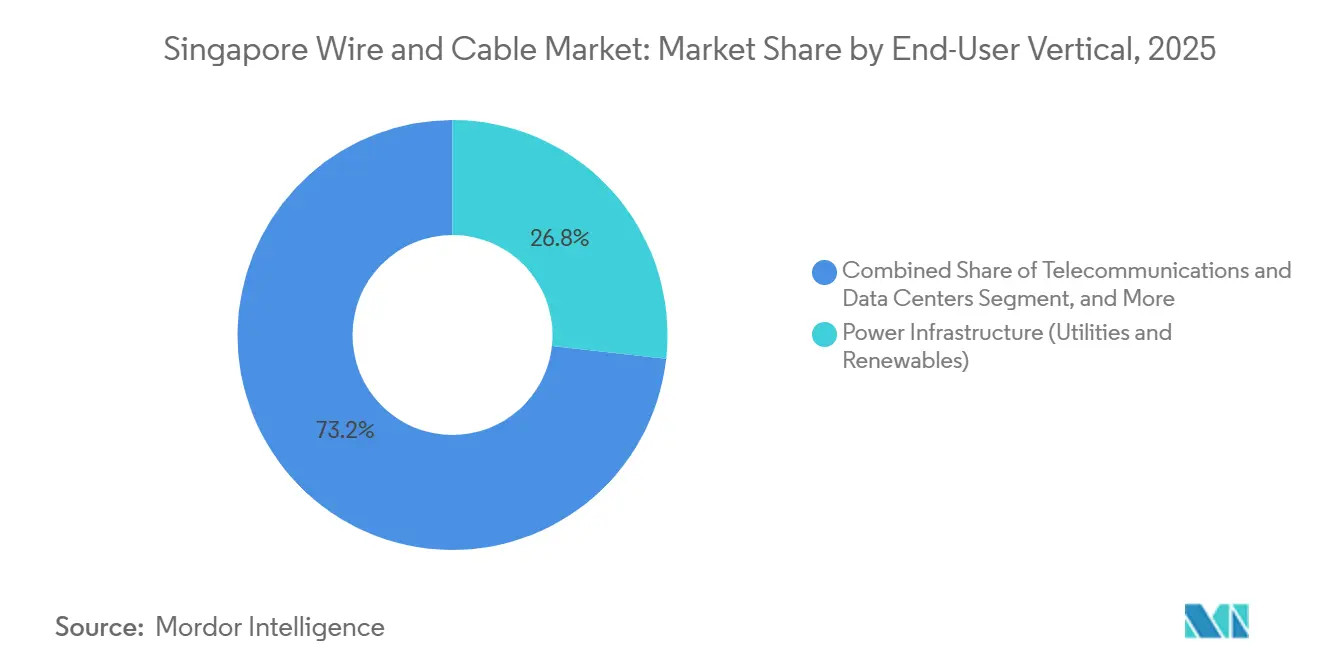
- By end-user vertical, power infrastructure, utilities, and renewables accounted for 26.77% in 2025, while telecommunications and data centers are projected to expand at an 8.87% CAGR through 2031 in the Singapore wire and cable market.
- By insulation, insulated cables accounted for 75.65% share in 2025 and are projected to grow at a 9.12% CAGR through 2031 in the Singapore wire and cable market.
Note: Market size and forecast figures in this report are generated using Mordor Intelligence’s proprietary estimation framework, updated with the latest available data and insights as of January 2026.
Singapore Wire and Cable Market Trends and Insights
Drivers Impact Analysis*
| DRIVER | (~) % IMPACT ON CAGR FORECAST | GEOGRAPHIC RELEVANCE | IMPACT TIMELINE |
|---|---|---|---|
| Data Center and Cloud Infrastructure Expansion | +2.2% | Singapore-wide, concentrated in Changi, Jurong Island, and Tuas precincts | Short term (≤ 2 years) |
| Undergrounding of High-Voltage Electricity Infrastructure | +1.8% | Singapore-wide, under the national grid mandate | Medium term (2-4 years) |
| Cross-Border Renewable Electricity Interconnections | +1.3% | Singapore is the terminal-demand node, with routes through Johor Strait, Peninsular Malaysia, and Sumatra | Long term (≥ 4 years) |
| 5G, Fiber Connectivity and Subsea Cable Capacity Expansion | +1.0% | Singapore-wide, with subsea cables concentrated at Changi and Jurong Island landing stations | Short term (≤ 2 years) |
| Demand for Sustainable and Recyclable Cable Materials | +0.4% | Singapore-wide, supported by BCA Green Mark and Singapore Green Plan 2030 | Medium term (2-4 years) |
| Integration of Cable Monitoring and Digital Grid Technologies | +0.3% | Singapore-wide, centered on SP Group's grid and JTC's Punggol Digital District smart grid | Medium term (2-4 years) |
| Source: Mordor Intelligence | |||
Data Center and Cloud Infrastructure Expansion
Singapore's data center estate operated at 1.4 GW of live IT capacity in 2026, with a vacancy rate of 2%, leaving little unused capacity across existing facilities and creating sustained demand for power and connectivity cabling. The 700 MW low-carbon data center precinct announced for Jurong Island in October 2025 requires new 230 kV feed circuits from the national grid, linking its growth directly to utility-grade transmission investment. Each transmission route requires more than 10 km of underground XLPE cable, which adds a substantial cable requirement before internal distribution systems are considered. The co-location of computing facilities, hydrogen import terminals, and battery storage increases cable density within a single industrial area and combines several separate infrastructure requirements. Singapore's Digital Connectivity Blueprint targets more than 40 subsea cable landings by 2028, up from 28 active systems in 2026, underscoring the need for network capacity beyond individual data center sites. This expansion requires more fiber routing, power distribution, and cable landing infrastructure across the Singapore wire and cable market.
Undergrounding of High-Voltage Electricity Infrastructure
Singapore requires new extra-high-voltage transmission lines to be built underground, reflecting high land-use intensity and the need to protect limited surface space. SP Group commissioned more than 150 km of new electricity cables and replaced 180 km of aging assets during its most recent reporting cycle, indicating that network renewal runs in parallel with capacity expansion.[1]SP Group, “Planning for Singapore’s Long-Term Network Reliability,” SP Group, spgroup.com.sg The company also commissioned Southeast Asia's first underground 230 kV substation at Labrador, serving Alexandra, Clementi, and the Science Park.[2]Energy Market Authority, “Regional Power Grids,” Energy Market Authority, ema.gov.sg Replacing aging overhead and paper-insulated-lead routes requires higher-specification systems, because new assets must meet current operating and safety requirements. Full turnkey contracts are more common because they combine manufacturing, laying, testing, and interface management into a single accountable scope. Technical requirements and active type-test certifications limit the pool of suppliers able to compete at the extra-high-voltage level.
Cross-Border Renewable Electricity Interconnections
In April 2025, Singapore established Singapore Energy Interconnections Pte Ltd to develop and operate cross-border electricity interconnections. The arrangement places renewable electricity corridors within national infrastructure planning rather than treating them as isolated commercial projects. In January 2026, Électricité Du Laos, the Electricity Generating Authority of Thailand, and Tenaga Nasional Berhad signed the Phase 2 Energy Wheeling Agreement under LTMS-PIP 2.0.[3]Electricity Generating Authority of Thailand, “EDL, EGAT, and TNB Advance ASEAN Power Grid Through Energy Wheeling Agreement Phase 2 Under LTMS-PIP 2.0,” Electricity Generating Authority of Thailand, egat.co.th The agreement doubled multilateral power trade to 200 MW, showing that the regional framework has moved beyond an earlier pilot phase. A second Malaysia-Singapore interconnection feasibility study targets at least 1,000 MW of commercial capacity by 2029. These projects require new high-voltage submarine routes, underground termination systems, and grid-integration equipment, supporting long-term demand in the Singapore wire and cable market.
5G, Fiber Connectivity and Subsea Cable Capacity Expansion
Singapore achieved nationwide 5G Standalone coverage in 2025, and mobile operators began migrating customers from non-standalone networks in 2026. The migration requires fiber densification across commercial zones and industrial estates, where existing conduits were not always designed for higher fiber counts. The Bifrost system was declared ready for service in October 2025 and began commercial traffic in December 2025, providing more than 240 Tb/s of trans-Pacific capacity for cloud and AI workloads. The Nongsa-Changi Cable landing in July 2026 added a 50 km system with 24 fiber pairs between Singapore and Indonesia, strengthening a nearby regional route. These projects increase demand for landing-station infrastructure, high-fiber-count internal routing, and the associated power systems that support digital facilities. A National Broadband Network upgrade to 10 Gbps for more than 500,000 households by 2028 also supports domestic fiber renewal.
Restraints Impact Analysis*
| RESTRAINT | (~) % IMPACT ON CAGR FORECAST | GEOGRAPHIC RELEVANCE | IMPACT TIMELINE |
|---|---|---|---|
| Copper and Aluminum Price Volatility | -0.8% | Global commodity markets, with direct pass-through to Singapore's import-dependent cable supply chain | Short term (≤ 2 years) |
| High Installation and Civil-Works Costs in Dense Urban Areas | -0.6% | Singapore-wide, most acute in the Central Business District and mature HDB estates with congested utilities | Medium term (2-4 years) |
| Limited Local Availability of High-Voltage Cable-Jointing Specialists | -0.3% | Singapore, with demand spillover across wider ASEAN | Medium term (2-4 years) |
| Import Dependency and Exposure to Regional Supply Disruptions | -0.2% | Singapore, with shipping-route exposure in the South China Sea | Short term (≤ 2 years) |
| Source: Mordor Intelligence | |||
Copper and Aluminum Price Volatility
Copper on the London Metal Exchange reached an intraday high of USD 14,527.50 per tonne on January 29, 2026. Singapore manufacturers buy copper and aluminum through international markets, so movements in metal prices directly affect working capital, tender pricing, and margins on fixed-price projects. Tai Sin Electric reported a reversal of SGD 2.322 million (USD 1.71 million) for onerous-contract provisions in the first half of FY2025, linked to copper price movements. The copper-to-aluminum price ratio reached 4.3 in January 2026, prompting procurement reviews of aluminum conductors for applications where the material meets technical requirements. Aluminum can support cable volumes when substitution is feasible, but it reduces revenue per meter due to its lower unit value. Buyers and contractors are increasingly using LME-linked formula pricing with monthly adjustment clauses to manage the exposure over longer project periods.
High Installation and Civil-Works Costs in Dense Urban Areas
Singapore's power, telecommunications, water, and gas networks share corridors within a 733 km² urban footprint, leaving limited room for new utility routes. This arrangement raises the cost of installing every new cable circuit because work must be planned around active services and constrained access. Tengah New Town includes a 12 km common services duct for telecommunications and power cables, but this approach does not yet cover most legacy districts that need replacement work. Extra-high-voltage circuits can be installed 60 meters underground, requiring specialized engineering, detailed surveys, and substantial civil work. Cable routes also require approvals from multiple agencies before excavation can begin, lengthening project preparation and coordination. A utility clash-resolution workflow has avoided SGD 300 million (USD 219 million) in unnecessary costs since 2024, but its coverage is still expanding across project types.
*Our forecasts treat driver/restraint impacts as directional, not additive. The impact forecasts reflect baseline growth, mix effects, and variable interactions.
Segment Analysis
By Voltage: Higher-Voltage Projects Strengthen the Upgrade Cycle
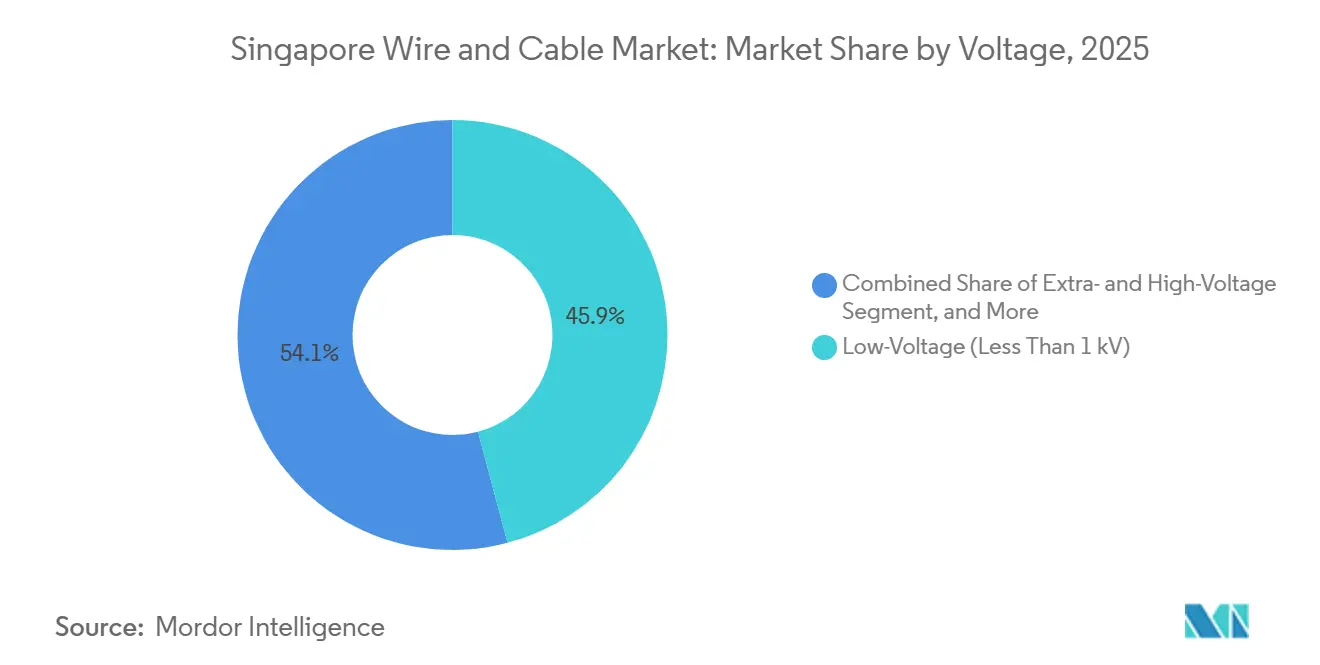
Low-voltage cables below 1 kV held 45.88% of the Singapore wire and cable market share in 2025. Residential construction in Tengah and Bayshore, commercial refurbishment work, and data center distribution systems support this broad installed base. Within campuses, individual IT loads require many low-voltage circuits, breakers, and cable runs. Extra- and high-voltage cables above 35 kV are projected to record an 8.99% CAGR from 2026 to 2031. Their growth reflects 230 kV and 400 kV underground upgrades, as well as renewable electricity entering the network at transmission voltage, where large cable systems, specialized joints, terminations, and controlled installation processes are required before the imported power can be distributed.
The Labrador underground 230 kV substation uses digital protection and control technology and serves as a reference for future network expansion.[4]Energy Market Authority, “Beneath the City, Exploring Singapore’s First 230kV Underground Electricity Substation,” Energy Market Authority, ema.gov.sg Medium-voltage cables from 1 kV to 35 kV connect transformers with final distribution panels in industrial sites, offices, and other commercial facilities. New solar photovoltaic arrays and battery storage systems also use 22 kV feeder cables, switchgear, and related connections. Conditional-license electricity-import projects from Indonesia, Cambodia, Australia, and Malaysia require high-voltage equipment at Singapore landing points. The Singapore wire and cable market for higher-voltage products will benefit from procurement that prioritizes transmission capacity, grid integration, assured operating reliability, tested accessory compatibility, and contractor capability to manage complex underground routes from design through final commissioning.



By Cable Type: Fiber Optics Change the Product Mix
Power cables held 39.98% share in 2025 in the Singapore wire and cable market. Grid expansion and asset replacement underpin demand, including more than 150 km of new cables and 180 km of replaced cables in SP Group's latest reporting cycle. Fiber-optic cables are projected to grow at a 9.02% CAGR through 2031. Subsea landing stations and AI data centers need dense fiber routing that copper alternatives cannot provide at comparable cost per bit. Nationwide 5G Standalone coverage and the planned household broadband upgrade support the same need for domestic fiber renewal, extending demand from international landing stations into commercial districts, industrial facilities, residential connections, and the internal networks that connect those locations.
Signal and control cables serve rail traction, building-management networks, and industrial automation, while coaxial and data cables perform related communication functions across transport and industrial sites. Procurement requirements, therefore, differ materially by cable type and intended use. Utility power-cable frameworks favor suppliers with SS 638 certification, established local execution capability, and proven project delivery records. Hyperscalers favor low-attenuation, high-bandwidth fiber specifications from global specialists. The Singapore wire and cable market rewards depth in defined cable categories rather than a broad product offer that lacks comparable specification strength, because utility frameworks, hyperscaler requirements, rail systems, and industrial controls each evaluate technical performance against different operating needs.
By Conductor Material: Aluminum Gains Ground in Selected Uses
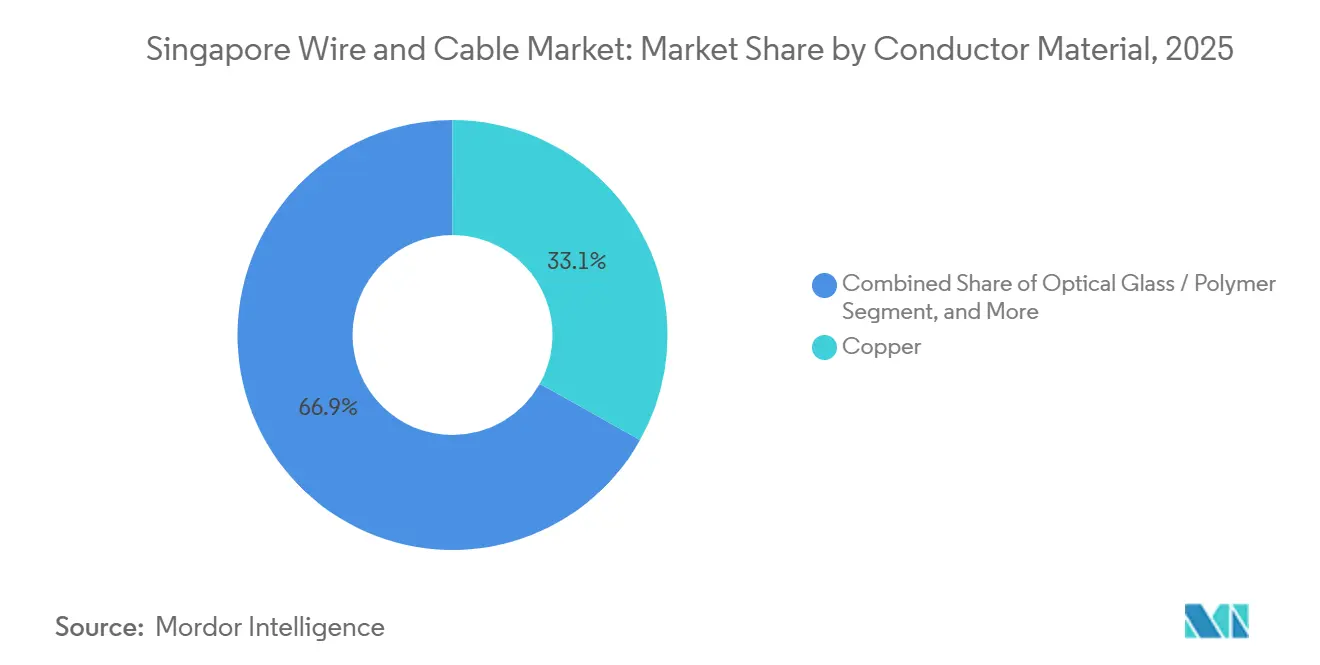
Copper accounted for 33.12% share in 2025 in the Singapore wire and cable market. It remains important where conductivity relative to cable cross-section matters at joints, terminations, and connector interfaces. Aluminum is projected to grow at a 8.12% CAGR from 2026 to 2031. Its growth follows the 4.3 copper-to-aluminum price ratio recorded in January 2026. Large low-voltage and medium-voltage projects are more likely to examine aluminum options when this price relationship persists, especially where the design can accommodate a different conductor cross-section without affecting the required electrical performance, installation method, or applicable safety specifications.
Optical glass and polymer conductors serve fiber-optic applications and track data center and subsea system deployments. Aluminum can reduce raw-material volatility in applications where technical substitution is feasible, but it also lowers revenue per meter because of its lower unit value. Singapore remains dependent on imported conductor materials, making exchange movements, supply terms, and commodity prices relevant to landed costs. Keystone Cable holds Singapore Green Building Product certification and reported a 99% copper recycling rate, linking material selection to Green Mark procurement criteria.[5]Keystone Cable, “Building Greener, Smarter, With SGBP-Certified Cables,” Keystone Cable, keystone-cable.com Longer-term supply agreements and formula-based pricing are becoming increasingly important as buyers seek greater certainty about material costs, delivery schedules, and the commercial implications of changes in imported copper and aluminum prices during the execution of large projects.
By Installation: Underground Systems Remain Central While Submarine Use Rises
Underground installation is expected to account for 40.12% of the market in 2025 in the Singapore wire and cable market. Singapore’s policy to preserve surface space, along with limited access to existing utility corridors, supports this position. SP Group’s network includes three cable tunnels extending 40 km and housing 1,200 km of extra-high-voltage cables at an average depth of 60 meters. Overhead installation continues to decline as legacy lines on Jurong Island’s industrial periphery are retired. Submarine installation is projected to expand at a CAGR of 9.11% from 2026 to 2031, as digital systems and power interconnections advance in parallel. This growth is increasing demand for products that can withstand marine conditions, long route lengths, offshore installation work, and complex links with onshore grid infrastructure.
The Nongsa-Changi Cable and the final Bifrost fiber-pair commitment are expected to mark two major submarine developments in July 2026. High-voltage submarine cables command higher per-meter prices than comparable land cables, while turnkey subsea agreements include broader engineering, installation, and commissioning scopes. ASEAN Cableship can support links between Singapore and neighboring markets, while the planned Sarawak interconnector study is expected to establish approaches relevant to future regional corridors. IEC 60840 and IEC 62067 standards create high qualification barriers, requiring suppliers to demonstrate established testing histories and specialized project capabilities. The Singapore wire and cable market is shifting away from overhead lines toward projects that require both underground and subsea expertise. As a result, route engineering, marine installation, testing, cable protection, and coordination with grid operators are becoming integral parts of supplier offerings.
By End-User Vertical: Utilities and Telecommunications Provide the Main Demand Base
Power infrastructure, utilities, and renewables are expected to account for 26.77% of the market in 2025 in the Singapore wire and cable market. Multi-year grid programs and renewable energy import corridors underpin demand from this vertical. Telecommunications and data centers are projected to grow at a CAGR of 8.87% through 2031. Hyperscale facilities require subsea connectivity, internal fiber routing, and medium- and low-voltage distribution systems. Residential and commercial construction remain important volume outlets for low-voltage copper and aluminum products, particularly when building refurbishment, energy-efficiency upgrades, new equipment, and safety requirements require replacing older distribution systems and associated cabling.
SP Group commissioned more than 2,700 new customer connections during its 2024-2025 capital program. Oil and gas and petrochemical operations on Jurong Island require flame-retardant armored signal and control cables, providing a steadier revenue source than construction-led activities. Singapore’s 2030 cleaner-energy vehicle requirement and target of 60,000 EV charging points are driving demand for charging cable assemblies. Manufacturing activity in Tuas and Seletar Aerospace Park supports demand for ruggedized automation and robotic control cables. This broad end-use base allows utility investment to offset weaker conditions in individual construction activities, while infrastructure upgrades, digital facilities, industrial operations, and transport electrification keep demand distributed across different product specifications and procurement cycles.
By Insulation: Insulated Products Maintain a Structural Lead
Insulated cables are expected to account for 75.65% of the Singapore wire and cable market share in 2025 and are projected to grow at a CAGR of 9.12% through 2031. XLPE and LSZH designs are widely required for underground, data center, and public infrastructure applications. SS 358 and IEC 60228 standards support this specification pattern. The transition to 230 kV and 400 kV networks requires replacing aging paper-insulated lead cables with modern XLPE cables. This transition creates a renewal requirement that is less dependent on the pace of new building activity, as existing network assets, public facilities, data centers, and underground utility routes still require modern insulation systems to meet current operating and fire-performance expectations.
Non-insulated conductors remain limited to specific applications, including parts of Jurong Island’s 66 kV distribution system and industrial transformer busbars. These categories serve different operating environments and, therefore, do not directly compete with each other. Nexans introduced a cable prototype with 99.5% recycled content, reflecting the direction of material specifications. Keystone Cable’s ISO 14001, ISO 45001, and ISO 9001 certifications support its environmental and quality credentials. Higher-temperature insulation designs for AI data centers can reduce cable cross-sections while maintaining the required power throughput. This trend is increasing competition within compounds and recyclable formulations as suppliers respond to requirements for thermal performance, fire safety, environmental credentials, and space-efficient installation.
Geography Analysis
Singapore represents a single metropolitan geography covering 733 km², with no agricultural hinterland or low-density expansion frontier to absorb infrastructure demand. SP Group serves 1.6 million electricity accounts through 12,000 substations and 18,000 transformers, which require continuous replacement, preventive maintenance, and capacity upgrades across the city-state. The Singapore wire and cable market size is also expected to be supported by 28 active international subsea cable systems in 2026, connecting global traffic to local facilities and terrestrial networks. Singapore's Digital Connectivity Blueprint targets more than 40 systems by 2028, making landing-station upgrades, nearby power systems, and associated network infrastructure key components of local demand. The Singapore Green Plan 2030 target of at least 2 GWp of solar deployment by 2030 adds distributed cable requirements across commercial, industrial, and public facilities.
Jurong Island and the Tuas corridor concentrate extra-high-voltage and industrial cable demand, with the 400 kV underground grid and planned 700 MW low-carbon data center precinct increasing procurement in the western cluster. Changi and the eastern corridor support submarine and fiber-optic demand through landing points for Bifrost, Nongsa-Changi Cable, and other systems that require both external connections and local routing. The Central Business District and mature HDB estates in Toa Payoh, Queenstown, and Bishan drive low-voltage replacement and medium-voltage distribution work as stakeholders upgrade buildings and utilities. Punggol Digital District is testing underground networks with built-in monitoring that may influence future procurement requirements across the Singapore wire and cable market. This concentration of demand across distinct zones makes corridor access, construction sequencing, utility coordination, and reliable installation planning critical to project execution.
Singapore serves as the southern node of mainland Asia's digital backbone and a northern power-import hub for ASEAN renewable electricity routes, linking its requirements with infrastructure decisions in Malaysia, Indonesia, Vietnam, and Thailand. The LTMS-PIP Phase 2 framework supports 200 MW of multilateral hydropower trade through regional infrastructure. The Energy Market Authority sets grid-connection compatibility requirements through Singapore Energy Interconnections Pte Ltd, shaping technical specifications, operational requirements, and equipment choices for inbound interconnector projects. These requirements make the Singapore wire and cable market a regional reference point for high-voltage and submarine cable procurement.
Competitive Landscape
The Singapore wire and cable market is moderately concentrated in extra-high-voltage applications and fragmented across low- and medium-voltage categories. Qualification barriers remain much higher for transmission systems than for standard building and distribution products because high-voltage projects require extensive testing, installation history, and technical approvals. LS Cable and System has maintained a position in Singapore's ultra-high-voltage cable segment since 2010, supported by accumulated installation experience and established technical qualifications. Its 2025 and 2026 project awards are expected to strengthen its presence in the high-voltage pipeline before later energy-import routes reach construction. Prysmian combines a long-established Singapore presence with products for energy and digital infrastructure, enabling it to serve both utility and data center requirements.
Tai Sin Electric and Keystone Cable have established positions in public-sector construction and low- to medium-voltage supply chains, where timely supply and local operating knowledge remain important. Keystone has invested in factory digitalization and real-time production data capture through EnterpriseSG's Scale-Up program, supporting local manufacturing, quality control, and tender-quality requirements. Prysmian has introduced higher-temperature power cable designs for AI data center applications, where space, heat, and power density influence equipment selection. Nexans has advanced recyclable cable materials that may become more relevant to Green Mark projects. Chinese manufacturers Jiangsu Zhongtian Technology and Hengtong Optic-Electric are competing more actively in fiber-optic systems through scale and pricing.
Digital monitoring is an emerging area of competition in the Singapore wire and cable market. SP Group's Grid Digital Twin program provides a data foundation for monitoring-integrated systems and more informed asset management. Power Technologies Singapore has deployed sensor-based monitoring systems that detect insulation faults with a sensitivity of 2 picocoulombs on SP Group's network. Digital substations based on IEC 61850 are likely to tighten requirements for accessories and monitoring, favoring suppliers that combine cable design, installation capability, and continuous asset visibility.
Singapore Wire and Cable Industry Leaders
Prysmian S.p.A.
Nexans S.A.
Belden Inc.
NKT A/S
Keystone Cable
- *Disclaimer: Major Players sorted in no particular order

Recent Industry Developments
- July 2026: The Nongsa-Changi Cable (NCC), a 50 km submarine cable with 24 fiber pairs developed by Telin and BW Digital, landed in Batam, adding over 1.6 Pb/s of capacity between Singapore and Indonesia at under 2 ms latency. The landing coincided with ASEAN member states preparing a regional digital economy framework, reinforcing Singapore's role as a subsea cable hub and driving additional demand for cable landing-station infrastructure and intra-facility fiber routing in the Changi corridor.
- July 2026: Keppel secured an indefeasible right-of-use agreement with a global hyperscaler for the fifth and final fiber pair on the Bifrost Cable System, bringing the total committed contract value to USD 1.3 billion, including 25-year operations and maintenance. Keppel simultaneously announced that it is evaluating 2 new cable systems: 1 linking Singapore to the Middle East and another to Japan through the South China Sea, signaling a sustained pipeline of subsea cable civil and integration work.
- June 2026: LS Cable and System secured a KRW 140 billion (USD 0.09 billion) ultra-high-voltage grid project from Singapore's national power authority, covering the supply of 400 kV and 230 kV cables to expand the national transmission grid. The win extended LS Cable's uninterrupted number one position in Singapore's ultra-high-voltage cable segment to 16 consecutive years.
- June 2026: Tai Sin Electric Limited, through subsidiaries Lim Kim Hai Electric Co. and PT Elmecon Multikencana, signed a shareholder framework agreement with Elvo Energy Ltd. to establish PT Elvo Electric Indonesia, a new entity focusing on industrial electrical automation distribution. The move marked a geographic expansion into Indonesia for Tai Sin's distribution business, complementing its manufacturing footprint in Singapore, Malaysia, and Vietnam.


Singapore Wire and Cable Market Report Scope
The Singapore Wire and Cable Market Report is Segmented by Voltage (Extra-and High-Voltage [Greater Than 35 kV], Medium-Voltage [1-35 kV], and Low-Voltage [Less Than 1 kV]), Cable Type (Power Cable, Fiber-Optic Cable, Signal and Control Cable, and Coaxial and Data Cable), Conductor Material (Copper, Aluminum, and Optical Glass / Polymer), Installation (Overhead, Underground, and Submarine), End-User Vertical (Residential Construction, Commercial Construction, Power Infrastructure, Telecommunications and Data Centers, Oil and Gas and Petrochemicals, Automotive and Mobility, and Industrial Manufacturing), and Insulation (Insulated, and Non-Insulated). The Market Forecasts are Provided in Terms of Value (USD).
| Extra- and High-Voltage (Greater Than 35 kV) |
| Medium-Voltage (1-35 kV) |
| Low-Voltage (Less Than 1 kV) |
| Power Cable |
| Fiber-Optic Cable |
| Signal and Control Cable |
| Coaxial and Data Cable |
| Copper |
| Aluminum |
| Optical Glass / Polymer |
| Overhead |
| Underground |
| Submarine |
| Residential Construction |
| Commercial Construction |
| Power Infrastructure (Utilities and Renewables) |
| Telecommunications and Data Centers |
| Oil and Gas and Petrochemicals |
| Automotive and Mobility |
| Industrial Manufacturing |
| Insulated |
| Non-Insulated |
| By Voltage | Extra- and High-Voltage (Greater Than 35 kV) |
| Medium-Voltage (1-35 kV) | |
| Low-Voltage (Less Than 1 kV) | |
| By Cable Type | Power Cable |
| Fiber-Optic Cable | |
| Signal and Control Cable | |
| Coaxial and Data Cable | |
| By Conductor Material | Copper |
| Aluminum | |
| Optical Glass / Polymer | |
| By Installation | Overhead |
| Underground | |
| Submarine | |
| By End-User Vertical | Residential Construction |
| Commercial Construction | |
| Power Infrastructure (Utilities and Renewables) | |
| Telecommunications and Data Centers | |
| Oil and Gas and Petrochemicals | |
| Automotive and Mobility | |
| Industrial Manufacturing | |
| By Insulation | Insulated |
| Non-Insulated |


Key Questions Answered in the Report
What is the size of the Singapore wire and cable market?
The Singapore wire and cable market was valued at USD 1.01 billion in 2025 and is projected to reach USD 1.08 billion in 2026. It is projected to reach USD 1.52 billion by 2031 at a CAGR of 7.07%.
What is driving wire and cable demand in Singapore?
Data center capacity, underground grid investment, renewable electricity imports, and new subsea connectivity systems are the primary demand drivers. Together, these projects require power, fiber, submarine, and grid-connection cable systems across the Singapore wire and cable market.
Which voltage segment is growing fastest in Singapore?
Extra- and high-voltage cables are projected to expand at an 8.99% CAGR from 2026 to 2031. The growth is associated with 230 kV and 400 kV transmission projects and infrastructure for imported renewable electricity.
Why are submarine cables growing in importance?
Submarine installation is projected to grow at a 9.11% CAGR through 2031, driven by Singapore's expansion of digital cable systems and renewable-power interconnectors. These links require cable landing facilities, network integration, and specialist marine installation capability.
Which end users create the largest demand for cable products?
Power infrastructure, utilities, and renewables held 26.77% share in 2025, while telecommunications and data centers are projected to grow at an 8.87% CAGR through 2031. Construction, industrial manufacturing, mobility, and petrochemicals also provide demand across specialized applications.
How do commodity prices affect cable suppliers in Singapore?
Singapore relies on imported copper and aluminum, so changes in global metal prices affect working capital, tender margins, and material selection. Formula-based contracts and monthly price adjustments can help manage exposure on longer cable projects.
Page last updated on:





