
SIM Swap Fraud Prevention Software Market Size and Share
Market Overview
| Study Period | 2020 - 2031 |
|---|---|
| Market Size (2026) | USD 1.64 Billion |
| Market Size (2031) | USD 3.97 Billion |
| Growth Rate (2026 - 2031) | 19.34 % |
| Fastest Growing Market | Middle East |
| Largest Market | North America |
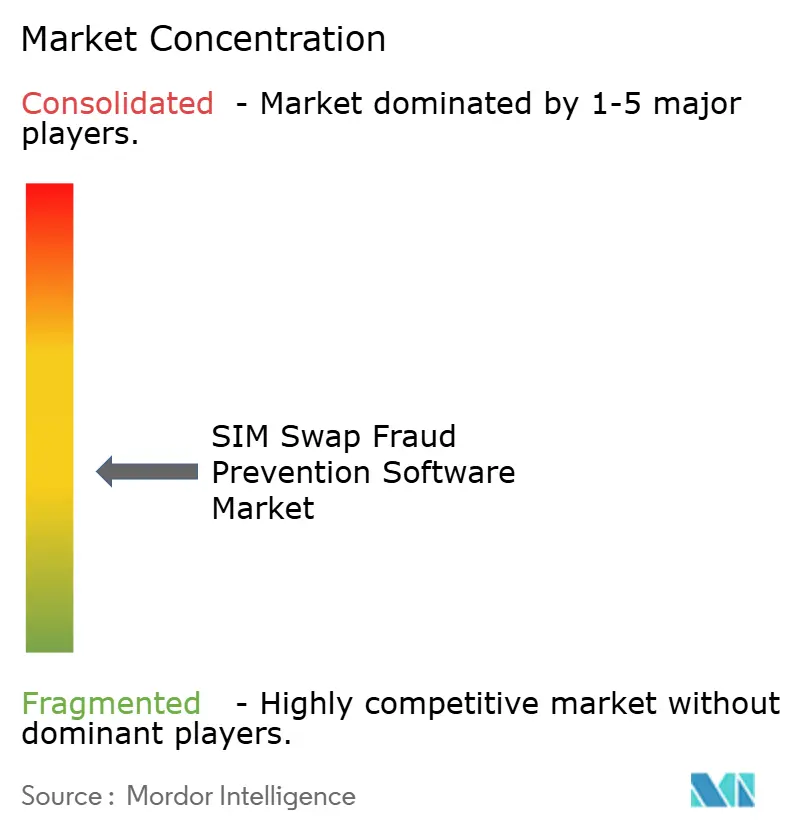
| Market Concentration | Medium |
Major Players *Disclaimer: Major Players sorted in no particular order Image © Mordor Intelligence. Reuse requires attribution under CC BY 4.0. | |
SIM Swap Fraud Prevention Software Market Analysis by Mordor Intelligence
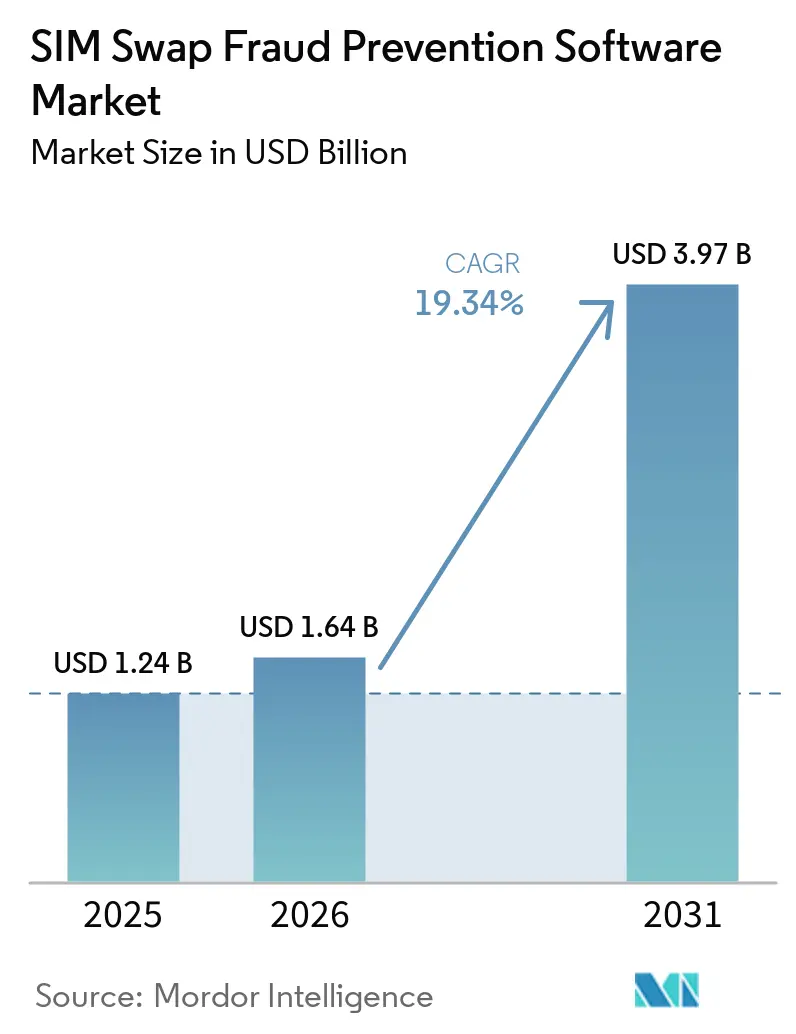
The SIM Swap Fraud Prevention Software Market size is projected to be USD 1.24 billion in 2025, USD 1.64 billion in 2026, and reach USD 3.97 billion by 2031, growing at a CAGR of 19.34% from 2026 to 2031. The SIM Swap Fraud Prevention Software Market is expanding as mobile numbers remain a common fallback for accessing bank accounts, e-commerce services, and government portals. Redirecting a mobile number to a criminal-controlled SIM card can give the criminal rapid access to one-time passcodes and account recovery processes. Buyers are moving fraud controls closer to the carrier network, using real-time SIM-change signals, behavioral scoring, and policy rules rather than relying only on application-level checks. Regulatory authentication requirements, mobile banking growth, and carrier network API deployments are increasing the demand for these tools. The SIM Swap Fraud Prevention Software Market also benefits from a wider group of buyers, including banks, fintech firms, telecom operators, and enterprises that need to protect mobile-based customer journeys.
Key Report Takeaways
- By component, software held 81.23% of the SIM Swap Fraud Prevention Software Market share in 2025, while services are projected to expand at a 22.71% CAGR through 2031.
- By deployment mode, cloud commanded 79.14% of the SIM Swap Fraud Prevention Software Market share in 2025, and it's also leading with a CAGR of 22.83%.
- By application, account takeover prevention accounted for 44.21% of revenue in 2025, while mobile number porting and SIM replacement monitoring are projected to expand at a 22.97% CAGR through 2031.
- By end user, banks and financial institutions held 48.12% of the SIM Swap Fraud Prevention Software Market revenue in 2025, while fintech and digital payment providers are projected to expand at a 22.91% CAGR through 2031.
- By organization size, large enterprises accounted for 73.21% of revenue in 2025, while SMEs are projected to grow at a 22.79% CAGR through 2031.
- By geography, North America held 38.14% revenue share in 2025, while Middle-East is projected to expand at a 22.81% CAGR through 2031.
Note: Market size and forecast figures in this report are generated using Mordor Intelligence’s proprietary estimation framework, updated with the latest available data and insights as of January 2026.
Market Trends and Insights
Drivers Impact Analysis of SIM Swap Fraud Prevention Software Market*
| Driver | (~) % Impact on CAGR Forecast | Geographic Relevance | Impact Timeline |
|---|---|---|---|
| Escalating Account Takeover and SIM Swap Incidents | +5.2% | Global | Short term (≤ 2 years) |
| Expansion of Mobile Banking and High-Value Digital Transactions | +4.6% | North America, Europe, Asia-Pacific | Short term (≤ 2 years) |
| Regulatory Requirements for Stronger Subscriber Authentication | +3.8% | North America and Europe | Medium term (2-4 years) |
| Adoption of Carrier-Grade Network APIs | +3.0% | Global, with concentration in North America and Europe | Medium term (2-4 years) |
| eSIM and Digital Provisioning Complexity | +2.2% | Global, Asia-Pacific core, spillover to Middle East and Africa | Long term (≥ 4 years) |
| Cross-Industry Demand for Silent Mobile Identity Verification | +1.5% | North America, Europe, Asia-Pacific | Medium term (2-4 years) |
| Source: Mordor Intelligence | |||
Escalating Account Takeover and SIM Swap Incidents
SIM swap activity and account takeover losses are giving security teams a direct reason to improve mobile identity controls. UK SIM swap cases rose 38% year over year in 2025, after a 1,055% increase in 2024, while account takeover filings exceeded 78,000 and represented 18% of fraud-risk events.[1] Cifas linked the 2025 rise partly to more automated attack methods, which make manual review less effective at scale. This software category responds by assessing whether a mobile number changed before a user completes a high-risk action. The FBI reported an average loss of USD 26,460 per victim from SIM swap attacks in the United States during 2024.[2] These loss levels support spending decisions based on avoided losses rather than on fraud volumes alone.
Expansion of Mobile Banking and High-Value Digital Transactions
Mobile banking has made the phone number an important authentication asset for high-value transactions. Account takeover fraud affected 23% of U.S. financial institutions in the fourth quarter of 2025, a 7% year-over-year increase, according to the Federal Reserve Financial Services survey.[3] Real-time payment systems can reduce the time available to identify and reverse a fraudulent transfer. Bharti Airtel, Reliance Jio, and Vodafone Idea announced access to federated SIM Swap and Number Verification APIs for enterprise users in banking and retail in 2025. Those APIs allow a financial institution to check a recent SIM change during authentication rather than after a payment has been made. This supports adoption in payment corridors where mobile numbers remain closely tied to customer identity. The SIM Swap Fraud Prevention Software Market benefits from this shift, as each mobile-led payment journey can create a new need for carrier-level risk checks.
Regulatory Requirements for Stronger Subscriber Authentication
Regulatory requirements are turning subscriber authentication into a defined operational responsibility for wireless providers. The FCC adopted FCC-23-95 in November 2023, requiring providers to use secure customer authentication before SIM changes or port-outs and to immediately notify subscribers of those requests.[4] These requirements increase the importance of controls that identify suspicious changes before an account is exposed. Data protection enforcement also raises the cost of weak duplicate-SIM procedures. The Spanish data protection authority issued a EUR 1.2 million (USD 1.39 million) fine against Orange Espagne in February 2025 for the unauthorized use of a duplicate SIM card, as cited in the supplied research. These platforms can support carriers and service providers that need auditable checks across SIM-change workflows.
Adoption of Carrier-Grade Network APIs
Carrier-grade APIs are reducing the need for enterprises to build separate integrations with each mobile network operator. The GSMA Open Gateway initiative has expanded a standardized route for operators to expose network capabilities to developers. In November 2025, Vonage announced commercial SIM Swap Detection and Silent Authentication APIs across major U.S. carriers and in 7 European markets. The standardized approach can make it easier to add a recent SIM change check to a fraud decision workflow. It can also lower integration demands for mid-sized buyers that do not have direct relationships with mobile network operators. This category can expand as API aggregators provide carrier intelligence via fewer technical connections.
Restraints Impact Analysis of SIM Swap Fraud Prevention Software Market*
| Restraint | (~) % Impact on CAGR Forecast | Geographic Relevance | Impact Timeline |
|---|---|---|---|
| Privacy and Consent Constraints for Subscriber Data | -1.8% | Europe, North America, Asia-Pacific | Short term (≤ 2 years) |
| Fragmented International KYC and SIM-Change Standards | -1.4% | South America, Middle East and Africa, Asia-Pacific | Medium term (2-4 years) |
| Limited Awareness and Budgets Among MVNOs and SMEs | -1.0% | Global, with concentration in Middle East and Africa and South America | Medium term (2-4 years) |
| Complex Revenue-Sharing Between MNOs and Identity Aggregators | -0.7% | Global | Long term (≥ 4 years) |
| Source: Mordor Intelligence | |||
Privacy and Consent Constraints for Subscriber Data
SIM-change history is sensitive subscriber information, so access to it must meet privacy and telecom rules. The GSMA has stated that privacy-by-design practices are central to Open Gateway services and that data protection obligations shape API deployment. Legal grounds can differ between markets, including consent, legitimate interest, and contractual necessity. Orange’s SIM Swap API documentation describes a service that detects whether a SIM card has been replaced recently. Cross-border use can require additional reviews where data residency rules limit the movement of subscriber data. These platforms can face longer sales cycles when legal, compliance, and security teams must agree on each use case.
Fragmented International KYC and SIM-Change Standards
International deployments can be difficult because SIM-change data, KYC processes, and commercial arrangements differ by market. The GSMA Open Gateway model depends on local operator participation, rather than a single global agreement that covers every network. Ecuador launched GSMA Open Gateway services in August 2025, while Paraguay launched its service in October 2025. Enterprises operating in several countries may still need market-specific agreements, compliance reviews, and workflow adjustments. This raises implementation work for fintech platforms that need consistent mobile identity controls across borders. Providers must therefore support flexible integrations and local data-handling requirements.
*Our forecasts treat driver/restraint impacts as directional, not additive. The impact forecasts reflect baseline growth, mix effects, and variable interactions.
SIM Swap Fraud Prevention Software Market Segment Analysis
By Component:
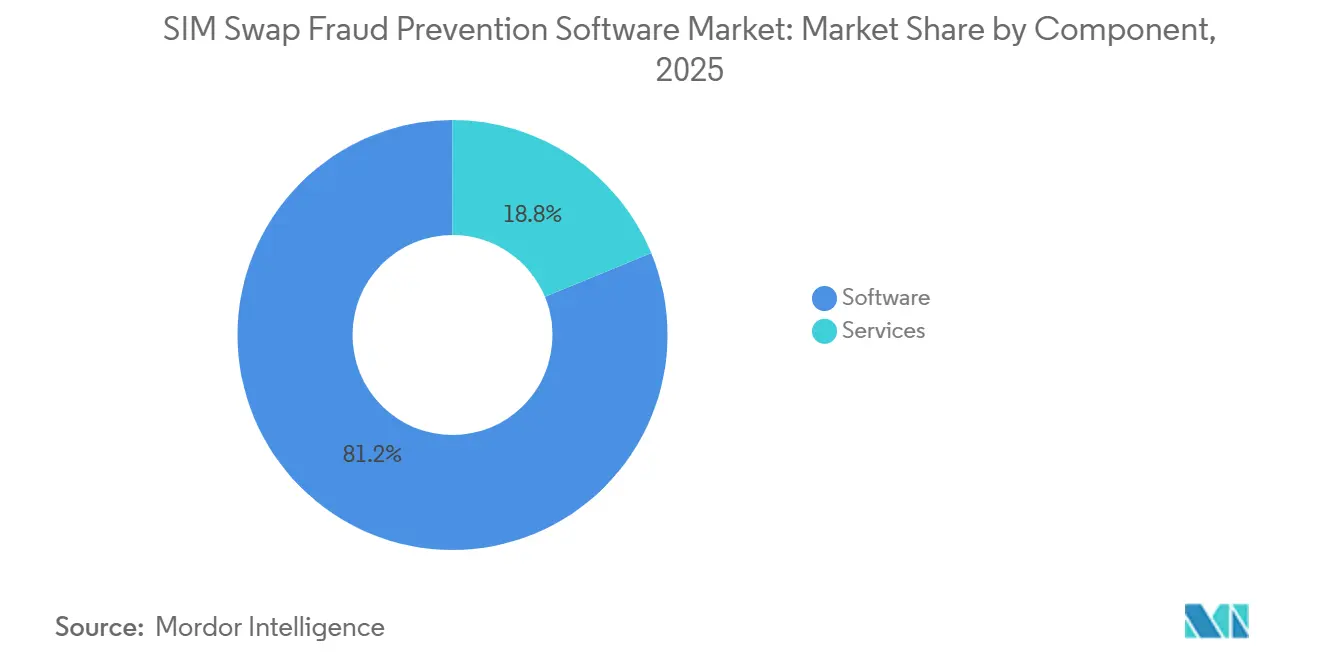
Software Remains the Core Revenue Base While Services Support IntegrationSoftware accounted for 81.23% of the SIM Swap Fraud Prevention Software Market share in 2025. Enterprises favor software platforms that combine risk rules, decision logic, API orchestration, and workflow controls into a configurable system. These deployments can connect with core banking systems, customer identity platforms, and fraud operations. A platform approach also allows organizations to apply the same SIM-change signal across several customer journeys. The software segment benefits when a buyer wants direct control over policy settings and alerts. The SIM Swap Fraud Prevention Software Market is therefore centered on products that turn carrier data into an immediate decision for a high-risk event.
Services are projected to expand at a 22.71% CAGR through 2031. Their growth reflects the practical work involved in connecting to mobile network operators and applying carrier APIs across different environments. Buyers may need support with operator agreements, privacy reviews, data residency mapping, API version changes, and workflow design. Managed services can help teams without specialist telecom integration resources. In July 2026, Vonage launched the Protection Suite for Okta, a prebuilt connector that uses SIM-swap detection and network-verified OTP delivery. Such offerings show how software providers can package connectivity and implementation support into a single customer proposition.
By Deployment Mode:
Cloud Leads While Local Processing Retains a RoleCloud deployment commanded 79.14% of the SIM Swap Fraud Prevention Software Market share in 2025, and its alsop the fastest segment with a CAGR of 22.83%. Cloud systems can quickly distribute rule updates and risk-model changes as attack methods shift. This is relevant when SIM swap schemes are automated, and fraud teams need to revise controls without lengthy release cycles. The approach also supports API-based connections with banks, payment providers, and customer identity services. Cloud delivery can make the platform accessible to buyers seeking consumption-based pricing and lower infrastructure requirements. The SIM Swap Fraud Prevention Software Market benefits from this model, as it enables carrier intelligence to be applied in real time across digital channels.
On-premises deployment continues to serve buyers with strict data sovereignty or internal security requirements. Some telecom operators and regulated institutions limit the external movement of subscriber data. Hybrid designs can process carrier signals locally while using cloud services for selected risk-scoring and administrative tasks. This structure gives organizations a way to balance local control with operational speed. The EU Cyber Resilience Act and NIS2-related security expectations strengthen attention to data protection and secure digital infrastructure. Hybrid and on-premises configurations remain important where the location of subscriber data is part of the procurement decision.
By Application:
Account Takeover Prevention Leads While Port Monitoring Grows FastestAccount takeover prevention held 44.21% of the SIM Swap Fraud Prevention Software Market share in 2025. This application is closely aligned with the losses that occur when a criminal takes control of a number and requests a password reset or a one-time code. A recent SIM-change signal can prompt a financial institution to step up authentication or to stop a transaction. The application is especially relevant for banks and payment providers with mobile-based login and recovery processes. It can also support fraud teams that need a clear reason for an alert at the moment of account access. This revenue position reflects the value of preventing a downstream takeover before credentials or funds are changed.
Mobile number porting and SIM replacement monitoring is projected to expand at a 22.97% CAGR through 2031. The application focuses on the early window after a carrier-level number transfer or SIM replacement. Brazil processes 500,000 SIM swap and number verification API transactions each month through GSMA Open Gateway deployments, according to the supplied research. This use case helps banks act before their own customer records have fully reflected a recent mobile change. Transaction authentication and digital onboarding also need these signals when a new user has a limited behavioral history. Password reset and account recovery protections can block the common post-swap sequence in which a criminal attempts to replace account credentials via SMS authentication.
By End User:
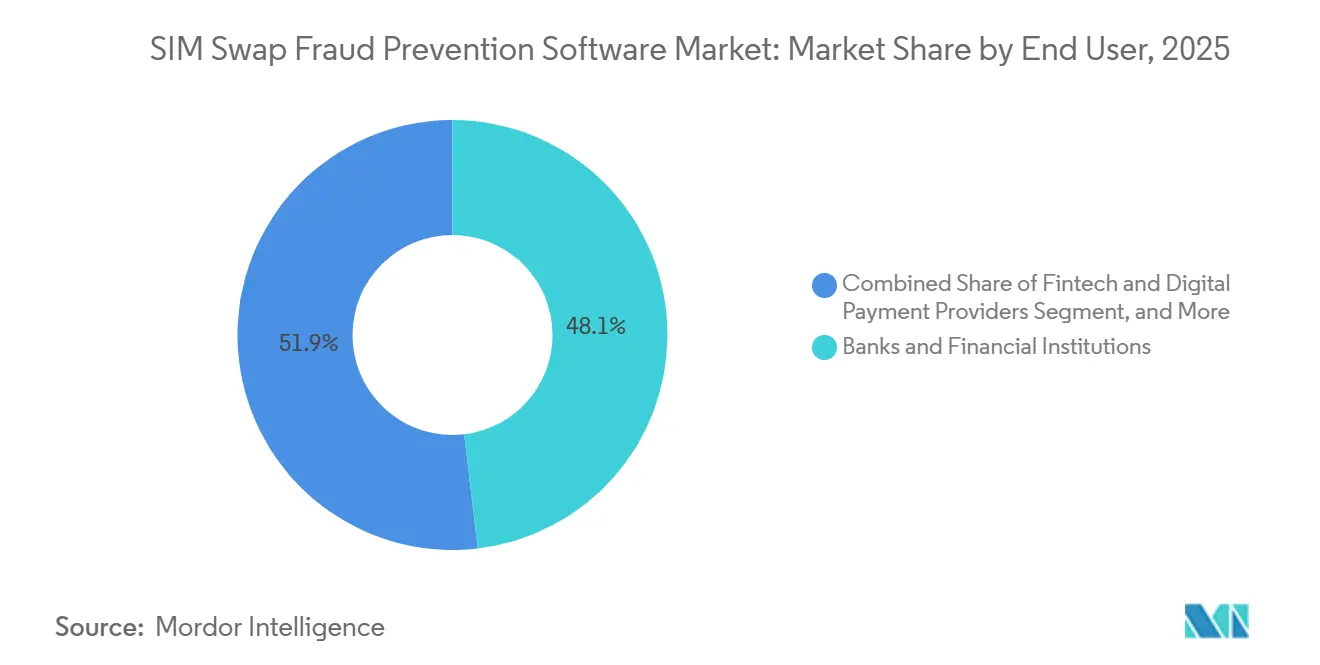
Banks Provide the Revenue Base While Fintechs Set the Faster Adoption PaceBanks and financial institutions accounted for 48.12% of the SIM Swap Fraud Prevention Software Market share in 2025. Banks are frequent targets because mobile numbers are commonly linked to account alerts, sign-in codes, payment approval, and password recovery. UK bank account identity fraud exceeded 63,000 cases in 2025, an increase of 10% from the prior year. A carrier-level check allows a bank to identify when a customer’s number may have changed before it approves a high-risk event. These institutions also have established fraud operations and compliance processes that can use a risk signal within existing decision systems. Their revenue position reflects both the value at risk and the ability to fund specialized control tools.
Fintech and digital payment providers are projected to expand at a 22.91% CAGR through 2031. Real-time payment designs leave less time to reverse fraudulent transfers after a number has been compromised. These providers can use SIM-change intelligence during login, payment initiation, account recovery, and customer onboarding. Telecom operators have a different but important role because they supply network data and also manage the SIM-change process. Government programs can use mobile verification where digital credentials depend on a confirmed phone number. Healthcare organizations are earlier adopters, using these tools mainly to reduce patient portal account takeover risks. The SIM Swap Fraud Prevention Software Market can gain new demand as more sectors use mobile identifiers for account access.

By Organization Size:
Large Enterprises Lead Revenue While SMEs Gain AccessLarge enterprises held 73.21% of the SIM Swap Fraud Prevention Software Market share in 2025. Large banks, multinational telecom companies, and major retailers had earlier access to direct agreements with mobile network operators. They also have the technical teams needed to integrate carrier data with fraud systems and customer authentication flows. Their established governance processes can support detailed reviews of privacy, security, and procurement. Bouygues Telecom reported that its Aduna-related API services supported more than 40 companies across banking, insurance, and e-commerce in 2025. This customer base shows why large organizations remain important buyers in the SIM Swap Fraud Prevention Software Market.
SMEs are projected to expand at a 22.79% CAGR through 2031. Consumption-based pricing and pre-built integrations can reduce the commitment required to use carrier-grade fraud signals. Smaller businesses can apply a SIM-change check without negotiating individual agreements with every mobile operator. Cloud delivery also reduces the need to maintain dedicated infrastructure. This can make protection more practical for digital merchants, regional financial firms, and smaller payment platforms. The growth of API aggregators can reduce the difference in access between large enterprises and smaller buyers. Organization size may become a less important predictor of adoption as packaged network-authentication services become more widely available.
Geography Analysis
North America and Europe SIM Swap Fraud Prevention Software Market
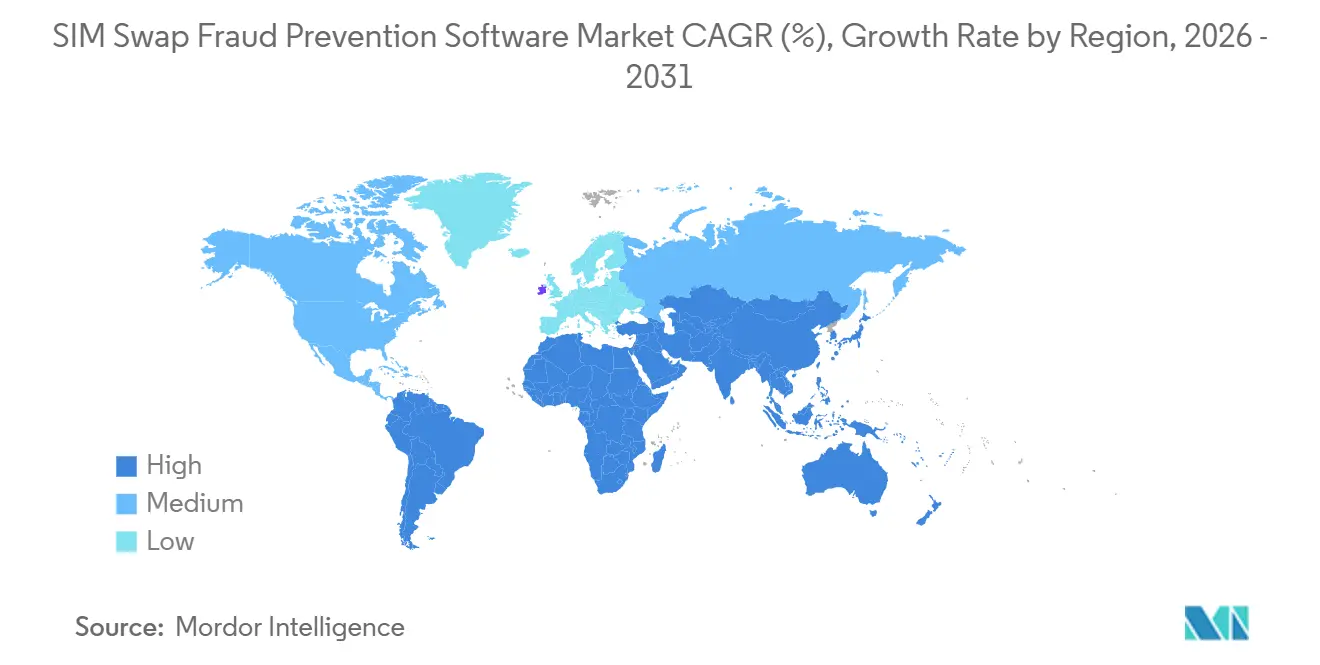
North America held 38.14% of the SIM Swap Fraud Prevention Software Market share in 2025. The region combines widespread use of mobile banking, formal authentication rules, and an advanced vendor ecosystem. FCC-23-95 requires wireless providers to use secure authentication for SIM changes and port-outs, which supports investment in stronger controls. In February 2026, Aduna announced U.S. coverage for SIM Swap Detection and Number Verification across AT&T, T-Mobile, and Verizon, covering more than 300 million connections through a single platform. This type of coverage gives developers a clearer route to add carrier signals to authentication workflows. Canada also faces a material fraud challenge, with the supplied research reporting 33,854 fraud cases and CAD 544 million in losses during 2025. Europe remains another significant revenue area because operators, regulators, and financial institutions have placed greater emphasis on subscriber data controls.
APAC SIM Swap Fraud Prevention Software Market
France was the first country where 4 major operators jointly launched KYC Match and SIM Swap APIs under CAMARA, according to the supplied research. Greece launched GSMA Open Gateway services in March 2026, expanding national support for fraud prevention and customer security. Croatia’s data protection authority imposed a EUR 4.5 million fine on a telecommunications operator in November 2025 for failures in accessing subscriber data. These events make compliance controls part of the regional buying case. Mobile-first financial services and a large base of mobile subscribers support the Asia-Pacific. India’s 3 largest operators introduced access to federated SIM Swap and Number Verification APIs for enterprise developers in 2025. The SIM Swap Fraud Prevention Software Market in Asia-Pacific can benefit as banks apply carrier checks to mobile-led account access and payments.
MEA and South America SIM Swap Fraud Prevention Software Market
The Middle East is projected to expand at a 22.81% CAGR through 2031. Digital economy programs and the rollout of network API ecosystems across Gulf markets support demand. Ooredoo and Vodafone Qatar released CAMARA-standardized anti-fraud APIs in 2025. South America and Africa remain early-stage markets, but their mobile financial systems create a strong need for affordable detection tools. Ecuador and Paraguay launched GSMA Open Gateway services in 2025, widening the availability of standardized operator capabilities. Brazil’s monthly volume of 500,000 SIM-swap and number-verification API transactions indicates that carrier-level verification can be used at a meaningful scale. Cloud-based services may be particularly relevant in these regions because they can lower deployment requirements for banks, fintech companies, and smaller digital businesses.
Competitive Landscape
The SIM Swap Fraud Prevention Software Market is fragmented, comprising carrier API aggregators, independent software and identity orchestration platforms, and focused providers serving specific use cases or regions. Carrier API aggregators have an advantage when they can secure access to mobile network operator data and present it through standardized interfaces. Aduna’s U.S. network API coverage aggregates connections from AT&T, T-Mobile, and Verizon through a single integration point. Vonage announced in November 2025 that it had launched fraud prevention network APIs across major U.S. carriers and 7 European markets. These capabilities can make technical access easier for enterprises that need real-time SIM-change intelligence. CAMARA alignment is becoming important for buyers seeking interoperable network APIs. The competitive position of software-only providers depends on how effectively they connect carrier data with customer risk decisions.
XConnect completed its acquisition of Sekura.id in April 2025, adding mobile identity, KYC match, and number verification capabilities to its numbering intelligence portfolio. The transaction shows that numbering intelligence and SIM-based identity functions are becoming more closely connected. Vendors can use acquisitions to broaden their ability to serve carriers, banks, and communications platforms. The SIM Swap Fraud Prevention Software Market has room for providers that address MVNOs and SMEs, where carrier-direct integrations can still be difficult to obtain. Healthcare and government also remain less-developed buyer groups despite growing exposure to mobile account takeover. In these areas, suppliers need simple integrations and pricing structures that fit smaller or specialized programs. The market’s fragmented design leaves room for both large network-backed platforms and focused specialists.
Visa announced in August 2026 that it had agreed to acquire BioCatch for USD 2.4 billion, with closing targeted for the second quarter of 2027. The planned acquisition links behavioral fraud intelligence with a broader payment-security platform. It also signals interest in combining multiple forms of identity and fraud data to prevent account takeover. Vendors are likely to compete on data coverage, workflow integration, privacy controls, and the ability to make rapid fraud decisions. Network API providers can differentiate through the reach and consistency of their mobile operator connections. Software platforms can differentiate through rule management, alerting, and fit with a customer’s existing fraud stack. The SIM Swap Fraud Prevention Software Market remains open to consolidation, as buyers value fewer, more reliable connections across multiple mobile networks.
SIM Swap Fraud Prevention Software Industry Leaders
-
TeleSign Corporation
-
Prove Identity, Inc.
-
Twilio Inc.
-
Mobileum Inc.
-
Syniverse Technologies, LLC
- *Disclaimer: Major Players sorted in no particular order
SIM Swap Fraud Prevention Software Market Companies Covered in this Report
- TeleSign Corporation
- Prove Identity, Inc.
- Twilio Inc.
- Infobip Ltd.
- Syniverse Technologies, LLC
- Mobileum Inc.
- Boku, Inc.
- Sinch AB
- Vonage Holdings Corp.
- Callsign Limited
- 1Kosmos Inc.
- Trulioo Information Services Inc.
- Authlete, Inc.
- Tru.ID Limited
- Giesecke+Devrient Mobile Security GmbH
- Thales S.A.
- Tyntec GmbH
- Mitek Systems, Inc.
- Aeris Communications, Inc.
- netnumber, Inc.
- Subex Limited
- Entersekt Technologies (Pty) Ltd
- XConnect Limited
- Socure, Inc.
Recent Industry Developments in SIM Swap Fraud Prevention Software Market
- August 2026: Visa announced a USD 2.4 billion agreement to acquire BioCatch, a behavioral-first fraud intelligence company. The deal positions Visa to combine behavioral signals with network-layer identity data to prevent account takeover, with closure targeted for Q2 2027.
- July 2026: Vonage, Ericsson, launched the Vonage Protection Suite for Okta, a pre-built MFA connector integrating SIM swap detection and network-verified OTP delivery across more than 200 countries.
- March 2026: COSMOTE TELEKOM and Vodafone Greece jointly launched Number Verification and SIM Swap APIs under GSMA Open Gateway at MWC26 Barcelona, with plans to release Number Verification v2 later in 2026 extending to WiFi and VPN connections.
- February 2026: Aduna announced comprehensive CAMARA-compliant SIM Swap Detection and Number Verification coverage across the entire U.S. market, integrating AT&T, T-Mobile, and Verizon, more than 300 million connections, through a single aggregated platform.
Global SIM Swap Fraud Prevention Software Market Report Scope
The SIM swap fraud prevention software market refers to solutions and services designed to detect and block unauthorized SIM card replacements in real-time. By leveraging direct integrations with mobile network operators and SIM swap APIs, these platforms monitor porting and replacement activities to secure critical digital touchpoints, such as customer onboarding, transaction authentication, and password recovery. Deployed across cloud, on-premises, or hybrid environments, these solutions help telecom operators, financial institutions, and enterprises protect their customers from account takeovers, identity theft, and financial fraud driven by malicious SIM swaps.
The SIM Swap Fraud Prevention Software Market Report is Segmented by Component (Software, and Services), Deployment Mode (Cloud, On-Premises, and Hybrid), Application (Account Takeover Prevention, Transaction Authentication, Digital Onboarding and Customer Enrollment, Password Reset and Account Recovery Protection, Mobile Number Porting and SIM Replacement Monitoring, and Other Applications), End User (Mobile Network Operators, Mobile Virtual Network Operators, Banks and Financial Institutions, Fintech and Digital Payment Providers, E-Commerce and Retail Companies, Government and Public Sector Organizations, Healthcare Organizations, and Other End Users), Organization Size (Small and Medium-Sized Enterprises, and Large Enterprises), and Geography (North America, South America, Europe, Asia-Pacific, Middle East, and Africa). The Market Forecasts are Provided in Terms of Value (USD).
Segmentation Overview
| Software |
| Services |
| Cloud |
| On-Premises |
| Hybrid |
| Account Takeover Prevention |
| Transaction Authentication |
| Digital Onboarding and Customer Enrollment |
| Password Reset and Account Recovery Protection |
| Mobile Number Porting and SIM Replacement Monitoring |
| Other Applications |
| Mobile Network Operators |
| Mobile Virtual Network Operators |
| Banks and Financial Institutions |
| Fintech and Digital Payment Providers |
| E-Commerce and Retail Companies |
| Government and Public Sector Organizations |
| Healthcare Organizations |
| Other End Users |
| Small and Medium-Sized Enterprises |
| Large Enterprises |
| North America | United States |
| Canada | |
| Mexico | |
| South America | Brazil |
| Argentina | |
| Chile | |
| Rest of South America | |
| Europe | Germany |
| United Kingdom | |
| France | |
| Italy | |
| Spain | |
| Rest of Europe | |
| Asia-Pacific | China |
| Japan | |
| India | |
| South Korea | |
| Australia | |
| Rest of Asia-Pacific | |
| Middle East | United Arab Emirates |
| Saudi Arabia | |
| Qatar | |
| Rest of Middle East | |
| Africa | South Africa |
| Egypt | |
| Nigeria | |
| Rest of Africa |
| By Component | Software | |
| Services | ||
| By Deployment Mode | Cloud | |
| On-Premises | ||
| Hybrid | ||
| By Application | Account Takeover Prevention | |
| Transaction Authentication | ||
| Digital Onboarding and Customer Enrollment | ||
| Password Reset and Account Recovery Protection | ||
| Mobile Number Porting and SIM Replacement Monitoring | ||
| Other Applications | ||
| By End User | Mobile Network Operators | |
| Mobile Virtual Network Operators | ||
| Banks and Financial Institutions | ||
| Fintech and Digital Payment Providers | ||
| E-Commerce and Retail Companies | ||
| Government and Public Sector Organizations | ||
| Healthcare Organizations | ||
| Other End Users | ||
| By Organization Size | Small and Medium-Sized Enterprises | |
| Large Enterprises | ||
| By Geography | North America | United States |
| Canada | ||
| Mexico | ||
| South America | Brazil | |
| Argentina | ||
| Chile | ||
| Rest of South America | ||
| Europe | Germany | |
| United Kingdom | ||
| France | ||
| Italy | ||
| Spain | ||
| Rest of Europe | ||
| Asia-Pacific | China | |
| Japan | ||
| India | ||
| South Korea | ||
| Australia | ||
| Rest of Asia-Pacific | ||
| Middle East | United Arab Emirates | |
| Saudi Arabia | ||
| Qatar | ||
| Rest of Middle East | ||
| Africa | South Africa | |
| Egypt | ||
| Nigeria | ||
| Rest of Africa | ||
Key Questions Answered in the Report
What is the size of the SIM Swap Fraud Prevention Software Market?
The SIM Swap Fraud Prevention Software Market was valued at USD 1.24 billion in 2025 and is estimated at USD 1.64 billion in 2026. It is forecast to reach USD 3.97 billion by 2031 at a 19.34% CAGR.
What is driving demand for SIM swap fraud prevention software?
Rising account takeover incidents, high-value mobile transactions, subscriber authentication rules, and wider use of carrier network APIs are supporting demand. These factors increase the value of checking a recent SIM change before account access or payment approval.
Which component holds the largest share of this software category?
Software held 81.23% of revenue in 2025 because buyers need configurable decision logic, API orchestration, and fraud workflow controls. Services are growing as customers need help with telecom integrations and compliance reviews.
Which application is growing fastest for SIM swap prevention tools?
Mobile number porting and SIM replacement monitoring is projected to expand at a 22.97% CAGR through 2031 because it identifies risk soon after a carrier-level change. This timing can help prevent account recovery abuse and unauthorized payments.
Which end users are adopting SIM swap fraud prevention software?
Banks and financial institutions led revenue with a 48.12% share in 2025. Fintech and digital payment providers are projected to expand fastest at a 22.91% CAGR, reflecting the immediate nature of real-time transfers.
Why do privacy rules affect deployment of SIM swap prevention tools?
These services use sensitive subscriber information, so buyers must address consent, legal basis, data residency, and telecom-specific data protection requirements. These reviews can lengthen implementation and sales timelines in some markets, especially for multinational deployments involving several network operators and jurisdictions.