
Silage Inoculants And Enzymes Market Size and Share
Market Overview
| Study Period | 2021 - 2031 |
|---|---|
| Market Size (2026) | USD 1.03 Billion |
| Market Size (2031) | USD 1.56 Billion |
| Growth Rate (2026 - 2031) | 8.60 % |
| Fastest Growing Market | Asia-Pacific |
| Largest Market | North America |
| Market Concentration | High |
Major Players *Disclaimer: Major Players sorted in no particular order Image © Mordor Intelligence. Reuse requires attribution under CC BY 4.0. | |
Silage Inoculants And Enzymes Market Analysis by Mordor Intelligence
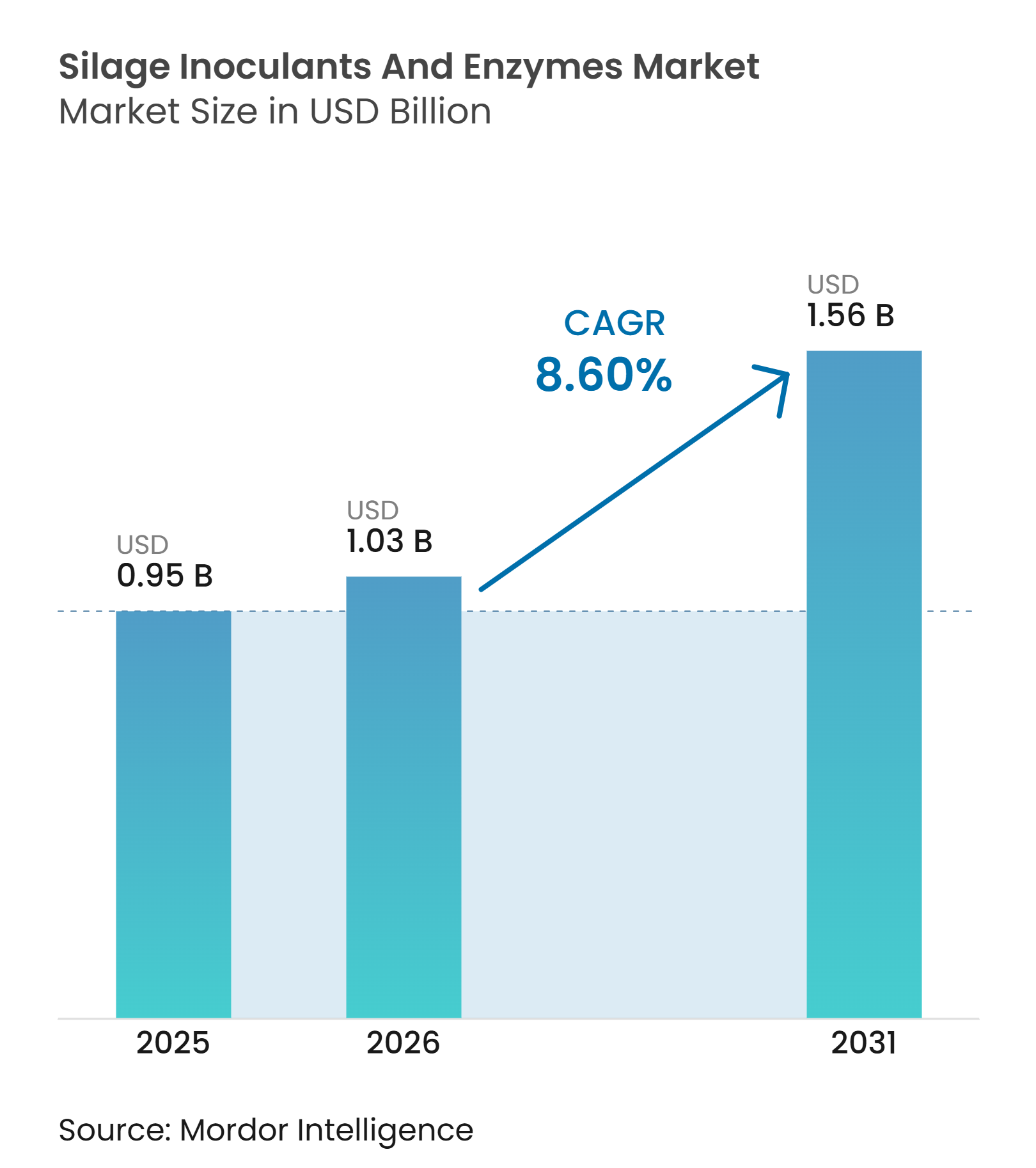
The silage inoculants and enzymes market was valued at USD 0.95 billion in 2025 and is projected to grow from USD 1.03 billion in 2026 to USD 1.56 billion by 2031, at a CAGR of 8.60% during the forecast period (2026-2031). The market is supported by larger commercial dairy and beef operations, where feed quality directly affects operating costs and production consistency. Feed preservation has become increasingly important as producers manage variable forage quality, higher livestock densities, and documented feed-efficiency requirements. Biological products are gaining preference over chemical preservatives in regulated markets, supporting demand for microbial formulations. Suppliers are focusing on multi-strain products, enzyme packages, and application systems that help producers measure fermentation outcomes. However, temperature control requirements, limited technical support, and varying regulatory approval standards continue to restrict adoption in smaller and less developed production systems.
Key Report Takeaways
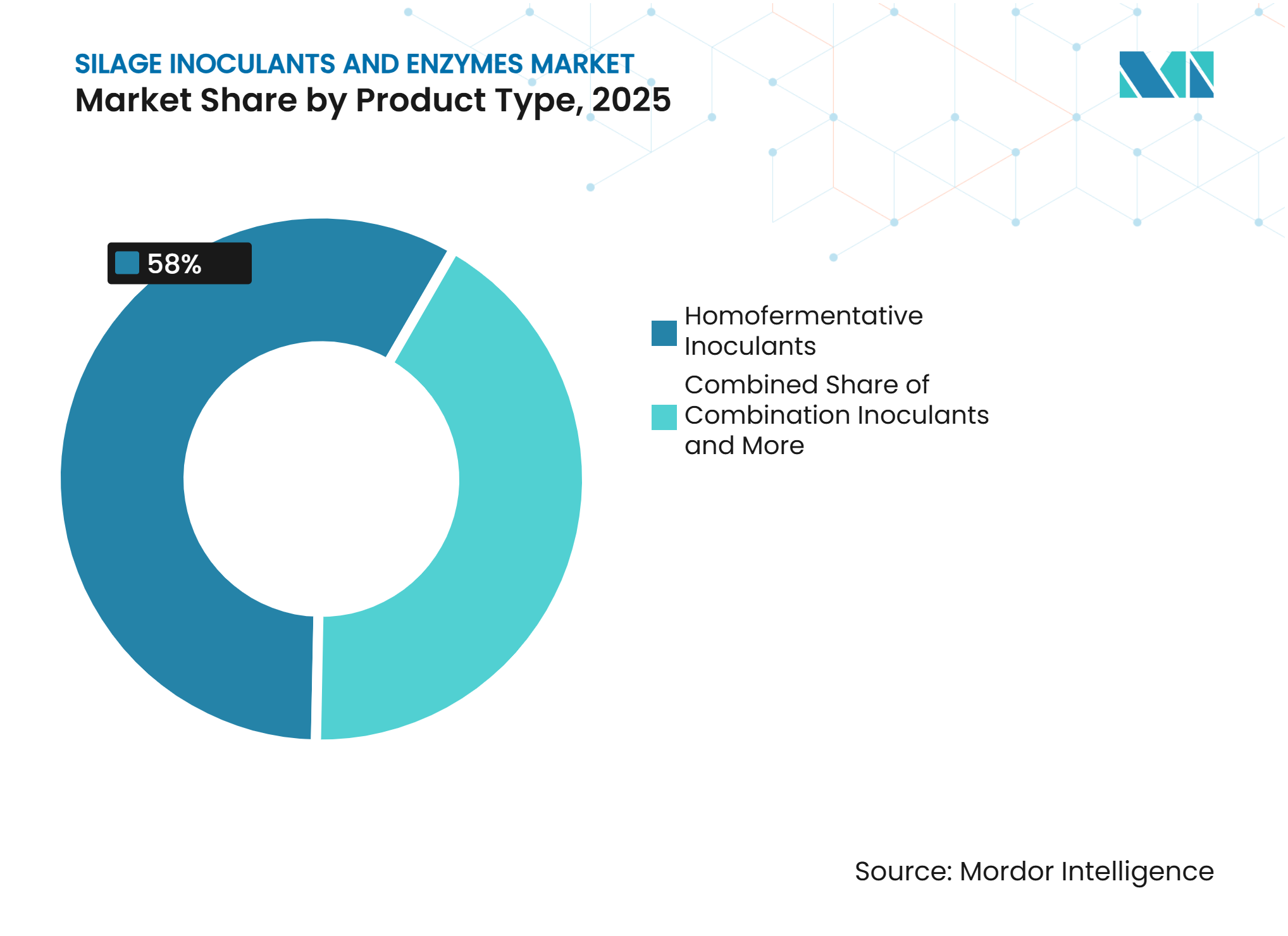
- By product type, homofermentative inoculants were the largest segment and held 58.0% of the silage inoculants and enzymes market share in 2025, while combination inoculants are the fastest-growing segment and are forecasted to expand at a 6.8% CAGR between 2026 and 2031.
- By form, dry formulations were the largest segment and held 61.0% of the silage inoculants and enzymes market size in 2025, while liquid formulations are the fastest-growing segment and are forecasted to expand at a 6.5% CAGR between 2026 and 2031.
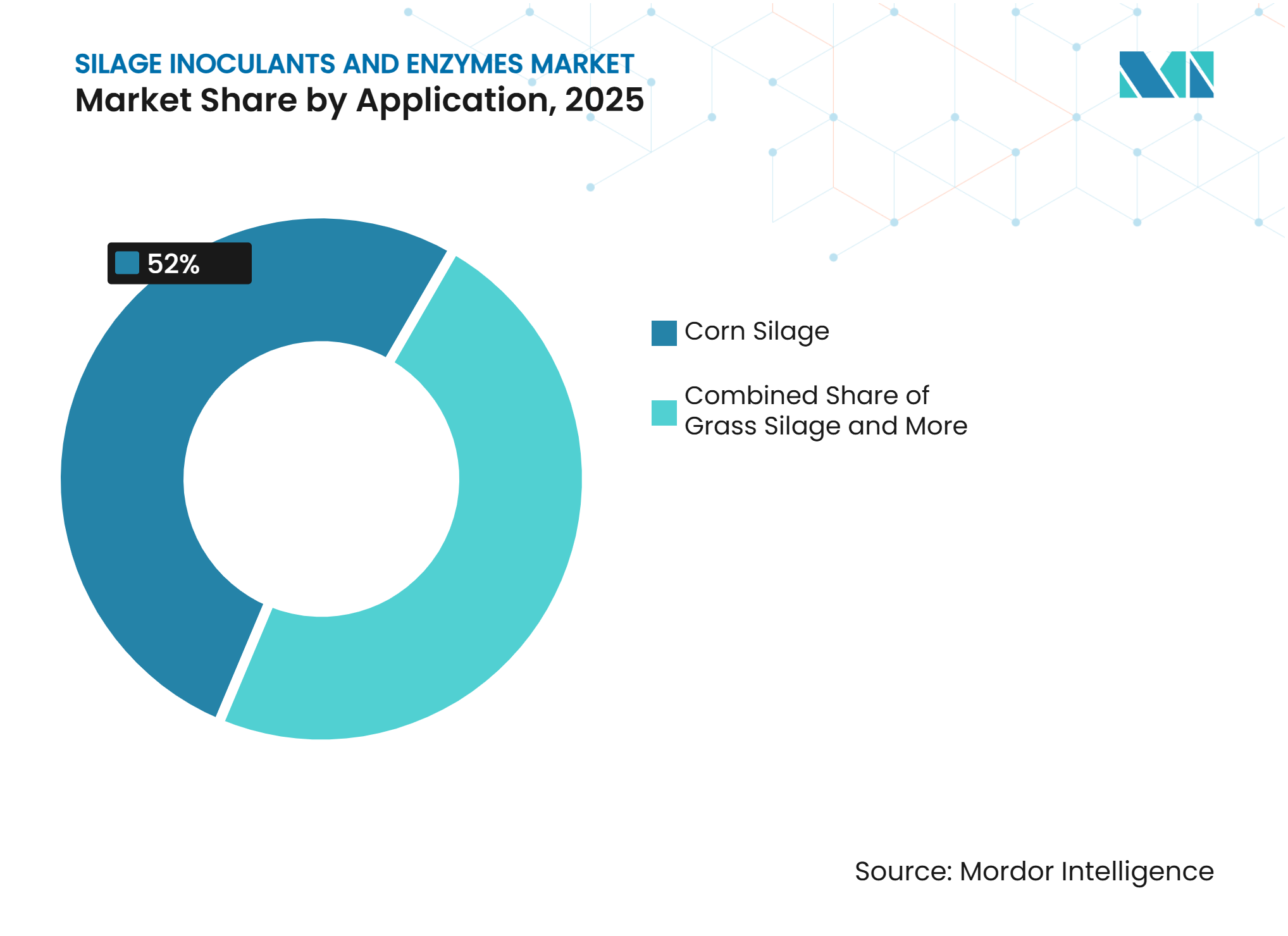
- By application, corn silage was the largest segment and held 52.0% of the market share in 2025, while grass silage is the fastest-growing segment and is forecasted to expand at a 7.2% CAGR between 2026 and 2031.
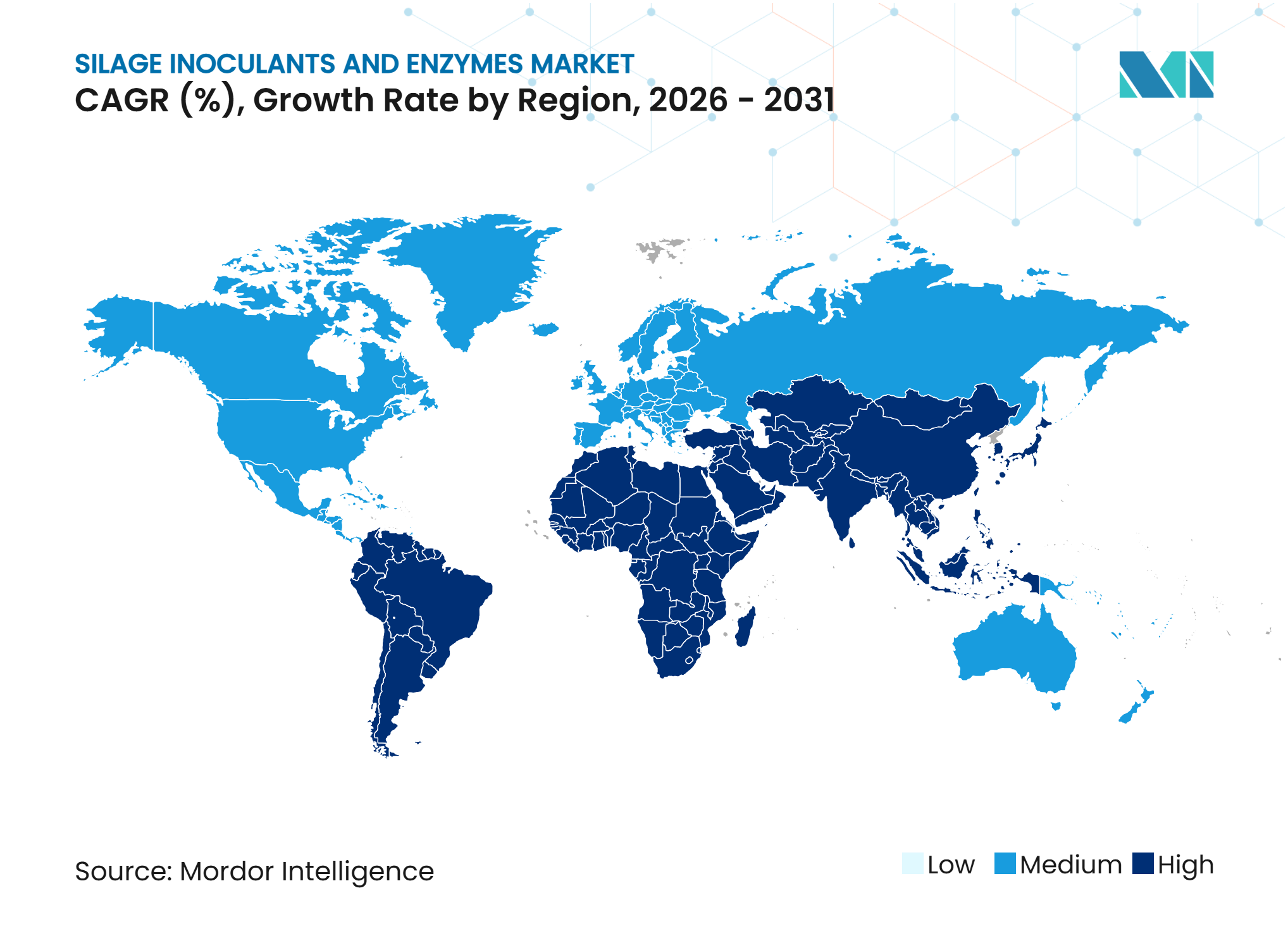
- By geography, North America is the largest regional segment and held 34.0% of the market share in 2025, while Asia-Pacific is the fastest-growing regional segment and is forecasted to expand at more than 10.0% CAGR between 2026 and 2031.
Note: Market size and forecast figures in this report are generated using Mordor Intelligence’s proprietary estimation framework, updated with the latest available data and insights as of January 2026.
Market Trends and Insights
Drivers Impact Analysis of Silage Inoculants And Enzymes Market*
| Driver | (~) % Impact on CAGR Forecast | Geographic Relevance | Impact Timeline |
|---|---|---|---|
| Expansion of commercial dairy and beef operations | +2.2% | Global, with North America, Europe, and Asia-Pacific as primary markets | Long term (≥ 4 years) |
| Feed-efficiency and dry-matter loss reduction | +2% | Global, with advanced measurement practices in North America and Europe | Medium term (2-4 years) |
| Increasing adoption of sustainable biological feed additives | +1.5% | Europe and North America, with adoption extending to South America and Asia-Pacific | Medium term (2-4 years) |
| Commercialization of multi-strain and enzyme-enhanced formulations | +1.3% | North America and Europe, with emerging use in Asia-Pacific | Short term (≤ 2 years) |
| Intensification of livestock production in Asia-Pacific | +1.4% | China, India, Southeast Asia, and Western Asia | Long term (≥ 4 years) |
| Precision forage management and digital feed optimization | +0.8% | North America and Northern Europe, with early adoption in Australia and New Zealand | Medium term (2-4 years) |
| Source: Mordor Intelligence | |||
Expansion of Commercial Dairy and Beef Operations
Expansion of commercial livestock production is supporting demand for silage inoculants and enzymes by increasing the need for consistent forage quality, efficient feed utilization, and stable feed inventories. The Organisation for Economic Co-operation and Development and Food and Agriculture Organization of the United Nations (OECD-FAO) Agricultural Outlook 2026–2035 projects global milk production to reach 1,223 million metric tons by 2035, growing at approximately 2.0% annually over the outlook period[1]. Growth is anticipated to be concentrated in major producing regions such as India and Pakistan, while productivity improvements, improved animal health, feed efficiency, and genetics remain key drivers of dairy-sector expansion. As commercial dairy and beef operations become more intensive, producers are increasingly focused on preserving forage quality and minimizing nutrient losses during storage, supporting the use of silage inoculants and enzymes to improve fermentation stability, feed preservation, and livestock performance.
Feed-Efficiency and Dry-Matter Loss Reduction
Uninoculated silage can lose 10% to 20% of dry matter in commercial operations. A 2025 study published in MDPI found that bacterial-enzymatic inoculants reduced total dry-matter losses by 35.26% and increased lactic acid production by 37.48% compared with untreated controls. The same study reported a 15.63% reduction in effluent production[2]. These results support demand in the silage inoculants and enzymes market, as lower dry-matter losses in large silage stores translate directly into lower usable-feed costs. Producers managing large silage inventories stand to recover a measurable share of feed value that would otherwise be lost during fermentation and storage. Heterofermentative strains can also improve aerobic stability, which is important for bunker silos with high daily feed-out volumes. Improved aerobic stability reduces spoilage at the feed face, helping maintain consistent nutritional quality during feed-out.
Increasing Adoption of Sustainable Biological Feed Additives
Biological silage inoculants can reduce the use of chemical preservatives and lower silage effluent output. Biological products that support livestock supply chains in tracking environmental performance and feed use benefit the silage inoculants and enzymes market. European Union Regulation (EC) No 1831/2003 governs feed additive authorization and requires scientific evaluation of microbial products. The European Food Safety Authority (EFSA) issued positive opinions in 2024 and 2025 for strains including Lentilactobacillus buchneri DSM 32651 and Lacticaseibacillus rhamnosus NBRC 3425 for silage use. These approvals provide a clearer route for biological products in jurisdictions that favor authorized microorganisms over synthetic preservatives and give formulators a documented basis for using particular strains in commercial silage additives in markets that require formal authorization.
Commercialization of Multi-Strain and Enzyme-Enhanced Formulations
Multi-strain products combine functions previously handled by separate products. Homofermentative strains support rapid pH reduction, while heterofermentative strains support aerobic stability. Enzyme packages can improve access to fiber and starch in forage. Together, these components address multiple stages of the ensiling process within a single product. Lallemand Animal Nutrition launched MAGNIVA Platinum in Canada in March 2026, which contains Lentilactobacillus hilgardii CNCM I-4785, L. buchneri NCIMB 40788, Pediococcus pentosaceus NCIMB 12455, and an enzyme package. This combination is designed to support both fermentation efficiency and aerobic stability across a range of forage types. The silage inoculants and enzymes market is moving toward products that offer multiple fermentation benefits in a single application, raising the competitive bar for single-strain products. As multi-strain formulations become more common, producers of single-strain products face increasing pressure to demonstrate comparable performance or differentiate on cost or application-specific advantages.
Restraints Impact Analysis of Silage Inoculants And Enzymes Market*
| Restraint | (~) % Impact on CAGR Forecast | Geographic Relevance | Impact Timeline |
|---|---|---|---|
| Performance sensitivity to moisture, compaction and oxygen control | -0.5% | Global, with greater exposure in sub-Saharan Africa, Southeast Asia, and smallholder markets | Short term (≤ 2 years) |
| Limited smallholder technical support and product awareness | -0.4% | India, Southeast Asia, Africa, and parts of South America | Long term (≥ 4 years) |
| Viability, shelf-life and cold-chain constraints | -0.3% | Middle East and Africa, with effects in tropical Asia | Medium term (2-4 years) |
| Differing registration requirements for microbial strains and enzyme claims | -0.3% | Europe, North America, and Asian national markets | Long term (≥ 4 years) |
| Source: Mordor Intelligence | |||
Performance Sensitivity to Moisture, Compaction and Oxygen Control
Silage inoculants require suitable moisture levels, adequate compaction, and effective oxygen exclusion to perform effectively. Poor management practices can reduce product performance and lead to negative repeat-purchase experiences. A 2025 study published in Agricultural and Food Science (AFSci) found that compaction methods materially affected grass silage fermentation outcomes. The study also found that chemical preservatives could outperform biological inoculants when aerobic stability had already been compromised. The market faces greater adoption risk in high-heat and high-humidity locations where face heating can occur even in sealed silos. In these conditions, the effectiveness of inoculants can be significantly reduced, making it difficult for producers to achieve consistent fermentation quality. Repeat use can decline when producers attribute failed results to the product rather than to forage management conditions. This misattribution presents a challenge for market growth, as it can discourage producers from continued investment in inoculant-based solutions despite their potential benefits under proper management practices.
Limited Smallholder Technical Support and Product Awareness
Demand is concentrated among large commercial operations with technical staff and established forage programs. Smallholder farms manage significant livestock numbers but often have limited access to application guidance and cold storage. This gap is notable in India, Southeast Asia, Africa, and parts of South America, where smallholder farming accounts for a substantial share of total livestock production. Liquid products with live bacteria can be difficult to distribute where last-mile cold-chain infrastructure is inconsistent, as temperature fluctuations during transit can reduce product viability and effectiveness. The silage inoculants and enzymes market has lower accessible demand in these regions, as product format and limited technical support constrain use alongside product price. Dry and granular formulations have shown some advantage in these settings due to their greater stability during storage and transport, but adoption remains limited. Demonstration units and training programs can help producers understand silage preparation, but the available evidence does not establish their broad effect on purchasing behavior.
*Our forecasts treat driver/restraint impacts as directional, not additive. The impact forecasts reflect baseline growth, mix effects, and variable interactions.
Silage Inoculants And Enzymes Market Segment Analysis
By Product Type:
Homofermentative Inoculants Lead While Combination Products Gain TractionHomofermentative inoculants held the largest share of the silage inoculants and enzymes market by product type, accounting for 58.0% of the market in 2025. Their leading position is supported by established use in forage preservation and their ability to promote rapid lactic acid production and pH reduction during ensiling. Lactiplantibacillus plantarum and Pediococcus pentosaceus are among the lactic acid bacteria commonly used in homofermentative or facultative heterofermentative inoculant products. These products are used across forage types including grass, alfalfa, and cereal silages, although their effectiveness can vary according to forage characteristics and ensiling conditions.
Combination inoculants are projected to be the fastest-growing sub-segment, registering a CAGR of 6.8% during the forecast period 2026–2031. Their growth is supported by formulations that combine multiple lactic acid bacteria with complementary fermentation functions, allowing producers to address fermentation quality and aerobic stability within a single treatment. Combination formulations can include homofermentative or facultative heterofermentative strains alongside heterofermentative bacteria such as Lentilactobacillus buchneri. This multifunctional positioning supports their use in commercial silage systems where producers seek to improve fermentation while maintaining stability during feed-out.



By Form:
Dry Formulations Lead, but Liquid Formats Gain Commercial MomentumDry formulations held a 61.0% share in 2025. Their role is supported by ambient-temperature shelf life and simpler transport requirements. Dry powders and granules are compatible with distribution systems that have limited cold-chain coverage. Large producers in North America and Europe have also integrated dry application into forage-harvesting equipment. The format fits established practices at commercial corn and alfalfa silage operations.
Liquid formulations are forecasted to expand at a 6.5% CAGR between 2026 and 2031. Liquid concentrates can be placed directly into tank-mix systems on self-propelled forage harvesters. This supports consistent application during large bunker-fill operations. Liquid systems are particularly relevant for producers using automated dosing equipment and near-infrared moisture sensing. Micro-encapsulation is intended to improve the storage stability of live bacteria in liquid products. Combination products can also be more difficult to dry-process without harming microbial viability. This creates a practical reason for some multi-strain products to enter the Silage inoculants and enzymes market in liquid form. Cold-chain dependence remains a constraint where distribution infrastructure is weak.
By Application:
Corn Silage Dominates, Grass Silage Grows on Forage DiversificationCorn silage held a 52.0% share in 2025, driven by high ensiling volumes and its energy density in commercial dairy and beef rations. This dominance is supported by the widespread availability of corn as a feedstock and well-established infrastructure for large-scale ensiling operations. Tongliao cultivated 5.36 million mu of silage corn in 2025, remaining China's largest silage corn production center. Lower dry-matter loss has a direct cost benefit when corn silage is stored in large volumes, supporting routine inoculant use in major corn silage programs.
Grass silage is forecast to expand at a 7.2% CAGR between 2026 and 2031. Growth is linked to the intensification of pasture-based systems in Western and Northern Europe, Oceania, and parts of South America. Research presented by Lallemand Animal Nutrition in July 2025 reported that a multi-strain inoculant with L. buchneri, L. hilgardii, P. pentosaceus, and xylanase improved fermentation quality and aerobic stability in grass-legume silage during a 160-day ensiling period. Alfalfa has a high buffering capacity, making inoculant selection important. Sorghum is gaining interest in drought-prone areas as farms seek alternatives to corn. Cereal crop and mixed-forage silages offer volume potential where on-farm forage systems use varied crops, though penetration in these segments remains below corn silage adoption levels.

Geography Analysis
North America accounted for 34.0% of the silage inoculants and enzymes market share in 2025. The market in the region is supported by consolidated dairy and beef operations in the United States Corn Belt and Canadian Prairie provinces. These operations manage large corn and alfalfa silage programs and can justify investment in premium combination products. Producers increasingly link inoculant selection with near-infrared analyzers and automated dosing systems. In March 2025, Novonesis expanded its SiloSolve distribution arrangement across Canada through regional warehouses. Europe's market is supported by a rigorous feed additive authorization system under European Union Regulation (EC) No 1831/2003.
Asia-Pacific is the fastest-growing region and is forecast to expand at more than 10% CAGR between 2026 and 2031. China, India, and Southeast Asia are modernizing dairy and beef production systems. Inner Mongolia planted more than 20.9 million mu of artificial forage in 2025 and supplied more than 75 million metric tons of forage[3]. The region's combined dairy and beef output value was CNY 500 billion (USD 72 billion) in 2025. Feed self-sufficiency measures and support for storage infrastructure provide a distinct basis for silage-input demand in China. The market also has growth potential in India as commercial silage use extends beyond the largest dairy farms.
South America's market is supported by Brazil's beef herd rebuilding following drought-related liquidation. Africa has low current market penetration, but livestock modernization programs support longer-term demand. Western Asia is investing in year-round feed preservation for emerging dairy systems. Oceania has established silage-quality practices in Australia and New Zealand, resulting in more incremental growth. Russia has a large livestock base but limited technology diffusion channels. The silage inoculants and enzymes market must adapt formats and technical service models to regional differences in infrastructure and farm scale.
Competitive Landscape
Market Concentration
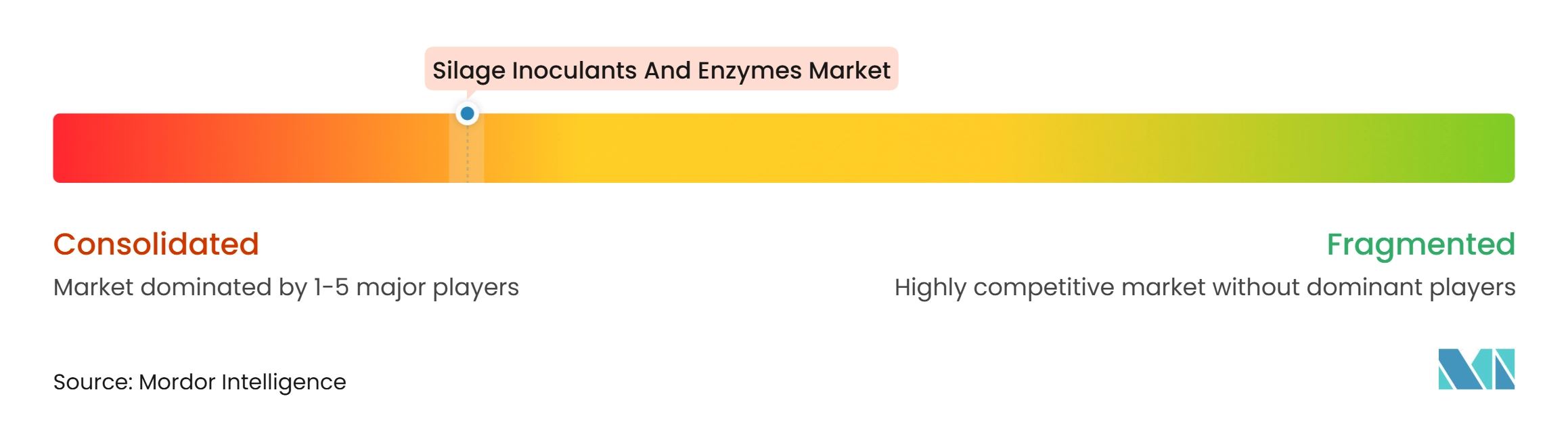
The silage inoculants and enzymes market is concentrated, with the top five companies — Novonesis, Corteva Agriscience, Cargill, Archer Daniels Midland, and Lallemand — holding a major share in 2025. Their positions are supported by microbial strain development, fermentation manufacturing, regulatory filings, and broad distribution networks. These factors create meaningful barriers for new suppliers that lack validated strains and established market access. Larger companies also benefit from the ability to support portfolios across multiple regions.
Suppliers compete through proprietary strain libraries, product performance, and farm-level technical support. Lallemand's L. hilgardii platform and Corteva's Pioneer 11C33 Rapid React Technology illustrate the focus on differentiated microbial offerings. In 2024, EFSA supported the renewal assessment of L. buchneri ATCC PTA-2494 for Pioneer Hi-Bred International, a Corteva subsidiary. In 2026, Corteva updated the Pioneer Brand Silage Inoculant portfolio for the 2026–2027 season. Lallemand introduced MAGNIVA Platinum in Mexico in July 2026, extending its three-strain forage inoculant technology to Latin American dairy and beef producers.
Smaller specialists, including Agri-King Inc., Provita Eurotech Ltd., and Strong Microbials Inc., focus on specific forage crops, regional substrates, and agronomist-supported programs. In 2025, EFSA issued a positive opinion on Enterococcus lactis NCIMB 10415 from Agri-King for use as a silage additive for all animal species. Lower-cost, ambient-stable products could address the needs of smallholder operations in Asia and Africa. Integrated products that combine inoculants, enzymes, and fermentation monitoring may also shift the basis of competition. While the market remains centered on product efficacy, digital measurement tools can help producers assess the return on application more consistently.
Silage Inoculants And Enzymes Industry Leaders
-
Novonesis A/S
-
Corteva Agriscience, Inc.
-
Cargill, Incorporated
-
Archer Daniels Midland Company
-
Lallemand Inc.
- *Disclaimer: Major Players sorted in no particular order
Silage Inoculants And Enzymes Market Companies Covered in this Report
- Novonesis A/S
- Corteva Agriscience, Inc.
- Lallemand Inc.
- Kemin Industries, Inc.
- Cargill, Incorporated
- Archer Daniels Midland Company
- Volac International Limited
- Micron Bio-Systems Ltd. (Volac International Limited)
- ADDCON GmbH (Esseco Group)
- Biomin Holding GmbH (dsm-firmenich AG)
- Schaumann BioEnergy GmbH
- Agri-King, Inc.
- Josera GmbH and Co. KG
- American Farm Products, Inc.
- Provita Eurotech Ltd.
- Strong Microbials, Inc.
Recent Industry Developments in Silage Inoculants And Enzymes Market
- July 2026: Lallemand expanded its MAGNIVA Platinum forage-inoculant technology to Mexican dairy and beef producers. The product combines three lactic acid bacteria strains with an enzyme package and is positioned around dry-matter recovery, nutrient retention, aerobic stability, and feed-out flexibility.
- June 2025: Alltech expanded market activity around its Egalis silage-inoculant portfolio. Alltech published new technical material highlighting Egalis as its silage-inoculant range, positioned to improve nutrient preservation and reduce dry-matter losses.
- May 2025: BEC Feed Solutions Indonesia, in collaboration with Novonesis, launched SiloSolve FC in Indonesia. SiloSolve FC is a multi-microbe silage inoculant designed to improve fermentation and aerobic stability across forage types.
Global Silage Inoculants And Enzymes Market Report Scope
Silage inoculants and enzymes are biological and biochemical additives applied to forage crops during the ensiling process to improve fermentation, preserve nutrients, reduce storage losses, and maintain feed quality.
The Silage Inoculants and Enzymes Market Report is Segmented by Product Type (Homofermentative Inoculants and More), by Form (Dry Formulations and Liquid Formulations), by Application (Corn Silage, Grass Silage, and More), and by Geography (North America, South America, Europe, and More). The Market Forecasts are Provided in Terms of Value (USD) and Volume (Metric Tons).
Segmentation Overview
| Homofermentative Inoculants |
| Heterofermentative Inoculants |
| Combination Inoculants |
| Enzyme-Based Silage Additives |
| Organic-Acid-Based Inoculants |
| Dry Formulations |
| Liquid Formulations |
| Corn Silage |
| Grass Silage |
| Alfalfa Silage |
| Sorghum Silage |
| Cereal Crop Silage |
| Mixed Forage Silage |
| North America | United States |
| Canada | |
| Mexico | |
| Rest of North America | |
| South America | Brazil |
| Argentina | |
| Rest of South America | |
| Europe | Germany |
| Spain | |
| France | |
| The Netherlands | |
| Italy | |
| Russia | |
| Rest of Europe | |
| Asia-Pacific | China |
| India | |
| Japan | |
| South Korea | |
| Australia | |
| Rest of Asia-Pacific | |
| Middle East | Saudi Arabia |
| United Arab Emirates | |
| Turkiye | |
| Rest of Middle East | |
| Africa | Morocco |
| South Africa | |
| Egypt | |
| Rest of Africa |
| By Product Type | Homofermentative Inoculants | |
| Heterofermentative Inoculants | ||
| Combination Inoculants | ||
| Enzyme-Based Silage Additives | ||
| Organic-Acid-Based Inoculants | ||
| By Form | Dry Formulations | |
| Liquid Formulations | ||
| By Application | Corn Silage | |
| Grass Silage | ||
| Alfalfa Silage | ||
| Sorghum Silage | ||
| Cereal Crop Silage | ||
| Mixed Forage Silage | ||
| By Geography | North America | United States |
| Canada | ||
| Mexico | ||
| Rest of North America | ||
| South America | Brazil | |
| Argentina | ||
| Rest of South America | ||
| Europe | Germany | |
| Spain | ||
| France | ||
| The Netherlands | ||
| Italy | ||
| Russia | ||
| Rest of Europe | ||
| Asia-Pacific | China | |
| India | ||
| Japan | ||
| South Korea | ||
| Australia | ||
| Rest of Asia-Pacific | ||
| Middle East | Saudi Arabia | |
| United Arab Emirates | ||
| Turkiye | ||
| Rest of Middle East | ||
| Africa | Morocco | |
| South Africa | ||
| Egypt | ||
| Rest of Africa | ||
Key Questions Answered in the Report
What is the size of the silage inoculants and enzymes market?
The Silage inoculants and enzymes market was USD 0.95 billion in 2025 and is forecasted to reach USD 1.56 billion by 2031 at an 8.60% CAGR between 2026 and 2031.
What is driving demand for silage inoculants and enzymes?
Larger dairy and beef operations, lower dry-matter losses, biological additive adoption, and multi-strain formulations support demand.
Which region leads adoption of silage inoculants and enzymes?
North America led with 34.0% share in 2025, while Asia-Pacific is forecasted to expand at more than 10.0% CAGR between 2026 and 2031.
Why are combination inoculants gaining use?
They combine fermentation, aerobic-stability, and enzyme functions in a single application, which can simplify use on commercial farms.