
Shape Memory Alloys Market Size and Share
Market Overview
| Study Period | 2021 - 2031 |
|---|---|
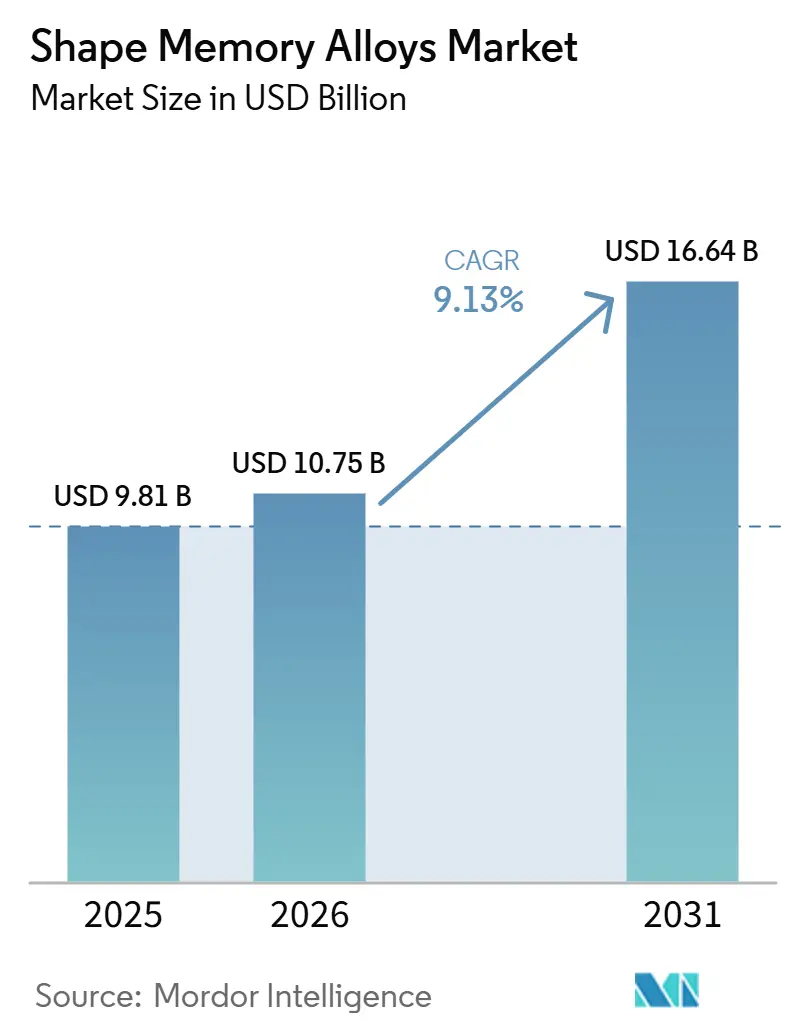
| Market Size (2026) | USD 10.75 Billion |
| Market Size (2031) | USD 16.64 Billion |
| Growth Rate (2026 - 2031) | 9.13 % |
| Fastest Growing Market | Asia-Pacific |
| Largest Market | North America |
| Market Concentration | Medium |
Major Players *Disclaimer: Major Players sorted in no particular order Image © Mordor Intelligence. Reuse requires attribution under CC BY 4.0. | |
Shape Memory Alloys Market Analysis by Mordor Intelligence
The Shape Memory Alloys Market was valued at USD 9.81 billion in 2025 and is estimated to grow from USD 10.75 billion in 2026 to reach USD 16.64 billion by 2031, at a CAGR of 9.13% during the forecast period (2026–2031). The shape memory alloys market benefits from materials that return to a preset form after thermal or mechanical activation. This property can replace several mechanical parts in products where weight and installation space matter. Medical device makers, aerospace integrators, and automotive Tier 1 suppliers therefore use these materials for functions that conventional alloys cannot provide in the same form. Nitinol continues to set the commercial standard because it combines recoverable strain, passive actuation, and biocompatibility. The shape memory alloys market also faces a supply risk because qualified medical-grade material capacity is concentrated among a small group of manufacturers.
Key Report Takeaways
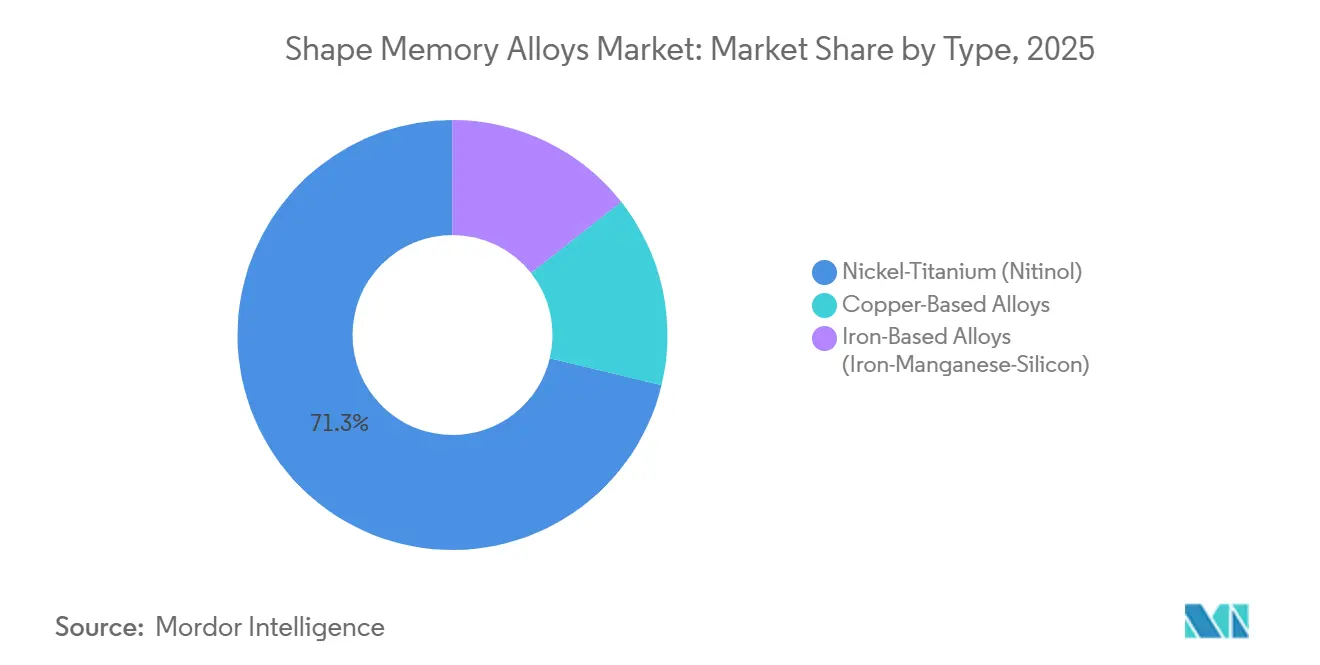
- By type, Nickel-Titanium (Nitinol) held 71.25% of the shape memory alloys market share in 2025 and is forecast to grow at a 9.76% CAGR through 2031.
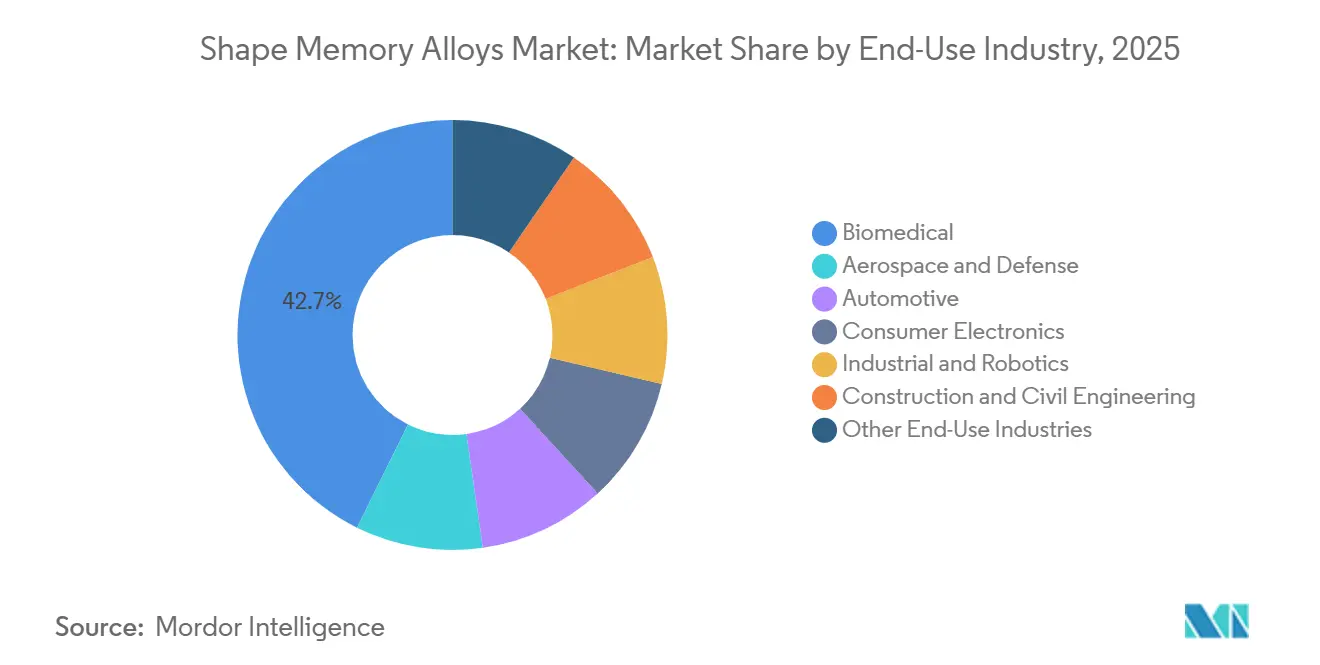
- By end-use industry, biomedical held 42.68% of the shape memory alloys market share in 2025, while industrial and robotics is forecast to grow at a 10.42% CAGR through 2031.
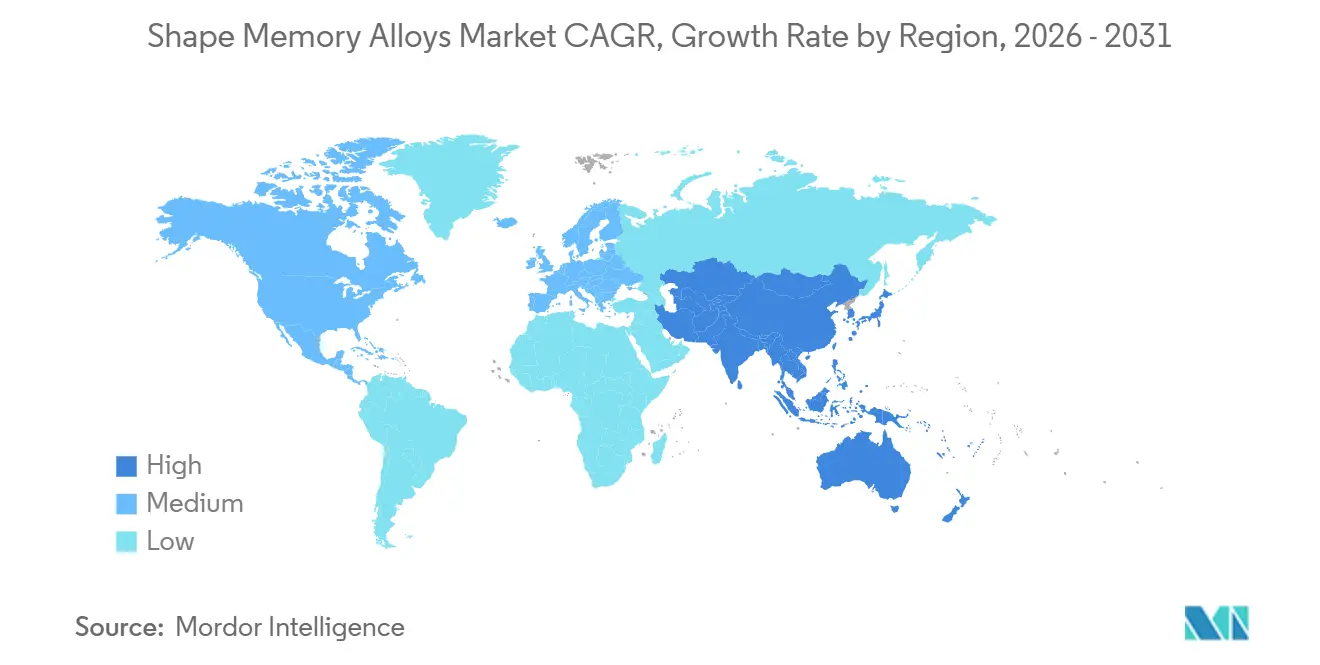
- By geography, North America held 39.72% of the shape memory alloys market share in 2025, while Asia-Pacific is forecast to grow at a 10.22% CAGR through 2031.
Note: Market size and forecast figures in this report are generated using Mordor Intelligence’s proprietary estimation framework, updated with the latest available data and insights as of January 2026.
Market Trends and Insights
Drivers Impact Analysis of Shape Memory Alloys Market*
| Driver | (~) % Impact on CAGR Forecast | Geographic Relevance | Impact Timeline |
|---|---|---|---|
| Increasing Adoption of Shape Memory Alloys in Minimally Invasive Medical Devices | +2.8% | North America, Europe; rapidly scaling in Japan and South Korea | Medium term (2–4 years) |
| Growing Demand for Lightweight and High-Performance Actuation Systems in Aerospace and Defense | +1.6% | North America (NASA, DARPA programs), Europe (Airbus morphing programs), APAC defense procurement | Long term (≥ 4 years) |
| Rising Electrification of Vehicles Driving Demand for Compact Thermal and Mechanical Actuators | +1.5% | China, Europe, North America | Short to medium term (≤ 3 years) |
| Expanding Use of Precision-Engineered Components in Consumer Electronics and Industrial Equipment | +1.2% | APAC core (China, Japan, South Korea); spill-over to North America and Europe | Short term (≤ 2 years) |
| Increasing Replacement of Conventional Metallic Alloys in High-Cycle and High-Performance Applications | +0.9% | Global, accelerating in high-performance industrial hubs | Long term (≥ 4 years) |
| Source: Mordor Intelligence | |||
Increasing Adoption of Shape Memory Alloys in Minimally Invasive Medical Devices
Nitinol can be compressed into very small delivery catheters and can self-expand to controlled shapes inside the body. This capability supports its established role in interventional cardiac devices. Adona Medical completed enrollment in June 2025 for its first-in-human Delphi adjustable interatrial shunt study. The study enrolled 10 patients and reported 100% procedural success, while all implants were adjusted after implantation through non-contact inductive heating. This design moves Nitinol beyond a passive structure and toward an adjustable implant component. The shape memory alloys market can benefit as adjustable implants increase the functional role of the material after placement. Confluent Medical Technologies and ATI announced an investment of more than USD 50 million in January 2024 to more than triple medical Nitinol melt capacity in Millersburg, Oregon, with operations targeted for 2027.
Growing Demand for Lightweight and High-Performance Actuation Systems in Aerospace and Defense
Aerospace applications require systems that tolerate thermal cycling and avoid actuator fatigue failure. Shape memory alloy actuators can reduce the number of motors, pumps, and electronic components used in adaptive aircraft systems. Research on variable-area fan nozzle concepts found that bundled shape memory alloy (SMA) cable actuators could vary the nozzle exit area by up to 20% under aerodynamic load. The same work reported up to 9% improvement in thrust-specific fuel consumption, 2-3% cost savings, and 5-6% range improvements compared with fixed-geometry nozzle configurations[1]Kyushu University, “Advancements and Future Directions of Shape Memory Alloys in Aerospace Applications,” Evergreen, tj.kyushu-u.ac.jp. A 2025 study found that NiTi and carbon fiber–polyether ketone (CF-PEKK) fiber-metal laminates maintained structural integrity at elevated temperatures and displayed pseudo-ductile behavior for aircraft morphing surfaces. These findings support the longer qualification path for the shape memory alloys market in aerospace systems. The shape memory alloys market depends on subsystem qualification before these weight and complexity benefits reach production aircraft.
Rising Electrification of Vehicles Driving Demand for Compact Thermal and Mechanical Actuators
Electric vehicle battery packs require controlled thermal management within a narrow temperature range. SMA thermostats can activate at programmed transformation temperatures without electronic control units. This can provide a simpler coolant-routing option than wax-element valves in selected vehicle designs. Quaternary NiTiXY alloys can be engineered for precise operating points and stable performance over a vehicle's lifetime. A 2025 study also examined NiTi actuators in morphable vehicle underbody shields for adaptive aerodynamics. The shape memory alloys market benefits from thermal actuators, which reduce the need for additional electronic controls.
Expanding Use of Precision-Engineered Components in Consumer Electronics and Industrial Equipment
Nitinol wires can provide useful force in dimensions that conventional voice-coil motors cannot match. Cambridge Mechatronics describes SMA wires thinner than a human hair that can lift more than 50 g per wire. These properties support optical image stabilization, autofocus, virtual-reality display actuation, and haptic mechanisms. Consistent transformation temperature across millions of wire segments remains the central manufacturing challenge. A 2026 review identified wire-form SMA applications in robotic grippers, civil-engineering dampers, haptic systems, and precision-positioning equipment. Shared demand for compact precision actuation is helping the shape memory alloys market support manufacturing investment beyond medical-device volumes. This wider demand base gives the shape memory alloys market a second route for sustaining wire-production investment.
Restraints Impact Analysis of Shape Memory Alloys Market*
| Restraint | (~) % Impact on CAGR Forecast | Geographic Relevance | Impact Timeline |
|---|---|---|---|
| Limited Formability and Challenges Associated with Machining and Joining Shape Memory Alloys | -2.1% | Global; most acute in precision manufacturing hubs: USA, Germany, Japan | Long term (≥ 4 years) |
| Narrow Processing Window for Achieving Consistent Phase Transformation Performance | -1.4% | Global, with impact concentrated among mid-tier manufacturers in APAC | Medium term (2–4 years) |
| Lengthy Qualification and Certification Requirements for Safety-Critical Applications | -1.8% | North America and Europe (FDA, EASA, Nadcap compliance); growing APAC adoption adds certification lead time | Long term (≥ 4 years) |
| Source: Mordor Intelligence | |||
Limited Formability and Challenges Associated with Machining and Joining Shape Memory Alloys
Nitinol’s superelasticity makes cutting and joining more difficult than for conventional metals. Turning studies reported cutting forces of 60 N to 175 N, with the highest forces observed at cutting speeds of 20-60 m/min. The same work found machined-surface microhardness of up to 360 HV at low cutting speeds because of stress-induced martensitic transformation. Cemented carbide tools can experience notch wear and pitting, while ceramic tools lack sufficient flexural strength for this application. Polycrystalline diamond tools at 130 m/min showed the most favorable wear profile, but their cost can limit high-volume machining economics. Surface transformation caused during machining can also alter finished-component transformation temperature and recovery stress, which raises the risk in precision and safety-critical designs.
Narrow Processing Window for Achieving Consistent Phase Transformation Performance
Nitinol's transformation temperature shifts by 10 °C for every 0.1% change in the nickel-to-titanium ratio. Small compositional deviations can therefore create out-of-specification behavior that is detected only during component testing. This raises yield losses and limits the effective use of installed supplier capacity. A 2025 review found that layer-by-layer thermal histories in laser powder-bed fusion can create microstructural variation in NiTi and NiMnGa alloys. Copper-based alloys also need careful aluminum and manganese control, while Fe-Mn-Si alloys need controlled thermomechanical training for repeatable two-way behavior. The resulting quality gap can slow the adoption of lower-cost materials in regulated end uses within the shape memory alloys market. The shape memory alloys market, therefore, continues to favor suppliers that control melting and thermomechanical processing.
*Our forecasts treat driver/restraint impacts as directional, not additive. The impact forecasts reflect baseline growth, mix effects, and variable interactions.
Shape Memory Alloys Market Segment Analysis
By Type:
Nitinol Sustains Dominance as Iron and Copper Alloys Find Commercial FootholdsNitinol held 71.25% of revenue in 2025, supported by its long clinical record, established supply base, and availability as wire, tube, sheet, and foam. It remains the default material when engineers require recoverable deformation and compatibility with in vivo use. Its recovery strain reaches 6-8% under mechanical loading, compared with less than 1% for most conventional spring steels. Its biocompatibility under ISO 10993-1 also supports medical-device selection. Nitinol is forecast to grow at a 9.76% CAGR through 2031.
Quaternary Nitinol formulations add hafnium, copper, or palladium to broaden the material’s transformation-temperature range. These formulations may allow actuation in higher-temperature aerospace settings that binary Nitinol cannot address. Copper-based alloys, including Cu-Al-Mn and Cu-Al-Be, offer superelastic behavior at one-third to one-half of Nitinol’s material cost. This cost position favors structural and seismic-damping uses where biocompatibility is not required. Research published in July 2025 found that single-crystal Cu-Al-Mn alloys could operate as cryogenic actuators at 50-75 K and achieved a maximum work output of 42.12 × 10⁶ J·m⁻³. Iron-based Fe-Mn-Si alloys are gaining attention for civil infrastructure, but limited large-scale production and the absence of standardized installation codes keep them at an early commercial stage.



By End-Use Industry:
Biomedical Anchors Demand, Industrial and Robotics Sets the Growth PaceThe biomedical industry accounted for 42.68% of global revenue in 2025. The segment benefits from the functional role of Nitinol in stents, guidewires, bone staples, and structural heart devices. Medical-grade pricing also reflects the regulatory requirements placed on these components. Pulsed-field ablation catheters and structural heart implants are expanding areas within cardiac electrophysiology. The U.S. Food and Drug Administration cleared a coronary implant in 2025 that combines superelastic Nitinol wire with radiopaque polymer components[2]U.S. Food and Drug Administration, “Nitinol Enhanced Device 510(k) Clearance K250276,” U.S. Food and Drug Administration, accessdata.fda.gov. The adoption of multi-material assemblies can raise Nitinol content per device in the shape memory alloys market. This can support the shape memory alloys market even where device dimensions become smaller.
Industrial and robotics is forecast to expand at a 10.42% CAGR through 2031, the fastest end-use growth rate. Collaborative robots need compact and quiet actuators that can perform fine movements in a limited space. A 2026 study validated a bistable, SMA-driven parallel gripper with a 2.5 mm stroke per jaw and 1.4 N maximum gripping force. Aerospace and defense remain important for morphing wings and adaptive flow-control devices. Automotive demand is linked to electric-vehicle thermal management, while consumer electronics uses include camera modules and haptic systems. Construction industry remains earlier in development, with iron-based SMA prestressing strips being evaluated in bridge-strengthening projects.
Geography Analysis
North America Shape Memory Alloys Market
North America held 39.72% of global revenue in 2025. The region has a large medical-device innovation base, federally supported aerospace research, and qualified Nitinol manufacturers. Structural heart and neurovascular devices consume many of the region’s higher-value Nitinol components. Axel Johnson completed its acquisition of Fort Wayne Metals Research Products on July 1, 2026. The company announced USD 18.5 million in follow-on local investment and 150 additional manufacturing positions in Indiana. The United States leads regional revenue, while Canada and Mexico are smaller but growing markets. The shape memory alloys market in North America is also supported by qualified local wire and tubing capacity.
Europe Shape Memory Alloys Market
In Europe, Germany combines precision automotive suppliers, medical technology makers, and active materials research. SMA pneumatic valves introduced by German suppliers have exceeded 140 million cumulative units by 2025. The United Kingdom, France, Italy, and Russia contribute demand through aerospace, defense, and industrial robotics. Procurement requirements for Nadcap accreditation or DIN EN 9100 aerospace certification favor established suppliers and make market entry harder for lower-cost competitors.
APAC Shape Memory Alloys Market
Asia-Pacific is forecast to grow at a 10.22% CAGR through 2031, the fastest regional rate. China has identified NiTi alloys as a priority advanced material for aerospace equipment and high-performance biomedical devices. Japan combines precision robotics capacity with an aging population that supports demand for minimally invasive instruments. Japanese and South Korean electronics manufacturers are incorporating Nitinol actuators into foldable smartphones and advanced camera modules. Confluent Medical Technologies’ decision to open a dedicated Nitinol wire facility in India reflects the growing importance of local production for the country’s medical-device manufacturing base.
South America and MEA Shape Memory Alloys Market
South America, and Middle-East and Africa remain early-stage regions, although Brazil’s medical-device demand and Saudi Arabia’s healthcare investment provide a foundation for future growth. The shape memory alloys market has limited local manufacturing in these regions, so demand remains concentrated in imported finished medical devices.

Competitive Landscape
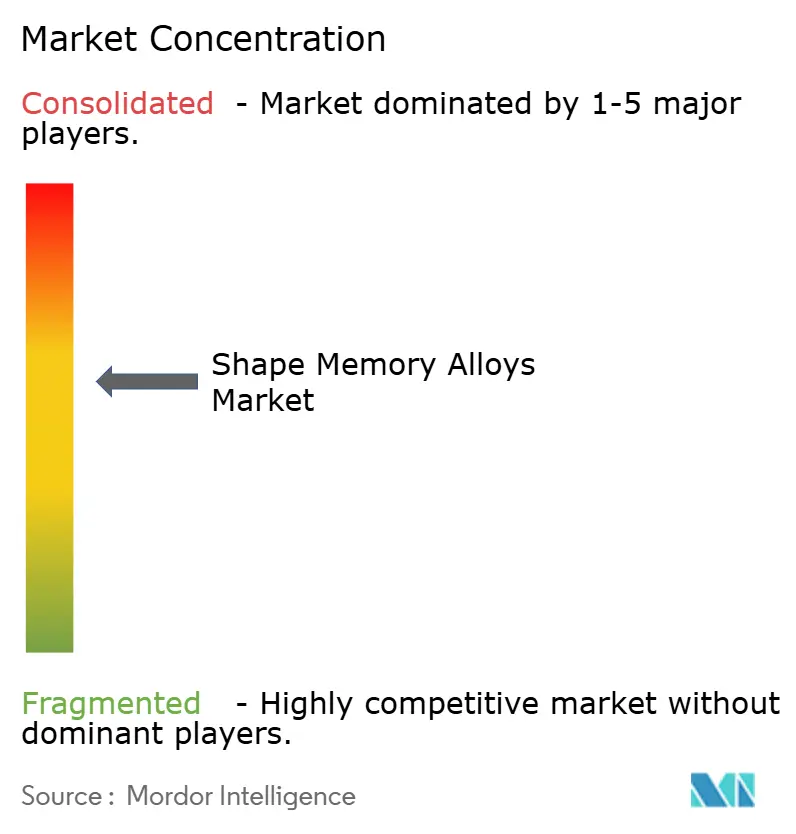
The shape memory alloys market is moderately consolidated. The finished-component level has many specialists competing on application engineering, customization speed, and proximity to original equipment manufacturer design centers. Supply-chain control has become a central competitive strategy. Vertical integration remains important because medical-device customers need consistent material quality from melt through component production.
This upstream consolidation raises barriers for new medical-device entrants that need a qualified external Nitinol supply. It also encourages downstream manufacturers to use more than one approved supplier. Validated mid-tier suppliers can benefit where they have credible melting and processing capability. Axel Johnson’s 2026 agreement to acquire Fort Wayne Metals further reflects the value assigned to certified melt-to-wire capacity. Intellectual property is also becoming more important in steerable catheter designs using SMA wires with programmed curvature. The competitive field is therefore shaped by material qualification, component design expertise, and the ability to meet demanding medical quality systems. In the shape memory alloys market, these requirements can matter more than price for safety-critical components.
Iron-based SMA products for bridge and concrete rehabilitation remain a relatively open field. A 2025 study reported that Fe-SMA strengthening was used on a 113-year-old steel-concrete composite bridge in the Czech Republic. Additive manufacturing is another competitive path because laser powder-bed fusion can produce complex Nitinol geometries. The shape memory alloys market may gain new component options as suppliers move from laboratory feasibility to pilot production. Suppliers that document repeatable processes could differentiate themselves in stent frames, patient-specific orthopedic staples, and specialized aerospace actuators.
Shape Memory Alloys Industry Leaders
SAES Getters S.p.A.
Fort Wayne Metals Research Products, LLC
Baoji Seabird Metal Materials Co. Ltd.
ATI
FURUKAWA ELECTRIC CO., LTD.
- *Disclaimer: Major Players sorted in no particular order
Shape Memory Alloys Market Companies Covered in this Report
- ATI
- Baoji Seabird Metal Materials Co. Ltd.
- Confluent Medical Technologies
- DYNALLOY, Inc.
- EUROFLEX GmbH
- Fort Wayne Metals Research Products, LLC
- FURUKAWA ELECTRIC CO., LTD.
- G.RAU GmbH & Co. KG
- Huizhou Zhilian Smart Nitinol Co., Ltd.
- INGPULS GmbH
- Mishra Dhatu Nigam Limited (MIDHANI)
- Nippon Seisen Co., Ltd.
- SAES Getters S.p.A.
- Shenzhen Starspring Materials.,Ltd.
- Ultimate Wireforms, Inc.
- Vascotube

Recent Industry Developments in Shape Memory Alloys Market
- July 2026: Researchers at Korea Advanced Institute of Science and Technology (KAIST) developed a wire-free, light-driven shape memory alloy structure that transformed from flat metal into 3D forms through a single UV laser process. The material operated without wires, separate actuators, or light-absorbing coatings.
- July 2026: Axel Johnson Inc. completed its full acquisition of Fort Wayne Metals Research Products, LLC taking 100% ownership of the Indiana-based precision medical wire manufacturer. The company subsequently announced plans to invest USD 18.5 million in its local operations and to reinforce its Nitinol melting and forming capacity for next-generation cardiovascular implant and catheter markets.


Global Shape Memory Alloys Market Report Scope
Shape memory alloys are metals that can undergo severe deformation and return to their original, pre-defined shape when heated. A reversible, solid-state phase transformation between a low-temperature crystal structure (martensite) and a high-temperature crystal structure (austenite) drives this property.
The Shape Memory Alloys Market is segmented by type, end-use industry and geography. By type, the market is segmented into nickel-titanium (nitinol), copper-based alloys, and iron-based alloys (iron-manganese-silicon). By end-use industry, the market is segmented into biomedical, aerospace and defense, automotive, consumer electronics, industrial and robotics, construction and civil engineering, and other end-use industries. The report also covers the market size and forecasts for shape memory alloys in 16 countries across major regions. For each segment, the market sizing and forecasts have been done on the basis of value (USD).
| Nickel-Titanium (Nitinol) |
| Copper-Based Alloys |
| Iron-Based Alloys (Iron-Manganese-Silicon) |
| Biomedical |
| Aerospace and Defense |
| Automotive |
| Consumer Electronics |
| Industrial and Robotics |
| Construction and Civil Engineering |
| Other End-Use Industries |
| Asia-Pacific | China |
| India | |
| Japan | |
| South Korea | |
| Rest of Asia-Pacific | |
| North America | United States |
| Canada | |
| Mexico | |
| Europe | Germany |
| United Kingdom | |
| France | |
| Italy | |
| Russia | |
| Rest of Europe | |
| South America | Brazil |
| Argentina | |
| Rest of South America | |
| Middle-East and Africa | Saudi Arabia |
| South Africa | |
| Rest of Middle-East and Africa |
| By Type | Nickel-Titanium (Nitinol) | |
| Copper-Based Alloys | ||
| Iron-Based Alloys (Iron-Manganese-Silicon) | ||
| By End-Use Industry | Biomedical | |
| Aerospace and Defense | ||
| Automotive | ||
| Consumer Electronics | ||
| Industrial and Robotics | ||
| Construction and Civil Engineering | ||
| Other End-Use Industries | ||
| By Geography | Asia-Pacific | China |
| India | ||
| Japan | ||
| South Korea | ||
| Rest of Asia-Pacific | ||
| North America | United States | |
| Canada | ||
| Mexico | ||
| Europe | Germany | |
| United Kingdom | ||
| France | ||
| Italy | ||
| Russia | ||
| Rest of Europe | ||
| South America | Brazil | |
| Argentina | ||
| Rest of South America | ||
| Middle-East and Africa | Saudi Arabia | |
| South Africa | ||
| Rest of Middle-East and Africa | ||


Key Questions Answered in the Report
What is the size of the shape memory alloys market?
The shape memory alloys market stands at USD 10.75 billion in 2026 and is projected to reach USD 16.64 billion by 2031.
Which type led demand in 2025?
Nickel-Titanium (Nitinol) led with a 71.25% share in 2025.
Why are shape memory alloys used in medical devices?
Nitinol can fit into small catheters and return to a predetermined geometry, supporting stents, guidewires, and structural heart devices.
Which end-use application is expected to grow fastest?
Industrial and robotics is forecast to expand at a 10.42% CAGR through 2031, supported by demand for compact and quiet actuators.
Page last updated on:





