
Sesame Oil Market Size and Share
Market Overview
| Study Period | 2022 - 2032 |
|---|---|
| Market Size (2027) | USD 5.96 Billion |
| Market Size (2032) | USD 7.42 Billion |
| Fastest Growing Market | North America |
| Largest Market | Asia-Pacific |
| Market Concentration | Low |
Major Players *Disclaimer: Major Players sorted in no particular order Image © Mordor Intelligence. Reuse requires attribution under CC BY 4.0. | |
Sesame Oil Market Analysis by Mordor Intelligence
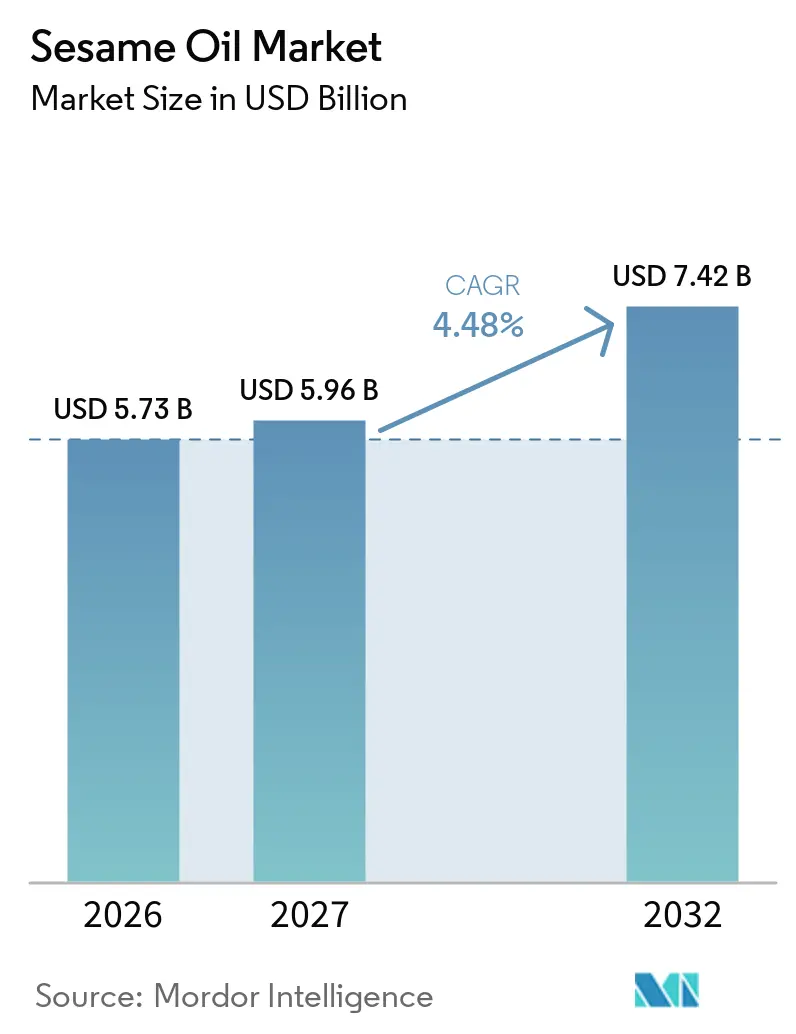
The global sesame oil market size is expected to grow from USD 5.73 billion in 2026 to USD 5.96 billion in 2027 and is forecast to reach USD 7.42 billion by 2032 at a 4.48% CAGR over 2027-2032. The global sesame oil market is driven by the growing popularity of Asian and ethnic cuisines, increasing consumer preference for distinctive flavors, and the wider use of sesame oil in household cooking, foodservice, and packaged food production. Its characteristic nutty aroma makes it a preferred ingredient in stir-fries, marinades, dressings, sauces, and ready-to-eat meals, supporting demand across diverse culinary applications. Rising interest in cold-pressed and minimally processed oils is encouraging manufacturers to introduce products differentiated by extraction methods, seed varieties, flavor profiles, and production practices. Innovation in organic, premium, and specialty sesame oil products is creating opportunities for brand differentiation and expansion into new consumer segments. The growing use of sesame oil in cosmetic and personal care formulations, including massage oils and skin care products, is broadening its application base beyond food. Improvements in extraction, filtration, refining, packaging, and quality control are helping manufacturers maintain consistent product characteristics and meet the requirements of food processors and international markets.
Key Report Takeaways
- By processing type, refined sesame oil held 60.13% of global value share in 2026, while other processing types are forecast to grow at a 6.35% CAGR through 2032.
- By sesame seed source, white sesame oil held 42.65% of global value share in 2026, while black sesame oil is forecast to grow at a 6.14% CAGR through 2032.
- By nature, conventional sesame oil held 92.53% share in 2026, while organic sesame oil is forecast to grow at a 7.23% CAGR through 2032.
- By application, B2B held 54.64% share in 2026, while B2C is forecast to grow at a 6.08% CAGR through 2032.
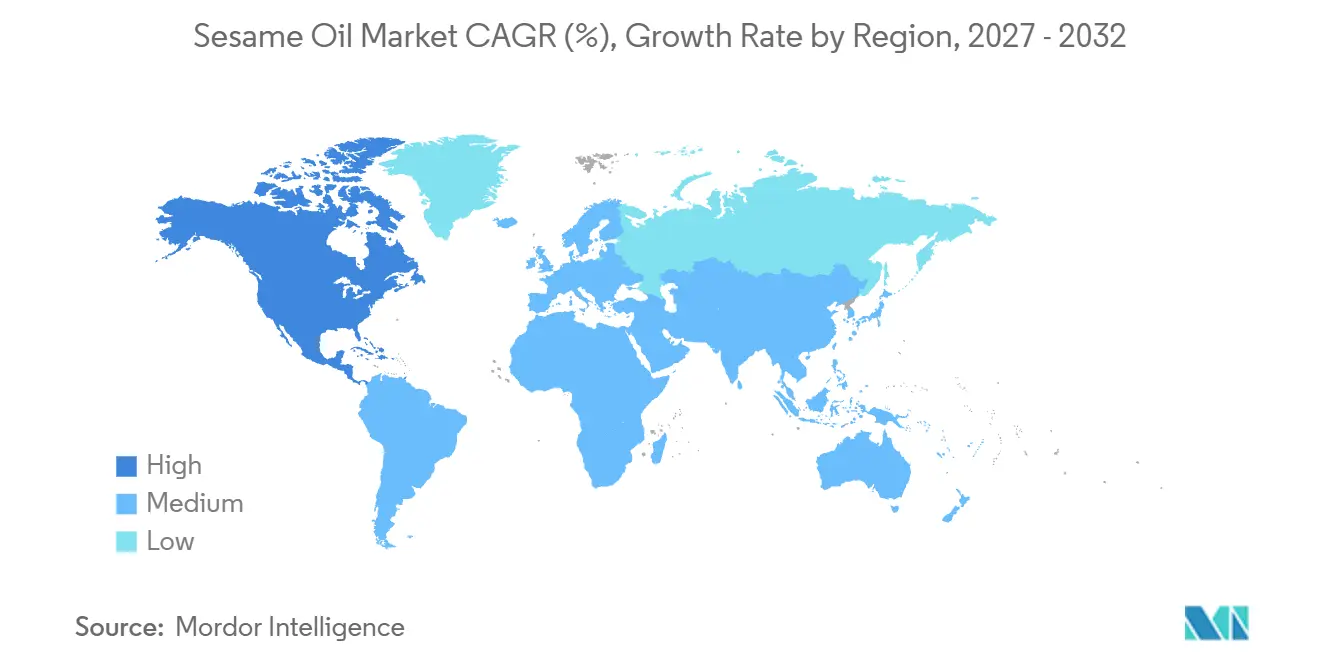
- By geography, Asia-Pacific held 42.13% share in 2026, while North America is forecast to grow at a 6.54% CAGR through 2032.
Note: Market numbers in this report are based on Mordor Intelligence's proprietary estimation framework, which combines nine months of actuals with Q4 projections for base year 2026.
Market Trends and Insights
Drivers Impact Analysis of Sesame Oil Market*
| Driver | (~) % Impact on CAGR Forecast | Geographic Relevance | Impact Timeline |
|---|---|---|---|
| Growing popularity of Asian and ethnic cuisines | +1.2% | Global, particularly North America, Europe, and South America | Medium term (2-4 years) |
| Increasing preference for cold-pressed and minimally processed oils | +0.9% | North America, Europe, and urban Asia-Pacific | Medium term (2-4 years) |
| Rising demand for specialty and flavor-enhancing oils | +0.7% | Asia-Pacific, North America, and Europe | Short term (≤ 2 years) |
| Increasing adoption across foodservice and hospitality | +0.6% | Asia-Pacific, North America, and South America | Medium term (2-4 years) |
| Product innovation in organic and premium sesame oil | +0.5% | North America and Europe | Medium term (2-4 years) |
| Improved processing technology and product quality | +0.4% | Asia-Pacific and Europe | Long term (≥ 4 years) |
| Source: Mordor Intelligence | |||
Growing Popularity of Asian and Ethnic Cuisines
The growing global popularity of Asian and ethnic cuisines is driving demand for sesame oil, increasing its use in restaurant menus, household cooking, and packaged food products across international markets. Sesame oil is widely used in Chinese, Japanese, Korean, and other Asian cuisines to enhance the flavor and aroma of stir-fries, noodles, marinades, dressings, and sauces. The National Restaurant Association identified Korean and Vietnamese cuisines among the prominent culinary trends in its 2025 forecast, reflecting increasing interest in diverse Asian flavors and ingredients[1]. Similarly, a 2025 survey conducted by South Korea's Ministry of Agriculture, Food and Rural Affairs and the Korean Food Promotion Institute across 22 cities and involving 11,000 consumers found that 68.6% of respondents were familiar with Korean food, 80.6% expressed an intention to consume it again, and 65.1% had tried or developed an interest in Korean food through exposure to Korean cultural content[2]. This growing international engagement with Asian cuisine is also reflected in trade performance: South Korean sesame oil exports reached USD 6.14 million during January–April 2026, representing a 37% year-on-year increase, while export volumes grew by 47.6% to 657 metric tons[3]. These developments indicate that the international spread of Asian culinary traditions is expanding sesame oil use beyond traditional consumption markets, encouraging product innovation, and strengthening demand from foodservice operators, food manufacturers, and retail consumers.
Increasing Preference for Cold-Pressed and Minimally Processed Oils
The growing preference for cold-pressed and minimally processed oils is supporting growth in the global sesame oil market, as consumers show greater interest in traditional extraction methods, recognizable ingredients, and limited processing. Cold-pressed sesame oil is produced by mechanically extracting oil from sesame seeds without applying substantial external heat, which helps preserve its characteristic aroma, flavor, and naturally occurring constituents. This processing method appeals to consumers seeking alternatives to conventionally refined oils and contributes to the differentiation of sesame oil in the premium edible oil segment. This trend is also encouraging manufacturers to expand their portfolios with cold-pressed, unrefined, and traditionally extracted sesame oils that emphasize processing transparency, seed quality, and product authenticity. The growing availability of these products through specialty food retailers, organic grocery stores, and online platforms is improving consumer access to differentiated sesame oil varieties across established and emerging markets. Foodservice operators and specialty food manufacturers are also incorporating minimally processed oils into dressings, marinades, dipping sauces, and other culinary applications where distinctive flavor characteristics are important. As consumers increasingly evaluate food products based on ingredient composition and processing methods, cold-pressed sesame oil offers manufacturers opportunities to strengthen product positioning, diversify their offerings, and expand their presence in the global specialty edible oils market.
Rising Demand for Specialty and Flavor-Enhancing Oils
Growing demand for specialty and flavor-enhancing oils is driving the global sesame oil market, as consumers, foodservice operators, and food manufacturers increasingly seek ingredients that improve the sensory appeal and distinctiveness of food products. Sesame oil is valued for its characteristic nutty aroma and flavor, which vary based on seed preparation and extraction methods, making it suitable for a wide range of culinary applications. Toasted sesame oil is particularly popular as a finishing oil in Asian cuisines, where it is used to enhance the taste of noodles, stir-fries, soups, marinades, dipping sauces, and salad dressings. Lighter-flavored sesame oils are used for cooking and as ingredients in food preparations where a more subtle sesame profile is preferred. The growing incorporation of international flavors into mainstream food products is further expanding opportunities for sesame oil in ready-to-eat meals, instant noodles, savory snacks, condiments, and specialty sauces. Food manufacturers are also using flavor-enhancing oils to differentiate product formulations and develop distinctive taste profiles that appeal to consumers exploring new culinary experiences. In response, producers are introducing sesame oils with varying roasting intensities, seed origins, extraction techniques, and packaging formats to meet specific consumer preferences and commercial requirements. This increasing emphasis on flavor differentiation and specialty ingredients is strengthening the role of sesame oil in both traditional cuisine and innovative food applications, supporting market expansion across retail, foodservice, and food processing channels.
Product Innovation in Organic and Premium Sesame Oil
Product innovation in organic and premium sesame oil is supporting the growth of the global sesame oil market. Manufacturers are differentiating their offerings through sourcing practices, extraction techniques, flavor profiles, and product quality. The development of organic sesame oils, cold-pressed variants, traditionally extracted products, and premium toasted oils is catering to consumers seeking specialized culinary ingredients with clearly defined product attributes. Organic sesame oil appeals to buyers who prioritize certified production practices and restrictions on synthetic agricultural inputs, while premium varieties attract consumers and foodservice operators looking for distinctive aromas, richer flavors, and consistent performance in specific culinary applications. Manufacturers are also introducing new packaging formats, including dark glass bottles, precision-pour containers, and smaller premium packs, to improve product protection, convenience, and presentation. Advancements in traceability, quality assurance, and seed sourcing allow brands to communicate the origin and production characteristics of their products more effectively. These developments are expanding sesame oil's presence in specialty grocery stores, online retail platforms, gourmet food outlets, and premium foodservice establishments. Product diversification also enables companies to target different consumer groups and culinary applications rather than competing exclusively in conventional edible oil categories. Continued innovation in organic and premium sesame oil is creating opportunities for brand differentiation, broader distribution, and increased adoption across international markets.
Restraints Impact Analysis of Sesame Oil Market*
| Restraint | (~) % Impact on CAGR Forecast | Geographic Relevance | Impact Timeline |
|---|---|---|---|
| Competition from alternative edible oils | -0.8% | Global | Medium term (2-4 years) |
| Dependence on sesame seed availability and climatic conditions | -0.5% | Asia-Pacific and Middle East and Africa | Long term (≥ 4 years) |
| Fluctuations in sesame seed prices and procurement costs | -0.4% | Global | Short term (≤ 2 years) |
| Sesame allergen risks and cross-contamination concerns | -0.3% | North America and Europe | Medium term (2-4 years) |
| Source: Mordor Intelligence | |||
Competition From Alternative Edible Oils
Competition from alternative edible oils is a key restraint on the global sesame oil market, as consumers and food manufacturers have access to a wide range of oils that serve similar cooking and food formulation purposes. Oils such as sunflower, soybean, canola, palm, peanut, and olive oil are widely used in household kitchens, foodservice establishments, and processed food manufacturing, limiting sesame oil adoption across all applications. Many alternative oils offer relatively neutral flavor profiles, making them suitable for recipes and industrial formulations where the distinctive nutty aroma of sesame oil is not desirable. Additionally, sesame oil's characteristic flavor can restrict its use as a primary cooking medium in certain cuisines, leading consumers to select more versatile alternatives for everyday frying, baking, and general food preparation. Food manufacturers may also substitute other vegetable oils in large-volume formulations when sesame oil's specific sensory characteristics are not essential to the finished product. The availability of multiple edible oil options with different functional properties, flavor profiles, and sourcing characteristics further intensifies competition among manufacturers and brands. Sesame oil producers must differentiate their products through flavor quality, specialized culinary applications, processing methods, and product authenticity to maintain consumer interest. This competitive environment limits sesame oil penetration in price-sensitive and flavor-neutral applications, constraining its adoption across certain consumer and industrial segments of the global edible oils market.
Sesame Allergen Risks and Cross-Contamination Concerns
Sesame allergen risks and cross-contamination concerns represent a significant restraint for the global sesame oil market. Sesame is recognized as a food allergen in several major markets and requires appropriate management throughout food production and distribution. In the United States, sesame was designated as the ninth major food allergen under the Food Allergy Safety, Treatment, Education, and Research (FASTER) Act, with mandatory labeling requirements taking effect on January 1, 2023. These requirements increase the importance of accurate ingredient declarations, supplier verification, and allergen control procedures for manufacturers producing sesame oil and sesame-containing food products. Processing facilities that handle multiple edible oils or food ingredients may need to implement additional cleaning protocols, equipment segregation, production scheduling, and testing procedures to reduce the risk of unintended allergen cross-contact. Such measures can increase operational complexity and require ongoing quality assurance throughout manufacturing and packaging. Additionally, the potential presence of residual sesame proteins can create further considerations for products marketed as highly refined oils, as allergen content may vary depending on the extraction and refining processes. Regulatory requirements and labeling practices also differ across countries, complicating international product distribution and market entry. As a result, allergen management obligations, the risk of product recalls, and the need to maintain consumer confidence can create additional compliance challenges for sesame oil producers, particularly those supplying packaged foods, foodservice operators, and international markets.
*Our forecasts treat driver/restraint impacts as directional, not additive. The impact forecasts reflect baseline growth, mix effects, and variable interactions.
Sesame Oil Market Segment Analysis
By Processing Type:
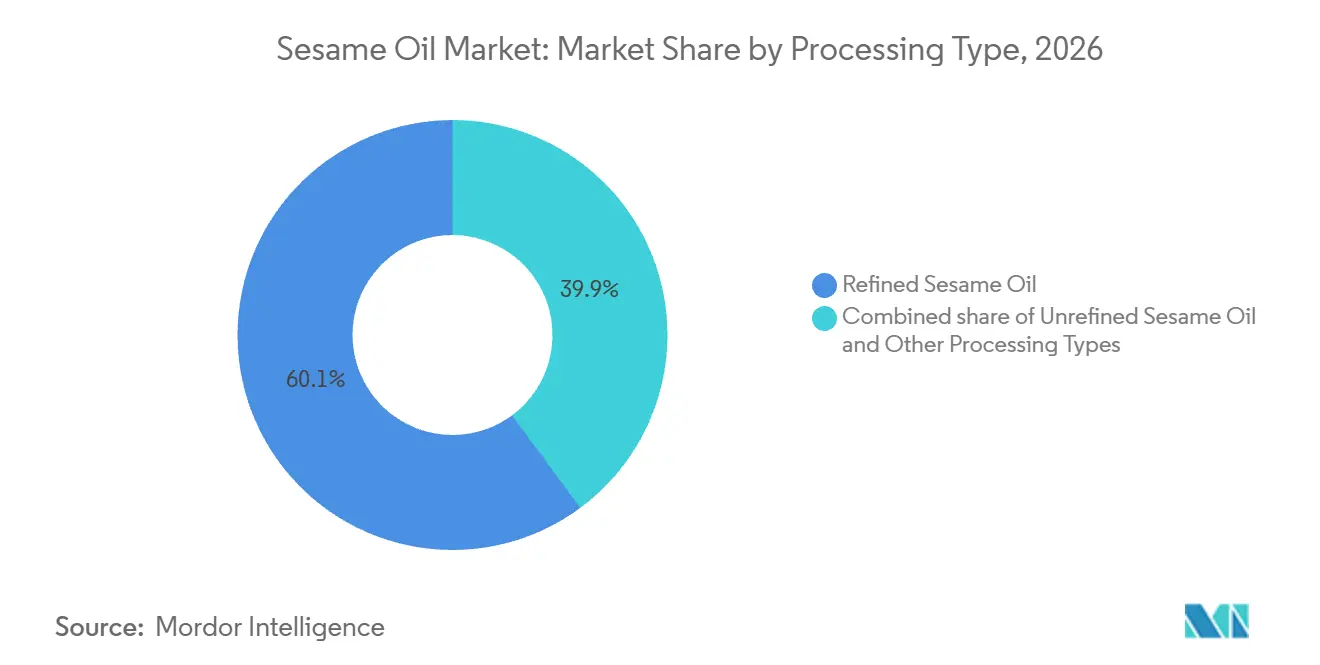
Refined Products Support Scale While Other Types Add ValueRefined sesame oil held 60.13% of global value share in 2026, driven by demand from food manufacturers, foodservice operators, and households seeking oils with consistent quality, a milder flavor profile, and suitability for diverse culinary applications. Refining reduces unwanted impurities, odors, and color variations, supporting product standardization and use in processed foods, cooking, and commercial food preparation. Improvements in refining technology, quality control, and packaging help manufacturers maintain product stability and meet the specifications of large-scale buyers.
Other processing types are forecast to expand at a 6.35% CAGR through 2032, supported by growing interest in traditional extraction methods, distinctive flavor profiles, and specialized culinary applications. Cold-pressed and mechanically extracted oils appeal to consumers seeking minimally processed alternatives, while toasted sesame oil is valued for its pronounced nutty aroma in Asian cuisines, sauces, dressings, and marinades. Product innovation, specialty food retail, and expanding international interest in ethnic cuisines are creating further opportunities for these differentiated sesame oil varieties.



By Sesame Seed Source:
White Sesame Leads While Black Sesame Gains Premium DemandWhite sesame oil held 42.65% of global value share in 2026, driven by its widespread use in traditional cooking, food processing, and culinary applications that require a mild, characteristic sesame flavor. Its suitability for preparing stir-fries, sauces, dressings, marinades, and other food products supports demand among households, restaurants, and food manufacturers. The availability of white sesame seeds for oil extraction, established processing practices, and the versatility of the resulting oil across different cuisines further contribute to segment growth.
Black sesame oil is forecast to grow at a 6.14% CAGR through 2032, supported by growing interest in specialty culinary ingredients, traditional Asian food preparations, and products derived from distinctive sesame varieties. Black sesame seeds are associated with traditional cuisines in East Asia, creating opportunities for their oil in specialty cooking, seasoning, and selected premium food applications. Increasing consumer interest in regional ingredients, product differentiation, and traditional food products is encouraging manufacturers to explore black sesame oil offerings for specialty retailers, restaurants, and niche consumer segments.
By Nature:
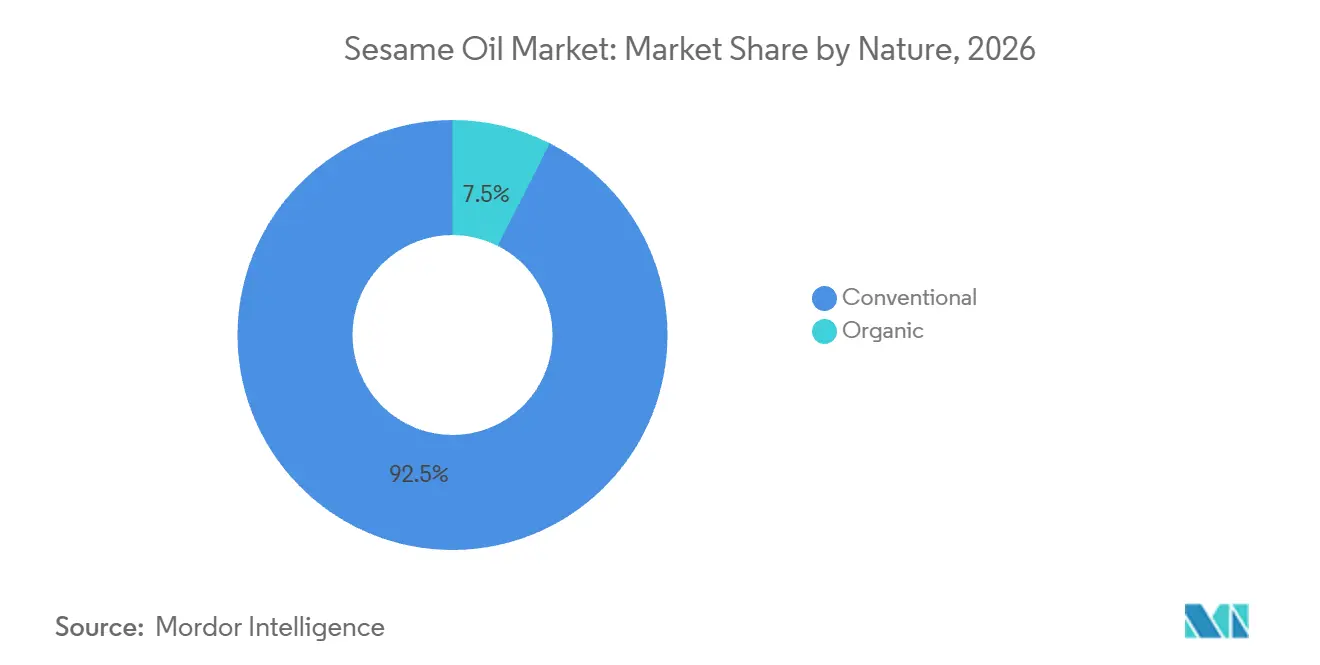
Conventional Products Retain Scale While Organic Products Grow FasterConventional sesame oil held a 92.53% share in 2026, driven by its established use in household cooking, foodservice, and processed food manufacturing, particularly across Asian countries where sesame oil is a key culinary ingredient. Its versatility in preparing stir-fries, sauces, marinades, dressings, and packaged foods supports demand from diverse end users. Established cultivation and processing networks, broad product availability, and the suitability of conventional sesame oil for both retail and bulk commercial applications further support market growth.
Organic sesame oil is forecast to grow at a 7.23% CAGR through 2032, driven by increasing consumer interest in organically produced food ingredients, transparent sourcing practices, and agricultural methods that restrict the use of synthetic pesticides and fertilizers in accordance with applicable certification standards. Manufacturers are expanding organic product offerings to serve specialty food retailers, health-focused consumers, and premium culinary markets. The availability of certified organic sesame seeds, growing interest in traceable ingredients, and product differentiation through organic certification and minimally processed formulations are creating additional opportunities for organic sesame oil across international markets.

By Application:
B2B Holds the Larger Base While B2C Expands FasterB2B accounted for a 54.64% share in 2026, driven by demand from food processing companies, restaurants, hotels, catering operators, and manufacturers of sauces, dressings, marinades, and ready-to-eat meals. Sesame oil's distinctive flavor and aroma make it a valued ingredient in Asian-inspired food products, and its versatility supports applications across commercial kitchens and industrial food formulations. The need for consistent product quality, bulk packaging, reliable sourcing, and customized flavor profiles encourages sesame oil suppliers to develop long-term relationships with food manufacturers and institutional buyers.
B2C is forecast to grow at a 6.08% CAGR through 2032, driven by growing consumer interest in Asian cuisines, home cooking, and specialty ingredients. Sesame oil is increasingly used in stir-fries, noodles, salads, marinades, and dressings, and the availability of toasted, cold-pressed, conventional, and organic varieties caters to different culinary preferences. Wider distribution through supermarkets, specialty grocery stores, and e-commerce platforms is improving product accessibility, while convenient packaging and greater awareness of sesame oil's culinary versatility are supporting household adoption across established and emerging markets.
Geography Analysis
Asia-Pacific Sesame Oil Market
Asia-Pacific accounted for 42.13% of the global value share in 2026. The region's sesame oil market is driven by established culinary traditions, widespread use of sesame oil in household cooking, and strong demand from foodservice establishments and food manufacturers. Countries such as China, Japan, South Korea, and India incorporate sesame oil into traditional dishes, seasonings, sauces, and marinades, supporting consistent consumption across multiple applications. The presence of sesame seed cultivation, oil extraction facilities, and established distribution networks further strengthens regional supply. Product innovation in toasted, cold-pressed, and specialty sesame oils is also expanding opportunities across retail and commercial food markets.
North America Sesame Oil Market
North America is forecast to grow at a CAGR of 6.54% through 2032. The region's sesame oil market is driven by the growing popularity of Asian cuisines, increasing availability of international food products, and the incorporation of sesame oil into packaged foods and restaurant menus. Rising interest in Korean, Japanese, Chinese, and other Asian-inspired dishes is supporting demand for sesame oil in stir-fries, noodles, dressings, sauces, and marinades. The expansion of specialty grocery stores, online food retail, and foodservice distribution is improving product accessibility. Consumer interest in cold-pressed, organic, and premium culinary oils is also encouraging manufacturers to diversify their offerings and target specialized consumer segments.
Europe, South America, and the Middle East and Africa Sesame Oil Market
The sesame oil markets in Europe, South America, and the Middle East and Africa are supported by the increasing adoption of international cuisines, the expansion of foodservice operations, and the growing availability of specialty food ingredients through retail and online distribution channels. In Europe, demand is driven by interest in Asian-inspired cooking, premium oils, and diverse culinary products. South America offers opportunities through the incorporation of sesame oil into sauces, dressings, and contemporary food preparations. In the Middle East and Africa, traditional sesame-based food practices in select countries, along with demand from restaurants, food manufacturers, and specialty food retailers, support market development. Across all three regions, product diversification, wider distribution networks, and growing familiarity with sesame oil's distinctive flavor are contributing to broader adoption.
Competitive Landscape
Market Concentration

The global sesame oil market is characterized by a fragmented competitive landscape, with numerous regional manufacturers, specialized producers, and diversified edible oil companies competing across consumer and industrial segments. Market participants differentiate themselves through product quality, flavor profiles, seed sourcing, extraction techniques, packaging formats, and distribution capabilities. While specialized manufacturers focus on traditional production methods, distinctive aromas, and product authenticity, larger edible oil suppliers leverage processing capabilities, established procurement networks, and relationships with food manufacturers and distributors. The competitive environment varies across regions according to culinary preferences, consumption patterns, and product requirements, creating opportunities for both established brands and emerging regional players.
Product differentiation and portfolio expansion are important competitive strategies in the global sesame oil market. Manufacturers are developing products with varying roasting intensities, extraction methods, flavor characteristics, and quality specifications to serve diverse culinary applications. The introduction of premium, organic, cold-pressed, and specialty sesame oils is helping companies target distinct consumer groups and strengthen their market positioning. Producers are also exploring new consumption occasions beyond traditional Asian cooking, including applications in salads, dressings, marinades, sauces, and contemporary food preparations. In parallel, investments in processing facilities, packaging innovation, distribution partnerships, and supply chain optimization are enabling market participants to improve product accessibility and respond to changing customer requirements.
Quality consistency, food safety compliance, and supply chain reliability are becoming increasingly important factors influencing competitive positioning. Manufacturers must maintain appropriate allergen controls, product traceability, accurate labeling, and consistent product specifications to meet the requirements of retailers, food processors, and international buyers. Effective sourcing strategies and quality assurance systems can strengthen supplier relationships and support access to regulated markets. Additionally, digital commerce and direct-to-consumer distribution are creating opportunities for smaller brands to improve visibility and reach specialized customer segments.
Sesame Oil Industry Leaders
-
Kadoya Sesame Mills Incorporated
-
Lee Kum Kee
-
TAKEMOTO OIL & FAT CO., LTD.
-
Wilmar International Limited
-
Kuki Sangyo Co., Ltd.
- *Disclaimer: Major Players sorted in no particular order
Sesame Oil Market Companies Covered in this Report
- Kadoya Sesame Mills Incorporated
- Wilmar International Limited
- TAKEMOTO OIL & FAT CO., LTD.
- Lee Kum Kee
- Kuki Sangyo Co., Ltd.
- Daesang Corporation
- Dipasa Group
- La Tourangelle, Inc.
- Archer Daniels Midland Company
- Borges International Group S.L.U.
- Kevala International LLC
- Pansari Group
- Chee Seng Oil Factory Pte Ltd
- OLVEA Group
- AAK AB
- Cargill, Incorporated
- Marico Limited
- Adani Wilmar Limited
- Tingzhi Foodstuff Co., Ltd.
- HAITOGLOU BROS S.A.
Recent Industry Developments in Sesame Oil Market
- September 2026: Singapore-based Chee Seng Oil Factory Pte Ltd launched a sesame oil portfolio under its Double Pagoda brand, including Chee Seng Pure Sesame Oil, made from roasted sesame seeds, and flavored oils. Its product range includes mala sesame oil with Sichuan peppercorn and chili flavors. The company distributes its products across North America, Europe, Southeast Asia, and Oceania through importers, retailers, foodservice operators, and e-commerce platforms, supported by food safety certifications.
- June 2025: Marico Limited expanded its cold-pressed oil portfolio under the Saffola brand with the introduction of 100% sesame oil. The product highlights its single-seed composition, naturally occurring essential fatty acids, and authentic sesame flavor, targeting consumers who prefer minimally processed oils and distinctive culinary ingredients. This launch reflects the growing emphasis on product differentiation and specialized offerings in the sesame oil market.
- May 2024: Tata Consumer Products launched a cold-pressed sesame oil under its Tata Simply Better brand, expanding its range of cold-pressed edible oils that also includes groundnut, virgin coconut, and mustard oils. The product is positioned around traditional cold-pressing methods, authentic sesame flavor, and the retention of naturally occurring oil constituents, targeting consumers seeking alternatives to conventional cooking oils.
Global Sesame Oil Market Report Scope
This study defines the global sesame oil market as all commercially produced oils extracted from sesame seeds. The market is categorized by processing type (refined sesame oil, unrefined sesame oil, and other processing types), sesame seed source (white, black, brown, and other sesame seed varieties), and nature (conventional and organic). It covers sesame oil supplied for business-to-business (B2B) and business-to-consumer (B2C) applications, including food and other relevant end uses, distributed through retail, foodservice, and industrial channels across North America, Europe, Asia-Pacific, South America, and the Middle East and Africa.
Segmentation Overview
| Refined Sesame Oil |
| Unrefined Sesame Oil |
| Other Processing Types |
| White |
| Black |
| Brown |
| Other Sesame Seed Oil |
| Conventional |
| Organic |
| B2B | Food and Beverages |
| Cosmetics and Personal Care | |
| Pharmaceuticals and Nutraceuticals | |
| Other B2B Applications | |
| B2C | Supermarkets/Hypermarkets |
| Specialty Stores | |
| Online Retail Stores | |
| Other Retail Stores |
| North America | United States |
| Canada | |
| Mexico | |
| Rest of North America | |
| Europe | Germany |
| United Kingdom | |
| Italy | |
| France | |
| Spain | |
| Rest of Europe | |
| Asia-Pacific | China |
| India | |
| Japan | |
| South Korea | |
| Australia | |
| Rest of Asia-Pacific | |
| South America | Brazil |
| Argentina | |
| Rest of South America | |
| Middle East and Africa | South Africa |
| Saudi Arabia | |
| United Arab Emirates | |
| Turkey | |
| Rest of Middle East and Africa |
| By Processing Type | Refined Sesame Oil | |
| Unrefined Sesame Oil | ||
| Other Processing Types | ||
| By Sesame Seed Source | White | |
| Black | ||
| Brown | ||
| Other Sesame Seed Oil | ||
| By Nature | Conventional | |
| Organic | ||
| By Application | B2B | Food and Beverages |
| Cosmetics and Personal Care | ||
| Pharmaceuticals and Nutraceuticals | ||
| Other B2B Applications | ||
| B2C | Supermarkets/Hypermarkets | |
| Specialty Stores | ||
| Online Retail Stores | ||
| Other Retail Stores | ||
| By Geography | North America | United States |
| Canada | ||
| Mexico | ||
| Rest of North America | ||
| Europe | Germany | |
| United Kingdom | ||
| Italy | ||
| France | ||
| Spain | ||
| Rest of Europe | ||
| Asia-Pacific | China | |
| India | ||
| Japan | ||
| South Korea | ||
| Australia | ||
| Rest of Asia-Pacific | ||
| South America | Brazil | |
| Argentina | ||
| Rest of South America | ||
| Middle East and Africa | South Africa | |
| Saudi Arabia | ||
| United Arab Emirates | ||
| Turkey | ||
| Rest of Middle East and Africa | ||
Key Questions Answered in the Report
What is the projected growth rate for sesame oil through 2032?
The sesame oil market is forecast to grow at a 4.48% CAGR from 2027 to 2032, reaching USD 7.42 billion by 2032.
Which processing type holds the largest share of sesame oil sales?
Refined sesame oil holds the largest share, at 60.13% in 2026, supported by food manufacturing and foodservice demand.
Which sesame oil type is growing the fastest?
Organic sesame oil is the fastest-growing nature segment, with a forecast CAGR of 7.23% through 2032.
Which region leads sesame oil consumption?
Asia-Pacific leads with 42.13% share in 2026 because sesame oil is deeply established in household and foodservice cooking across the region.