
Security Operations Center (SOC) Analyst Training Market Size and Share
Market Overview
| Study Period | 2020 - 2031 |
|---|---|
| Market Size (2026) | USD 3.37 Billion |
| Market Size (2031) | USD 8.08 Billion |
| Growth Rate (2026 - 2031) | 19.11 % |
| Fastest Growing Market | Asia-Pacific |
| Largest Market | North America |
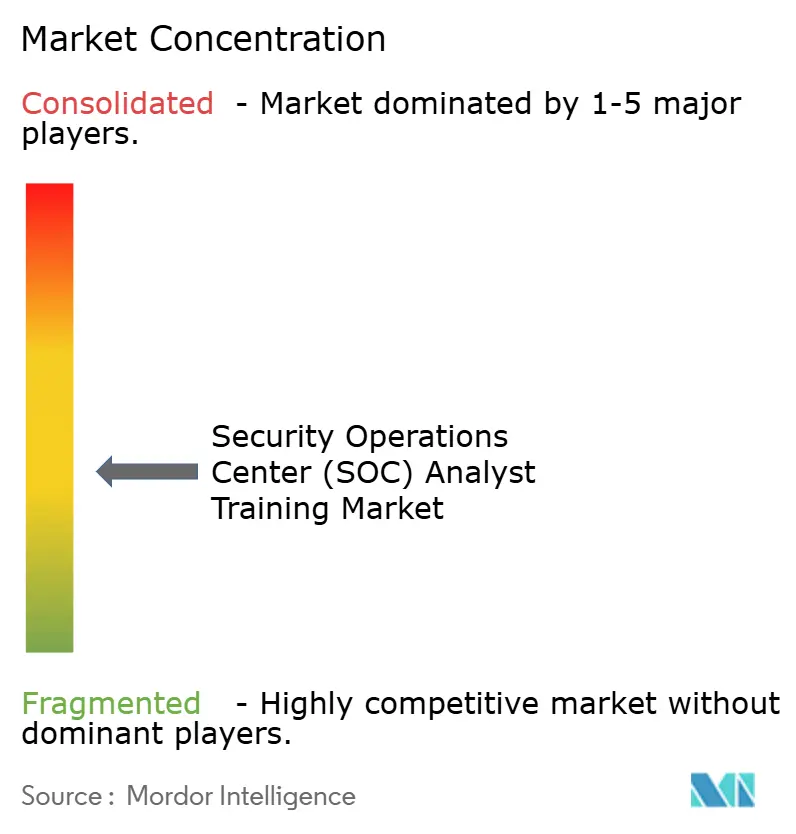
| Market Concentration | Medium |
Major Players *Disclaimer: Major Players sorted in no particular order Image © Mordor Intelligence. Reuse requires attribution under CC BY 4.0. | |
Security Operations Center (SOC) Analyst Training Market Analysis by Mordor Intelligence
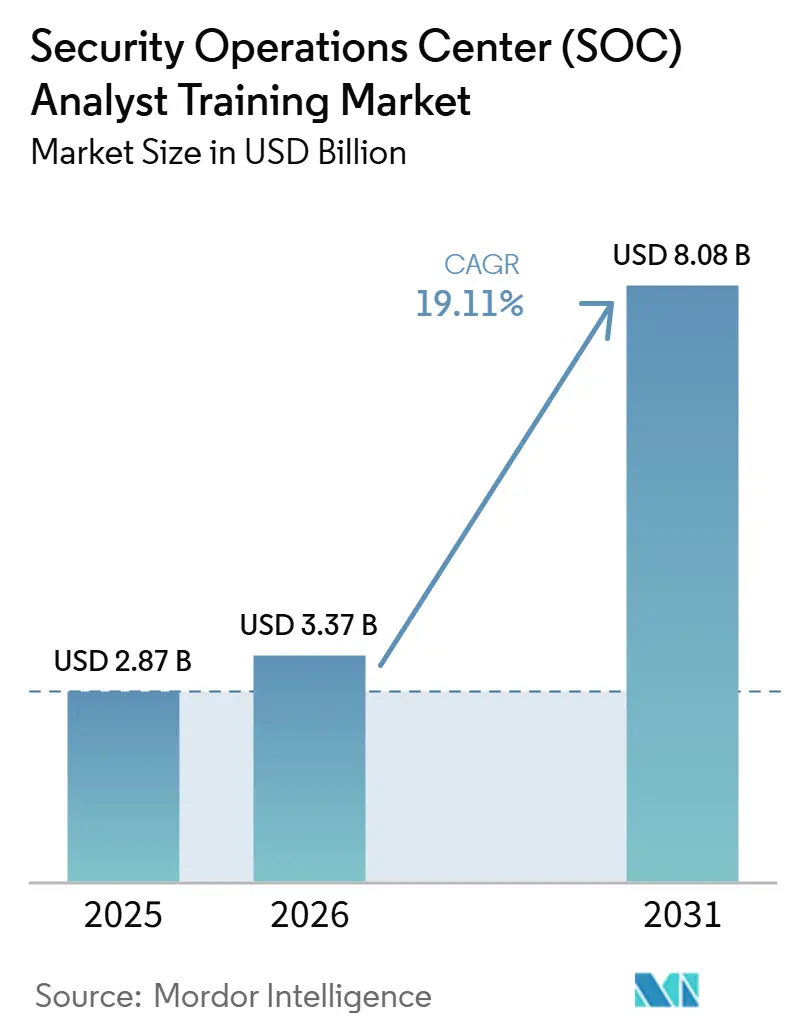
The Security Operations Center (SOC) analyst training market size was valued at USD 2.87 billion in 2025 and estimated to grow from USD 3.37 billion in 2026 to reach USD 8.08 billion by 2031, at a CAGR of 19.11% during the forecast period (2026-2031). The Security Operations Center (SOC) analyst training market is expanding because enterprises now treat analyst capability as an operating requirement instead of a periodic certification task. The shift is moving demand away from one-time course completion and toward continuous, role-based readiness that can be checked in live settings. Breaches linked to workforce capability gaps are also pushing training budgets closer to risk prevention budgets. The Security Operations Center (SOC) analyst training market is also showing a clear split between mature formats that still hold current volume and hands-on models that are growing faster. Regional demand remains strongest in North America, while Asia-Pacific is growing fastest as regulation, digital expansion, and AI-driven threats reshape buyer priorities and vendor strategy.
Key Report Takeaways
- By training format, Instructor-Led Virtual Learning led the Security Operations Center (SOC) analyst training market with a 31.42% revenue share in 2025, while Blended Learning is projected to expand at a 22.83% CAGR through 2031.
- By offering Certification Programs, held 28.41% share in 2025, while Cyber Range and Hands-on Lab Programs are projected to grow at a 24.16% CAGR through 2031.
- By enterprise size, Large Enterprises accounted for 62.18% share in 2025, while Small and Medium Enterprises are projected to expand at a 21.74% CAGR through 2031.
- By end user, IT and Telecommunication held 24.86% share in 2025, while Healthcare and Life Sciences are projected to advance at a 21.39% CAGR through 2031.
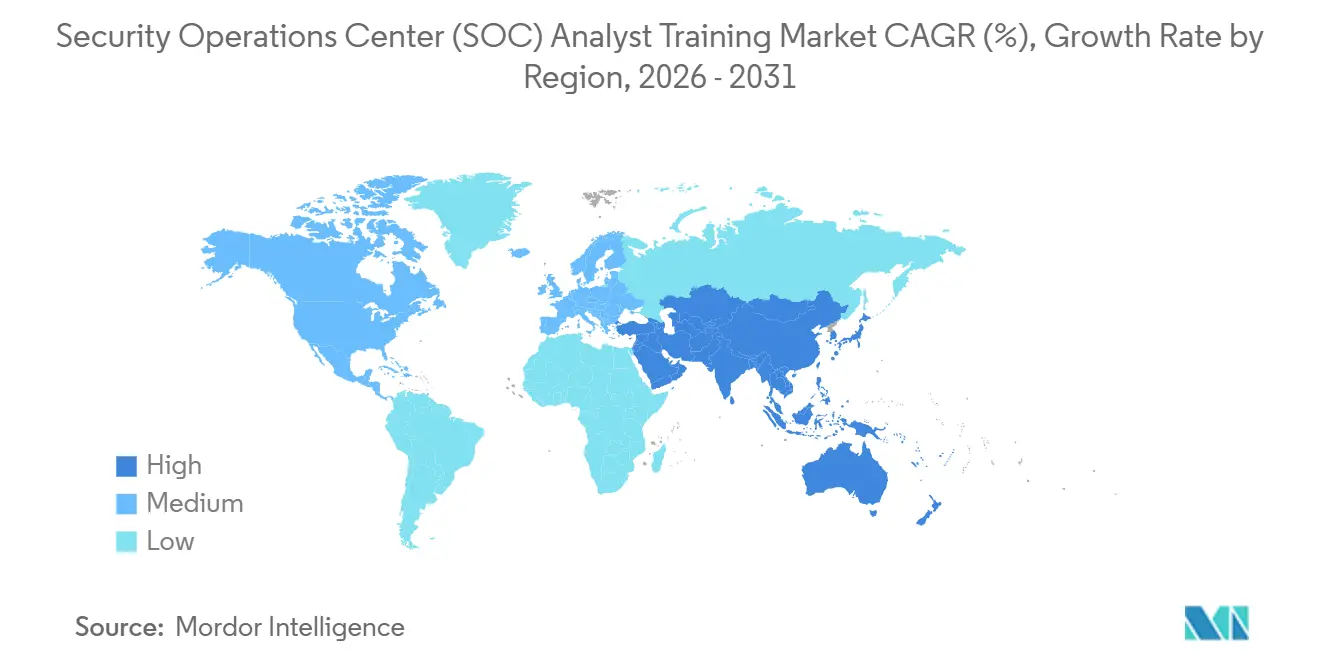
- By geography, North America held 34.62% of the Security Operations Center (SOC) analyst training market share in 2025, while Asia-Pacific is projected to grow at a 23.48% CAGR through 2031.
Note: Market size and forecast figures in this report are generated using Mordor Intelligence’s proprietary estimation framework, updated with the latest available data and insights as of January 2026.
Market Trends and Insights
Drivers Impact Analysis of Security Operations Center (SOC) Analyst Training Market*
| Driver | (~) % Impact on CAGR Forecast | Geographic Relevance | Impact Timeline |
|---|---|---|---|
| Rising AI-Driven Threat Simulation Demand | +3.8% | Global | Short term (≤ 2 years) |
| Compliance-Led Analyst Readiness Programs | +3.2% | North America and EU | Medium term (2-4 years) |
| Persistent Security Skills Shortage in SOC Teams | +2.8% | Global | Medium term (2-4 years) |
| Shift to Role-Based, Scenario-Based Learning | +2.1% | North America, EU, Asia-Pacific | Medium term (2-4 years) |
| Growth of Hybrid and Virtual Lab Delivery | +1.6% | Global | Short term (≤ 2 years) |
| Procurement Preference for Measurable Training Outcomes | +1.0% | North America and EU | Long term (≥ 4 years) |
| Source: Mordor Intelligence | |||
Rising AI-Driven Threat Simulation Demand
The Security Operations Center (SOC) analyst training market is responding to a growing mismatch between static course content and rapidly evolving AI-enabled attack behavior in real-world environments.[1]ISC2, “How Enterprises Are Strengthening Their Cybersecurity Teams Through Training,” ISC2, edge.sitecorecloud.io ISC2 found that 47% of security leaders identified AI as the most pressing competency now being addressed through training. The same research showed that 28% of respondents already view agentic AI as the next skill frontier for their teams. SANS reported that 74% of organizations say AI is already affecting SOC team size and role composition, but only 38% provide comprehensive AI security training. Fortinet also found that 60% of organizations cite AI-specific experience as their top recruiting challenge, which is pushing buyers toward adaptive simulations and AI-aware lab environments.[2]SANS Institute, “SANS Research: The Cybersecurity Talent Shortage Narrative Is Wrong. The Real Crisis Is Skills and AI Just Rewrote the List,” GlobeNewswire, globenewswire.com
Compliance-Led Analyst Readiness Programs
The Security Operations Center (SOC) analyst training market is gaining steady support from compliance programs that now expect training to be role-specific, documented, and effective. NIS2 became enforceable across most EU member states from October 2024, and DORA came into direct application on January 17, 2025. DORA Article 13(6) requires training depth that matches job responsibility, including hands-on drills for personnel with privileged ICT access. ENISA's June 2025 guidance also treated cybersecurity training as 1 of 12 mandatory control domains and required effectiveness assessment with maintained records. The SANS and GIAC workforce report showed that the share of organizations in which regulation affects hiring and training decisions rose from 40% in 2025 to 95% in 2026, making compliance one of the clearest demand triggers in this market.
Persistent Security Skills Shortage in SOC Teams
The Security Operations Center (SOC) analyst training market is growing because employers now care more about analyst capability quality than raw hiring volume. SANS found that skills quality overtook headcount as the main workforce challenge, and the gap widened from 4 percentage points in 2025 to 20 percentage points in 2026.[3]ISACA, “Resilience and Security in Critical Sectors: Navigating NIS2 and DORA Requirements,” ISACA, isaca.org This change is shifting spending away from simple credential volume and toward simulations, role-based learning, and continuous assessment. The same report stated that adoption of NICE and ECSF role frameworks rose to 56% in 2026 from 46% in 2025. Standard role maps now make it easier for buyers to justify structured training by connecting budgets to measured gaps and job-specific requirements.
Shift to Role-Based, Scenario-Based Learning
The Security Operations Center (SOC) analyst training market is benefiting from a shift toward role-based learning, as Tier 1, Tier 2, and Tier 3 analysts do not need the same practice model.[4]Immersive Labs, “Beyond Assumed Readiness: Cyber Resilience with Immersive One,” Immersive Labs, immersivelabs.com ISC2 found that 52% of respondents reported that training for effective human-AI collaboration was limited or insufficient. That gap remains visible even in organizations that already use AI-assisted SOC workflows, because workflow change has moved faster than training design. Immersive Labs gained strong recognition in early 2026 for a platform that maps readiness to MITRE ATT&CK, NIST CSF, and ISO 27001. Buyers are therefore giving more weight to programs that show which analyst skills improved, because that evidence is easier to defend in audits and budget reviews.
Restraints Impact Analysis of Security Operations Center (SOC) Analyst Training Market*
| Restraint | (~) % Impact on CAGR Forecast | Geographic Relevance | Impact Timeline |
|---|---|---|---|
| Budget Pressure on Discretionary Training Spend | -2.4% | Global | Short term (≤ 2 years) |
| Limited Hands-On Lab Fidelity for Advanced Scenarios | -1.8% | Global | Medium term (2-4 years) |
| Low Completion Rates in Multi-Module Training Programs | -1.2% | North America, EU | Medium term (2-4 years) |
| Difficulty Proving ROI Beyond Awareness Metrics | -0.9% | Global | Long term (≥ 4 years) |
| Source: Mordor Intelligence | |||
Budget Pressure on Discretionary Training Spend
The Security Operations Center (SOC) analyst training market still faces budget constraints, as many organizations continue to treat analyst development as discretionary spending. The SANS and GIAC 2026 report found that budget constraints are the main obstacle to closing skills gaps for 36% of organizations. The same research also showed that budget limitations and time constraints together affect 57% of organizations. Team strain is rising as well, with 61% reporting higher stress over the prior 2 years, which leaves less room for structured learning time. NIS2 and DORA should reduce this pressure over time, as documented training gaps can cost more in compliance than the training itself.
Limited Hands-On Lab Fidelity For Advanced Scenarios
The Security Operations Center (SOC) analyst training market is slowed when lab environments fail to mirror the tools and pressure levels of a live SOC. Cyberbit found that 83% of cybersecurity roles require hands-on experience and 93% require proficiency with security tools. Basic lab tiers often lack full SIEM, SOAR, or EDR visibility, so course completion does not always translate into production confidence. That weakens renewal decisions because buyers struggle to prove that lab time improved operational performance in the actual workplace. Immersive Labs addressed part of this issue in 2026 by upgrading Elastic infrastructure to enterprise licensing across all labs and Dynamic Threat Range exercises, but smaller providers may find this harder to match.
*Our forecasts treat driver/restraint impacts as directional, not additive. The impact forecasts reflect baseline growth, mix effects, and variable interactions.
Security Operations Center (SOC) Analyst Training Market Segment Analysis
By Training Format:
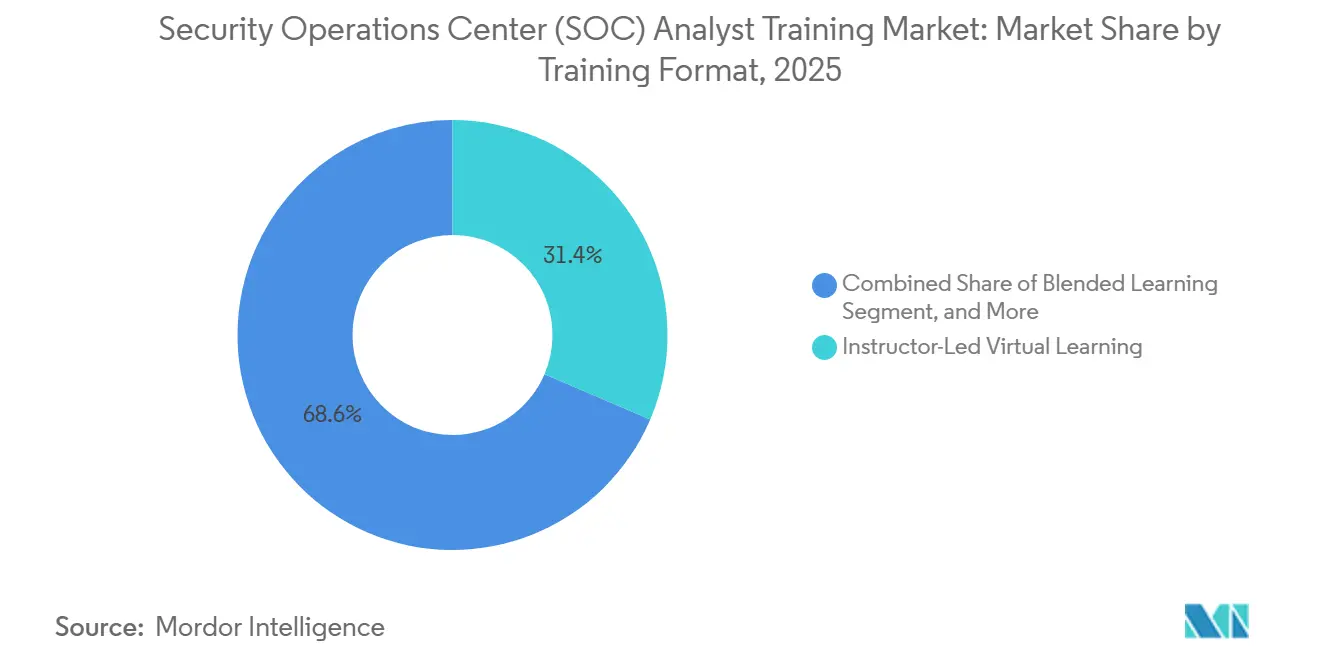
Live Delivery Holds The Base While Blended Models Set The PaceInstructor-Led Virtual Learning held 31.42% of the Security Operations Center (SOC) analyst training market share in 2025, making it the anchor format for documented, live instruction. This format fits compliance expectations because synchronous delivery creates stronger attendance and participation records than self-paced completion alone. It also suits SOC work because instructors can correct log interpretation and response steps in real time. Self-Paced Online Learning still serves an important role for foundational preparation and for globally distributed cohorts that need easier access.
Blended Learning is projected to grow at a 22.83% CAGR through 2031, making it the fastest-expanding training format in the Security Operations Center (SOC) analyst training market. Buyers are using this model to combine the structure of live sessions with the scale and repeatability of on-demand labs. Classroom Learning remains relevant in classified government settings, hardware-heavy operational technology courses, and programs where content sensitivity limits virtual delivery. ISC2's 2026 findings on AI as both the top current priority and the main future demand driver support this format, because blended delivery can handle both formal instruction and repeated scenario refresh.



By Offering:
Credentials Keep Scale While Cyber Ranges Gain MomentumCertification Programs held a 28.41% share in 2025, making them the largest offering category in the Security Operations Center (SOC) analyst training market. That position remains durable because certifications are still the top hiring signal at 64% of organizations, ahead of skills assessments at 49% and academic degrees at 17%. EC-Council reinforced that demand by upgrading its Certified SOC Analyst curriculum to include AI-powered log analysis, SIEM- and SOAR-based automation workflows, and threat-hunter tracks. Awareness seminars and executive briefings also play a governance role, as board and senior management training expectations have increased under NIS2 and DORA.
Cyber Range and Hands-on Lab Programs are projected to grow at a 24.16% CAGR through 2031, making them the fastest-growing offerings in the Security Operations Center (SOC) analyst training market. Cyberbit found that 75% of junior SOC roles explicitly require hands-on experience, which gives simulation-heavy training a strong pull at the entry and mid-level pipeline stages. Customized Corporate Training, Workshops, and Bootcamps remain important for enterprises that need course content aligned with their own tools, workflows, and incident playbooks. The mix shows that buyers are keeping formal credentials in place while increasing spend on applied practice that is easier to connect to day-to-day analyst readiness.
By Enterprise Size:
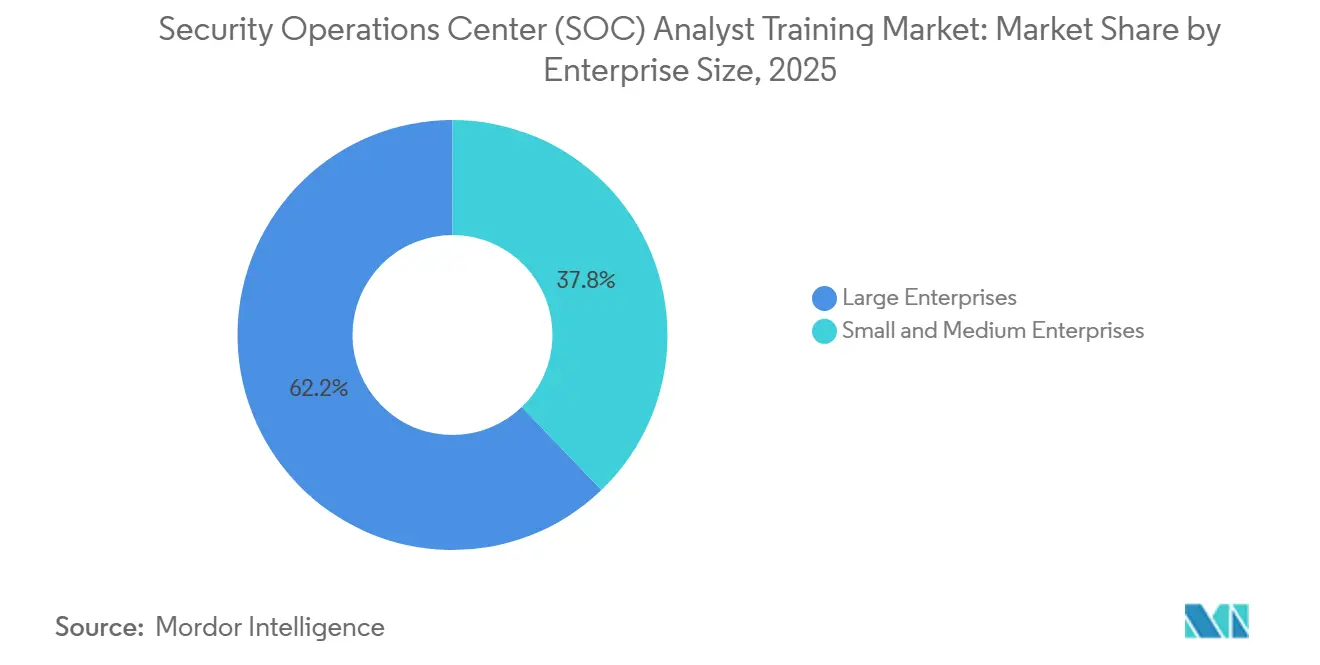
Large Enterprises Supply Volume While SMEs Expand FasterLarge Enterprises accounted for 62.18% of the Security Operations Center (SOC) analyst training market in 2025, making them the largest buyer group. Their lead reflects formal security budgets, dedicated learning teams, and the operational complexity of managing multi-tier SOC structures across larger workforces. These buyers are also more likely to purchase premium blended programs, custom curricula, and subscription-based cyber range platforms that generate audit-ready performance evidence. Large organizations, therefore, continue to anchor current revenue across certification, instructor-led, and measurement-heavy training models.
Small and Medium Enterprises are projected to grow at a 21.74% CAGR through 2031, which makes them the most attractive expansion opportunity in the Security Operations Center (SOC) analyst training market. ESET found that 87% of SMBs consider cybersecurity training critical, and 41% ranked planned investment in employee training and awareness first among priority areas. Public and partner-led programs are reinforcing this demand, including Singapore's IMDA initiative to uplift 12,000 SMEs and the SECURE project allocation of EUR 22 million (USD 24.9 million) from January 2025 for SME cyber resilience support. SoSafe's June 2025 MSP platform launch shows how vendors are adjusting distribution models so smaller buyers can access scalable training through managed service partners.
By End User:
Critical Infrastructure And Data Exposure Shape DemandIT and Telecommunication held a 24.86% share in 2025, making it the largest end-user segment in the Security Operations Center (SOC) analyst training market. The segment's lead reflects its role as the infrastructure backbone for other sectors and its higher concentration of in-house SOC teams with continuous-readiness needs. BFSI remained the second-largest vertical because DORA requires role-appropriate ICT security and resilience training, including hands-on preparation for staff with privileged access. Healthcare and Life Sciences are projected to grow at a 21.39% CAGR through 2031, as ransomware incidents and the need to handle sensitive data heighten the need for trained response teams.
Meharry Medical College noted a global cybersecurity workforce gap of 4.8 million professionals in 2026, underscoring the staffing pressure driving healthcare-specific training demand. Government and Administration also remain structurally important because federal and defense environments continue to rely on role-specific cybersecurity training paths. Retail and E-Commerce, Industrial Manufacturing, and Energy and Utilities keep mid-tier demand because compliance and operational risk require scenario-based training that covers sector-specific attack patterns. Media and Entertainment, Education, and Research Institutions are smaller today, but demand is rising as data-rich, resource-constrained environments become more frequent ransomware targets.
Geography Analysis
North America Security Operations Center (SOC) Analyst Training Market
North America held 34.62% of the Security Operations Center (SOC) analyst training market share in 2025, maintaining its position as the largest regional market. The United States remained the core demand center because large enterprises and public institutions maintain more formal SOC role definitions and recurring training cycles. The 2026 SANS SOC Survey, based on 444 active SOC practitioners and 69 CISOs, found a 27-point gap between management and practitioner views on retention needs. That gap matters because vendors that can show measurable readiness gains are better placed to win budget approval in the region.
APAC Security Operations Center (SOC) Analyst Training Market
Asia-Pacific is projected to grow at a 23.48% CAGR through 2031, making it the fastest-growing region in the Security Operations Center (SOC) analyst training market. Growth in the region is being shaped by different national demand drivers rather than by a single regional pattern. India is seeing stronger demand as digital payments and fintech activity widen the need for structured analyst readiness. Japan and South Korea are also adding demand through closer alignment between cybersecurity practice and advanced industrial operations. Singapore's IMDA partnered with Grab and RSM Stone Forest IT in May 2026 to uplift 12,000 SMEs in AI and cybersecurity, demonstrating public support for broader capability-building.
EMEA and South America Security Operations Center (SOC) Analyst Training Market
Europe remains a deep and structurally important region in the Security Operations Center (SOC) analyst training market, as NIS2 and DORA have made training an auditable compliance obligation. For essential entities, NIS2 penalties can reach EUR 10 million (USD 11.3 million) or 2% of annual turnover, which raises the board-level importance of training evidence. ENISA's June 2025 guidance requires scheduled, role-specific training with effectiveness records, which supports sustained demand in Germany, the United Kingdom, and France. South America, the Middle East, and Africa are earlier-stage opportunity zones, with Brazil leading current South American demand and Saudi Arabia and the UAE strengthening regional momentum through broader digital security and skills initiatives.

Competitive Landscape
The Security Operations Center (SOC) analyst training market remains moderately fragmented, with certification leaders and platform providers competing on different strengths. SANS Institute, EC-Council, and Offensive Security maintained strong brand recognition for technical credentials, as 64% of organizations still view certifications as the top hiring signal. KnowBe4 pushed the platform side of competition in May 2026 with AI-native training tiers and a Deepfake Training Content Agent. EC-Council also updated its Certified SOC Analyst path to include AI-powered log analysis, SIEM-SOAR workflows, and threat-hunter tracks.
Immersive Labs strengthened the premium simulation tier in 2026 by adding live cyber simulations for CrowdStrike Falcon and by extending support across major security stacks. The company also upgraded Elastic infrastructure to enterprise licensing across all labs and Dynamic Threat Range exercises. These moves matter because buyers want lab fidelity that more closely matches the tools they use every day. SoSafe targeted a different gap in June 2025 with an MSP platform that helps partners deliver training and phishing simulations to SMEs at scale. Direct competition is therefore strongest among vendors that can combine role-based content, measurable outcomes, and flexible delivery economics.
White-space remains strongest in healthcare scenarios, OT-heavy industrial environments, and cloud-native SOC workflows, where generic content has less depth. Providers that align their outcomes with MITRE ATT&CK, NIST CSF, or ISO 27001 can make the program's value easier to defend in audits and budget reviews. The Security Operations Center (SOC) analyst training market also shows a clear divide between direct SOC training specialists and adjacent awareness or application security training firms, which keeps replacement pressure focused on cyber ranges and blue-team platforms. That structure supports steady competition because no single vendor leads every format, buyer class, and sector.
Security Operations Center (SOC) Analyst Training Industry Leaders
SANS Institute
KnowBe4, Inc.
Proofpoint, Inc.
Infosec Institute
EC-Council
- *Disclaimer: Major Players sorted in no particular order
Security Operations Center (SOC) Analyst Training Market Companies Covered in this Report
- SANS Institute
- EC-Council
- Infosec Institute
- Offensive Security, LLC
- Cybrary, Inc.
- Immersive Labs Limited
- KnowBe4, Inc.
- Proofpoint, Inc.
- Cofense, Inc.
- SoSafe GmbH
- Terranova Security Inc.
- Mimecast Limited
- Hoxhunt Oy
- NINJIO, Inc.
- Security Journey, Inc.
- Security Innovation, Inc.
- Inspired eLearning, LLC
- Global Learning Systems, LLC
- Barracuda Networks, Inc.
- Pluralsight, LLC

Recent Industry Developments in Security Operations Center (SOC) Analyst Training Market
- June 2026: Hoxhunt launched Content Studio, an AI-powered solution enabling organizations to generate, edit, and deploy customized security awareness training content tailored to their specific workforce risk profiles. The release represents a structural shift from static library-based training delivery toward organization-specific behavioral change programs, directly intensifying competition with enterprise platforms that have historically owned the custom-content segment of the SOC training market.
- June 2026: SoSafe launched an interactive vishing simulation module equipping organizations to train employees against AI-generated voice impersonation attacks, extending the platform from phishing-only simulation to multi-channel social engineering defense training across voice, SMS, and email vectors.
- May 2026: KnowBe4 launched its restructured AI-native Security Awareness Training portfolio, comprising SAT Foundation and SAT Advanced tiers, alongside a 12th AI agent under its AIDA framework, including a Deepfake Training Content Agent that generates simulations featuring an organization's own leadership personas. Trusted by more than 70,000 organizations worldwide, the tiered product architecture formally acknowledges the split between organizations with mature security culture programs and those building baseline risk posture.
- May 2026: SoSafe updated its platform to support multiple simultaneous personalized learning campaigns using unique access codes, improving accessibility for deskless and field-based employees without corporate email addresses and reducing manual administrative overhead for global program management.


Global Security Operations Center (SOC) Analyst Training Market Report Scope
The Security Operations Center (SOC) analyst training market comprises educational programs, courses, and practical laboratories that equip cybersecurity professionals with the skills to monitor, detect, investigate, and respond to cyber threats in a SOC environment. This market encompasses various delivery formats, including self-paced online learning, instructor-led virtual training, classroom learning, and blended approaches. The offerings range from formal certification programs and customized corporate training modules to intensive bootcamps, executive awareness briefings, and highly immersive cyber-range simulations that replicate real-world attack scenarios using tools such as SIEM, EDR, and SOAR. Catering to organizations of all sizes across industries such as BFSI, IT, healthcare, and government, these training services are critical for bridging the widening cybersecurity talent gap, ensuring compliance with regulatory standards, and enhancing an organization's overall security posture by keeping SOC teams adept at handling evolving threat landscapes and advanced persistent threats.
The Security Operations Center (SOC) Analyst Training Market Report is Segmented by Training Format (Self-Paced Online Learning, Instructor-Led Virtual Learning, Classroom Learning, and Blended Learning), Offering (Certification Programs, Customized Corporate Training, Workshops and Bootcamps, Awareness Seminars and Executive Briefings, and Cyber Range and Hands-on Lab Programs), Enterprise Size (Large Enterprises, and Small and Medium Enterprises), End-User Industry (IT and Telecommunication, BFSI, Healthcare and Life Sciences, Retail and E-Commerce, Industrial Manufacturing, Education and Research Institutions, Media and Entertainment, Government and Administration, Energy and Utilities, and Other End-User Industries), and Geography (North America, South America, Europe, Asia-Pacific, and Middle East and Africa). The Market Forecasts are Provided in Terms of Value (USD).
| Self-Paced Online Learning |
| Instructor-Led Virtual Learning |
| Classroom Learning |
| Blended Learning |
| Certification Programs |
| Customized Corporate Training |
| Workshops and Bootcamps |
| Awareness Seminars and Executive Briefings |
| Cyber Range and Hands-on Lab Programs |
| Large Enterprises |
| Small and Medium Enterprises |
| IT and Telecommunication |
| BFSI |
| Healthcare and Life Sciences |
| Retail and E-Commerce |
| Industrial Manufacturing |
| Education and Research Institutions |
| Media and Entertainment |
| Government and Administration |
| Energy and Utilities |
| Other End-user Industries |
| North America | United States | |
| Canada | ||
| Mexico | ||
| South America | Brazil | |
| Argentina | ||
| Rest of South America | ||
| Europe | Germany | |
| United Kingdom | ||
| France | ||
| Russia | ||
| Spain | ||
| Rest of Europe | ||
| Asia-Pacific | China | |
| Japan | ||
| India | ||
| South Korea | ||
| Southeast Asia | ||
| Rest of Asia-Pacific | ||
| Middle East and Africa | Middle East | Saudi Arabia |
| United Arab Emirates | ||
| Rest of Middle East | ||
| Africa | South Africa | |
| Nigeria | ||
| Rest of Africa | ||
| By Training Format | Self-Paced Online Learning | ||
| Instructor-Led Virtual Learning | |||
| Classroom Learning | |||
| Blended Learning | |||
| By Offering | Certification Programs | ||
| Customized Corporate Training | |||
| Workshops and Bootcamps | |||
| Awareness Seminars and Executive Briefings | |||
| Cyber Range and Hands-on Lab Programs | |||
| By Enterprise Size | Large Enterprises | ||
| Small and Medium Enterprises | |||
| By End-user Industry | IT and Telecommunication | ||
| BFSI | |||
| Healthcare and Life Sciences | |||
| Retail and E-Commerce | |||
| Industrial Manufacturing | |||
| Education and Research Institutions | |||
| Media and Entertainment | |||
| Government and Administration | |||
| Energy and Utilities | |||
| Other End-user Industries | |||
| By Geography | North America | United States | |
| Canada | |||
| Mexico | |||
| South America | Brazil | ||
| Argentina | |||
| Rest of South America | |||
| Europe | Germany | ||
| United Kingdom | |||
| France | |||
| Russia | |||
| Spain | |||
| Rest of Europe | |||
| Asia-Pacific | China | ||
| Japan | |||
| India | |||
| South Korea | |||
| Southeast Asia | |||
| Rest of Asia-Pacific | |||
| Middle East and Africa | Middle East | Saudi Arabia | |
| United Arab Emirates | |||
| Rest of Middle East | |||
| Africa | South Africa | ||
| Nigeria | |||
| Rest of Africa | |||


Key Questions Answered in the Report
What is the current size and forecast of the Security Operations Center (SOC) analyst training market?
The Security Operations Center (SOC) analyst training market size was USD 2.87 billion in 2025, is USD 3.37 billion in 2026, and is forecast to reach USD 8.08 billion by 2031 at a 19.11% CAGR.
Which training format leads current demand for SOC analyst training?
Instructor-Led Virtual Learning held the largest share at 31.42% in 2025 because buyers still value live instruction, documentation, and real-time feedback.
Which offering is growing fastest in SOC analyst training programs?
Cyber Range and Hands-on Lab Programs are projected to grow fastest at a 24.16% CAGR through 2031, showing stronger demand for applied practice and tool-based training.
Why are compliance rules increasing demand for SOC analyst training?
NIS2 and DORA now require role-specific and auditable training in many cases, which pushes organizations toward structured programs with documented outcomes.
Which buyer group offers the strongest expansion opportunity?
Small and Medium Enterprises are projected to grow at a 21.74% CAGR through 2031, supported by rising awareness, public programs, and MSP-led delivery models.
Which region is expanding fastest for SOC analyst training?
Asia-Pacific is projected to grow at a 23.48% CAGR through 2031, while North America remained the largest regional segment with 34.62% share in 2025.
Page last updated on:


 Your data is secure and never sold or shared.


