
Secrets Vault Software Market Size and Share
Market Overview
| Study Period | 2021 - 2032 |
|---|---|
| Market Size (2027) | USD 2.99 Billion |
| Market Size (2032) | USD 6.78 Billion |
| Growth Rate (2027 - 2032) | 17.79 % |
| Fastest Growing Market | Asia-Pacific |
| Largest Market | North America |
| Market Concentration | Medium |
Major Players *Disclaimer: Major Players sorted in no particular order Image © Mordor Intelligence. Reuse requires attribution under CC BY 4.0. | |
Secrets Vault Software Market Analysis by Mordor Intelligence
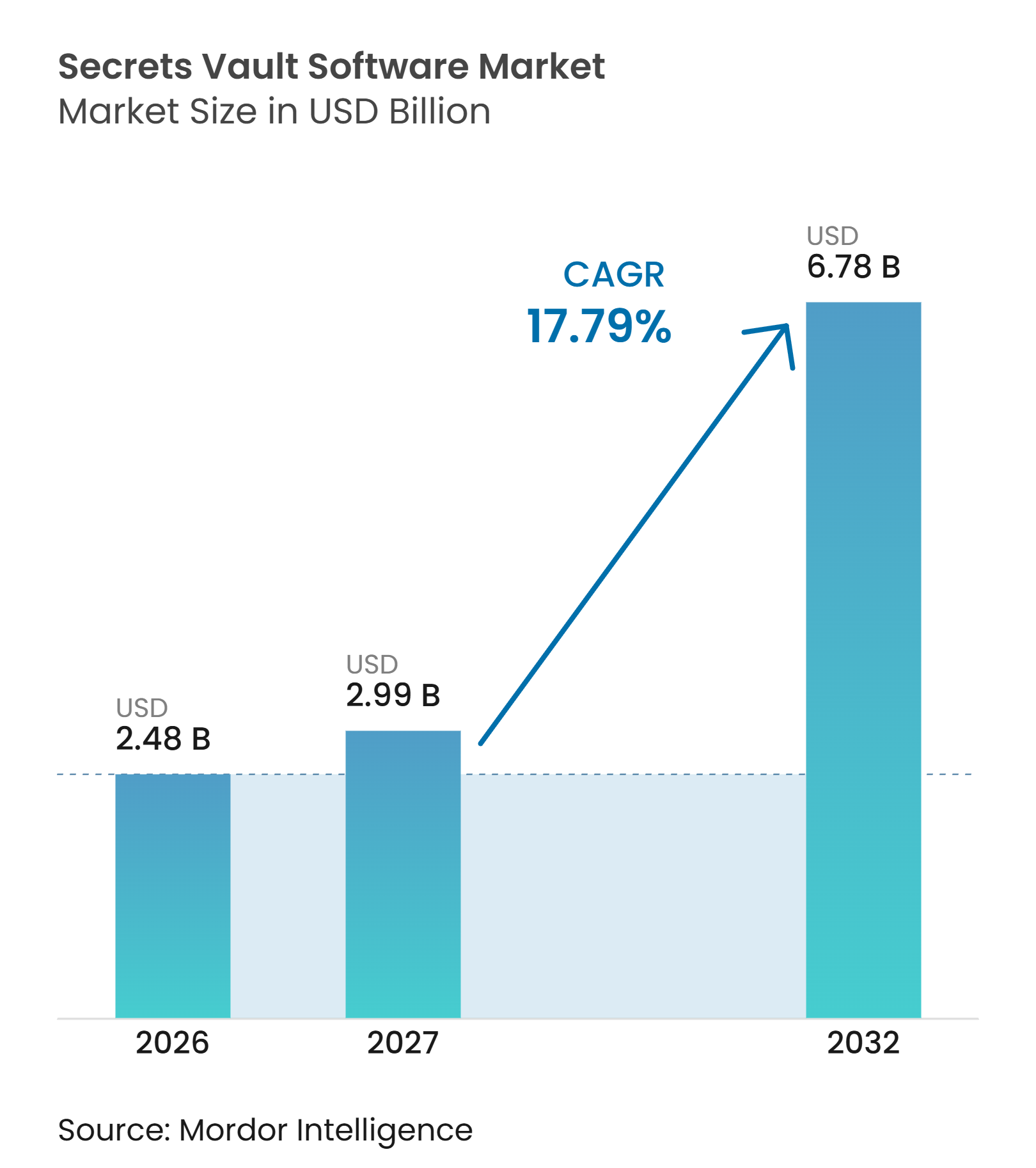
The secrets vault software market size is projected to expand from USD 2.48 billion in 2026 to USD 6.78 billion by 2032, registering a CAGR of 17.79% between 2027 to 2032. Machine identity volumes, auditable credential controls, and cloud-native application architectures are expanding the need for secrets governance. AI agents also require credentials across several systems while completing autonomous tasks, which raises the need for short-lived and tightly scoped access. The market is moving beyond standalone vaults toward platforms that combine discovery, rotation, orchestration, and nonhuman identity lifecycle controls. Recent acquisitions by IBM and Palo Alto Networks place two widely deployed standalone platforms within broader security portfolios, while also giving buyers a reason to consider independent cloud-native providers. Rising hardcoded-secret exposure and the operational cost of frequent credential retrieval make implementation quality, automation, and runtime reliability central to purchasing decisions.
Key Report Takeaways
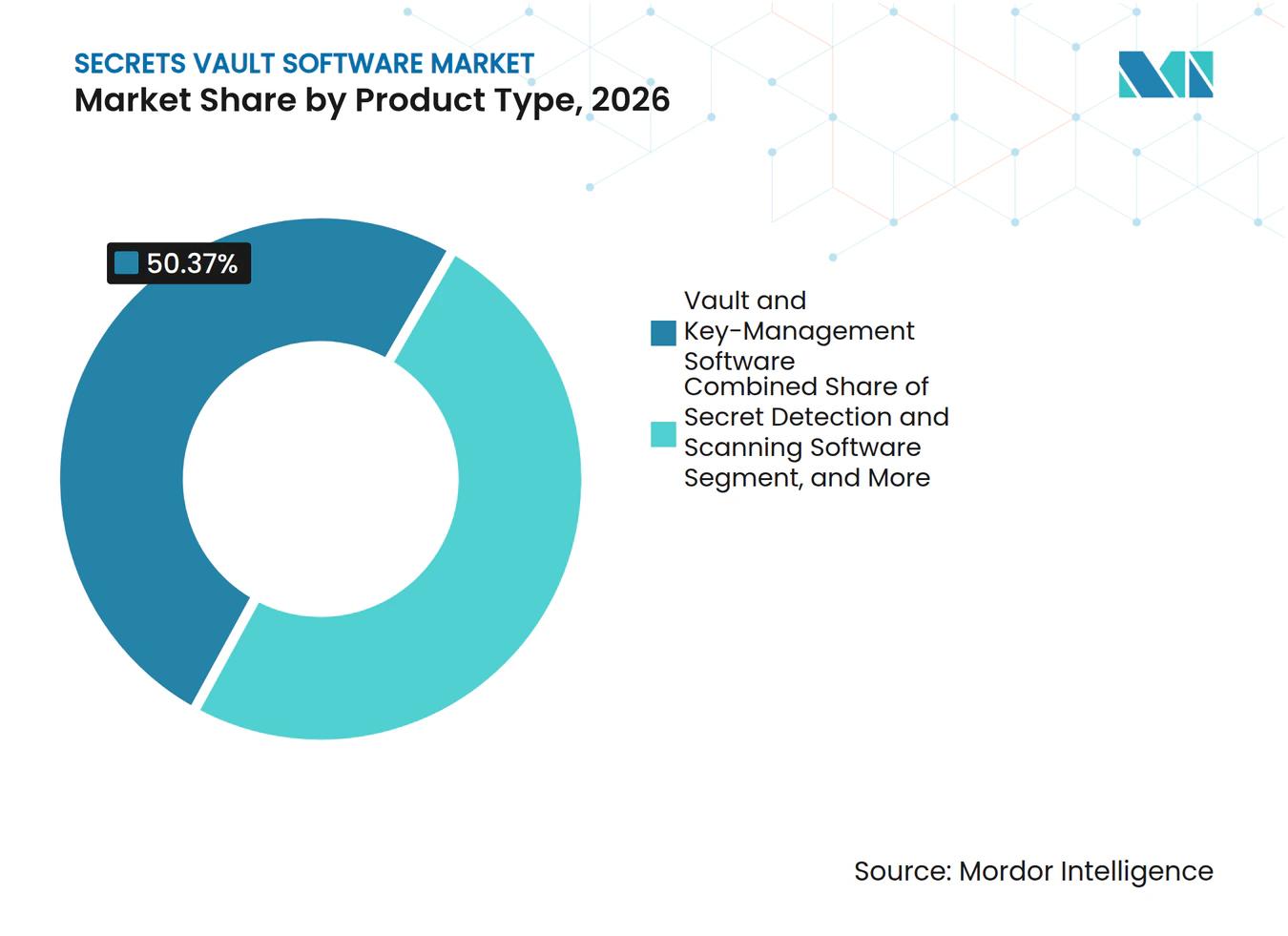
- By product type, Vault and Key-Management Software held 50.37% of the secrets vault software market share in 2026, while Machine Identity and Certificate-Linked Secrets Software is projected to expand at an 18.04% CAGR through 2032.
- By deployment model, cloud-based deployment accounted for 46.68% of the secrets vault software market share in 2026 and is projected to expand at an 18.58% CAGR through 2032.
- By organization size, large enterprises held 68.36% of revenue in 2026, while small and medium enterprises are projected to expand at an 18.36% CAGR through 2032.
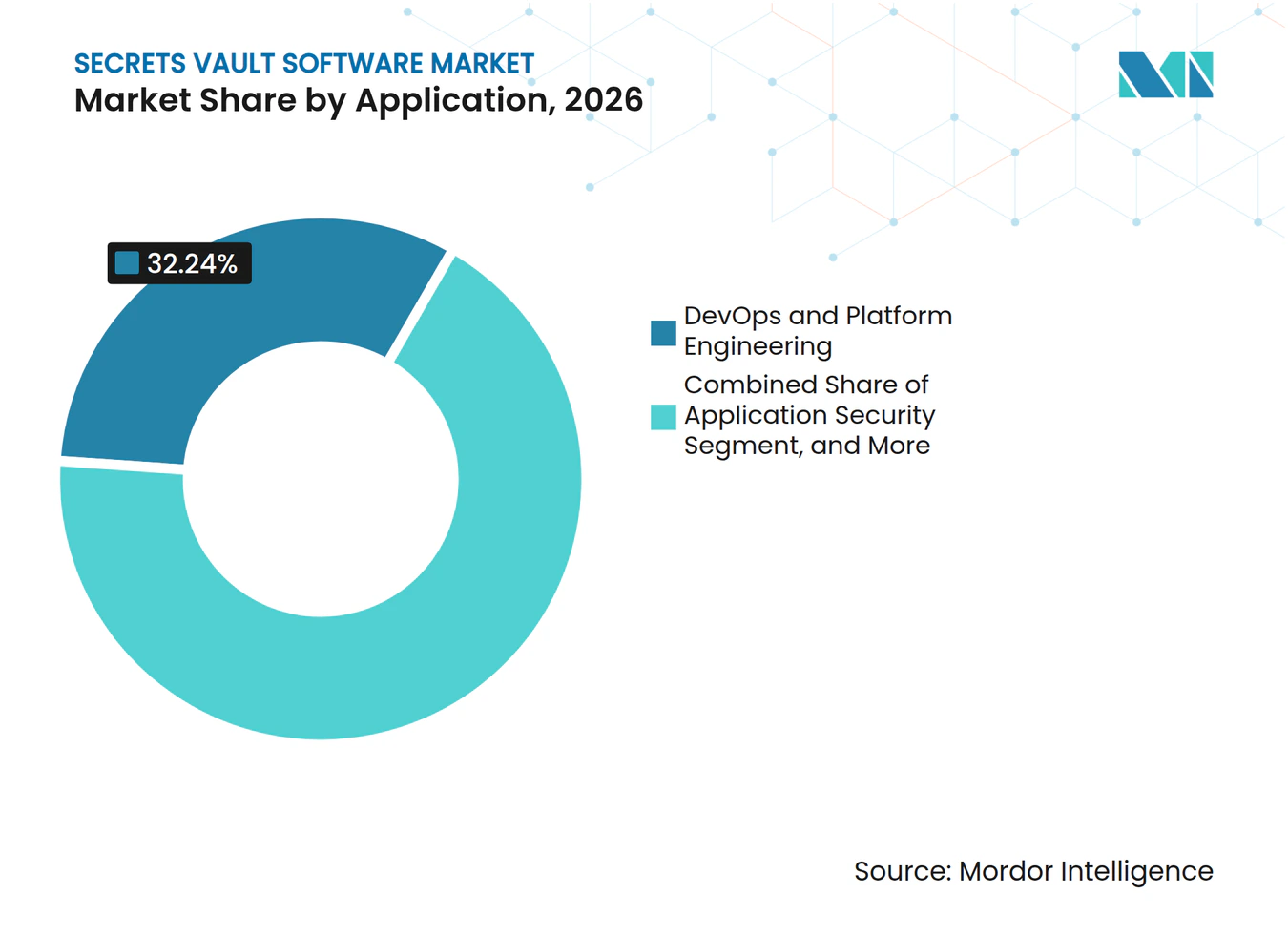
- By application, DevOps and Platform Engineering accounted for 32.24% of secrets vault software market revenue for 32.24% of revenue in 2026, while AI Agent and Autonomous Workload Secret Access is projected to expand at an 18.28% CAGR through 2032.
- By end-user industry, BFSI accounted for 23.42% of demand in 2026, while IT and Telecommunications is projected to expand at an 18.74% CAGR through 2032.
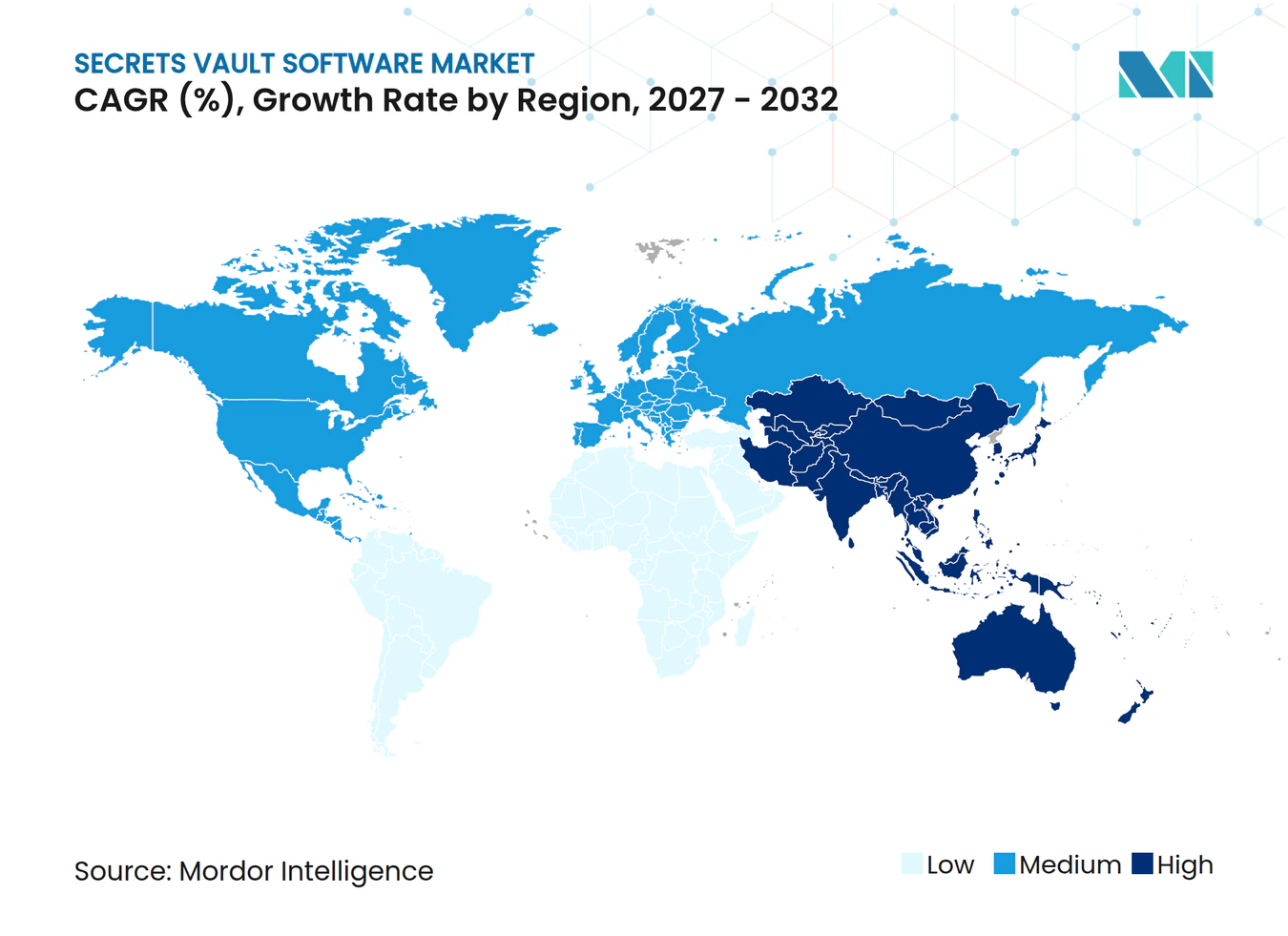
- By geography, North America held 43.88% of revenue in 2026, while Asia-Pacific is projected to expand at an 18.46% CAGR through 2032.
Note: Market numbers in this report are based on Mordor Intelligence's proprietary estimation framework, which combines nine months of actuals with Q4 projections for base year 2026.
Market Trends and Insights
Drivers Impact Analysis of Secrets Vault Software Market*
| Driver | (~) % Impact on CAGR Forecast | Geographic Relevance | Impact Timeline |
|---|---|---|---|
| Cloud-Native Application and DevOps Adoption | +5.2% | Global, concentrated in North America and Asia-Pacific core | Short term (≤ 2 years) |
| Rising Nonhuman Identity and Machine Credential Volumes | +4.6% | Global, with early gains in hyperscaler-heavy North America and Western Europe | Short term (≤ 2 years) |
| Mandatory Credential Rotation and Auditability | +3.4% | North America and Europe, with spillover to Asia-Pacific | Medium term (2-4 years) |
| Expansion of Hybrid and Multicloud Workloads | +2.8% | Global, with early gains in North America and Northern Europe | Medium term (2-4 years) |
| AI Agent and Autonomous Workload Secret Access | +3.0% | Global, concentrated in North America and East Asia AI infrastructure hubs | Long term (≥ 4 years) |
| Vault Consolidation to Reduce Secret Sprawl | +2.1% | Global | Medium term (2-4 years) |
| Source: Mordor Intelligence | |||
Cloud-Native Application and DevOps Adoption
Cloud-native application design in the secrets vault software market has turned secrets from static configuration data into operating assets that must be issued, rotated, and revoked at machine speed. Each CI/CD pipeline step, container runtime, and service request can create a credential event that manual processes cannot manage at enterprise scale. More than 85% of cloud-native enterprises used a dedicated secrets management tool in 2025, either within a cloud-provider suite or through a third-party platform. This use pattern makes secrets controls part of the development workflow rather than an isolated security function. Engineering teams often select tools independently, which can create disconnected vault estates before a central governance team is involved. The secrets vault software market therefore benefits both from new cloud adoption and later consolidation projects that standardize controls across existing tools.
Rising Nonhuman Identity and Machine Credential Volumes
Nonhuman identities in the secrets vault software market are growing faster than traditional identity processes can manage. The machine-to-human identity ratio has risen significantly, while early adopters of agentic AI have reported substantial annual growth in nonhuman identities. Entro Security reported a notable year-over-year increase in nonhuman identity sprawl, with active secrets remaining unrotated for extended periods. PKI certificate lifecycle management is increasingly integrating with secrets management because AI agents can accumulate multiple credentials for a single task. Automated discovery and just-in-time provisioning are becoming essential as organizations create and retire identities at scale. This trend is expanding the role of the secrets vault software market from secret storage to broader machine-access governance.
Mandatory Credential Rotation and Auditability
Compliance obligations in the secrets vault software market make credential rotation and recorded access events procurement requirements for many regulated buyers. PCI DSS v4.0.1 requires risk-based management of application and system account credentials and audit logging for credential access.[1] SOX, GDPR Article 32, and DORA also require controls that support accountability for sensitive access. An ISACA case study published in 2026 described a multinational organization where credentials held in local files and lacking clear rotation ownership became a board-level governance issue.[2] ISO/IEC 27001:2022 and NIS2 add further pressure on European organizations to evidence their access-control practices. These requirements favor vault platforms that combine rotation workflows with immutable and searchable audit records.
Expansion of Hybrid and Multicloud Workloads
Hybrid and multicloud environments in the secrets vault software market make it difficult for a single centrally located vault to serve every application and jurisdiction. Organizations using AWS, Azure, Google Cloud, and on-premises infrastructure can have separate stores, inconsistent rotation policies, and disconnected logs. The Cloud Security Alliance found in 2026 that only 20% of organizations maintained formal API key offboarding processes.[3] This leaves an important lifecycle gap when credentials remain active after a workload, employee, or project has ended. Vendors are responding with federation and synchronization features that keep policy-consistent copies across providers without forcing a full migration. The secrets vault software market gains from this complexity, although managing many vaults across regions can also make deployment more difficult.
Restraints Impact Analysis of Secrets Vault Software Market*
| Restraint | (~) % Impact on CAGR Forecast | Geographic Relevance | Impact Timeline |
|---|---|---|---|
| Deployment and Migration Complexity | -2.6% | Global, most pronounced in enterprises with legacy PAM or inherited vault environments | Medium term (2-4 years) |
| Total Cost of Ownership for High-Volume Secret Operations | -1.3% | Global, with acute impact in Asia-Pacific SMEs and South America enterprises | Medium term (2-4 years) |
| Runtime Availability Dependence on Secret Stores | -0.7% | Global | Short term (≤ 2 years) |
| Fragmented Ownership of Machine Identities Across Teams | -0.4% | Global, concentrated in large enterprises with distributed DevOps | Long term (≥ 4 years) |
| Source: Mordor Intelligence | |||
Deployment and Migration Complexity
Moving secrets from environment variables, configuration files, hardcoded pipeline values, and local stores into a central vault requires discovery, ownership assignment, and rotation planning. Credentials may be spread across Jenkins, Kubernetes clusters, CI/CD pipelines, and developer devices, with no complete inventory at the outset. Organizations that acquired multiple businesses or allowed separate team-level deployments may also need to align rotation schedules, access models, and audit formats. These activities can delay a full rollout by 12-18 months. Regulated organizations must avoid interrupting applications while moving credentials, which can require a staged implementation. This restraint makes implementation services, discovery tools, and compatibility with inherited systems important purchase factors.
Total Cost of Ownership for High-Volume Secret Operations
At scale, the secrets vault software market involves costs beyond subscription fees, including API requests, stored versions, and rotation events. Microservice environments can generate substantial credential-request volumes as containers retrieve secrets at startup. Cloud pricing models can increase spending when transaction volumes are high. A Thales case study reported a significant reduction in total secrets management costs after a customer migrated from a previous provider to a SaaS vault model. For small and medium enterprises, managing highly available clusters and audit pipelines can divert resources from product development. SaaS delivery can reduce this burden, but buyers still require pricing models that remain manageable as usage expands.
*Our forecasts treat driver/restraint impacts as directional, not additive. The impact forecasts reflect baseline growth, mix effects, and variable interactions.
Secrets Vault Software Market Segment Analysis
By Product Type:
Established Key Management Supports New Machine Identity NeedsVault and Key-Management Software held 50.37% of the share of the secrets vault software market in 2026. Its position reflects the central role of key management in enterprise security architectures that existed before widespread DevOps adoption. Banks, utilities, and insurers adopted centralized key controls before containerized workloads became common. These installed bases can add cloud and nonhuman identity functions through feature extensions rather than replace their foundational platform. This supports continued demand for established vault and key-management products. Machine Identity and Certificate-Linked Secrets Software is projected to expand at an 18.04% CAGR through 2032. Its adoption is supported by PKI lifecycle management, workload identity standards such as SPIFFE/SPIRE, and the credential requirements of autonomous AI systems.
Within the secrets vault software market, Secret Detection and Scanning Software identifies exposed credentials that need to be remediated during consolidation programs. This creates a practical connection between scanning products and vault implementations. Secrets Orchestration and Synchronization Software supports policy-consistent distribution across multiple cloud stores without requiring a company to retire every existing tool. Delinea integrated Google Cloud Secret Manager into its external secrets governance framework during Q3 2026. Akeyless also offers external secrets management functions for multivault environments. recommends dedicated secrets managers and scoped tokens for AI-agent credentials. These developments place machine-identity controls closer to core enterprise security procurement.



By Deployment Model:
Cloud Services Lead While Hybrid Designs Address Control NeedsCloud-based deployment accounted for 46.68% of the share of the secrets vault software market in 2026. It is also projected to expand at an 18.58% CAGR through 2032. Managed vault services integrate naturally with cloud workloads and remove the operational task of maintaining a cluster. AWS introduced managed external secrets capabilities in November 2025 to extend zero-code rotation to third-party SaaS credentials. Managed options can make dedicated secrets controls practical for mid-market organizations that lack specialist platform teams. This widens the base of organizations adopting purpose-built secrets tools.
Hybrid deployment remains important in enterprise buying cycles because some cryptographic material must stay within defined geographic or physical locations. These requirements can lead to designs that use cloud-based policy management with on-premises key storage. HashiCorp expanded HCP Vault Dedicated into additional AWS and Azure regions in 2025 and added paired disaster-recovery configurations. The release responds to requirements around availability, data residency, and recovery. On-premises deployment remains relevant in air-gapped environments, including parts of defense and healthcare. The secrets vault software market therefore retains a role for several deployment patterns rather than moving solely to public cloud delivery.
By Organization Size:
Large Enterprises Provide Scale While SMEs Adopt Managed ToolsLarge enterprises held 68.36% of secrets vault software market revenue in 2026. Their share is supported by regulatory obligations and wide deployment scopes across financial services, healthcare, and government. These organizations frequently operate several vaults after years of acquisitions, technology changes, and team-led implementations. Uber described consolidating 25 separately managed vault instances across multiple clouds into 6 managed by one team. The program reduced blast-radius risk and supported more consistent policy enforcement. Such work makes large enterprises a central source of demand for discovery, federation, and governance layers.
Small and medium enterprises are projected to expand at an 18.36% CAGR through 2032. SaaS vault models reduce the infrastructure burden that previously made purpose-built secrets management difficult for smaller teams. Open-source products with managed cloud tiers can also offer developer-focused adoption paths. Infisical raised USD 16 million in Series A financing in June 2025, with backing from Elad Gil, Y Combinator, and Gradient Ventures. The company targets a unified stack for secrets, PKI, and SSH key management. These offerings give smaller organizations access to controls that would otherwise require specialized security engineering resources.
By Application:
DevOps Leads Current Use While AI Agents Drive New DemandDevOps and Platform Engineering accounted for 32.24% of the secrets vault software market revenue for 32.24% of application revenue in 2026. Pipeline-embedded injection has become a standard practice for delivering credentials to applications without hardcoding them into source code. GitGuardian reported that 59% of compromised machines in its analyzed incident data were CI/CD runners rather than developer workstations. This directs attention to credential hygiene within automated software delivery environments. Continuous Integration and Continuous Deployment remain a high-volume use case across organizations of different sizes. Application Security, Infrastructure, and Cloud Security are also incorporating secrets governance into broader DevSecOps workflows.
AI Agent and Autonomous Workload Secret Access is projected to expand at an 18.28% CAGR through 2032. An agent carrying out a multistep task needs short-lived credentials tied to specific tool calls rather than reusable static secrets. Akeyless launched Runtime Authority for AI Agents in April 2026 with intent-aware authorization controls. Infisical launched Agent Proxy in July 2026 to prevent agents from receiving plaintext secrets. Compliance and Audit Management is also becoming more important where frameworks require evidence across the credential lifecycle. Privileged and Nonhuman Access Management brings traditional privileged access management closer to emerging nonhuman identity governance.

By End-User Industry:
Financial Services Anchors Demand While IT and Telecommunications AdvancesBFSI accounted for 23.42% of the secrets vault software market end-user demand in 2026. Payment security, financial reporting obligations, and operational resilience requirements make credential lifecycle controls necessary for many institutions. PCI DSS, SOX, GLBA, FINMA, and DORA each affect how institutions protect sensitive systems or document access. HashiCorp has described banking use cases where dynamic secrets and centralized governance support zero-trust practices. Financial institutions need credible controls for service accounts, payment systems, and API access. This sustains their role as a core customer group in the secrets vault software industry.
IT and Telecommunications is projected to expand at an 18.74% CAGR through 2032. Carrier networks, cloud-native 5G workloads, network functions, and exposed service meshes create many machine credential surfaces. Healthcare and Life Sciences need controls for electronic health record access and medical-device authentication. Government and Public Sector demand is tied to sovereign key management and zero-trust programs aligned with NIST SP 800-53. Retail and e-commerce face payment-card requirements similar to financial services. Manufacturing and Industrial customers need credentials for robotic controllers and IoT sensors as Industry 4.0 projects expand.
Geography Analysis
North America held 43.88% of the market revenue in 2026. Cloud-native technology companies, early DevOps adoption, and overlapping requirements under FedRAMP, NIST SP 800-53, HIPAA, and PCI DSS support regional demand. The United States represents most North American revenue, with financial services, healthcare, and federal contractors among the active buyer groups. Canada adds demand from digital banking, while Mexico contributes through technology-services activity. HashiCorp expanded HCP Vault Dedicated into additional AWS and Azure regions in 2025 with paired disaster-recovery configurations. This addressed availability and data-residency needs among regulated North American customers.
Asia-Pacific is projected to expand at an 18.46% CAGR through 2032, the strongest regional pace in the provided forecast. Cloud-first digital banking, public digital infrastructure, and stricter cybersecurity requirements support adoption across India, Singapore, South Korea, China, and Australia. India’s Digital Personal Data Protection Act and Singapore’s Cybersecurity Act add compliance considerations for financial institutions. China’s localization requirements support on-premises and private-cloud vault models that differ from the public-cloud approach common in North America. Adfinis launched Secretz Enterprise for Asia-Pacific in 2025 with requirements that include APRA CPS 234, IRAP, and New Zealand ISM. The release shows how national requirements can influence product design and regional go-to-market plans.
Europe is the second-largest regional market, where GDPR, NIS2, and DORA make unauthorized credential access a serious data-protection and operational-resilience matter. Germany’s manufacturing base supports demand for operational-technology credential controls, while the United Kingdom’s financial services sector supports API-security spending. South America remains an earlier-stage opportunity, with Brazil leading adoption in BFSI under the LGPD and Argentina adding demand through technology-services exports. Middle East and Africa adoption is at an earlier stage, although Saudi Arabia and the UAE are advancing sovereign digital infrastructure programs. These programs support demand for localized key management and hardware security module-integrated vaults. Thales, Fortanix, and Entrust have established positions in regulated deployments that require this type of control.
Competitive Landscape
Market Concentration
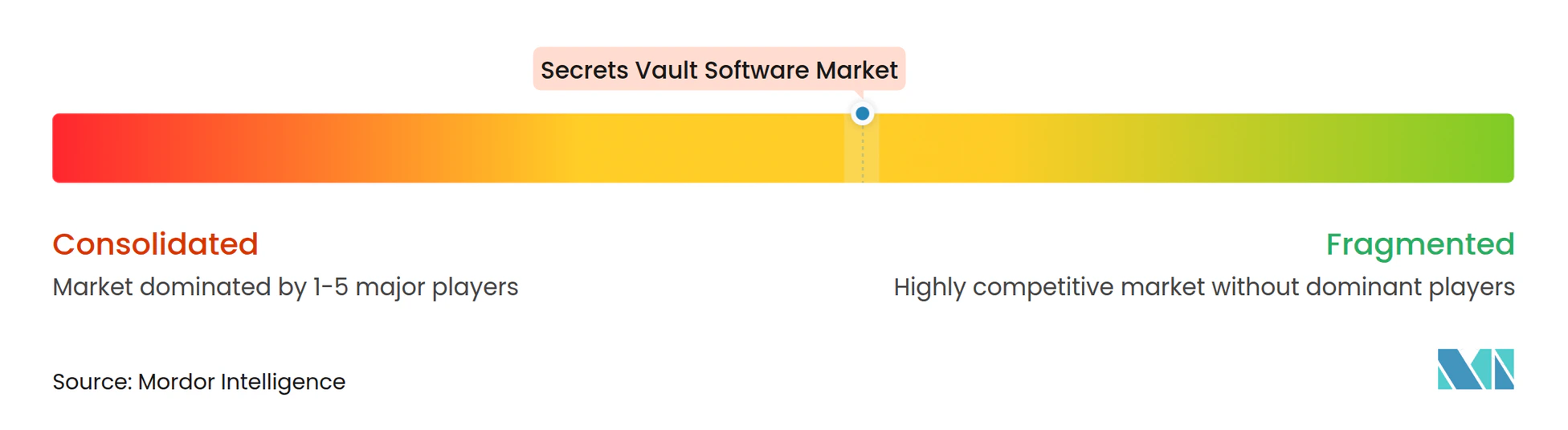
The secrets vault software market is moderately concentrated among enterprise platforms and more fragmented among developer-focused providers. IBM completed its USD 6.4 billion acquisition of HashiCorp, with the business transition effective September 1, 2025. Palo Alto Networks completed its acquisition of CyberArk for USD 25 billion in February 2026. The transactions bring widely deployed vault and privileged-access platforms into broader security ecosystems. They also make buyer concerns over platform dependency more relevant in competitive evaluations. Akeyless, Infisical, and GitGuardian are among the specialized providers seeking to benefit from this opening.
Product differentiation centers on AI-agent credential brokering, multivault governance, and cryptographic readiness. Akeyless launched Runtime Authority for AI Agents in April 2026, using intent-aware authorization for agent access requests. Infisical released Agent Proxy in July 2026, with a network-based approach that exchanges synthetic keys for real credentials at the access boundary. Delinea added Google Cloud Secret Manager support to its external secrets governance framework in Q3 2026. These moves show the importance of allowing enterprises to govern several stores without a disruptive migration. Hyperscalers compete through tight integration with their own cloud services, while independent vendors emphasize multicloud and hybrid support.
Fortanix expanded support for NIST-selected post-quantum cryptography algorithms in its Data Security Manager HSM in December 2025. This provides an early differentiator for customers beginning longer-term cryptographic migration planning. FIPS 140-2 Level 3 certification and SOC 2 Type II attestation remain important procurement filters for regulated buyers. BeyondTrust introduced Secrets Insights in December 2025 to provide cross-vault discovery, rotation hygiene scoring, and broad-access detection across AWS Secrets Manager, Azure Key Vault, GitHub secret scanning, and its own vaulted accounts. The product reflects the way privileged-access providers are incorporating secrets governance into their platforms. Provider strategies now need to address enterprise control requirements while keeping the developer workflow simple.
Secrets Vault Software Industry Leaders
-
HashiCorp, Inc.
-
Amazon Web Services, Inc.
-
Microsoft Corporation
-
Google LLC
-
IBM Corporation
- *Disclaimer: Major Players sorted in no particular order
Secrets Vault Software Market Companies Covered in this Report
- HashiCorp, Inc.
- Amazon Web Services, Inc.
- Microsoft Corporation
- Google LLC
- Delinea Inc.
- Akeyless Security Ltd.
- BeyondTrust Corporation
- Thales S.A.
- IBM Corporation
- Keeper Security, Inc.
- AgileBits Inc.
- Doppler Technologies, Inc.
- GitGuardian SAS
- Bitwarden Inc.
- Infisical, Inc.
- Fortanix, Inc.
- Entrust Corporation
- Saviynt, Inc.
- GitHub, Inc.
Global Secrets Vault Software Market Report Scope
The Secrets Vault Software Market comprises security solutions that centrally store, manage, rotate, and audit sensitive digital credentials such as API keys, passwords, encryption keys, certificates, and tokens used by applications, services, machines, and CI/CD pipelines.
The Secrets Vault Software Market Report is Segmented by Product Type (Vault, Key-Management, Detection, and Machine Identity), Deployment (Cloud-Based, Hybrid, and On-Premises), Organization Size (Large Enterprises, and SMEs), Application (CI/CD, DevOps, Security, Compliance, and Privileged Access), End-User (BFSI, IT, Healthcare, Government, Retail, and Manufacturing), and Geography (North America, South America, Europe, Asia-Pacific, and Middle East and Africa) The Market Forecasts are Provided in Terms of Value (USD).
Segmentation Overview
| Vault and Key-Management Software |
| Secret Detection and Scanning Software |
| Secrets Orchestration and Synchronization Software |
| Machine Identity and Certificate-Linked Secrets Software |
| Cloud-Based |
| Hybrid |
| On-Premises |
| Large Enterprises |
| Small and Medium Enterprises |
| Continuous Integration and Continuous Deployment |
| DevOps and Platform Engineering |
| Application Security |
| Infrastructure and Cloud Security |
| Compliance and Audit Management |
| Privileged and Nonhuman Access Management |
| Banking, Financial Services and Insurance |
| IT and Telecommunications |
| Healthcare and Life Sciences |
| Government and Public Sector |
| Retail and E-Commerce |
| Manufacturing and Industrial |
| Other End-User Industries |
| North America | United States |
| Canada | |
| Mexico | |
| South America | Brazil |
| Argentina | |
| Rest of South America | |
| Europe | Germany |
| United Kingdom | |
| France | |
| Italy | |
| Spain | |
| Rest of Europe | |
| Asia-Pacific | China |
| Japan | |
| India | |
| South Korea | |
| Rest of Asia-Pacific | |
| Middle East and Africa | Saudi Arabia |
| United Arab Emirates | |
| South Africa | |
| Egypt | |
| Rest of Middle East and Africa |
| By Product Type | Vault and Key-Management Software | |
| Secret Detection and Scanning Software | ||
| Secrets Orchestration and Synchronization Software | ||
| Machine Identity and Certificate-Linked Secrets Software | ||
| By Deployment Model | Cloud-Based | |
| Hybrid | ||
| On-Premises | ||
| By Organization Size | Large Enterprises | |
| Small and Medium Enterprises | ||
| By Application | Continuous Integration and Continuous Deployment | |
| DevOps and Platform Engineering | ||
| Application Security | ||
| Infrastructure and Cloud Security | ||
| Compliance and Audit Management | ||
| Privileged and Nonhuman Access Management | ||
| By End-User Industry | Banking, Financial Services and Insurance | |
| IT and Telecommunications | ||
| Healthcare and Life Sciences | ||
| Government and Public Sector | ||
| Retail and E-Commerce | ||
| Manufacturing and Industrial | ||
| Other End-User Industries | ||
| By Geography | North America | United States |
| Canada | ||
| Mexico | ||
| South America | Brazil | |
| Argentina | ||
| Rest of South America | ||
| Europe | Germany | |
| United Kingdom | ||
| France | ||
| Italy | ||
| Spain | ||
| Rest of Europe | ||
| Asia-Pacific | China | |
| Japan | ||
| India | ||
| South Korea | ||
| Rest of Asia-Pacific | ||
| Middle East and Africa | Saudi Arabia | |
| United Arab Emirates | ||
| South Africa | ||
| Egypt | ||
| Rest of Middle East and Africa | ||
Key Questions Answered in the Report
What is the size of the secrets vault software market?
The secrets vault software market is projected at USD 2.48 billion in 2026 and is forecast to reach USD 6.78 billion by 2032 at a 17.79% CAGR.
What is driving demand for secrets vault software?
Cloud-native workloads, nonhuman identities, credential audit requirements, hybrid environments, and AI-agent access needs are supporting adoption.
Which product category has the largest share of secrets vault software?
Vault and Key-Management Software holds 50.37% of the product type segment in 2026.
Which deployment model is expanding fastest for secrets vault software?
Cloud-based deployment is projected to expand at an 18.58% CAGR through 2032 and held 46.68% of revenue in 2026.
Which end-user sector is expanding fastest for secrets vault software?
IT and Telecommunications is projected to expand at an 18.74% CAGR through 2032, supported by cloud-native networks and machine credential volumes.
Which region has the strongest forecast for secrets vault software?
Asia-Pacific is projected to expand at an 18.46% CAGR through 2032, supported by digital banking, public digital infrastructure, and cybersecurity requirements.