
Seam Tapes Market Size and Share
Market Overview
| Study Period | 2021 - 2031 |
|---|---|
| Market Size (2026) | USD 207.20 Million |
| Market Size (2031) | USD 285.62 Million |
| Growth Rate (2026 - 2031) | 6.63 % |
| Fastest Growing Market | Asia-Pacific |
| Largest Market | Asia-Pacific |
| Market Concentration | Low |
Major Players *Disclaimer: Major Players sorted in no particular order Image © Mordor Intelligence. Reuse requires attribution under CC BY 4.0. | |
Seam Tapes Market Analysis by Mordor Intelligence
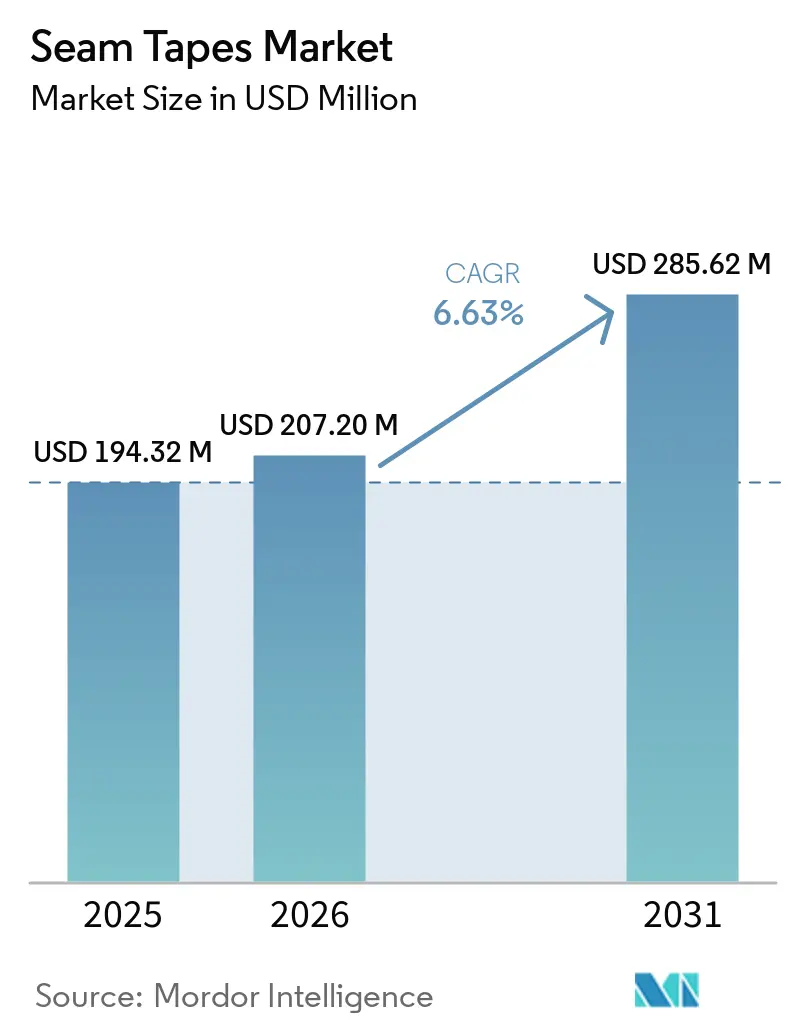
The Seam Tapes Market size was valued at USD 194.32 million in 2025 and is estimated to grow from USD 207.20 million in 2026 to reach USD 285.62 million by 2031, at a CAGR of 6.63% during the forecast period (2026-2031). The seam tapes market is moving toward bonded and sealed garment construction because technical apparel requires reliable protection that sewn seams cannot always provide. Demand is supported by waterproof outerwear, performance sportswear, footwear, intimate apparel, and protective garments. The shift to per- and polyfluoroalkyl substances (PFAS)-free fabric finishes is raising adhesive performance requirements and giving an advantage to suppliers that can qualify tapes on new fabric surfaces. Asia-Pacific combines manufacturing scale with growing domestic demand, while North America and Europe support higher-value demand from defense, medical, and premium outdoor uses. The seam tapes market also faces raw material cost pressure and longer qualification work for advanced fabrics, which favors suppliers with established formulation, testing, and technical service capabilities.
Key Report Takeaways
- By type, single-layered held 62.13% of the seam tapes market share in 2025, while multi-layered is projected to advance at a 6.98% CAGR through 2031.
- By material, polyurethane held 55.06% of the seam tapes market share in 2025, while thermoplastic polyurethane (TPU) is projected to advance at a 7.21% CAGR through 2031.
- By application, intimate apparel held 34.52% of the seam tapes market share in 2025 and is projected to advance at a 7.47% CAGR through 2031.
- By geography, Asia-Pacific held 42.78% of the seam tapes market share in 2025 and is projected to advance at a 7.63% CAGR through 2031.
Note: Market size and forecast figures in this report are generated using Mordor Intelligence’s proprietary estimation framework, updated with the latest available data and insights as of January 2026.
Market Trends and Insights
Drivers Impact Analysis of Seam Tapes Market*
| Driver | (~) % Impact on CAGR Forecast | Geographic Relevance | Impact Timeline |
|---|---|---|---|
| Demand for Waterproof and Weather-Resistant Apparel | +2.1% | Global, with peak intensity in Asia-Pacific and Europe | Long term (≥ 4 years) |
| Growth of Sportswear, Outdoor Gear, and Performance Footwear | +1.6% | Global; highest in North America, Europe, and Asia-Pacific | Medium term (2–4 years) |
| Expansion of Protective, Medical, and Defense Clothing | +1.2% | North America & EU core, spillover to Asia-Pacific and MEA | Medium term (2–4 years) |
| PFAS-Free and Lower-Impact Adhesive Innovation | +0.9% | EU-led, early adoption in North America and Asia-Pacific | Long term (≥ 4 years) |
| Automation of Hot-Air, Ultrasonic, and Robotic Seam Sealing | +0.6% | Asia-Pacific core, spill-over to Eastern Europe and MEA | Medium term (2–4 years) |
| Source: Mordor Intelligence | |||
Demand for Waterproof and Weather-Resistant Apparel
Waterproof outerwear is increasing the performance standards that seam tape suppliers must meet in the seam tapes market. Leading outdoor brands target hydrostatic head ratings from 20,000 mm to 40,000 mm H₂O in flagship garments, which requires barrier performance through repeated high-temperature industrial wash cycles and limits the use of simple sealing solutions. The move toward C0 Durable Water Repellent (DWR) coatings creates lower-surface-energy fabric surfaces that need redesigned adhesive chemistry and more detailed validation with each fabric construction. Polartec launched AirCore in September 2025 as a 100% per- and polyfluoroalkyl substances-free waterproof and windproof fabric using nanofiber membrane technology. Suppliers that can demonstrate durable adhesion on these materials can support premium garment programs where commodity tape converters face qualification limits, and brands must protect end-product performance. This requirement raises the value of documented testing, product consistency, close work with fabric mills and apparel brands, and dependable technical support within the seam tapes market.
Growth of Sportswear, Outdoor Gear, and Performance Footwear
Sportswear, outdoor gear, and performance footwear provide a wider outlet for seam-sealing technologies in the seam tapes market. Waterproof footwear uses membrane layers across complex, multi-panel constructions, so every stitch penetration can require sealing to preserve the barrier function of the completed shoe. This can increase tape use per unit compared with garments made from flatter fabric panels and simpler construction methods. Early approval of tape materials by footwear membrane producers can support repeat business because competing products must complete their own material, process, and performance qualification work. Germany, the United States, and China are important locations for outdoor sports shoe demand, which aligns with high-specification tape requirements in the seam tapes market. Tape suppliers can benefit when they offer compatible materials, stable process settings, and technical support that footwear factories can apply across recurring production programs.
Expansion of Protective, Medical, and Defense Clothing
Protective, medical, and defense clothing is strengthening the demand for certified tape grades in the seam tapes market. Chemical protective garments that meet EN 943 Type 3 and Type 5 requirements need seams that can provide a liquid-tight barrier across garment panels and construction points. These specifications support premium tape applications because standard single-layer formats may not meet the required barrier performance or certification expectations. European NATO-aligned countries have increased defense budgets since 2024, supporting a more durable base for field-ready protective apparel procurement and related textile requirements. South Korean specialist Bokwang INT used artificial intelligence-guided fabric thickness and tension sensing for seam-quality inspection on high-specification production lines in 2026. Continued defense and healthcare spending can favor multilayer and substrate-certified tape configurations in institutional applications within the seam tapes market.
PFAS-Free and Lower-Impact Adhesive Innovation
Per- and polyfluoroalkyl substances-free fabric development is changing the adhesive requirements of the seam tapes market. Technical outerwear requires strong bonding after repeated industrial washing, but conventional hot-melt polyurethane may not wet low-surface-energy C0 Durable Water-Repellent surfaces effectively or retain consistent performance on every fabric platform. Michelman stated in July 2025 that regulation was accelerating the transition to per- and polyfluoroalkyl substances-free textile chemistry and identified water-based, solvent-free alternatives for textiles[1]. ANTA Sports released AEROVENT ZERO in 2025 as a domestically developed Chinese per- and polyfluoroalkyl substances-free bio-based waterproof membrane, with an 18,000 mm H₂O hydrostatic head and moisture vapor transmission of 7,000 g/(m²·24h). Regulatory requirements and protocols from Registration, Evaluation, Authorisation and Restriction of Chemicals (REACH), bluesign, and OEKO-TEX STANDARD 100 increase the importance of traceability and material documentation for suppliers in the seam tapes market. Suppliers with polymer engineering and validated compatibility can compete more effectively as these fabric platforms enter wider use.
Restraints Impact Analysis of Seam Tapes Market*
| Restraint | (~) % Impact on CAGR Forecast | Geographic Relevance | Impact Timeline |
|---|---|---|---|
| Volatility in Polyurethane and Other Adhesive Raw Material Costs | -1.2% | Global; acute in import-dependent regions (ASEAN, South Asia, MEA) | Short term (≤ 2 years) |
| Substrate Compatibility and Process-Qualification Complexity | -0.8% | Global; most acute in Asia-Pacific manufacturing hubs | Medium term (2–4 years) |
| Performance Trade-Offs in Recyclable and PFAS-Free Formulations | -0.6% | EU-led; North America and Japan increasingly affected | Long term (≥ 4 years) |
| Source: Mordor Intelligence | |||
Volatility in Polyurethane and Other Adhesive Raw Material Costs
Polyurethane-based tapes depend on inputs that can create pressure on converter margins when costs rise, particularly where customer contracts or purchasing arrangements limit rapid price changes. Raw material exposure is especially difficult for smaller tape manufacturers that have limited purchasing scale and less room to negotiate supply terms or hold larger inventories. Import-dependent production regions can face added pressure when supply conditions become unstable, and suppliers must manage longer procurement routes. Larger or vertically integrated suppliers are better placed to manage procurement and inventory conditions across their production networks. This gap can encourage consolidation and supply chain integration among producers serving major garment manufacturing centers in the seam tapes market.
Substrate Compatibility and Process-Qualification Complexity
Advanced fabrics make product qualification more demanding across the seam tapes market. Ultra-light stretch laminates, woven-knit constructions, and per- and polyfluoroalkyl substances-free membrane composites need different adhesive rheology, temperature, speed, and pressure settings for reliable production. A new fabric program can require 6 to 12 months of development and validation before a brand approves production, which extends the time needed to introduce new tape combinations. Intimate apparel is particularly sensitive because heat activation settings can vary within similar fabric families, and high-stretch materials require controlled processing. HOSHIMA International describes artificial intelligence vision equipment that calculates dispensing paths from edge detection on complex garment shapes, illustrating the precision that automated production systems require. The process burden can stabilize established supplier relationships, but it can slow adoption in the seam tapes market, where garment factories do not have sufficient technical service support.
*Our forecasts treat driver/restraint impacts as directional, not additive. The impact forecasts reflect baseline growth, mix effects, and variable interactions.
Seam Tapes Market Segment Analysis
By Type:
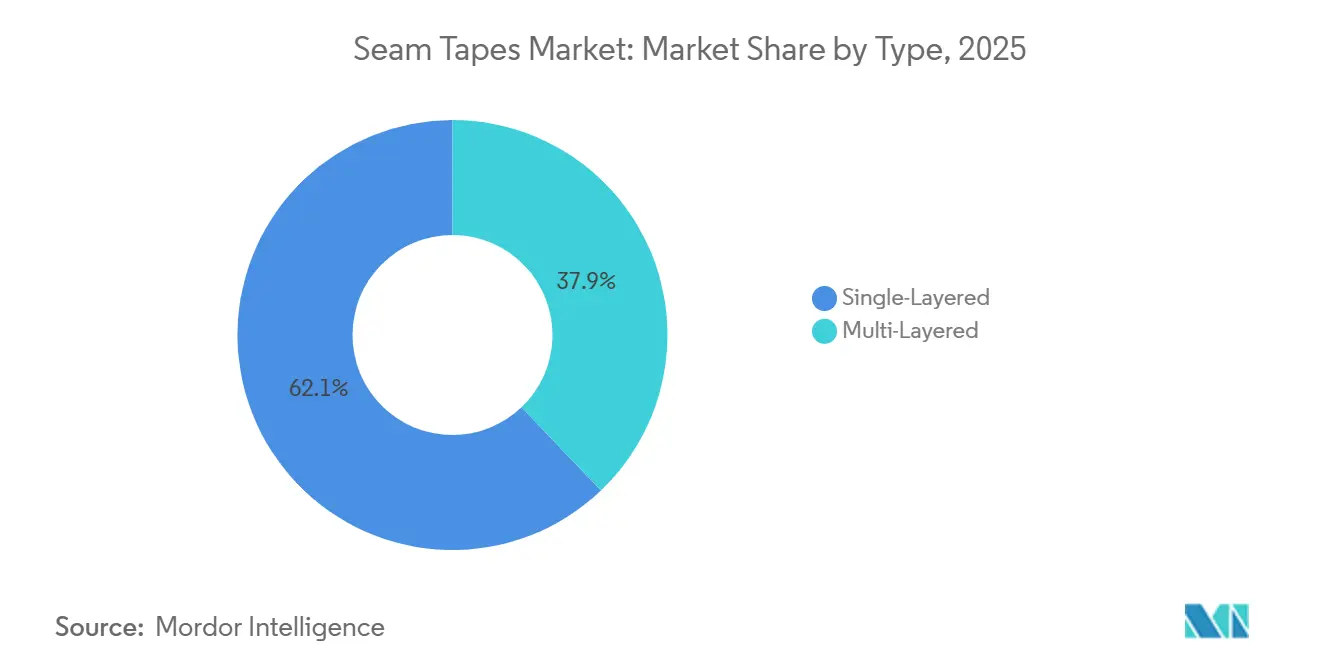
Multi-Layered Formats Gaining Premium SpecificationsSingle-layered commanded 62.13% of the seam tapes market share in 2025. Their position reflected cost efficiency, straightforward high-speed machine application, and use in standard rainwear, casual outerwear, and mid-tier sportswear. Factories using commercial hot-air sealing systems favor the format when steady throughput and repeatable application are the main production objectives. Single-layered tapes remain relevant because they fit established workflows in major apparel-producing countries and meet the needs of volume-driven programs that do not require the highest barrier performance.
Multi-layered is projected to advance at a 6.98% CAGR through 2031 in the seam tapes market. Demand is increasing in ski apparel, mountaineering gear, and protective workwear, where durable moisture barriers must withstand repeated wash-and-dry cycles. A three-layer structure places a carrier film between adhesive layers and can provide continuous protection for garments exposed to demanding weather or workplace conditions. These formats typically achieve higher selling prices than comparable single-layer alternatives, which supports revenue per meter for suppliers able to meet demanding specifications. Bemis Associates Inc. included Global Recycled Standard certified three-layer tape variants ST356RC and ST390RC with 11% recycled content in its December 2024 selector guide, while OEKO-TEX STANDARD 100 documentation supports their use in European apparel programs and strengthens their relevance to formal procurement requirements in the seam tapes market.
By Material:
TPU's Chemistry Advantage Challenges Polyurethane's Scale LeadPolyurethane held 55.06% of the market revenue in 2025. Its scale reflected established processing infrastructure, broad substrate compatibility, and documented performance in standard waterproof apparel. The material remains important in existing garment production processes and provides a familiar material platform for widely used tape formats. Its growth is slower in premium applications that need better compatibility with new fabric treatments and more specialized performance requirements.
Thermoplastic polyurethane is projected to advance at a 7.21% CAGR through 2031 in the seam tapes market. TPU offers flex recovery and low-temperature adhesion properties that support advanced performance fabrics and high-polymer processing methods. It can also support bonding systems for per- and polyfluoroalkyl substances-free C0 Durable Water-Repellent fabric platforms, where reliable adhesion is more difficult to achieve. Polyamide tapes continue to serve healthcare and high-temperature industrial requirements where chemical compatibility and lower activation temperatures are important. Polyvinyl chloride options face greater scrutiny under European material compliance requirements, while TORAY INDUSTRIES, INC.’s textile substrate and fiber technologies can support upstream qualification work, and Michelman’s Unyte portfolio shows the direction of lower-impact adhesive development in the seam tapes market.
By Application:
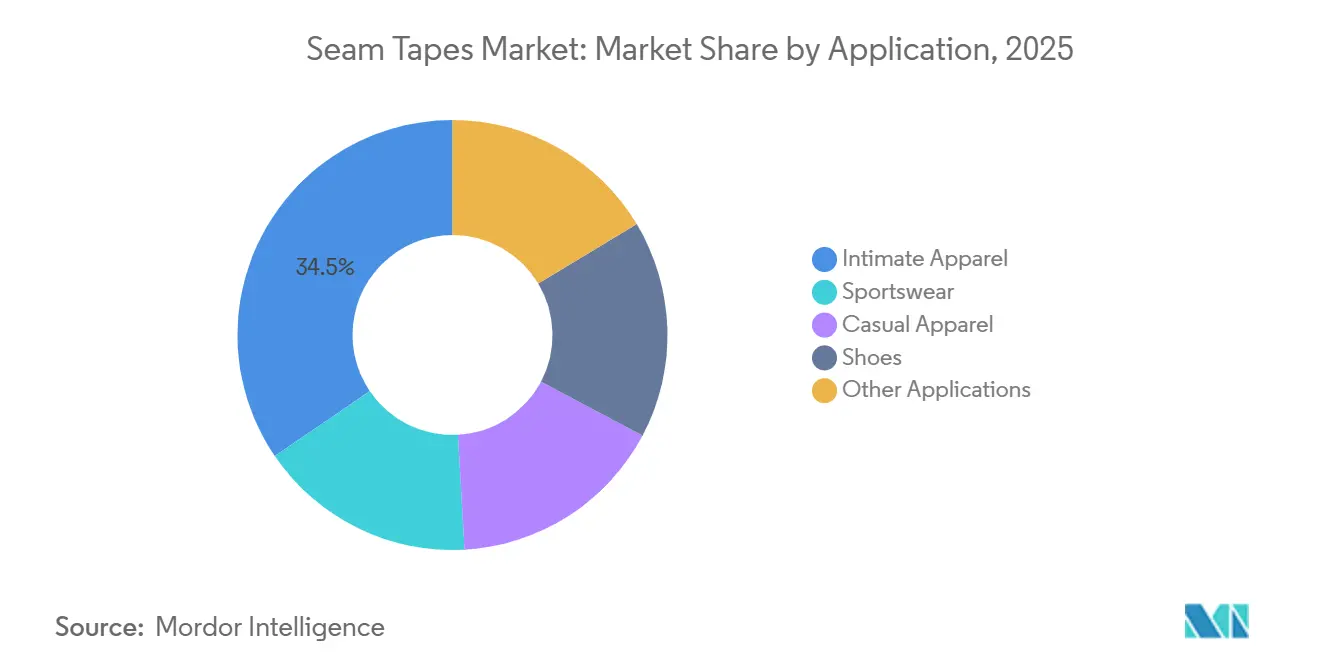
Intimate Apparel's Dual Leadership Signals Structural DemandIntimate apparel held 34.52% of the global market in 2025 and is projected to advance at a 7.47% CAGR through 2031. The category benefits from demand for garments with fewer stitch lines in bras, shapewear, and performance underwear. Bonded construction can reduce chafing, pressure marks, and seam-related moisture accumulation, which are common limitations of traditional sewn construction. The application combines a large installed base with continued use of seam tapes as consumers and brands favor seamless formats.
Sportswear uses seam tapes in running, cycling, and mountain sports apparel with waterproof membranes. Casual apparel and shoes add demand as waterproof hiking boots and trail-running footwear increasingly use seam-sealed membrane layers that require precise tape application. Automated adhesive dispensing can improve consistency on high-stretch fabrics where manual application is more difficult and more variable. HOSHIMA International’s dual-head artificial intelligence vision dispensing equipment is designed for real-time edge detection and curved garment geometries, which demonstrates the production focus on controlled placement. Tents, backpacks, and technical accessories add a smaller demand pool in the seam tapes market, supported by participation in outdoor recreation across North America, Europe, and East Asia.

Geography Analysis
APAC Seam Tapes Market
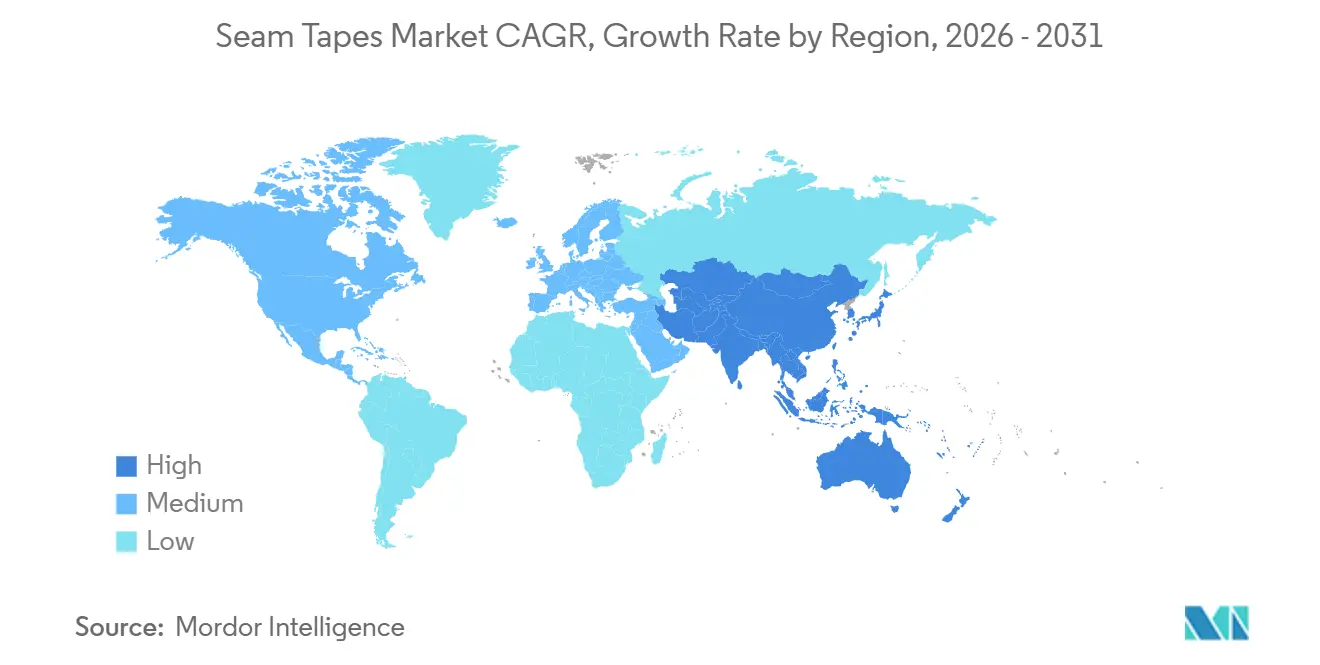
Asia-Pacific held 42.78% of the seam tapes market share in 2025 and is projected to advance at a 7.63% CAGR through 2031. China, India, Vietnam, and Bangladesh anchor the region’s garment manufacturing base, seam-sealing expertise, and concentration of hot-air sealing equipment. Domestic consumption of performance sportswear and seamless intimate apparel also supports regional demand beyond export production. South Korea adds a technology focus through greater use of precision automation in apparel manufacturing, which favors tapes that are consistent and compatible with machine-controlled processes.
South Korea and Japan Seam Tapes Market
Hansae signed a contract with Realworld in August 2026 to deploy robotic gripper artificial intelligence on apparel production lines. South Korea’s Ministry of Trade, Industry, and Energy is planning a KRW 310 billion investment (approximately USD 224 million) from 2028 to 2034 for advanced textile development that includes artificial intelligence across yarn, dyeing, and sewing processes. These programs can increase demand for tape grades that perform consistently in automated operations. Japan maintains demand for technically demanding grades used in consumer and industrial protective apparel.
The Americas and EMEA Seam Tapes Market
In North America, the United States supports demand through defense apparel, medical protective wear, and premium outdoor products, while Canada and Mexico provide additional demand through outdoor apparel activity and links with the United States brand supply chains. In Europe, technical outerwear brands in Germany, the United Kingdom, France, and Italy are increasing attention to per- and polyfluoroalkyl substances-free adhesives and recycled-content tapes. FRAMIS ITALIA documents per- and polyfluoroalkyl substances-free two-layer polyurethane tape lines for technical apparel, including Denver, Montreal Eco, and Siena. South America and Middle East and Africa offer more gradual demand development through activewear, domestic apparel production, defense, medical services, mining, chemical processing, and protective workwear. Price sensitivity supports single-layer polyurethane formats in these regions, while higher quality and safety requirements can support later adoption of multi-layered tapes in the seam tapes market.
Competitive Landscape
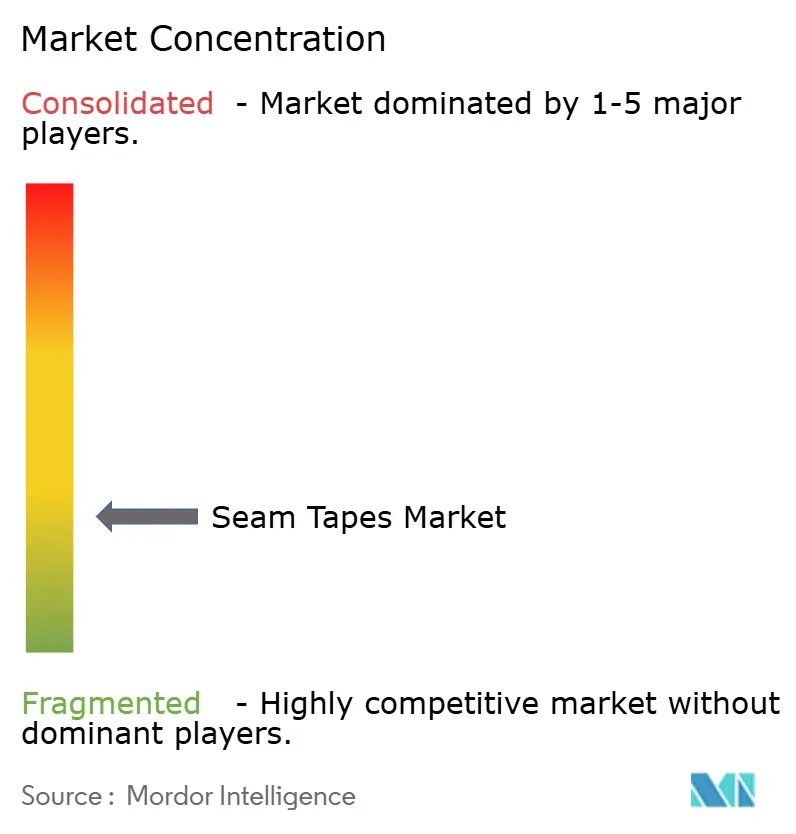
The seam tapes market is highly fragmented, with the top five players including Bemis Associates Inc., 3M, TORAY INDUSTRIES, INC., Sealon Co., Ltd., and DingZing Advanced Materials Inc. Bemis Associates Inc. and TORAY INDUSTRIES, INC. focus on multilayer tape construction, material development, and related textile capabilities. 3M’s adhesive science supports adjacent seam-sealing and multilayer film applications. FRAMIS ITALIA has a per- and polyfluoroalkyl substance-free product range for European technical apparel programs. DingZing Advanced Materials Inc., HiMEL Corp., Sealon Co., Ltd., Taiwan Hipster Enterprise Co., Ltd., E. TEXTINT CORP., and SAN CHEMICALS, LTD. compete through customization, proximity to Asia-Pacific garment clusters, and pricing flexibility.
H.B. Fuller Company supports the upstream market with industrial hot-melt adhesive capabilities, while Loxy AS, Gerlinger Industries GmbH, and Adhesive Films, Inc. serve specialized technical textile niches. Bemis Associates Inc. received U.S. Patent 12305088 in 2025 for waterproof seam construction and related methods, including UV-cured and water-based adhesive systems. This intellectual property can protect premium product development where multilayer construction, wash durability, and controlled adhesive application are important. The seam tapes industry, therefore, depends on product design, qualification support, and manufacturing consistency as well as price.
Per- and polyfluoroalkyl substances-free and bio-based adhesive chemistry, pre-qualified process support, and proximity to garment production centers shape competition. Suppliers can differentiate by providing tape, equipment settings, and process assistance as an integrated package for apparel factories. 3M filed patent WO-2025219975-A1 in April 2025 for a water-vapor-permeable polymeric multilayer film with adhesive functionality[2]. Bemis Associates Inc.’s recycled-content three-layer tape range is another product response to procurement and certification requirements. Suppliers that can achieve durable bonding on per- and polyfluoroalkyl substances-free substrates using water-based processing have room to compete because no single approach has established dominance.
Seam Tapes Industry Leaders
-
Bemis Associates Inc.
-
3M
-
TORAY INDUSTRIES, INC.
-
Sealon Co., Ltd.
-
DingZing Advanced Materials Inc.
- *Disclaimer: Major Players sorted in no particular order
Seam Tapes Market Companies Covered in this Report
- 3M
- Adhesive Films, Inc.
- Bemis Associates Inc.
- DingZing Advanced Materials Inc.
- E. TEXTINT CORP.
- FRAMIS ITALIA
- Gerlinger Industries GmbH
- H.B. Fuller Company
- HiMEL Corp.
- Loxy AS
- SAN CHEMICALS, LTD.
- Sealon Co., Ltd.
- Taiwan Hipster Enterprise Co., Ltd.
- TORAY INDUSTRIES, INC.
Recent Industry Developments in Seam Tapes Market
- August 2026: South Korean apparel manufacturer Hansae signed a formal contract with Realworld to deploy robotic gripper artificial intelligence on apparel production lines. The automation of garment manufacturing can support demand for precision seam tape application technologies compatible with automated production processes.
- September 2025: RoyOMartin introduced TuffStrand-WRB, an oriented strand board sheathing product designed for installation with specialized seam tape, eliminating the need for traditional house wrap. The product expands the use of seam tapes in building-envelope applications and supports demand for tape-based weatherproofing solutions.
Global Seam Tapes Market Report Scope
Seam tapes are narrow adhesive or thermoplastic tapes applied over stitched or bonded seams to reinforce joints and provide protection against moisture, abrasion, and other environmental exposure. They are used to improve seam durability and create cleaner, more functional finishes in textile and apparel products.
The Seam Tapes Market is segmented by type, material, application, and geography. By type, the market is segmented into single-layered and multi-layered. By material, the market is segmented into polyurethane, thermoplastic polyurethane (TPU), polyamide, polyvinyl chloride (PVC), and other materials. By application, the market is segmented into intimate apparel, sportswear, casual apparel, shoes, and other applications. The report also covers the market size and forecasts for seam tapes in 15 countries across major regions. For each segment, the market sizing and forecasts have been done on the basis of value (USD).
Segmentation Overview
| Single-Layered |
| Multi-Layered |
| Polyurethane |
| Thermoplastic Polyurethane (TPU) |
| Polyamide |
| Polyvinyl Chloride (PVC) |
| Other Materials |
| Intimate Apparel |
| Sportswear |
| Casual Apparel |
| Shoes |
| Other Applications |
| Asia-Pacific | China |
| India | |
| Japan | |
| South Korea | |
| ASEAN Countries | |
| Rest of Asia-Pacific | |
| North America | United States |
| Canada | |
| Mexico | |
| Europe | Germany |
| United Kingdom | |
| France | |
| Italy | |
| NORDIC Countries | |
| Rest of Europe | |
| South America | Brazil |
| Argentina | |
| Rest of South America | |
| Middle East and Africa | Saudi Arabia |
| South Africa | |
| Rest of Middle East and Africa |
| By Type | Single-Layered | |
| Multi-Layered | ||
| By Material | Polyurethane | |
| Thermoplastic Polyurethane (TPU) | ||
| Polyamide | ||
| Polyvinyl Chloride (PVC) | ||
| Other Materials | ||
| By Application | Intimate Apparel | |
| Sportswear | ||
| Casual Apparel | ||
| Shoes | ||
| Other Applications | ||
| By Geography | Asia-Pacific | China |
| India | ||
| Japan | ||
| South Korea | ||
| ASEAN Countries | ||
| Rest of Asia-Pacific | ||
| North America | United States | |
| Canada | ||
| Mexico | ||
| Europe | Germany | |
| United Kingdom | ||
| France | ||
| Italy | ||
| NORDIC Countries | ||
| Rest of Europe | ||
| South America | Brazil | |
| Argentina | ||
| Rest of South America | ||
| Middle East and Africa | Saudi Arabia | |
| South Africa | ||
| Rest of Middle East and Africa | ||
Key Questions Answered in the Report
What is the size of the seam tapes market?
The seam tapes market stands at USD 207.20 million in 2026 and is projected to reach USD 285.62 million by 2031.
What is driving demand for seam tapes?
Waterproof apparel, sportswear, performance footwear, intimate apparel, and protective clothing support demand for seam tapes.
Which type is expected to grow fastest through 2031?
Multi-layered is projected to advance at a 6.98% CAGR through 2031 as demand rises for premium barrier performance.
Which material is expected to grow fastest through 2031?
Thermoplastic polyurethane is projected to advance at a 7.21% CAGR through 2031 because it supports advanced performance fabric applications.