
Size and Share of Sealants Market For Battery Enclosures
Market Overview
| Study Period | 2021 - 2031 |
|---|---|
| Market Size (2026) | USD 1.28 Billion |
| Market Size (2031) | USD 1.93 Billion |
| Growth Rate (2026 - 2031) | 8.56 % |
| Fastest Growing Market | Asia-Pacific |
| Largest Market | Asia-Pacific |
| Market Concentration | Medium |
Major Players *Disclaimer: Major Players sorted in no particular order Image © Mordor Intelligence. Reuse requires attribution under CC BY 4.0. | |
Analysis of Sealants Market For Battery Enclosures by Mordor Intelligence
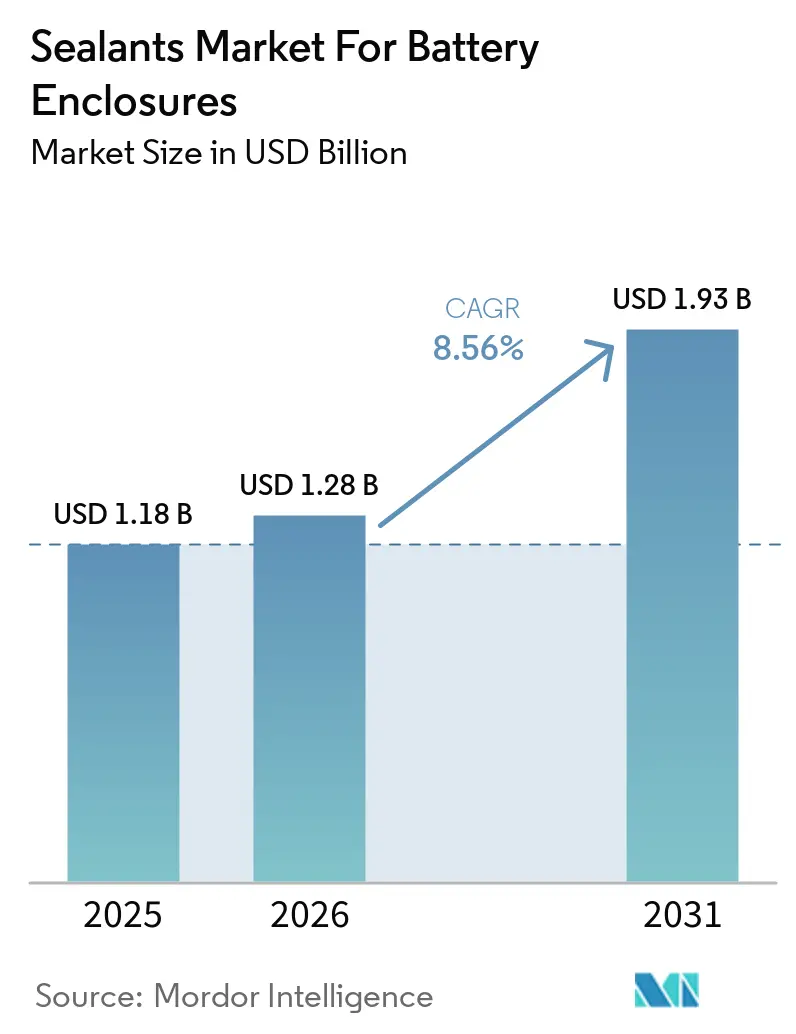
The Sealants Market for Battery Enclosures was valued at USD 1.18 billion in 2025 and is estimated to grow from USD 1.28 billion in 2026 to reach USD 1.93 billion by 2031, at a CAGR of 8.56% during the forecast period (2026–2031). The sealants market for battery enclosures is supported by rising lithium-ion battery production and expanding electric vehicle pack assembly. Global lithium-ion battery deployment reached 1.2 Terawatt-hour (TWh) in 2025, while manufacturing capacity exceeded 4 TWh at year-end, which increased the need for sealing at pack joints, module interfaces, and electrical connections. Higher energy density and faster charging have made thermal resistance, electrical insulation, and reliable sealing more important in enclosure design. Suppliers are responding through materials that support automated dispensing, more stable bead performance, and compatibility with aluminum, steel, and composite substrates. The sealants market for battery enclosures also has an opportunity in stationary energy storage systems, where larger enclosures require extensive sealing paths and dependable environmental protection.
Key Report Takeaways
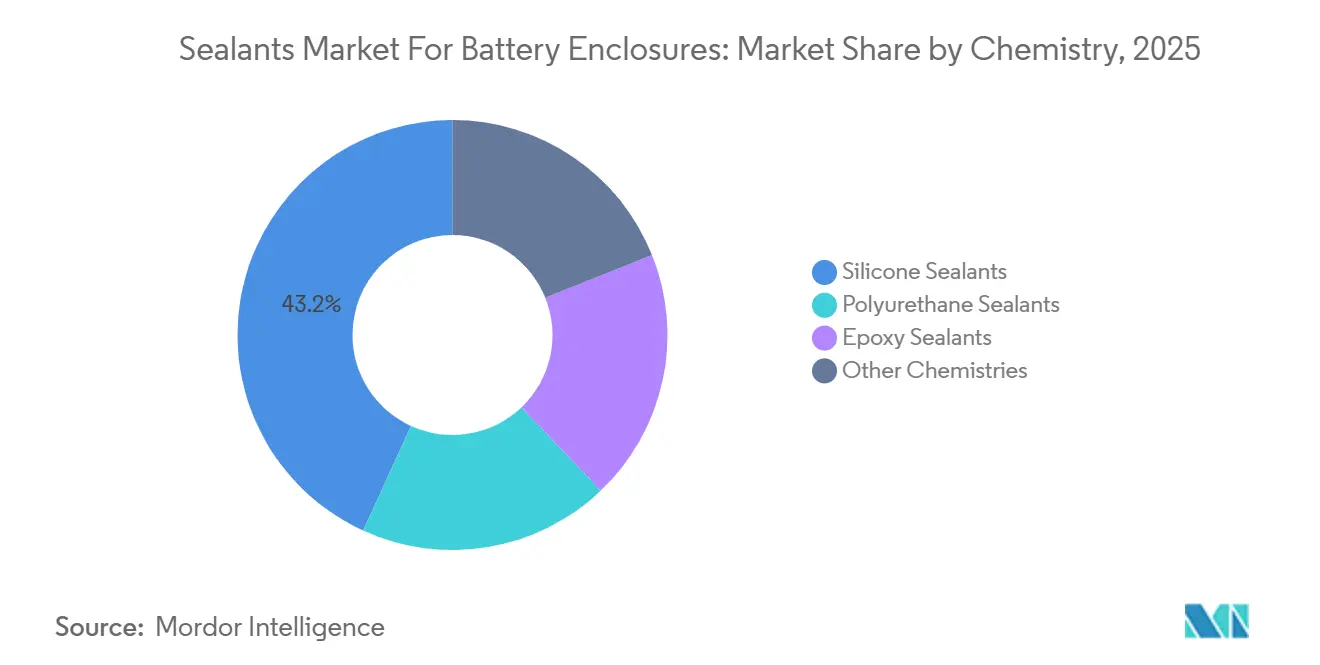
- By chemistry, silicone sealants held 43.18% of the sealants market for battery enclosures in 2025 and are projected to advance at a 9.12% CAGR through 2031.
- By battery enclosure material, aluminum battery enclosures held 53.23% of the sealants market for battery enclosures in 2025, while composite battery enclosures are projected to advance at a 10.08% CAGR through 2031.
- By application, cover-to-housing sealing held 40.02% of the sealants market for battery enclosures in 2025, while module-to-pack sealing is projected to advance at a 10.19% CAGR through 2031.
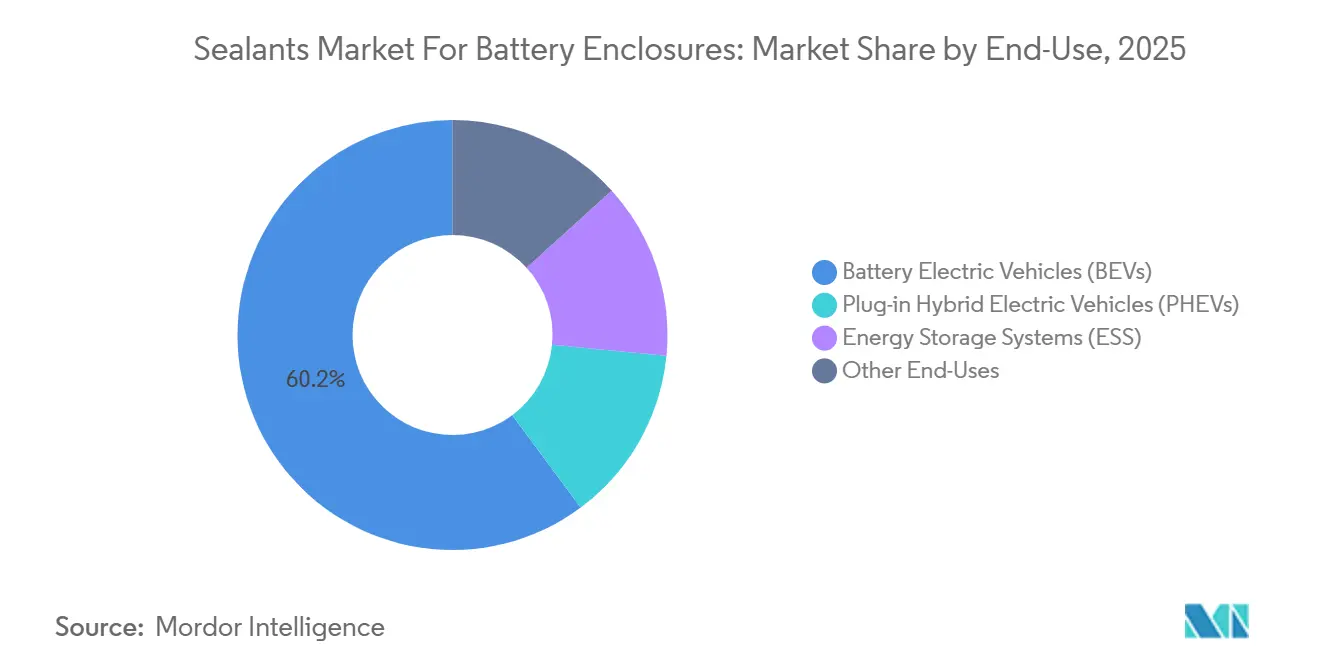
- By end-use, Battery Electric Vehicles (BEVs) held 60.18% of the sealants market for battery enclosures in 2025, while Energy Storage Systems (ESS) are projected to advance at an 11.23% CAGR through 2031.
- By geography, Asia-Pacific held 42.17% of the sealants market for battery enclosures in 2025 and is projected to advance at a 9.84% CAGR through 2031.
Note: Market size and forecast figures in this report are generated using Mordor Intelligence’s proprietary estimation framework, updated with the latest available data and insights as of January 2026.
Market Trends and Insights
Drivers Impact Analysis of Sealants Market For Battery Enclosures*
| Driver | (~) % Impact on CAGR Forecast | Geographic Relevance | Impact Timeline |
|---|---|---|---|
| Rising EV and Battery Manufacturing Volumes | +2.8% | Global | Short term (≤ 2 years) |
| Higher Battery Energy Density and Fast-Charging Thermal Cycles | +2.1% | Global | Medium term (2-4 years) |
| Shift Toward Lightweight Multi-Material Enclosures | +1.2% | APAC, Europe, North America | Medium term (2-4 years) |
| Demand for Automated, High-Throughput Pack Assembly | +0.9% | Asia-Pacific, North America & EU | Medium term (2-4 years) |
| Design-for-Disassembly and Battery Circularity Requirements | +0.6% | Europe, North America | Long term (≥ 4 years) |
| Thermal-Runaway Mitigation and Integrated Fire Protection | +0.5% | Global | Short term (≤ 2 years) |
| Source: Mordor Intelligence | |||
Rising EV and Battery Manufacturing Volumes
Global lithium-ion battery deployment reached 1.2 TWh in 2025, which was more than 7 times the 2020 level. Manufacturing capacity exceeded 4 TWh by the end of 2025 and expanded by nearly 30% during the year[1]. China accounted for more than 80% of global manufacturing capacity, while the European Union and the United States each increased domestic nameplate capacity by nearly 50% in 2025. Each increase in cell output adds sealing work at cover-to-housing joints, module-to-pack interfaces, and cable connections. Prismatic cells accounted for more than 60% of global electric vehicle and stationary-storage batteries in 2025, favoring flat-flange lid geometries and robotic dispensing of high-viscosity sealant. China’s GB 38031-2025 safety standard introduced fast-charging cycle tests that require packs to resist fire and explosion during repeated charging, which raises the performance requirements for enclosure materials.
Higher Battery Energy Density and Fast-Charging Thermal Cycles
Fast charging at 350 kilowatt (kW) or more can expose battery packs to temperatures of 80 °C to 95 °C. These conditions place repeated stress on joints that connect materials with different rates of thermal expansion. Research on predictive thermal management found that effective control can reduce charging energy use by up to 0.41 kWh and shorten charge times by up to 4.5%, provided coolant circuits remain sealed under changing pressure. A study of high-power-density battery modules found that cell-to-cell temperature differences needed to remain below 5 °C for safe operation. The spread of 800 V systems makes dielectric performance at cable and connector interfaces a central selection requirement. The sealants market for battery enclosures, therefore, favors silicone and polyurethane grades with tested electrical insulation, thermal durability, and flame resistance. Underwriters Laboratories (UL) 94 V-0 certification, which requires self-extinguishing behavior within 10 seconds and no flaming drips, has become a common requirement in high-energy battery pack qualification.
Shift Toward Lightweight Multi-Material Enclosures
Thermoplastic composite battery enclosures can reduce mass by 30% to 50% compared with aluminum alternatives. Research on composite battery enclosures showed that a carbon-fiber-reinforced plastic design achieved a 4.78 kg total mass with a 10–15-minute cure cycle. Composite-to-metal joints require sealants that accommodate different expansion rates during repeated heating and cooling. A life-cycle assessment reported 1,323.9 kg of carbon dioxide-equivalent emissions during production of a composite prototype battery enclosure. This has increased interest in solvent-free and low-outgassing materials that reduce volatile organic compound emissions. High-elongation, moisture-cured, and ultraviolet-activated systems can support polyamide and polypropylene substrates where standard materials may need primers.
Demand for Automated, High-Throughput Pack Assembly
Multi-gigawatt-hour battery plants need dispensing methods that work with robotic cure-in-place gasketing (CIPG) and form-in-place gasketing (FIPG) processes. High-volume lines can require more than 60 dispensing jobs per hour while maintaining bead dimensions that meet IP67 and IP69K ingress-protection tests. Three-dimensional vision systems now monitor bead height, width, and start-stop positions in real time, which makes rheological consistency essential. Materials that need heated pumping, show high temperature-related viscosity variation, or are sensitive to mix-ratio changes can fail during process qualification. In April 2025, Henkel AG & Co. KGaA launched LOCTITE AA 5885, a one-part ultraviolet-curable polyacrylate CIPG solution that cures at room temperature and removes interim part storage. Two-component formulations also give production teams greater control over open time and snap-cure behavior. These requirements encourage suppliers in the sealants market for battery enclosures to combine material performance with reliable dispensing behavior.
Restraints Impact Analysis of Sealants Market For Battery Enclosures*
| Restraint | (~) % Impact on CAGR Forecast | Geographic Relevance | Impact Timeline |
|---|---|---|---|
| Long OEM Qualification and Validation Cycles | -1.5% | Global | Long term (≥ 4 years) |
| Volatility in Silicone, Isocyanate, Polyol, Resin and Additive Costs | -1.2% | Global | Short term (≤ 2 years) |
| Difficult Reworkability and End-of-Life Separation in Permanently Sealed Packs | -0.8% | Europe, North America | Long term (≥ 4 years) |
| Process Sensitivity to Surface Contamination, Bead Geometry and Cure Conditions | -0.5% | Asia-Pacific, North America & EU | Medium term (2-4 years) |
| Source: Mordor Intelligence | |||
Long OEM Qualification and Validation Cycles
Automotive-grade sealants must pass thermal cycling, IP67 and IP69K validation, vibration testing, and compatibility checks against electrolytes and coolants. This process commonly lasts 18-24 months before approval for series production. Original equipment manufacturers (OEMs) often freeze material specifications 3-4 years before production begins. Materials approved for 2026 and 2027 programs were therefore selected for pack designs that existed years earlier. This gap limits the rapid adoption of chemistries that offer debonding or improved reworkability. ISO 16750 environmental testing and International Electrotechnical Commission (IEC) 62619 battery safety requirements add further validation work for material changes[2]. The sealants market for battery enclosures remains favorable to suppliers with established testing records, while new suppliers face lengthy validation costs.
Volatility in Silicone, Isocyanate, Polyol, Resin and Additive Costs
Sealant producers use silicone, isocyanates, polyols, resins, and additives that can experience supply and price volatility. Fixed-price agreements with battery OEMs can prevent formulators from immediately passing higher input costs through the supply chain. This can reduce margins and delay investment in next-generation products. Silicon metal remains a key upstream input for dimethylcyclosiloxane, which is used in silicone production. Its pricing is linked to Chinese production decisions and coal-power tariffs, which are difficult for many formulators to hedge. The sealants market for battery enclosures also faces risk when logistics disruptions constrain the supply of polyurethane feedstocks. Suppliers with broader procurement networks and vertically integrated silicone capacity can be better positioned to manage these pressures.
*Our forecasts treat driver/restraint impacts as directional, not additive. The impact forecasts reflect baseline growth, mix effects, and variable interactions.
Sealants Market For Battery Enclosures Segment Analysis
By Chemistry:
Silicone Sealants Dominate both Share and GrowthSilicone sealants held 43.18% of the sealants market for battery enclosures in 2025. Their position reflected operation across a -50 °C to +200 °C range, UL 94 V-0 flame resistance, and compatibility with automated CIPG and FIPG processes. Polyurethane sealants provide structural cohesion at a lower formulated cost for many aluminum tray-to-lid joints. Epoxy sealants served rigid, permanent interfaces where hermetic bonding mattered more than repairability. Their use remained limited in cold-climate applications because of lower flexibility at subzero temperatures. Other chemistries include modified silane (MS) polymer and silane-modified polymer sealants, acrylic sealants, butyl, and hybrid sealants. Butyl rubber offers useful reworkability at cover-to-housing joints because it can be applied at high viscosity without a chemical cure.
Silicone sealants are also projected to advance at a 9.12% CAGR through 2031, the highest rate in the chemistry category. Their growth is tied to both BEV pack volumes and ESS installations, where field thermal stability is important. In April 2025, Henkel AG & Co. KGaA launched LOCTITE AA 5885, showing that ultraviolet-cured polyacrylates are becoming a commercial alternative alongside silicone, polyurethane, and epoxy. Ultraviolet curing can reduce oven time and increase line throughput. Silane-modified polymers can improve adhesion to low-surface-energy composite substrates. The chemistry mix is therefore becoming more specialized as pack designers balance thermal performance, cure speed, repairability, and substrate compatibility. This supports product differentiation within the sealants market for battery enclosures.

By Battery Enclosure Material:
Aluminum Battery Enclosures Lead on Economics, Composite Battery Enclosures Gain on Weight TargetsAluminum battery enclosures held 53.23% of the sealants market for battery enclosures in 2025. Aluminum remains widely used because it combines formability, corrosion resistance, electrical conductivity for grounding, and established sealing practices. Steel battery enclosures retained use in commercial electric vehicles and heavy-duty applications where crash performance takes priority over weight reduction. These applications support polyurethane and butyl materials compatible with phosphate-treated and e-coated steel. Other battery enclosure materials include magnesium and hybrid assemblies used in premium vehicle programs. Their adoption remains limited by material cost and evaluation requirements. Aluminum’s established manufacturing base gives the sealants market for battery enclosures a stable demand foundation.
Composite battery enclosures are projected to advance at a 10.08% CAGR through 2031. Direct long-fiber thermoplastic molding can produce large battery lid panels on 10–15-minute cycles, supporting high-volume production. Composite materials generally expand 50-100 micrometers per meter per degree Celsius, compared with 23 micrometers for aluminum. Sealants used at these interfaces need high elongation to avoid cracking during temperature cycling. Fiber-reinforced panels may also create wider flange gaps than aluminum panels. This favors products with gap-fill capability of 3-6 mm instead of the 1-2 mm commonly needed for aluminum joints. Suppliers are responding with high-elongation polyurethane and foam-in-place systems that can accommodate dimensional variation.
By Application:
Cover-to-Housing Sealing Sustains Revenue Base, Module-to-Pack Sealing SurgesCover-to-housing sealing held 40.02% of the sealants market for battery enclosures in 2025. Every battery pack requires a sealed lid joint regardless of cell chemistry, voltage class, or pack size. This application is the principal setting for CIPG and FIPG automation. Robotic systems apply a continuous bead around the perimeter flange, while vision inspection checks geometry before the cover is assembled. Cable and connector sealing is becoming more important as 800 V architectures expand across BEV passenger vehicles and high-power energy storage installations. Other applications include vent and gasket sealing and sensor, busbar, and fastener sealing. These applications require precision dispensing and can support specialist suppliers.
Module-to-pack sealing is projected to advance at a 10.19% CAGR through 2031. The category follows the adoption of cell-to-pack (CTP) designs, where cells are integrated into the pack frame without intermediate module housings. CTP removes one sealing layer but concentrates thermal and hermetic requirements at the remaining pack-level interface. Stationary ESS uses module-to-rack and module-to-pack arrangements that require reliable protection from moisture and thermal cycling. Large containerized systems also require substantially longer sealing paths than passenger vehicle packs. This is increasing the demand for industrial automated dispensing systems. The sealants market for battery enclosures is, therefore, becoming less dependent on automotive production alone.
By End-Use:
BEVs Dominate Revenue, ESS Rewrites the Growth EquationBattery Electric Vehicles (BEVs) held 60.18% of the sealants market for battery enclosures in 2025. Passenger EV platforms across China, Europe, and the United States maintained the largest source of pack-level sealing demand. Pack sizes ranged from 40-50 kWh for compact urban vehicles to more than 90 kWh for full-size U.S. trucks. This variation creates different enclosure dimensions and sealant coverage areas across vehicle types. Plug-in Hybrid Electric Vehicles (PHEVs) had average pack sizes above 25 kWh in China and slightly above 20 kWh in the European Union. Their combined electric operation and internal-combustion exposure can create broad temperature cycles for enclosure materials.
Energy Storage Systems (ESS) are projected to advance at an 11.23% CAGR through 2031. ESS enclosures need long-life protection against moisture, heat, vibration, and electrical hazards. Commercial Electric Vehicles, Marine, Rail, and Aerospace Battery Systems add distinct certification requirements that can influence wider material specifications. Marine systems must meet IEC 60092 requirements, while aerospace systems may require testing under RTCA DO-160G conditions. These requirements can encourage sealant suppliers to establish nearby manufacturing or distribution. The sealants market for battery enclosures benefits as end-use demand becomes broader and less concentrated in passenger vehicles.
Geography Analysis
APAC Sealants Market for Battery Enclosures
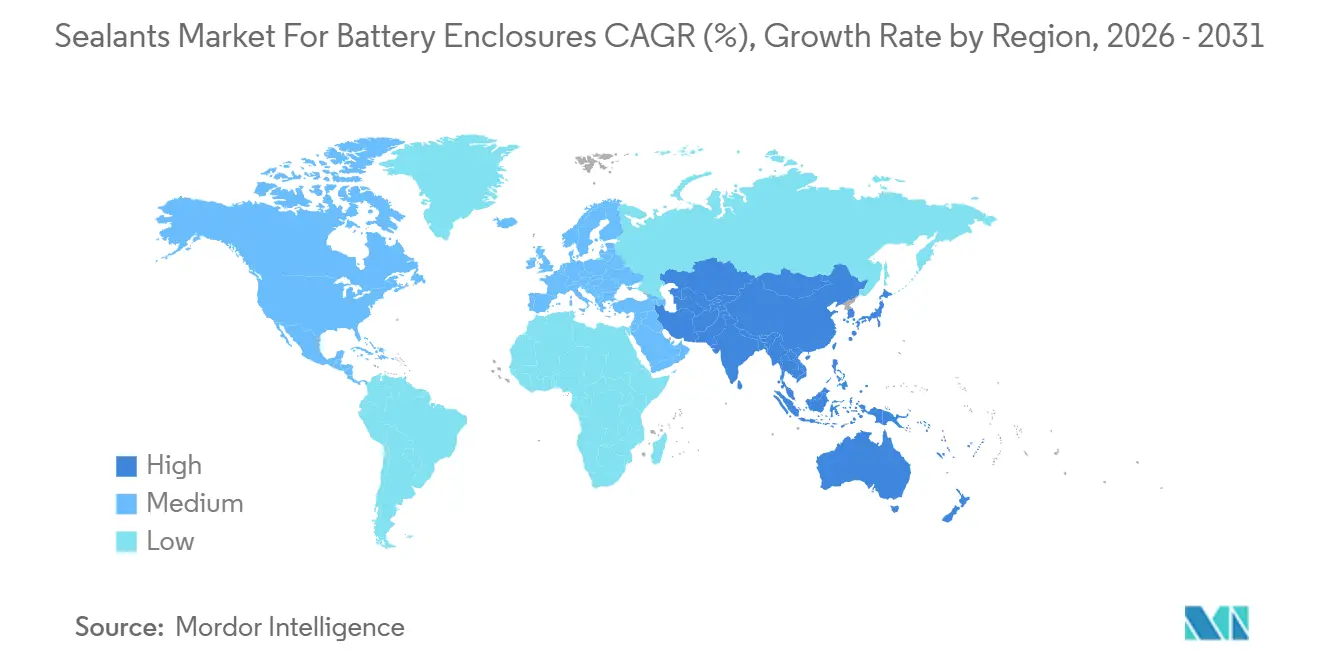
Asia-Pacific held 42.17% of the sealants market for battery enclosures in 2025 and is projected to advance at a 9.84% CAGR through 2031. China accounted for nearly 60% of global electric vehicle battery deployment in 2025 and hosted more than 80% of lithium-ion manufacturing capacity. This concentrated demand is around the pack assembly centers in Guangdong, Fujian, and Jiangsu provinces. Japan and South Korea supplied premium battery packs to European and North American OEMs. Shin-Etsu Chemical Co., Ltd., Momentive, and Korean battery integrators have helped establish demanding regional standards for sealant performance.
North America Sealants Market for Battery Enclosures
North America benefited from a domestic gigafactory buildout, and the United States increased nameplate battery manufacturing capacity by nearly 50% in 2025. Panasonic supplied more than 40% of batteries in U.S.-produced electric cars sold globally in 2025. The region’s demand was concentrated around large pack assembly plants, which created significant sealant purchasing points. The Inflation Reduction Act continued to support investments by LG Energy Solution, Samsung SDI, and other battery producers. These conditions make validated material performance important in the sealants market for battery enclosures.
EMEA and South America Sealants Market for Battery Enclosures
Europe’s battery rules are increasing interest in debondable formulations. Regulation (EU) 2023/1542 applies battery passport requirements from 2026 and QR-code labeling requirements from 2027. Regulation (EU) 2026/1738 also includes vehicle circularity requirements that influence battery removability. South America remains a smaller demand center, although Brazil’s ethanol-electric hybrid fleet requires thermally durable sealing at lower battery volumes. Argentina’s lithium resources support its longer-term role in battery supply chains, while local pack assembly remains limited. Saudi Arabia is developing clean-energy storage and electric vehicle infrastructure, and South Africa has battery-material resources that could support regional assembly over time. The sealants market for battery enclosures in the Middle-East and Africa presently depends more on imported packs than local production.
Competitive Landscape
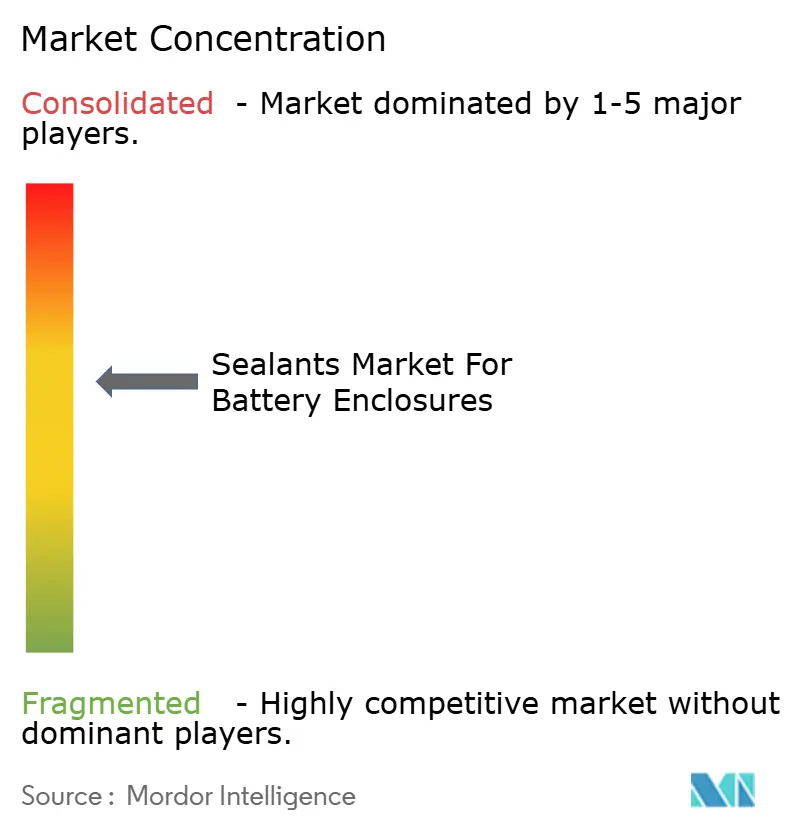
The sealants market for battery enclosures is moderately concentrated, with the top five players including Henkel AG & Co. KGaA, Dow, Sika AG, 3M Company, and H.B. Fuller Company. Sika AG offers polyurethane CIPG, sprayable silane-terminated polymer sealants, and ultraviolet-curable materials. This range allows it to address cover-to-housing, module-to-pack, and structural bonding needs within one supplier relationship. Smaller specialists compete through focused chemistries, including ultraviolet-curable polyacrylates and silane-modified polymers.
3M designed its SZ1000 two-part foam adhesive sealant to provide IPX8 water protection and UL 94 flame resistance in automated dispensing applications. Its resealable and compressible foam design can reduce reliance on irreversible curing. In April 2025, Henkel AG & Co. KGaA presented virtual adhesive simulation tools and structural adhesive debonding solutions for battery disassembly. These tools can shorten development work and support recycling requirements. In 2026, Sika AG updated its battery housing sealing portfolio with ultraviolet-curable CIPG technologies and sprayable silane-terminated polymer sealants. The competition increasingly centers on processing efficiency, repairability, and material compatibility as well as basic adhesion performance.
PPG Industries, Inc. and Arkema use coating and adhesion-promoter lines to support composite and low-surface-energy substrate bonding. These related products can strengthen engagement with OEM engineering teams during pack design. L&L Products brings structural sealing and reinforcing experience from automotive body-in-white applications, which can support battery tray stiffening proposals. DuPont and Ashland have specialty polymer and formulation capabilities for multi-component systems, although their enclosure-sealant presence is less visible than that of established silicone and polyurethane suppliers. Dymax and Permabond LLC can compete in cable and connector sealing, where rapid cure and precision dispensing are important. IEC 62619 qualification supports incumbents who already have battery-system testing infrastructure. H.B. Fuller Company and Momentive are developing hybrid formulations that combine silicone and polyurethane properties. The competitive narrative remains consistent with a market where a group of established suppliers holds technical advantages, but specialized materials create openings for focused entrants.
Leaders of Sealants Market For Battery Enclosures
-
Henkel AG & Co. KGaA
-
Dow
-
Sika AG
-
3M Company
-
H.B. Fuller Company
- *Disclaimer: Major Players sorted in no particular order
Sealants Market For Battery Enclosures Companies Covered in this Report
- 3M
- Arkema
- Ashland
- Dow
- DuPont
- Dymax
- H.B. Fuller Company
- Henkel AG & Co. KGaA
- L&L Products
- Momentive
- Permabond LLC
- PPG Industries, Inc.
- Shin-Etsu Chemical Co., Ltd.
- Sika AG
- Wacker Chemie AG
Recent Industry Developments in Sealants Market For Battery Enclosures
- May 2026: Henkel AG & Co. KGaA launched two new thermal-management materials for EV batteries: Bergquist TGF 2030APS thermal gap filler and LOCTITE TLB 9270APS thermally conductive adhesive, addressing higher energy densities and fast-charging requirements in next-generation battery systems. The development supports demand for battery enclosure materials and sealing solutions as EV manufacturers increasingly require integrated thermal management, protection, and reliability within battery-pack assemblies.
- May 2025: 3M updated its 3M Sealant SZ1000 for EV Enclosure Sealing, a two-part, cure-in-place flame-retardant foam sealant specifically designed for EV battery enclosures. The solution provides protection against water ingress, supports battery-pack serviceability, and can be automatically dispensed, directly supporting demand for battery enclosure sealing solutions.
Scope of Report on Sealants Market For Battery Enclosures
Sealants for battery enclosures are specialized materials used to create durable, leak-resistant, and protective seals around battery housings and their components. They help protect against moisture, dust, chemicals, vibration, and thermal stresses while supporting the structural integrity and safety of battery systems.
The Sealants Market for Battery Enclosures is segmented by chemistry, battery enclosure material, application, end-use, and geography. By chemistry, the market is segmented into silicone sealants, polyurethane sealants, epoxy sealants, and other chemistries (including MS polymer and silane-modified polymer sealants, acrylic sealants, and butyl and hybrid sealants). By battery enclosure material, the market is segmented into aluminum battery enclosures, steel battery enclosures, composite battery enclosures, and other battery enclosure materials (including magnesium and hybrid enclosures). By application, the market is segmented into cover-to-housing sealing, module-to-pack sealing, cable and connector sealing, and other applications (including vent and gasket sealing and sensor, busbar, and fastener sealing). By end-use, the market is segmented into battery electric vehicles (BEVs), plug-in hybrid electric vehicles (PHEVs), energy storage systems (ESS), and other end-uses (including commercial electric vehicles, marine, rail, and aerospace battery systems). The report also covers the market size and forecasts for sealants for battery enclosures in 15 countries across major regions. For each segment, the market sizing and forecasts have been done on the basis of value (USD).
Segmentation Overview
| Silicone Sealants |
| Polyurethane Sealants |
| Epoxy Sealants |
| Other Chemistries (MS Polymer and Silane-Modified Polymer Sealants, Acrylic Sealants, Butyl and Hybrid Sealants) |
| Aluminum Battery Enclosures |
| Steel Battery Enclosures |
| Composite Battery Enclosures |
| Other Battery Enclosure Materials (Magnesium and Hybrid Enclosures) |
| Cover-to-Housing Sealing |
| Module-to-Pack Sealing |
| Cable and Connector Sealing |
| Other Applications (Vent and Gasket Sealing, Sensor/Busbar/Fastener Sealing) |
| Battery Electric Vehicles (BEVs) |
| Plug-in Hybrid Electric Vehicles (PHEVs) |
| Energy Storage Systems (ESS) |
| Other End-Uses (Commercial Electric Vehicles, Marine, Rail and Aerospace Battery Systems) |
| Asia-Pacific | China |
| India | |
| Japan | |
| South Korea | |
| Rest of Asia-Pacific | |
| North America | United States |
| Canada | |
| Mexico | |
| Europe | Germany |
| United Kingdom | |
| France | |
| Italy | |
| Rest of Europe | |
| South America | Brazil |
| Argentina | |
| Rest of South America | |
| Middle-East and Africa | Saudi Arabia |
| South Africa | |
| Rest of Middle-East and Africa |
| By Chemistry | Silicone Sealants | |
| Polyurethane Sealants | ||
| Epoxy Sealants | ||
| Other Chemistries (MS Polymer and Silane-Modified Polymer Sealants, Acrylic Sealants, Butyl and Hybrid Sealants) | ||
| By Battery Enclosure Material | Aluminum Battery Enclosures | |
| Steel Battery Enclosures | ||
| Composite Battery Enclosures | ||
| Other Battery Enclosure Materials (Magnesium and Hybrid Enclosures) | ||
| By Application | Cover-to-Housing Sealing | |
| Module-to-Pack Sealing | ||
| Cable and Connector Sealing | ||
| Other Applications (Vent and Gasket Sealing, Sensor/Busbar/Fastener Sealing) | ||
| By End-Use | Battery Electric Vehicles (BEVs) | |
| Plug-in Hybrid Electric Vehicles (PHEVs) | ||
| Energy Storage Systems (ESS) | ||
| Other End-Uses (Commercial Electric Vehicles, Marine, Rail and Aerospace Battery Systems) | ||
| By Geography | Asia-Pacific | China |
| India | ||
| Japan | ||
| South Korea | ||
| Rest of Asia-Pacific | ||
| North America | United States | |
| Canada | ||
| Mexico | ||
| Europe | Germany | |
| United Kingdom | ||
| France | ||
| Italy | ||
| Rest of Europe | ||
| South America | Brazil | |
| Argentina | ||
| Rest of South America | ||
| Middle-East and Africa | Saudi Arabia | |
| South Africa | ||
| Rest of Middle-East and Africa | ||
Key Questions Answered in the Report
What is the size of the sealants market for battery enclosures?
The sealants market for battery enclosures stands at USD 1.28 billion in 2026 and is projected to reach USD 1.93 billion by 2031.
What is driving demand for battery enclosure sealants?
Expanding lithium-ion battery production, higher energy density, fast charging, and automated pack assembly are supporting demand.
Which chemistry leads market demand?
Silicone sealants held a 43.18% market share in 2025 and are projected to advance at a 9.12% CAGR through 2031.
Which battery enclosure material led the market demand in 2025?
Aluminum battery enclosures held a 53.23% market share in 2025 because of their established manufacturing base and sealant compatibility.