
Scaffolding Rental Market Size and Share
Market Overview
| Study Period | 2021 - 2032 |
|---|---|
| Market Size (2027) | USD 22.02 Billion |
| Market Size (2032) | USD 30.63 Billion |
| Growth Rate (2027 - 2032) | 6.82 % |
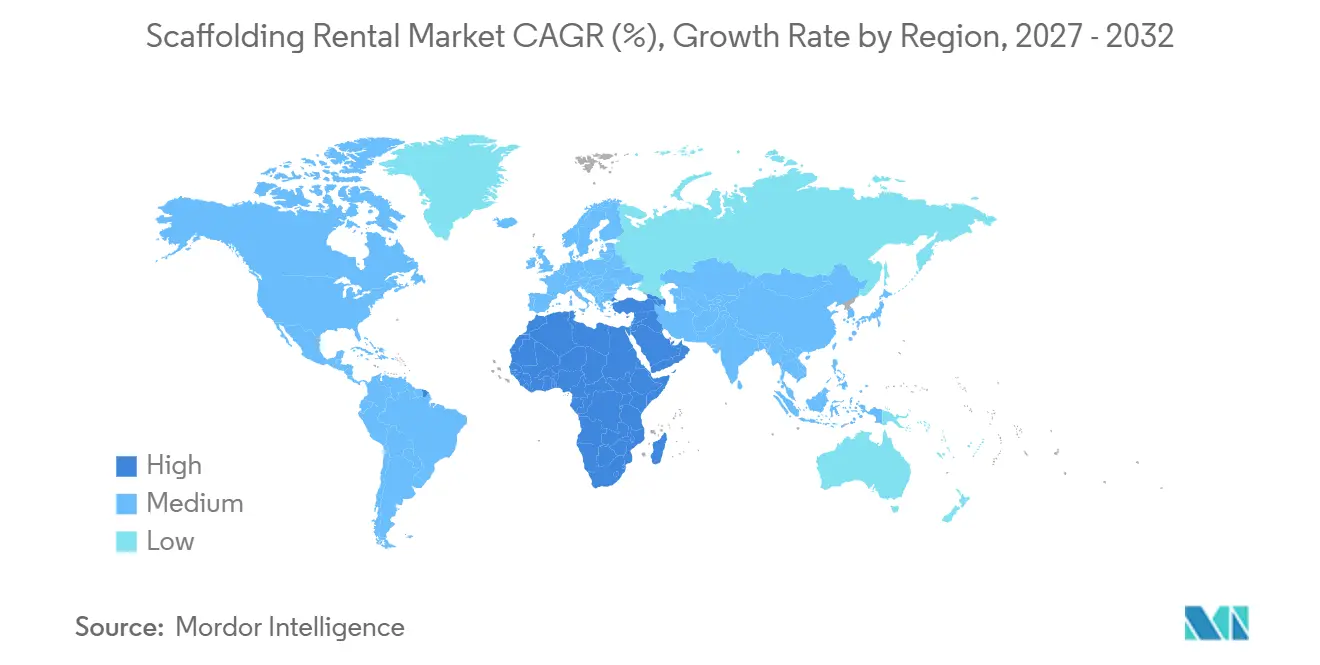
| Fastest Growing Market | Middle East and Africa |
| Largest Market | Asia-Pacific |
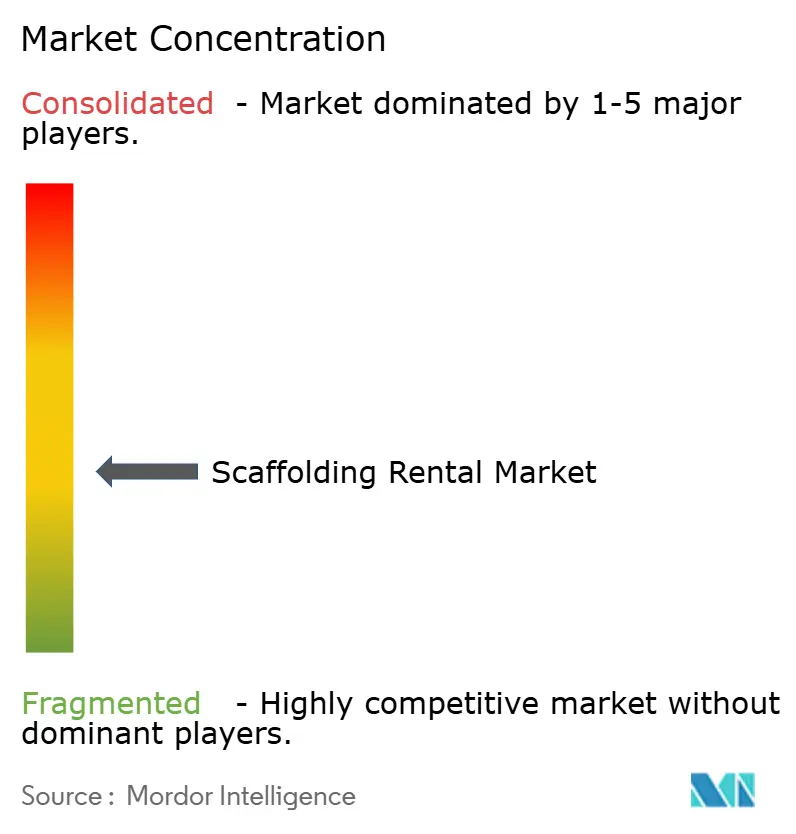
| Market Concentration | Medium |
Major Players *Disclaimer: Major Players sorted in no particular order Image © Mordor Intelligence. Reuse requires attribution under CC BY 4.0. | |
Scaffolding Rental Market Analysis by Mordor Intelligence
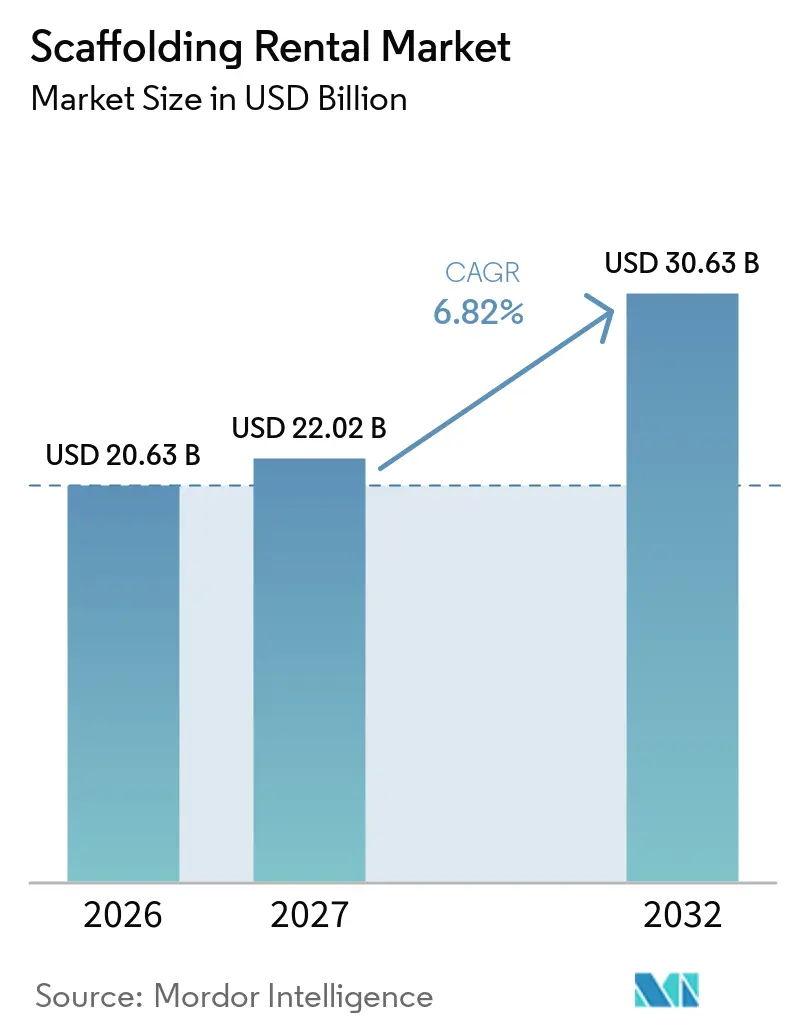
The Scaffolding Rental Market size was valued at USD 20.63 billion in 2026 and is estimated to grow from USD 22.02 billion in 2027 to reach USD 30.63 billion by 2032, at a CAGR of 6.82% during the forecast period (2027-2032).
The move from owned equipment to rented fleets supports demand because contractors can obtain compliant systems without carrying storage, inspection, and replacement costs between projects. Public infrastructure, industrial maintenance, and urban renewal create work that needs access equipment over multiple project phases. Modular systems and digital planning tools are making rental fleets easier to configure, track, and reuse across sites. Larger operators are responding through acquisitions, broader industrial service packages, and investment in fleet technology. Price pressure on steel and aluminum, along with shortages of qualified erection crews, may limit fleet expansion for smaller providers.
Key Report Takeaways
- By type, Supported Scaffold held 54% of the scaffolding rental market share in 2026, while Suspended Scaffold is forecast to grow at a 7.8% CAGR through 2032.
- By system, Modular and Ringlock accounted for 36% of the scaffolding rental market size in 2026 and is forecast to expand at an 8.2% CAGR through 2032.
- By material type, Steel held 63% of revenue in 2026 in the scaffolding rental market, while Aluminum is forecast to grow at an 8.3% CAGR through 2032.
- By sector, Infrastructure held 35% of revenue in 2026 in the scaffolding rental market, while Industrial and Logistics is forecast to grow at a 7.9% CAGR through 2032.
- By geography, Asia-Pacific held 43% of revenue in 2026 in the scaffolding rental market, while Middle East and Africa is forecast to grow at an 8.1% CAGR through 2032.
Note: Market numbers in this report are based on Mordor Intelligence's proprietary estimation framework, which combines nine months of actuals with Q4 projections for base year 2026.
Market Trends and Insights
Drivers Impact Analysis of Scaffolding Rental Market of Scaffolding Rental Market*
| Drivers | (~) % Impact on CAGR Forecast | Geographic Relevance | Impact Timeline |
|---|---|---|---|
| Infrastructure and Public Construction Investment | +2.2% | Global, highest in Asia-Pacific, Middle East, and North America | Long term (≥ 4 years) |
| Rising Rental Penetration Among Contractors | +2% | Global, highest in North America and Europe | Medium term (2-4 years) |
| High-Rise Construction and Urban Renewal | +1.8% | Asia-Pacific, Middle East, and Europe | Long term (≥ 4 years) |
| Industrial Shutdown and Maintenance Activity | +1.5% | Global, concentrated in North America, Europe, and the Middle East | Medium term (2-4 years) |
| Rental Demand for Complex, Short-Cycle Projects | +1.4% | North America, Europe, and Asia-Pacific | Short term (≤ 2 years) |
| Digital Scaffold Planning and Fleet Management | +1.2% | North America and Europe | Medium term (2-4 years) |
| Source: Mordor Intelligence | |||
Infrastructure and Public Construction Investment
Long-duration infrastructure programs create steady work for the scaffolding rental market because bridge repairs, rail expansion, and utility upgrades require access at several stages. Saudi Arabia, the United Arab Emirates, and Qatar remain key destinations for capital and infrastructure investment under national development programs. Airport work can also require substantial scaffold packages, as shown by Brogan Group's 2025 award for work at Terminals 1 and 2 of King Khalid International Airport. The project is part of the planned King Salman International Airport development, which will include 6 runways and 7 terminals. Public contracts also tend to require documented safety practices and reliable equipment records, which favors rental providers with established fleets. The scaffolding rental market therefore retains recurring demand even when private development is less active.
Rising Rental Penetration Among Contractors
Rental helps contractors use current scaffolding systems without committing capital to equipment that can stand unused between jobs, supporting the scaffolding rental market. This benefit is important where project starts are uncertain, and equipment needs vary by site. United Rentals reported 14% year-on-year growth in specialty rental revenue in the second quarter of 2025, with strength in infrastructure and nonresidential construction. The company also spent nearly USD 1.6 billion on rental capital expenditure during that quarter to meet demand. Complex systems can be difficult to transport, inspect, and store, which makes rental especially useful for industrial and infrastructure work. The scaffolding rental market benefits when customers view access equipment as a project service rather than a permanent asset purchase.
High-Rise Construction and Urban Renewal
High-rise work and renovation projects create demand for systems that can reach façades and elevated structures without relying on ground support. Suspended Scaffold is forecast to grow at 7.8% between 2027 and 2032 as dense urban projects and restoration work require flexible access. Brand Access Solutions provides internal and external scaffolding for the restoration of the A-listed Jenners department store in Edinburgh. The work runs from July 2024 through June 2027 and includes a 36-meter structure with 18 lifts and several bespoke configurations. Such projects are often scheduled around inspection, repair, and preservation work rather than only new building activity. That pattern can support steadier fleet use for rental providers serving cities with older building stock.
Industrial Shutdown and Maintenance Activity
Industrial plants need scaffold access during shutdowns for inspection, cleaning, catalyst replacement, and equipment repair. These jobs often require large equipment volumes within a short mobilization window. Equinor awarded long-term agreements for insulation, scaffolding, and surface treatment across 6 Norwegian onshore plants, with the contracts effective from January 2026[1]. The agreements show the value of combining access work with adjacent industrial services. New energy, processing, and logistics facilities can add construction demand while established plants continue to require maintenance access. This gives the scaffolding rental market a demand base that is not limited to residential or office construction and supports steadier equipment use.
Restraints Impact Analysis of Scaffolding Rental Market of Scaffolding Rental Market*
| Restraints | (~) % Impact on CAGR Forecast | Geographic Relevance | Impact Timeline |
|---|---|---|---|
| Skilled Erection Labor Shortages | -1.5% | Global, most acute in the United Kingdom and North America | Medium term (2-4 years) |
| Steel and Aluminum Price Volatility | -1.2% | Global, with the highest cost impact in North America | Short term (≤ 2 years) |
| Construction-Cycle Volatility and Project Delays | -1% | United Kingdom, Europe, and North America | Short term (≤ 2 years) |
| Substitution by Aerial Work Platforms and Rope Access | -0.8% | North America, Europe, and Australia | Long term (≥ 4 years) |
| Source: Mordor Intelligence | |||
Skilled Erection Labor Shortages
Qualified scaffold erection depends on specialized skills, including safe working load interpretation and technical drawing literacy. NASC and CISRS reported more than 1,200 unfilled scaffolding roles in the United Kingdom in January 2025. In the United States, 92% of construction firms hiring in August 2025 reported difficulty finding qualified workers, and 45% cited worker shortages as the leading cause of delays. The Construction Industry Training Board projected a need for 239,300 additional construction workers through 2029[2]. Labor shortages favor providers that can offer qualified crews alongside rental equipment. They can also limit how quickly the scaffolding rental market can take on new work.
Steel and Aluminum Price Volatility
Fleet replacement costs depend heavily on steel and aluminum because tubes, couplers, base plates, decks, and frames use these materials. The producer price index for steel mill products rose 27.6% year-on-year through September 2026, while aluminum mill shapes rose 25.2% over the same period. These increases raise the capital required to repair, replace, or expand rental fleets. The AGC also reported that some buyers seeking steel beams and structural shapes were being told that order books were full through spring 2027. Smaller operators may find it harder to protect margins when contracts use fixed prices over longer periods. The cost environment encourages more careful fleet purchasing and may increase interest in lighter or multi-material systems.
*Our forecasts treat driver/restraint impacts as directional, not additive. The impact forecasts reflect baseline growth, mix effects, and variable interactions.
Scaffolding Rental Market Segment Analysis
By Type:
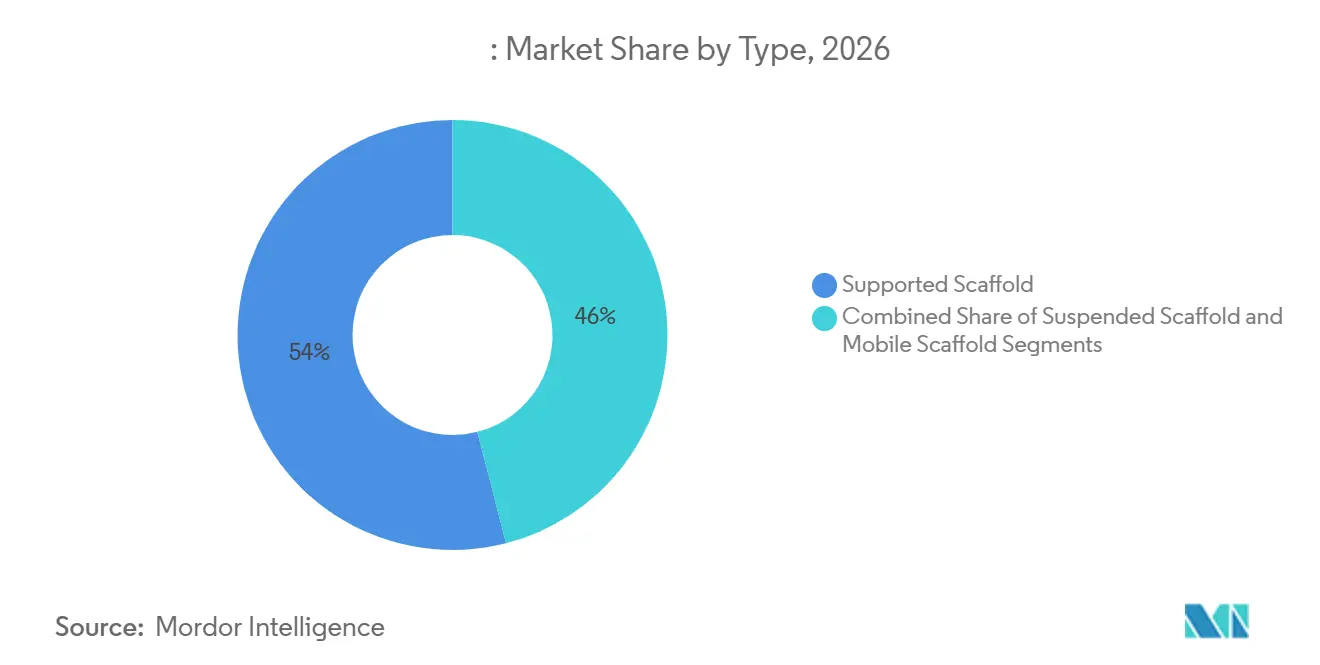
Supported Scaffold Remains the Broad-Based Access SystemSupported Scaffold held 54% of the scaffolding rental market share in 2026, reflecting its use in ground-level and mid-rise construction, industrial maintenance, and infrastructure rehabilitation. Its load-bearing ability and familiar configuration make it suitable for a wide range of project sizes. It works with Modular and Ringlock systems as well as Tube and Coupler arrangements. This flexibility helps rental operators serve customers with different site conditions without redesigning the entire access approach. Supported systems are especially relevant when work needs a stable platform area for several trades. Their lead reflects the continuing importance of mainstream construction and maintenance activity.
Suspended Scaffold is forecast to grow at a 7.8% CAGR through 2032 because high-rise construction, offshore work, and façade renovation need access beyond the practical reach of ground-supported equipment. BrandSafway used the QuikDeck system, custom stair towers, and more than 1,000 feet of custom-engineered access for the US 181 Harbor Bridge replacement. Mobile Scaffold also serves lighter inspection and maintenance work where repositioning speed is important. Work at height rules require safe installation and regular checks, which supports established providers with trained personnel and documented procedures. The scaffolding rental industry is therefore shaped by a large base of supported work and faster growth in systems used for technically demanding sites.

By System:
Modular and Ringlock Combines Scale with Faster AssemblyModular and Ringlock accounted for 36% of the scaffolding rental market size in 2026 and is forecast to expand at an 8.2% CAGR through 2032. The system allows rapid assembly across variable building shapes and can reduce labor time compared with older configurations. It is well suited to infrastructure work, industrial shutdowns, and high-rise projects that require repeated layouts. Connolly Scaffolding reported that the Plettac Metrix system scaffold supported 90% of its projects, alongside a GBP 3.5 million fleet investment with TRAD UK. This shows why system scaffolds have become a practical option for companies seeking better assembly speed and repeat use. The segment supports an ongoing conversion of rental fleets toward standardized modular components.
PERI deployed 3,400 tons of PERI UP Modular Scaffold at the Rotterdam Capacity Growth biofuel refinery expansion in the Netherlands[3]. The installation provided 100,000 m² of working platforms, showing the scale that modular systems can support. Tube and Coupler remains useful in the United Kingdom and parts of Asia-Pacific where irregular shapes and bespoke designs are common. Cuplock has a strong presence in India and Southeast Asia because of its affordability and fit with labor-intensive assembly practices. Frame and H-Frame systems remain relevant for mid-rise residential and commercial work in North America and Latin America. The scaffolding rental market size for modular systems is supported by projects that value speed, repeatability, and reliable safety performance.
By Material Type:
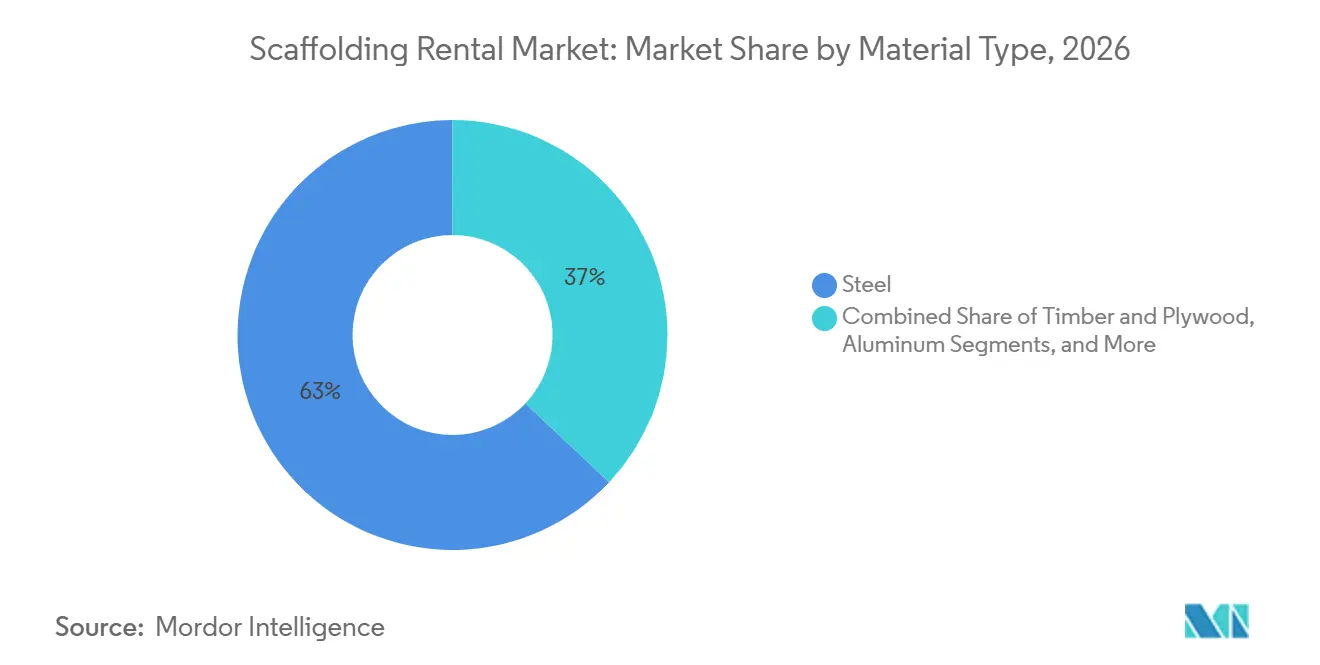
Steel Leads Fleet Volume While Aluminum Gains Use CasesSteel held 63% of revenue by material type in 2026 because it combines high load-bearing capacity with broad supply availability. Tube and Coupler systems in established markets are mainly steel, and many Modular and Ringlock fleets also use galvanized steel. Steel remains a practical material for demanding construction and industrial applications. Its large installed base gives rental providers a familiar equipment base and readily available components. However, changes in input costs affect replacement planning. The 2026 increase in steel product prices has made fleet renewal more expensive for operators.
Aluminum is forecast to grow at an 8.3% CAGR through 2032 as coastal construction, food processing, pharmaceutical manufacturing, and petrochemical facilities need materials with better corrosion resistance. Its lower weight can reduce transport effort and physical strain during erection. This matters in regions where experienced labor is scarce. Segouchi Shoji identified rising interest in modular and lightweight systems in Japan as the sector responds to an aging workforce. Timber and Plywood still serve price-sensitive work in some South and Southeast Asian locations. Plastic and Fiberglass remain relevant for electrical work and highly corrosive environments. Material choice in the scaffolding rental market increasingly depends on site conditions, labor availability, and the cost of fleet replacement.
By Sector:
Infrastructure Creates Volume and Industrial and Logistics Expands FasterInfrastructure held 35% of revenue in 2026, making it the largest sector in the scaffolding rental market. Bridge rehabilitation, road widening, transit construction, and utility programs each require access at several stages. These projects can create multi-year equipment demand because work moves through sequential phases. Brogan Group's work at King Khalid International Airport reflects the size of access packages needed for major infrastructure expansion. Commercial and residential work also contributes to equipment demand through renovation, fit-out, hotel refurbishment, and building maintenance. Infrastructure remains important because public projects can continue to create work across different economic cycles.
Industrial and Logistics is forecast to grow at a 7.9% CAGR through 2032. Refinery turnarounds, chemical plant maintenance, warehouses, cold storage sites, and data centers need access during construction and subsequent upkeep. PERI's Rotterdam project is an example of an energy-transition facility that required a large modular scaffold installation during expansion. Biofuel, liquefied natural gas, and battery plants can add both construction and maintenance requirements. Residential work remains meaningful in volume but is more exposed to financing costs and housing starts. These conditions make the scaffolding rental industry more dependent on infrastructure and industrial projects for stable utilization.
Geography Analysis
Asia-Pacific
Asia-Pacific held 43% of revenue in 2026, making it the largest geographic segment in the scaffolding rental market. China supports volume through urban regeneration, rail construction, and power projects, with increasing use of modular systems. India is moving toward a rental model as contractors seek to avoid ownership and storage costs across metro rail, industrial corridor, and data center activity. Rental represented 58% of India's scaffolding revenue in 2025 and is forecast to be the fastest-growing business model through 2031. Japan also has demand linked to renovation of healthcare facilities, older housing, and urban amenities as its population ages. Lightweight and modular systems can help address labor constraints in the region.
Middle East and Africa
Middle East and Africa is forecast to grow at an 8.1% CAGR through 2032, giving it the fastest regional growth rate in the scaffolding rental market. Saudi Vision 2030 projects, airport development, logistics construction, and commercial real estate investment support demand during the building phase. The region also has a recurring maintenance base from oil, gas, and petrochemical assets. Saudi Aramco reported capital investment of USD 52.2 billion in 2025 and guided USD 50 billion to USD 55 billion for 2026, which supports continuing field, processing, and plant work. Localization requirements can create opportunities for providers that build local depot capacity and train local crews. Project awards can be vulnerable to geopolitical conditions, so companies need balanced exposure across construction and maintenance work.
North America, Europe, and South America
North America benefits from recurring needs at aging bridges, industrial sites, and commercial façades. United Rentals reported continued strength in infrastructure and nonresidential construction in 2025, including demand from data centers, hospitals, and airports. Canada also supports demand through transit, municipal bridge, and facility upgrade programs. Europe has varied conditions, with construction pressure in Germany and the United Kingdom alongside support from infrastructure programs in Southern Europe. Layher opened a facility in Farnham, Quebec, in 2025 to provide local inventory and service to industrial, infrastructure, and construction clients. South America has demand from industrial expansion, mining infrastructure, and energy projects. These regions give the scaffolding rental market a mix of steady maintenance demand, public infrastructure work, and selective growth projects.
Competitive Landscape
The scaffolding rental market is moderately concentrated globally but remains fragmented across regional and national providers. Larger companies compete through geographic coverage, specialized equipment, industrial service packages, and fleet management systems. Altrad completed the acquisition of Stork's United Kingdom business on February 1, 2025, adding 1,900 employees and annual revenue of GBP 230.5 million to its operations. The acquisition expanded Altrad's offshore fabric maintenance activities and its onshore scaffolding, insulation, and painting offering. This type of transaction shows how service bundling can help suppliers capture work beyond equipment rental. It also improves the ability to support customers across maintenance, shutdown, and access needs.
Technology is becoming a clearer part of competition in the scaffolding rental market. Layher's SIM2Field system links digital planning with site layout and component-level positioning. Doka uses automated material counting to improve visibility of scaffolding and formwork inventory across its operations. Avontus reported that Actavo used ScaffoldIQ for request management, status tracking, and compliance documentation on large projects. These tools can reduce lost materials and improve the speed of planning and reporting. They also give mid-sized providers a path to improve operational control without building a fully centralized fleet structure.
Company activity also reflects continued interest in regional platforms and adjacent services. Homs Rentals entered a partnership with VGO Capital in May 2025 after completing 7 acquisitions across construction, rehabilitation, events, and industrial rental divisions. J-STAR facilitated a capital alliance between J-Step Holdings, Takahashigumi, and HB in Japan to support regional expansion in large-scale renovation, factory maintenance, and bridge repair work. Brand Access Solutions also rebranded from Lyndon SGB in February 2025, aligning its United Kingdom operations with the BrandSafway name. These actions show that brand integration, local scale, and a broader service mix remain important. The wider competitive field still includes many smaller firms that compete through local relationships, flexible pricing, and specialized delivery.
Scaffolding Rental Industry Leaders
-
BrandSafway
-
Altrad Group
-
United Rentals, Inc.
-
PERI SE
-
Layher Holding GmbH & Co. KG
- *Disclaimer: Major Players sorted in no particular order
Scaffolding Rental Market Companies Covered in this Report
- BrandSafway
- Altrad Group
- United Rentals, Inc.
- PERI SE
- Layher Holding GmbH & Co. KG
- ULMA Construction
- Ashtead Group plc
- Sunbelt Rentals
- ASNOVA Co., Ltd.
- The Brock Group
- Waco International
- Condor S.p.A.
- Beerenberg AS
- Altrad RMD Kwikform
- Scafom-rux
- MJ-Gerüst GmbH
- Atlantic Pacific Equipment LLC
- Enigma Industrial Services
- Loxam Group
- American Scaffolding
Recent Industry Developments in Scaffolding Rental Market
- October 2026: Brogan Group was awarded a scaffolding access package for a monorail station linked to the Riyadh Metro at King Abdullah Financial District (KAFD), supporting construction of a 3.6-kilometre elevated circular loop with six stations. The project highlights continued demand for specialized scaffolding and temporary access solutions in large-scale transport infrastructure projects and strengthens Brogan Group's presence across the Riyadh Metro programme.
- October 2026: BWYS Group Bhd completed the acquisition of a freehold industrial land parcel in Kuala Langat, Selangor, for approximately USD 23.1 million to expand the operational capacity of its BW Scaffold business, which provides scaffolding rental and sheet-metal products. The company plans to develop a new facility on the site to support expected growth in Malaysia's scaffolding rental demand while reducing existing rental expenses of approximately USD 0.65 million annually.
- September 2026: Altrad Group launched Altrad Hire & Sales following the merger of Generation Hire & Sales and TRAD UK. The unified platform provides scaffolding, access, temporary works, and construction equipment across the UK and Ireland, strengthening Altrad's position in the European scaffolding rental market.
Global Scaffolding Rental Market Report Scope
Segmentation Overview
| Supported Scaffold |
| Suspended Scaffold |
| Mobile Scaffold |
| Tube and Coupler |
| Cuplock |
| Modular and Ringlock |
| Frame and H-Frame |
| Timber and Plywood |
| Steel |
| Aluminum |
| Plastic and Fiberglass |
| Others |
| Residential |
| Commercial |
| Industrial and Logistics |
| Infrastructure |
| North America | United States |
| Canada | |
| Mexico | |
| Europe | Germany |
| United Kingdom | |
| France | |
| Italy | |
| Spain | |
| Rest of Europe | |
| Asia-Pacific | China |
| India | |
| Japan | |
| South Korea | |
| Australia | |
| Rest of Asia-Pacific | |
| South America | Brazil |
| Argentina | |
| Chile | |
| Rest of South America | |
| Middle East & Africa | United Arab Emirates |
| Saudi Arabia | |
| South Africa | |
| Nigeria | |
| Rest of Middle East & Africa |
| By Type | Supported Scaffold | |
| Suspended Scaffold | ||
| Mobile Scaffold | ||
| By System | Tube and Coupler | |
| Cuplock | ||
| Modular and Ringlock | ||
| Frame and H-Frame | ||
| By Material Type | Timber and Plywood | |
| Steel | ||
| Aluminum | ||
| Plastic and Fiberglass | ||
| Others | ||
| By Sector | Residential | |
| Commercial | ||
| Industrial and Logistics | ||
| Infrastructure | ||
| By Region | North America | United States |
| Canada | ||
| Mexico | ||
| Europe | Germany | |
| United Kingdom | ||
| France | ||
| Italy | ||
| Spain | ||
| Rest of Europe | ||
| Asia-Pacific | China | |
| India | ||
| Japan | ||
| South Korea | ||
| Australia | ||
| Rest of Asia-Pacific | ||
| South America | Brazil | |
| Argentina | ||
| Chile | ||
| Rest of South America | ||
| Middle East & Africa | United Arab Emirates | |
| Saudi Arabia | ||
| South Africa | ||
| Nigeria | ||
| Rest of Middle East & Africa | ||
Key Questions Answered in the Report
What is the forecast growth rate for scaffolding rentals?
The scaffolding rental market is forecast to grow at a 6.82% CAGR from 2027 to 2032, reaching USD 30.6 billion by 2032.
Which scaffolding type has the largest share?
Supported Scaffold led with a 54% share in 2026 because it serves a broad range of construction, maintenance, and infrastructure applications.
Which system is growing fastest?
Modular and Ringlock is forecast to grow at an 8.2% CAGR through 2032. Its fast assembly and repeat use support demand on complex projects.
Which material is expected to grow fastest?
Aluminum is forecast to grow at an 8.3% CAGR through 2032, supported by corrosion-sensitive sites and its lower weight.
Which end-use sector offers the fastest growth?
Industrial and Logistics is forecast to expand at a 7.9% CAGR through 2032 due to plant maintenance, warehouses, data centers, and energy facilities.
Which region will grow the fastest?
Middle East and Africa is forecast to grow at an 8.1% CAGR through 2032, supported by major construction programs and industrial maintenance demand.