
Saudi Arabia Same Day Delivery Market Size and Share
Market Overview
| Study Period | 2021 - 2032 |
|---|---|
| Forecast Data Period | 2027 - 2032 |
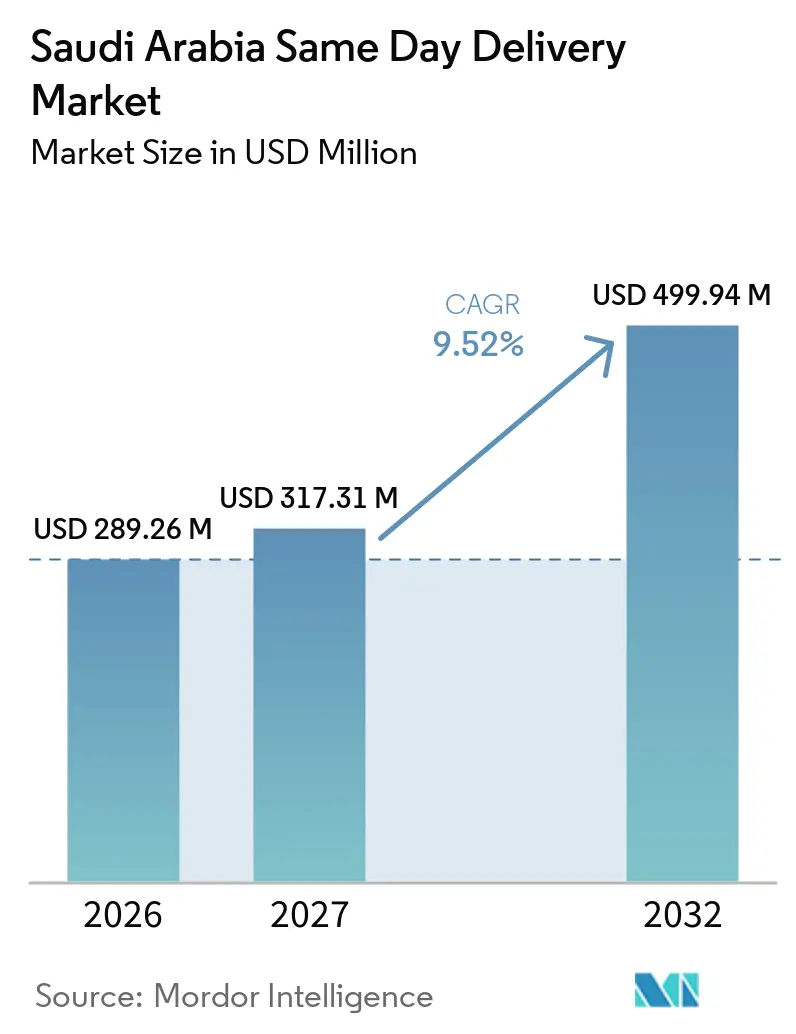
| Base Year Market Size (2026) | USD 289.26 Million |
| Market Size (2027) | USD 317.31 Million |
| Market Size (2032) | USD 499.94 Million |
| Growth Rate (2027 - 2032) | 9.52 % |
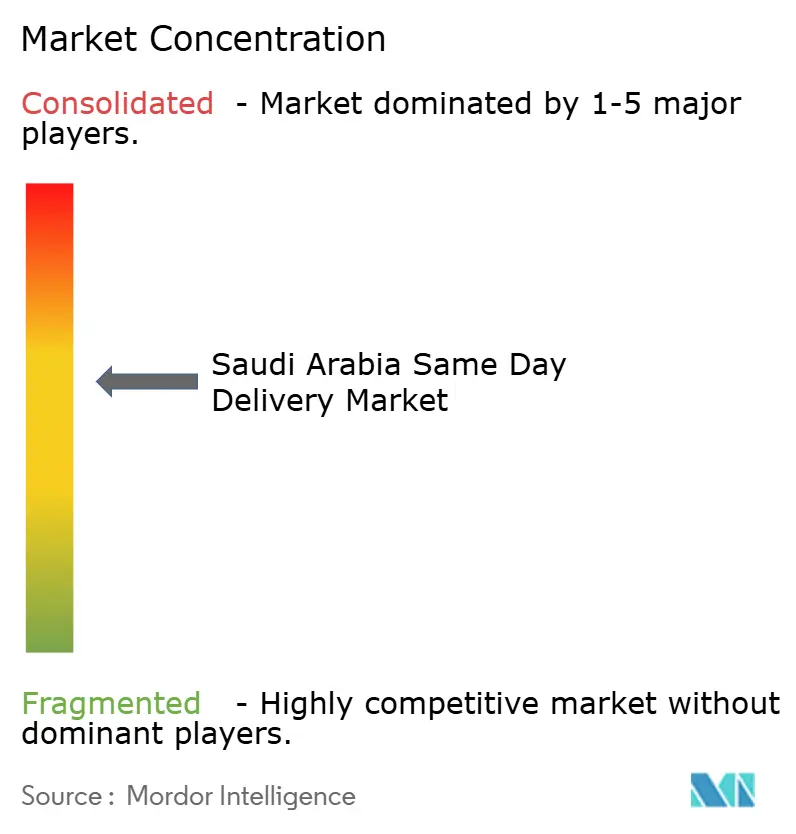
| Market Concentration | Medium |
Major Players *Disclaimer: Major Players sorted in no particular order Image © Mordor Intelligence. Reuse requires attribution under CC BY 4.0. | |
Saudi Arabia Same Day Delivery Market Analysis by Mordor Intelligence
The Saudi Arabia same day delivery market size is valued at USD 289.26 million in 2026. It is estimated to grow from USD 317.31 million in 2027 to reach USD 499.94 million by 2032, at a CAGR of 9.52% during the forecast period (2027-2032).
Growth is supported by expanding e-commerce activity, wider adoption of digital payments, and investment in logistics infrastructure. Denser fulfillment networks in Riyadh and Jeddah allow retailers to position inventory closer to customers and shorten delivery times. Operators are increasingly focusing on inventory placement, route planning, and reliable payment confirmation alongside fleet capacity. Licensing requirements and the cost of serving sparsely populated areas may favor established operators with compliant networks and local infrastructure. Healthcare deliveries, scheduled services, and expansion into secondary cities offer additional opportunities, although profitability will depend on route density and efficient capacity management.
Key Report Takeaways
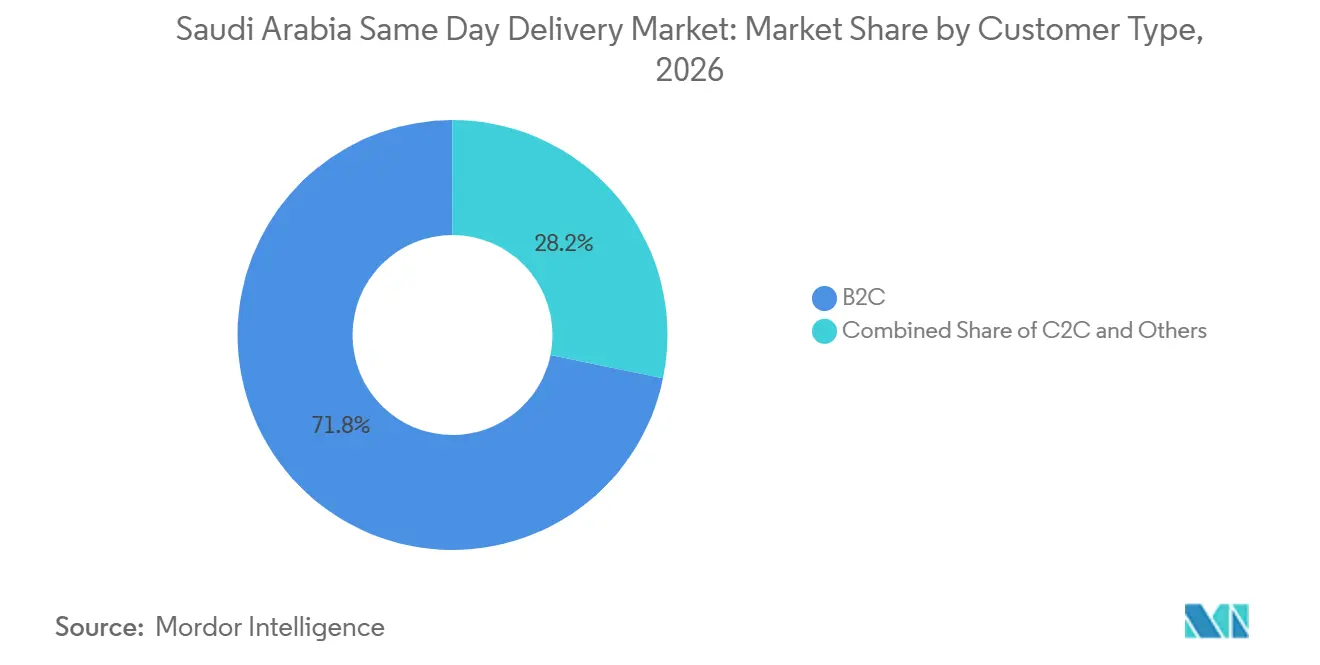
- By customer type, B2C accounts for 71.78% of the Saudi Arabia same day delivery market share in 2026, while C2C is forecast to record the fastest growth, at a CAGR of 11.45% during 2026–2032.
- By service model, standard same day accounts for 45.89% of the Saudi Arabia same day delivery market size in 2026, while scheduled same day is forecast to register at a CAGR of 12.93% during 2026–2032.
- By shipment type, parcels and small packages account for 56.83% of the Saudi Arabia same day delivery market share in 2026, while medium and large parcels are forecast to register at a CAGR of 11.98% during 2026–2032.
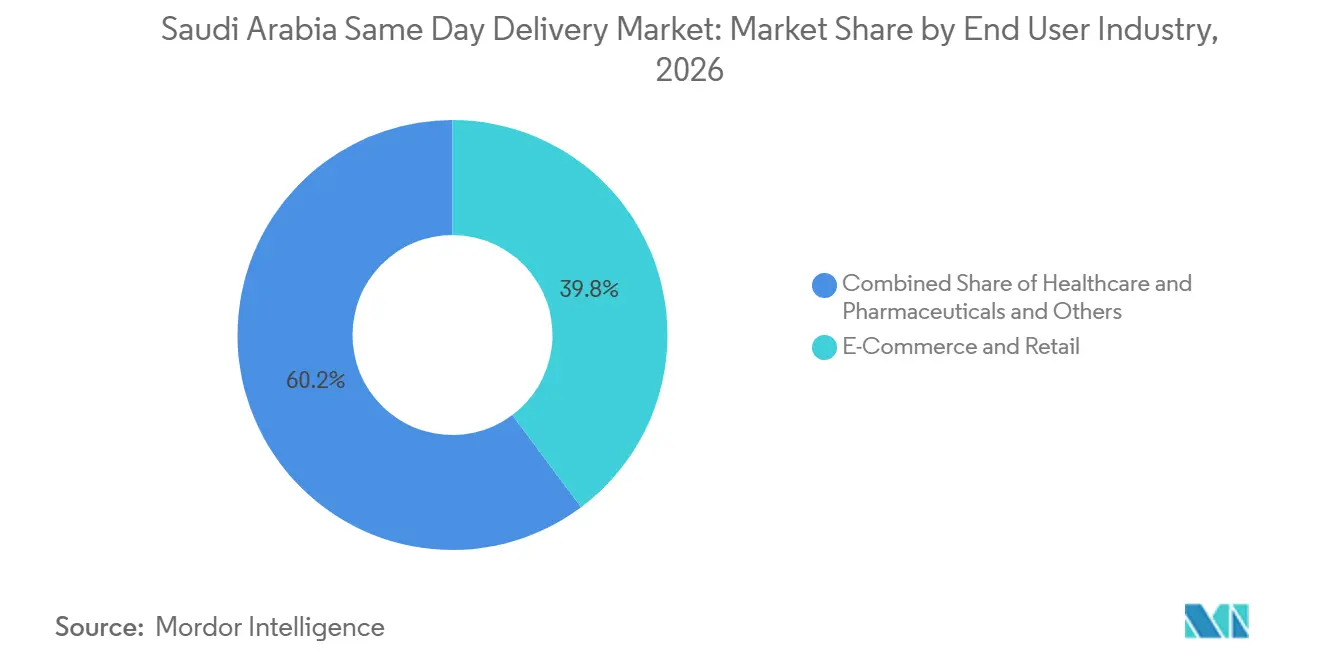
- By end-user industry, e-commerce and retail account for 39.79% of the Saudi Arabia same day delivery market share in 2026, while healthcare and pharmaceuticals are forecast to register at a CAGR of 12.73% during 2026–2032.
- By region, the Central region accounts for 45.73% of the Saudi Arabia same day delivery market size in 2026, while the Western region is forecast to register a CAGR of 12.46% during 2026–2032.
Note: Market numbers in this report are based on Mordor Intelligence's proprietary estimation framework, which combines nine months of actuals with Q4 projections for base year 2026.
Saudi Arabia Same Day Delivery Market Trends and Insights
Drivers Impact Analysis*
| Driver | (~) % Impact on CAGR Forecast | Geographic Relevance | Impact Timeline |
|---|---|---|---|
| E-Commerce Growth Expanding Same Day Delivery Demand | +3.2% | National, with concentration in Riyadh, Jeddah, and Dammam | Short term (≤ 2 years) |
| Faster Fulfillment Expectations Increasing Delivery Speed Requirements | +2.1% | National; strongest in Central and Western regions | Short term (≤ 2 years) |
| Vision 2030 Investment Strengthening Digital Logistics Infrastructure | +2.0% | National, with early gains in SILZ, SPARK, and Jeddah Islamic Port corridors | Long term (≥ 4 years) |
| Digital Payments Accelerating Mobile-First Delivery Order Growth | +1.5% | National, with higher penetration in urban centers | Medium term (2–4 years) |
| Dark-Store Expansion Improving Same Day Fulfillment Proximity | +1.2% | Central (Riyadh) and Western (Jeddah) with spill-over to Eastern province | Medium term (2–4 years) |
| Autonomous Delivery Technologies Improving Last-Mile Network Resilience | +0.8% | National, with early gains in Riyadh, Jeddah, and Hajj corridors | Long term (≥ 4 years) |
| Source: Mordor Intelligence | |||
E-Commerce Growth Expanding Same Day Delivery Demand
Expanding online retail activity is increasing the volume of orders that merchants must fulfill on the same day. E-commerce spending through Mada cards increased by 42% year over year to SAR 98.4 billion (USD 26.22 billion) in the first quarter of 2026[1]. It also indicates growth in the Retail Trade E-Commerce Sales Index during the same period. The growing use of prepaid transactions can reduce payment-related delays and enable merchants to confirm orders before dispatching couriers. As consumers purchase products online across a wider range of categories, delivery operators require accurate address data, reliable handoffs, and closer coordination with retailers to maintain service reliability.
Faster Fulfillment Expectations Increasing Delivery Speed Requirements
Consumers increasingly expect rapid delivery for food, groceries, beauty products, pharmacy purchases, and convenience items. App-based ordering creates a need for delivery networks that can handle frequent orders within narrow time windows. Jahez's FY 2025 order volume and gross merchandise value growth are indicators of this demand. Shorter delivery windows require operators to organize service areas around local order density rather than relying solely on conventional delivery routes. Retailers may respond by positioning inventory in stores, dark stores, and micro-fulfillment locations near high-demand neighborhoods. Scheduled services can also help group nearby orders while maintaining a defined delivery commitment.
Vision 2030 Investment Strengthening Digital Logistics Infrastructure
Saudi Arabia's transport and logistics development plans are intended to strengthen the Kingdom's role as a regional logistics hub. Investment in logistics zones, warehousing, and transport connections can improve access to imported goods and support more efficient domestic distribution. DHL Supply Chain's planned logistics hub is in the Special Integrated Logistics Zone in Riyadh, and a proposed facility is at King Salman Energy Park in the Eastern Province. These developments could improve inventory availability and create additional links between major distribution centers and urban delivery networks. Over time, additional logistics infrastructure may support same day delivery beyond the largest urban markets, although its impact will depend on merchant adoption and local order density.
Digital Payments Accelerating Mobile-First Delivery Order Growth
Digital payments can simplify order confirmation and reduce the handling time associated with cash collection at delivery. Electronic payments represented 85% of retail payment volume in Saudi Arabia in 2025, compared with 79% in 2024[2]. For delivery operators, prepaid orders can make dispatch decisions more predictable and reduce the time couriers spend completing transactions at customers' doorsteps. Digital payment records can also help reconcile orders and improve coordination between merchants and carriers. These benefits are particularly relevant to app-based purchases in food, beauty, pharmacy, and other consumer categories.
Restraints Impact Analysis*
| Restraint | (~) % Impact on CAGR Forecast | Geographic Relevance | Impact Timeline |
|---|---|---|---|
| Low-Density Deliveries Increasing Last-Mile Service Costs | -2.8% | National; most acute in Northern and Southern regions | Long term (≥ 4 years) |
| Courier Compliance Costs Pressuring Delivery Operating Economics | -1.6% | National; implementation concentrated in major cities | Medium term (2–4 years) |
| Extreme Heat Reducing Rider Productivity and Reliability | -1.1% | National, with highest severity in interior and southern geographies | Short term (≤ 2 years) |
| Seasonal Demand Peaks Increasing Same Day Capacity Volatility | -0.7% | Western (Makkah, Medina) during Hajj; national during Ramadan | Short term (≤ 2 years) |
| Source: Mordor Intelligence | |||
Low-Density Deliveries Increasing Last-Mile Service Costs
Low order density can make same day delivery expensive outside major urban centers. When customers are spread across large areas, couriers may travel longer distances between stops and complete fewer deliveries per route. Same day services have limited flexibility to postpone individual shipments until a route becomes sufficiently full, which can put pressure on delivery costs. Operators therefore need well-defined delivery zones, efficient route planning, and reliable address information to maintain productivity. High temperatures may create additional operating challenges, particularly for time-sensitive or temperature-controlled shipments. Demand peaks during Ramadan and Hajj can also require temporary capacity adjustments around Makkah and Medina.
Courier Compliance Costs Pressuring Delivery Operating Economics
Regulatory requirements can increase the cost of operating a formal delivery network, particularly for smaller businesses. The Ministry of Municipalities and Housing introduced a Home Delivery Permit service in June 2025, with mandatory enforcement beginning on July 1, 2025[3]. It also refers to requirements relating to delivery-worker health certificates, vehicle identification, and product-handling specifications. Licensing and compliance can require investment in trained personnel, compliant vehicles, and operating systems. Although these requirements may raise costs, they can also improve customer safety, accountability, and service standards.
*Our forecasts treat driver/restraint impacts as directional, not additive. The impact forecasts reflect baseline growth, mix effects, and variable interactions.
Segment Analysis
By Customer Type: B2C Leads Current Demand While C2C Expands
B2C accounted for 71.78% of the Saudi Arabia same day delivery market share in 2026. B2C demand is supported by consumer e-commerce, food delivery, and other platform-based purchases. Retailers use same day delivery to fulfil urgent orders and offer customers faster alternatives to conventional shipping. B2B shipments also contribute to demand, particularly for healthcare supplies, office replenishment, and industrial components. Their delivery requirements vary according to the urgency of the shipment and the operating needs of the business customer.
C2C is forecast to register a CAGR of 11.45% during 2026–2032. C2C services allow individuals to arrange deliveries through digital platforms without operating as formal merchants. Peer-to-peer marketplaces and app-based courier services can increase demand for tracked deliveries between households and other individual senders. These shipments may be less geographically concentrated than orders originating from retail stores or fulfillment centers, making route planning and courier allocation important. Operators need reliable address information and effective matching systems to combine deliveries where possible without compromising the promised delivery time. The segment's growth potential will depend on customer adoption, service reliability, and the ability to manage fragmented pickup and drop-off locations economically.

By Service Model: Scheduled Delivery Supports Better Network Use
Standard same day accounts for 45.89% of the Saudi Arabia same day delivery market share in 2026. Standard same day supports merchants that accept orders before a defined cutoff and deliver them later that day. It suits consumer purchases that require quick fulfillment but do not necessarily need immediate dispatch. On-demand and instant delivery serve more time-sensitive purchases, including food, pharmacy products, and convenience groceries. The choice of service model depends on customer urgency, inventory proximity, order density, and the delivery cost merchants and customers are willing to bear.
Scheduled same day is forecast to register at a CAGR of 12.93% during 2026–2032. Scheduled same day lets customers select a delivery window within the same day. This approach can help operators group shipments by area and time, potentially increasing stops per route and reducing idle capacity. Partnerships between digital platforms and retailers can also broaden access to local inventory and delivery networks. Scheduled services may appeal to merchants seeking predictable fulfillment without paying for immediate dispatch, although their effectiveness depends on accurate slot planning and sufficient order density.
By Shipment Type: Small Parcels Provide the Largest Volume Base
Parcels and small packages account for 56.83% of the Saudi Arabia same day delivery market share in 2026. Small shipments include apparel, beauty products, accessories, documents, and selected pharmacy items. Their handling requirements make them suitable for motorcycles, passenger vehicles, and compact fulfillment locations. Documents can also require rapid delivery for financial, legal, and administrative purposes. Larger shipments generally require more vehicle capacity, additional handling, or coordinated delivery arrangements, which can raise costs and complicate first-attempt delivery.
Medium and large parcels are forecast to register at a CAGR of 11.98% during 2026–2032. Medium and large parcels may benefit from retailers offering faster delivery for home furnishings, larger consumer electronics, and other bulky goods. Serving these shipments requires accurate order dimensions, appropriate vehicles, and delivery windows that reflect handling needs. Dense residential areas may make such services more practical by reducing travel between stops. Operators also need to account for additional labor, vehicle utilization, and the cost of failed deliveries. Expansion will therefore depend on local demand, merchant inventory placement, and the ability to price larger shipments in a way that covers their higher service requirements.
By End-User Industry: Healthcare and Pharmaceuticals Have the Fastest Growth
E-Commerce and retail account for 39.79% of the Saudi Arabia same day delivery market share in 2026. Retail demand includes online purchases of apparel, beauty products, consumer goods, and other items for which delivery speed can influence the customer experience. Food and grocery orders also contribute to the wider rapid-delivery ecosystem. Retailers can use local stores and fulfillment points to place products closer to customers and reduce delivery distances.
Healthcare and pharmaceuticals are forecast to register at a CAGR of 12.73% during 2026–2032. Healthcare and pharmaceuticals may grow faster because medical products and prescriptions can require timely delivery and careful handling. The medical-supply drone initiative was conducted during Hajj in June 2025, involving government and technology partners. It reports a reduction in delivery time from more than 90 minutes to less than 6 minutes at Mina and Arafat[4]. Healthcare delivery requires secure handoffs and, for some products, temperature control and adherence to applicable handling standards. These requirements can create opportunities for specialized providers, but the potential market impact depends on the scale of commercial adoption beyond pilot programs.
Geography Analysis
The Central region accounts for 45.73% of market share in 2026, supported by Riyadh’s position as a major center for consumer demand and logistics activity. DHL Supply Chain plans to establish a hub at the Special Integrated Logistics Zone in Riyadh, with operations targeted to begin in 2027. SMSA also plans to convert selected service centers into fulfillment nodes. Logistics facilities near airports and urban consumption centers enable retailers to position inventory closer to customers, while localized fulfillment operations can reduce delivery distances. The resulting improvement in same day delivery performance will depend on the integration of these assets with merchant inventory systems and courier networks.
The Western region is projected to register a CAGR of 12.46% during 2026–2032. Jeddah’s role as a major commercial gateway, combined with consumer demand in Makkah and Medina, supports parcel delivery and rapid-delivery services. Pilgrimage periods create specific capacity-planning requirements, while residential and commercial demand supports year-round delivery activity. Medical drone deliveries during Hajj and the Maersk–Saudi Post agreement demonstrate developments in specialized medical logistics and cross-border fulfillment.
The Eastern region combines consumer delivery demand in Dammam and Al-Khobar with business demand associated with industrial and energy activities. The proposed logistics facility at King Salman Energy Park could strengthen distribution links between the Eastern Province and other parts of Saudi Arabia. Its contribution to same day delivery services will depend on the types of goods handled, participating merchants, and integration with local courier networks. Northern and Southern areas operate under conditions that differ from those of major metropolitan markets, including more dispersed demand and potentially longer distances between delivery stops. Expansion in these areas will depend on serviceable order density, reliable addressing systems, local infrastructure, and commercially viable route planning.
Competitive Landscape
The Saudi Arabia same day delivery market is consolidated, with competition among digital platforms, parcel carriers, express logistics providers, and fulfillment companies. Platform-linked operators differentiate themselves through customer reach, order frequency, local inventory availability, and delivery speed. Asset-backed providers compete based on geographic coverage, business-to-business delivery capabilities, established logistics facilities, and compliance with applicable operating requirements.
Strategic partnerships and investments offer opportunities to extend customer access, expand fulfillment capacity, and strengthen delivery networks. Closer integration between consumer-facing platforms and established logistics providers can improve coordination across order fulfillment and last-mile delivery, supporting broader service coverage and more consistent delivery performance. Technology remains a key competitive differentiator, with automated sorting, inventory visibility, dispatch management, and route optimization supporting operational efficiency. Providers that integrate these capabilities effectively can improve delivery reliability, manage peak demand, and control fulfillment costs.
Growth opportunities include healthcare deliveries, scheduled business shipments, and consumer-to-consumer services, particularly in secondary cities. Sustainable expansion will depend on maintaining compliant operations, providing reliable service, and matching network investment with demand while optimizing vehicle and delivery-personnel utilization.
Saudi Arabia Same Day Delivery Industry Leaders
-
Saudi Post | SPL (including NAQEL Express)
-
Jahez Group (including Jahez and Logi)
-
Aramex
-
DHL Group
-
SMSA Express Transportation Company Ltd
- *Disclaimer: Major Players sorted in no particular order
Recent Industry Developments
- February 2026: ASMO and Arcapita agreed to develop a logistics facility at King Salman Energy Park in the Eastern Province. The site is 1.4 million m², including a temperature-controlled warehouse and a large open yard.
- November 2025: DHL Supply Chain signed a land lease agreement to develop a regional logistics and distribution hub at Saudi Arabia's Special Integrated Logistics Zone in Riyadh. The EUR 130 million (USD 152.92 million) investment covers a 78,000 m² site, including 53,000 m² of warehouse space, with completion planned for the second quarter of 2027.
- August 2025: DHL eCommerce completed a strategic minority investment in AJEX Logistics Services, a Saudi-based parcel operator. AJEX operates more than 60 facilities, 1,200 vehicles, and a workforce of 2,000 professionals across Saudi Arabia and the wider GCC.
- July 2025: Saudi Post and Maersk signed a memorandum of understanding to develop integrated cross-border e-commerce logistics services in Saudi Arabia. The arrangement was described as combining Maersk's international transportation and bonded fulfillment capabilities with Saudi Post's customs clearance and final-mile delivery network.
Saudi Arabia Same Day Delivery Market Report Scope
| B2C |
| B2B |
| C2C |
| On-Demand / Instant |
| Scheduled Same Day |
| Standard Same Day |
| Parcels and Small Packages |
| Documents |
| Medium and Large Parcels |
| Bulky / Heavy Shipments |
| E-commerce and Retail |
| Food and Grocery |
| Healthcare and Pharmaceuticals |
| Consumer Electronics |
| Fashion and Apparel |
| Business Services |
| Home and Furniture |
| Others |
| Central (Riyadh, Al-Qassim, and Hail) |
| Eastern (Ash-Sharqiyah) |
| Western (Al-Bahah, Makkah, Medina, and Tabuk) |
| Northern (Al-Jouf and Arar) |
| Southern (Asir, Jazan, and Najran) |
| By Customer Type | B2C |
| B2B | |
| C2C | |
| By Service Model | On-Demand / Instant |
| Scheduled Same Day | |
| Standard Same Day | |
| By Shipment Type | Parcels and Small Packages |
| Documents | |
| Medium and Large Parcels | |
| Bulky / Heavy Shipments | |
| By End-User Industry | E-commerce and Retail |
| Food and Grocery | |
| Healthcare and Pharmaceuticals | |
| Consumer Electronics | |
| Fashion and Apparel | |
| Business Services | |
| Home and Furniture | |
| Others | |
| By Region | Central (Riyadh, Al-Qassim, and Hail) |
| Eastern (Ash-Sharqiyah) | |
| Western (Al-Bahah, Makkah, Medina, and Tabuk) | |
| Northern (Al-Jouf and Arar) | |
| Southern (Asir, Jazan, and Najran) |
Key Questions Answered in the Report
What is the forecast growth rate for same day delivery in Saudi Arabia?
The market is projected to register a CAGR of 9.52% during 2027–2032, increasing from USD 317.31 million in 2027 to USD 499.94 million in 2032. E-commerce activity, digital payments, and investment in fulfillment infrastructure support growth.
Which customer type leads same day delivery demand in Saudi Arabia?
B2C accounts for 71.78% of the market in 2026, supported by consumer e-commerce and app-based delivery demand. C2C is forecast to be the fastest-growing customer type, with a CAGR of 11.45% during 2026–2032.
Which service model is growing fastest in Saudi Arabia?
Scheduled same day is forecast to register a CAGR of 12.93% during 2026–2032. Scheduled delivery windows can help operators group shipments by location and use vehicles and couriers more efficiently.
Why is healthcare delivery growing quickly in Saudi Arabia?
Healthcare and pharmaceuticals are forecast to register a CAGR of 12.73% during 2026–2032. Demand for timely medical deliveries and the need for reliable handling create opportunities for specialized services. The scale of future growth will depend on adoption, infrastructure, and compliance requirements.
Which Saudi region has the largest same day delivery market share?
The Central region accounts for 45.73% of the market in 2026, supported by Riyadh's concentration of consumers, businesses, and logistics infrastructure. The Western region is forecast to register the fastest growth rate, with a CAGR of 12.46% during 2026–2032.
What limits same day delivery expansion outside major Saudi cities?
Low order density, last-mile operating costs, regulatory compliance, high temperatures, and seasonal demand peaks can constrain expansion. Operators need efficient routes, suitable local fulfillment infrastructure, and sufficient order volumes to provide reliable service at sustainable costs.