
Saudi Arabia Modern Methods Of Construction Market Size and Share
Market Overview
| Study Period | 2021 - 2032 |
|---|---|
| Forecast Data Period | 2027 - 2032 |
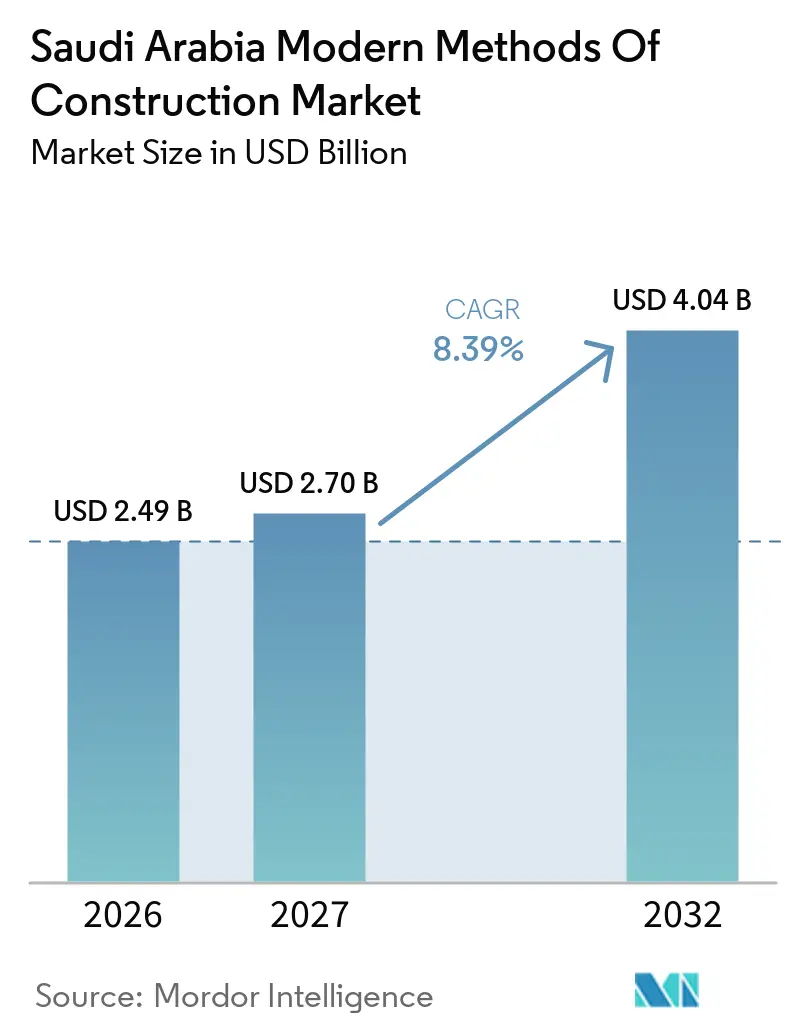
| Base Year Market Size (2026) | USD 2.49 Billion |
| Market Size (2027) | USD 2.70 Billion |
| Market Size (2032) | USD 4.04 Billion |
| Growth Rate (2027 - 2032) | 8.39 % |
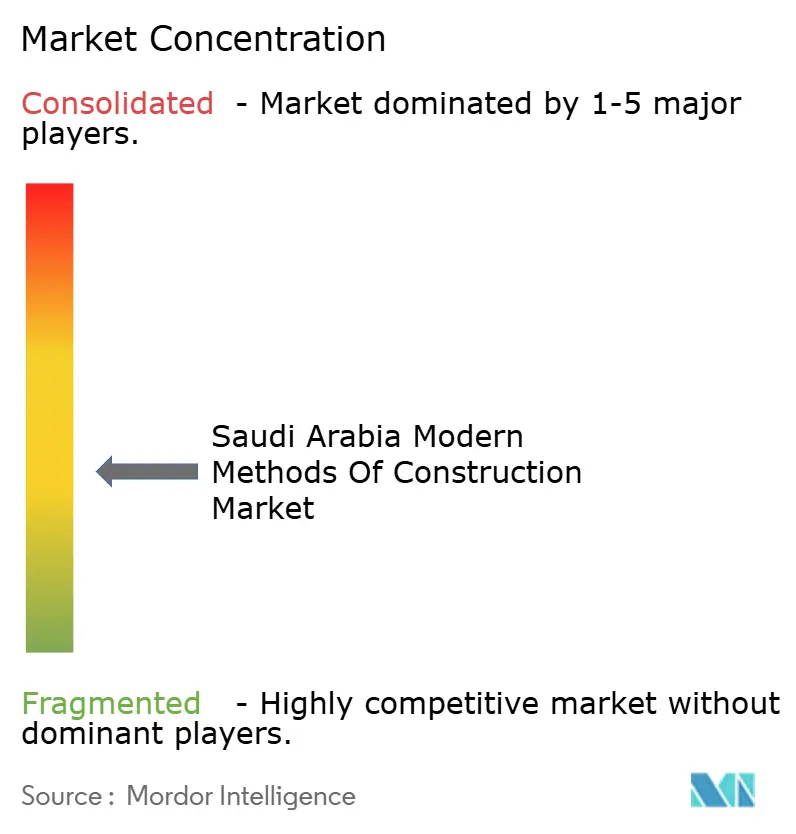
| Market Concentration | Medium |
Major Players *Disclaimer: Major Players sorted in no particular order Image © Mordor Intelligence. Reuse requires attribution under CC BY 4.0. | |
Saudi Arabia Modern Methods Of Construction Market Analysis by Mordor Intelligence
The Saudi Arabia Modern Methods Of Construction Market size is expected to increase from USD 2.49 billion in 2026 to USD 2.70 billion in 2027 and reach USD 4.04 billion by 2032, growing at a CAGR of 8.39% over 2027-2032.
Public housing, tourism, industrial development, and social infrastructure are moving more projects toward repeatable factory production. The Ministry of Municipalities and Housing has supported more than 22 Saudi factories under its Modern Building Initiative, with combined annual capacity above 40,000 homes, and it announced financing for 4 additional factories in June 2026. This support changes procurement from isolated project orders toward a more stable manufacturing base. Large master developers are also raising the value of production capacity, certification, and delivery records. The Saudi Arabia modern methods of construction market therefore has room for firms that can combine factory output with installation, quality control, and local supply relationships.
Key Report Takeaways
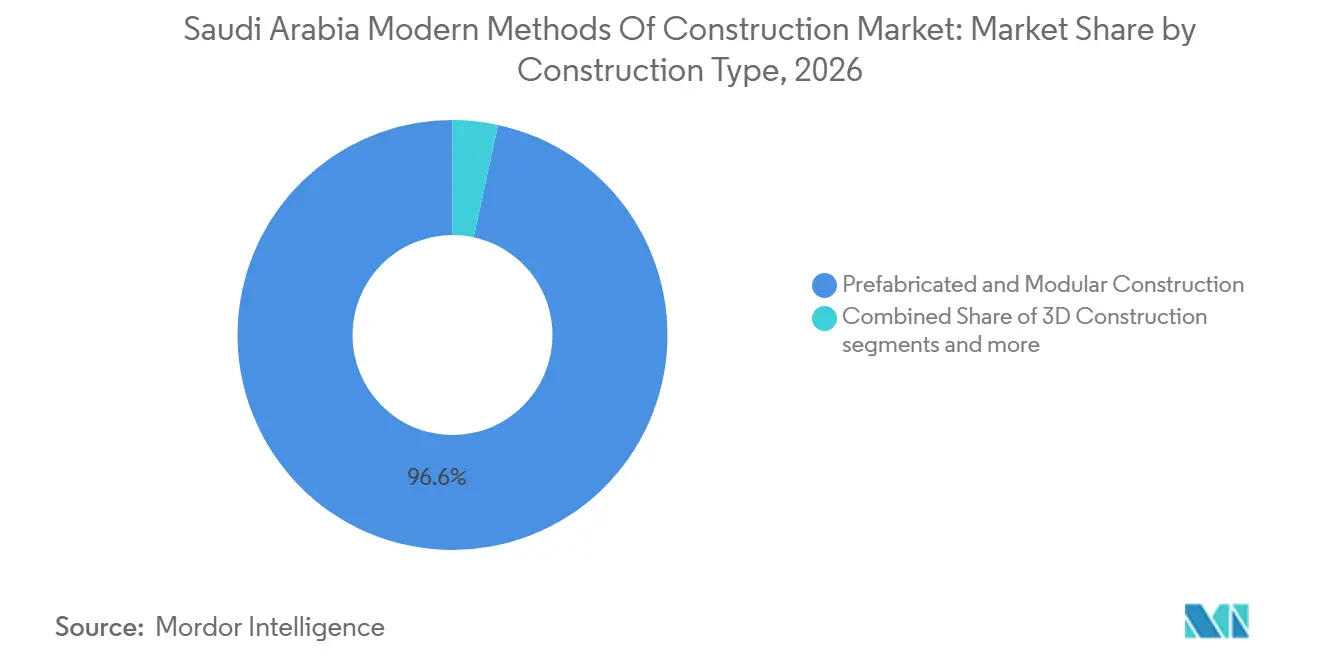
- By construction type, prefabricated & modular construction held 96.60% of the Saudi Arabia modern methods of construction market share in 2026, while 3D construction is forecast to grow at a 40.50% CAGR through 2032.
- By material type, concrete held 45.60% of the Saudi Arabia modern methods of construction market share in 2026, while timber is forecast to grow at a 9.49% CAGR through 2032.
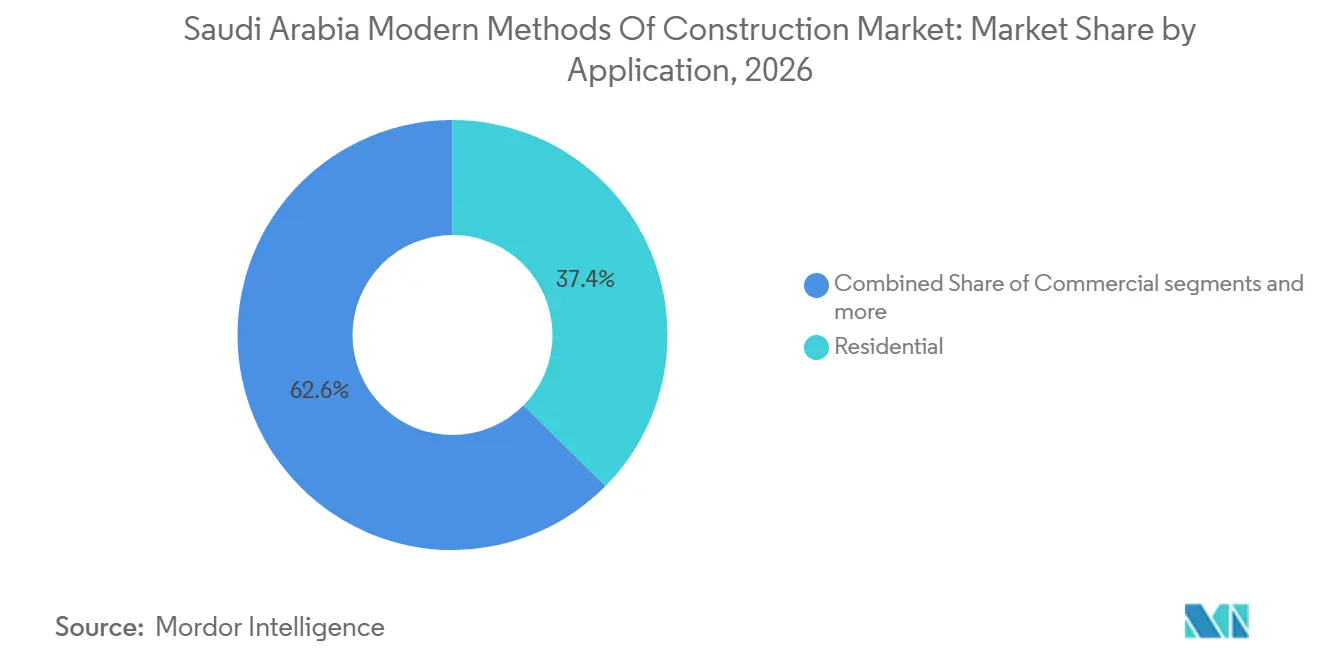
- By application, residential construction accounted for 37.40% of the Saudi Arabia modern methods of construction market size in 2026, while commercial construction is forecast to grow at a 9.07% CAGR through 2032.
- By geography, Riyadh held 34.60% of the Saudi Arabia modern methods of construction market share in 2026, while Jeddah is forecast to grow at a 9.66% CAGR through 2032.
Note: Market numbers in this report are based on Mordor Intelligence's proprietary estimation framework, which combines nine months of actuals with Q4 projections for base year 2026.
Saudi Arabia Modern Methods Of Construction Market Trends and Insights
Drivers Impact Analysis*
| Drivers | (~) % Impact on CAGR Forecast | Geographic Relevance | Impact Timeline |
|---|---|---|---|
| Vision 2030 Housing and Urban-Development Programs | +3.20% | National, with concentrated gains in Riyadh, Jeddah, and Dammam Metropolitan Area | Long term (≥ 4 years) |
| NEOM, The Red Sea, and Other Megaprojects | +1.80% | Northwest, West Coast, and national spillover | Medium term (2-4 years) |
| Demand for Rapid Workforce and Hospitality Accommodation | +1.20% | NEOM, Amaala, Red Sea Global, and Qiddiya corridors | Short term (≤ 2 years) |
| Industrial Localization of Building-System Manufacturing | +0.80% | National, with early gains in Riyadh, Dammam, and Yanbu industrial clusters | Medium term (2-4 years) |
| Extreme-Climate Performance and Factory Quality Requirements | +0.50% | National, across Saudi Building Code climate zones | Long term (≥ 4 years) |
| Public Investment in Healthcare, Education, and Infrastructure | +0.40% | National, concentrated in Riyadh and King Abdullah Financial District corridors. | Medium term (2-4 years) |
| Source: Mordor Intelligence | |||
Vision 2030 Housing and Urban-Development Programs
Vision 2030 housing policy now has a direct link to factory-based building supply. The Ministry of Municipalities and Housing issued more than 34,000 building permits in the first half of 2026, including more than 28,000 residential permits. The Housing Program also reports that homeownership rose from 47% in 2016 to 66.24% by the end of 2025, moving the Kingdom closer to its 70% target. The ministry’s planned cooperation with a Chinese consortium targets more than 100,000 homes and an expected investment exceeding SAR 10.5 billion (USD 2.80 billion), which supports manufacturing as well as procurement. Certified prefabricated systems can meet program volume requirements with greater production control than project-specific site work. This makes housing delivery a steady foundation for the Saudi Arabia modern methods of construction market.
NEOM, The Red Sea, and Other Megaprojects
Giga-project activity continues to shape demand, even as project schedules are adjusted. NEOM’s workforce housing program remained active after the September 2025 suspension of The Line construction, with Homagic awarded a SAR 2.8 billion (USD 0.75 billion) contract for 12,000 permanent modular units in November 2025. The Red Sea and Amaala programs offer more immediate construction demand for accommodation and hospitality assets. DuBox delivered 1,404 modular concrete studio units across 27 buildings for the Amaala Staff Village in June 2026. Such programs favor suppliers able to deliver finished modules, not only structural elements. The Saudi Arabia modern methods of construction market benefits from developers seeking predictable schedules for repeatable building types.
Demand for Rapid Workforce and Hospitality Accommodation
Workforce housing and tourism facilities create concentrated demand for volumetric construction. Homagic’s NEOM contract requires permanent units with 50-year structural certification, which raises the standard for project suppliers. CIMC Modular Building Systems shipped 104 finished steel modules for Earth Hotels Riyadh in August 2026, its first Middle East modular hospitality project. The project is designed for replication across the hotel chain and is expected to reduce the construction timeline by more than 50%. These orders require suppliers to coordinate design, factory production, transport, and installation. They also open a practical route for international producers to develop Saudi supply chains. This accommodation demand supports near-term activity in the Saudi Arabia modern methods of construction market.
Industrial Localization of Building-System Manufacturing
Saudi Arabia is directing more building-system activity toward domestic manufacturing. The National Industrial Strategy identifies building materials as a priority manufacturing subsector, while the ministry’s factory support reduces part of the risk for new capacity. Manar Al Omran announced the launch of its MAO Industrial Complex in Saudi Arabia’s Eastern Province in September 2026. Spanning approximately 1 million square meters, the development comprises five production factories, a corporate headquarters, and residential facilities for 7,000 employees, with the company reporting a Saudization ratio exceeding 60%. Local production can reduce exposure to import delays and support compliance with local-content frameworks. It can also help suppliers respond more quickly to orders from master developers. The Saudi Arabia modern methods of construction industry is consequently placing greater value on in-Kingdom factories and skilled local teams.
Restraints Impact Analysis*
| Restraints | (~) % Impact on CAGR Forecast | Geographic Relevance | Impact Timeline |
|---|---|---|---|
| High Logistics Costs for Remote and Desert Sites | -0.70% | Northwest, West Coast island sites, and off-road desert corridors | Short term (≤ 2 years) |
| Limited Local Supplier Depth for Advanced Modular Systems | -0.50% | National, especially high-specification mechanical, electrical, plumbing, timber, and cleanroom modules | Medium term (2-4 years) |
| Project-Specific Design Requirements and Low Repeatability | -0.30% | National, concentrated in bespoke hospitality, heritage, and giga-project architecture. | Medium term (2-4 years) |
| Dependence on Large Public and Master-Developer Contracts | -0.20% | National, especially smaller manufacturers without tier-1 developer access | Long term (≥ 4 years) |
| Source: Mordor Intelligence | |||
High Logistics Costs for Remote and Desert Sites
Remote locations raise the delivered cost of prefabricated elements. Tabuk’s mountainous desert terrain requires specialized haulage, permits, and coordinated delivery for oversized modules. Island projects such as Amaala also need marine access for large components. High summer temperatures can constrain installation work and affect equipment availability. These conditions make distance more than a simple transport cost for the Saudi Arabia modern methods of construction market. They favor suppliers with nearby factories or logistics plans built around the project site.
Limited Local Supplier Depth for Advanced Modular Systems
The domestic supply base is strongest in precast concrete and basic light-gauge steel systems. Advanced mechanical, electrical, and plumbing modules, cleanroom assemblies, engineered timber products, and specialized facade components remain more import-dependent. The source material estimates that only 15% of the local workforce is trained in modular and prefabrication methods. This limits production for precision-fit volumetric systems even where projects are available. Healthcare and education construction face the sharpest challenge because these projects need specialized components. The skills gap and supplier gap can slow order conversion in the Saudi Arabia modern methods of construction market.
*Our forecasts treat driver/restraint impacts as directional, not additive. The impact forecasts reflect baseline growth, mix effects, and variable interactions.
Segment Analysis
By Construction Type: Prefabricated & Modular Systems Lead Demand
Prefabricated & modular construction held 96.60% of the Saudi Arabia modern methods of construction market size in 2026. The segment reflects established use of precast concrete, volumetric steel modules, and light-gauge steel panel systems. Its strength comes from housing, industrial facilities, and workforce accommodation that can be built through repeated designs. China Harbour Engineering completed hoisting for 1,894 villas at Sedra Phase 3 in Riyadh by June 2026. The project used around 208,000 prefabricated components and expanded output from 24 villas a month to 240.
3D construction is forecast to grow at 40.50% CAGR through 2032, making it the fastest-growing construction type. Artificial Engineering completed 3D concrete printing work at King Salman Park in May 2026 after a 2-year engagement. A 2025 Saudi case study using a COBOD printer reported a 50% reduction in construction time and 80% labor savings against conventional methods. The same study reported that 99% of the concrete mix was locally sourced. This method remains small relative to modular and precast systems, but it has clearer evidence of use in major projects.

By Material Type: Concrete Remains the Main Structural Material
Concrete held 45.60% of the Saudi Arabia modern methods of construction market share in 2026. It supports hollow-core slabs, bearing walls, structural frames, and infrastructure components. The material is familiar to developers and is available through local precast plants. KPC Precast became the first precast manufacturer in the Middle East to localize CarbonCure technology in September 2026. The process injects captured carbon dioxide into concrete during production, where it is mineralized into the material. This move gives concrete suppliers a response to lower-carbon material specifications.
Timber is forecast to grow at a 9.49% CAGR through 2032, the fastest rate across material types. Engineered timber, cross-laminated timber, and glue-laminated timber can support lower- and mid-rise hospitality, education, and public projects. Timber systems also fit insulated wall designs that can meet thermal performance requirements. Saudi Arabia remains dependent on imported structural timber, which limits local supply depth. Metal continues to serve industrial buildings, commercial structures, and workforce accommodation.
By Application: Residential Construction Anchors Current Volume
Residential construction accounted for 37.40% of the Saudi Arabia modern methods of construction market size in 2026. Housing Program delivery needs and master developer pipelines provide a broad base for repeated units. The national homeownership rate reached 66.24% by the end of 2025, supporting the continued need for housing supply. Repeated villas, apartments, and community assets suit precast and volumetric methods because structural designs can be standardized. The Sedra project in Riyadh demonstrates this approach through a large-scale prefabricated villa program. Residential work therefore remains the main volume base for the Saudi Arabia modern methods of construction industry.
Commercial construction is forecast to grow at a 9.07% CAGR through 2032. Hotel, retail, office, and operational facilities benefit when internal finishes and building services are prepared offsite. CIMC’s Earth Hotels Riyadh shipment illustrates how completed hotel modules can be transported for rapid installation. The King Faisal Specialist Hospital and Research Centre modular campus also shows that specialized commercial-style facilities can use offsite construction. Industrial, institutional, energy, utilities, and infrastructure projects make up the other application category. These projects use modular site offices, operation centers, and permanent technical buildings.
Geography Analysis
Riyadh held 34.60% of the Saudi Arabia modern methods of construction market share in 2026. The capital combines large housing programs, institutional procurement, and major infrastructure activity. Sedra Phase 3 is located on Riyadh’s outskirts and shows the scale of repetitive residential construction in the city. Riyadh also hosts new 3D concrete printing work at King Salman Park. These project types make the city a core demand center for precast, volumetric, and emerging construction systems.
Jeddah is forecast to expand at a 9.66% CAGR through 2032. Tourism, mixed-use development, and hospitality construction support its faster outlook. The city’s pipeline increases the need to coordinate factory work and site preparation in parallel. The Dammam Metropolitan Area has a different role as an industrial and precast production center. The MAO Industrial Complex in the Eastern Province adds 5 manufacturing facilities to the regional base. This production base can support projects across the eastern seaboard and elsewhere in Saudi Arabia modern methods of construction market.
Other parts of Saudi Arabia include AlUla, Tabuk, Makkah, and Madinah. These areas benefit from tourism, religious-city expansion, and hospitality construction. Tabuk requires strong logistics planning because of the location and scale of northwest projects. The Red Sea and Amaala programs are important sources of accommodation demand in western corridors. DuBox’s Amaala delivery shows that suppliers can use volumetric concrete for these projects.
Competitive Landscape
The Saudi Arabia modern methods of construction market is moderately fragmented in broad volume work, but the giga-project tier favors firms with factory-to-installation capacity. Red Sea International Company has broadened its role from modular manufacturing into engineering, procurement, and construction-adjacent work. Its subsidiary signed a SAR 353 million (USD 94.11 million) mechanical, electrical, and plumbing subcontract for Diriyah City in June 2026. Earlier, the company also signed a SAR 265.95 million (USD 70.90 million) Baker Hughes contract for modular accommodation facilities in the Eastern Province. These moves show how large suppliers are combining manufactured systems with service delivery.
Capacity and technical positioning are important areas of competition. KPC Precast’s CarbonCure deployment positions the company around lower-carbon precast production. Manar Al Omran’s 1 million sqm industrial complex shows a different strategy based on vertical manufacturing integration. International manufacturers are also gaining major orders where projects require permanent, certified modular systems.
Homagic’s SAR 2.8 billion (USD 0.75 billion) NEOM Phase II award is an example of this competitive position. Healthcare, education, timber modules, and standardized 3D concrete printing remain less served parts of the market. The modular advanced therapy campus in Riyadh demonstrates demand for specialized clean production environments. Timber systems have limited local production even though their use is growing in selected hospitality and public projects. Artificial Engineering has delivered 3D concrete printing on large Saudi projects, but repeatable production at scale remains an open field. Public contracts increasingly require compliance with the Saudi Building Code and relevant modular standards.
Saudi Arabia Modern Methods Of Construction Industry Leaders
-
Red Sea International Company
-
CIMC Modular Building
-
Tamimi Pre-Engineering Buildings Co. (Tamimi PEB)
-
Tamimi Manufacturing Company (TAMCO)
-
Pan Gulf Industries
- *Disclaimer: Major Players sorted in no particular order
Recent Industry Developments
- September 2026: KPC Precast became the first precast concrete manufacturer in the Middle East to localize and deploy CarbonCure technology, injecting captured carbon dioxide into concrete during production.
- September 2026: Manar Al Omran unveiled the MAO Industrial Complex in the Eastern Province, with 5 production factories, a corporate head office, and residential space for 7,000 employees, while its Saudization ratio exceeds 60%.
- August 2026: CIMC Modular Building Systems shipped 104 finished volumetric steel modules for Earth Hotels Riyadh, its first modular hospitality project in the Middle East.
Saudi Arabia Modern Methods Of Construction Market Report Scope
| Prefabricated & Modular Construction | Panelized Systems | Structural Insulated Panels (SIPs) |
| Timber/Wood Frame Panels | ||
| Light Gauge Steel (LGS) Panels | ||
| Others | ||
| Volumetric Modules | Steel-Framed Volumetric Modules | |
| Timber-Framed Volumetric Modules | ||
| Concrete (Precast/Monolithic) Volumetric Modules | ||
| Others | ||
| Hybrid Modular Construction | ||
| 3D Construction | Extrusion Method | |
| Power Bonding Method | ||
| Others | ||
| Other Construction Methods | ||
| Concrete |
| Glass |
| Metal |
| Timber |
| Other Material Type |
| Residential |
| Commercial |
| Other Application (Industrial, Institutional, Energy and Utilities, Infrastructure) |
| Riyadh |
| Jeddah |
| DMA (Dammam Metropolitan Area) |
| Rest of Saudi Arabia |
| By Construction Type | Prefabricated & Modular Construction | Panelized Systems | Structural Insulated Panels (SIPs) |
| Timber/Wood Frame Panels | |||
| Light Gauge Steel (LGS) Panels | |||
| Others | |||
| Volumetric Modules | Steel-Framed Volumetric Modules | ||
| Timber-Framed Volumetric Modules | |||
| Concrete (Precast/Monolithic) Volumetric Modules | |||
| Others | |||
| Hybrid Modular Construction | |||
| 3D Construction | Extrusion Method | ||
| Power Bonding Method | |||
| Others | |||
| Other Construction Methods | |||
| By Material Type | Concrete | ||
| Glass | |||
| Metal | |||
| Timber | |||
| Other Material Type | |||
| By Application | Residential | ||
| Commercial | |||
| Other Application (Industrial, Institutional, Energy and Utilities, Infrastructure) | |||
| By Geography | Riyadh | ||
| Jeddah | |||
| DMA (Dammam Metropolitan Area) | |||
| Rest of Saudi Arabia | |||
Key Questions Answered in the Report
What is the projected value of Saudi Arabia's modern methods of construction sector by 2032?
The Saudi Arabia modern methods of construction market is projected to reach USD 4.04 billion by 2032, growing at an 8.39% CAGR from 2027.
Which construction method currently leads demand in Saudi Arabia?
Prefabricated and modular construction leads, holding a 96.6% share in 2026.
What is the fastest-growing construction technology in Saudi Arabia?
3D construction is the fastest-growing construction type, with a projected 40.50% CAGR through 2032.
Which material has the largest role in factory-built construction?
Concrete leads material demand with a 45.60% share in 2026, supported by broad precast use in housing and infrastructure.
Why is residential construction important for factory-built systems?
Residential construction accounted for a 37.40% share in 2026, supported by national housing delivery and master developer programs.
Which Saudi city is expected to grow the fastest for modern construction methods?
Jeddah is expected to grow at a 9.66% CAGR through 2032, supported by tourism, hospitality, and mixed-use development.