
Saudi Arabia Hydroponics Market Size and Share
Market Overview
| Study Period | 2021 - 2031 |
|---|---|
| Forecast Data Period | 2026 - 2031 |
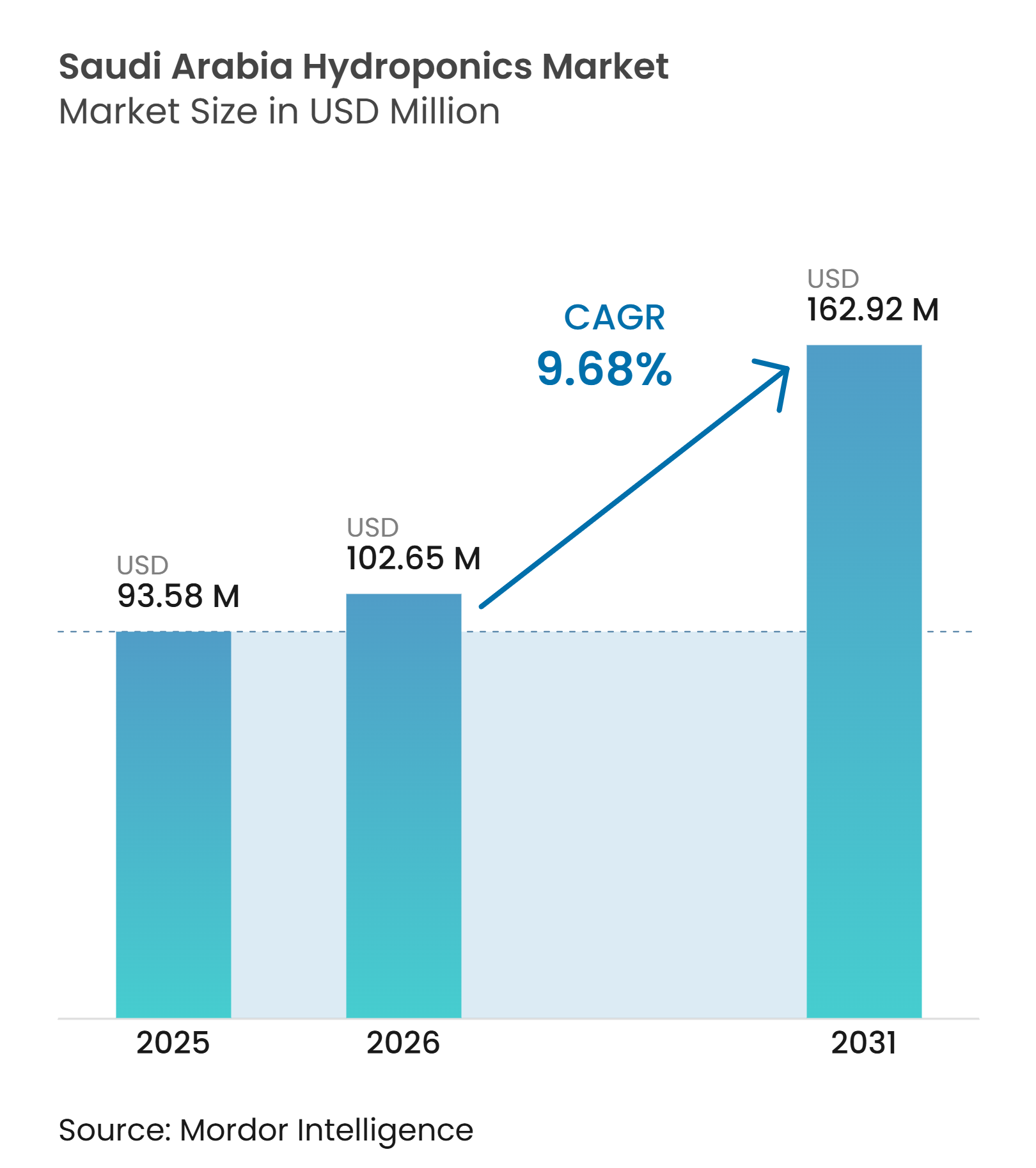
| Base Year Market Size (2025) | USD 93.58 Million |
| Market Size (2026) | USD 102.65 Million |
| Market Size (2031) | USD 162.92 Million |
| Growth Rate (2026 - 2031) | 9.68 % |
| Market Concentration | Medium |
Major Players *Disclaimer: Major Players sorted in no particular order Image © Mordor Intelligence. Reuse requires attribution under CC BY 4.0. | |
Saudi Arabia Hydroponics Market Analysis by Mordor Intelligence
The Saudi Arabia hydroponics market size is estimated to be USD 93.58 million in 2025 and USD 102.65 million in 2026, projected to reach USD 162.92 million by 2031, at a CAGR of 9.68% during the forecast period (2026-2031). The Saudi Arabia hydroponics market is supported by the country’s effort to reduce reliance on imported fresh produce. Saudi Arabia imported 18.7 million metric tons of agricultural products in 2024[1]. Public financing and certification rules favor operators that can build compliant, climate-controlled facilities. Water constraints strengthen the case for closed-loop growing systems, although cooling and treated-water costs remain material barriers. The Saudi Arabia hydroponics market also offers room for urban facilities that shorten delivery times and reduce dependence on cold-chain distribution. Growing investments in smart agriculture, automation, and controlled-environment technologies are further improving production efficiency and supporting commercial-scale hydroponic farming across the country.
Key Report Takeaways
- By production system, greenhouse hydroponics accounted for the largest share, at 54.4% of the Saudi Arabia hydroponics market in 2025, while indoor vertical farms are projected to grow at the fastest CAGR of 12.2% from 2026 to 2031.
- By crop type, tomatoes accounted for a 32.1% share of the Saudi Arabia hydroponics market size in 2025, while herbs and microgreens are projected to grow at the fastest CAGR of 11.9% from 2026 to 2031.
- By equipment, irrigation components and pumps held the largest share, at 39.5% of the Saudi Arabia hydroponics market in 2025, while climate systems are projected to grow at the fastest CAGR of 12.5% from 2026 to 2031.
- By production scale, large operations accounted for a 51.5% share of the Saudi Arabia hydroponics market size in 2025, while small operations are projected to grow at the fastest CAGR of 11.8% from 2026 to 2031.
Note: Market size and forecast figures in this report are generated using Mordor Intelligence’s proprietary estimation framework, updated with the latest available data and insights as of January 2026.
Market Trends and Insights
Drivers Impact Analysis of Saudi Arabia Hydroponics Market*
| Driver | (~) % Impact on CAGR Forecast | Geographic Relevance | Impact Timeline |
|---|---|---|---|
| Vision 2030 food security and import substitution programs | +2.80% | National, strongest in Riyadh, Eastern Province, and Jeddah-Makkah Corridor | Short term (≤ 2 years) |
| Extreme water scarcity and groundwater salinization | +1.60% | National, most acute in Eastern Province and central agricultural zones | Long term (≥ 4 years) |
| Year-round production during high-temperature seasons | +1.30% | National, across all production clusters | Medium term (2-4 years) |
| Growing demand for locally produced fresh vegetables | +1.10% | Riyadh and Jeddah-Makkah Corridor, with spillover to Eastern Province | Short term (≤ 2 years) |
| Renewable energy integration in large greenhouse projects | +0.90% | Riyadh Region, Eastern Province, NEOM, and giga-project corridors | Medium term (2-4 years) |
| Desert climate crop genetics and locally manufactured systems | +0.70% | National, concentrated in Al-Kharj and Qassim research clusters | Long term (≥ 4 years) |
| Source: Mordor Intelligence | |||
Vision 2030 Food Security and Import Substitution Programs
Public financing is a major driver for the Saudi Arabia hydroponics market. The Agricultural Development Fund (ADF) allocated approximately USD 220 million between 2021 and 2025 to support high-tech greenhouse farming, including technologies such as precision irrigation, automated climate control, energy-efficient lighting, and crop-monitoring systems. The program supports modernization of local food production and can finance up to 70% of investment costs for projects using modern technologies[2]. This support improves project economics for climate-controlled hydroponic farms with high initial costs. It also directs investment toward larger facilities that can meet certification and capacity requirements. Saudi Food and Drug Authority protocols can guide supermarket procurement toward certified domestic producers. That framework gives compliant growers a clearer route to retail buyers. The National Food Security Strategy also supports an increase in domestic fresh-produce self-sufficiency from 20% to 40% by 2030. This policy setting strengthens the Saudi Arabia hydroponics market for operators that align expansion plans with national food-security priorities.
Extreme Water Scarcity and Groundwater Salinization
Water scarcity gives recirculating farming systems a practical role in the Saudi Arabia hydroponics market. Agriculture accounted for 88% of national water consumption while contributing 3% of gross domestic product, according to the 2025 Applied Water Science study, Status of Wastewater Treatment and Reuse in Saudi Arabia. Agricultural abstraction of nonrenewable groundwater fell to 9,356 million cubic meters in 2024, down 7% from 2022[3]. Hydroponic facilities can use 80% to 90% less water than conventional farming systems, making them well suited to Saudi Arabia’s water-scarce environment. Closed-loop nutrient and water cycles allow farms to recirculate water and maintain tighter control over water quality compared with open-field irrigation. This advantage is increasingly important as groundwater resources in agricultural areas face rising salinity and depletion. The National Water Strategy 2030 further emphasizes reducing reliance on nonrenewable groundwater resources and improving water-use efficiency. As a result, hydroponic farms that demonstrate measurable water savings can align more closely with national water-management priorities while strengthening their position in commercial procurement and food-supply programs.
Year-Round Production During High-Temperature Seasons
Year-round harvesting supports supply continuity in the Saudi Arabia hydroponics market. Summer temperatures regularly exceed 45°C and can reach 55°C in interior areas, according to the 2025 Applied Water Science study, Status of Wastewater Treatment and Reuse in Saudi Arabia. These conditions limit outdoor cultivation of many commercial vegetables. Climate-controlled hydroponic greenhouses maintain growing conditions between 20°C and 26°C through active cooling. This allows farms to continue harvests when conventional production is under heat stress. DAVA Agricultural Company uses solar-assisted cooling at its Al-Kharj glasshouse facilities for year-round tomato, cucumber, pepper, lettuce, and herb production. Established farms with dependable cooling systems can serve buyers through seasonal supply gaps. Their infrastructure also raises the capital and operating threshold for new farms. The Saudi Arabia hydroponics market consequently favors operators that combine reliable cooling with consistent production planning.
Growing Demand for Locally Produced Fresh Vegetables
Demand for domestic fresh vegetables supports investment in the Saudi Arabia hydroponics market. Saudi Arabia’s agricultural imports reached 18.7 million metric tons in 2024. The output increase shows that controlled-environment farms are supplying a larger portion of domestic demand. Consumers in urban areas place value on fresh, pesticide-free produce with a shorter delivery path. Mishkat Agritech Farms supplies produce to retail customers within 45 minutes of harvest, making freshness a clear product attribute. Shorter delivery times can extend shelf life and reduce retail waste. These features support premium retail and foodservice channels in Riyadh and Jeddah. The Saudi Arabia hydroponics market benefits, as growers can pair local production with reliable distribution. Growing demand from supermarkets, restaurants, hotels, and institutional buyers further encourages growers to expand localized production and strengthen year-round supply capabilities.
Restraints Impact Analysis of Saudi Arabia Hydroponics Market*
| Restraint | (~) % Impact on CAGR Forecast | Geographic Relevance | Impact Timeline |
|---|---|---|---|
| Cooling and desalinated-water operating costs | -2.00% | National, highest in Eastern Province and Jeddah-Makkah Corridor | Long term (≥ 4 years) |
| High upfront cost of climate-controlled greenhouses | -1.50% | National, most constraining for small and medium entrants outside state subsidy brackets | Medium term (2-4 years) |
| Limited availability of hydroponic crop genetics suited to Saudi conditions | -0.80% | National, affecting yield consistency and crop diversification across all clusters | Long term (≥ 4 years) |
| Limited technical expertise and skilled labor for hydroponic farm management | -0.90% | National, acute in smaller cities outside Riyadh and Jeddah | Medium term (2-4 years) |
| Source: Mordor Intelligence | |||
Cooling and Desalinated Water Operating Costs
Cooling and desalinated-water costs represent a significant operating restraint for hydroponic farms in Saudi Arabia. Climate-controlled facilities require continuous cooling to maintain suitable growing conditions during the country’s hot seasons, increasing electricity consumption as production capacity expands. At the same time, desalinated seawater accounted for 50% of the total distributed water supply in 2023, following a 31% year-on-year increase in desalination capacity. Reliance on treated water can increase operating costs compared with access to lower-cost groundwater, particularly for commercial-scale farms with high water requirements. These combined energy and water costs increase the cost of producing each kilogram of hydroponic crops and can pressure profit margins. While DAVA Agricultural Company’s planned 65-hectare solar park could help reduce future energy costs, such investments also require substantial upfront capital[4]. Smaller hydroponic farms have limited financing capacity to adopt similar energy-saving infrastructure, making cooling and water-treatment expenses a more significant barrier to expansion. Consequently, the Saudi Arabia hydroponics market remains constrained by the high recurring costs of maintaining both suitable temperatures and reliable water quality.
High Upfront Cost of Climate-Controlled Greenhouses
Climate-controlled hydroponic greenhouses require substantial upfront investment. A full facility requires glasshouse cladding, active cooling, recirculating irrigation, lighting, automation, and water pre-treatment systems. These components increase total project costs and typically require a multi-year payback period. Government-backed agricultural financing can help lower borrowing costs relative to commercial lending; however, subsidy eligibility requirements and administrative processes may delay project implementation. Operators must also adapt imported technologies to Saudi climatic and operating conditions, creating additional costs that may not be fully captured in standard equipment budgets. Consequently, the Saudi Arabia hydroponics market is more accessible to developers with patient capital, strong technical capabilities, and certification readiness.
*Our forecasts treat driver/restraint impacts as directional, not additive. The impact forecasts reflect baseline growth, mix effects, and variable interactions.
Saudi Arabia Hydroponics Market Segment Analysis
By Production System:
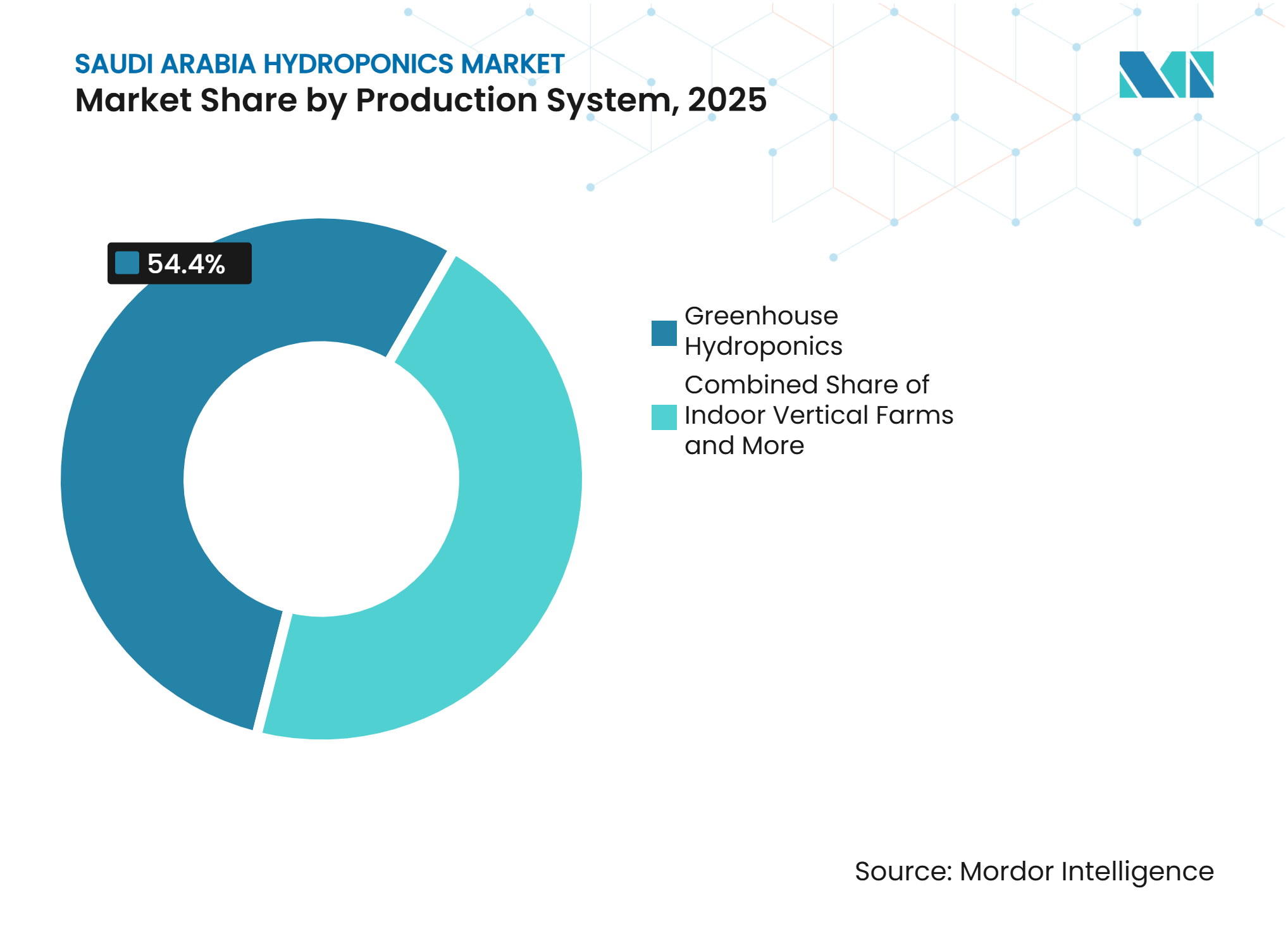
Greenhouse Hydroponics Leads Revenue While Vertical Farms Grow FasterGreenhouse hydroponics accounted for the largest share, at 54.4% of the Saudi Arabia hydroponics market in 2025, supported by established glass and polycarbonate greenhouse infrastructure in Al-Kharj and the Riyadh corridor. DAVA Agricultural Company operates a five-project greenhouse network, while Saudi Greenhouses Management and Agri. Marketing Co. maintains a multi-site portfolio. These established facilities provide the scale required for commercial production, supporting diverse crop portfolios and consistent supply to retail and foodservice customers. Container farms remain less prevalent in commercial applications, although their modular design makes them suitable for remote locations and smaller-scale projects. However, their higher cost per unit of production limits their competitiveness with larger greenhouse facilities. Consequently, greenhouse hydroponics continues to account for the largest market share, supported by established infrastructure, greater production capacity, and established distribution networks.
Indoor vertical farms are projected to record the fastest CAGR of 12.2% through 2031 in the Saudi Arabia hydroponics market, driven by growing adoption in urban centers such as Riyadh and Jeddah. Their ability to operate close to consumers can reduce transportation distances and cold-chain requirements while improving freshness and shelf life. Vertical farms also require substantially less land than conventional greenhouses, making them suitable for land-constrained urban locations. However, reliance on supplemental lighting increases electricity requirements and operating costs. Despite this constraint, demand for consistent, locally produced fresh vegetables near retail and foodservice customers is expected to support expansion. Container farms also serve remote and pilot applications, but their smaller commercial base limits their contribution to overall market growth.



By Crop Type:
Tomatoes Lead Output While Herbs and Microgreens Grow FasterTomatoes accounted for the largest share, at 32.1% of the Saudi Arabia hydroponics market, supported by established consumer demand and suitability for controlled-environment cultivation. Cucumbers followed as another major crop, while peppers and leafy greens remain important within commercial greenhouse portfolios. DAVA Agricultural Company and National Agricultural Development Company operate large-scale tomato-focused hydroponic programs, while Saudi Greenhouses Management and Agri. Marketing Co. maintains a diversified portfolio spanning lettuce, cucumbers, herbs, peppers, and strawberries. This crop mix enables growers to maintain consistent production while serving supermarkets and foodservice channels.
Herbs and microgreens are projected to record the fastest CAGR of 11.9% through 2031, supported by rising demand for specialty produce, shorter production cycles, and growing adoption across foodservice and premium retail channels. A Madinah hydroponic farm produced more than 2 million kilograms of lettuce, celery, rosemary, wild thyme, and basil across 183,000 square meters of air-conditioned halls. Bather Smart Farm and Mojan Farms further support specialty produce supply in Riyadh and Jeddah, while hydroponic strawberries remain a smaller niche crop.
By Equipment:
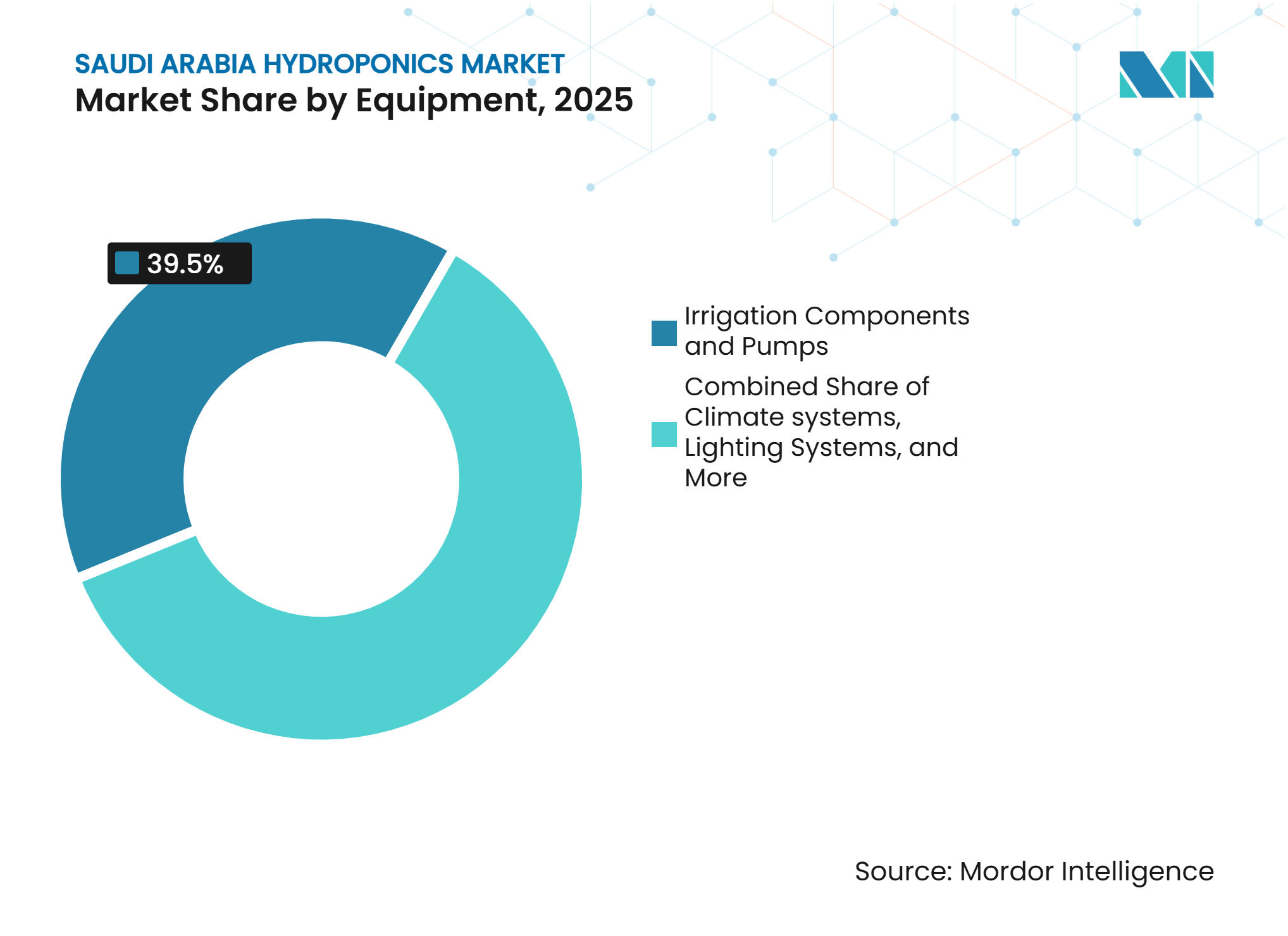
Irrigation Infrastructure Holds the Largest Equipment PositionIrrigation components and pumps accounted for 39.5% of the Saudi Arabia hydroponics market in 2025, reflecting their essential role in recirculating water and nutrient solutions across commercial facilities. Climate systems followed as another important equipment category, supporting temperature, humidity, and air-quality management in controlled environments. Lighting systems remain particularly important for vertical farms, where artificial illumination replaces natural sunlight. Automation and control systems further improve precision, monitoring, and operational efficiency across farms.
Climate systems are projected to grow at the fastest CAGR of 12.5% from 2026 to 2031, driven by the need to maintain stable growing conditions despite Saudi Arabia’s extreme temperatures. Automation and control systems represent the second-fastest equipment segment, as growers increasingly adopt sensors, automated nutrient dosing, monitoring platforms, and connected controls. These technologies can improve resource efficiency and reduce labor requirements. Lighting systems are estimated to continue supporting indoor vertical farming expansion across urban production facilities.

By Production Scale:
Large Operations Lead Capacity While Small Farms ExpandLarge operations held the leading position, accounting for 51.5% of the Saudi Arabia hydroponics market size in 2025, supported by higher production capacity, established infrastructure, and access to financing. Agricultural Development Fund programs support projects aligned with national food-security objectives. DAVA Agricultural Company operates 107 hectares of advanced hydroponic greenhouses, while National Agricultural Development Company operates a large facility in Haradh. These advantages reinforce the dominance of large operations across commercial hydroponic production.
Small operations are projected to record the fastest CAGR of 11.8% from 2026 to 2031, supported by vertical farming, modular facilities, and localized production models. Bather Smart Farm operates a 2,500-square-meter vertical facility in Riyadh, while Mojan Farms expanded from a 400-square-meter pilot greenhouse to a 15,000-square-meter multi-greenhouse site. Arable also raised USD 2 million in January 2025 for controlled-environment farming systems. Their flexibility supports faster expansion across urban markets.
Geography Analysis
Riyadh Region represents the leading geographic cluster for hydroponic farming in Saudi Arabia, supported by established agricultural infrastructure, access to financing, and proximity to the country’s largest consumer market. The Al-Kharj corridor provides suitable conditions for large-scale greenhouse development, while Riyadh’s urban market supports demand for locally produced fresh vegetables. DAVA Agricultural Company operates a five-project greenhouse network in the area, while Mowreq Specialized Agriculture Co. operates vertical farming facilities near the capital. National Agricultural Development Company also maintains high-technology greenhouse operations in the Riyadh-Eastern corridor. Qassim has similarly adopted hydroponic cultivation methods across vegetable greenhouse clusters. These established production and distribution capabilities position the central region as the country’s primary hub for commercial hydroponic farming.
The Jeddah-Makkah Corridor is emerging as an important growth cluster, supported by a large urban population, strong foodservice demand, and the need for rapid delivery of fresh produce. Farms located near major consumption centers can reduce transportation distances and improve product freshness. Mishkat Agritech Farms operates a glasshouse and vertical farm in Jeddah, producing cherry tomatoes and leafy greens through controlled-environment cultivation. Mojan Farms supplies herbs and specialty produce to supermarkets, restaurants, and distributors across western and central markets. The combination of urban demand, premium foodservice channels, and localized production creates favorable conditions for further hydroponic investment across the western corridor.
The Eastern Province represents another important hydroponic farming cluster, benefiting from developed industrial infrastructure, reliable grid connectivity, and access to treated and desalinated water. Saudi Arabian Hydroponic Co. operates from Al-Khobar and focuses on controlled-environment cultivation and greenhouse production. However, water treatment and energy requirements remain important operating considerations for farms in the region. Najran is also emerging as a potential production area, supported by planned investments in high-technology greenhouses, smart climate controls, and closed-loop irrigation. Farms and agricultural projects across Qassim, Riyadh, and other regions further contribute to geographic diversification. Overall, these emerging locations can expand domestic hydroponic production beyond established commercial centers.
Competitive Landscape
Market Concentration
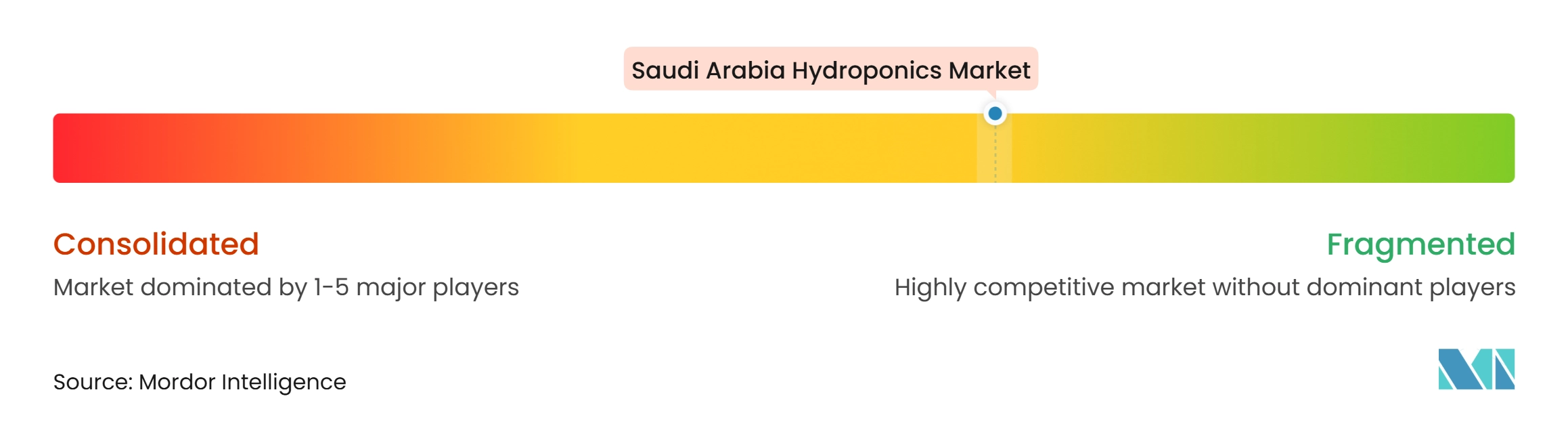
The Saudi Arabia hydroponics market had a moderately fragmented competitive structure in 2025. DAVA Agricultural Company, National Agricultural Development Company, and Saudi Greenhouses Management and Agri. Marketing Co. among the prominent operators. DAVA benefits from its extensive high-tech greenhouse footprint and integrated production capabilities, while NADEC leverages its broader agricultural infrastructure and protected-cultivation activities. Saudi Greenhouses maintains a multi-site, multi-crop portfolio, strengthening its presence across commercial production and distribution channels. Competition among leading producers is shaped by production scale, greenhouse technology, automation, product quality, and distribution reach.
DAVA Agricultural Company is expanding its controlled-environment agriculture footprint, with recent reports indicating 107 hectares of high-tech hydroponic greenhouses. The company has also announced a Taif expansion targeting 350 hectares and 1,000 tonnes of daily production by 2030, alongside a planned 65-hectare solar energy park. National Agricultural Development Company is set to take ownership and management of the approximately six-hectare high-tech hydroponic greenhouse in Haradh, strengthening its position in protected cultivation. The facility is supported by a 30-MW solar facility, highlighting the increasing integration of renewable energy into large-scale hydroponic operations.
Mowreq Specialized Agriculture Co. and Mishkat Agritech Farms strengthen competition among specialized hydroponic producers, serving premium retail, foodservice, and urban customers through controlled-environment cultivation. Saudi Arabian Hydroponic Co., Arable, and Dream Farm also serve niche and regional markets, while Bather Smart Farm, Mojan Farms, and Hadyanah Farm focus on specialty crops such as microgreens, herbs, and leafy greens. These producers compete through freshness, local sourcing, product quality, and crop specialization rather than production scale alone. Hydroponic strawberries and other soft fruits remain relatively underdeveloped, with fewer established suppliers, while in-store vertical farming applications for herbs are still limited. This competitive structure creates opportunities for specialized entrants while larger greenhouse operators continue to lead commercial production.
Saudi Arabia Hydroponics Industry Leaders
-
DAVA Agricultural Company
-
National Agricultural Development Company (NADEC)
-
Saudi Greenhouses Management and Agri. Marketing Co.
-
Mowreq Specialized Agriculture Co.
-
Mishkat Agritech Farms
- *Disclaimer: Major Players sorted in no particular order
Saudi Arabia Hydroponics Market Companies Covered in this Report
- DAVA Agricultural Company
- National Agricultural Development Company (NADEC)
- Saudi Greenhouses Management and Agri. Marketing Co.
- Mowreq Specialized Agriculture Co.
- Mishkat Agritech Farms
- Saudi Arabian Hydroponic Co.
- Arable
- Dream Farm
- Bather Smart Farm
- Mojan Farms
- Hadyanah Farm
Recent Industry Developments in Saudi Arabia Hydroponics Market
- August 2026: Saudi Arabia's National Agricultural Development Company (NADEC) has signed an agreement with Pure Harvest Smart Farms to acquire the assets of a high-tech greenhouse project in Haradh for about USD 22.7 million. The facility, operating since 2022, will be fully owned and run by NADEC to expand local tomato production
- July 2026: Saudi Arabia’s Jazan Region launched a USD 160 million tropical fruit and greenhouse development project covering 1 million square meters. The project includes 500,000 square meters of high-technology greenhouses equipped with smart climate-control systems and closed-loop irrigation designed to reduce water consumption.
- April 2026: DAVA Agricultural Company signs a contract for a 244,000-square-meter foil greenhouse expansion in Al-Kharj, bringing the total hydroponic footprint to 110 hectares across 6 Saudi locations in support of its target to reach 250 tonnes per day by 2028
Saudi Arabia Hydroponics Market Report Scope
The Saudi Arabia hydroponics market covers the value of soilless crop cultivation systems where plants are grown using nutrient solutions, with or without an inert medium, across commercial and smaller-scale controlled environments.
Scope exclusions: We exclude aquaponics and soil-based greenhouse or open-field cultivation, even if similar crops are produced.
The Saudi Arabia hydroponics market report is segmented by production system (greenhouse hydroponics, indoor vertical farms, and container farms), by crop type (leafy greens, tomatoes, cucumbers, peppers, herbs and microgreens, and strawberries and other soft fruit), by equipment (lighting systems, irrigation components and pumps, climate systems, automation and control systems, and structural components), and by production scale (large operations, medium operations, and small operations). The market forecasts are provided in terms of value (USD).
Segmentation Overview
| Greenhouse Hydroponics |
| Indoor Vertical Farms |
| Container Farms |
| Leafy Greens |
| Tomatoes |
| Cucumbers |
| Peppers |
| Herbs and Microgreens |
| Strawberries and Other Soft Fruit |
| Lighting Systems |
| Irrigation Components and Pumps |
| Climate Systems |
| Automation and Control Systems |
| Structural Components |
| Large Operations |
| Medium Operations |
| Small Operations |
| By Production System | Greenhouse Hydroponics |
| Indoor Vertical Farms | |
| Container Farms | |
| By Crop Type | Leafy Greens |
| Tomatoes | |
| Cucumbers | |
| Peppers | |
| Herbs and Microgreens | |
| Strawberries and Other Soft Fruit | |
| By Equipment | Lighting Systems |
| Irrigation Components and Pumps | |
| Climate Systems | |
| Automation and Control Systems | |
| Structural Components | |
| By Production Scale | Large Operations |
| Medium Operations | |
| Small Operations |
Key Questions Answered in the Report
How large is Saudi Arabia’s hydroponics sector?
The sector was estimated at USD 102. 65 million in 2026 and is forecast to reach USD 162.92 million by 2031.
Which production system is growing fastest in Saudi Arabia?
Indoor vertical farms recorded the highest projected CAGR at 12.2% through 2031.
Which crops are most important for hydroponic growers in Saudi Arabia?
Tomatoes led greenhouse output, accounted for 32.1% share of the Saudi Arabia hydroponics market in 2025.
What are the main operating challenges for hydroponic farms?
Cooling demand, desalinated-water costs, large upfront investment, crop adaptation, and limited technical expertise are important constraints.