
Saudi Arabia Home Insurance Market Size and Share
Market Overview
| Study Period | 2021 - 2032 |
|---|---|
| Forecast Data Period | 2027 - 2032 |
| Base Year Market Size (2026) | USD 166.20 Million |
| Market Size (2027) | USD 181.20 Million |
| Market Size (2032) | USD 260.10 Million |
| Growth Rate (2027 - 2032) | 7.50 % |
| Market Concentration | High |
Major Players *Disclaimer: Major Players sorted in no particular order Image © Mordor Intelligence. Reuse requires attribution under CC BY 4.0. | |
Saudi Arabia Home Insurance Market Analysis by Mordor Intelligence
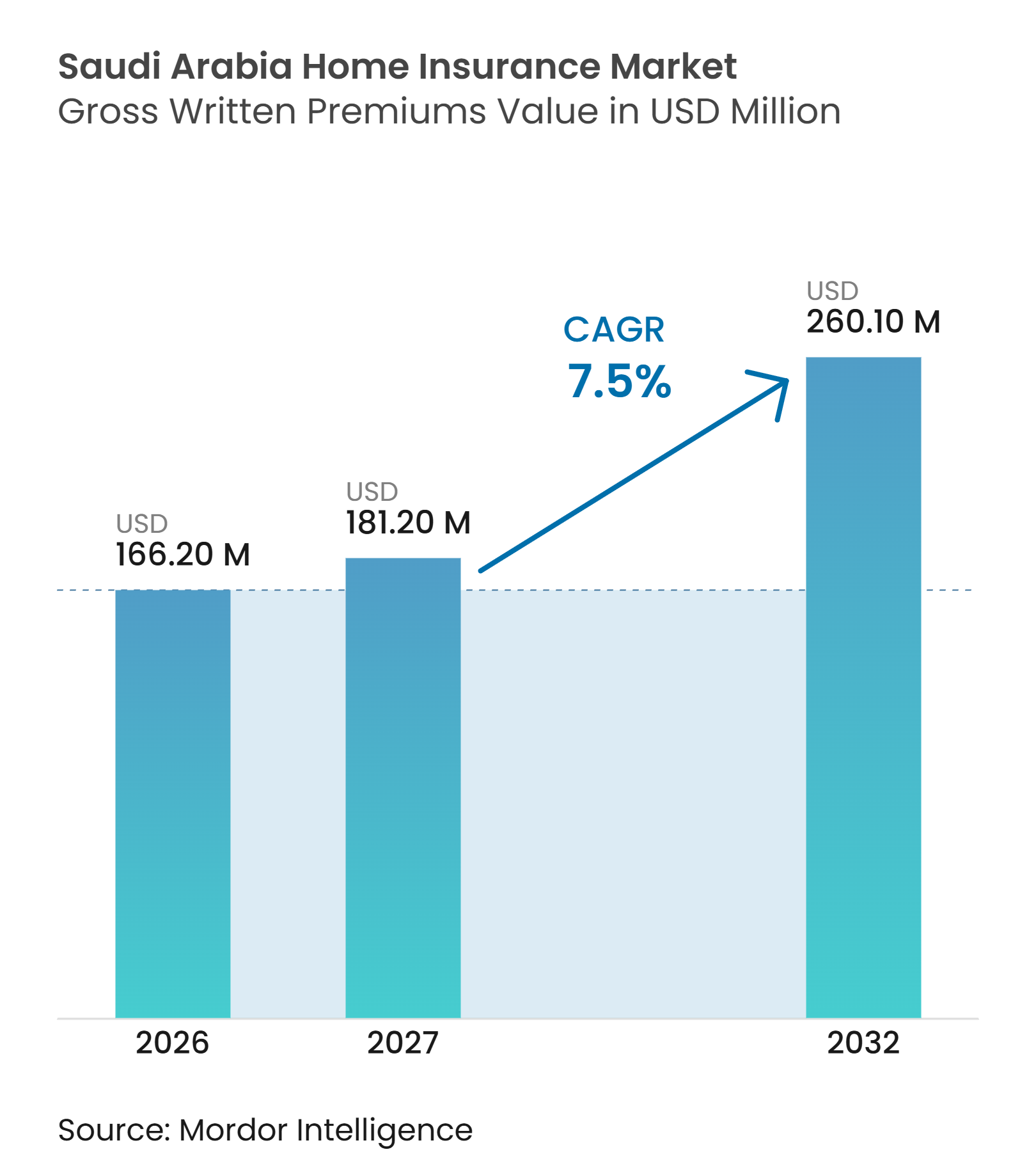
The Saudi Arabia Home Insurance Market size in terms of gross written premiums value is projected to be USD 166.20 million in 2026, USD 181.20 million in 2027, and reach USD 260.10 million by 2032, growing at a CAGR of 7.5% from 2027 to 2032.
Growth rests on an expanding pool of homeowners, residential mortgage borrowers, and newly completed homes. Saudi Arabia’s homeownership rate reached 66.24% by the end of 2025, and 63,076 families moved into their first home during the first half of 2026. Mortgage-linked building cover remains the most reliable route into the Saudi Arabia home insurance market because lenders protect the financed structure at loan origination. Digital distribution is widening access through insurer, broker, real estate, and rental platforms, although voluntary cover outside the mortgage channel remains limited. The Saudi Arabia home insurance market also faces a more demanding operating setting as insurers prepare for risk-based capital requirements from January 2027.
Key Report Takeaways
- By coverage type, building-only insurance captured 47.8% of the Saudi Arabia home insurance market share in 2026, while combined building and contents insurance is projected to grow at 9.2% CAGR through 2032.
- By policyholder type, owner-occupiers captured 56.3% of the Saudi Arabia home insurance market share in 2026, while renters and tenants are projected to grow at 9.8% CAGR through 2032.
- By property type, villas and detached houses captured 40.7% of the Saudi Arabia home insurance market share in 2026, while apartments and flats are projected to grow at 8.6% CAGR through 2032.
- By distribution channel, direct sales captured 39.8% of the Saudi Arabia home insurance market share in 2026, while embedded and affinity partnerships are projected to grow at 11.5% CAGR through 2032.
- By geographic location, the Central Region captured 36.4% of the Saudi Arabia home insurance market share in 2026, while the Western Region is projected to grow at 8.5% CAGR through 2032.
Note: Market numbers in this report are based on Mordor Intelligence's proprietary estimation framework, which combines nine months of actuals with Q4 projections for base year 2026.
Market Trends and Insights
Drivers Impact Analysis of Saudi Arabia Home Insurance Market*
| Driver | (~) % Impact on CAGR Forecast | Geographic Relevance | Impact Timeline |
|---|---|---|---|
| Rising Homeownership and Expansion of the Insurable Household Base | +1.8% | National, led by Riyadh and Jeddah metro areas | Medium term (2-4 years) |
| Growth in Mortgage Financing and Lender-Linked Property Protection | +1.4% | National, with early gains in Central and Western regions | Short term (≤ 2 years) |
| Expansion of Residential Construction and New Housing Supply | +1.1% | National, Riyadh, Jeddah, and giga-project zones driving new exposure | Long term (≥ 4 years) |
| Increasing Exposure to Flooding, Fire, and Residential Property Damage | +0.9% | Jeddah, Makkah, coastal Western Region, and spillover to Central Region | Medium term (2-4 years) |
| Growing Availability of Comprehensive Household Insurance Products | +0.7% | National, concentrated in urban markets with active broker distribution | Short term (≤ 2 years) |
| Insurance Sector Modernization and Digital Distribution Development | +0.8% | National, concentrated in digital-access urban markets | Short term (≤ 2 years) |
| Source: Mordor Intelligence | |||
Rising Homeownership and the Expansion of the Insurable Household Base
Saudi Arabia’s homeownership rate reached 66.24% by the end of 2025, exceeding the Housing Program’s annual target of 65% and progressing towards its Vision 2030 target of 70%[1]. The Ministry of Municipalities and Housing also reported that 63,076 Saudi families moved into their first homes during the first half of 2026, reflecting continued expansion of the owner-occupied housing base. First-time homeowners represent a potential customer segment for home insurance, particularly when purchasing a property through mortgage financing, where lenders may require building insurance to protect the mortgaged asset. As homeownership expands, insurers have opportunities to increase household property coverage through standalone building policies and combined building and contents products.
Growth in Mortgage Financing and Lender-Linked Property Protection
Mortgage financing remains an important distribution channel for residential property insurance in Saudi Arabia. Outstanding real estate loans provided by commercial banks reached SAR 932.8 billion (USD 248.7 billion) in Q2 2025, up 15% year-on-year, with retail mortgages accounting for approximately SAR 711.6 billion (USD 189.8 billion), or 76% of the total. However, new residential mortgage financing provided by banks declined from SAR 91.1 billion (USD 24.3 billion) in 2024 to SAR 80.4 billion (USD 21.4 billion) in 2025, indicating a slowdown in new mortgage originations. In August 2025, the Saudi Central Bank granted the Saudi Real Estate Refinance Company approval to launch the Kingdom’s first domestic residential mortgage-backed securities programme, supporting liquidity and the development of the housing finance market[2]. A large outstanding mortgage portfolio provides an established base for lender-linked property protection.
Expansion of Residential Construction and New Housing Supply
Saudi Arabia’s expanding residential construction pipeline is increasing the number of properties potentially requiring insurance protection. By the end of 2025, more than 300,000 housing units had been delivered across 16 cities, while the Ministry of Municipalities and Housing announced plans to provide a further 300,000 housing units in Riyadh over the following three years. Newly completed homes create opportunities for insurers to acquire customers at property handover, particularly where mortgage financing arrangements require building cover. In addition, Saudi Arabia mandates Inherent Defects Insurance for contractors undertaking residential and commercial building projects, excluding government buildings. Insurers can use these opportunities to cross-sell building, contents and liability coverage to homeowners and landlords.
Increasing Exposure to Flooding and Residential Property Damage
Flood exposure represents an important potential driver of residential property insurance demand in Saudi Arabia, particularly in urban areas vulnerable to intense rainfall and flash flooding. A study published in Acta Geophysica on 9 January 2026 assessed flood susceptibility and potential asset damage in Makkah, estimating potential damage of SAR15.9 billion (USD4.24 billion) to buildings, SAR28.1 billion (USD7.49 billion) to hospitals and SAR3.36 billion (USD896 million) to roads[3]. The study identified vulnerable areas including Aziziyah, Al-Haram and Al Misfalah. While the estimated building damage is not limited exclusively to residential properties, it highlights the financial exposure of the built environment to flooding. Greater awareness of such risks can support demand for property insurance covering flood and other specified perils, subject to policy terms, exclusions and underwriting conditions. Insurers can respond through location-based risk assessment, appropriate pricing and broader building and contents protection.
Restraints Impact Analysis of Saudi Arabia Home Insurance Market*
| Restraint | (~) % Impact on CAGR Forecast | Geographic Relevance | Impact Timeline |
|---|---|---|---|
| Low Voluntary Adoption of Household Insurance | -1.5% | National, more acute in secondary cities and rural areas | Long term (≥ 4 years) |
| Affordability Constraints and Competing Household Expenses | -1.1% | National, concentrated among low-to-middle-income households | Medium term (2-4 years) |
| Limited Awareness of Coverage Scope and Policy Benefits | -0.9% | National, Southern and Northern regions show lowest penetration | Long term (≥ 4 years) |
| Property Valuation, Underinsurance and Claims Assessment Challenges | -0.7% | National, most complex in villa and large residential markets | Medium term (2-4 years) |
| Source: Mordor Intelligence | |||
Low Voluntary Adoption of Household Insurance
Home insurance adoption remains constrained by the limited penetration of voluntary household protection, particularly among homeowners without mortgage-linked insurance requirements. Saudi Arabia’s Insurance Authority reported that property and casualty insurance represented approximately 15% of total gross written premiums in 2025, compared with 57% for health insurance and 18% for motor insurance. However, this P&C category includes several commercial and personal insurance lines and should not be interpreted as the share of household insurance. The absence of a separately reported household insurance penetration figure makes it difficult to quantify voluntary home insurance adoption directly. Nevertheless, the availability of standalone building and contents policies, including products for tenants, indicates scope to expand coverage beyond mortgage-linked customers. Insurers can address this gap through simplified online purchasing, affordable entry-level policies and partnerships with property platforms and retailers.
Affordability Constraints and Competing Household Expenses
Affordability can limit voluntary household insurance purchases, particularly among lower- and middle-income households managing housing and other living expenses. However, publicly available insurer-linked offers indicate that basic coverage can be accessed at relatively low annual premiums. IKEA’s household insurance, powered by Tawuniya, advertises coverage starting at SAR 229 (USD 61) annually, while Tawuniya packages distributed through Saudi National Bank offer building-only coverage starting at SAR 500 (USD 133), contents-only coverage starting at SAR 599 (USD 160) and combined building and contents options starting at SAR 699 (USD 186) annually. These prices vary according to insured limits, coverage and package conditions, rather than representing standard premiums for all homes. Lower-cost contents-only policies also provide an entry point for renters who do not own the building. Insurers can further improve affordability through modular coverage, flexible payment arrangements and partnerships with retailers and digital platforms.
*Our forecasts treat driver/restraint impacts as directional, not additive. The impact forecasts reflect baseline growth, mix effects, and variable interactions.
Saudi Arabia Home Insurance Market Segment Analysis
By Coverage Type:
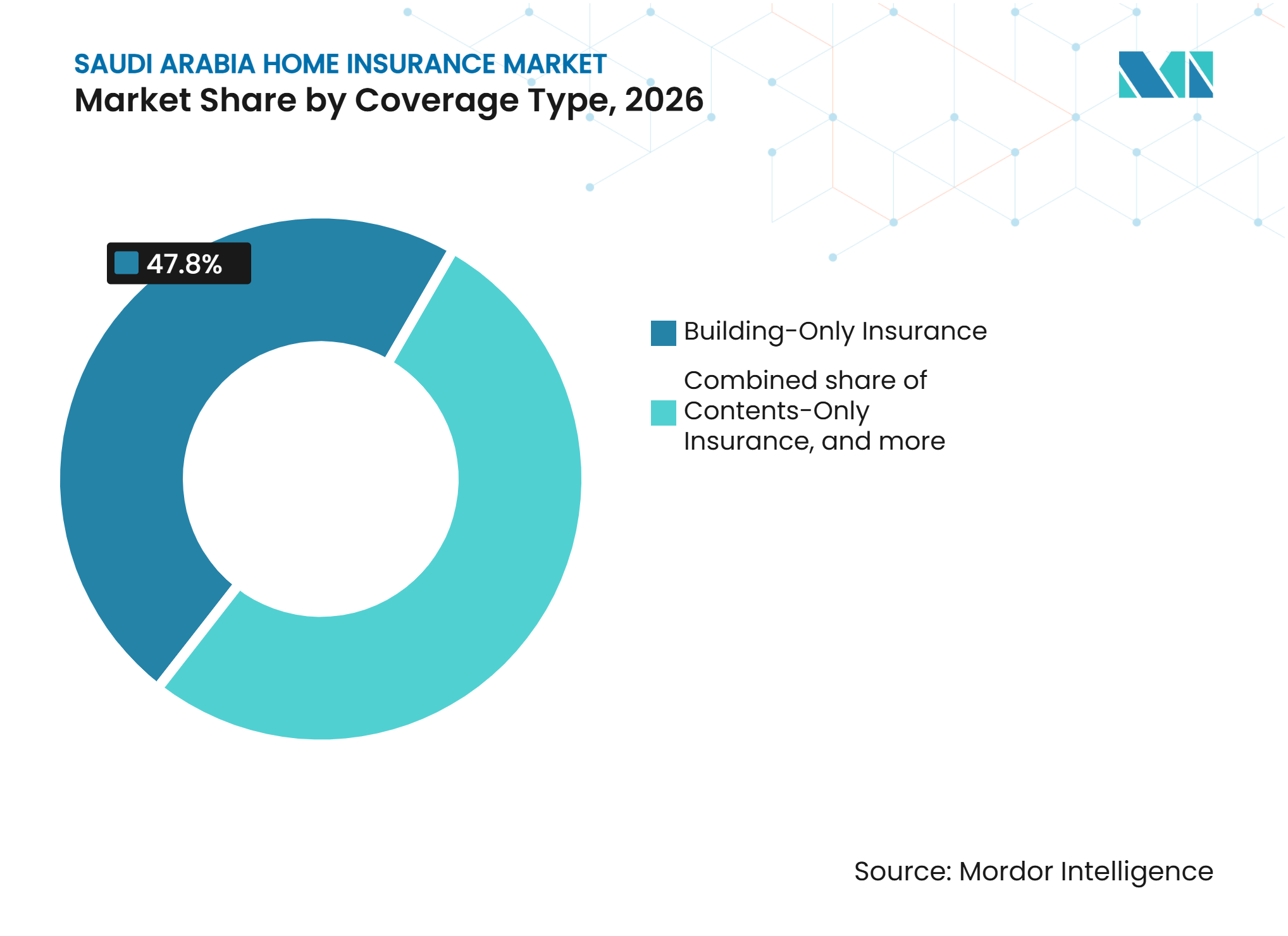
Building-Only Insurance Leads While Bundled Cover BroadensBuilding-only insurance accounted for 47.8% of the Saudi Arabia home insurance market in 2026, making it the leading coverage category in the supplied market estimates. Its position is supported by mortgage-linked property protection, as lenders have a financial interest in safeguarding the financed building. However, building-only cover should not be described as universally compulsory for all homeowners, since requirements depend on the mortgage and financing arrangements. Combined building and contents insurance is forecast to expand at 9.2% CAGR through 2032, reflecting potential demand from homeowners seeking protection for both the physical structure and household possessions. Contents-only insurance also provides an option for tenants who do not own the building but want to protect their belongings.
Combined policies can appeal to homeowners seeking broader protection against covered property damage, while contents-only products offer a more focused option for renters. In November 2026, Malath Cooperative Insurance launched its Kamin product for mandatory latent-defect protection of residential and commercial buildings, providing coverage for up to 10 years. The product covers specified construction defects and related building components, including waterproofing and certain mechanical, electrical and plumbing installations. However, it is a contractor's latent-defect insurance product rather than conventional household building-and-contents insurance. Its launch nevertheless reflects continued development of property-related insurance solutions in Saudi Arabia.


By Policyholder Type:
Owner-Occupiers Remain the Largest Group While Renters Gain MomentumOwner-Occupiers accounted for 56.3% of the Saudi Arabia home insurance market in 2026, supported by their direct financial interest in protecting residential property. Mortgage-linked insurance arrangements provide an established distribution route for building protection, while expanding homeownership creates opportunities to reach additional owner-occupier households. Saudi Arabia's homeownership rate reached 66.24% by the end of 2025, exceeding the annual target of 65% and progressing towards the Vision 2030 target of 70%. The Ministry of Municipalities and Housing also reported that 63,076 Saudi families moved into their first homes during H1 2026, expanding the potential customer base for residential property insurance.
Renters and Tenants are projected to expand at 9.8% CAGR through 2032, supported by demand for contents and tenant-focused protection. On 27 March 2025, Al Rajhi Takaful signed a one-year agreement with Al Rajhi Bank to provide insurance coverage to customers in the bank's real estate finance portfolio. The insurer expected the contract value to exceed 5% of its latest audited annual revenue, highlighting the commercial importance of mortgage-linked distribution. Separately, in June 2025, Rize partnered with Takaful Insurance Company to integrate tenant protection into its rent-now-pay-later service, covering specified risks such as fire, water leaks, theft and vandalism. This provides an example of insurance distribution through rental platforms beyond traditional mortgage channels.
By Property Type:
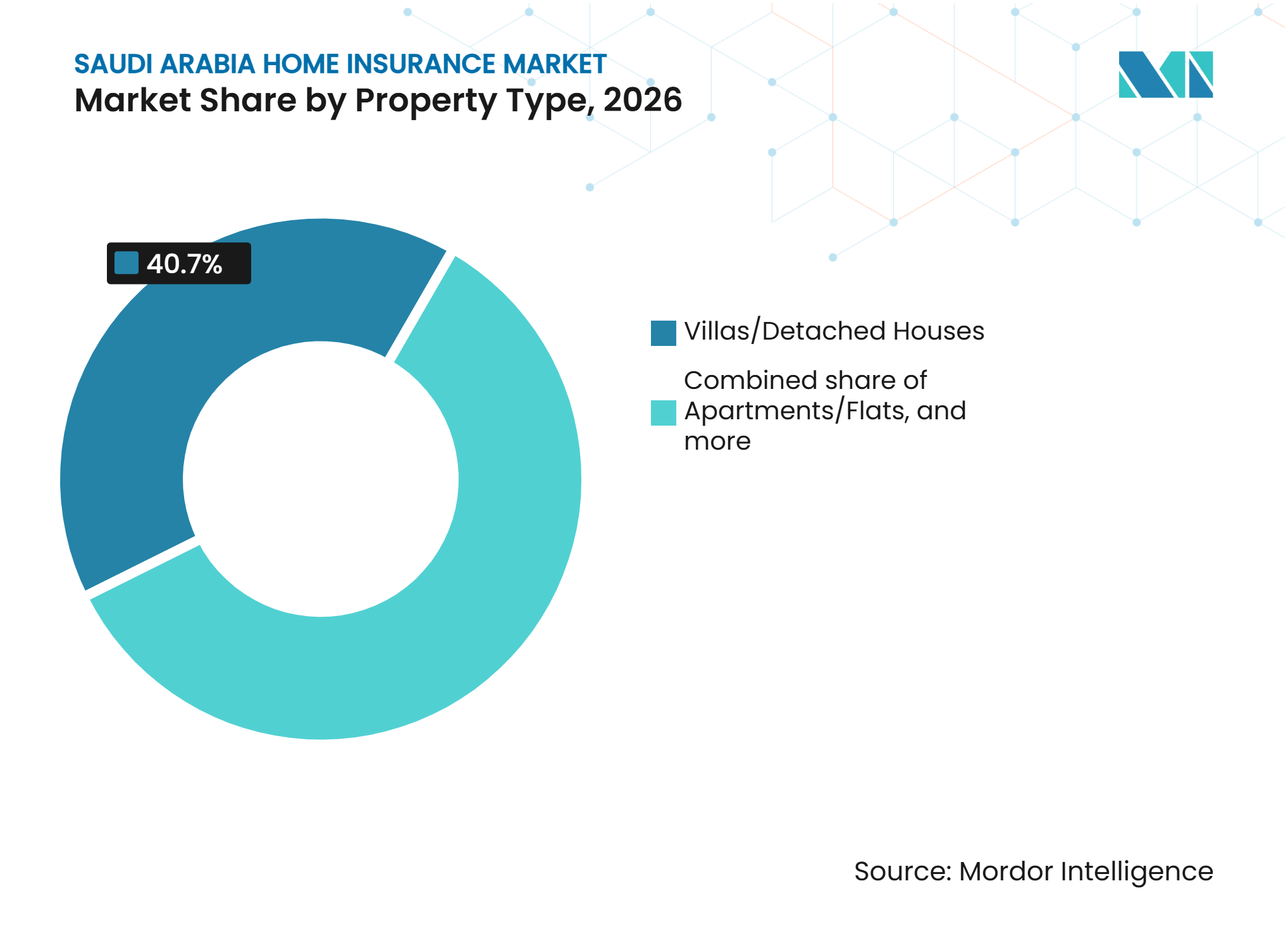
Villas and Detached Houses Retain the Largest PositionVillas and detached houses held 40.7% of the Saudi Arabia home insurance market in 2026, remaining the largest property category in the supplied estimates. Their larger floor areas and potentially higher rebuilding values can create greater insured-value requirements, although premiums vary according to location, construction, insured value and coverage selected. SAMA data show that new residential mortgage financing for villas provided by banks reached SAR 51.44 billion (USD 13.72 billion) in 2025, accounting for approximately 64% of total new residential mortgage financing to individuals. This was higher than financing for apartments, which reached SAR 24.30 billion (USD 6.48 billion), and land, which accounted for SAR 4.68 billion (USD 1.25 billion). These figures demonstrate the importance of villas in bank-financed housing, rather than their share of home insurance premiums.
Apartments and flats are forecast to grow at 8.6% CAGR through 2032, supported by continued urban housing demand and the expansion of apartment-based residential developments. SAMA reported that bank-provided new residential apartment financing reached SAR 24.30 billion (USD 6.48 billion) in 2025, compared with SAR 28.09 billion (USD 7.49 billion) in 2024, indicating that apartment financing declined year-on-year despite its substantial contribution to residential lending. In 2026, apartment financing reached SAR 16.40 billion (USD 4.37 billion) in Q2 and SAR 17.27 billion (USD 4.61 billion) in Q3, showing continued financing activity. Townhouses and duplexes remain relevant to suburban housing developments, while affordable housing delivered through government-supported programs adds to the potential residential insurance customer base.

By Distribution Channel:
Direct Sales Are Largest While Embedded Partnerships AccelerateDirect sales through online and offline channels accounted for 39.8% of the Saudi Arabia home insurance market in 2026, according to the supplied market estimates. Insurer websites, branches and direct customer relationships remain important routes for policy acquisition, servicing and renewal. Direct distribution also allows insurers to explain coverage limits, exclusions and optional benefits to customers purchasing building or contents protection. However, digital intermediaries and partnerships with banks, property platforms and retailers are creating additional opportunities to reach customers during housing transactions and other consumer activities. Embedded and affinity partnerships are forecast to record the fastest growth at 11.5% CAGR through 2032, reflecting the potential to integrate insurance into existing customer journeys.
The Insurance Authority launched 15 additional digital services through its TAMEEN portal on 8 December 2025, including electronic sales, electronic integration and services related to bancassurance agreements. On 25 December 2025, it also licensed Abdul Latif Jameel Insurance Brokerage Company to conduct digital insurance brokerage activities under an experimental launch. These developments support the broader digitalization of insurance distribution and can facilitate access to insurance products, including household protection. Bancassurance remains relevant for mortgage-linked building policies, while property platforms and digital brokers offer opportunities to reach renters, landlords and homeowners. However, these regulatory initiatives are sector-wide developments and do not establish that all digital services or brokerage activity relates specifically to home insurance.
Geography Analysis
Central Region: Riyadh Supports the Largest Regional Base
The Central Region accounted for 36.4% of the Saudi Arabia home insurance market in 2026, retaining the largest regional share. Riyadh is the primary demand centre, supported by its concentration of employment, mortgage lending, residential development and higher-value housing. National real estate loans reached SAR922.2 billion (USD 245.9 billion) at the end of Q1 2025, representing 15.2% year-on-year growth; however, this figure covers the Kingdom as a whole and should not be attributed specifically to the Central Region. More recent estimates from Knight Frank indicate that Riyadh's residential stock is projected to increase from approximately 2.81 million units in 2026 to 3.3 million by 2030. This updated outlook replaces the earlier 2.7 million units in 2025 baseline and supports the expectation of a growing insurable property base.
New housing supply and mortgage activity create opportunities for building-only and combined building-and-contents policies, particularly at property purchase, mortgage origination and renewal. The Ministry of Municipalities and Housing reported that Saudi homeownership reached 66.24% by the end of 2025, while 63,076 families moved into their first homes during H1 2026, supporting the expansion of the homeowner base (Ministry of Municipalities and Housing). Insurers will also need to prepare for the Insurance Authority's Risk-Based Capital framework, which entered parallel implementation in 2026 and is scheduled to become effective on 1 January 2027.
Western Region: Physical Risk and Housing Growth Strengthen Demand
The Western Region is projected to record the fastest growth, at 8.5% CAGR through 2032, according to the market estimates. Jeddah, Makkah and Madinah provide a substantial residential base, while exposure to heavy rainfall and flooding strengthens the relevance of property protection. A 2026 peer-reviewed study estimated potential building damage of SAR 15.9 billion (USD 4.24 billion) in flood-exposed areas of Makkah.
Residential supply is also expected to expand. Knight Frank's 2026 outlook projects Jeddah's housing stock to reach approximately 1.47 million units by 2030, while Makkah and Madinah are also expected to add residential supply. The Ministry's housing programme has reported delivery activity across projects in the Makkah region, including Jeddah, Makkah and Taif, as part of its nationwide housing expansion. These developments can expand opportunities for building and combined policies, while insurers can differentiate offerings through clearly defined flood-related cover, household contents protection and risk-prevention services.
Eastern, Northern, and Southern Regions: Distribution and Affordability Shape Development
The Eastern Region, including Dammam, Al-Khobar and Al-Ahsa, benefits from established residential communities, energy-sector employment and ongoing housing development. Knight Frank projects the Dammam Metropolitan Area's residential stock to approach 986,000 units by 2030, indicating an expanding potential base for property insurance. Recent market activity also points to continued demand: the Dammam Metropolitan Area recorded 3,896 residential transactions in Q2 2026, up 21% year on year (Knight Frank). This provides a more current indicator of regional housing activity than the earlier figures of 500 units added in 2025 and 4,800 expected in 2026.
Northern and Southern regions have smaller urban markets and more dispersed populations, making distribution reach, product affordability and consumer awareness important considerations for insurers. The Housing Program's 2024 Annual Report documents housing solutions across regions, including Riyadh, the Eastern Province, Makkah, Madinah, Asir, Jazan and other areas, demonstrating that government-supported housing activity extends beyond the largest cities. Insurers can use partnerships with banks, housing programme operators, developers and digital platforms to reach first-time homeowners and households in underserved locations. A localized distribution strategy, supported by affordable building and contents options, will be important for expanding adoption across these regions.
Competitive Landscape
Market Concentration
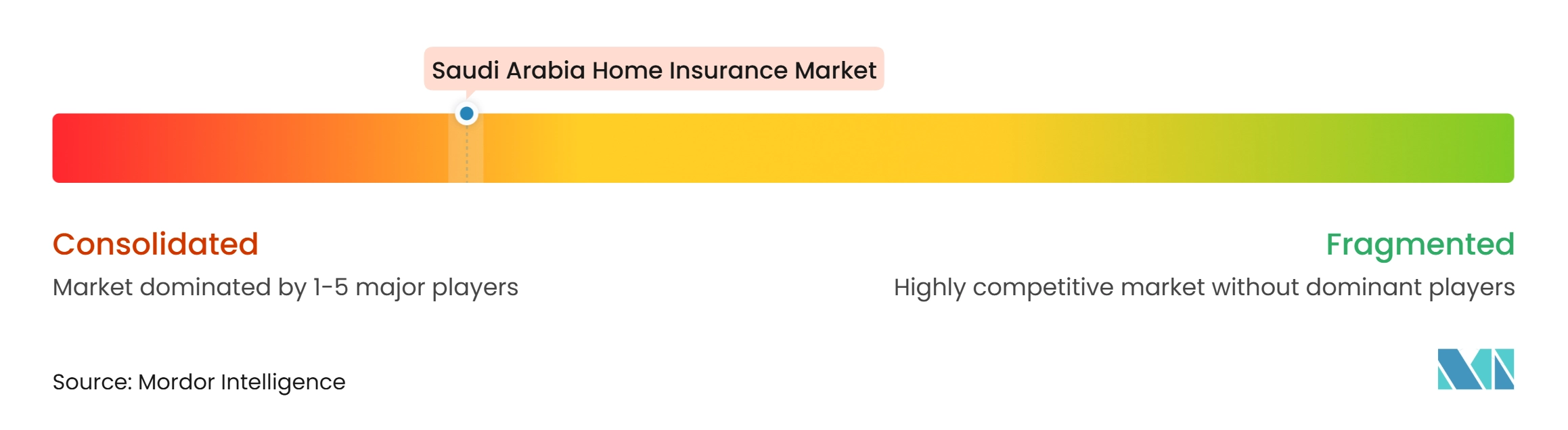
The Saudi Arabia home insurance market is supported by the expansion of the residential property sector, mortgage financing, housing development, and increasing awareness of property protection. The broader Saudi insurance industry recorded gross written premiums (GWP) of SAR 84.3 billion (USD 22.5 billion) in 2025, representing 10.7% year-on-year growth. The market maintained its expansion in Q1 2026, with GWP reaching SAR 29.8 billion (USD 7.9 billion), an increase of 14.4% year-on-year. The Insurance Authority reported improved sector performance, with the net combined ratio declining to 98.3% from 99.9%. Although health and motor insurance continue to account for the majority of industry premiums, property and casualty insurance is receiving greater strategic attention under the National Insurance Sector Strategy, which aims to expand protection for individuals and businesses.
Market development is increasingly influenced by regulatory reforms, residential construction activity, and the integration of insurance into property-related transactions. The introduction of the Risk-Based Capital (RBC) framework from 1 January 2027 will require insurers to maintain capital levels aligned with their underlying risk exposures, strengthening solvency assessment and underwriting discipline. In parallel, the Insurance Authority is promoting digitalization, improved distribution channels, and broader insurance penetration through its National Insurance Sector Strategy. These initiatives are expected to support the development of more accessible residential protection products, including building insurance, contents protection, landlord cover, and tenant-related policies. Mortgage-linked insurance distribution and digital integration with real estate and housing platforms also provide opportunities to increase policy uptake.
The broader insurance sector is also undergoing consolidation and operational restructuring as insurers respond to capital requirements, profitability pressures, and changing market conditions. During the first nine months of 2026, listed insurers recorded 16% growth in insurance revenue to SAR 59.1 billion (USD 15.8 billion), while profit after zakat increased 19% to SAR 2.3 billion (USD 0.6 billion), reflecting an improvement in underwriting performance. Domestic reinsurance capacity also reached 37% of total ceded premiums in Q1 2026, supporting greater retention of insurance premiums within the Kingdom. Going forward, market development is expected to be supported by housing-sector expansion, stronger regulatory oversight, digital policy issuance, and wider access to residential protection products. However, the home insurance segment's growth will depend on improving consumer awareness, affordability, coverage customization, and the availability of products suited to homeowners, landlords, and tenants.
Saudi Arabia Home Insurance Industry Leaders
-
The Company for Cooperative Insurance (Tawuniya)
-
Gulf Insurance Group (GIG Saudi)
-
Walaa Cooperative Insurance Co.
-
Mediterranean and Gulf Cooperative Insurance and Reinsurance Co. (MEDGULF)
-
Allianz Saudi Fransi Cooperative Insurance Co.
- *Disclaimer: Major Players sorted in no particular order
Saudi Arabia Home Insurance Market Companies Covered in this Report
- The Company for Cooperative Insurance (Tawuniya)
- Gulf Insurance Group (GIG Saudi)
- Walaa Cooperative Insurance Company
- The Mediterranean and Gulf Cooperative Insurance and Reinsurance Company (MEDGULF)
- Allianz Saudi Fransi Cooperative Insurance Company
- Wataniya Insurance Company
- Al Rajhi Company for Cooperative Insurance (Al Rajhi Takaful)
- LIVA Insurance Company
- Gulf General Cooperative Insurance Company
- Salama Cooperative Insurance Company
- Aljazira Takaful Taawuni Company
- Arabian Shield Cooperative Insurance Company
- Malath Cooperative Insurance Company
- Saudi Arabian Cooperative Insurance Company (SAICO)
- Al-Etihad Cooperative Insurance Company
- Gulf Union Al Ahlia Cooperative Insurance Company
- Al Sagr Cooperative Insurance Company
- Allied Cooperative Insurance Group (ACIG)
- Arabia Insurance Cooperative Company
- United Cooperative Assurance Company (UCA)
Recent Industry Developments in Saudi Arabia Home Insurance Market
- September 2026: The Insurance Authority of Saudi Arabia published draft Risk-Based Capital rules for public consultation, with an October 2026 deadline, formalizing the capital adequacy framework that will replace the current solvency regime from January 2027 and require all insurance and reinsurance companies to align capital with their risk profile across underwriting, market, credit, and operational exposures.
- August 2026: The Saudi Real Estate Refinance Company launched Saudi Arabia’s first Residential Mortgage-Backed Securities transaction, with the Saudi Central Bank’s no-objection approval on August 21, 2025. The milestone deepens mortgage market liquidity and strengthens lender incentives to maintain fully insured portfolios ahead of potential securitization.
- August 2026: the Insurance Authority signed a cooperation agreement with HUMAIN to support artificial intelligence adoption, secure insurance data access, advanced analytics, and digital infrastructure across the Saudi insurance sector. These capabilities could improve property risk assessment, underwriting efficiency, claims processing, and digital delivery of home insurance products.
- June 2026: Malath Cooperative Insurance signed a one-year strategic partnership with National Housing Services Company to facilitate the issuance of Contractor's Works Insurance for latent-defect policies and integrate related services for real estate developers, contractors, and property owners. The agreement is expected to support the distribution of construction-related property protection through the housing ecosystem.
Saudi Arabia Home Insurance Market Report Scope
Segmentation Overview
| Building-Only Insurance |
| Contents-Only Insurance |
| Combined Building and Contents Insurance |
| Owner-Occupiers |
| Landlords / Non-Occupying Property Owners |
| Renters / Tenants |
| Other Residential Property Insureds |
| Villas / Detached Houses |
| Apartments / Flats |
| Townhouses / Duplexes |
| Other Residential Property Types |
| Direct Sales (Online and Offline) |
| Bancassurance |
| Insurance Brokers |
| Insurance Agents |
| Embedded and Affinity Partnerships |
| Other Distribution Channels |
| Central Region |
| Western Region |
| Eastern Region |
| Northern Region |
| Southern Region |
| By Coverage Type | Building-Only Insurance |
| Contents-Only Insurance | |
| Combined Building and Contents Insurance | |
| By Policyholder Type | Owner-Occupiers |
| Landlords / Non-Occupying Property Owners | |
| Renters / Tenants | |
| Other Residential Property Insureds | |
| By Property Type | Villas / Detached Houses |
| Apartments / Flats | |
| Townhouses / Duplexes | |
| Other Residential Property Types | |
| By Distribution Channel | Direct Sales (Online and Offline) |
| Bancassurance | |
| Insurance Brokers | |
| Insurance Agents | |
| Embedded and Affinity Partnerships | |
| Other Distribution Channels | |
| By Geographic Location | Central Region |
| Western Region | |
| Eastern Region | |
| Northern Region | |
| Southern Region |
Key Questions Answered in the Report
What is the forecast growth rate for home insurance in Saudi Arabia?
The Saudi Arabia home insurance market is projected to grow at a CAGR of 7.5% from 2027 to 2032 and reach USD 260.1 million by 2032. Demand is supported by rising homeownership, mortgage-linked protection, and a larger residential property base.
Which coverage type leads home insurance in Saudi Arabia?
Building-Only Insurance led with 47.8% share in 2026, supported by mortgage requirements for the financed structure. Combined Building and Contents Insurance is expected to expand at 9.2% CAGR through 2032 as household protection needs broaden.
Why are renters becoming important for insurers in Saudi Arabia?
Renters and Tenants are projected to grow at 9.8% CAGR through 2032 as contents-only products and rent-platform integrations become more available. This group does not own the building but may need protection for personal belongings and related liabilities.
Which property category has the largest insured position?
Villas and Detached Houses held 40.7% share in 2026, supported by their high share of residential mortgage financing. Larger insured values and wider contents exposure can also lead to higher insurance premiums for villa owners.
Which sales channel is growing fastest for home cover?
Embedded and Affinity Partnerships are forecast to expand at 11.5% CAGR through 2032 as digital real estate, rental, and other platforms add insurance journeys. The channel can place cover at moments when consumers already arrange property, rental, or payment services.
Which Saudi region will grow fastest for home insurance?
The Western Region is projected to grow at 8.5% CAGR through 2032 because of flood exposure and expanding residential supply. Jeddah, Makkah, and Madinah contribute to the region’s growth through property risk and new housing delivery.