
Saudi Arabia Fixed Wireless Access Market Size and Share
Market Overview
| Study Period | 2020 - 2031 |
|---|---|
| Forecast Data Period | 2026 - 2031 |
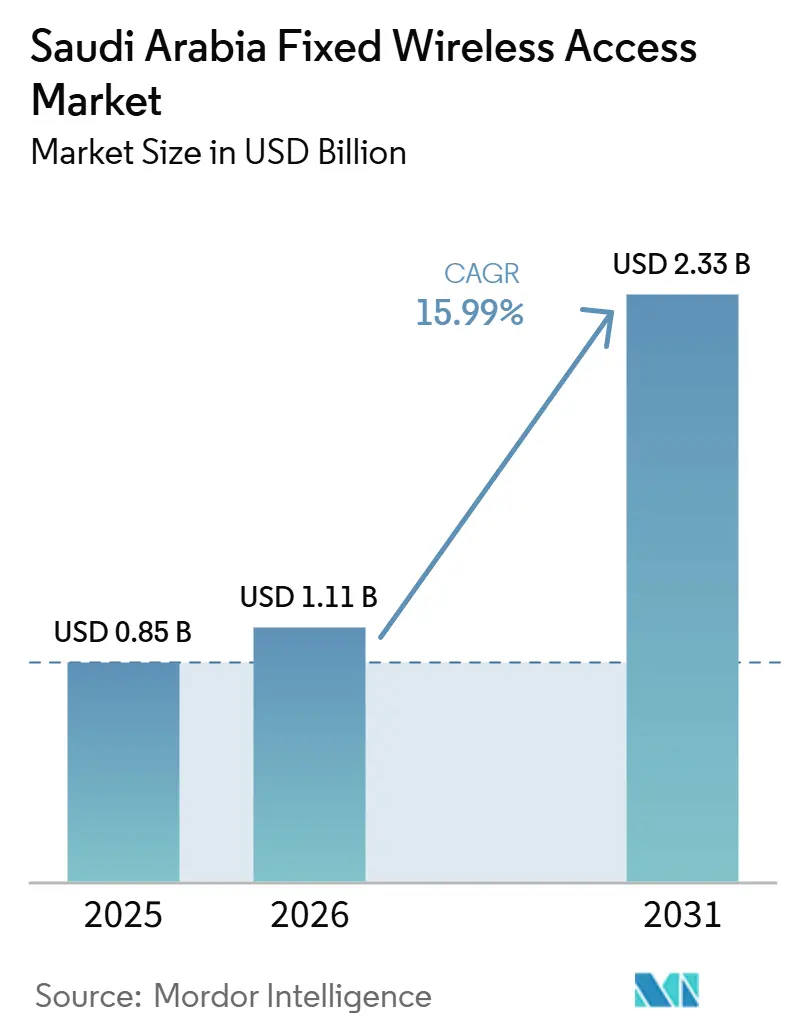
| Base Year Market Size (2025) | USD 0.85 Billion |
| Market Size (2026) | USD 1.11 Billion |
| Market Size (2031) | USD 2.33 Billion |
| Growth Rate (2026 - 2031) | 15.99% CAGR |
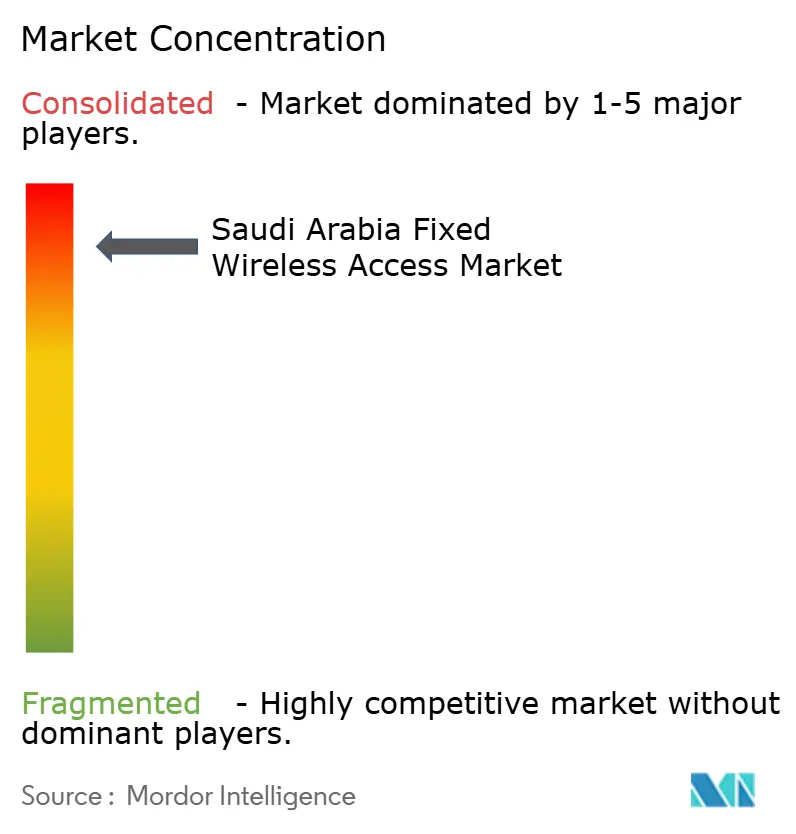
| Market Concentration | High |
Major Players *Disclaimer: Major Players sorted in no particular order Image © Mordor Intelligence. Reuse requires attribution under CC BY 4.0. | |
Saudi Arabia Fixed Wireless Access Market Analysis by Mordor Intelligence
The Saudi Arabia fixed wireless access market size was valued at USD 0.85 billion in 2025 and estimated to grow from USD 1.11 billion in 2026 to reach USD 2.33 billion by 2031, at a CAGR of 15.99% during the forecast period (2026-2031). Growth is being shaped by fast 5G network expansion, direct regulatory support from the Communications, Space and Technology Commission, and broadband targets tied to Vision 2030. The Saudi Arabia fixed wireless access market has already moved beyond an early-adopter phase, as fixed wireless access accounted for a significant share of total fixed broadband subscriptions in 2025 and now serves as a core access layer for households and businesses. Structural conditions also favor wireless deployment, since high temperatures, difficult last-mile fiber economics, and the need for rapid service activation continue to support 5G home broadband in many locations. Demand is also being reinforced by giga-project construction activity and by a large expatriate population that tends to value quick installation and flexible service arrangements. Competition among stc, Mobily, and Zain KSA is now centered on spectrum depth, coverage quality, device choice, bundled connectivity plans, and enterprise-grade reliability, which keeps the Saudi Arabia fixed wireless access market active across both mass and specialized demand.
Key Report Takeaways
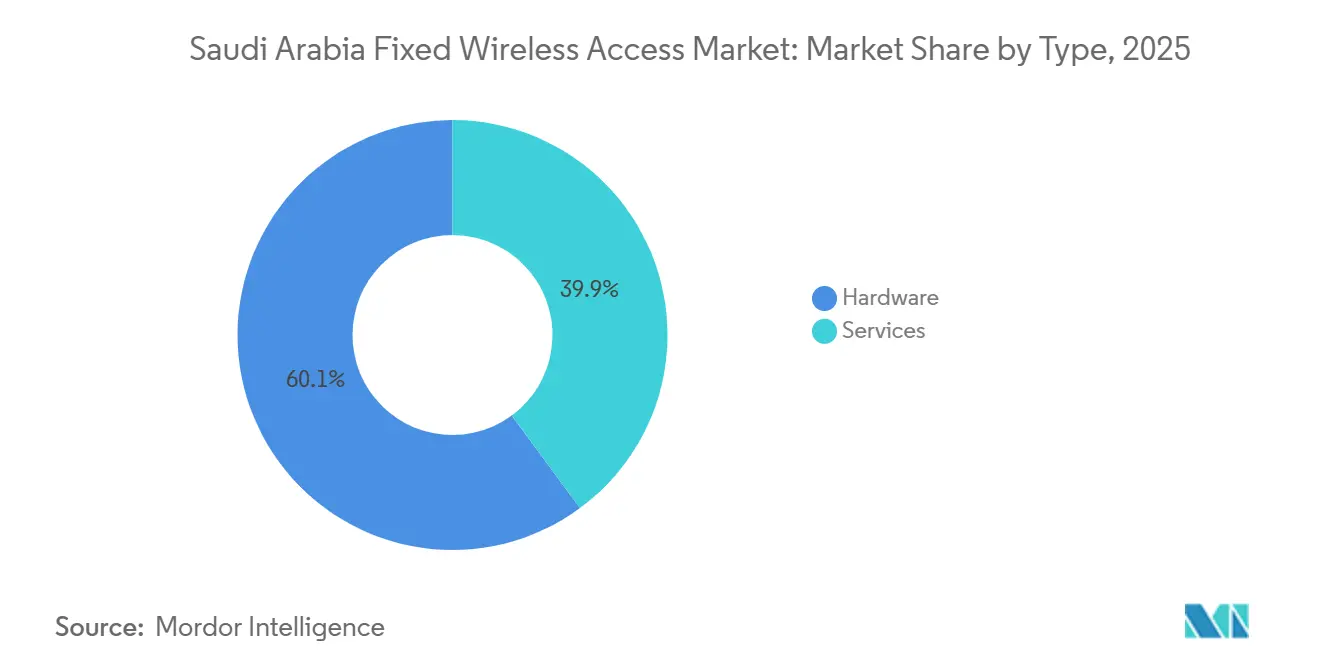
- By type, hardware held 60.11% share of the Saudi Arabia fixed wireless access market size in 2025, while services are projected to expand at a 16.98% CAGR through 2031.
- By application, residential connections held 65.21% share in 2025, while government and public safety are projected to expand at a 17.31% CAGR through 2031.
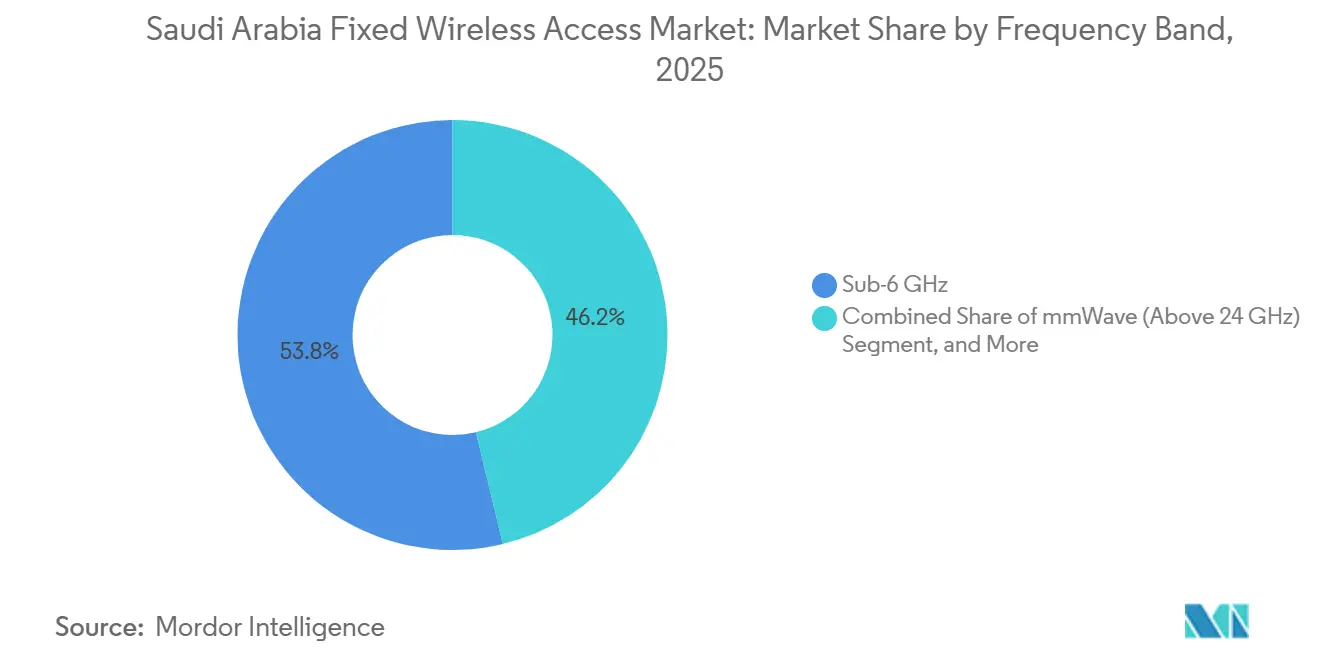
- By frequency band, sub-6 GHz held 53.76% Saudi Arabia fixed wireless access market size in 2025, while mmWave above 24 GHz is projected to grow at a 16.92% CAGR through 2031.
- By deployment mode, indoor CPE held 62.71% share in 2025, while self-install window-mount CPE is projected to grow at a 17.41% CAGR through 2031.
Note: Market size and forecast figures in this report are generated using Mordor Intelligence’s proprietary estimation framework, updated with the latest available data and insights as of January 2026.
Saudi Arabia Fixed Wireless Access Market Trends and Insights
Drivers Impact Analysis*
| DRIVER | (~) % IMPACT ON CAGR FORECAST | GEOGRAPHIC RELEVANCE | IMPACT TIMELINE |
|---|---|---|---|
| 5G Network Expansion Supporting Gigabit-Class Fixed Wireless Access | +4.5% | National, with concentrated near-term gains in Riyadh, Jeddah, Dammam, and 5G-covered provincial cities | Short term (≤ 2 years) |
| Rapid Home Broadband Substitution for Faster Time-to-Service | +3.2% | National, particularly pronounced in suburban and newly developed residential zones | Short term (≤ 2 years) |
| Fiber-Lite Last-Mile Economics in Under-Served Areas | +2.3% | National, with primary impact in secondary cities, peri-urban areas, and rural governorates | Medium term (2-4 years) |
| Enterprise Backup Connectivity for Digital Operations Continuity | +1.8% | Eastern Province, Riyadh, and Jeddah | Medium term (2-4 years) |
| Self-Install Customer Premise Equipment: Reducing Service Activation Friction | +1.2% | National, with accelerated uptake in high-density residential areas and expatriate-heavy districts | Short term (≤ 2 years) |
| Operator Bundling with Mobile and Converged Connectivity Plans | +0.8% | National, with early gains in Riyadh, Jeddah, and Makkah | Medium term (2-4 years) |
| Source: Mordor Intelligence | |||
5G Network Expansion Supporting Gigabit-Class Fixed Wireless Access
Saudi Arabia’s 5G coverage reached 78% of the population by Q1 2025, which gave operators a much larger base from which to scale residential and business fixed wireless subscriptions. stc is also committed to extending that reach to 99% of the population by the end of 2026, which supports a broader service footprint for the Saudi Arabia fixed wireless access market during the current buildout cycle. The November 2024 CST spectrum auction expanded the total licensed spectrum from 1,110 MHz to 1,400 MHz across the 600 MHz, 700 MHz, and 3800 MHz bands, strengthening the capacity base for future 5G fixed access growth.[1]Communications Space and Technology Commission, “Saudi Arabia Ranked 1st Globally in the ITU's ICT Development Index 2026,” Communications, Space and Technology Commission, cst.gov.sa This wider-spectrum position matters because gigabit-class fixed wireless access depends on both reach and available channel depth, especially in large cities where traffic growth can outpace coverage gains.[2]GSMA, “Continued Spectrum Supply as a Driver of Technology Evolution - Saudi Arabia Spectrum Licensing Best Practice,” GSMA, gsma.com The CST Spectrum Outlook 2025-2027 also identified fixed wireless access as a priority use case for future allocation planning, which improves investment clarity for operators and equipment suppliers. Together, these factors support a supply-led expansion pattern in the Saudi Arabia fixed wireless access market rather than one driven solely by short-term subscriber promotions.
Rapid Home Broadband Substitution for Faster Time-To-Service
The strongest consumer advantage of fixed wireless access in Saudi Arabia remains speed of deployment, because household equipment can be activated far faster than a new fiber drop in a recently developed neighborhood.[3]Communications Space and Technology Commission, “Spectrum Outlook for Commercial and Innovative Use 2025-2027,” Communications, Space and Technology Commission, cst.gov.sa KSA’s internet usage rate reached 99% among individuals aged 15-74 in 2025, indicating that many new connections now depend more on service upgrades and quality improvements than on first-time internet adoption. That shift favors the Saudi Arabia fixed wireless access market because operators can use 5G home broadband to shorten activation cycles while still offering speeds that satisfy primary household use.[4]Ericsson, “The 5G Fixed Wireless Access Growth in KSA - stc Network Build-Out,” Ericsson Mobility Report, ericsson.com Vision 2030 coverage targets reinforce the same pattern, since wireless deployment can help operators meet service obligations in areas where fiber civil works would take much longer to complete. The demand effect is durable because fast installation reduces waiting time at the moment of purchase and keeps switching decisions tied to usable performance instead of to infrastructure lead times. As a result, the Saudi Arabia fixed wireless access market is benefiting from a substitution cycle driven by practical service delivery rather than a narrow pricing discount.
Fiber-Lite Last-Mile Economics in Under-Served Areas
Lower-density regions in Saudi Arabia still face challenging fiber economics due to long distances, dispersed settlement patterns, and harsh environmental conditions, which raise the cost of civil works. The Saudi Arabia fixed wireless access market gains from this imbalance because a 5G macro site can extend broadband service without the same excavation burden that fixed wireline buildouts require. Operators are also moving residual wireless-to-the-x users toward 5G-based services in 2025 and 2026, thereby improving spectral efficiency and elevating the quality profile of the access network. This advantage matters most in secondary cities, peri-urban districts, and rural governorates, where fiber arrival can lag demand for years even when broadband needs are already present. The CST Spectrum Outlook 2025-2027 reduced policy uncertainty by explicitly supporting additional mid-band and mmWave pathways for fixed wireless access. That clearer policy runway strengthens the long-range economics of the KSA fixed wireless access market in places where wireline expansion is least efficient.
Enterprise Backup Connectivity for Digital Operations Continuity
Enterprise and public-sector demand is adding a second revenue layer to the Saudi Arabia fixed wireless access market beyond the household broadband base. Organizations increasingly want resilient secondary access paths for digital operations, especially when downtime poses service, safety, or financial risks. The February 2026 Memorandum of Understanding between Ericsson and specialized by stc confirmed that public safety connectivity is moving into formal delivery frameworks that rely on 5G Standalone, network slicing, and defined quality-of-service structures. This widens the commercial role of fixed wireless access from rapid broadband replacement toward continuity, redundancy, and secure operational coverage. The result is a more diversified Saudi Arabia fixed wireless access market with stronger exposure to institutional and enterprise spending cycles.
Restraints Impact Analysis*
| RESTRAINT | (~) % IMPACT ON CAGR FORECAST | GEOGRAPHIC RELEVANCE | IMPACT TIMELINE |
|---|---|---|---|
| Spectrum Capacity Constraints in Dense Urban Clusters | -1.5% | Riyadh, Jeddah, Makkah, and Medina are high-density central districts | Short term (≤ 2 years) to medium term (2-4 years) |
| Weather and Line-of-Sight Sensitivity in Higher Frequency Deployments | -1.0% | National, with acute effects in inland high-temperature regions and mmWave deployment zones | Medium term (2-4 years) |
| Pricing Pressure from Fiber and High-Capacity Wireline Alternatives | -0.7% | Urban cores with high FTTH penetration, especially Riyadh and Jeddah | Medium term (2-4 years) to long term (≥ 4 years) |
| Outdoor CPE and Network Densification CAPEX Requirements | -0.5% | National, particularly for mmWave rollouts in secondary cities and suburban outdoor zones | Long term (≥ 4 years) |
| Source: Mordor Intelligence | |||
Spectrum Capacity Constraints in Dense Urban Clusters
The KSA fixed wireless access market faces its clearest operational limit in dense urban clusters where traffic demand is rising faster than available radio capacity. Riyadh, Jeddah, Makkah, and Medina are the main pressure points because household use, business traffic, and large-event demand converge there. The November 2024 spectrum auction materially improved the national spectrum position, but it did not remove the need for further density-oriented allocation in the highest-load districts. Commercial mmWave licensing remains a major next step because higher-frequency bands are the most direct solution to congestion in very busy urban areas. Techniques such as carrier aggregation and Massive MIMO help operators use present holdings more efficiently, but they do not fully replace the need for fresh spectrum and denser site grids. This means urban capacity management will remain one of the main constraints on service consistency in the Saudi Arabia fixed wireless access market through the near term.
Weather And Line-Of-Sight Sensitivity in Higher Frequency Deployments
Higher-frequency fixed wireless access remains more exposed to local conditions because mmWave performance depends heavily on clean propagation paths and tighter engineering margins. Saudi Arabia’s inland heat, sandstorms, and regional weather variation can create a more difficult rollout environment than trial conditions suggest, especially when operators want stable commercial service rather than peak demonstration speeds. ZTE and GO Telecom showed in 2024 that 5G-A mmWave could reach 6 km with throughput above 2 Gbps, but that result still needs to be translated into repeatable service delivery across mixed terrain and building conditions. The Saudi Arabia fixed wireless access market, therefore, still needs more beam management, stronger link-budget design, and built-in redundancy when outdoor or window-mount equipment is used at scale. Line-of-sight sensitivity can also complicate self-install activation in dense building stock, weakening one of the category’s main operational advantages. These factors are likely to keep higher-frequency deployment disciplined rather than universal across the Saudi Arabia fixed wireless access market.
*Our forecasts treat driver/restraint impacts as directional, not additive. The impact forecasts reflect baseline growth, mix effects, and variable interactions.
Segment Analysis
By Type: Hardware Scale Still Leads While Services Gain Revenue Weight
Hardware is expected to hold 60.11% of the by-type segment in 2025, underscoring the extent to which early expansion in the Saudi Arabia fixed wireless access market depends on large-volume customer-premises equipment procurement. This mix reflects a phase in which operators continue to build their installed base and require device availability to convert 5G coverage into subscriber growth. Consumer premises equipment remains central to residential onboarding, while access units and related network hardware support higher-capacity enterprise campuses and indoor service environments. The hardware lead also indicates that network reach and device readiness are advancing together, rather than through a model in which service revenue expands independently of deployment activity. In the current cycle, the Saudi Arabia fixed wireless access market continues to rely on equipment scale to convert spectrum and radio investment into active fixed broadband relationships.
Services are projected to grow at a 16.98% CAGR through 2031, and this trend in the Saudi Arabia fixed wireless access market size indicates that recurring revenue will become more important as the installed device base matures. This transition typically occurs when operators have enough connected homes and enterprises to shift their focus from basic equipment rollout to managed performance, software support, and service continuity. The December 2025 master frame agreement between stc and Ericsson points in the same direction, combining radio expansion with cloud-native platforms, AI-driven managed services, and longer-term infrastructure planning. This shift does not reduce the role of hardware, but it changes where value is likely to accumulate within the Saudi Arabia fixed wireless access industry as coverage becomes more established. Over time, the segment mix is expected to shift from an equipment-heavy conversion to a more balanced model that combines devices, connectivity, optimization, and managed enterprise support.


By Application: Residential Demand Holds The Base While Government Use Expands Fastest
Residential connections are expected to account for 65.21% of the market in 2025, making household demand the main volume driver of the KSA fixed wireless access market. Very high internet usage, the appeal of quick activation, and continued 5G footprint expansion across urban and emerging residential areas support this position. Operators are also using a hybrid access model in which fiber serves dense premium corridors, while fixed wireless fills coverage gaps and accelerates service delivery in lower-density or recently built districts. This structure broadens the Saudi Arabia fixed wireless access market by enabling wireless and wireline networks to address different access challenges, rather than relying on a single network type for every location. Residential scale, therefore, remains central, even as the market becomes more specialized around service quality and customer segment needs.
Government and public safety are projected to grow at a 17.31% CAGR through 2031, making it the fastest-growing application area in the Saudi Arabia fixed wireless access market. This growth is linked to e-government expansion, crowd-management requirements during Hajj and Umrah, and the need for secure, low-latency links in emergency response environments. The February 2026 agreement between Ericsson and specialized by stc is important because it indicates that these use cases are moving into structured implementation rather than remaining at the proof-of-concept stage. Commercial and industrial demand continues to build in parallel, especially where temporary sites, branches, logistics points, and operating facilities require rapid and resilient links. This trend gives the Saudi Arabia fixed wireless access industry a broader application base than a purely residential model would allow.
By Frequency Band: Sub-6 GHz Anchors Scale While mmWave Builds Premium Capacity
Sub-6 GHz is expected to hold a 53.76% share in 2025, confirming its role as the core coverage and capacity layer for the Saudi Arabia fixed wireless access market. Its lead comes from stronger coverage per site, broader suitability for mixed geographies, and a more mature device ecosystem than higher-frequency alternatives. The 2024 auction outcome reinforced this position, as additional mid-band holdings expanded the bandwidth base available for mass-market residential and commercial services. This balance of reach and capacity explains why sub-6 GHz continues to support the broadest service layer across cities, secondary regions, and developing corridors. In practical terms, the Saudi Arabia fixed wireless access market continues to rely on sub-6 GHz as the band that scales most reliably across multiple demand conditions.
The mmWave segment is projected to grow at a 16.92% CAGR through 2031, and this Saudi Arabia fixed wireless access market size outlook reflects rising confidence in very high-capacity wireless delivery, where dense usage justifies the investment. In 2024, ZTE and GO Telecom demonstrated that 5G-A mmWave could extend to 6 km while delivering throughput above 2 Gbps, improving the technology’s commercial credibility beyond short-range urban assumptions. This development matters for Saudi Arabia because smart-city districts, venue environments, and premium enterprise sites need more than coverage; they need sustained capacity and performance headroom. Even so, commercial scale still depends on licensing progress, densification, and careful deployment economics. Therefore, mmWave is more likely to complement than replace the mass layer in the Saudi Arabia fixed wireless access industry. The band has the strongest growth profile, but it still sits atop a broader sub-6 GHz foundation rather than standing alone.

By Deployment Mode: Indoor CPE Leads Current Scale While Self-Install Gains Speed
Indoor CPE is expected to hold a 62.71% share in 2025, making it the largest deployment mode in the KSA fixed wireless access market. This lead reflects ease of setup, limited weatherproofing requirements, and a strong fit with apartment-led housing patterns in major Saudi cities. Indoor units also support faster activation because they avoid some of the site complexity that outdoor antenna installations can require. This makes indoor equipment the practical scale layer for operators that aim to convert customers quickly without a heavy field-service burden. As a result, indoor CPE remains the dominant format during the current expansion phase of the Saudi Arabia fixed wireless access market.
Self-install window-mount CPE is projected to grow at a 17.41% CAGR through 2031, making it the fastest-growing deployment mode. Its appeal is clear: plug-and-play hardware reduces activation friction and reduces dependence on technician visits at the time of customer sign-up. This is especially relevant in expatriate-heavy districts and fast-moving residential zones, where simple onboarding can influence the final provider choice. Outdoor CPE also remains important in suburban districts and construction-led giga-project zones, where better line-of-sight is needed for stable performance. Over time, the Saudi Arabia fixed wireless access market is likely to adopt indoor, self-install, and outdoor modes, with each serving different cost and coverage requirements.
Geography Analysis
The Central Region is expected to be the largest revenue pool in 2025, supported by dense 5G macro infrastructure, government demand, and premium residential development. Riyadh remains the primary demand center, as policy activity, business concentration, and housing growth reinforce fixed wireless uptake within the same geography. Large development programs also create early demand for high-capacity connectivity before providers fully extend permanent wireline infrastructure across every site. The 2024 spectrum auction strengthens the bandwidth base available to operators in this region, which is critical because density gains require sufficient licensed spectrum. This combination keeps the Central Region at the core of the Saudi Arabia fixed wireless access market across both household and enterprise demand.
The Western Region follows a different demand pattern, as Jeddah, Makkah, and Medina are shaped by religious travel, seasonal crowd cycles, and high service demand during major events. This pattern requires operators to maintain high service readiness, even when usage peaks occur during specific periods. Jeddah adds a more stable commercial layer, as its logistics, port, retail, and SME base support year-round enterprise connectivity needs. For the Saudi Arabia fixed wireless access market, the Western Region therefore combines event-driven network stress with a steady business demand profile that extends beyond pilgrimage activity.
The Eastern Province stands out because oil, gas, petrochemicals, and industrial logistics generate stronger enterprise demand than household subscriber counts alone would indicate. Connectivity needs in this region are linked to operational continuity, monitoring, predictive maintenance, and secure backup links for critical facilities. Secondary cities such as Abha, Tabuk, Al-Qassim, and Hail also remain important because wireless broadband can reach these areas more quickly, even though fiber economics remain challenging. This expands the Saudi Arabia fixed wireless access market beyond the three largest metro areas and creates a broader national mix of residential, institutional, and industrial demand. As higher-capacity enterprise wireless links mature, these non-core geographies are expected to remain among the clearest sources of premium connectivity spending in the Saudi Arabia fixed wireless access market.
Competitive Landscape
The Saudi Arabia fixed wireless access market is expected to remain highly concentrated at the operator level in 2025, with stc, Mobily, and Zain KSA, and is expected to hold 516 MHz of spectrum after the November 2024 auction, giving it the deepest spectrum position among the three leading operators. A converged fiber and 5G architecture reinforces this position, enabling stc to determine where fixed wireless access should complement or precede wireline expansion. This creates a competitive structure in which scale, spectrum, and network design matter more than headline subscriber offers alone. Even within this concentrated structure, competition in the Saudi Arabia fixed wireless access market continues to intensify, as each leading operator uses a distinct strategy to protect and expand its position.
Mobily has used spectrum acquisition as a competitive lever, purchasing an additional 120 MHz across the 700 MHz and 3800 MHz bands for SAR 9.4 billion (USD 2.51 billion), which doubled its C-band allocation to 200 MHz. stc is expected to strengthen its long-term network position in December 2025 through a five-year master frame agreement with Ericsson covering Ericsson Radio System, Massive MIMO, 5G Standalone, 5G Advanced, cloud-native platforms, AI-driven managed services, and 6G readiness planning. Ericsson and specialized by stc also signed a February 2026 Memorandum of Understanding on mission-critical public safety connectivity, indicating that enterprise and institutional segments are becoming a sharper competitive battleground. These developments show that competition in the Saudi Arabia fixed wireless access market is being shaped by spectrum depth, service architecture, and differentiated vertical capabilities rather than price alone.
On the vendor side, the market is more fragmented, with multiple technology firms supplying radios, CPE, software, and indoor solutions rather than a concentrated group of service providers. Ericsson maintains a strong long-term position through its close alignment with stc, while ZTE has demonstrated mmWave capabilities that support future premium wireless use cases in Saudi Arabia. Wewins has also supplied operator-grade 5G FWA CPE platforms to stc at a national scale, showing that specialized device vendors can still secure important roles in the Saudi Arabia fixed wireless access market. This split between concentrated operators and broader vendor participation helps explain why retail competition remains tight while procurement choices remain relatively open. It also indicates that future competitive advantage will depend on how effectively operators combine shared infrastructure, software performance, spectrum strategy, and device design into a consistent service experience.
Saudi Arabia Fixed Wireless Access Industry Leaders
Saudi Telecom Company (stc)
Mobile Telecommunications Company Saudi Arabia (Zain KSA)
Etihad Etisalat Company (Mobily)
Huawei Technologies Co. Ltd.
Nokia Corporation
- *Disclaimer: Major Players sorted in no particular order

Recent Industry Developments
- February 2026: Ericsson and specialized by stc signed a Memorandum of Understanding to advance mission-critical 5G connectivity for public safety and first responders in Saudi Arabia, using network slicing and dedicated quality-of-service frameworks on stc's 5G Standalone network.
- December 2025: stc Group and Ericsson signed a five-year Master Frame Agreement covering 5G infrastructure expansion with Ericsson Radio System, Massive MIMO, 5G Standalone and 5G Advanced technologies, cloud-native platforms, AI-driven managed services, and 6G readiness roadmaps aligned with Vision 2030.
- July 2025: CST published the Spectrum Outlook for Commercial and Innovative Use (2025-2027), explicitly prioritizing FWA spectrum expansion, non-terrestrial network enablement, Automated Frequency Coordination for outdoor Wi-Fi, dynamic spectrum access models, and a research and innovation pathway for 6G networks.
- March 2025: Nokia, TAWAL, stc, and Zain, supported by CST, completed the world's first 5G Standalone mmWave active spectrum-sharing trial at LEAP 2025 in Riyadh, utilizing 800 MHz bandwidth in the 26 GHz band.


Saudi Arabia Fixed Wireless Access Market Report Scope
The Saudi Arabia Fixed Wireless Access Market Report is Segmented by Type (Hardware [Consumer Premise Equipment and Access Units] and Services), Application (Residential, Commercial, Industrial, and Government and Public Safety), Frequency Band (Sub-6 GHz, mmWave (Above 24 GHz), and Unlicensed/Shared CBRS), and Deployment Mode (Indoor CPE, Outdoor CPE, and Self-Install Window-Mount CPE). The Market Forecasts are Provided in Terms of Value (USD).
| Hardware | Consumer Premise Equipment (CPE) |
| Access Units (Femto and Picocells) | |
| Services |
| Residential |
| Commercial |
| Industrial |
| Government and Public Safety |
| Sub-6 GHz |
| mmWave (Above 24 GHz) |
| Unlicensed / Shared CBRS |
| Indoor CPE |
| Outdoor CPE |
| Self-Install Window-Mount CPE |
| By Type | Hardware | Consumer Premise Equipment (CPE) |
| Access Units (Femto and Picocells) | ||
| Services | ||
| By Application | Residential | |
| Commercial | ||
| Industrial | ||
| Government and Public Safety | ||
| By Frequency Band | Sub-6 GHz | |
| mmWave (Above 24 GHz) | ||
| Unlicensed / Shared CBRS | ||
| By Deployment Mode | Indoor CPE | |
| Outdoor CPE | ||
| Self-Install Window-Mount CPE |


Key Questions Answered in the Report
What is the Saudi Arabia fixed wireless access market size in 2026, and where is it headed by 2031?
The Saudi Arabia fixed wireless access market stands at USD 1.11 billion in 2026 and is forecast to reach USD 2.33 billion by 2031, growing at a 15.99% CAGR.
Why is 5G expansion so important for fixed wireless access in Saudi Arabia?
5G is the foundation of service growth because coverage reached 78% of the population by Q1 2025, and broader spectrum availability is improving the ability to scale high-speed household and enterprise connections.
Which application area is growing the fastest?
Government and public safety is the fastest-growing application segment, with a projected 17.31% CAGR through 2031, supported by public-sector digitalization and mission-critical connectivity needs.
Which frequency band leads adoption today?
Sub-6 GHz led with a 53.76% share in 2025 because it offers the best balance of coverage and capacity, while mmWave is the fastest-growing band at a 16.92% CAGR.
How are the leading operators competing with each other?
Stc, Mobily, and Zain KSA are competing through spectrum holdings, 5G coverage depth, bundled service offers, device strategy, and stronger enterprise and public-sector connectivity capabilities.
What deployment model is gaining the most momentum?
Self-install window-mount CPE is gaining the fastest momentum with a projected 17.41% CAGR through 2031, while indoor CPE remained the largest deployment mode with a 62.71% share in 2025.
Page last updated on:






