
Saudi Arabia Container Homes Market Size and Share
Market Overview
| Study Period | 2021 - 2032 |
|---|---|
| Forecast Data Period | 2027 - 2032 |
| Base Year Market Size (2026) | USD 1.51 Billion |
| Market Size (2027) | USD 1.63 Billion |
| Market Size (2032) | USD 2.41 Billion |
| Growth Rate (2027 - 2032) | 8.10 % |
| Market Concentration | Medium |
Major Players *Disclaimer: Major Players sorted in no particular order Image © Mordor Intelligence. Reuse requires attribution under CC BY 4.0. | |
Saudi Arabia Container Homes Market Analysis by Mordor Intelligence
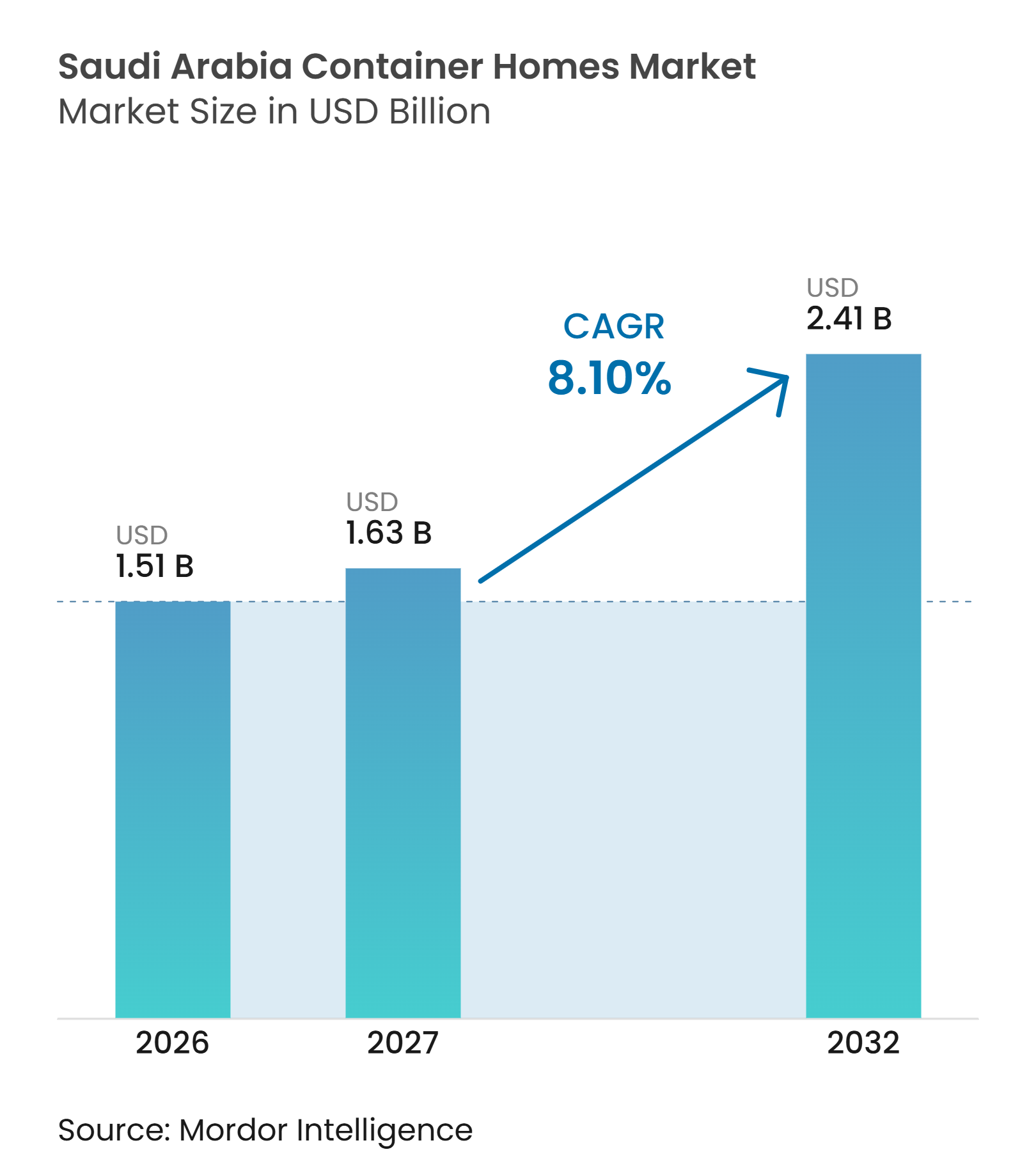
The Saudi Arabia Container Homes Market size was valued at USD 1.51 billion in 2026 and is forecast to grow to USD 1.63 billion in 2027 and USD 2.41 billion by 2032, reflecting a CAGR of 8.10% during 2027–2032.
Government-backed construction, housing, tourism, and pilgrimage activity is sustaining demand for quickly deployable accommodation. Large projects need worker housing that can be installed on demanding timelines and then adjusted as site requirements change. Domestic manufacturing is becoming more important because compliance, delivery certainty, and after-sales support matter alongside unit cost. The Saudi Arabia container homes industry also faces a higher technical threshold for permanent use because thermal performance, fire protection, and occupancy certification must meet national requirements. Suppliers that can provide compliant, insulated units at scale are better placed to address permanent housing, hospitality, and institutional orders.
Key Report Takeaways
- By offering, on-site built units held 60.5% of the Saudi Arabia container homes market share in 2026, while factory-built units are projected to grow at an 8.85% CAGR through 2032.
- By construction type, fixed structures held 50.5% of the Saudi Arabia container homes market size in 2026, while movable structures are projected to grow at a 9.3% CAGR through 2032.
- By end use, residential homes accounted for 38% of the Saudi Arabia container homes market size in 2026, while emergency homes are projected to grow at a 9.6% CAGR through 2032.
- By city, Riyadh held 34% of the Saudi Arabia container homes market share in 2026 and is projected to grow at an 8.9% CAGR through 2032.
Note: Market numbers in this report are based on Mordor Intelligence's proprietary estimation framework, which combines nine months of actuals with Q4 projections for base year 2026.
Market Trends and Insights
Drivers Impact Analysis of Saudi Arabia Container Homes Market*
| Drivers | (~) % Impact on CAGR Forecast | Geographic Relevance | Impact Timeline |
|---|---|---|---|
| Giga-Project and Remote-Worker Accommodation | +3.0% | National, led by NEOM, Red Sea coast, Qiddiya, and Riyadh | Short-term (≤ 2 years) |
| Vision 2030 Housing and Homeownership Programs | +1.5% | National, with early gains in Riyadh, Makkah, and Eastern Region | Medium term (2-4 years) |
| Local Prefab and Container-House Manufacturing Expansion | +1.2% | National, concentrated in Riyadh and Dammam Metropolitan Area | Long term (≥ 4 years) |
| Tourism and Hospitality Developments | +1.0% | Red Sea coast, NEOM, Tabuk, AlUla, and Taif highlands | Medium term (2-4 years) |
| Event, Pilgrimage, and Rapid-Deployment Temporary Housing | +0.8% | Makkah and Madinah, with spillover to Jeddah staging areas | Short term (≤ 2 years) |
| Source: Mordor Intelligence | |||
Giga-Project and Remote-Worker Accommodation
Giga-project activity remains the leading demand source for temporary and semi-permanent accommodation across Saudi Arabia. NEOM, Red Sea Global, Qiddiya, and Diriyah Gate require sleeping units, offices, welfare areas, kitchens, and service buildings. Site operators need facilities that can be delivered quickly and adjusted as workforce numbers change. Longer service-life requirements also increase the value of documented quality, durable materials, and controlled installation. This demand supports suppliers that can provide compliant modular systems at the scale required by complex projects.
Vision 2030 Housing and Homeownership Programs
Housing policy is extending demand beyond construction camps into standardized residential formats. The Ministry of Municipalities and Housing reported that 51,072 Saudi families moved into first-owned homes during the first months of 2026[1]. Buyers and public programs need short delivery periods, predictable construction, certification, and accessible financing. The Modern Building Initiative also financed 4 additional Saudi factories and reported more than 40,000 units of annual capacity across supported facilities[2]. This policy framework gives compliant container-home suppliers a clearer route into formal housing supply.
Local Prefab and Container-House Manufacturing Expansion
Local capacity is shifting supply from project-based assembly toward a more industrial model. China Harbour Engineering Company reported that its Riyadh smart factory was supplying the modular Sedra residential project with digital production systems[3]. Standardized factory output can improve production consistency and reduce on-site construction work at remote locations. AluHouse also announced plans for a Saudi factory that could produce 30,000 modular flat units annually by 2027. Greater local capacity can shorten delivery times while increasing competition among suppliers serving the Kingdom.
Tourism and Hospitality Developments
Tourism is creating demand for permanent, higher-specification modular accommodation rather than basic worker cabins. Remote destinations require lodging that can limit on-site disruption while meeting expectations for interior quality and guest comfort. CIMC Modular Building Systems shipped 104 finished volumetric modules to Riyadh for the Earth Hotels boutique property in August 2026. The project shows that factory-finished modules can support permanent hospitality uses under Saudi Building Code requirements. This demand stream creates a practical opportunity for suppliers that combine design, production, installation, and service support.
Restraints Impact Analysis of Saudi Arabia Container Homes Market*
| Restraints | (~) % Impact on CAGR Forecast | Geographic Relevance | Impact Timeline |
|---|---|---|---|
| Extreme Heat and Cooling-Load Requirements | -1.8% | National, most severe in Riyadh, Dammam, and inland sites | Long term (≥ 4 years) |
| Building-Code Recognition of Permanent Container Dwellings | -1.5% | National, with specific challenges in municipality-governed urban zones | Medium term (2-4 years) |
| Limited Mortgage and Valuation Support for Container Homes | -1.0% | National, more constrained in secondary cities and non-urban zones | Medium term (2-4 years) |
| Project-Pipeline Concentration and Import Dependence | -0.9% | National, with spillover to Middle East and Africa supply chains | Short term (≤ 2 years) |
| Source: Mordor Intelligence | |||
Extreme Heat and Cooling-Load Requirements
Extreme heat is a core product-design constraint for permanent and semi-permanent container homes. A 2026 Riyadh study found that better envelope insulation and solar-gain control could reduce cooling demand by 72.3%. A poorly protected unit may have high operating costs and struggle to maintain indoor comfort. Certified insulation, reflective roofing, shading, glazing control, and efficient heating, ventilation, and air conditioning systems increase compliance costs. Suppliers that build thermal performance into each unit are better placed to serve certified long-term applications.
Building-Code Recognition of Permanent Container Dwellings
Permanent container homes must satisfy structural, fire, and energy requirements before they can serve as standard residential assets. This protects occupants but can increase documentation, design, and approval work for non-traditional formats. Municipal interpretation can also create uncertainty when the proposed use is permanent rather than temporary. Units with a clear conformity record can access more credible residential, institutional, and hospitality opportunities. Faster and more consistent certification would improve planning confidence for both suppliers and buyers.
*Our forecasts treat driver/restraint impacts as directional, not additive. The impact forecasts reflect baseline growth, mix effects, and variable interactions.
Saudi Arabia Container Homes Market Segment Analysis
By Offering:
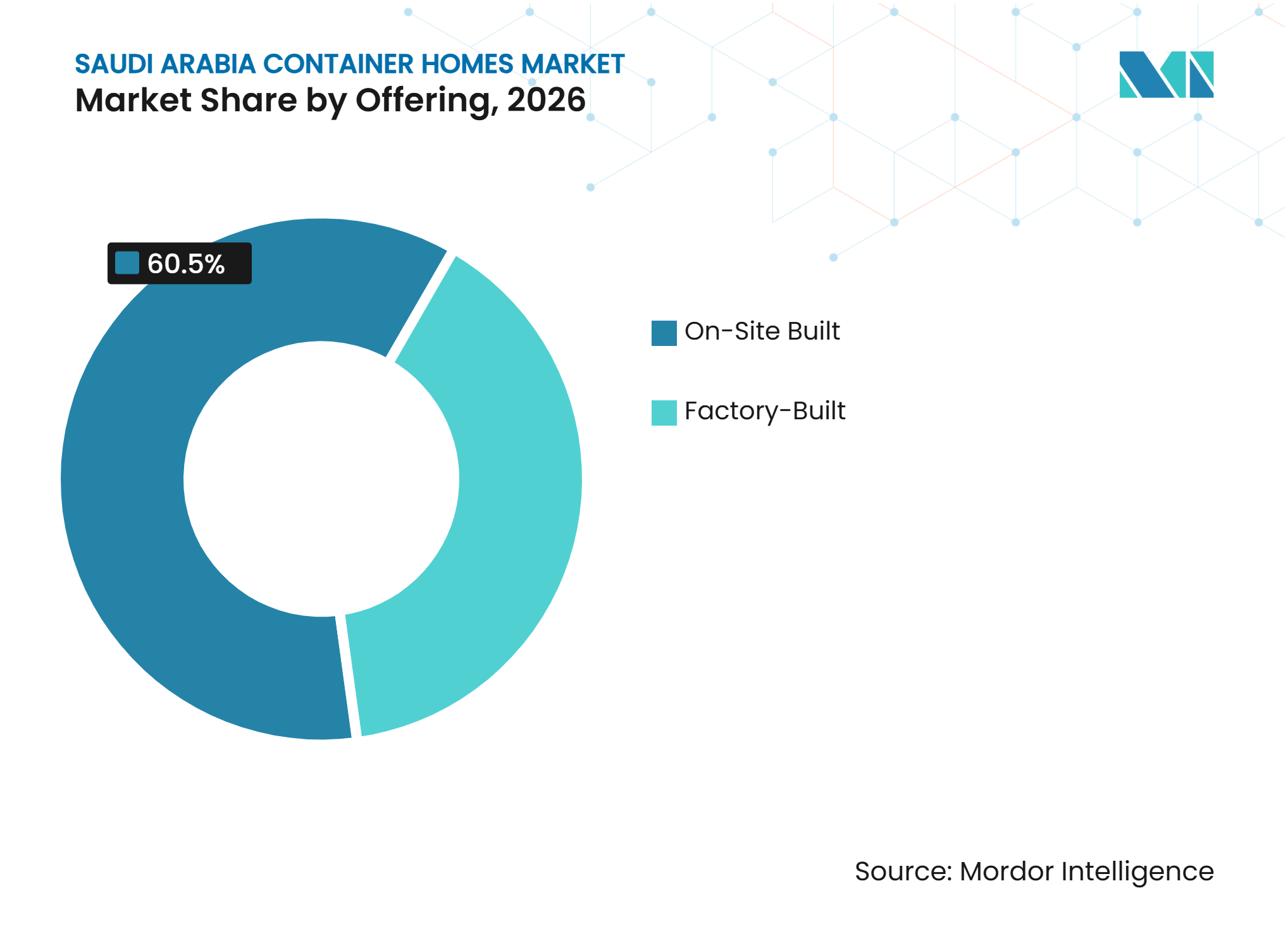
On-Site Built Units Retain Scale as Factory-Built Formats Gain GroundOn-site-built units held 60.5% of the Saudi Arabia container homes market share in 2026. This position reflects the continued need for site-specific worker camps, operational buildings, and hospitality installations. Remote project locations can require layouts that are tailored to the site, local access, and workforce requirements. On-site assembly gives operators flexibility when the final configuration is not fully defined at the point of order. It also allows suppliers to adjust facilities as the project moves through different stages. These advantages remain important in large developments where accommodation needs are closely tied to construction progress. On-site formats can include several building functions, which supports their use in larger compounds. They are therefore likely to retain a significant role even as factory production increases.
Factory-built units are projected to grow at an 8.85% CAGR through 2032. Their appeal rests on consistent production, faster finishing, and clearer quality control before delivery. Government and institutional buyers increasingly expect documented specifications and repeatable performance. That environment supports modules manufactured under controlled factory conditions. Factory-built products are particularly relevant for hospitality and institutional applications where interior finishes and quality traceability carry more weight. They also fit repeated layouts that can be produced in volume without extensive site modification. The segment is likely to reduce the gap with on-site construction in value terms as permanent uses become more common. The Saudi Arabia container homes industry is therefore moving toward a balance between site flexibility and controlled factory output.


By Construction Type:
Fixed Structures Lead While Movable Units Gain from ReuseFixed units held 50.5% of the Saudi Arabia container homes market share in 2026. Their role is strongest in accommodation programs that require a long service life and a stable site layout. Permanent worker compounds, residential projects, and hospitality properties all benefit from a structure designed for sustained use. Fixed installations can also accommodate more extensive services and finished interiors. The Earth Hotels project in Riyadh demonstrates this direction because its 104 volumetric modules were supplied for a permanent boutique hotel. Such projects place greater importance on certified quality, building integration, and long-term durability. They support the continued relevance of fixed construction in higher-specification applications. These needs keep the fixed category important despite the attraction of movable units.
Movable structures are projected to expand at a 9.3% CAGR through 2032. Their central advantage is redeployability across projects and project phases. A unit installed at one development can be moved to another site rather than being left behind when activity shifts. This can improve the lifetime value of the asset for operators managing several construction programs. Movable units are also well suited to seasonal accommodation and short-notice requirements. Their format aligns with pilgrimage, civil-defense, and remote workforce applications. However, their performance still depends on transportability, suitable services, and adequate thermal design. The Saudi Arabia container homes industry is likely to favor suppliers that can provide movable units without compromising safety, comfort, or maintenance access.
By End Use:
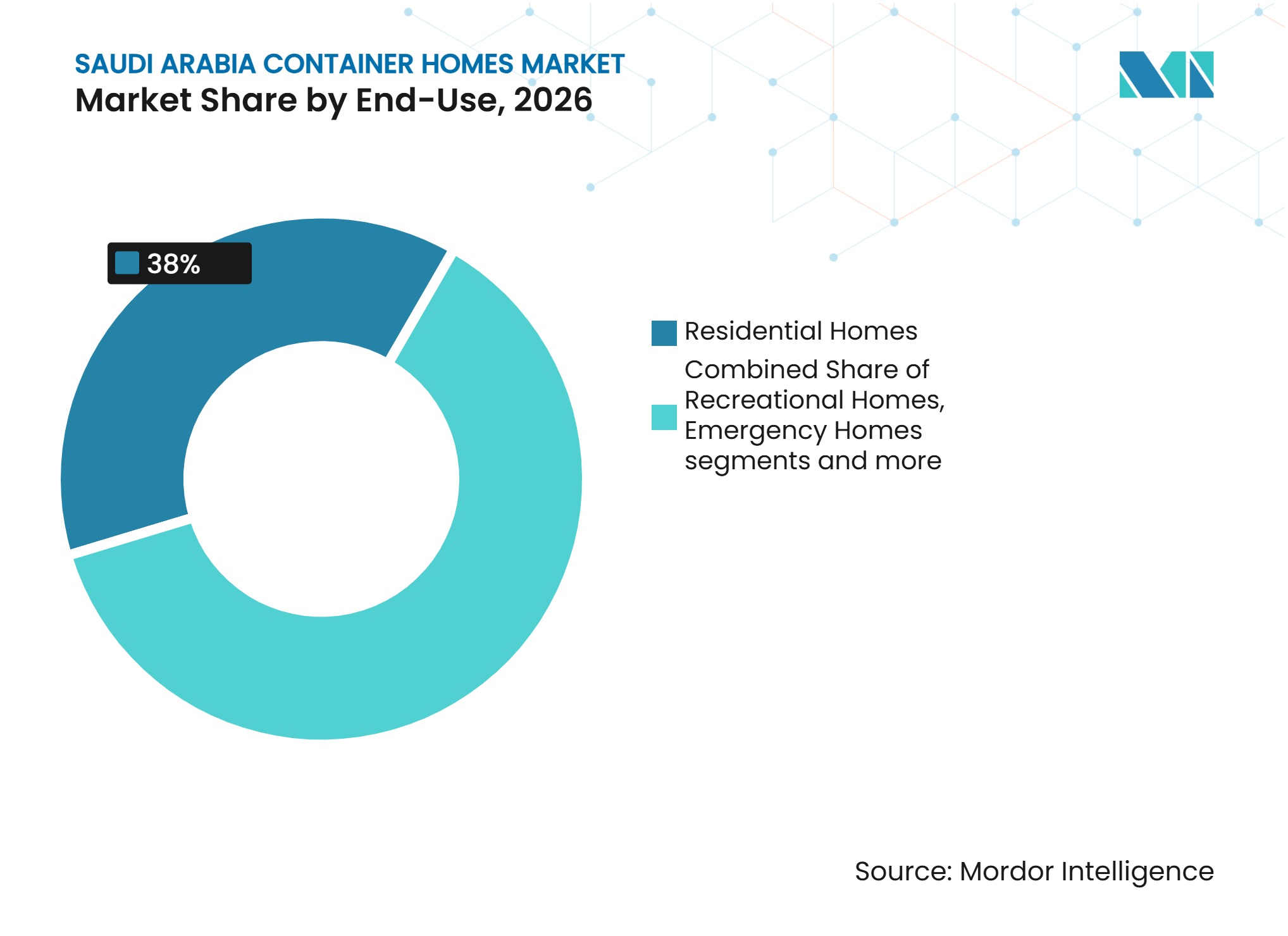
Residential Homes Provide Scale While Emergency Homes Lead GrowthResidential homes accounted for 38% of the Saudi Arabia container homes market size in 2026. Housing programs and the need for more affordable supply support this position. The Ministry of Municipalities and Housing reported continuing progress in first-home occupancy during 2026. Residential applications need more than a quick construction method because occupants require comfort, reliable utilities, and long-term confidence. This makes energy performance, fire safety, and compliance central to the segment. Factory-built housing can offer more predictable production where designs are standardized. The segment will remain sensitive to mortgage availability and valuation practices. These factors determine how widely container-based homes can move from a specialized option into owner-occupied housing.
Emergency homes are projected to grow at a 9.6% CAGR through 2032. The segment benefits from the need for accommodation that can be dispatched and installed quickly. It also overlaps with pilgrimage operations, temporary facilities, and disaster or civil-defense response. The Mina housing project announced by Kidana illustrates the role of modular, climate-aware accommodation in high-volume seasonal settings. Emergency units must balance speed with ventilation, shading, hygiene, and operational durability. These requirements can favor suppliers with experience in repeatable deployment and maintenance. Recreational homes also create an adjacent opportunity through eco-lodges, glamping, and desert retreats. Nursing-home applications remain at an early stage because permanent-use restrictions and care requirements limit near-term expansion.


Geography Analysis
Riyadh
Riyadh held 34% of the Saudi Arabia container homes market share in 2026 and is projected to grow at an 8.9% CAGR through 2032. The city combines housing policy activity, large construction programs, and a developing factory-based supply network. This makes it relevant for both worker accommodation and permanent modular applications. China Harbour Engineering Company reported that its Riyadh smart factory was serving the Sedra development using digital production systems. The project points to a greater role for controlled factory production in the capital. Riyadh buyers also face a higher need for certified thermal and building performance because permanent use requires formal compliance. This favors suppliers that can document unit performance, support approvals, and deliver consistent quality. The city remains the most important market for firms seeking both volume and sustained growth.
Jeddah
Jeddah's demand is shaped by tourism, pilgrimage logistics, and its role as a Red Sea gateway. The city serves as a staging and support location for accommodation needs connected with Makkah and Madinah. Seasonal requirements favor modular solutions that can be organized around tight schedules and high occupancy volumes. The port function also supports the movement of imported components and fully finished units. At the same time, local service capability remains important because accommodation operators require installation, maintenance, and reliable replacement support. The city offers a different demand profile from Riyadh because visitor accommodation plays a stronger role. Suppliers that can combine rapid deployment with climate-appropriate design have a clearer fit with this market.
Dammam Metropolitan Area (DMA) and Rest of Saudi Arabia
The Eastern Province supports workforce accommodation through industrial and oil-and-gas activity, while NEOM and other remote areas support projects with demanding logistics. Dammam, Khobar, and Dhahran need a mix of temporary site cabins and more durable camp facilities. NEOM creates another important demand center because large-scale development needs accommodation that can be deployed in remote conditions. AlUla, the Asir region, and northern mining locations also favor lightweight, relocatable formats where conventional delivery is harder. The 2026 Mina project confirms that modular solutions can address ventilation and shading needs in demanding operating environments. Across these areas, suppliers must adapt units to climate, transport access, and site services. The geographic spread reduces reliance on one city, although project timing can still vary. The Saudi Arabia container homes market becomes more resilient when suppliers serve both large urban programs and specialized remote locations.
Competitive Landscape
Market Concentration
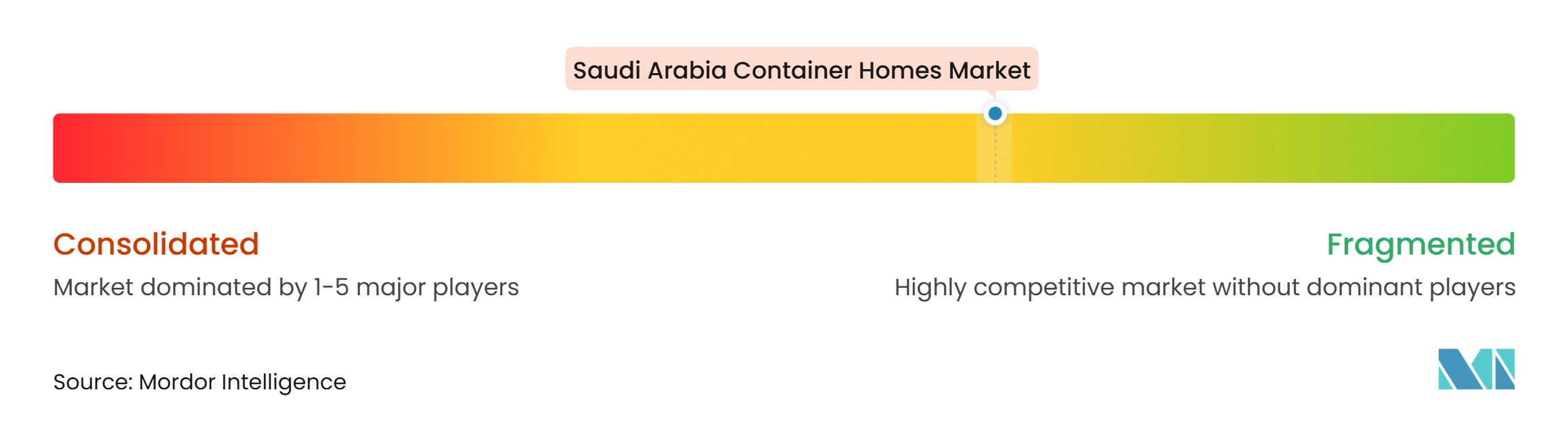
The Saudi Arabia container homes market is moderately fragmented. Domestic companies include Red Sea International, Aldamegh Portable Houses Factory, Mokamela Prefab, and Ahmed & Naif Al-Owaidah Co. for Industries. These firms benefit from local customer relationships, familiarity with national requirements, and the ability to provide service after installation. International manufacturers also compete through factory scale, repeatable product designs, and project-specific supply contracts. Competition therefore extends beyond unit price to include delivery reliability, compliance documentation, thermal performance, and field support. Domestic firms can be particularly strong where buyers require close coordination with local authorities and operators. International players can remain competitive where large orders reward production scale and factory finishing.
CIMC Modular Building Systems made a strategic move toward permanent hospitality applications by shipping 104 fully finished modules for the Earth Hotels project in Riyadh. China Harbour Engineering Company added local production capability through its Riyadh smart factory for the Sedra modular residential project. AluHouse also announced plans for Saudi production capacity for 30,000 modular flats each year by 2027. These moves show that companies are positioning around local production, higher-value permanent uses, and standardized output. The strategic contest is shifting toward the ability to meet formal specifications and maintain delivery quality at volume. That change can benefit firms that combine manufacturing scale with Saudi-based installation and support.
Competitive openings remain in certified permanent residential units and hospitality formats that can meet high operating requirements. A container home designed for a permanent application needs stronger evidence of comfort, durability, safety, and lifecycle performance. Suppliers can differentiate through insulated envelopes, reflective roofing, efficient heating, ventilation, and air conditioning systems, and complete interior fit-outs. These features are especially relevant in the Saudi climate because cooling performance is tied to the total operating value of the building. The need for certification and financing support can slow adoption, but it also raises barriers for low-specification competitors. The market is unlikely to be defined by a single player because demand spans many project types, locations, and specifications. It remains a contest between local knowledge, factory capacity, technical compliance, and project delivery capability.
Saudi Arabia Container Homes Industry Leaders
-
GDI (Gulf Development International)
-
Saudind
-
SAGA Industrial Company
-
Koyee International Container Industrial Company
-
Portable House
- *Disclaimer: Major Players sorted in no particular order
Saudi Arabia Container Homes Market Companies Covered in this Report
- GDI (Gulf Development International)
- Saudind
- SAGA Industrial Company
- Koyee International Container Industrial Company
- Portable House
- Haal Portable Cabin Manufacturing Company
- Al-Buyoot Al-Saree'a for Prefabricated Homes
- Royal Portable House Co.
- Ahmed & Naif Al-Owaidah Co. for Industries
- Red Sea International
- Mokamela Prefab
- Karmod
- Guangdong WELLCAMP Building Materials Co., Ltd.
- GS Housing
- K-HOME
- Lida Group
- CIMC Modular Building Systems
- Homagic (CSCEC subsidiary)
- CGCH (China Green Container House)
- Heshi (Hebei) Integrated Housing Co., Ltd
Recent Industry Developments in Saudi Arabia Container Homes Market
- August 2026: CIMC Modular Building Systems shipped 104 fully finished volumetric modules from its Jiangmen production facility to Riyadh for the Earth Hotels boutique hospitality project in the Al Maathar District. The project, CIMC's first permanent hotel in the Middle East, is designed and constructed to the Saudi Building Code and is expected to reduce the construction schedule by over 40% and on-site waste by 70% compared with conventional methods, with opening planned for early 2027.
- March 2026: SPACEMAKER KSA, part of the Nesma Group, commenced construction of three modular operation centres for Tahakom across Dammam, Makkah, and Riyadh, involving approximately 327 prefabricated modules. The same company was also manufacturing 21 prefabricated staff-accommodation units for Qiddiya.
- March 2026: Shunyao Supply Chain signed a new order for 200 steel-structure prefabricated container houses for the Saudi Arabian market, designed for worker accommodation and temporary site offices. Units include hot-dip galvanized steel frames, thermally insulated wall panels rated for desert climates, and pre-installed electrical systems, illustrating continued Chinese export momentum into the Kingdom's worker-accommodation segment.
Saudi Arabia Container Homes Market Report Scope
Segmentation Overview
| Factory-Built |
| On-Site Built |
| Fixed |
| Movable |
| Residential Homes |
| Recreational Homes |
| Emergency Homes |
| Nursing Homes |
| Riyadh |
| Jeddah |
| Dammam Metropolitan Area (DMA) |
| Rest of Saudi Arabia |
| By Offering | Factory-Built |
| On-Site Built | |
| By Construction Type | Fixed |
| Movable | |
| By End-Use | Residential Homes |
| Recreational Homes | |
| Emergency Homes | |
| Nursing Homes | |
| By City | Riyadh |
| Jeddah | |
| Dammam Metropolitan Area (DMA) | |
| Rest of Saudi Arabia |
Key Questions Answered in the Report
What is the projected value of Saudi Arabia container homes by 2032?
The sector is projected to reach USD 2.41 billion by 2032, growing at an 8.1% CAGR from 2027.
Which offering type leads container-home demand in Saudi Arabia?
On-site built units lead with a 60.5% share in 2026, supported by project-specific workforce and operational requirements.
Which construction type is growing fastest in Saudi Arabia?
Movable structures are projected to grow at a 9.3% CAGR through 2032 because they can be redeployed across projects and seasonal uses.
Why are thermal specifications important for container homes in Saudi Arabia?
High cooling demand makes insulation, solar control, reflective roofing, and efficient HVAC systems important for compliant, comfortable occupancy.
What is driving container-home demand in Riyadh?
Riyadh combines housing activity, large project demand, and growing local factory capacity, giving it a 34% share in 2026 and an 8.9% CAGR through 2032.
How are tourism and Hajj projects affecting demand for modular accommodation?
Tourism supports permanent hospitality modules, while Hajj requirements support rapidly deployed units with ventilation, shading, and repeatable layouts.