
Rx-to-OTC Switches Market Size and Share
Market Overview
| Study Period | 2020 - 2031 |
|---|---|
| Market Size (2026) | USD 48.40 Billion |
| Market Size (2031) | USD 65.39 Billion |
| Growth Rate (2026 - 2031) | 6.20% CAGR |
| Fastest Growing Market | Asia-Pacific |
| Largest Market | North America |
| Market Concentration | Medium |
Major Players *Disclaimer: Major Players sorted in no particular order Image © Mordor Intelligence. Reuse requires attribution under CC BY 4.0. | |
Rx-to-OTC Switches Market Analysis by Mordor Intelligence
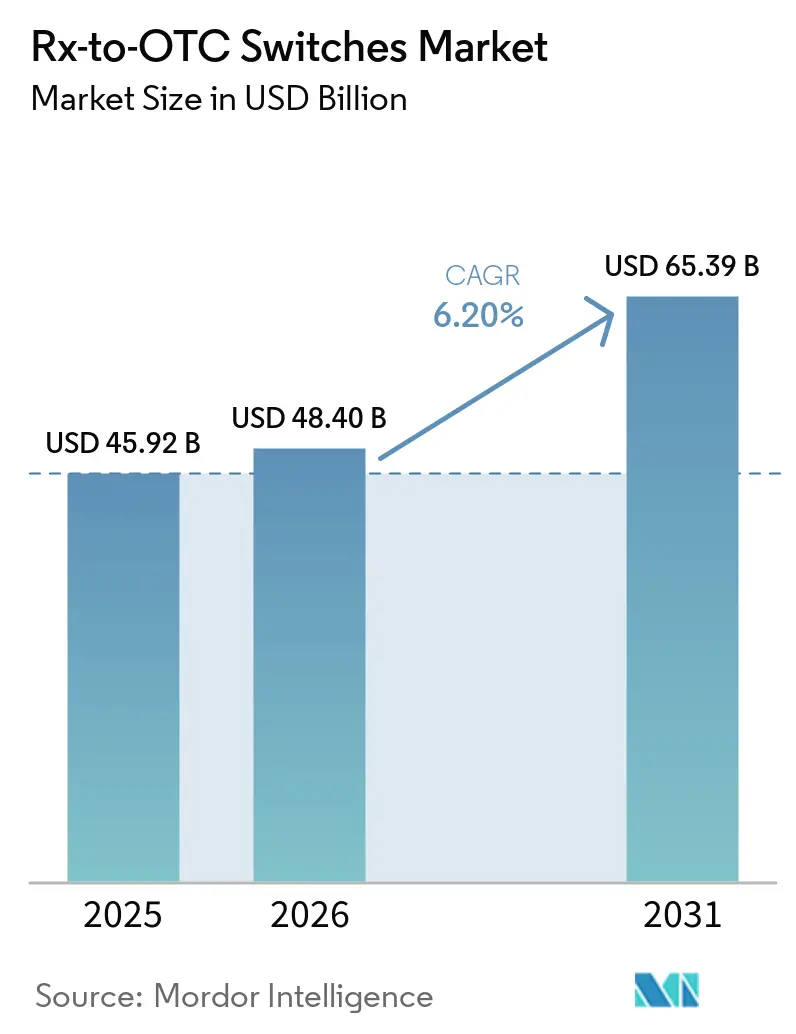
The Rx-to-OTC Switches Market size was valued at USD 45.92 billion in 2025 and is estimated to grow from USD 48.40 billion in 2026 to reach USD 65.39 billion by 2031, at a CAGR of 6.20% during the forecast period (2026-2031).
Rising out-of-pocket exposure and consumer demand for practical self-care continue to support the Rx-to-OTC Switches Market, especially when common conditions can be managed without a clinical visit. The FDA Additional Condition for Nonprescription Use framework has widened the path for products that need tools beyond conventional labeling to support safe self-selection. Consumer health companies are separating from diversified pharmaceutical parents, which has placed switch development, brand investment, and regulatory capability within more focused businesses. The next opportunity set includes categories that historically required prescription oversight, but these programs need credible digital safeguards and careful post-market monitoring. Retail pharmacies remain important for advice and access, while online channels increasingly shape product discovery before a purchase is made.
Key Report Takeaways
- By product type, Allergy and Respiratory Products held 24.56% of Rx-to-OTC Switches Market share in 2025, while Reproductive and Women's Health Products are forecast to grow at a 7.54% CAGR through 2031.
- By switch type, Full Rx-to-OTC Switch held 52.43% of Rx-to-OTC Switches Market share in 2025, while Behind-the-Counter Switch is forecast to grow at a 6.78% CAGR through 2031.
- By dosage form, Tablets and Capsules held 58.32% of the Rx-to-OTC Switches Market share in 2025, while Transdermal Patches are forecast to grow at a 7.67% CAGR through 2031.
- By distribution channel, Retail Pharmacies held 52.43% of the Rx-to-OTC Switches Market share in 2025, while Online Pharmacies and E-Commerce are forecast to grow at a 9.32% CAGR through 2031.
- By geography, North America held 39.67% of the Rx-to-OTC Switches Market share in 2025, while Asia-Pacific is forecast to grow at a 7.45% CAGR through 2031.
Note: Market size and forecast figures in this report are generated using Mordor Intelligence’s proprietary estimation framework, updated with the latest available data and insights as of January 2026.
Global Rx-to-OTC Switches Market Trends and Insights
Drivers Impact Analysis*
| Driver | (~) % Impact on CAGR Forecast | Geographic Relevance | Impact Timeline |
|---|---|---|---|
| Consumer Demand for Convenient Self-Care | +1.3% | Global, led by North America and the Asia-Pacific urban markets | Short term (≤ 2 years) |
| Rising Out-of-Pocket Healthcare Costs | +1.1% | North America, Western Europe, and emerging APAC markets | Short term (≤ 2 years) |
| Regulatory Precedents for Safe Switches | +0.9% | Global, with US FDA and EMA as anchoring jurisdictions | Medium term (2–4 years) |
| Digital Self-Selection Under Additional Conditions for Nonprescription Use | +0.8% | North America initially, expanding to EU and select APAC markets | Medium term (2–4 years) |
| Patent Expiry and Pharmaceutical Lifecycle Optimization | +0.7% | Global, concentrated in high-income markets with mature IP frameworks | Long term (≥ 4 years) |
| Retail and E-Pharmacy Shelf Expansion | +0.9% | APAC core with spill-over to MEA and South America | Medium term (2–4 years) |
| Source: Mordor Intelligence | |||
Consumer Demand for Convenient Self-Care
Consumer preference for self-directed health management now extends beyond minor ailments. People often seek products that can address familiar symptoms without an appointment or a delay at the pharmacy. The Rx-to-OTC Switches Market benefits when consumers recognize a condition and understand the available treatment choices. Choice can also create confusion when similar products present different strengths, warnings, and administration instructions. Clear labeling, shelf navigation, and pharmacist support can help brands convert interest into appropriate selection. Digital channels increasingly influence brand preference before consumers visit a pharmacy or select an item online.
Rising Out-of-Pocket Healthcare Costs
Prescription affordability has become a direct consideration for consumers who must pay part of the cost of care. The Centers for Medicare & Medicaid Services reported that U.S. out-of-pocket spending increased 5.90% to USD 556.60 billion in 2024[1]Centers for Medicare & Medicaid Services, “NHE Fact Sheet,” CMS, cms.gov.. This pressure can make nonprescription alternatives more attractive for conditions that consumers can manage safely without supervision. The Rx-to-OTC switches market, therefore, has a broader potential user base in categories with high prescription costs or inconsistent coverage. Sponsors must still show that a switched product can be selected and used correctly outside a traditional prescribing setting. Cost savings alone do not remove the need for appropriate labeling, consumer studies, and ongoing safety oversight.
Regulatory Precedents for Safe Switches
Each successful switch gives regulators and sponsors a body of experience that can inform later applications. The FDA finalized its rule for nonprescription products with an Additional Condition for Nonprescription Use in December 2024, and the rule took effect on May 27, 2025[2]U.S. Food and Drug Administration, “FDA Issues Final Rule to Broaden Types of Nonprescription Drugs Available to Consumers,” FDA, fda.gov.. The rule allows prescription and nonprescription status to coexist when an additional condition helps consumers make an appropriate choice. Such conditions can include structured questionnaires, digital self-selection tools, or pharmacist-supported protocols. This approach can support the Rx-to-OTC switches market by creating a route for products that conventional labels cannot address alone. Sponsors need to plan evidence development early because the relevant consumer-use and operational evidence cannot be added easily at the end of a program.
Digital Self-Selection Under Additional Conditions
The Additional Condition for Nonprescription Use pathway changes the role of technology in a switch application. A digital tool can guide consumers through criteria that determine whether a product is suitable for them. A technology-assisted web application for rosuvastatin showed how a structured cardiovascular risk algorithm could support consumer self-selection in a study published in 2024[3]L. J. Laffin, K. E. Watson, E. D. Michos, et al., “A Technology-Assisted Web Application for Consumer Access to Rosuvastatin,” Journal of the American College of Cardiology, jacc.org.. It also requires sponsors to build reliable tools, monitor their performance, and protect the quality of the consumer decision process. For behind-the-counter products, the same approach may strengthen the pharmacist's role as a source of guidance rather than only a point of sale.
Restraints Impact Analysis*
| Restraint | (~) % Impact on CAGR Forecast | Geographic Relevance | Impact Timeline |
|---|---|---|---|
| Consumer Misuse and Self-Selection Risk | -0.6% | Global; most acute in lower-health-literacy markets across South Asia, MEA, and Latin America | Medium term (2–4 years) |
| High Cost and Long Duration of Switch Programs | -0.4% | Global, most pronounced for sponsors without a dedicated consumer health R&D infrastructure | Long term (≥ 4 years) |
| Brand and Generic Price Erosion After Switch | -0.4% | Global, particularly severe in North America and Western Europe, where generic competition is rapid | Long term (≥ 4 years) |
| Digital Additional-Condition Infrastructure and Post-Market Governance Burden | -0.3% | North America and the EU, where digital health compliance requirements are most stringent | Medium term (2–4 years) |
| Source: Mordor Intelligence | |||
Consumer Misuse and Self-Selection Risk
Wider nonprescription access can create safety concerns when consumers do not recognize contraindications or warning signs. The World Health Organization has stated that more than half of medicines are prescribed, dispensed, or sold inappropriately worldwide.[4]World Health Organization, “Medicines,” World Health Organization, who.int. This concern is relevant to the Rx-to-OTC switches market because a product may be appropriate for many consumers but unsafe for particular groups. The risk is greater where health literacy, access to advice, or pharmacovigilance systems are limited. Sponsors need strong label-comprehension evidence, consumer self-selection studies, and post-market monitoring plans. A failure in one category can also influence regulatory caution toward similar products that are under review.
High Cost and Long Duration of Switch Programs
A switch program requires more than a new package and a retail launch. Sponsors may need actual-use studies, consumer self-selection studies, label-comprehension testing, and tools that satisfy the Additional Condition for Nonprescription Use framework. Regulatory uncertainty can affect program timelines when safety evidence or self-management evidence is incomplete. These demands favor established companies with dedicated regulatory, medical, and consumer-health capabilities. Smaller specialty pharmaceutical companies may have suitable molecules but lack the infrastructure needed to advance a full program. The resulting concentration of experience can narrow the range of products that enter the Rx-to-OTC switches market.
*Our forecasts treat driver/restraint impacts as directional, not additive. The impact forecasts reflect baseline growth, mix effects, and variable interactions.
Segment Analysis
By Product Type: Allergy and Respiratory Products Hold Structural Lead
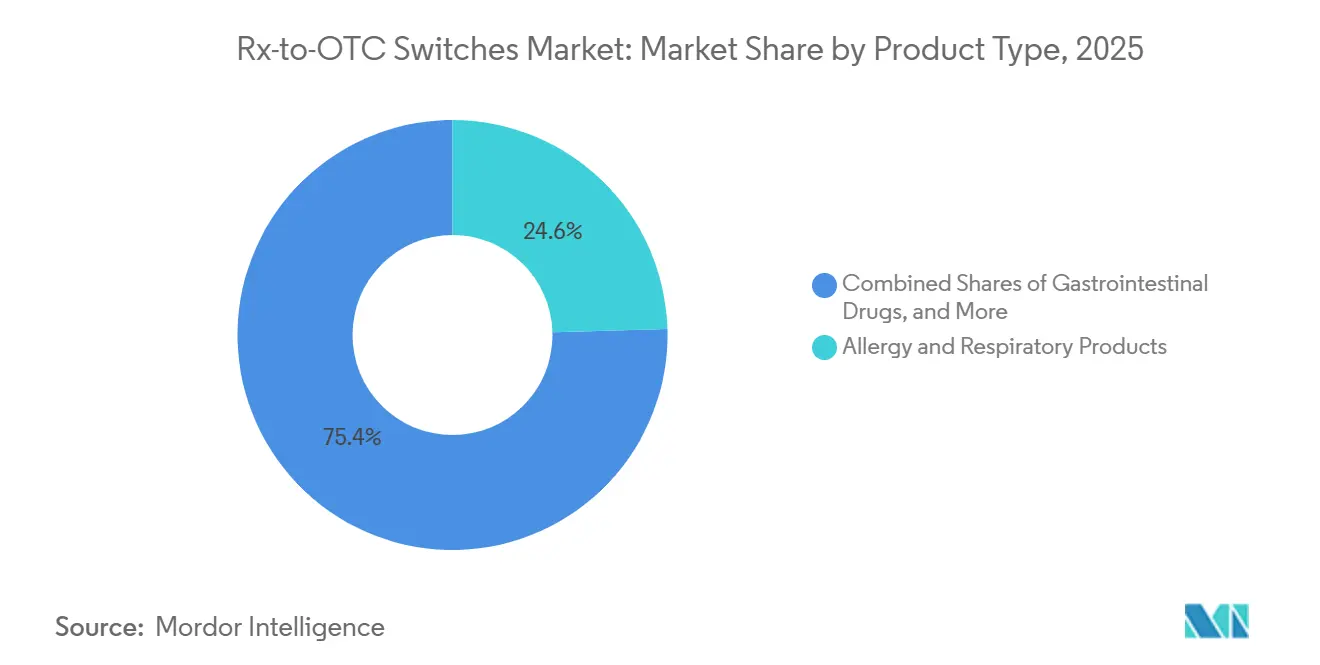
Allergy and Respiratory Products held 24.56% of product-type revenue in 2025, giving the category the leading share of the Rx-to-OTC switches Market size. The category includes antihistamines, intranasal corticosteroids, and ocular antihistamines that consumers commonly use for familiar symptoms. This history has created established brand awareness and a wide base of generic and store-brand alternatives. The product group also benefits from recurring seasonal demand and clear consumer recognition of allergy symptoms.
Reproductive and Women's Health Products are forecast to grow at a 7.54% CAGR through 2031, the fastest rate within product types. Perrigo's Opill became available in U.S. stores and online in March 2024 as the first daily oral contraceptive sold without a prescription in the United States. The launch confirmed a pathway for hormonal contraception when consumers can use the product safely with accessible information. Dermatology Products and Fungal and Other Infection Products represented smaller categories with defined switch potential.



By Switch Type: Full Switches Lead While Behind-the-Counter Access Expands
Full Rx-to-OTC Switch accounted for 52.43% of switch-type revenue in 2025, representing the largest Rx-to-OTC Switches Market share within this classification. This position reflects decades in which a complete reclassification was the primary route to nonprescription access. Established products in allergy, gastrointestinal, and pain categories have created a substantial base of full-switch revenue. Their history can help sponsors understand consumer behavior, label needs, and safety questions for related products.
Behind-the-Counter Switch is forecast to expand at a 6.78% CAGR through 2031. The Additional Condition for Nonprescription Use rule supports this model when a label alone cannot ensure safe self-selection. A pharmacist questionnaire or a digital screening process can provide the extra safeguard needed for access. This route allows products to reach consumers without the normal prescription transaction while keeping controls around selection.
By Dosage Form: Tablets and Capsules Retain Scale as Patches Gain Interest
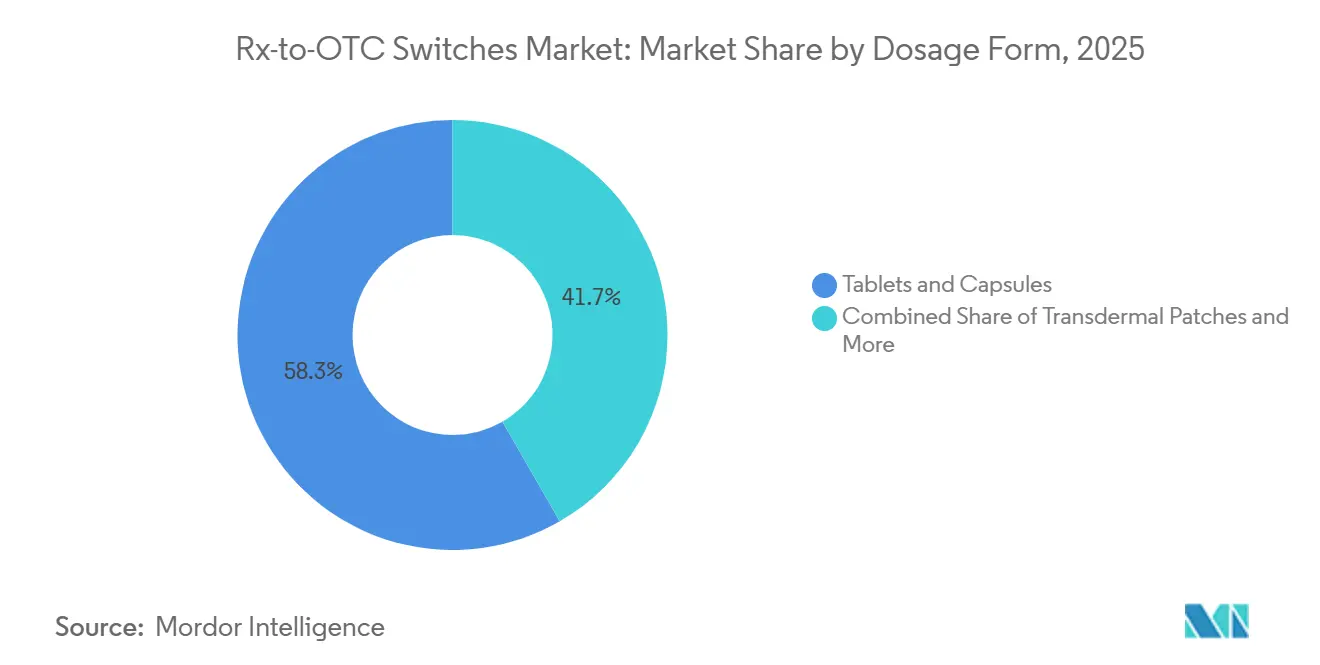
Tablets and Capsules held 58.32% of dosage-form revenue in 2025, the largest Rx-to-OTC Switches Market share among dosage forms. Oral solid products have manufacturing scale, mature supply chains, and a familiar dosing format. The format supports a wide range of switched treatments, including antihistamines, acid reducers, and oral contraceptives.
Transdermal Patches are forecast to expand at a 7.67% CAGR through 2031. Nicotine transdermal systems remain an important product group, and FDA DailyMed records showed new nicotine patch listings during 2025 and 2026.
By Distribution Channel: Retail Pharmacies Lead While Digital Channels Grow Faster
Retail Pharmacies retained 52.43% of distribution-channel revenue in 2025, the leading Rx-to-OTC Switches Market share for channels. Pharmacies provide physical access and a setting where a trained professional can guide consumers. This role is especially important for behind-the-counter and partial switches that need controlled access or have more complex questions.
Online Pharmacies and E-Commerce are forecast to grow at a 9.32% CAGR through 2031, the fastest rate among channels. Digital platforms help consumers compare products, learn about usage, and move from initial research to purchase. Direct-to-consumer sites can also help brands communicate label information before an item reaches the consumer.
Geography Analysis
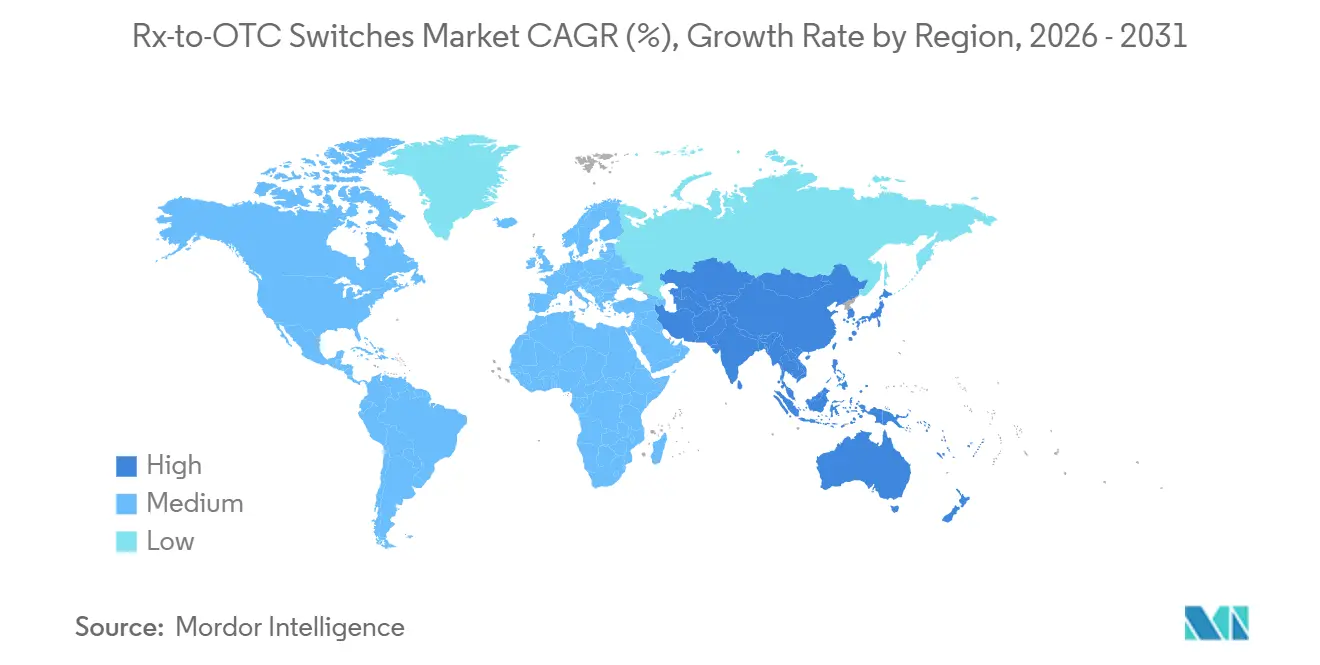
North America held 39.67% of the global Rx-to-OTC switches market revenue in 2025, making it the largest regional contributor. The region has a long record of documented switches and a substantial retail ecosystem for consumer health products. U.S. consumers spent USD 58.20 billion on over-the-counter healthcare products in 2025. Perrigo's Opill retail launch in March 2024 established a new precedent for oral contraceptive access. Europe represented a substantial share of the Rx-to-OTC switches market because national regulators maintain established review processes.
Asia-Pacific is forecast to grow at a 7.45% CAGR through 2031, the highest regional rate in the Rx-to-OTC switches market. China supports the regional base through pharmacy networks, urban expansion, and e-commerce penetration. India has growth potential as organized retail, generic medicine access programs, and smartphone-based pharmacy services change how consumers buy nonprescription products.

Competitive Landscape
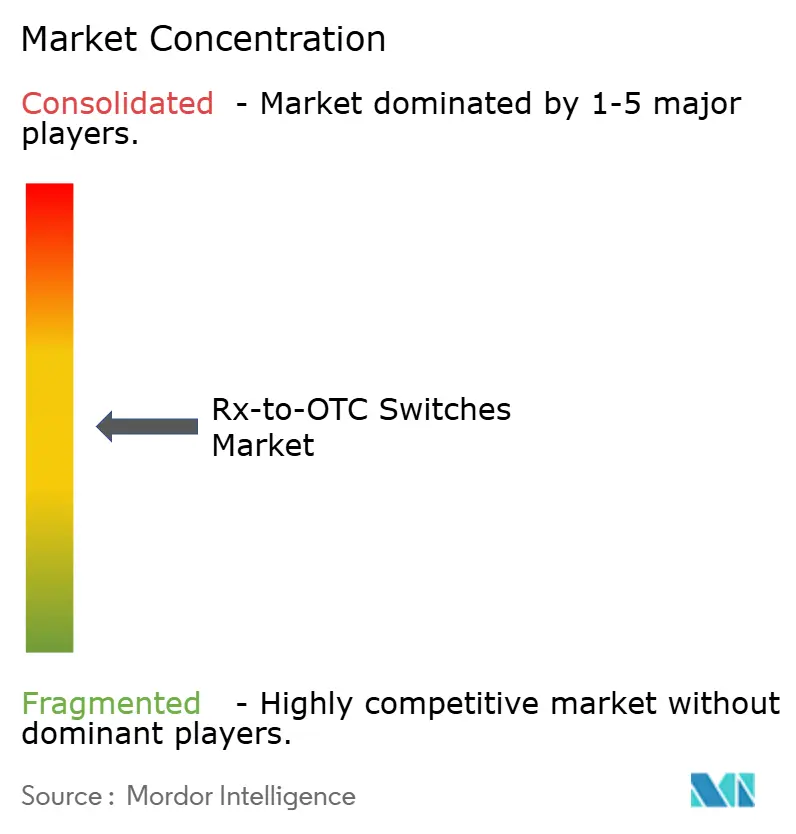
The Rx-to-OTC Switches Market is semi-concentrated, with Haleon, Kenvue, Bayer, Perrigo, Reckitt Benckiser, and Opella among the principal consumer health competitors. Recent divestments and separations have moved consumer health portfolios into businesses with clearer commercial priorities. Sanofi closed the transfer of a controlling 50.00% stake in Opella to Clayton, Dubilier & Rice in April 2025, while retaining 48.20% and Bpifrance retaining 1.80%.
This structure places more attention on switch programs, consumer brands, and geographic expansion. Haleon has stated that it is pursuing selected Rx-to-OTC opportunities in the United States and Europe. Kenvue's July 2026 approval for Tylenol with Naproxen provides a clear example of formulation-based category expansion. The product received a 3-year exclusivity period, giving Kenvue time to establish the brand before expected generic competition.
Rx-to-OTC Switches Industry Leaders
Bayer AG
Haleon plc
Kenvue Inc.
Pfizer Inc.
Sanofi
- *Disclaimer: Major Players sorted in no particular order

Recent Industry Developments
- May 2026: Galderma received approval from the United States FDA for the Rx-to-OTC switch of Differin Epiduo Acne Gel (adapalene 0.1%/benzoyl peroxide 2.5%), making the acne treatment available without a prescription for consumers aged 12 years and older. The approval expanded consumer access to the combination therapy and represented the first FDA prescription-to-OTC switch approval in two years.
- June 2025: Eisai launched Pariet S (rabeprazole sodium), the first proton pump inhibitor (PPI) in Japan to transition from prescription-only to over-the-counter (RX-to-OTC) status. The product contains the same 10 mg dose of rabeprazole sodium as the prescription version and is designed to provide 24-hour relief from severe heartburn and stomach discomfort caused by gastric acid reflux.


Global Rx-to-OTC Switches Market Report Scope
As per the scope of the market, Rx-to-OTC (Prescription-to-Over-the-Counter) switches refer to the regulatory process through which prescription medicines are reclassified for non-prescription use, enabling consumers to purchase and use these products without obtaining a physician's prescription. Rx-to-OTC switches support self-care, improve medication accessibility, reduce healthcare system burden, and expand consumer access to safe and effective treatments for common health conditions.
The Rx-to-OTC switches market report segments the market by product type, including allergy and respiratory products, gastrointestinal drugs, pain management products, reproductive and women's health products, dermatology products, fungal and other infection products, and others (smoking cessation and addiction products, etc.). The market is also segmented by switch type, comprising full Rx-to-OTC switches, partial Rx-to-OTC switches, and behind-the-counter switches. Based on dosage form, the market is segmented into tablets and capsules, nasal sprays, ophthalmic drops, topical solutions, creams and gels, and transdermal patches.
Additionally, the report analyzes the market by distribution channel, including retail pharmacies, online pharmacies and e-commerce, supermarkets and hypermarkets, and others (health and wellness stores, institutional/healthcare channels). Geographically, the market is segmented into North America, Europe, Asia-Pacific, the Middle East & Africa, and South America. The market report also covers the estimated market sizes and trends for 17 countries across major regions globally. For each segment, the market size and forecast are provided in terms of value (USD).
| Allergy and Respiratory Products |
| Gastrointestinal Drugs |
| Pain Management Products |
| Reproductive and Women's Health Products |
| Dermatology Products |
| Fungal and Other Infection Products |
| Others (Smoking Cessation and Addiction Products, etc.) |
| Full Rx-to-OTC Switch |
| Partial Rx-to-OTC Switch |
| Behind-the-Counter Switch |
| Tablets and Capsules |
| Nasal Sprays |
| Ophthalmic Drops |
| Topical Solutions, Creams and Gels |
| Transdermal Patches |
| Retail Pharmacies |
| Online Pharmacies and E-Commerce |
| Supermarkets and Hypermarkets |
| Others (Health and Wellness Stores, Institutional/Healthcare Channels) |
| North America | United States |
| Canada | |
| Mexico | |
| Europe | Germany |
| United Kingdom | |
| France | |
| Italy | |
| Spain | |
| Rest of Europe | |
| Asia-Pacific | China |
| India | |
| Japan | |
| Australia | |
| South Korea | |
| Rest of Asia-Pacific | |
| Middle East and Africa | GCC |
| South Africa | |
| Rest of Middle East and Africa | |
| South America | Brazil |
| Argentina | |
| Rest of South America |
| By Product Type | Allergy and Respiratory Products | |
| Gastrointestinal Drugs | ||
| Pain Management Products | ||
| Reproductive and Women's Health Products | ||
| Dermatology Products | ||
| Fungal and Other Infection Products | ||
| Others (Smoking Cessation and Addiction Products, etc.) | ||
| By Switch Type | Full Rx-to-OTC Switch | |
| Partial Rx-to-OTC Switch | ||
| Behind-the-Counter Switch | ||
| By Dosage Form | Tablets and Capsules | |
| Nasal Sprays | ||
| Ophthalmic Drops | ||
| Topical Solutions, Creams and Gels | ||
| Transdermal Patches | ||
| By Distribution Channel | Retail Pharmacies | |
| Online Pharmacies and E-Commerce | ||
| Supermarkets and Hypermarkets | ||
| Others (Health and Wellness Stores, Institutional/Healthcare Channels) | ||
| By Geography | North America | United States |
| Canada | ||
| Mexico | ||
| Europe | Germany | |
| United Kingdom | ||
| France | ||
| Italy | ||
| Spain | ||
| Rest of Europe | ||
| Asia-Pacific | China | |
| India | ||
| Japan | ||
| Australia | ||
| South Korea | ||
| Rest of Asia-Pacific | ||
| Middle East and Africa | GCC | |
| South Africa | ||
| Rest of Middle East and Africa | ||
| South America | Brazil | |
| Argentina | ||
| Rest of South America | ||


Key Questions Answered in the Report
What is the projected value of Rx-to-OTC switches by 2031?
The Rx-to-OTC Switches Market is forecast to reach USD 65.39 billion by 2031 from USD 48.40 billion in 2026, growing at a 6.20% CAGR through the forecast period.
Which product category leads Rx-to-OTC switches?
Allergy and Respiratory Products led product-type revenue with a 24.56% share in 2025. Its established switch record, consumer familiarity, and seasonal demand support this position.
Which Rx-to-OTC product group is growing fastest?
Reproductive and Women's Health Products is projected to grow at a 7.54% CAGR through 2031. The availability of Opill demonstrates an important pathway for nonprescription hormonal contraception and shows how access, education, and self-selection evidence can shape adoption over time in retail settings.
Why are behind-the-counter switches important?
They can enable nonprescription access when a pharmacist process or digital tool is needed to support safe consumer self-selection. This model is particularly relevant for products that standard labeling cannot support alone.
Which sales channel is expanding fastest for switched medicines?
Online Pharmacies and E-Commerce is forecast to grow at a 9.32% CAGR through 2031. Online platforms can shape product selection before purchase and may support appropriately managed post-market follow-up.
Which region has the highest growth outlook for Rx-to-OTC switches?
Asia-Pacific is forecast to expand at a 7.45% CAGR through 2031. Pharmacy networks, urban growth, and e-commerce use support the regional outlook.
Page last updated on:





