
Rubber Coated Fabric Market Size and Share
Market Overview
| Study Period | 2022 - 2032 |
|---|---|
| Market Size (2027) | USD 7.42 Billion |
| Market Size (2032) | USD 9.34 Billion |
| Growth Rate (2027 - 2032) | 4.72 % |
| Fastest Growing Market | Asia-Pacific |
| Largest Market | Asia-Pacific |
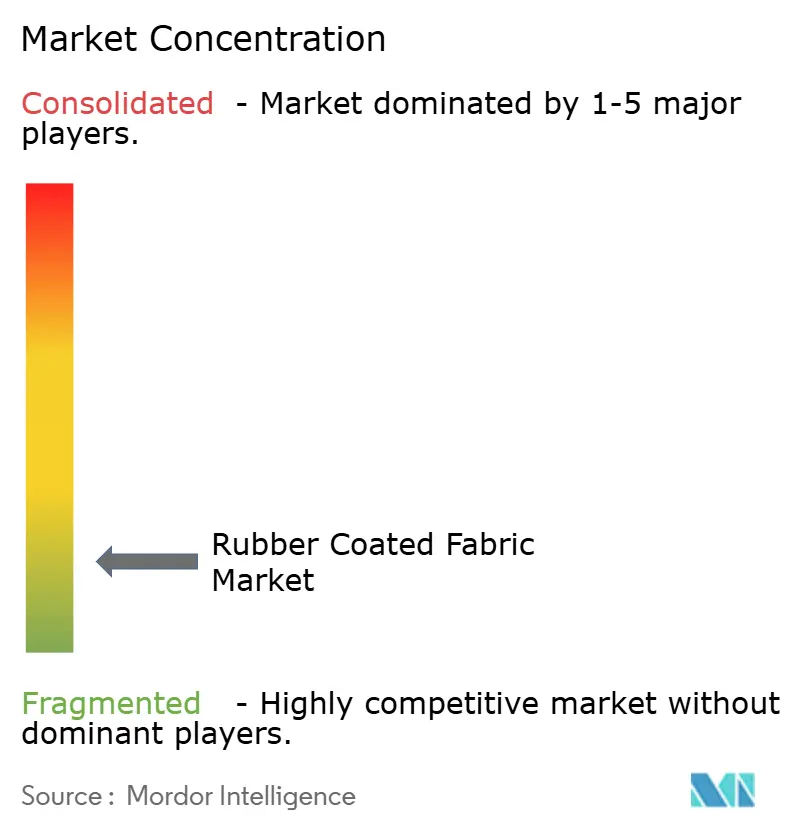
| Market Concentration | Low |
Major Players *Disclaimer: Major Players sorted in no particular order Image © Mordor Intelligence. Reuse requires attribution under CC BY 4.0. | |
Rubber Coated Fabric Market Analysis by Mordor Intelligence
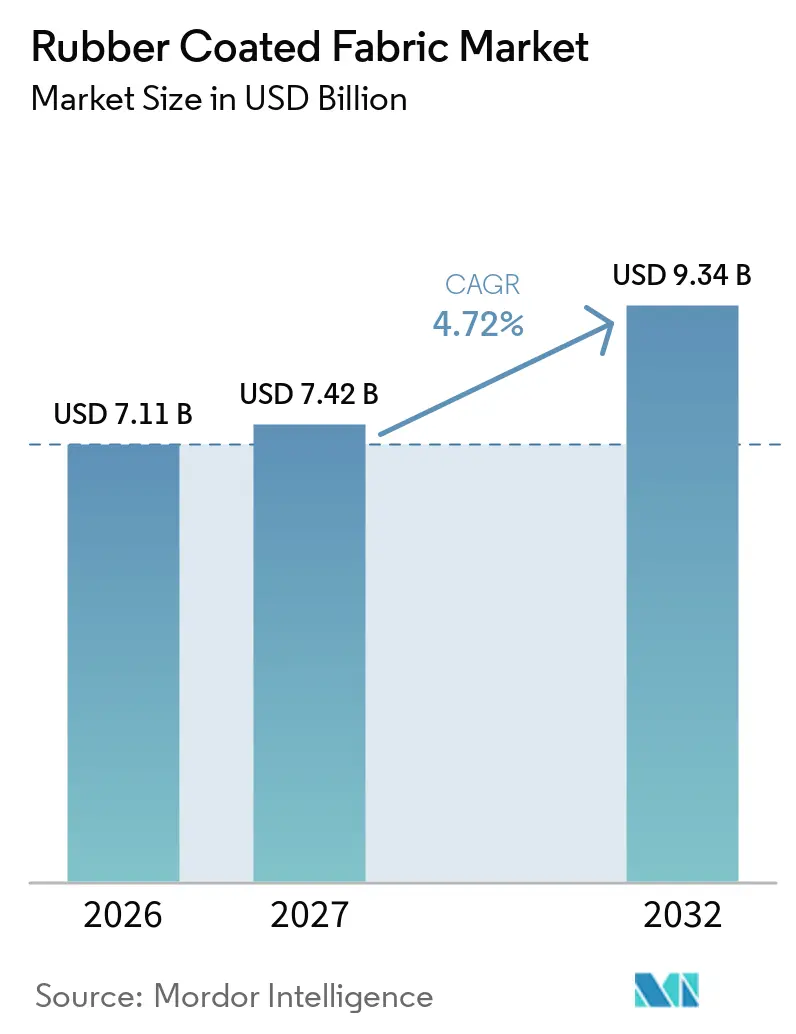
The Rubber coated fabric market size was valued at USD 7.11 billion in 2026 and is estimated to grow from USD 7.42 billion in 2027 to USD 9.34 billion by 2032, at a CAGR of 4.72% during the forecast period (2027-2032). The rubber coated fabric market is supported by a shift toward materials that help users meet safety, reliability, and supply requirements in demanding operating environments. Buyers increasingly evaluate coated textiles on their ability to resist chemical exposure, heat, ozone, water, and physical wear, rather than on price alone. This favors suppliers that can qualify specialized synthetic elastomer formulations and maintain consistent coating performance. Competition centers on technical performance, process control, and customer qualification, while low-cost standard products remain exposed to margin pressure. The rubber-coated fabric market also faces material-cost volatility and tighter environmental requirements, which favor producers with defined feedstock arrangements and lower-emission coating capabilities.
Key Report Takeaways
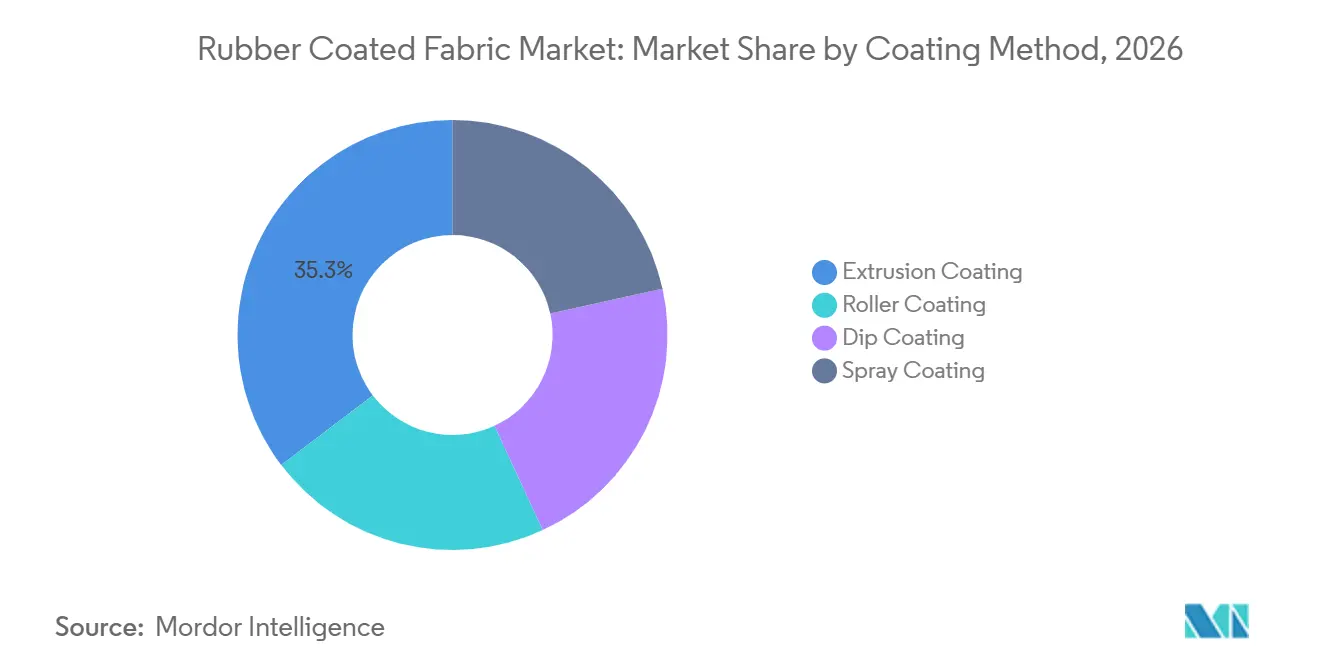
- By coating method, Extrusion Coating held 35.34% of the Rubber coated fabric market share in 2026, while Spray Coating is forecast to grow at a 5.34% CAGR through 2032.
- By application, Protective Suits and Gloves accounted for 29.56% of the Rubber coated fabric market share in 2026 and are projected to advance at a 5.78% CAGR through 2032.
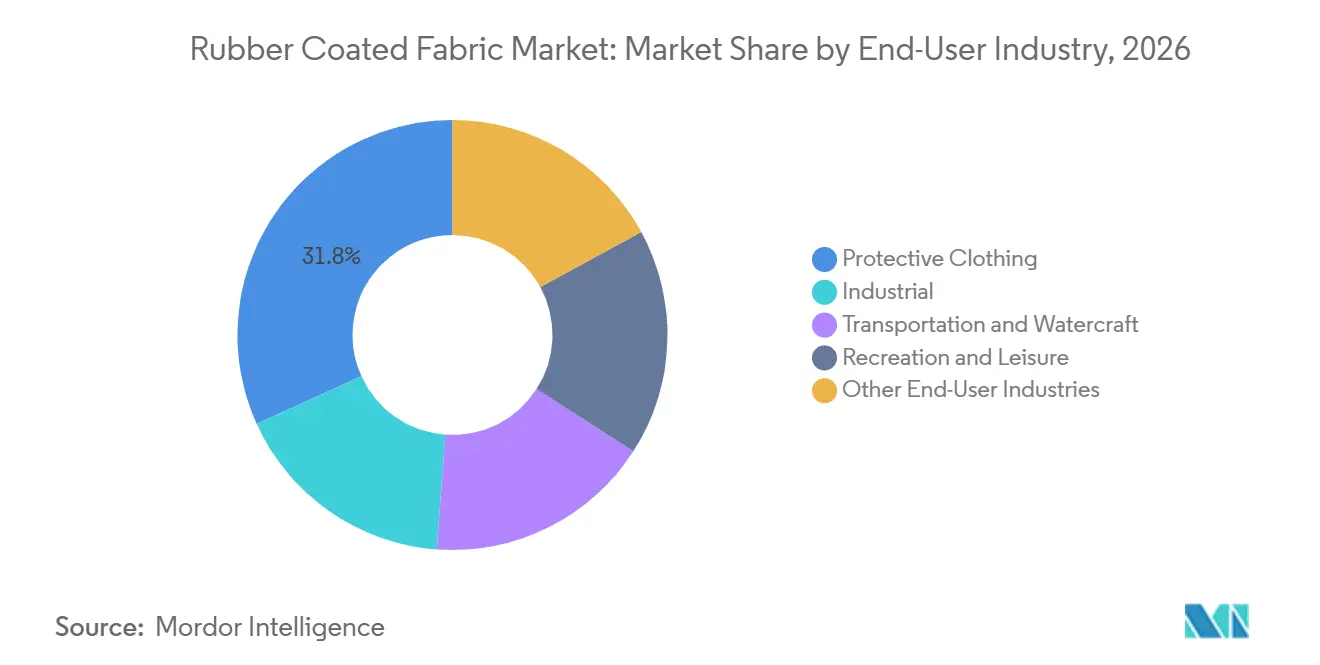
- By end-user industry, Protective Clothing held 31.78% of the Rubber coated fabric market share in 2026, while also forecast to grow at a CAGR of 5.91% through 2032.
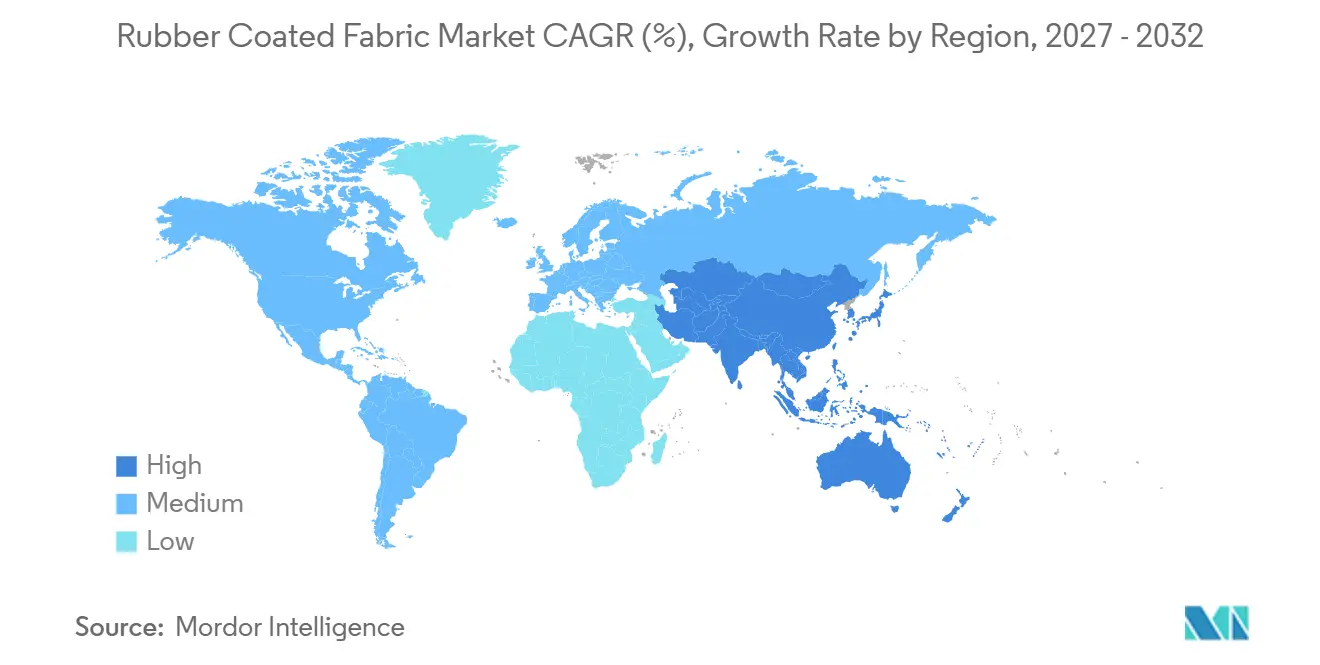
- By geography, Asia-Pacific accounted for 42.61% of the Rubber coated fabric market share in 2026 and is forecast to expand at a 5.63% CAGR through 2032.
Note: Market numbers in this report are based on Mordor Intelligence's proprietary estimation framework, which combines nine months of actuals with Q4 projections for base year 2026.
Market Trends and Insights
Drivers Impact Analysis of Rubber Coated Fabric Market*
| Drivers | (~) % Impact on CAGR Forecast | Geographic Relevance | Impact Timeline |
|---|---|---|---|
| Expanding Protective Clothing and Workplace Safety Requirements | +0.8% | Global, led by Asia-Pacific, North America, and Europe | Short term (≤ 2 years) |
| Rising Transportation and Watercraft Demand | +0.6% | Asia-Pacific core, with spillover to Europe and North America | Medium term (2-4 years) |
| Growth in Industrial Material Handling and Conveyor Infrastructure | +0.7% | Global, including mining and logistics in Asia-Pacific and South America | Medium term (2-4 years) |
| Premiumization Toward High-Performance Synthetic Coatings | +0.5% | North America and Europe, with early-stage adoption in the Asia-Pacific | Long term (≥ 4 years) |
| Defense and Public Safety Procurement for Chemical and Ballistic Protection | +0.4% | North America, Europe, and the Asia-Pacific, including India and South Korea | Medium term (2-4 years) |
| Source: Mordor Intelligence | |||
Expanding Protective Clothing and Workplace Safety Requirements
Workplace safety requirements support steady demand for rubber coated protective textiles across manufacturing, healthcare, chemical handling, and emergency response. The American Industrial Hygiene Association updated its Chemical Protective Clothing guide in 2025, including current guidance on material selection for protective garments used in chemical, biological, and radiological settings[1]. OSHA requires employers to provide personal protective equipment when workplace hazards are present under 29 Code of Federal Regulations (CFR) 1910 Subpart I. A January 2026 federal proposal also addressed domestic sourcing preferences for personal protective equipment and essential medical supplies used by Medicare-participating hospitals. These regulations make compliance and certification requirements a purchasing factor for customers who cannot use products that do not meet required specifications. The rubber coated fabric market benefits when qualified suppliers maintain price discipline in applications where safety standards limit substitution.
Growth in Industrial Material Handling and Conveyor Infrastructure
Rubber coated fabrics are used in conveyor belt systems that support mining, logistics, warehousing, and energy-transition mineral activity. Demand is linked to projects that require dependable movement of bulk materials or automated goods flows. In April 2025, Continental fulfilled an order for a 3.2-meter-wide conveyor belt capable of supporting a static load of 3,200 metric tons. High-load systems continue to require specialized fabric and rubber constructions. Wider, higher-specification belt designs require more substrate material than standard products and can increase revenue per unit length for qualified suppliers. The rubber coated fabric market has scope to serve a mix of high standard belts and higher-value heavy-duty systems.
Defense and Public Safety Procurement for Chemical and Ballistic Protection
Defense and emergency-response customers require materials that meet demanding chemical, heat, and physical-protection specifications. These customers often rely on formal qualification processes and multi-year supply arrangements, which support more stable orders for approved materials. At SOFINS 2025, BORFLEX presented rubber coated fabrics, rubber bellows, and composite profiles for use in armored vehicles and the nuclear sector. This reflects the overlap between defense, public safety, and high-specification industrial applications. Demand also extends to chemical protective garments and equipment components that require high resistance. The rubber coated fabric market can benefit from this demand where suppliers hold the testing capability and certifications required for procurement programs.
Premiumization Toward High-Performance Synthetic Coatings
Buyers are shifting selected applications from commodity natural rubber coatings to engineered synthetic elastomers, including chlorosulfonated polyethylene, neoprene, EPDM, and fluorocarbon-based materials. These compounds are used where chemical resistance, weatherability, flame performance, and durability need to work together. Trelleborg reported investment in an engineered coated fabric facility in Rutherfordton, North Carolina, serving aerospace evacuation slides, water infrastructure, healthcare, and outdoor applications. ISO 17581:2025 establishes methods for determining water-absorption resistance in rubber or plastics coated fabrics. DIN EN ISO 11612:2025 sets minimum performance requirements for clothing that protects against heat and flame. These requirements increase the importance of consistent material performance and support the move toward premium synthetic coatings in the rubber coated fabric market.
Restraints Impact Analysis of Rubber Coated Fabric Market*
| Restraints | (~) % Impact on CAGR Forecast | Geographic Relevance | Impact Timeline |
|---|---|---|---|
| Volatile Rubber, Textile, and Chemical Input Costs | -0.5% | Global, with the strongest effect in price-sensitive Asia-Pacific manufacturing | Short term (≤ 2 years) |
| Environmental Compliance and Coating-Process Emissions | -0.4% | Europe and North America, with emerging relevance in the Asia-Pacific | Medium term (2-4 years) |
| Qualification Risk from Adhesion, Recyclability, and End-of-Life Constraints | -0.3% | Europe, with spillover to North America | Long term (≥ 4 years) |
| Source: Mordor Intelligence | |||
Volatile Rubber, Textile, and Chemical Input Costs
Natural rubber and synthetic rubber are major cost elements in the manufacture of coated fabrics. Their prices can vary, complicating purchasing decisions, contract pricing, and formulation planning. The All India Rubber Industries Association stated that manufacturers may adjust formulations toward natural rubber when synthetic rubber costs rise with petrochemical feedstock inflation. Such changes can affect compound characteristics and may require renewed customer qualification. Suppliers without multi-year agreements that define feedstock price ranges face greater uncertainty when quoting long-term programs. This cost exposure can delay capacity commitments and limit flexibility across the rubber coated fabric market.
Environmental Compliance and Coating-Process Emissions
Solvent-borne coating systems may release volatile organic compounds and face closer environmental oversight in Europe and North America. The EU continues to update the Registration, Evaluation, Authorization and Restriction of Chemicals (REACH) framework, reinforcing the importance of chemical compliance for material producers and downstream users[2]. Water-based and solvent-free alternatives can reduce process emissions, but high-performance applications still require reliable adhesion and substrate penetration. ISO 2411 remains the key standard for determining coating adhesion in rubber or plastics coated fabrics. Producers must balance lower-emission manufacturing with the performance demanded by chemical protection, transport, and industrial customers. This tension can raise qualification costs and extend product development cycles within the rubber coated fabric market.
*Our forecasts treat driver/restraint impacts as directional, not additive. The impact forecasts reflect baseline growth, mix effects, and variable interactions.
Rubber Coated Fabric Market Segment Analysis
By Coating Method:
Spray Coating Builds a Precision Position Alongside ExtrusionExtrusion Coating held 35.34% of the 2026 value in the rubber coated fabric market. The method supports high throughput, uniform film thickness, and repeatable output across conveyor substrates, protective-clothing base fabrics, and transportation covers. Its production efficiency suits applications with high volumes and stable technical requirements. Extrusion lines are particularly relevant for industrial material-handling products where customers require consistent material performance across long production runs. Roller Coating and Dip Coating continue to serve applications that require full-fabric encapsulation or specific surface treatments. These methods remain relevant in marine bellows and protective-suit applications, where coating coverage requirements take precedence over line speed.
Spray Coating is projected to grow at a 5.34% CAGR through 2032. It supports thin, localized, or varied coatings on substrates that are not fully planar, including protective-garment panels and curved watercraft sections, making it useful where roller processes may produce thickness variation. ISO 17581:2025 provides standardized water-absorption tests that place greater emphasis on coating uniformity and water resistance. Digitally controlled multi-nozzle spray systems help producers improve consistency in specialty production runs. The rubber coated fabric market is therefore likely to retain extrusion for scale while using spray systems where precision and complex geometry are required.

By Application:
Protective Suits and Gloves Combine Scale with Faster ExpansionProtective Suits and Gloves accounted for 29.56% of the rubber coated fabric market size in 2026 and are forecast to grow at a 5.78% CAGR through 2032, outpacing other listed applications. Chemical plants, healthcare facilities, and emergency-response organizations require garments and gloves that meet task-specific hazard requirements. The American Industrial Hygiene Association's (AIHA) 2025 guidance addresses material selection for chemical protective clothing, while OSHA's personal protective equipment requirements further underscore the need for appropriate workplace protective materials. This combination of compliance requirements and safety needs supports the application's large share in the rubber coated fabric market.
Boats and Gangway Bellows represent a separate application area linked to marine equipment and watercraft use. Chlorosulfonated polyethylene and chloroprene coatings are used in marine settings due to their resistance to ozone and ultraviolet exposure. Transmission and Conveyor Belts remain a major application, as mining, logistics, and industrial facilities rely on dependable material movement. Continental's high-load conveyor-belt order demonstrates the continued need for engineered materials in demanding systems. Other applications include architectural membranes and gaskets, where specialized formulations can create higher-value opportunities. This diversity of applications allows producers to balance regulated PPE demand with industrial and marine requirements.
By End-User Industry:
Protective Clothing Leads Current Demand and GrowthProtective Clothing held 31.78% of the 2026 end-user value and is expected to record the highest CAGR, at 5.91%, through 2032. Employer liability requirements, workforce safety regulations, and demand for garments with multiple protective functions are central to this position. The CEN-CENELEC working group on EN 469, the European firefighter protective-clothing standard, expanded participation in 2025 as the standard's revision continued, underscoring the ongoing importance of protective clothing for heat and fire exposure. The rubber coated fabric market supplies the coated layers and constructions required where users must combine flame, chemical, and physical protection.
Industrial customers provide a stable, replacement-driven demand base for coated fabrics. Manufacturing sites, oil and gas operations, and automated logistics facilities use these materials in conveyor systems, covers, and equipment enclosures. Transportation and Watercraft demand is associated with marine activity, protective covers, and specialized weather-resistant components. Recreation and Leisure drive demand for lightweight, flexible materials used in drysuits and outdoor equipment, supporting premium formulations where flexibility and durability outweigh cost considerations. Together, the end-user base distributes the rubber coated fabric market across regulated protective equipment, industrial assets, transport equipment, and specialist consumer products.
Geography Analysis
Asia-Pacific
Asia-Pacific held 42.61% of global value in 2026 and is forecast to grow at a 5.63% CAGR through 2032. The region combines large-scale manufacturing activity with demand for conveyor systems, protective clothing, transport materials, and watercraft-related products. China is a major center for industrial applications and conveyor belt demand, and its export capacity adds pricing pressure in other markets. India is an important base for technical textiles and coated fabric production; SRF reported revenue growth across its businesses in FY2025. Japan and South Korea support higher-specification demand in marine, defense, and automotive-related applications. Formalization of workplace safety regulations in ASEAN is expanding demand for protective garments and coated gloves. ISO 17581:2025 provides a common reference point for water-absorption performance in coated fabrics. The rubber coated fabric market in Asia-Pacific combines scale demand with a growing need for tested, specification-grade materials.
North America
North American demand is supported by defense procurement, domestic-content preferences, industrial infrastructure, mining, construction, and warehousing. The January 2026 federal proposal on domestic personal protective equipment and essential medical supplies highlights the policy focus on supply resilience in healthcare settings. Trelleborg's investment in a North Carolina facility for engineered coated fabrics reflects the value of local production capacity for aerospace, water infrastructure, healthcare, and outdoor applications. Close customer support and reliable certification are important where procurement requirements are strict. These conditions favor proven formulations for regulated and high-specification applications.
Europe, South America, the Middle East, and Africa
Europe has established demand in automotive, industrial, and defense supply chains, particularly in Germany, France, and Italy. REACH developments increase the need to assess chemical use across the value chain, while ISO 2411 remains relevant when producers evaluate lower-emission coating approaches. Brazil supports demand through mining and agribusiness conveyor systems, while industrial zones in Saudi Arabia and South Africa drive demand for coated protective materials and conveyor fabrics. These smaller demand corridors offer opportunities for suppliers to align products with local operating conditions, safety requirements, and project specifications.
Competitive Landscape
The rubber coated fabric market is fragmented. Trelleborg AB, Sioen Industries NV, and Continental AG's ContiTech division are European specialists with vertically integrated capabilities and established positions in industrial, defense, aerospace, and related applications. SRF Limited and Zenith Rubber are among the Asian producers active in this competitive space. Competitive differentiation is based on elastomer formulations, coating control, product qualification, and relationships with original equipment manufacturers. Standard products remain exposed to price competition from lower-cost conversion capacity, while suppliers of specialized products can compete on performance in markets where customers value certification, technical support, and dependable supply.
Trelleborg's investment in its Rutherfordton, North Carolina, facility reflects a focus on engineered coated fabrics for aerospace evacuation slides, water infrastructure, healthcare, and outdoor products. Sioen acquired Contender Sailcloth in July 2025, adding high-performance sailcloth capabilities to its marine activities. Continental announced in March 2026 that it was targeting completion of its realignment in 2026, including the planned separation of ContiTech. These moves indicate how suppliers are pursuing specialty capacity, marine materials, and more focused corporate structures. They also suggest that the rubber coated fabric market is shaped by application-specific positions rather than by a single uniform product category.
Environmental performance and end-of-life considerations are likely to influence competitive positioning. Producers are exploring lower-emission water-based and hybrid coating approaches while maintaining adhesion and water-resistance standards. ISO 2411 testing remains important for evaluating coating adhesion, and ISO 17581:2025 provides methods for assessing water-absorption resistance. Recyclability is also a relevant consideration, as rubber coated composite fabrics can be difficult to recover at end of use. This may create opportunities for alternatives in lower-stress applications, particularly where customers prioritize sustainability requirements. Suppliers with existing low-emission process capabilities may be better positioned to meet evolving customer and regulatory expectations.
Rubber Coated Fabric Industry Leaders
-
Trelleborg AB
-
Continental AG
-
Saint-Gobain
-
Sioen Industries NV
-
Seaman Corporation
- *Disclaimer: Major Players sorted in no particular order
Rubber Coated Fabric Market Companies Covered in this Report
- Arville Textiles Limited
- Auburn Manufacturing, Inc.
- Borflex Group
- CAODETEX S.A.
- COLMANT COATED FABRICS
- Continental AG
- Fothergill Group
- Saint-Gobain
- Seaman Corporation
- Sioen Industries NV
- SRF Limited
- THE RUBBER COMPANY
- Trelleborg AB
- White Cross Rubber Products Ltd
- Zenith Rubber
Recent Industry Developments in Rubber Coated Fabric Market
- February 2026: Fothergill Coated Fabrics launched a direct e-commerce channel in the UK, enabling uPVC window manufacturers and composite processors to procure PTFE-coated release fabrics and enclosures directly, responding to quality disruptions caused by lower-grade imported substitutes in the UK market.
- July 2025: Sioen Industries NV acquired Contender Sailcloth, a Netherlands-based manufacturer of high-performance spinnakers and technical sailcloth, for an estimated EUR 30 million. The acquisition expanded Sioen’s marine coated fabric portfolio under the Sioen Sailcloth Technologies umbrella, reinforcing its ambition to lead the sail and sport-industry segment that accounts for approximately 10% of group revenue.
Global Rubber Coated Fabric Market Report Scope
Rubber coated fabric (also known as rubber proofed or rubberized fabric) is a flexible composite material made by applying a layer of rubber or a rubber-like polymer compound onto one or both sides of a base textile substrate, such as cotton, polyester, or nylon.
The rubber coated fabric market is segmented by coating method, application, end-user industry, and geography. By coating method, the market is segmented into extrusion coating, roller coating, dip coating, and spray coating. By application, the market is segmented into protective suits and gloves, boats and gangway bellows, transmission and conveyor belts, and other applications. By end-user industry, the market is segmented into protective clothing, industrial, transportation and watercraft, recreation and leisure, and other end-user industries. The report also covers market sizes and forecasts for the rubber coated fabric across 15 countries in major regions. The market sizes and forecasts are provided in terms of value (USD).
Segmentation Overview
| Extrusion Coating |
| Roller Coating |
| Dip Coating |
| Spray Coating |
| Protective Suits and Gloves |
| Boats and Gangway Bellows |
| Transmission and Conveyor Belts |
| Other Applications |
| Protective Clothing |
| Industrial |
| Transportation and Watercraft |
| Recreation and Leisure |
| Other End-User Industries |
| Asia-Pacific | China |
| India | |
| Japan | |
| South Korea | |
| ASEAN Countries | |
| Rest of Asia-Pacific | |
| North America | United States |
| Canada | |
| Mexico | |
| Europe | Germany |
| United Kingdom | |
| France | |
| Italy | |
| NORDIC Countries | |
| Rest of Europe | |
| South America | Brazil |
| Argentina | |
| Rest of South America | |
| Middle East and Africa | Saudi Arabia |
| South Africa | |
| Rest of Middle East and Africa |
| By Coating Method | Extrusion Coating | |
| Roller Coating | ||
| Dip Coating | ||
| Spray Coating | ||
| By Application | Protective Suits and Gloves | |
| Boats and Gangway Bellows | ||
| Transmission and Conveyor Belts | ||
| Other Applications | ||
| By End-User Industry | Protective Clothing | |
| Industrial | ||
| Transportation and Watercraft | ||
| Recreation and Leisure | ||
| Other End-User Industries | ||
| By Geography | Asia-Pacific | China |
| India | ||
| Japan | ||
| South Korea | ||
| ASEAN Countries | ||
| Rest of Asia-Pacific | ||
| North America | United States | |
| Canada | ||
| Mexico | ||
| Europe | Germany | |
| United Kingdom | ||
| France | ||
| Italy | ||
| NORDIC Countries | ||
| Rest of Europe | ||
| South America | Brazil | |
| Argentina | ||
| Rest of South America | ||
| Middle East and Africa | Saudi Arabia | |
| South Africa | ||
| Rest of Middle East and Africa | ||
Key Questions Answered in the Report
What is current market size of Rubber Coated Fabric Market?
The Rubber coated fabric market size was valued at USD 7.11 billion in 2026 and is estimated to grow from USD 7.42 billion in 2027 to USD 9.34 billion by 2032, at a CAGR of 4.72% during the forecast period (2027-2032).
Which application has the strongest growth outlook for coated fabrics?
Protective Suits and Gloves accounted for 29.56% of 2026 application revenue and are forecast to grow at a 5.78% CAGR through 2032.
Why is protective clothing important for coated fabric suppliers?
Protective Clothing accounted for 31.78% of the 2026 end-user value and is forecast to grow at a 5.91% CAGR through 2032, supported by workplace safety and protective equipment requirements.
Which region leads demand for rubber coated fabrics?
Asia-Pacific held 42.61% of the 2026 value and is expected to grow at a 5.63% CAGR through 2032.