
Rotary Lobe Pump Market Size and Share
Market Overview
| Study Period | 2022 - 2032 |
|---|---|
| Market Size (2027) | USD 215.91 Billion |
| Market Size (2032) | USD 298.80 Billion |
| Growth Rate (2027 - 2032) | 6.71 % |
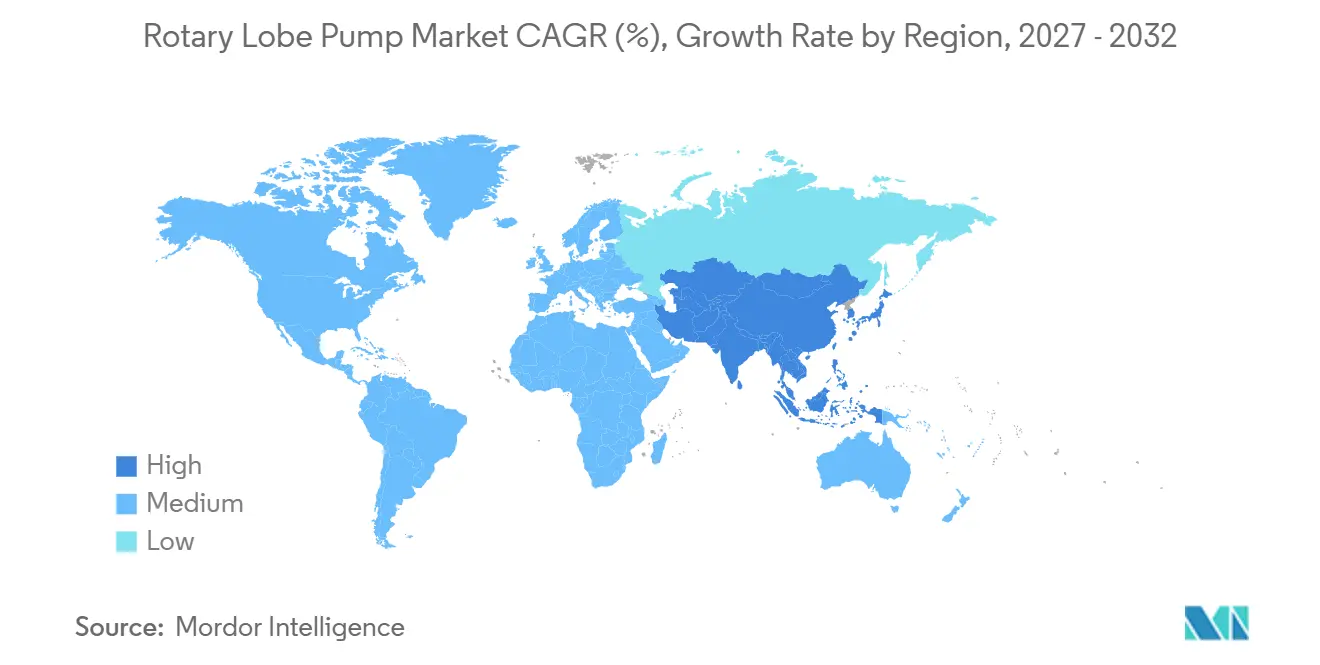
| Fastest Growing Market | Asia-Pacific |
| Largest Market | North America |
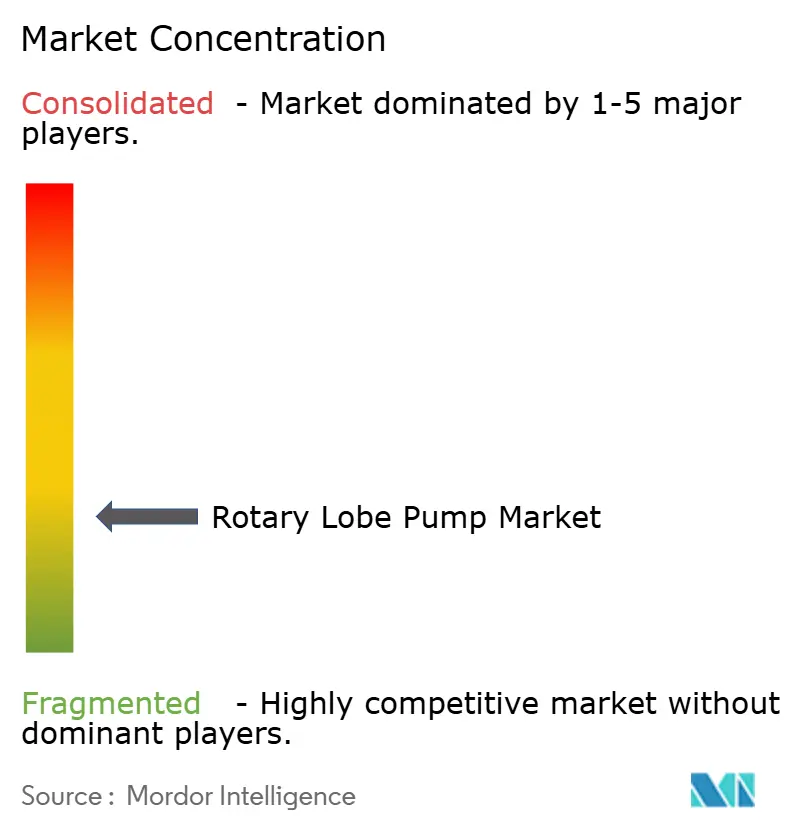
| Market Concentration | Low |
Major Players *Disclaimer: Major Players sorted in no particular order Image © Mordor Intelligence. Reuse requires attribution under CC BY 4.0. | |
Rotary Lobe Pump Market Analysis by Mordor Intelligence
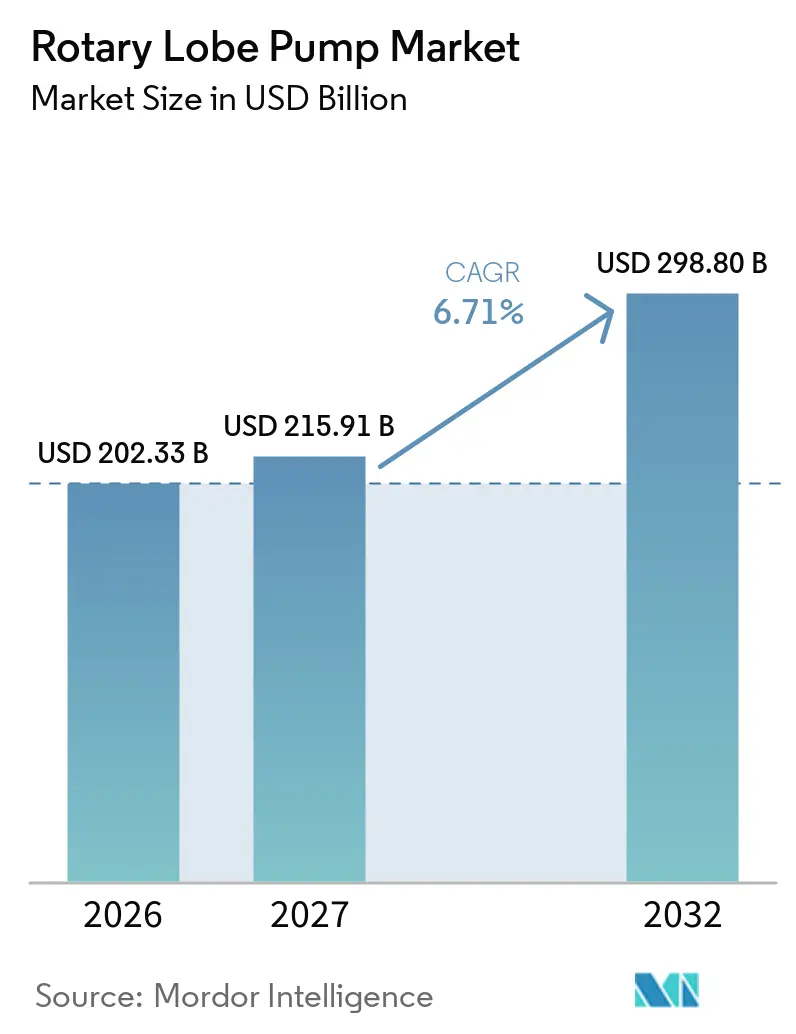
The Rotary Lobe Pump Market size is expected to increase from USD 202.33 billion in 2026 to USD 215.91 billion in 2027 and reach USD 298.80 billion by 2032, at a CAGR of 6.71% over 2027-2032. The global rotary lobe pump market serves applications where low-shear transfer, solids handling, hygienic design, or reversible flow are essential. Food, dairy, pharmaceutical, wastewater, and industrial operators use these pumps when centrifugal equipment is less suitable for viscous or solids-laden fluids. Certification requirements and service access shape purchasing decisions in hygienic and municipal applications. The global rotary lobe pump market also benefits from infrastructure investment in wastewater treatment, while sensor-ready equipment is changing service expectations. Material costs, service skills, and longer replacement intervals from predictive maintenance remain constraints.
Key Report Takeaways
- By product type, bi-wing lobe pumps held 37.6% of the global rotary lobe pump market share in 2026, while single-lobe pumps are forecast to grow at a 6.9% CAGR through 2032.
- By flow rate, the 50,001-200,000 L/h band accounted for 29.4% of the global rotary lobe pump market size in 2026, while the up to 1,000 L/h band is projected to expand at a 7.1% CAGR through 2032.
- By end user, food and beverage held 28.4% of the global rotary lobe pump market share in 2026, while water and wastewater treatment is forecast to grow at a 6.8% CAGR through 2032.
- By geography, North America held 33.2% of the global rotary lobe pump market in 2026, while Asia-Pacific is forecast to grow at a 7.3% CAGR through 2032.
Note: Market numbers in this report are based on Mordor Intelligence's proprietary estimation framework, which combines nine months of actuals with Q4 projections for base year 2026.
Market Trends and Insights
Drivers Impact Analysis of Rotary Lobe Pump Market*
| Driver | (~) % Impact on CAGR Forecast | Geographic Relevance | Impact Timeline |
|---|---|---|---|
| Hygienic handling demand in food, beverage, and pharmaceutical processing | +1.5% | Global, concentrated in North America, Europe, and Japan | Medium term (2-4 years) |
| Wastewater and sludge-handling infrastructure investment | +1.3% | Asia-Pacific, Middle East and Africa, and South America | Long term (≥ 4 years) |
| Industrial demand for viscous, abrasive, and solids-laden fluid transfer | +0.8% | Global, concentrated in North America and Europe | Short term (≤ 2 years) |
| Industrial automation, IoT monitoring, and predictive maintenance | +0.6% | North America, Europe, and advanced Asia-Pacific manufacturing hubs | Medium term (2-4 years) |
| Retrofit demand for reversible, low-shear pumping in constrained plants | +0.5% | North America and Europe | Short term (≤ 2 years) |
| Modular sealing and wear-part designs that reduce maintenance downtime | +0.4% | Global | Medium term (2-4 years) |
| Source: Mordor Intelligence | |||
Hygienic Handling Demand in Food, Beverage, and Pharmaceutical Processing
Food and pharmaceutical producers are designing process lines around clean-in-place and steam-in-place requirements. This supports the global rotary lobe pump market because sanitary lobe pumps can be cleaned without disassembly and can be specified for validated hygienic processes. The 3-A Sanitary Standards Institute sets requirements for positive rotary pumps used in food and dairy processing, while EHEDG certification is relevant to hygienic food equipment selection in Europe. [1]Biopharmaceutical users select tri-lobe and multi-lobe designs when lower pulsation can help protect shear-sensitive protein products during aseptic transfer. NETZSCH describes its TORNADO T.Sano pump as an all-metal, dead-space-free design with smooth contact surfaces intended to reduce product retention points in food applications.[2] In personal care production, this flexibility is useful when operators transfer formulations with widely different viscosities, from lighter serums to thicker creams.
Wastewater and Sludge-Handling Infrastructure Investment
Wastewater investment supports the global rotary lobe pump market because treatment plants require reliable transfer of primary sludge, return activated sludge, thickened sludge, and digester feed. Rotary lobe designs are used where solids handling and maintenance access are important operational considerations for continuous treatment processes. The equipment can be selected when operators need to replace or service rotors without disconnecting the full pipe arrangement. This is particularly relevant where plant operators have limited in-house maintenance resources and need to minimize shutdown work. Börger positions its rotary lobe pumps for wastewater and sludge applications, including configurations for industrial process duties. A January 2026 Börger order for 22 BLUEline pumps for an Australian wastewater treatment plant illustrates the scale of municipal sludge-conveyance installations.
Industrial Demand for Viscous, Abrasive, and Solids-Laden Fluid Transfer
Chemical, pulp and paper, biogas, and oil and gas operators often specify rotary lobe equipment after alternatives have struggled with viscous or solids-laden media. This replacement demand can be time-sensitive because process interruptions create immediate operating costs and place pressure on plant reliability. The global rotary lobe pump market is supported by lower rotor speeds that can reduce wear exposure in applications containing abrasive particles or fibrous solids. Rotary lobe equipment also provides reversible flow, allowing one unit to support charging and draining duties in pulp and paper operations. Börger lists API and NACE-compliant rotary lobe pump configurations for applicable industrial uses. Vogelsang documented a biogas application in which performance improved after pipeline outgassing was addressed, showing why materials, seals, and wider system conditions matter to pump selection.
Industrial Automation, IoT Monitoring, and Predictive Maintenance
Condition monitoring is becoming more common in pump procurement, particularly where shutdowns can interrupt regulated production and create compliance concerns. The global rotary lobe pump market can benefit because vibration and temperature data can help maintenance teams identify abnormal operating patterns. A 2025 study in Electronics evaluated low-cost IoT-based anomaly detection on pump test benches and reported strong results for several models and data segmentation combinations. Siemens documented the use of Senseye Predictive Maintenance at Sachsenmilch to identify pump end-of-service-life conditions and route notifications through SAP Plant Maintenance. Sensor-ready designs can support service contracts that combine equipment access, condition information, and planned interventions. Better maintenance planning can also extend operating life, which delays replacement demand in the installed base.
Restraints Impact Analysis of Rotary Lobe Pump Market*
| Restraint | (~) % Impact on CAGR Forecast | Geographic Relevance | Impact Timelin |
|---|---|---|---|
| Stainless-steel and specialty-alloy cost volatility | -0.6% | Global, most acute in Asia-Pacific manufacturing and European project procurement | Short term (≤ 2 years) |
| Higher ownership cost and maintenance complexity versus centrifugal pumps | -0.4% | Emerging economies in Asia-Pacific, South America, and Middle East and Africa | Medium term (2-4 years) |
| Seal failure, dry-running, and abrasive-wear exposure | -0.3% | Global, with higher incidence in mining and industrial sludge | Short term (≤ 2 years) |
| Application-specific sizing and skilled-service dependence | -0.3% | Middle East and Africa, South America, and developing Asia-Pacific markets | Long term (≥ 4 years) |
| Source: Mordor Intelligence | |||
Stainless-Steel and Specialty-Alloy Cost Volatility
AISI 316L stainless steel is used for wetted parts in hygienic rotary lobe pumps, which leaves suppliers exposed to changes in nickel and alloy costs. This exposure is more pronounced for applications that require duplex or nickel-bearing materials. Higher material costs can affect quotation timing, component availability, and project budgets. The global rotary lobe pump market can therefore experience uneven order timing when customers defer purchases or specify lower-cost materials. The effect is especially relevant to municipal authorities and engineering contractors working under fixed project budgets. Suppliers with broad sourcing capability and pricing discipline may be better placed to manage this pressure.
Higher Ownership Cost and Maintenance Complexity Versus Centrifugal Pumps
Rotary lobe pumps can require more initial capital than lower-cost centrifugal alternatives. They also require operators to understand rotor clearance, seal materials, and cleaning compatibility. These requirements can slow adoption where trained service personnel are scarce. The global rotary lobe pump market faces this constraint most clearly in cost-sensitive installations that prioritize purchase price over lifecycle performance. Modular cartridges and front-access maintenance designs can reduce service time and make routine work more manageable. Local service networks and training programs can therefore influence purchasing decisions as much as pump specifications.
*Our forecasts treat driver/restraint impacts as directional, not additive. The impact forecasts reflect baseline growth, mix effects, and variable interactions.
Rotary Lobe Pump Market Segment Analysis
By Product Type:
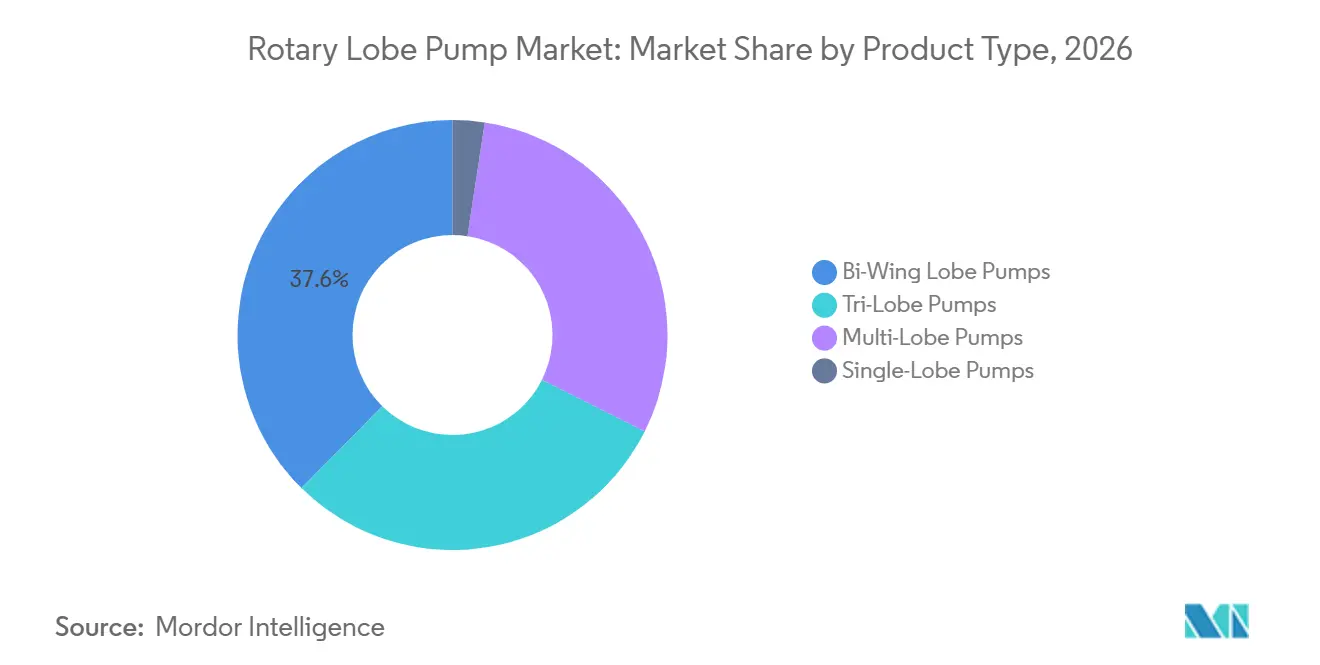
Bi-Wing Designs Lead, Tri-Lobe and Multi-Lobe Pumps AdvanceBi-wing lobe pumps held 37.6% of the global rotary lobe pump market in 2026. Their position reflects a balance of volumetric efficiency, cleanability, and resistance to rotor wear in food and dairy operations. Large bi-wing cavities can handle beverages, creams, and other products with different viscosities, which makes this design common in dairy, beverage, and cosmetics lines. Single-lobe pumps are forecast to grow at a 6.9% CAGR from 2027 to 2032 because their larger displacement per revolution suits biogas feed, thickened sludge, and slurry transfer. The global rotary lobe pump industry relies on these designs where throughput is more important than highly even flow.
Tri-lobe and multi-lobe pumps address applications where low pulsation and gentle handling carry greater weight. In biopharmaceutical transfer, these configurations can reduce pulsation and help preserve sensitive protein products. Alfa Laval states that its SX rotary lobe range offers 14 pump-head displacements, flows up to 115 m³/h, and pressures up to 15 bar. These pumps are also relevant to personal care formulations such as serums, emulsions, and active-ingredient suspensions, where manufacturers seek to limit excessive shear. The global rotary lobe pump market has room for several rotor designs because product properties and process requirements differ substantially.

By Flow Rate:
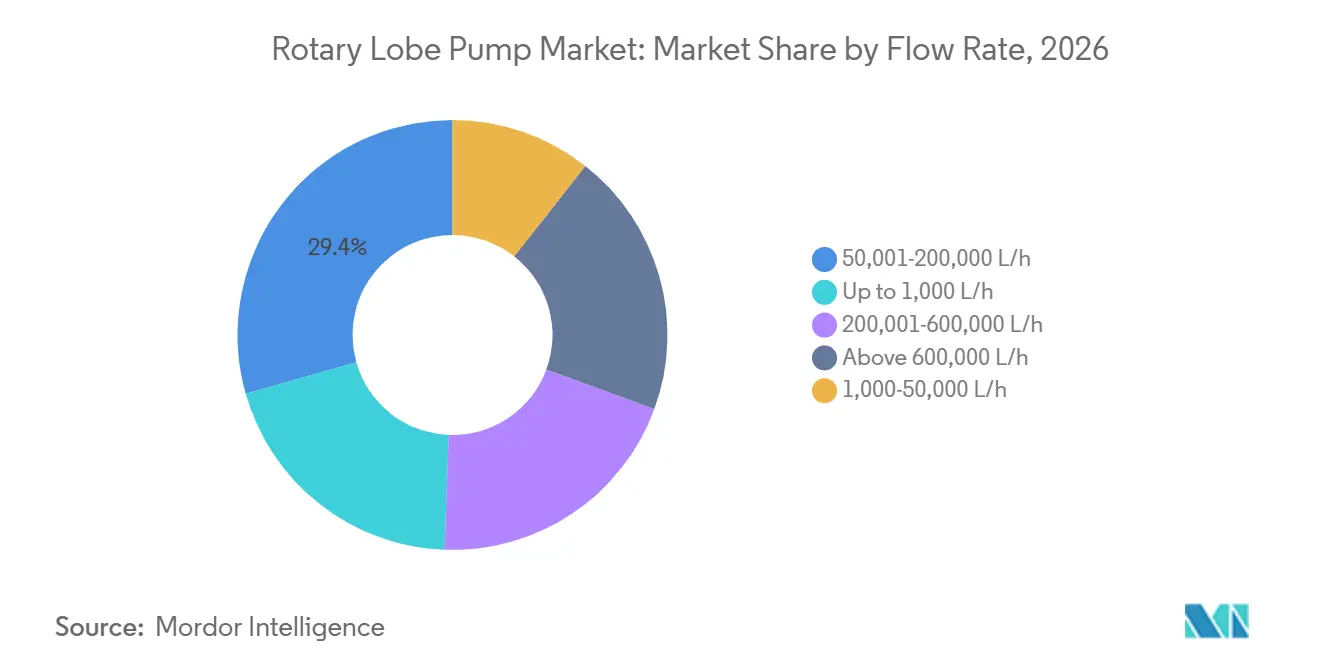
Mid-Range Dominates, Micro-Flow Band OutpacesThe 50,001-200,000 L/h flow-rate band held 29.4% of the global rotary lobe pump market in 2026. It aligns with municipal wastewater, food processing, and chemical production, where primary sludge transfer and bulk ingredient movement require capacity with manageable motor sizing. The 1,000-50,000 L/h range covers many installed units across dairy cleaning circuits, breweries, pharmaceutical processing, and personal care production. The global rotary lobe pump industry serves this broad range through several displacement and drive configurations.
The up to 1,000 L/h band is forecast to grow at a 7.1% CAGR from 2027 to 2032. Pharmaceutical and biotechnology users need precise positive-displacement transfer for micro-dosing, injectables, and continuous bioreactor feed. Compact wastewater systems in rural parts of South and Southeast Asia also need small-capacity pumping equipment. The above 600,000 L/h band remains specialized but important to large municipal and pulp operations, while the 200,001-600,000 L/h range serves larger food plants and industrial wastewater installations. The global rotary lobe pump market therefore spans small precision duties and large solids-transfer projects.
By End User:
Food and Beverage Anchors Volume, Water Treatment Leads GrowthFood and beverage held 28.4% of the global rotary lobe pump market in 2026. The segment benefits from extensive processed food, dairy, and beverage production and from the need for hygienic positive-displacement equipment. The 3-A Sanitary Standards Institute covers positive rotary pump requirements for sanitary processing equipment. 3-A SSI Pharmaceutical and biotechnology applications require sterile designs for aseptic filling and biologics production, while dairy processors use lobe pumps for cheese and concentrated milk transfer. The global rotary lobe pump industry supports these users where product integrity and cleanability affect operating decisions.
Water and wastewater treatment is forecast to grow at a 6.8% CAGR from 2027 to 2032. Municipal infrastructure programs and wastewater treatment requirements underpin demand for sludge-handling equipment, as illustrated by Börger's January 2026 order for 22 BLUEline pumps for an Australian treatment plant. Chemical processing, oil and gas, and biogas and sludge handling form another cluster for heavy-duty designs. Pulp and paper users value reversible flow, while personal care and cosmetics manufacturers need controlled transfer for shear-sensitive ingredients. Other users include mining and construction slurry operations that require abrasion-resistant components.
Geography Analysis
North America held 33.2% of the global rotary lobe pump market in 2026. The region has large food processing, pharmaceutical manufacturing, and municipal water systems in the United States and Canada. These industries create demand for hygienic and solids-handling equipment. U.S. food and dairy processing also relies on established sanitary pump requirements, while Mexico adds demand through dairy and beverage manufacturing.
Asia-Pacific is forecast to grow at a 7.3% CAGR from 2027 to 2032. China and India are important because water treatment and industrial capacity additions broaden the customer base for rotary lobe equipment. Southeast Asian pharmaceutical development, industrial wastewater compliance, and expanding food and dairy processing also support new installations. The global rotary lobe pump market can expand where suppliers combine suitable configurations with close service support. Local availability of trained technicians remains important when customers assess operating risk.
South America and the Middle East and Africa remain smaller regional markets with identifiable demand centers. Brazil supports food processing demand, while Argentina and Chile contribute chemical and mining-related applications. Saudi Arabia and the United Arab Emirates are developing water recycling and desalination pretreatment systems, and South Africa and Egypt provide industrial and municipal wastewater opportunities. The global rotary lobe pump market depends on after-sales coverage in these regions because skilled service capacity remains a central purchasing consideration.
Competitive Landscape
The global rotary lobe pump market is fragmented. European original equipment manufacturers maintain strong positions in hygienic, wastewater, and specialized industrial applications through certified designs, application knowledge, and established service networks. ITT Inc. completed its acquisition of SPX FLOW in March 2026 for USD 4.8 billion. The transaction created ITT Flow Technologies and added SPX FLOW's Waukesha product heritage to ITT's broader fluid-handling portfolio. This combination expands cross-selling potential across hygienic and industrial process applications.
Alfa Laval, GEA Group, Vogelsang, and Börger hold established positions in their respective operating areas. Suppliers differentiate through rotor geometry, material selection, sealing systems, and application support. The global rotary lobe pump market increasingly rewards front-access designs that allow technicians to service lobes, wear plates, and seals without disconnecting adjoining pipework. These designs can reduce downtime in municipal and food applications. Equipment providers are also positioning sensor-ready products for customers that want condition monitoring and more structured service agreements.
Smaller suppliers compete by specializing in selected applications rather than matching the broad product portfolios of larger manufacturers. Wright Flow Technologies and LobePro focus on niche applications that require specific engineering support. Börger's BLUEline installation for an Australian treatment plant shows the continuing importance of wastewater-specific sales and application capability. NETZSCH's TORNADO T.Sano documentation shows how hygienic certification and cleanability remain central to food-processing positioning.
Rotary Lobe Pump Industry Leaders
-
Alfa Laval AB
-
NETZSCH-Group
-
GEA Group Aktiengesellschaft
-
Börger GmbH
-
Vogelsang GmbH and Co. KG
- *Disclaimer: Major Players sorted in no particular order
Rotary Lobe Pump Market Companies Covered in this Report
- Alfa Laval AB
- Ampco Pumps Company
- Borger GmbH
- Fristam Pumpen GmbH
- GEA Group Aktiengesellschaft
- INOXPA Group
- IPEC Pump Systems, Inc.
- KSB SE and Co. KGaA
- LobePro, Inc.
- Megator Ltd.
- NETZSCH-Group
- ProMinent GmbH
- SPX FLOW, Inc.
- Tuthill Corporation
- Vanton Pump, Inc.
- Verder Group
- Vogelsang GmbH and Co. KG
- Wastecorp Pumps LLC
- Wilden Pump and Engineering LLC
- Wright Flow Technologies
Recent Industry Developments in Rotary Lobe Pump Market
- March 2026: ITT Inc. completed the USD 4.775 billion acquisition of SPX FLOW, creating the ITT Flow Technologies segment by renaming its Industrial Process unit. SPX FLOW, which recorded USD 1.3 billion in 2025 revenue with 14% organic orders growth, brings the Waukesha Cherry-Burrell rotary lobe pump portfolio into a combined fluid handling platform with ITT's centrifugal and valve operations, significantly expanding cross-selling coverage across food, pharma, and industrial markets.
- January 2026: Börger GmbH secured an order for 22 BLUEline rotary lobe pumps for delivery to an Australian wastewater treatment plant for sludge conveyance service, demonstrating sustained demand for large-scale municipal wastewater pump installations in the Asia-Pacific region.
- January 2026: NETZSCH Pumps & Systems published documentation on the TORNADO T.Sano All-Metal Rotary Lobe Pump for food processing, confirming EHEDG and 3-A Sanitary Standards compliance for applications including dairy, beverage, confectionery, sauce, and meat processing.
Global Rotary Lobe Pump Market Report Scope
A rotary lobe pump is a positive displacement pump that uses two or more synchronized rotating lobes within a housing to move fluids gently and efficiently without contact between the lobes.
The global rotary lobe pump market is segmented by product type, flow rate, end user, and geography. By product type, the market is segmented into single-lobe pumps, bi-wing lobe pumps, tri-lobe pumps, and multi-lobe pumps. By flow rate, the market is segmented into up to 1,000 L/h, 1,000-50,000 L/h, 50,001-200,000 L/h, 200,001-600,000 L/h, and above 600,000 L/h. By end user, the market is segmented into food and beverage, dairy, pharmaceutical and biotechnology, water and wastewater treatment, chemical processing, pulp and paper, oil and gas, biogas and sludge handling, personal care and cosmetics, and other end users. The report also covers the market size and forecasts for the global rotary lobe pump market across 26 countries in the key regions. For each segment, market sizing and forecasts are provided in terms of value (USD).
Segmentation Overview
| Single-Lobe Pumps |
| Bi-Wing Lobe Pumps |
| Tri-Lobe Pumps |
| Multi-Lobe Pumps |
| Up to 1,000 L/h |
| 1,000-50,000 L/h |
| 50,001-200,000 L/h |
| 200,001-600,000 L/h |
| Above 600,000 L/h |
| Food and Beverage |
| Dairy |
| Pharmaceutical and Biotechnology |
| Water and Wastewater Treatment |
| Chemical Processing |
| Pulp and Paper |
| Oil and Gas |
| Biogas and Sludge Handling |
| Personal Care and Cosmetics |
| Other End Users |
| North America | United States |
| Canada | |
| Mexico | |
| Europe | Germany |
| France | |
| Italy | |
| Spain | |
| United Kingdom | |
| Poland | |
| Russia | |
| Rest of Europe | |
| Asia-Pacific | China |
| India | |
| Japan | |
| South Korea | |
| Australia | |
| Indonesia | |
| Vietnam | |
| Thailand | |
| Rest of Asia-Pacific | |
| South America | Brazil |
| Argentina | |
| Chile | |
| Rest of South America | |
| Middle East and Africa | Saudi Arabia |
| United Arab Emirates | |
| Egypt | |
| South Africa | |
| Morocco | |
| Rest of Middle East and Africa |
| By Product Type | Single-Lobe Pumps | |
| Bi-Wing Lobe Pumps | ||
| Tri-Lobe Pumps | ||
| Multi-Lobe Pumps | ||
| By Flow Rate | Up to 1,000 L/h | |
| 1,000-50,000 L/h | ||
| 50,001-200,000 L/h | ||
| 200,001-600,000 L/h | ||
| Above 600,000 L/h | ||
| By End User | Food and Beverage | |
| Dairy | ||
| Pharmaceutical and Biotechnology | ||
| Water and Wastewater Treatment | ||
| Chemical Processing | ||
| Pulp and Paper | ||
| Oil and Gas | ||
| Biogas and Sludge Handling | ||
| Personal Care and Cosmetics | ||
| Other End Users | ||
| By Geography | North America | United States |
| Canada | ||
| Mexico | ||
| Europe | Germany | |
| France | ||
| Italy | ||
| Spain | ||
| United Kingdom | ||
| Poland | ||
| Russia | ||
| Rest of Europe | ||
| Asia-Pacific | China | |
| India | ||
| Japan | ||
| South Korea | ||
| Australia | ||
| Indonesia | ||
| Vietnam | ||
| Thailand | ||
| Rest of Asia-Pacific | ||
| South America | Brazil | |
| Argentina | ||
| Chile | ||
| Rest of South America | ||
| Middle East and Africa | Saudi Arabia | |
| United Arab Emirates | ||
| Egypt | ||
| South Africa | ||
| Morocco | ||
| Rest of Middle East and Africa | ||
Key Questions Answered in the Report
What is driving demand for rotary lobe pumps?
Hygienic processing, wastewater infrastructure, and difficult fluid-transfer duties support demand through 2031.
What is the projected growth rate for rotary lobe pumps?
The Rotary Lobe Pump Market size is expected to increase from USD 202.33 billion in 2026 to USD 215.91 billion in 2027 and reach USD 298.80 billion by 2032, growing at a CAGR of 6.71% over 2027-2032.
Which rotary lobe pump product type leads sales?
Bi-wing lobe pumps led with 37.6% share in 2026, supported by food, dairy, and cosmetics applications.
Which end user is growing fastest?
Water and wastewater treatment is forecast to grow at a 6.8% CAGR through 2032.
Which region is growing fastest for rotary lobe pumps?
Asia-Pacific is forecast to grow at 7.3% CAGR from 2027 to 2032.
Why are hygienic rotary lobe pumps used in food and pharmaceutical facilities?
They support clean-in-place and steam-in-place processes and can provide lower-shear handling for sensitive products.