
Robotics Foundation Models Market Size and Share
Market Overview
| Study Period | 2020 - 2031 |
|---|---|
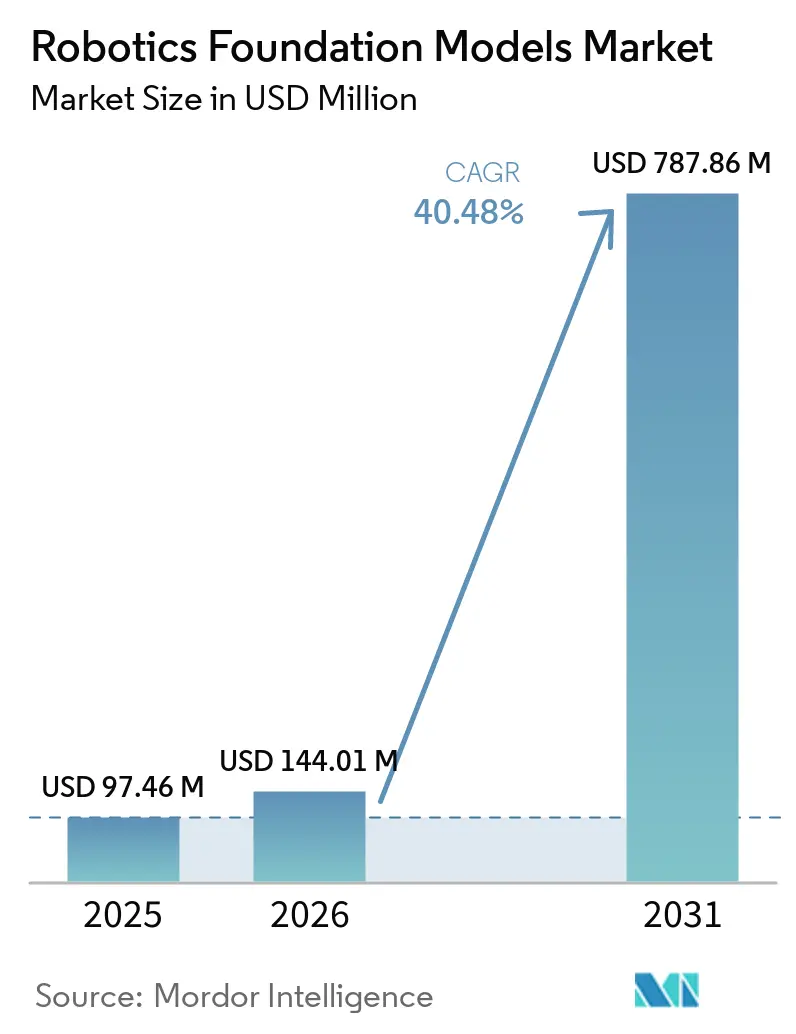
| Market Size (2026) | USD 144.01 Million |
| Market Size (2031) | USD 787.86 Million |
| Growth Rate (2026 - 2031) | 40.48% CAGR |
| Fastest Growing Market | Asia-Pacific |
| Largest Market | North America |
| Market Concentration | Medium |
Major Players *Disclaimer: Major Players sorted in no particular order Image © Mordor Intelligence. Reuse requires attribution under CC BY 4.0. | |
Robotics Foundation Models Market Analysis by Mordor Intelligence
The robotics foundation models market size is projected to expand from USD 97.46 million in 2025 and USD 144.01 million in 2026 to USD 787.86 million by 2031, registering a CAGR of 40.48% between 2026 to 2031. The robotics foundation models market is moving from laboratory work into commercial use in warehouses, factories, and healthcare facilities. Persistent shortages in manufacturing and logistics support demand for systems that can handle varied tasks with less programming. Firms are directing investment toward model platforms, data collection, simulation, and deployment tools rather than relying on a single robot design. Open models are widening access for smaller integrators, although they also reduce the ability to differentiate through model architecture alone. The robotics foundation models market still faces limits in real-world training data, safety validation, and liability rules, especially where robots work near people.
Key Report Takeaways
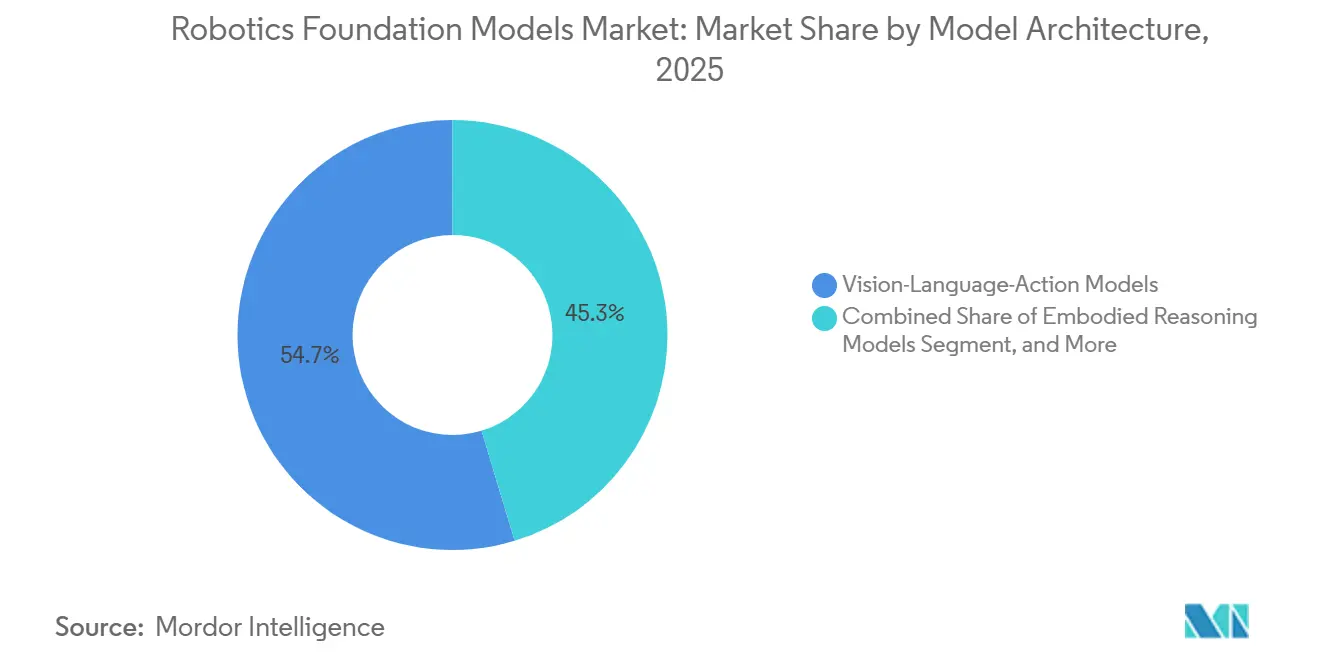
- By model architecture, Vision-Language-Action models held 54.67% revenue share in the robotics foundation models market in 2025, while embodied reasoning models are projected to expand at a 46.53% CAGR through 2031.
- By deployment mode, cloud-based deployment accounted for 57.26% of revenue in 2025 and is projected to expand at a 43.61% CAGR through 2031.
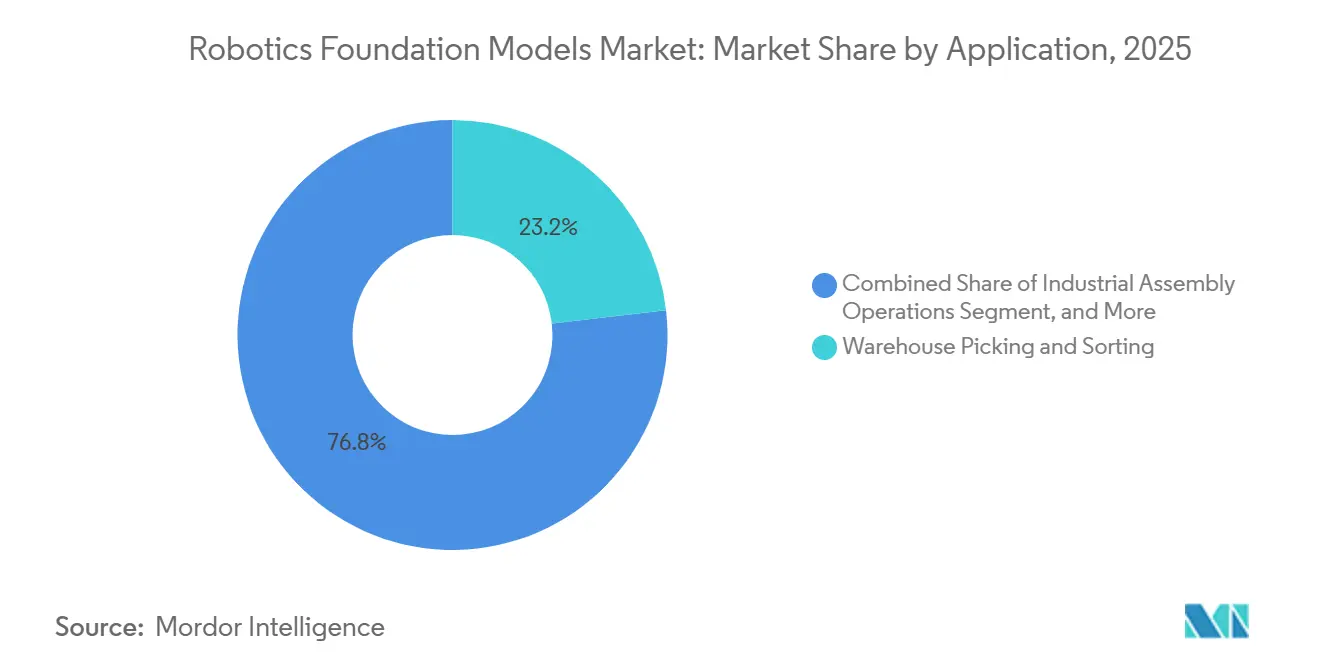
- By application, warehouse picking and sorting accounted for 23.16% of revenue in 2025, while home service execution is projected to expand at a 46.32% CAGR through 2031 in the robotics foundation models market.
- By end user, manufacturers held 35.21% revenue share in 2025, while healthcare providers are projected to expand at a 47.27% CAGR through 2031.
- By geography, North America held a 45.74% revenue share in the robotics foundation models market in 2025, while Asia-Pacific is projected to expand at a 46.84% CAGR through 2031.
Note: Market size and forecast figures in this report are generated using Mordor Intelligence’s proprietary estimation framework, updated with the latest available data and insights as of January 2026.
Global Robotics Foundation Models Market Trends and Insights
Drivers Impact Analysis*
| DRIVER | (~) % IMPACT ON CAGR FORECAST | GEOGRAPHIC RELEVANCE | IMPACT TIMELINE |
|---|---|---|---|
| Industrial Automation and Labor Shortages | +8.5% | Global, with highest intensity in North America, Europe, and East Asia | Short term (≤ 2 years) |
| Demand for General-Purpose Robot Intelligence | +7.2% | Global, led by North America and Asia-Pacific | Medium term (2-4 years) |
| Expansion of Multimodal Vision-Language-Action Models | +6.8% | North America and Asia-Pacific core, with spillover to Europe and the Middle East and Africa | Medium term (2-4 years) |
| Open Robotics Models Lowering Development Barriers | +5.5% | Global, with early adoption in North America, East Asia, and Europe | Short term (≤ 2 years) |
| Robot Data Flywheels From Commercial Deployments | +4.2% | North America and China core, with spillover to Europe | Medium term (2-4 years) |
| Simulation-First Training Reducing Physical Data Requirements | +3.8% | Global, led by North America and Asia-Pacific | Long term (≥ 4 years) |
| Source: Mordor Intelligence | |||
Industrial Automation and Labor Shortages
Manufacturing and logistics employers are increasing automation investment because shortages now affect tasks that fixed equipment cannot easily perform. U.S. industrial robot installations rose 11% to 38,000 units in 2025, while robot density reached 307 operational units per 10,000 manufacturing employees.[1]International Federation of Robotics, “US Robot Industry Returns to Double Digit Growth,” IFR Press Release, ifr.org These conditions favor robots that can interpret changing product layouts, package shapes, and work instructions. Foundation models can support restocking, mixed-item handling, and other tasks where conventional robots require extensive reprogramming. Global industrial robot installations reached 621,000 units in 2025, and Asia accounted for 79% of installations, showing that the automation push extends beyond North America. The robotics foundation models market therefore benefits when employers seek flexible capacity rather than another narrowly programmed machine that must be reconfigured when local tasks, stock profiles, or product conditions change.
Demand for General-Purpose Robot Intelligence
Enterprises with task-specific robots often incur new integration costs when product lines or facility layouts change. This issue has increased interest in systems that can transfer learned skills across tasks and robot types. Physical Intelligence reported that its π0.7 model combined skills learned from separate datasets to complete novel manipulation sequences without task-specific training.[2]Physical Intelligence, “π0.7: A Steerable Generalist Robotic Foundation Model with Emergent Capabilities,” arXiv, arxiv.org The result points to a practical value proposition for general-purpose robot intelligence, particularly in automotive, electronics, and logistics operations with frequent variation. A broader robot policy may reduce the need to maintain separate systems for each handling or assembly task. This opportunity supports the robotics foundation models market because enterprises increasingly view model access and ongoing updates as core automation infrastructure for facilities where changing tasks otherwise increase integration effort and delay operational returns.
Expansion of Multimodal Vision-Language-Action Models
Vision-Language-Action, or VLA, models combine visual inputs, language instructions, and robot-state information within one control system. This can reduce the integration burden associated with separate perception, planning, and action components. NVIDIA stated that GR00T N1.7 was trained using 32,000 hours of real demonstration and egocentric human data, along with 8,000 hours of simulated rollouts. A common model can be post-trained for material handling, packaging, and inspection, reducing the number of configurations an enterprise needs to maintain. In healthcare, NVIDIA-Medtech reported that GR00T-H-N1.7 achieved 25% full end-to-end suturing success on the SutureBot benchmark. These developments broaden the robotics foundation models market beyond traditional industrial automation while raising the importance of safety assessment in settings where robot behavior affects workers, patients, and customers.
Open Robotics Models Lowering Development Barriers
Open-source and open-weight models are changing the cost structure of robot software development. OpenVLA used 970,000 robot episodes from the Open X-Embodiment dataset and outperformed RT-2-X by 16.5% in absolute task success across 29 evaluation tasks while using fewer parameters. This evidence indicates that robotics performance can improve through better training data and model design rather than parameter count alone. Xiaomi released Xiaomi-Robotics-0 with weights, inference code, and evaluation tools, then released post-training code for real-robot deployment. As access to baseline models improves, integrators can concentrate on deployment, data collection, and customer-specific validation. The robotics foundation models market may therefore see faster participation by mid-sized integrators, although model providers must protect performance advantages through data and operating experience accumulated across real customer environments and varied physical conditions.
Restraints Impact Analysis*
| RESTRAINT | (~) % IMPACT ON CAGR FORECAST | GEOGRAPHIC RELEVANCE | IMPACT TIMELINE |
|---|---|---|---|
| High Cost and Scarcity of Real-World Robot Data | -3.8% | Global, most acute in North America and Europe due to compliance and annotation requirements | Medium term (2-4 years) |
| Safety Certification and Liability Uncertainty | -2.5% | North America and Europe most affected, with emerging markets less constrained in the near term | Long term (≥ 4 years) |
| Embodiment Transfer Failures in Long-Tail Tasks | -1.8% | Global | Medium term (2-4 years) |
| Inference Economics and Edge-Compute Constraints | -1.2% | Global, most constraining in markets with limited cloud infrastructure | Short term (≤ 2 years) |
| Source: Mordor Intelligence | |||
High Cost and Scarcity of Real-World Robot Data
Real-world robot demonstrations require synchronized visual, force, motion, and language data, which is costly to collect at a commercial scale. The constraint is most evident in garment handling, surgical work, and complex assembly, where physical variation limits the value of synthetic data alone. NVIDIA-Medtech released Open-H-Embodiment in 2026 with 770 hours of surgical robot data from 50 or more institutions across 20 robot platforms.[3]NVIDIA-Medtech, “Open-H-Embodiment: A Large-Scale Dataset for Enabling Foundation Models in Medical Robotics,” arXiv, arxiv.org The scale of this coordinated dataset also shows the operational work needed to standardize actions and data streams across institutions. Universal Robots and Scale AI introduced UR AI Trainer to capture synchronized motion, force, and vision data from production robots for industrial VLA training. The robotics foundation models market remains advantaged toward companies with deployed fleets, even as simulation, cross-embodiment training, and shared datasets improve access for firms without large operating fleets or specialist data teams.
Safety Certification and Liability Uncertainty
Safety rules for learning-based robot behavior have not progressed as quickly as model deployment. ISO 10218-1:2025 and ISO 10218-2:2025 set safety requirements for industrial robots, including requirements relevant to design and use. ANSI/A3 R15.06-2025 also updated industrial robot safety requirements for functional safety, risk assessment, end effectors, and cybersecurity. These standards are important, but do not establish complete evaluation methods for neural-network action policies that encounter unseen conditions. Responsibility may remain unclear among the model developer, robot manufacturer, system integrator, and operator if a robot causes damage or injury. This uncertainty can delay use in healthcare, defense, and public spaces, limiting near-term demand where operators need predictable evidence before allowing robots to work alongside people in the robotics foundation models market.
*Our forecasts treat driver/restraint impacts as directional, not additive. The impact forecasts reflect baseline growth, mix effects, and variable interactions.
Segment Analysis
By Model Architecture: VLA Models Lead While Reasoning Architectures Extend Capability
Vision-Language-Action models held 54.67% of the robotics foundation models market share in 2025. Their lead reflects the ability to process images, language task descriptions, and robot-state data in one backbone. This design supports instruction-following behavior without complex links between separate perception, planning, and action components. NVIDIA described GR00T N1.7 as an open, commercially licensed VLA for general humanoid robot skills and identified training partners, including Unitree Robotics and Agile Robots.[4]NVIDIA-Medtech, “GR00T-H-N1.7,” Hugging Face, huggingface.co The industrial installed base gives VLA models a clear commercial route across established industrial settings with repeatable handling and assembly work in the robotics foundation models market.
World models hold a smaller revenue position but remain important because they represent physical environments for planning and testing. NVIDIA-Medtech stated that Cosmos-H-Surgical-Simulator generated realistic surgical video from robot kinematics across nine surgical platforms, which can support validation before physical deployment. Embodied reasoning models are projected to expand at a 46.53% CAGR through 2031, the fastest rate within the architecture segment. Physical Intelligence reported that π0.7 matched task-specific systems on coffee preparation, laundry folding, and box assembly without task-specific training data. Behavior policy, cross-embodiment control, and tool-orchestration models serve narrower needs as development frameworks improve access for smaller integrators that need affordable starting points and adaptable control policies in the robotics foundation models market.



By Deployment Mode: Cloud Systems Support Continuous Model Improvement
Cloud-based deployment accounted for 57.26% of revenue in 2025. Enterprises use cloud systems for centralized model updates, shared compute, and the aggregation of robot data across sites. Universal Robots and Scale AI stated that UR AI Trainer captures production motion, force, and vision data to support imitation learning from the lab to the factory. This model connects deployment data with policy refinement and lowers infrastructure barriers for mid-sized enterprises. The cloud channel is projected to expand at a 43.61% CAGR through 2031, making it the fastest deployment mode in the robotics foundation models market.
On-premises deployment remains important where operations need data control, low latency, or reliable local operation. Defense sites, pharmaceutical cleanrooms, and remote mining operations may not accept dependence on external cloud connections. NVIDIA positioned Jetson Thor for real-time robot inference and control at the edge, helping facilities retain sensitive operational data. European data-residency rules and sector security requirements also support local deployment where cloud use is restricted. The coexistence of cloud learning and edge control will remain relevant as customers balance model improvement with operational control, local resilience, and data-protection obligations in the robotics foundation models market.
By Application: Warehouse Use Leads While Home Service Use Accelerates
Warehouse picking and sorting held 23.16% of revenue in 2025. Warehouses require robots to handle varied stock-keeping units, irregular packages, mixed-weight totes, and changing storage patterns. These tasks are poorly suited to rigid automation because they require contextual recognition and flexible grasping. Foundation models can reduce manual reprogramming when packaging or product mixes change. The continued expansion of e-commerce and distribution operations gives the robotics foundation models market a dependable commercial base in warehouse automation.
Industrial assembly, material handling, packaging, and mobile inspection also remain meaningful application areas. Model-guided systems can adjust to new part shapes and production changes that previously required manual intervention. Mobile inspection and navigation can reduce human exposure in energy and manufacturing sites with hazardous conditions. Home service execution is projected to expand at a 46.32% CAGR through 2031, supported by lower humanoid hardware costs and stronger general-purpose model capability. Unstructured homes remain harder than factories because robots must work around vulnerable occupants, diverse objects, and limited machine-readable structure, so widespread use remains a longer-term commercial opportunity for the robotics foundation models market as reliability and safety expectations remain demanding.
By End User: Manufacturers Provide Volume While Healthcare Providers Advance Fastest
Manufacturers held 35.21% of revenue in 2025 and remained the largest end-user group. Automotive producers, electronics assemblers, and food processors need adaptable automation because product variation and shorter production runs make fixed programming less efficient. Foundation models offer greater flexibility, not just lower labor costs, across changing operating conditions. Commercial deployments of humanoid and general-purpose systems show that these technologies are moving beyond pilot settings in manufacturing and logistics. Logistics and warehousing providers represent the next major user group because distribution work is labor-intensive and service targets are strict, creating demand for systems that can adjust to changing workloads without lengthy reprogramming cycles.
Healthcare providers are projected to expand at a 47.27% CAGR through 2031, the fastest end-user rate. Surgical robotics and hospital logistics can extend clinical capacity and improve operational workflows where safety and validation requirements are met. NVIDIA-Medtech presented GR00T-H-N1.7 as a commercially licensed model for surgical and healthcare robotics using data from 50 or more institutions and 20 robot platforms. The company reported 25% full end-to-end suturing success on the SutureBot benchmark. Clinical validation and medical-device compliance will influence adoption timing, particularly in European surgical settings, where deployment must align with clinical validation and established medical-device processes in the robotics foundation models market.
Geography Analysis
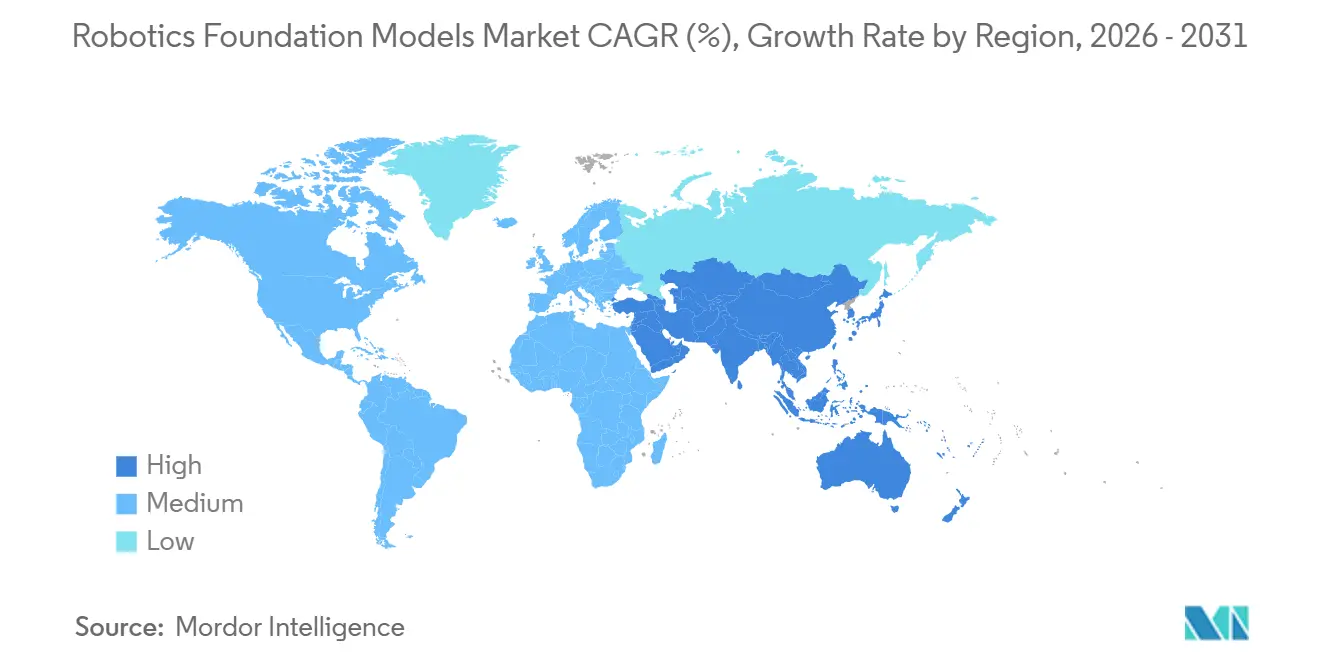
North America held 45.74% of the robotics foundation models market share in 2025. The region combines frontier model developers, cloud infrastructure, and enterprise spending on automation. U.S. industrial robot installations increased by 11% to 38,000 units in 2025, while robot density reached 307 units per 10,000 manufacturing employees, supporting deployments in manufacturing, logistics, and related services. ANSI/A3 R15.06-2025 sets updated industrial safety requirements that align with ISO 10218 and create a clearer validation reference for deployers.
Asia-Pacific is projected to expand at a 46.84% CAGR through 2031, representing the fastest-growing regional opportunity. The Japan Robot Industry Association reported that 2025 robot orders rose 25.7% to JPY 1,045.6 billion (USD 6.97 billion), and forecast 2026 orders of JPY 1,220 billion (USD 8.13 billion).[5]Japan Robot Industry Association, “Statistical Press Release: 2025 Robot Orders and Production,” Japan Robot Industry Association, jara.jp Japan is coordinating data collection and shared development of foundation models through the AI Robot Foundation Technology Consortium. South Korea had a robot density of 1,220 units per 10,000 manufacturing employees, creating a large installed base for retrofits in electronics and semiconductor production. Asia-Pacific can expand the robotics foundation models market through new deployments and upgrades to established automated facilities.
Europe had a robot density of 267 units per 10,000 manufacturing employees in 2024, the highest regional level reported by the International Federation of Robotics. This installed automation base supports adoption, although detailed compliance requirements and slower investment in frontier models may limit the pace relative to North America and Asia-Pacific. South America, the Middle East, and Africa held a modest but emerging position in the robotics foundation models market. Brazil offers demand from automotive assembly and food processing, while South Africa offers a relevant use case in mining inspection and hazardous navigation. Broader adoption will depend on cloud infrastructure, smart manufacturing, and logistics initiatives in Gulf countries, as well as localized data that reflects regional languages, work environments, and operating conditions in the robotics foundation models market.

Competitive Landscape
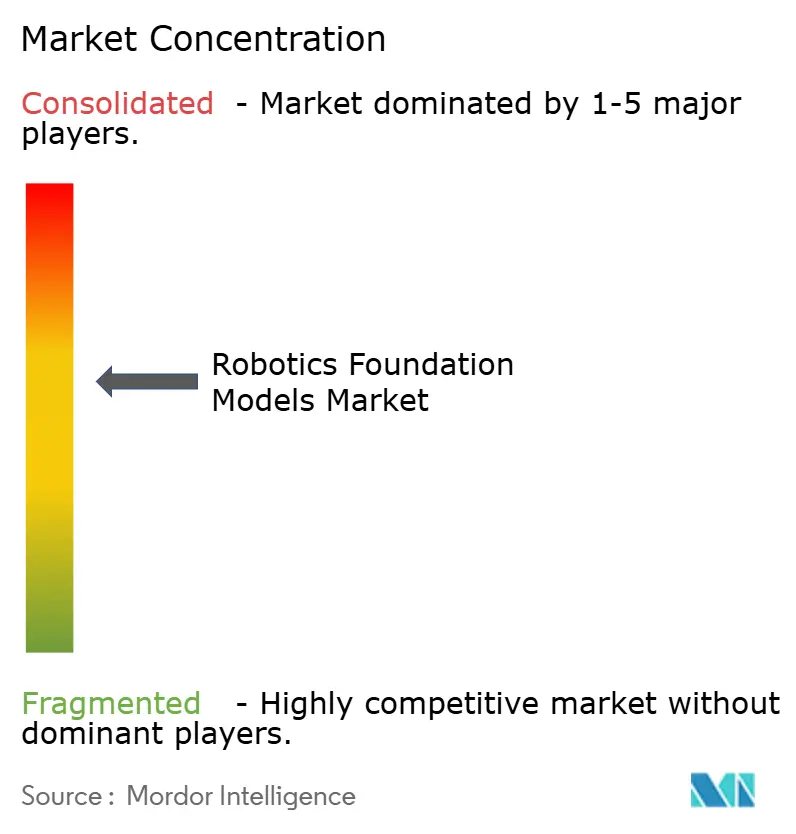
The robotics foundation models market is moderately concentrated at the frontier model layer. A limited group of well-funded developers competes with specialist deployers, hardware manufacturers, and infrastructure providers. NVIDIA competes through a development stack that combines Isaac GR00T models, Isaac Lab, Isaac Sim, and Jetson hardware. NVIDIA also works with robot makers, including Unitree Robotics and Agile Robots, to support post-training and deployment. This strategy can strengthen NVIDIA’s position across the value chain as general-purpose robots enter more customer settings, including facilities that need linked tools for simulation, training, inference, and integration.
Data accumulation is likely to influence competitive positions as much as model architecture. Universal Robots and Scale AI established UR AI Trainer to collect data from production robots, creating a route from physical deployment to model improvement. Providers with operating fleets can collect manipulation, motion, and visual data under real-world conditions, creating an advantage that entrants cannot easily replicate at a comparable scale. Open systems such as OpenVLA and NVIDIA’s Apache-licensed GR00T model also provide integrators with capable starting points. This availability can pressure model-layer margins and shift value toward data, integration, safety validation, and customer support.
Physical Intelligence published π0.7 in April 2026 to demonstrate generalist manipulation across tasks not explicitly included in training. Xiaomi released Xiaomi-Robotics-0 and later opened its post-training code, widening developer access to real-time VLA capabilities. Boston Dynamics described its collaboration with Toyota Research Institute on Large Behavior Models for Atlas, showing that established robotics firms are also pursuing foundation-model approaches through research partnerships. These choices increase competitive intensity while rewarding companies with proven deployments, deployment data, and credible safety processes that can be demonstrated to customers operating in regulated or people-facing environments.
Robotics Foundation Models Industry Leaders
NVIDIA Corporation
Alphabet Inc.
Physical Intelligence
Skild AI
Covariant
- *Disclaimer: Major Players sorted in no particular order

Recent Industry Developments
- July 2026: FedEx Corp. and Dexterity Inc. announced an expanded collaboration to scale Dexterity's Foresight world model and Mech trailer-loading systems at the FedEx Hagerstown Hub in Maryland, a production-grade deployment of a physical AI world model in high-volume logistics, extending well beyond the initial pilot site.
- June 2026: NVIDIA released GR00T-H-N1.7, the first commercially licensed AI foundation model for surgical and healthcare robotics under the NVIDIA Open Model License, covering 20 robot platforms and 50 or more institutions. The model achieved 25% full end-to-end suturing success on the SutureBot benchmark, versus 0% for all prior models.
- April 2026: Physical Intelligence published research on π0.7, a 5-billion-parameter steerable generalist robotic foundation model on a Gemma3 backbone, demonstrating compositional generalization to manipulation tasks unseen during training, including an air-fryer cooking sequence assembled from unrelated prior training episodes.
- March 2026: NVIDIA released GR00T-H, the first open foundation VLA model for medical robotics, trained on data from 50 or more institutions and multiple surgical platforms, and achieving 64% average success across a 29-step ex-vivo suturing sequence.


Global Robotics Foundation Models Market Report Scope
The robotics foundation models market includes large-scale AI models trained on extensive multimodal datasets, including visual, language, sensor, and robotic interaction data. These models enable robots to interpret information, learn from context, and execute a broad range of tasks with limited task-specific programming. They serve as a general-purpose intelligence layer for robotics applications, supporting adaptation to new environments, natural language instruction following, improved manipulation capabilities, and autonomous decision-making. The market covers software models, development tools, training frameworks, and related services used across industrial robotics, humanoid robots, warehouse automation, healthcare robotics, autonomous systems, and research environments.
The Robotics Foundation Models Market Report is Segmented by Model Architecture (Vision-Language-Action Models, Embodied Reasoning Models, World Models, and Other Model Architectures), Deployment Mode (Cloud-Based, and On-Premises), Application (Warehouse Picking and Sorting, Industrial Assembly Operations, Material Handling and Packaging, Mobile Inspection and Navigation, Home Service Execution, and Other Applications), End-User Industry (Manufacturers, Logistics and Warehousing Providers, System Integrators, Healthcare Providers, Defense and Security Organizations, and Other End-User Industries), and Geography (North America, South America, Europe, Asia-Pacific, Middle East, and Africa). The Market Forecasts are Provided in Terms of Value (USD).
| Vision-Language-Action Models |
| Embodied Reasoning Models |
| World Models |
| Other Model Architectures (Behavior Policy Models, Cross-Embodiment Control Models, Tool-Orchestration Models) |
| Cloud-Based |
| On-Premises |
| Warehouse Picking and Sorting |
| Industrial Assembly Operations |
| Material Handling and Packaging |
| Mobile Inspection and Navigation |
| Home Service Execution |
| Other Applications (Commercial Service Interaction, Medical Care Assistance, Agriculture and Field Operations, Agriculture and Field Operations, Defense and Security Operations, Hazardous-Environment Operations, Research and Education Development) |
| Manufacturers |
| Logistics and Warehousing Providers |
| System Integrators |
| Healthcare Providers |
| Defense and Security Organizations |
| Other End-User Industries |
| North America | United States |
| Canada | |
| Mexico | |
| South America | Brazil |
| Argentina | |
| Chile | |
| Rest of South America | |
| Europe | Germany |
| United Kingdom | |
| France | |
| Italy | |
| Russia | |
| Rest of Europe | |
| Asia-Pacific | China |
| Japan | |
| South Korea | |
| India | |
| Southeast Asia | |
| Rest of Asia-Pacific | |
| Middle East | Turkey |
| Israel | |
| GCC Countries | |
| Rest of Middle East | |
| Africa | South Africa |
| Egypt | |
| Rest of Africa |
| By Model Architecture | Vision-Language-Action Models | |
| Embodied Reasoning Models | ||
| World Models | ||
| Other Model Architectures (Behavior Policy Models, Cross-Embodiment Control Models, Tool-Orchestration Models) | ||
| By Deployment Mode | Cloud-Based | |
| On-Premises | ||
| By Application | Warehouse Picking and Sorting | |
| Industrial Assembly Operations | ||
| Material Handling and Packaging | ||
| Mobile Inspection and Navigation | ||
| Home Service Execution | ||
| Other Applications (Commercial Service Interaction, Medical Care Assistance, Agriculture and Field Operations, Agriculture and Field Operations, Defense and Security Operations, Hazardous-Environment Operations, Research and Education Development) | ||
| By End-User Industry | Manufacturers | |
| Logistics and Warehousing Providers | ||
| System Integrators | ||
| Healthcare Providers | ||
| Defense and Security Organizations | ||
| Other End-User Industries | ||
| By Geography | North America | United States |
| Canada | ||
| Mexico | ||
| South America | Brazil | |
| Argentina | ||
| Chile | ||
| Rest of South America | ||
| Europe | Germany | |
| United Kingdom | ||
| France | ||
| Italy | ||
| Russia | ||
| Rest of Europe | ||
| Asia-Pacific | China | |
| Japan | ||
| South Korea | ||
| India | ||
| Southeast Asia | ||
| Rest of Asia-Pacific | ||
| Middle East | Turkey | |
| Israel | ||
| GCC Countries | ||
| Rest of Middle East | ||
| Africa | South Africa | |
| Egypt | ||
| Rest of Africa | ||


Key Questions Answered in the Report
What is the robotics foundation models market size?
The robotics foundation models market size is projected to expand from USD 97.46 million in 2025 and USD 144.01 million in 2026 to USD 787.86 million by 2031, registering a CAGR of 40.48% between 2026 to 2031, reflecting the rapid transition from research activity to commercial deployment across warehouse automation, flexible manufacturing systems, healthcare applications, and other physical work environments that require adaptable robot behavior.
Which model architecture leads robotics foundation model adoption?
Vision-Language-Action models led with 54.67% revenue share in 2025 because they combine vision, language instructions, and robot-state inputs within a single control framework for commercial robot operations.
Why are enterprises adopting robotics foundation models?
Manufacturers and logistics operators need flexible automation for varied products, changing layouts, and persistent labor shortages that fixed systems cannot address without significant reconfiguration, particularly when facilities handle irregular objects, frequent product changes, and multiple task sequences within the same operating shift and work cell.
Which application is growing fastest for foundation-model robotics?
Home service execution is projected to expand at a 46.32% CAGR through 2031, although home environments remain difficult to automate safely because tasks and surroundings vary widely.
Which end user is expected to adopt robotics foundation models fastest?
Healthcare providers are projected to expand at a 47.27% CAGR through 2031, supported by surgical robotics and hospital logistics use cases that require careful clinical validation.
Which region is expected to advance fastest?
Asia-Pacific is projected to expand at a 46.84% CAGR through 2031, supported by its manufacturing base, high installed robot density, and demand for adaptable automation systems.
Page last updated on:






