
RO Membrane Chemicals Market Size and Share
Market Overview
| Study Period | 2021 - 2031 |
|---|---|
| Market Size (2026) | USD 2.70 Billion |
| Market Size (2031) | USD 3.63 Billion |
| Growth Rate (2026 - 2031) | 6.05 % |
| Fastest Growing Market | Asia-Pacific |
| Largest Market | Asia-Pacific |
| Market Concentration | Medium |
Major Players *Disclaimer: Major Players sorted in no particular order Image © Mordor Intelligence. Reuse requires attribution under CC BY 4.0. | |
RO Membrane Chemicals Market Analysis by Mordor Intelligence
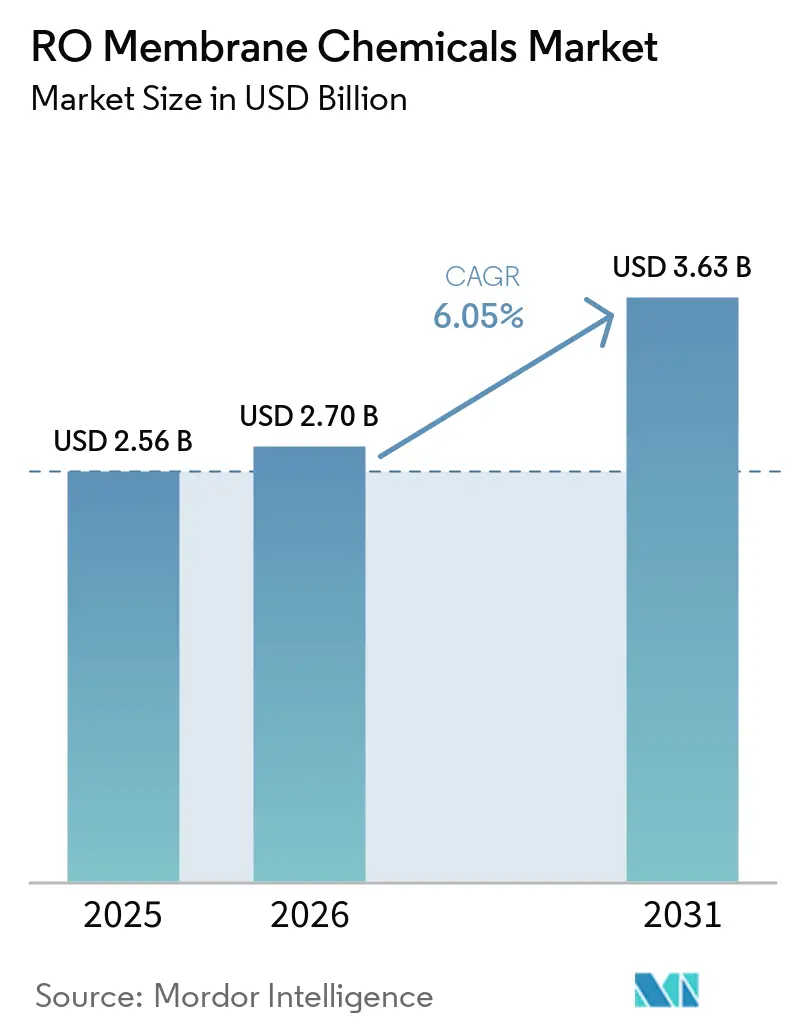
The RO Membrane Chemicals Market is projected to grow from USD 2.56 billion in 2025 to USD 2.70 billion in 2026 and reach USD 3.63 billion by 2031, at a CAGR of 6.05% during the forecast period (2026-2031). The expanding installed base of reverse osmosis systems, driven by desalination, water reuse, and high-purity manufacturing projects, is increasing the need for reliable treatment programs. Demand remains recurring, as plant operators require antiscalants, biocides, and membrane cleaners throughout system operations rather than only during facility commissioning.
Higher-recovery system designs intensify treatment requirements because concentrate streams contain elevated levels of calcium sulfate, silica, and barium sulfate. Suppliers are also integrating chemical supply with digital monitoring and dosing services, making technical support and operating performance increasingly important purchasing considerations relative to price. Regulatory scrutiny of certain biocides and phosphorus-containing formulations is increasing the need for product reformulation while favoring suppliers that can validate alternative products and maintain broad service coverage.
Key Report Takeaways
- By product type, biocides held 36.67% of the RO Membrane Chemicals Market share in 2025 and are forecast to expand at a 6.75% CAGR through 2031.
- By application, membrane fouling control accounted for 57.13% of the RO Membrane Chemicals Market Size in 2025 and is advancing at a 7.15% CAGR through 2031.
- By end user, municipal water and desalination held 41.34% revenue share in 2025, while industrial water treatment recorded the highest projected CAGR at 7.34% through 2031.
- By geography, Asia-Pacific held 35.76% revenue share in 2025 and is forecast to grow at a 6.82% CAGR through 2031.
Note: Market size and forecast figures in this report are generated using Mordor Intelligence’s proprietary estimation framework, updated with the latest available data and insights as of January 2026.
Market Trends and Insights
Drivers Impact Analysis of RO Membrane Chemicals Market*
| Driver | (~) % Impact on CAGR Forecast | Geographic Relevance | Impact Timeline |
|---|---|---|---|
| Expansion Of Desalination And Water Reuse Capacity | +1.8% | Global, concentrated in the Middle East, Asia-Pacific, and Southern Europe | Long term (≥ 4 years) |
| Rising High-Purity Water Demand In Pharmaceuticals, Electronics, And Food Processing | +1.3% | Asia-Pacific core markets, North America, and Europe | Medium term (2-4 years) |
| Stricter Discharge And Membrane-Performance Compliance Requirements | +0.8% | European Union, China, and North America | Medium term (2-4 years) |
| Digital Dosing And Predictive Membrane-Maintenance Adoption | +0.6% | Global, with early gains in North America, East Asia, and the Middle East | Long term (≥ 4 years) |
| Higher Recovery-Rate Designs Increasing Scale-Control Requirements | +0.7% | Global, with early industrial gains in China, the Middle East, and India | Long term (≥ 4 years) |
| Source: Mordor Intelligence | |||
Expansion Of Desalination And Water Reuse Capacity
Installed desalination capacity is projected to exceed 120 million m³ per day by 2026, with reverse osmosis expected to account for more than 70% of new desalination project awards in 2024 and 2025. This capacity-driven expansion generates recurring demand for RO membrane chemicals, as treatment plants require continuous control of scaling, biological growth, and cleaning cycles. The Middle East accounted for 53.1% of global contracted desalination capacity, and its operational capacity is projected to reach 41.0 million m³ per day by 2028. Spain committed EUR 23 billion to expand desalination and water reuse capacity, while Barcelona increased the share of desalinated water in its municipal supply from 3% to 33% during the 2024 drought.[1]Water reuse retrofits in industrial areas across eastern China and Maharashtra can generate chemical demand more rapidly than large-scale greenfield projects, as existing RO trains require updated chemical programs when reuse requirements increase. Therefore, the RO Membrane Chemicals Market benefits from both new plant construction and the immediate need to enhance operating performance across installed systems.
Rising High-Purity Water Demand In Pharmaceuticals, Electronics, And Food Processing
High-purity water applications require consistent membrane performance and therefore favor chemical programs validated for specific operating conditions. Semiconductor fabrication represents a concentrated source of demand, as a 300 mm advanced-node wafer facility requires 1,500–2,000 gallons of ultrapure water per minute. As process nodes evolve, purity specifications become more stringent, increasing the need for fouling prevention and controlled cleaning. Pharmaceutical production also requires Water for Injection that complies with United States Pharmacopeia and European Pharmacopoeia standards, creating a defined need for validated cleaning chemicals. Food processing further contributes to demand, as membrane systems must remove protein and organic residues without disrupting production schedules. These end-use applications support the RO Membrane Chemicals Market, as unplanned membrane performance losses can affect product quality, plant utilization, and regulatory compliance.
Stricter Discharge And Membrane-Performance Compliance Requirements
Water treatment regulations are increasing the importance of consistent membrane operation for municipal and industrial operators. The revised European Union Urban Wastewater Treatment Directive requires treatment plants to reduce phosphorus and nitrogen by at least 75%. This requirement increases the value of stable membrane performance and high-quality discharge.
China is also tightening limits on total dissolved solids and chemical oxygen demand, supporting a shift from conventional phosphonate antiscalants to biodegradable polymer formulations. NSF/ANSI 60 certification remains a key qualification requirement for chemicals used in direct or indirect potable reuse applications. This certification can restrict market access for suppliers without validated products while supporting demand in the RO Membrane Chemicals Market for suppliers that offer effective chemistry, robust quality systems, and monitoring capabilities.
Digital Dosing And Predictive Membrane-Maintenance Adoption
Digital dosing systems use operating data to guide chemical addition and cleaning recommendations. In April 2026, DuPont Water Solutions launched RO Operations Advisor, which analyzes historical system data, including cleaning events and fouling drivers, to provide recommendations for reverse osmosis operators. According to the company’s announcement, optimized operations can reduce operating expenditure by up to 20%.
In May 2025, Kemira received registration from the United States Environmental Protection Agency for FennoSurf 600, the core ingredient in its KemConnect DEX system. The system combines on-site chemical generation with digital dosing control.[2]Digital platforms enable operators to align chemical dosing with fouling conditions and membrane performance instead of relying solely on fixed treatment schedules. Consequently, the RO membrane chemicals market is shifting toward managed programs that more closely integrate chemical supply, measurement, technical support, and performance commitments.
Restraints Impact Analysis of RO Membrane Chemicals Market*
| Restraint | (~) % Impact on CAGR Forecast | Geographic Relevance | Impact Timeline |
|---|---|---|---|
| Chemical Mis-Dosing Risk And Membrane Damage Liability | -0.5% | Global | Short term (≤ 2 years) |
| Regulatory Phase-Out Of High-Risk Biocides And Phosphorus-Containing Formulations | -0.7% | European Union primarily, with spillover to Asia-Pacific | Medium term (2-4 years) |
| Total Cost Of Ownership For Small And Technically Constrained Operators | -0.4% | South Asia, Southeast Asia, Sub-Saharan Africa, and Latin America | Long term (≥ 4 years) |
| Source: Mordor Intelligence | |||
Chemical Mis-Dosing Risk And Membrane Damage Liability
Polyamide thin-film composite membranes are highly sensitive to chemical dosing errors, particularly oxidant exposure. Research published in ACS ES&T Engineering found that chlorine-based disinfectants can cause aromatic substitution and amide bond cleavage in polyamide chains. The study reported that cumulative chlorine exposure of 1,000 ppm-hours can reduce salt rejection capability by 50% over a 3-year service period. A separate 2025 study found that inadequate dechlorination increased solute permeation by 766% and reduced salt rejection by 5% to 8%. Overdosing dechlorinating agents can also create conditions that promote sulfate-reducing bacteria, thereby undermining biofouling control. Operators may delay implementing a new treatment program when dosing errors could damage a large membrane array and result in replacement costs exceeding USD 1 million.
Regulatory Phase-Out Of High-Risk Biocides And Phosphorus-Containing Formulations
The European Union Biocidal Products Regulation is narrowing the range of approved active substances used in water treatment chemicals. The draft reports anticipated updates to the ECHA Candidate List in June 2026, involving phosphorus-containing corrosion-inhibition components and an isothiazolinone derivative used in RO antiscalants. It also reports a July 2026 notice that may affect simplified exemptions for certain phosphonate-based active ingredients. These changes create formulation uncertainty, as suppliers must review product compositions, registration status, and downstream notification obligations. Registering a replacement antiscalant chemistry can require 18 to 36 months and several million euros in investment. These constraints may slow established phosphonate product lines while increasing demand for green polymer and bio-based inhibitor alternatives in the RO Membrane Chemicals Market.
*Our forecasts treat driver/restraint impacts as directional, not additive. The impact forecasts reflect baseline growth, mix effects, and variable interactions.
RO Membrane Chemicals Market Segment Analysis
By Product Type:
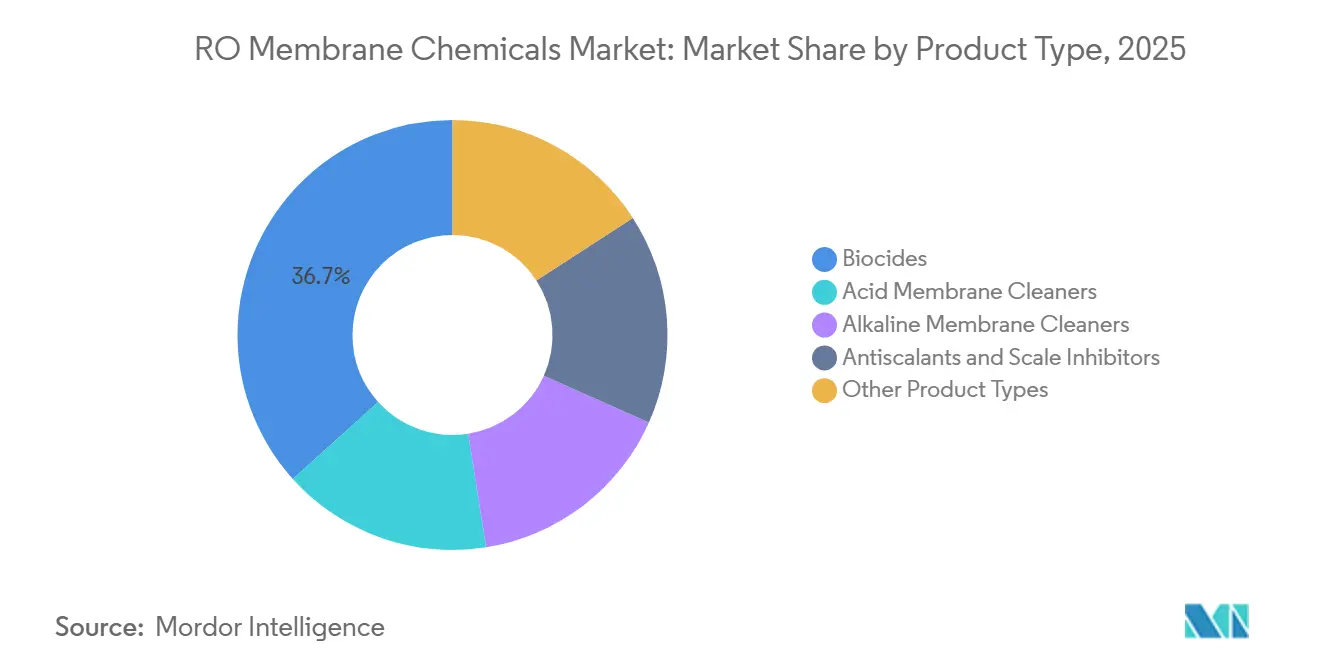
Biocides Lead On Both Revenue Share And Forecast GrowthBiocides accounted for 36.67% of the RO Membrane Chemicals Market in 2025 and expanded at a CAGR of 6.75% through 2031. They control biological fouling in seawater and brackish-water RO systems. The supplied draft identified biofouling as the primary failure mode in 49% of membrane autopsies reviewed by H2O Innovation Specialty Chemicals. This operational challenge continues to support the use of products that prevent microbial growth before it restricts membrane flux. Wastewater reuse applications and complex industrial effluents can contain more resilient microbial communities, increasing the need for effective biofouling control. The shift away from oxidizing biocides, which can degrade polyamide membranes, is driving demand for non-oxidizing alternatives, such as DBNPA and performic acid formulations. As operators assess treatment program compatibility with their membrane systems, these alternatives can generate substitution demand across the RO Membrane Chemicals Market. Kemira’s EPA-registered FennoSurf 600 supports this trend as a core component of a chlorine-free process water treatment system.
Acid and alkaline membrane cleaners support scheduled clean-in-place programs; therefore, their demand closely correlates with system utilization and maintenance requirements. These products generate steady demand because membranes require cleaning even when capacity additions slow. Antiscalants and scale inhibitors are particularly important in desalination-focused locations, where seawater feedwater contains multivalent ions that require treatment. The supplied draft identified standard dosing ranges of 2–5 mg/L for these applications. ECHA-related reformulation requirements are shifting antiscalant demand toward green polymer and carboxylate chemistries as phosphonate restrictions become more stringent. Other product types include dechlorinating agents, pH adjusters, and coating polymers used in specialized pretreatment applications. Product selection depends on feedwater quality, membrane material, recovery rate, discharge requirements, and the operator’s cleaning schedule. Suppliers in the RO Membrane Chemicals Industry can differentiate themselves through fit-for-purpose technical support rather than a single product category.

By Application:
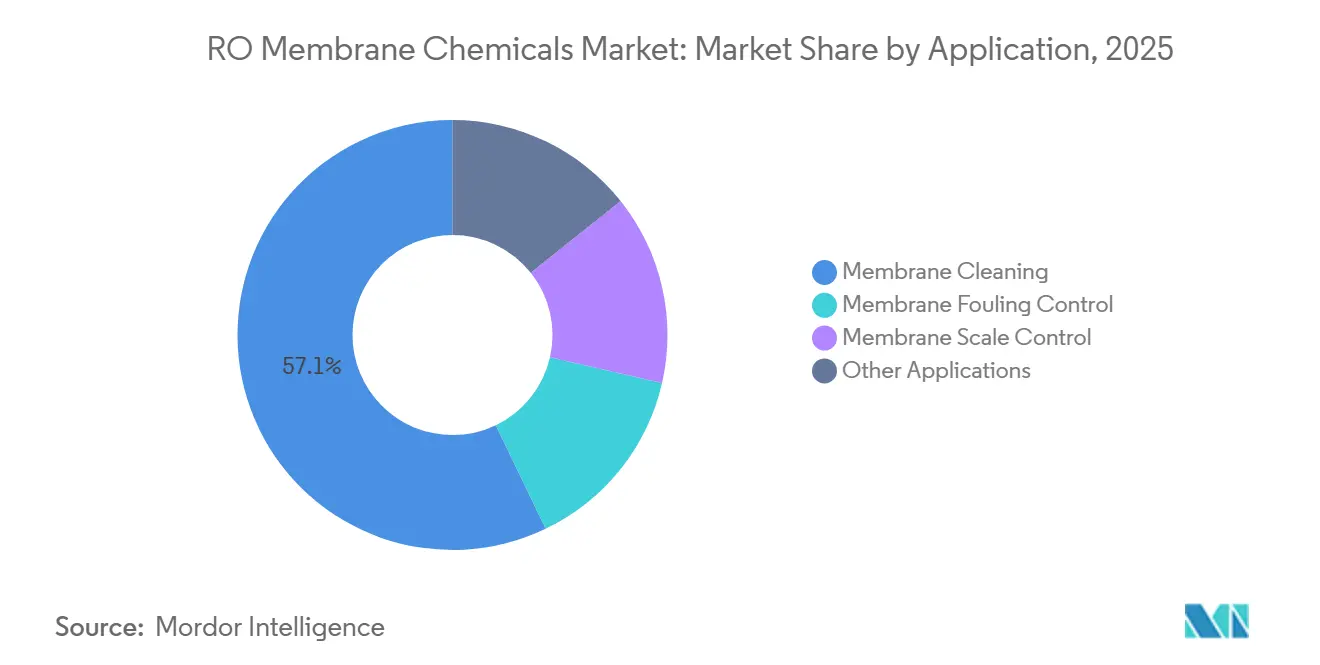
Membrane Fouling Control Anchors Market DynamicsMembrane fouling control accounted for 57.13% of the RO Membrane Chemicals Market size in 2025 and grew at a CAGR of 7.15% through 2031. This application holds the largest share because fouling directly affects water flow, energy consumption, cleaning frequency, and membrane replacement intervals. Growth is supported by the expanding installed RO capacity in Asia-Pacific and the Middle East, as well as increasingly challenging feedwater conditions that require reliable membrane performance. Predictive maintenance can support this application by identifying fouling conditions before extensive cleaning becomes necessary. A 2025 study cited in the supplied draft indicates that predictive maintenance systems can reduce operating costs by 15% to 20% and extend membrane replacement intervals. Effective fouling control requires chemical programs tailored to specific fouling mechanisms rather than generalized treatment schedules. This requirement supports demand for monitoring, dosing recommendations, and membrane performance reviews alongside chemical supply.
Demand for membrane cleaning chemicals increases as clean-in-place frequency rises in high-recovery systems and aging municipal membrane arrays. Kersia is scheduled to launch FILTERZYM 205, 305, and 405 in March 2026 as enzymatic cleaners for removing protein and organic residues from membrane systems. The launch will also include DEPTA UF HP, an alkaline buffer for membrane-cleaning applications. Scale control also presents growth potential as power generation and zero-liquid-discharge facilities adopt higher-recovery designs. Higher recovery rates increase the concentration of salts and silica in the reject stream, elevating the importance of scale-control performance. Potable reuse systems require NSF/ANSI 60-certified chemicals, which may limit this application to suppliers with established qualification portfolios. The remaining applications address treatment requirements that vary by feedwater type, pretreatment design, and operational objective. Collectively, these applications position the RO Membrane Chemicals Market as integral to routine operations and higher-value membrane performance management.
By End User:
Industrial Water Treatment Accelerates FastestIndustrial water treatment is forecast to grow at a CAGR of 7.34% through 2031, making it the fastest-growing end-user category in the supplied draft. Semiconductor fabrication, pharmaceutical manufacturing, and specialty chemical production require reliable water quality and offer limited tolerance for membrane performance failures. Under its second-phase national research and development program, South Korea aims to localize 90% of ultra-pure water production processes by 2030. This policy direction supports chemicals validated for local fabrication water requirements. Water for Injection requirements in pharmaceutical manufacturing also create a distinct cleaning chemical category with high switching costs. When changing chemical formulations, operators must consider validation requirements, water quality, cleaning effectiveness, and production continuity. These conditions can reduce price pressure when a chemical program forms part of an approved manufacturing process. Industrial facilities, therefore, represent a significant growth channel for the RO Membrane Chemicals Market, particularly as facilities install water reuse or ultra-pure water systems.
Municipal water and desalination segment accounted for a 41.34% revenue share in 2025, making this the largest end-user category. Large desalination facilities consume high volumes of chemicals because uninterrupted operations, consistent dosing, and membrane protection are essential. According to estimates in the supplied draft, Saudi Arabia’s planned desalination expansion of 8.4 million m³ per day through 2030 is expected to generate incremental demand for 12,000 tonnes of antiscalants and biocides annually. Commercial and institutional facilities also contribute to demand through potable water certification requirements that favor validated suppliers. Other end users include food and beverage operations and aquaculture facilities, where requirements vary according to water-contact, sanitation, and process-water conditions. These users often require specialized support but typically consume lower volumes than municipal and industrial plants. The diverse end-user base requires chemical suppliers to address varying standards, water chemistries, operating capabilities, and purchasing patterns. The RO Membrane Chemicals Industry is therefore supported by both large centralized plants and a broader base of specialized users.
Geography Analysis
APAC RO Membrane Chemicals Market
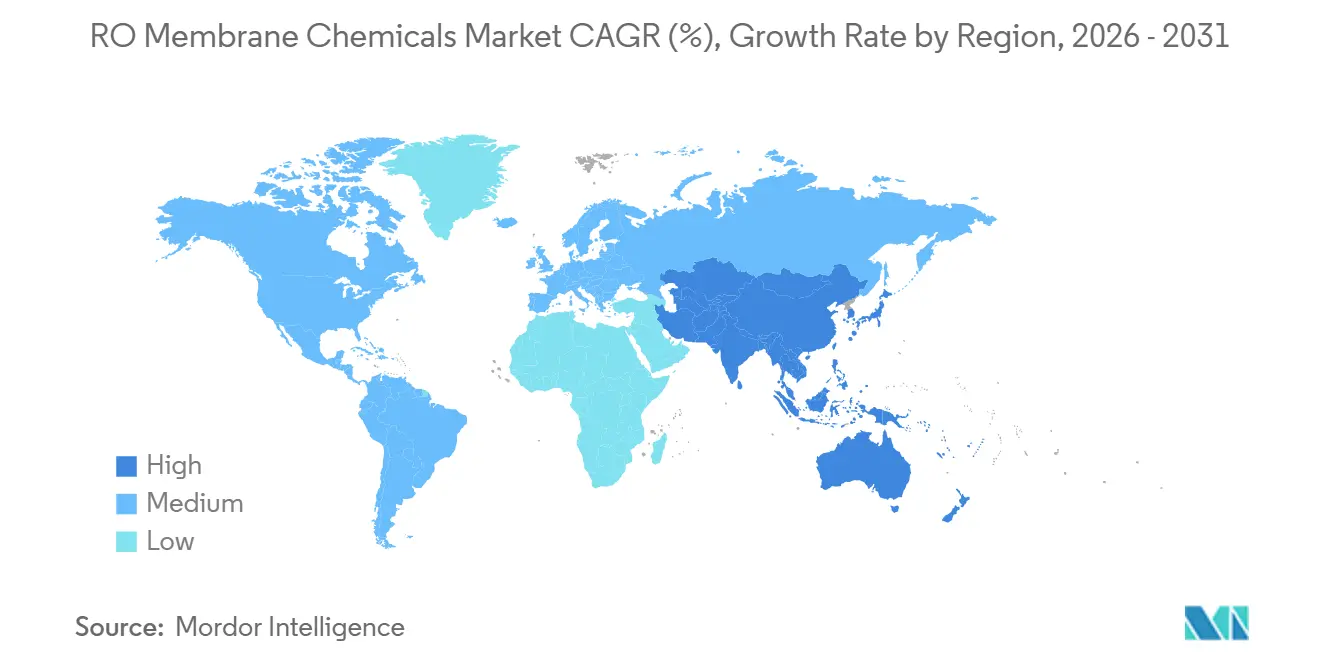
Asia-Pacific held a 35.76% share of the RO membrane chemicals market in 2025 and is forecast to grow at a CAGR of 6.82% through 2031. Investments in semiconductor fabrication plants, public desalination programs, and stricter industrial discharge standards are driving regional demand. China’s discharge standards are accelerating the shift toward biodegradable antiscalants in coastal provinces. In India, Gujarat, Tamil Nadu, and Andhra Pradesh are commissioning brackish-water desalination facilities to serve textile, petrochemical, and power generation clusters. Japan’s planned 2025 revision to the Water Supply Law and its Circular Economy Vision 2030 are increasing the focus on wastewater reuse and digital monitoring solutions. South Korea’s domestic ultra-pure water program is expected to gain a commercial reference when K-water begins supplying ultra-pure water to SK Hynix’s M15X HBM facility in November 2025. These requirements encourage RO membrane chemicals suppliers to offer formulations tailored to local feedwater conditions, water reuse requirements, and semiconductor water-quality standards.
North America and Europe RO Membrane Chemicals Market
North America and Europe are relatively mature regions, where infrastructure upgrades and compliance requirements influence demand more than capacity additions. In North America, utilities are adopting higher-grade antiscalants and NSF/ANSI 60-certified biocide programs to meet water treatment requirements. European operators face increasing pressure to maintain membrane performance under the revised Urban Wastewater Treatment Directive. Spain’s EUR 23 billion desalination commitment remains a significant catalyst for regional capacity expansion. Germany, the United Kingdom, France, and Italy continue to generate demand from pharmaceutical and food processing facilities, where validation requirements can discourage the use of commodity products. These regions favor suppliers that can demonstrate regulatory compliance, product consistency, and technical support across complex water treatment systems.
MEA and South America RO Membrane Chemicals Market
The Middle East and Africa, along with South America, generate demand driven by water scarcity, industrial development, and municipal water treatment needs. Saudi Arabia’s zero-liquid-discharge programs in Jubail and Yanbu support the use of high-performance scale inhibitors and specialty biocides in industrial water treatment. The UAE’s Taweelah expansion is expected to add 909,000 m³ per day of desalination capacity, increasing demand for pretreatment chemical sequences. Brazil and Argentina are expanding municipal RO capacity to address groundwater contamination and coastal salinity intrusion. Sub-Saharan Africa remains underserved, and the commissioning of large plants can generate periodic, project-driven demand rather than stable consumption. These regional differences require RO membrane chemicals market suppliers to balance large-scale desalination projects with smaller systems that may require local technical training and more affordable treatment program designs.
Competitive Landscape
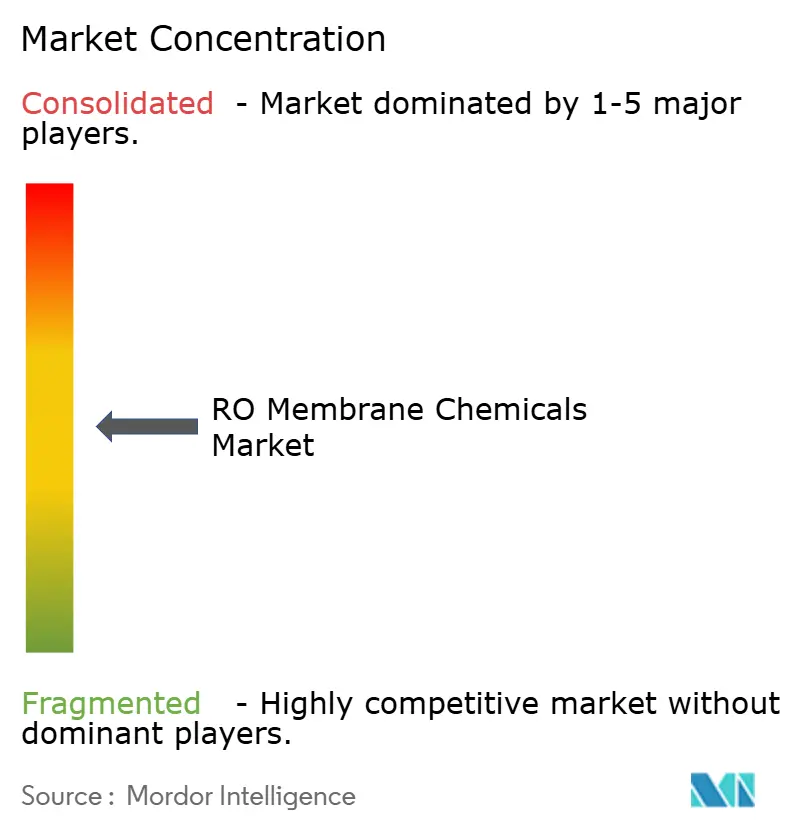
The RO Membrane Chemicals Market is moderately concentrated, with Ecolab, Kemira, Solenis, Kurita Water Industries, and Veolia Water Technologies holding broad product portfolios, extensive service networks, and established relationships with large accounts, as outlined in the supplied draft. These companies compete through chemical management platforms, membrane analysis services, monitoring solutions, and performance-based programs. Their market position reflects the importance of technical support in treating challenging feedwater and maintaining stable RO system performance. DuPont Water Solutions is scheduled to launch the RO Operations Advisor in April 2026, providing system-specific recommendations based on historical operating data and fouling information. Digital dosing capabilities can increase switching costs when a supplier’s system integrates with an operator’s broader chemical program. Regulatory capabilities also remain important, as suppliers require current registrations and qualified formulations to serve potable reuse applications and European Union markets. Consequently, competition centers on performance, service breadth, compliance readiness, and ownership of the overall chemical program.
Biodegradable and phosphorus-free antiscalants represent a key opportunity, as European Union requirements are prompting operators to seek replacement formulations. Ultra-pure water chemicals for semiconductor facilities in India and Southeast Asia represent another opportunity identified in the supplied draft. Digital chemical subscriptions can also shift one-time product sales toward recurring managed-service arrangements. Genesys International, American Water Chemicals, King Lee Technologies, Thermax Limited, and Universal Water Chemicals compete through regional specialization and feedwater-specific customization. Their smaller operating scale can enable faster adaptation to local water conditions and project requirements. Kurita is expected to merge Avista Technologies into Kurita America in April 2025, consolidating membrane chemical and service expertise under a single North American operating organization. Kurita also plans to establish Kurita Membrane India with Membrane Group India in July 2026 to serve semiconductor and electronics customers in India. These strategies provide RO Membrane Chemicals Market participants with a choice between local specialization and broader service coverage.
Solenis is expected to complete its acquisition of NCH Corporation in November 2025, expanding its water and hygiene solutions coverage to more than 160 countries. The acquisition would add on-site water treatment expertise for middle-market industrial accounts and provide Solenis with additional cross-selling opportunities. Ecolab is expected to complete its acquisition of Ovivo’s electronics ultrapure water business in December 2025, more than doubling its high-technology water treatment platform. These transactions indicate that suppliers are expanding their technical service capabilities and high-purity water offerings to strengthen their competitive positions. Research on compaction-resistant TFX membrane structures also suggests that new membrane materials may require revised chemical protocols. Suppliers that collaborate with membrane manufacturers to develop compatible formulations may be better positioned as new membrane designs gain broader adoption. The RO Membrane Chemicals Market remains accessible to specialists; however, established suppliers benefit from global service reach and stronger compliance resources.
RO Membrane Chemicals Industry Leaders
-
Ecolab Inc.
-
Solenis
-
Kemira Oyj
-
Kurita Water Industries Ltd.
-
Veolia
- *Disclaimer: Major Players sorted in no particular order
RO Membrane Chemicals Market Companies Covered in this Report
- American Water Chemicals, Inc.
- Applied Membranes, Inc.
- DuPont
- Ecolab Inc.
- Genesys International Ltd.
- H2O InnovationO Innovation
- Kemira Oyj
- King Lee Technologies
- Kurita Water Industries Ltd.
- Lenntech B.V.
- Solenis
- SUEZ
- Thermax Limited
- Universal Water Chemicals Pvt Ltd
- Veolia
Recent Industry Developments in RO Membrane Chemicals Market
- July 2026: Kurita Water Industries established Kurita Membrane India Pvt. Ltd., a joint venture with Membrane Group India, to provide advanced water treatment, wastewater recycling, and environmental solutions for India’s semiconductor and electronics sectors. The venture combines Membrane Group India’s local project execution track record with Kurita’s water treatment chemistry expertise.
- December 2025: Ecolab completed its acquisition of Ovivo’s electronics ultrapure water business, more than doubling its high-technology water treatment platform. The acquisition positions Ecolab as an integrated circular water management partner for semiconductor fabrication facilities and data center operators.
Global RO Membrane Chemicals Market Report Scope
Reverse osmosis (RO) membrane chemicals protect and clean purification systems by preventing scaling, removing organic and biological fouling, and dissolving mineral deposits.
The RO membrane chemicals market is segmented by product type, application, end-user, and geography. By product type, the market is segmented into biocides, acid membrane cleaners, alkaline membrane cleaners, antiscalants and scale inhibitors, and other product types. By application, the market is segmented into membrane cleaning, membrane fouling control, membrane scale control, and other applications. By end-user, the market is segmented into municipal water and desalination, industrial water treatment, and commercial and institutional facilities. By geography, the market is segmented into Asia Pacific, North America, Europe, South America, the Middle East and Africa. The report also covers the RO membrane chemicals market size and forecasts for the RO membrane chemicals market in 15 countries across major regions. For each segment, the market sizing and forecasts have been done on the basis of value (USD).
Segmentation Overview
| Biocides |
| Acid Membrane Cleaners |
| Alkaline Membrane Cleaners |
| Antiscalants and Scale Inhibitors |
| Other Product Types |
| Membrane Cleaning |
| Membrane Fouling Control |
| Membrane Scale Control |
| Other Applications |
| Municipal Water and Desalination |
| Industrial Water Treatment |
| Commercial and Institutional Facilities |
| Others |
| Asia-Pacific | China |
| India | |
| Japan | |
| South Korea | |
| Rest of Asia-Pacific | |
| North America | United States |
| Canada | |
| Mexico | |
| Europe | Germany |
| United Kingdom | |
| France | |
| Italy | |
| Rest of Europe | |
| South America | Brazil |
| Argentina | |
| Rest of South America | |
| Middle East and Africa | Saudi Arabia |
| South Africa | |
| Rest of Middle East and Africa |
| By Product Type | Biocides | |
| Acid Membrane Cleaners | ||
| Alkaline Membrane Cleaners | ||
| Antiscalants and Scale Inhibitors | ||
| Other Product Types | ||
| By Application | Membrane Cleaning | |
| Membrane Fouling Control | ||
| Membrane Scale Control | ||
| Other Applications | ||
| By End User | Municipal Water and Desalination | |
| Industrial Water Treatment | ||
| Commercial and Institutional Facilities | ||
| Others | ||
| By Geography | Asia-Pacific | China |
| India | ||
| Japan | ||
| South Korea | ||
| Rest of Asia-Pacific | ||
| North America | United States | |
| Canada | ||
| Mexico | ||
| Europe | Germany | |
| United Kingdom | ||
| France | ||
| Italy | ||
| Rest of Europe | ||
| South America | Brazil | |
| Argentina | ||
| Rest of South America | ||
| Middle East and Africa | Saudi Arabia | |
| South Africa | ||
| Rest of Middle East and Africa | ||
Key Questions Answered in the Report
What is the projected value of the RO Membrane Chemicals Market by 2031?
The RO Membrane Chemicals Market Size is forecast to reach USD 3.63 billion by 2031, expanding from USD 2.70 billion in 2026 at a 6.05% CAGR.
Which product type leads RO membrane chemicals demand?
Biocides led with 36.67% revenue share in 2025 and are forecast to grow at a 6.75% CAGR through 2031.
Which application held the largest share in RO membrane chemical use?
Membrane fouling control held 57.13% revenue share in 2025 and is expected to grow at a 7.15% CAGR through 2031.
Which region is growing fastest for RO membrane chemicals?
Asia-Pacific held 35.76% revenue share in 2025 and is forecast to advance at a 6.82% CAGR through 2031.