
Reverse Extract Transform Load Software Market Size and Share
Market Overview
| Study Period | 2020 - 2031 |
|---|---|
| Market Size (2026) | USD 1.31 Billion |
| Market Size (2031) | USD 3.14 Billion |
| Growth Rate (2026 - 2031) | 19.11 % |
| Fastest Growing Market | Asia-Pacific |
| Largest Market | North America |
| Market Concentration | Low |
Major Players *Disclaimer: Major Players sorted in no particular order Image © Mordor Intelligence. Reuse requires attribution under CC BY 4.0. | |
Reverse Extract Transform Load Software Market Analysis by Mordor Intelligence
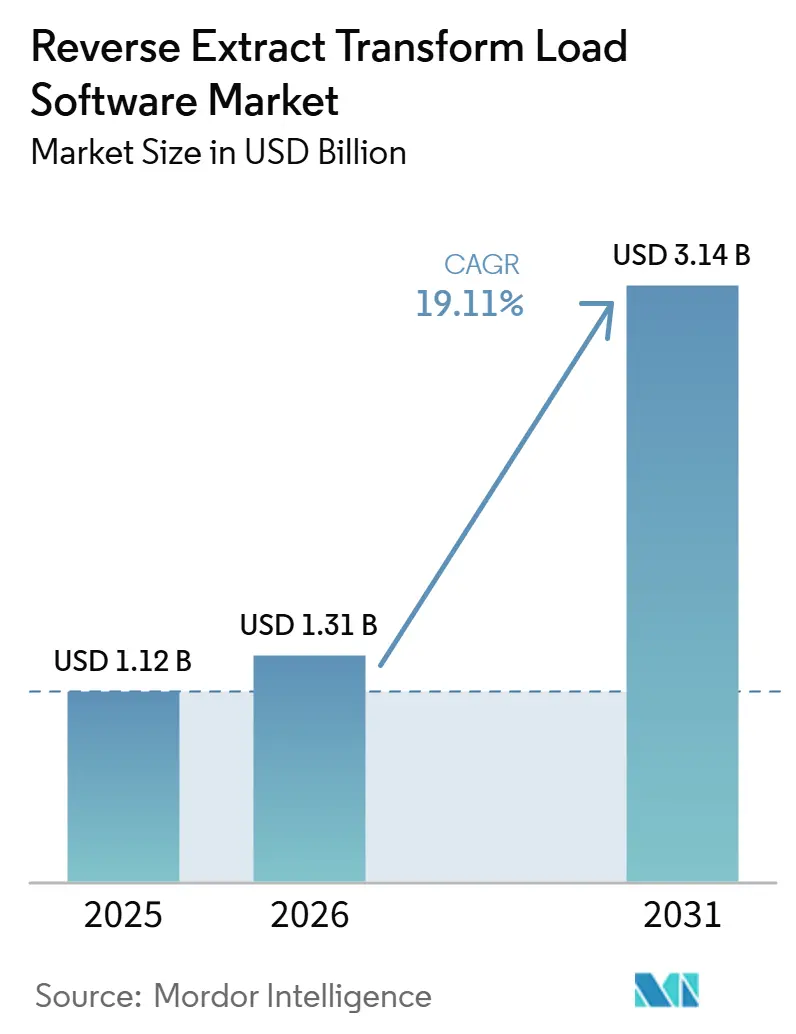
The Reverse Extract Transform Load Software Market size is projected to expand from USD 1.12 billion in 2025 and USD 1.31 billion in 2026 to USD 3.14 billion by 2031, registering a CAGR of 19.11% between 2026 and 2031. Demand is rising as companies treat cloud warehouses as the central source for governed business data and move that data into the tools used by sales, marketing, service, and operations teams. Warehouse-native systems are shifting work beyond dashboard reporting because users need approved data in the applications where they make decisions. AI-driven workflows are strengthening this requirement by generating operational signals that require controlled delivery to downstream systems. Competitive strategies increasingly center on broader connector libraries, easier configuration, and governance features that can support data activation across more destinations. The Reverse Extract Transform Load Software Market also faces reliability and compliance pressures when poor identity data, changes to destination APIs, and cross-border privacy rules disrupt data flows.
Key Report Takeaways
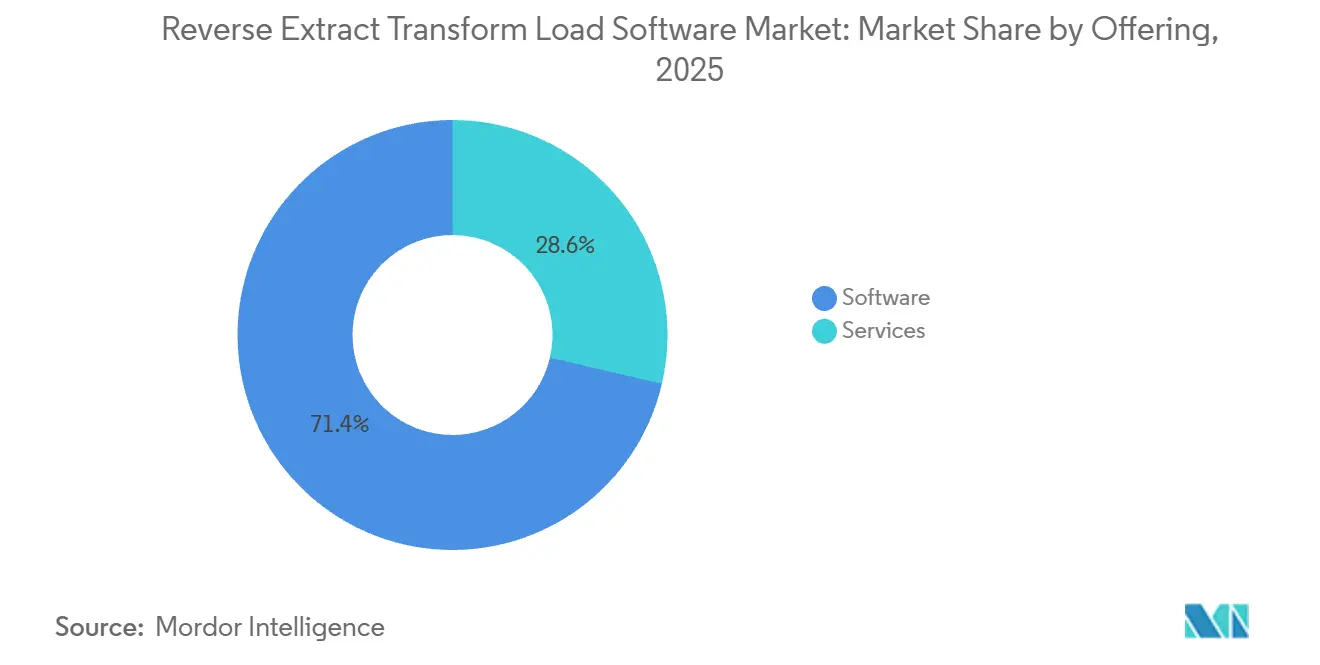
- By offering, software held 71.36% of the 2025 Reverse Extract Transform Load Software Market revenue, while services are projected to expand at a 20.28% CAGR through 2031.
- By deployment model, cloud accounted for 66.74% of the 2025 Reverse Extract Transform Load Software Market revenue, while hybrid is projected to expand at a 19.84% CAGR through 2031.
- By application, business intelligence and analytics accounted for 25.18% of 2025 revenue, while product analytics and product-led growth are projected to expand at a 20.16% CAGR through 2031.
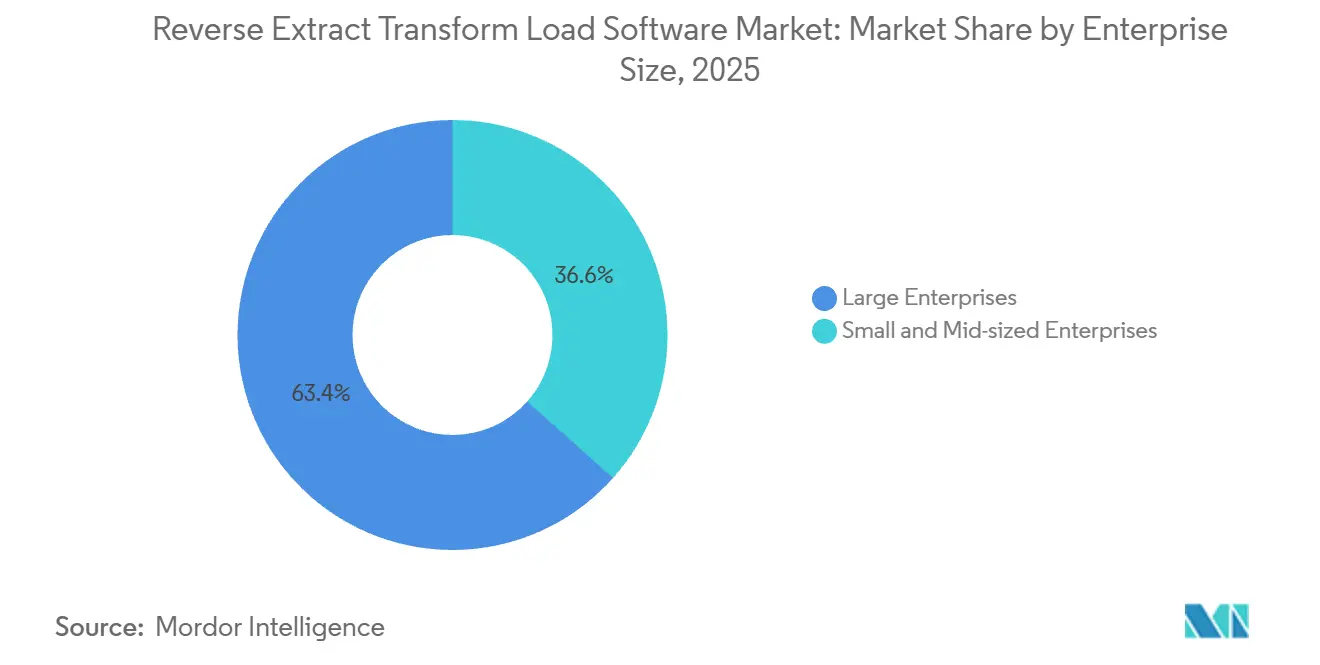
- By enterprise size, large enterprises held 63.42% of the 2025 Reverse Extract Transform Load Software Market revenue, while small and mid-sized enterprises are projected to expand at a 20.31% CAGR through 2031.
- By end user, IT and telecommunications accounted for 23.61% of the 2025 Reverse Extract Transform Load Software Market revenue, while healthcare and life sciences are projected to expand at a 19.92% CAGR through 2031.
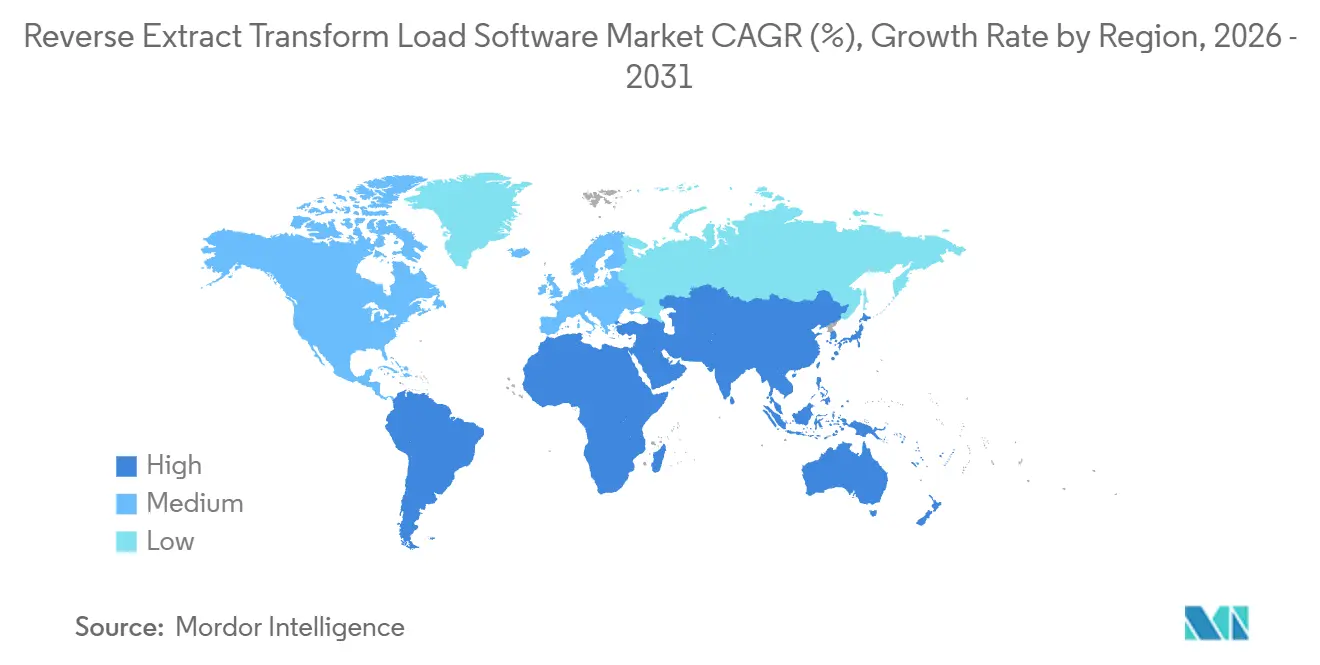
- By geography, North America accounted for 33.28% of the market, while Asia-Pacific is projected to expand at a 20.24% CAGR through 2031.
Note: Market size and forecast figures in this report are generated using Mordor Intelligence’s proprietary estimation framework, updated with the latest available data and insights as of January 2026.
Market Trends and Insights
Drivers Impact Analysis of Reverse Extract Transform Load Software Market*
| Driver | (~) % Impact on CAGR Forecast | Geographic Relevance | Impact Timeline |
|---|---|---|---|
| Cloud Data Warehouse and Lakehouse Adoption | +5.2% | Global | Short term (≤ 2 years) |
| Warehouse-Native AI Agent and Decisioning Workflows | +4.3% | North America and Europe, spill-over to Asia-Pacific | Medium term (2-4 years) |
| Demand for Real-Time Customer and Revenue Activation | +3.8% | Global | Short term (≤ 2 years) |
| Composable Customer Data Platform Adoption | +3.2% | North America and Europe | Medium term (2-4 years) |
| Expansion of Self-Service Data Access Across Business Functions | +2.4% | Global | Medium term (2-4 years) |
| Proliferation of API-First SaaS Destinations | +1.8% | North America, spill-over to Asia-Pacific and Europe | Short term (≤ 2 years) |
| Source: Mordor Intelligence | |||
Cloud Data Warehouse and Lakehouse Adoption
Cloud warehouse and lakehouse adoption provides the primary foundation for Reverse Extract Transform Load Software Market demand, as each new workload generates more data that can be used in business tools. Snowflake reported USD 3.5 billion in fiscal 2025 product revenue, up 30% year over year, and a 126% net revenue retention rate as of January 31, 2025, showing deeper use by existing enterprise customers.[1]Databricks, “Agent Bricks: Data + AI Summit 2026,” Databricks, databricks.com. That deeper use increases the number of operational cases for data that already sits in governed warehouse environments. Databricks introduced Agent Bricks at its 2026 Data and AI Summit to support autonomous data agents within a lakehouse environment governed by Unity Catalog. Adoption is also advancing in Asia-Pacific, the Middle East, and Africa as cloud infrastructure, regulatory clarity, and government digital programs support enterprise data modernization. Regulated organizations also favor cloud environments aligned with ISO/IEC 27001 because documented controls are important before data is sent to operational destinations.
Warehouse-Native AI Agent and Decisioning Workflows
Warehouse-resident AI agents are changing the role of reverse ETL from scheduled synchronization toward event-based delivery of governed information. Snowflake Cortex Agents became generally available in November 2025 and use the same role-based access controls as human users in Snowflake's governed environment. Databricks announced Genie Agents in 2026 to work with structured tables and unstructured documents, then take actions across systems through Model Context Protocol connections.[2]Databricks, “Introducing Genie One, Genie Agents, and Genie Ontology,” Databricks, databricks.com. These systems consume warehouse data but also generate signals that must be sent to CRM, marketing, and support applications. GrowthLoop launched Composable AI Decisioning in April 2026 on Google BigQuery and Snowflake, without copying data out of the cloud. European requirements for transparency and human oversight can slow some agent deployments, although they do not remove the longer-term need for governed activation.
Demand for Real-Time Customer and Revenue Activation
Revenue operations teams are extending reverse ETL beyond marketing by sending product, billing, and support signals into CRM systems and sales tools. The commercial value of these workflows increases when data is up to date, as teams can recognize churn risk or expansion opportunities during customer interactions. Hightouch reported USD 100 million in annualized recurring revenue in April 2026 after adding USD 70 million in ARR over 20 months following the launch of its AI-powered marketing activation product. The company also reported year-over-year growth above 100% in each of the prior 2 fiscal years. MessageGears connects marketing systems directly to warehouse data, avoiding additional data copies that can expose personal data under the California Consumer Privacy Act and the General Data Protection Regulation. Healthcare teams are also using near-real-time workflows to place patient risk scores and care gap alerts into electronic health records and care coordination systems.
Expansion of Self-Service Data Access Across Business Functions
More business users need approved warehouse data in the tools they use each day without waiting for data engineering teams. Operations managers, finance analysts, and customer success teams can use no-code or low-code interfaces to configure many common activation workflows. Peliqan offers more than 300 connectors through a low-code interface, helping teams move AI-ready data into business applications without custom pipeline code.[3]Peliqan B.V., “The Trust Layer for AI and BI,” Peliqan, peliqan.io. This approach expands the number of potential users and destinations within a single customer account. It is particularly relevant for small and mid-sized enterprises because lower configuration effort reduces the data engineering resources required for adoption. Fivetran moved Activations, previously Census, to consumption-based pricing in February 2026, removing the flat platform fee and allowing customers to start with a smaller activation workload.[4]Fivetran, “Census Joins Fivetran's Consumption-Based Pricing,” Fivetran, resources.fivetran.com.
Restraints Impact Analysis of Reverse Extract Transform Load Software Market*
| Restraint | (~) % Impact on CAGR Forecast | Geographic Relevance | Impact Timeline |
|---|---|---|---|
| Data Quality and Identity Resolution Dependency | -2.4% | Global | Short term (≤ 2 years) |
| Destination API Rate Limits and Schema Volatility | -1.8% | Global | Short term (≤ 2 years) |
| Governance Complexity Across Distributed Activation Destinations | -1.4% | Europe and North America | Medium term (2-4 years) |
| Warehouse Compute Costs and Custom-Script Substitution | -1.0% | North America and Asia-Pacific | Medium term (2-4 years) |
| Source: Mordor Intelligence | |||
Data Quality and Identity Resolution Dependency
A reverse ETL workflow is only as dependable as the identity data that it receives from upstream systems. Duplicate records, fragmented customer identities, and outdated contact details can be repeated into CRM records, advertising audiences, and customer messages at every sync cycle. Responsibility for identity resolution often sits in dbt transformations, a customer data platform, or manual SQL workflows rather than in the activation product. Healthcare and financial services face added difficulty because they manage complex identifiers across systems and product lines. The U.S. Department of Health and Human Services requires organizations to protect health information, which can require field-level masking at the warehouse layer before patient identifiers are transmitted. Pre-sync quality gates, schema contracts, and identity checks can limit the spread of poor data and distinguish more mature platforms from simpler configuration tools.
Destination API Rate Limits and Schema Volatility
Destination APIs impose rate limits and may change field structures or authentication methods outside a reverse ETL provider's control. A CRM field change, an advertising endpoint retirement, or an altered support-tool login process can interrupt a workflow with little notice. Fivetran states that SaaS application schemas and APIs change frequently, which can make integrations brittle without intelligent change detection and dependable synchronization logic. The issue becomes more difficult as enterprises add destinations, as they must monitor a wider range of external systems. Fivetran Activations supports more than 200 pre-built activation connectors, which illustrates the scale of destination management that larger deployments can require. Monitoring, automated schema detection, retry logic, and failover capabilities can increase total ownership costs, but they are important where activation reliability affects customer engagement and revenue operations.
*Our forecasts treat driver/restraint impacts as directional, not additive. The impact forecasts reflect baseline growth, mix effects, and variable interactions.
Reverse Extract Transform Load Software Market Segment Analysis
By Offering:
Software Maintains Its Lead While Services Gain MomentumSoftware held 71.36% of the Reverse Extract Transform Load Software Market share in 2025, because core platform licensing covered the pre-built destination connectors, governance controls, sync scheduling infrastructure, and visual audience builders that enterprises use in routine warehouse-to-tool activation.
Services are projected to expand at a 20.28% CAGR through 2031 as customers extend activation from initial marketing programs into revenue operations, healthcare data workflows, and AI agent orchestration, increasing the need for implementation support and managed integrations. The Reverse Extract Transform Load Software Market is therefore generating service demand as customers add destinations, revise governance settings, and require continuing operational support after initial deployment. Fivetran's May 2025 acquisition of Census added more than 200 reverse ETL connectors and professional services capabilities, demonstrating how platform companies can broaden their service attachment as software pricing matures. GDPR and CCPA obligations also require support for consent-aware suppression, deletion propagation, and data-residency controls that go beyond standard platform onboarding. Those requirements can sustain service engagement because destination systems, privacy obligations, and activation estates change over time.


By Deployment Model:
Cloud Leads While Hybrid Addresses Regulated RequirementsCloud deployment held 66.74% of 2025 revenue, reflecting the concentration of active deployments among organizations that had already moved their primary data stores to cloud-hosted warehouses. Cloud warehouses give data teams a common environment for calculated metrics, customer attributes, product signals, and business data that must be sent to operational tools. The model supports central administration across multiple source data sets and external destinations, reducing the need for scattered point-to-point processes. It also aligns with Snowflake, Google BigQuery, Amazon Redshift, and Databricks as core data environments for enterprise analytics and activation. The Reverse Extract Transform Load Software Market continues to rely on this cloud foundation because warehouse-hosted data is increasingly used beyond reporting and dashboard functions.
Hybrid deployment is projected to expand at a 19.84% CAGR through 2031, as financial institutions, healthcare systems, and government organizations cannot always move sensitive data entirely into public cloud environments. Hybrid designs give these organizations a controlled path to activate on-premises or private-cloud data through warehouse-native connectors without requiring a full infrastructure migration. On-premises systems also retain a role in sovereign data settings and air-gapped defense or clinical environments where data residency and classification requirements outweigh operational efficiency. Fivetran introduced Hybrid Deployment with its Activations rollout in February 2026, giving enterprises a shared governance and monitoring plane across cloud and on-premises activation pipelines. ISO/IEC 27001 expectations and regional sovereignty requirements, particularly in EU member states and Gulf Cooperation Council jurisdictions, continue to shape hybrid road maps rather than weakening cloud adoption.
By Application:
Business Intelligence and Analytics Leads While Product-Led Growth AdvancesBusiness intelligence and analytics accounted for 25.18% of 2025 revenue, supported by the established practice of sending warehouse-computed KPIs, aggregated metrics, and business-health indicators to BI tools, operational dashboards, and executive reporting systems. These workflows give decision makers access to governed performance information in familiar reporting environments without requiring them to work directly in the warehouse. They also support a more consistent view of business health, where teams would otherwise use different extracts or locally maintained reports. The segment is a common starting point for companies that already operate a warehouse and a BI layer before extending activation to sales, marketing, service, and product operations. This installed use case kept business intelligence and analytics at the forefront across the Reverse Extract Transform Load Software Market.
Product analytics and product-led growth are projected to expand at a 20.16% CAGR through 2031, as teams send warehouse-based product usage signals to sales automation tools that identify product-qualified leads and potential account expansion opportunities. Sales and marketing activation remains an important use case because organizations move audience segments and behavioral attributes into advertising platforms and CRM systems for more relevant outreach. Hightouch launched Lifecycle Studio in April 2026 as a workspace where marketing teams can build and execute warehouse-driven personalization campaigns. Customer experience and customer 360 programs use the same approach to maintain profiles across CRM, support, and billing systems that may otherwise be updated at different times. Revenue and customer-support operations can also place billing health scores, product signals, and warehouse-computed satisfaction measures into the tools used during customer interactions.
By Enterprise Size:
Large Enterprises Lead While SMEs Grow FasterLarge enterprises accounted for 63.42% of 2025 revenue because early adopters had established cloud warehouses, dedicated data engineering teams, and multi-destination SaaS estates, where systematic warehouse-to-tool synchronization has a strong commercial case. These companies can gain more value from reverse ETL because the same governed warehouse data can serve a broad group of sales, marketing, support, product, and operations systems. They also have the resources to manage the data quality, security, identity, and governance requirements that accompany more complex deployments. Existing warehouse investments reduce the effort required to add an activation layer, while larger destination portfolios make recurring synchronization more useful than manual exports. This combination maintained the leading position in the large-enterprise segment of the Reverse Extract Transform Load Software Market.
Small and mid-sized enterprises are projected to expand at a 20.31% CAGR through 2031, the highest rate across the listed segmentation types, as no-code tools, lower platform costs, and consumption-based pricing reduce earlier barriers to entry. Hightouch's free-tier offering lowers the experimentation threshold for companies developing their first composable data stack, while Fivetran's February 2026 pricing shift allows smaller buyers to use activation infrastructure as workloads develop. The Reverse Extract Transform Load Software Market is attracting a distinct group of lightweight, no-code-first products aimed at growth-stage companies without extensive data engineering capacity. Datazip Technologies Private Limited and Castled Data Technologies Private Limited illustrate this international pattern by addressing cost sensitivity and infrastructure limits among growth-stage companies in India and comparable emerging settings. Incumbent enterprise providers are also building downmarket tiers to protect their position as smaller companies adopt more capable warehouse and activation tools.
By End User:
IT and Telecommunication Leads While Healthcare and Life Sciences AccelerateIT and telecommunications accounted for 23.61% of 2025 revenue because the sector adopted cloud data infrastructure early, has a dense internal data engineering capability, and manages large volumes of product, customer, network, and business operations data. Its technology estate creates many opportunities to send governed warehouse signals to operational applications and customer-facing systems. Firms in the sector can apply activation patterns across product analytics, customer engagement, network operations, support, and revenue processes. This broad operating environment makes the business case for systematic synchronization clearer than in organizations with fewer data environments or destinations. These conditions supported the sector's leading position in the Reverse Extract Transform Load Software Market.
Healthcare and life sciences are projected to expand at a 19.92% CAGR through 2031 as value-based care increases the need to use patient data promptly in care management workflows, and FHIR interoperability makes more clinical information more accessible in clinical information warehouses. Organizations can send patient-risk scores and care-gap alerts from warehouse models to electronic health record and care coordination platforms, although they must account for strict health-data controls. BFSI firms use comparable workflows to load credit outputs, fraud risk scores, and customer lifetime value estimates into relationship management and digital banking applications. Automotive, transportation, energy, utilities, and industrial manufacturers use warehouse-held telemetry for predictive maintenance, consumption measures, fleet health, and field-service operations. Aerospace and defense adoption remains limited because data classification rules and air-gapped operating environments restrict the practical use of external activation.
Geography Analysis
North America Reverse Extract Transform Load Software Market
North America accounted for 33.28% of 2025 revenue, driven by early cloud warehouse adoption, a mature API-first SaaS ecosystem, and the presence of vendors such as Hightouch, GrowthLoop, and RudderStack. The United States remained the main regional center for early enterprise deployment and warehouse-native activation development. Hightouch raised USD 150 million in a Series D round at a USD 2.75 billion valuation in April 2026, indicating continued investment interest in North American data activation infrastructure. Canada contributes to the demand for Reverse Extract Transform Load Software in financial services and healthcare organizations. Mexico is emerging as a mid-market opportunity amid the expansion of nearshore technology services. The combination of Fivetran, Census, and Hightouch's wider marketing suite raises competitive pressure and encourages independent providers to specialize in application workflows or regulated verticals.
APAC Reverse Extract Transform Load Software Market
Asia-Pacific is projected to grow at a 20.24% CAGR through 2031 as cloud warehouse investment and digital-economy programs advance across China, India, Japan, South Korea, and Southeast Asia. India's data engineering talent base and new regional availability zones from major cloud providers are reducing infrastructure delays that previously constrained the Reverse Extract Transform Load Software Market. China's national data-residency framework creates demand for localized activation pipelines that operate within domestic data boundaries. Snowflake reported 31% year-over-year growth in international revenue during fiscal 2025, which reflects expanding warehouse use outside its domestic market. Japan and South Korea have mature enterprise data environments, while Southeast Asian organizations are moving directly into cloud-native, composable architectures. These developments create a broader base for the Reverse Extract Transform Load Software Market in the region.
EMEA and South America Reverse Extract Transform Load Software Market
The Reverse Extract Transform Load Software Market in Europe is shaped by GDPR enforcement, which drives demand for data-residency controls, consent propagation, and automated right-to-erasure. The European Data Protection Board started a coordinated enforcement action on the right to erasure in 2025, increasing the need for deletion workflows across downstream activation destinations. The United Kingdom passed the Data (Use and Access) Act in June 2025, introducing rules affecting data sharing, online identity verification, and data retention. Germany, the United Kingdom, and France remain the largest European markets. DinMo's privacy-oriented composable CDP position reflects the need for data minimization and consent management in European enterprise accounts. South America remains less developed, with Brazil leading through fintech and digital banking investments. In the Middle East and Africa, Saudi Arabia and the UAE are building data-center capacity and sovereign AI programs, while South Africa and Nigeria lead adoption in financial services and telecommunications.

Competitive Landscape
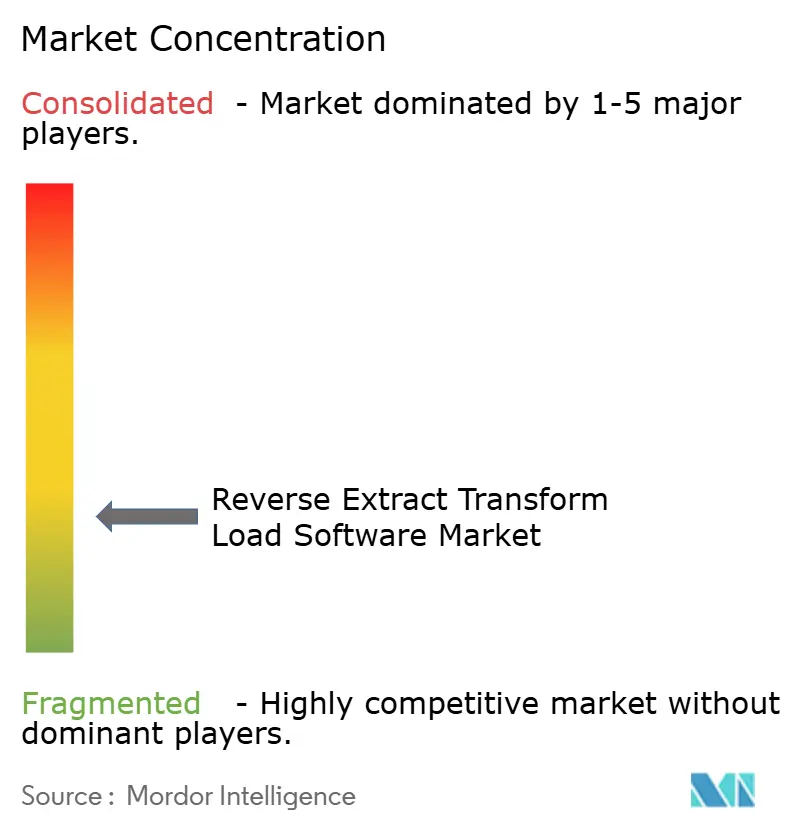
The Reverse Extract Transform Load Software Market was fragmented in 2026, with pure-play providers competing against broader data-platform companies that added reverse ETL through acquisition or product expansion. Fivetran's May 2025 agreement to acquire Census created a combined data movement platform with more than 900 connectors. This transaction shows that reverse ETL is becoming an expected capability within wider data movement offerings. Leading providers are expanding connector catalogs, building warehouse-governed AI capabilities, and offering visual tools that nontechnical users can configure. Hightouch moved beyond its earlier reverse ETL focus with Lifecycle Studio and Ad Studio, broadening its position in AI-supported marketing orchestration.
RudderStack is following an engineering-led, open-source-oriented strategy in the Reverse Extract Transform Load Software Market. It launched RudderAI in 2026 as an agentic layer for the customer-data lifecycle and introduced Lookout in June 2026 as an AI-driven analytics and instrumentation workspace. These products extend the platform from data activation into pipeline diagnostics and analytics delivery. GrowthLoop has focused on warehouse-native decisioning across Google BigQuery and Snowflake. Omnata uses a Snowflake-native connector approach, while DinMo positions its composable CDP around GDPR-oriented controls. These approaches show how platform and regulatory specialization can provide room for smaller vendors.
Indian and Southeast Asian providers such as Datazip and Castled are building lower-cost tools for growth-stage companies in price-sensitive parts of the Reverse Extract Transform Load Software Market. This tier could pressure mid-market pricing for established Western providers. Enterprise procurement also gives greater weight to documented governance practices when activation touches regulated data. SOC 2 Type II attestations, GDPR Article 28 data-processing agreement templates, and HIPAA Business Associate Agreement support can make vendor reviews more straightforward in regulated settings. The largest opportunity remains in linking AI agent outputs to business systems while preserving lineage and consent controls. Providers that combine dependable connectors with these governance capabilities can address the practical requirements of complex enterprise deployments.
Reverse Extract Transform Load Software Industry Leaders
Hightouch, Inc.
Census, Inc.
Polytomic Inc.
RudderStack Inc.
Hevo Data Inc.
- *Disclaimer: Major Players sorted in no particular order
Reverse Extract Transform Load Software Market Companies Covered in this Report
- Hightouch, Inc.
- Census, Inc.
- Polytomic Inc.
- RudderStack Inc.
- Weld ApS
- Hevo Data Inc.
- Integrate.io Inc.
- DataChannel Inc.
- Syncari Inc.
- Lytics Inc.
- MessageGears LLC
- DinMo SAS
- Peliqan B.V.
- Omnata Limited
- GrowthLoop Inc.
- SeekWell Inc.
- Datazip Technologies Private Limited
- Canner Inc.
- Castled Data Technologies Private Limited
- Grouparoo Inc.

Recent Industry Developments in Reverse Extract Transform Load Software Market
- June 2026: RudderStack, Inc. launched Lookout in private beta, an AI-powered analytics and instrumentation platform that integrates directly with RudderStack's warehouse and reverse ETL infrastructure. The tool allows teams to diagnose pipeline issues, build dashboards, review code changes, and generate instrumentation through natural language prompts, extending the company's platform scope from data activation into full-loop governed analytics delivery.
- April 2026: Hightouch, Inc. raised USD 150 million in a Series D financing round at a USD 2.75 billion valuation, led by Growth Equity at Goldman Sachs Alternatives and Bain Capital Ventures, with participation from Iconiq Capital, Sapphire Ventures, Amplify Partners, Y Combinator, and TD7, the venture capital arm of The Trade Desk. The funding will support expansion of AI-driven campaign orchestration, Lifecycle Studio, and Hightouch Ad Studio, advancing the company's positioning as an end-to-end agentic marketing platform.
- April 2026: Hightouch, Inc. reported reaching USD 100 million in annualized recurring revenue, driven by USD 70 million in ARR added over 20 months following the launch of its AI-powered marketing activation product. The company posted year-over-year growth exceeding 100% in each of the 2 prior fiscal years and was recognized as the 2026 Snowflake Marketers and Advertisers Product Partner of the Year.
- April 2026: GrowthLoop, Inc. launched Composable AI Decisioning, a warehouse-native platform running natively on Google BigQuery and Snowflake that combines experimentation, measurement, and real-time customer decisioning without copying data out of the cloud environment. The platform's Decisioning Node within Universal Journeys automatically allocates customers across channels in real time based on incremental lift measurement.


Global Reverse Extract Transform Load Software Market Report Scope
The reverse extract, transform, and load (Reverse ETL) software market refers to the ecosystem of software solutions and associated services designed to sync processed data from centralized data warehouses and data lakes back into front-end operational systems, such as customer relationship management (CRM) platforms, marketing automation tools, and advertising networks. Unlike traditional ETL, which moves raw data into a repository for analysis, reverse ETL moves analytical, highly refined data out to business applications to enable real-time, data-driven actions. The market includes tools deployed across cloud, hybrid, and on-premises environments, catering to organizations of all sizes. These solutions are heavily utilized for applications such as building a comprehensive customer 360 view, sales and marketing activation, revenue operations, and product analytics across industries, including IT, BFSI, healthcare, and manufacturing. By breaking down silos between data engineering teams and front-line business users, reverse ETL software empowers organizations to operationalize their data insights, enhance customer experiences, and drive personalized engagement at scale.
The Reverse Extract Transform Load Software Market Report is Segmented by Offering (Software, and Services), Deployment Model (Cloud, Hybrid, and On-Premises), Application (Sales and Marketing Activation, Customer Experience and Customer 360, Revenue Operations, Product Analytics and Product-Led Growth, Customer Support Operations, and Business Intelligence and Analytics), Enterprise Size (Large Enterprises, and Small and Mid-sized Enterprises), End Users (IT and Telecommunication, BFSI, Automotive and Transportation, Healthcare and Life Sciences, Energy and Utilities, Industrial Manufacturing, Aerospace and Defense, and Other End Users), and Geography (North America, South America, Europe, Asia-Pacific, and Middle East and Africa). The Market Forecasts are Provided in Terms of Value (USD).
| Software |
| Services |
| Cloud |
| Hybrid |
| On-Premises |
| Sales and Marketing Activation |
| Customer Experience and Customer 360 |
| Revenue Operations |
| Product Analytics and Product-Led Growth |
| Customer Support Operations |
| Business Intelligence and Analytics |
| Large Enterprises |
| Small and Mid-sized Enterprises |
| IT and Telecommunication |
| BFSI |
| Automotive and Transportation |
| Healthcare and Life Sciences |
| Energy and Utilities |
| Industrial Manufacturing |
| Aerospace and Defense |
| Other End Users |
| North America | United States | |
| Canada | ||
| Mexico | ||
| South America | Brazil | |
| Argentina | ||
| Rest of South America | ||
| Europe | Germany | |
| United Kingdom | ||
| France | ||
| Russia | ||
| Spain | ||
| Rest of Europe | ||
| Asia-Pacific | China | |
| Japan | ||
| India | ||
| South Korea | ||
| Southeast Asia | ||
| Rest of Asia-Pacific | ||
| Middle East and Africa | Middle East | Saudi Arabia |
| United Arab Emirates | ||
| Rest of Middle East | ||
| Africa | South Africa | |
| Nigeria | ||
| Rest of Africa | ||
| By Offering | Software | ||
| Services | |||
| By Deployment Model | Cloud | ||
| Hybrid | |||
| On-Premises | |||
| By Application | Sales and Marketing Activation | ||
| Customer Experience and Customer 360 | |||
| Revenue Operations | |||
| Product Analytics and Product-Led Growth | |||
| Customer Support Operations | |||
| Business Intelligence and Analytics | |||
| By Enterprise Size | Large Enterprises | ||
| Small and Mid-sized Enterprises | |||
| By End Users | IT and Telecommunication | ||
| BFSI | |||
| Automotive and Transportation | |||
| Healthcare and Life Sciences | |||
| Energy and Utilities | |||
| Industrial Manufacturing | |||
| Aerospace and Defense | |||
| Other End Users | |||
| By Geography | North America | United States | |
| Canada | |||
| Mexico | |||
| South America | Brazil | ||
| Argentina | |||
| Rest of South America | |||
| Europe | Germany | ||
| United Kingdom | |||
| France | |||
| Russia | |||
| Spain | |||
| Rest of Europe | |||
| Asia-Pacific | China | ||
| Japan | |||
| India | |||
| South Korea | |||
| Southeast Asia | |||
| Rest of Asia-Pacific | |||
| Middle East and Africa | Middle East | Saudi Arabia | |
| United Arab Emirates | |||
| Rest of Middle East | |||
| Africa | South Africa | ||
| Nigeria | |||
| Rest of Africa | |||


Key Questions Answered in the Report
What is the size of the Reverse Extract Transform Load Software Market?
The Reverse Extract Transform Load Software Market is projected to grow from USD 1.31 billion in 2026 to USD 3.14 billion by 2031 at a 19.11% CAGR. This growth reflects the need to make governed warehouse data available in operational applications.
What is driving reverse ETL software adoption?
Cloud warehouse adoption, AI decisioning workflows, real-time customer activation, and self-service access are supporting adoption. These forces increase the value of moving current, approved data into the applications that business teams already use.
Which deployment model leads reverse ETL adoption?
Cloud led with 66.74% of 2025 revenue because many active deployments rely on cloud-hosted warehouses. Hybrid is projected to expand at 19.84% CAGR as regulated users require a controlled way to work across public cloud and private environments.
Which end-user sector has the highest growth outlook?
Healthcare and life sciences is projected to grow at a 19.92% CAGR through 2031. The Reverse Extract Transform Load Software Market supports this use case by placing patient-risk scores and care-gap alerts into care coordination and electronic health record workflows.
Why do organizations use reverse ETL software?
Organizations use it to send governed warehouse data to CRM, marketing, service, reporting, and operational applications. The Reverse Extract Transform Load Software Market helps teams act on approved customer, product, billing, and performance signals without relying on separate manual extracts.
What factors can limit reverse ETL deployment?
Data-quality problems, identity-resolution gaps, API changes, rate limits, privacy requirements, and deployment costs can slow implementation. Organizations need data-quality checks, monitoring, schema-change detection, and governance controls to limit disruption across their destination portfolios.
Page last updated on:


 Your data is secure and never sold or shared.


