
Reusable Face Mask Market Size and Share
Market Overview
| Study Period | 2022 - 2032 |
|---|---|
| Market Size (2027) | USD 5.51 Billion |
| Market Size (2032) | USD 6.71 Billion |
| Growth Rate (2027 - 2032) | 4.03 % |
| Fastest Growing Market | Asia-Pacific |
| Largest Market | North America |
| Market Concentration | Medium |
Major Players *Disclaimer: Major Players sorted in no particular order Image © Mordor Intelligence. Reuse requires attribution under CC BY 4.0. | |
Reusable Face Mask Market Analysis by Mordor Intelligence
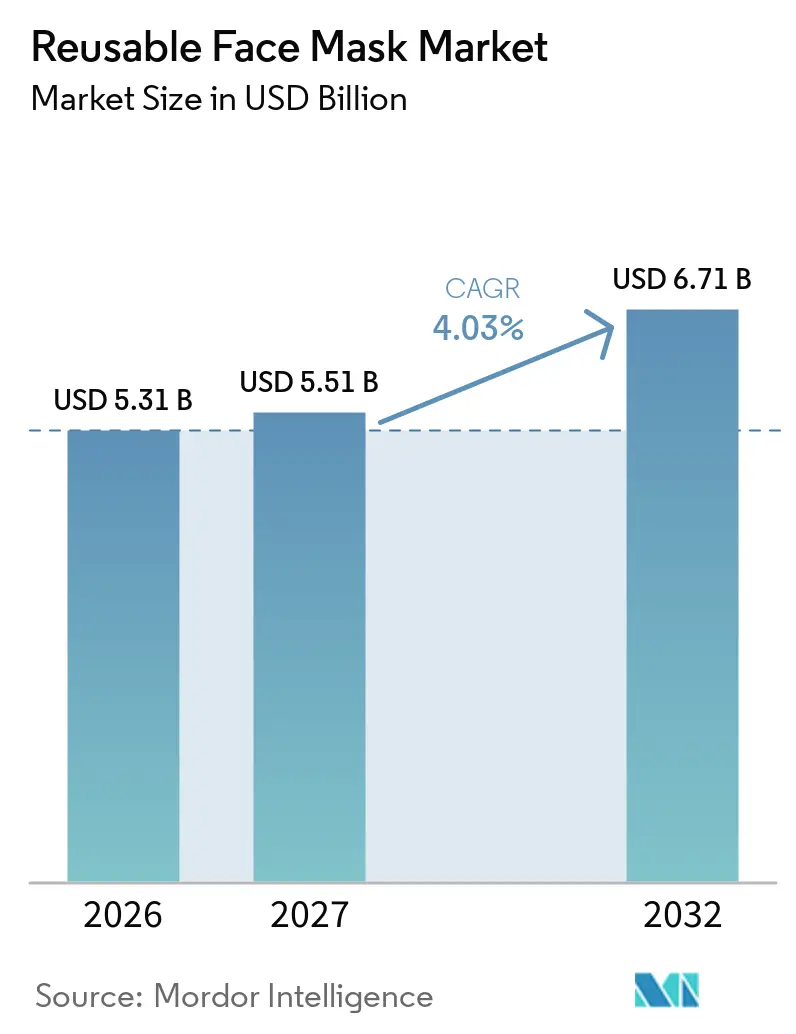
The reusable face mask market size is expected to grow from USD 5.31 billion in 2026 to USD 5.51 billion in 2027 and is forecast to reach USD 6.71 billion by 2032 at a 4.03% CAGR over 2027-2032. The reusable face mask market is shifting from emergency purchasing to routine respiratory protection that addresses air quality concerns, infection prevention, and the waste burden associated with single-use products. Air pollution and chronic respiratory diseases continue to support the use of respiratory protection in daily life, while consumers increasingly seek products that offer repeated use without compromising comfort. The reusable face mask market also faces substitution pressure from disposable respirators, personal air ionizers, and connected clean-air wearables, increasing the importance of certification and clear performance evidence beyond price considerations. Manufacturers that combine verified filtration performance, washable construction, and credible environmental positioning can address consumer, occupational, and institutional demand more effectively.
Key Report Takeaways
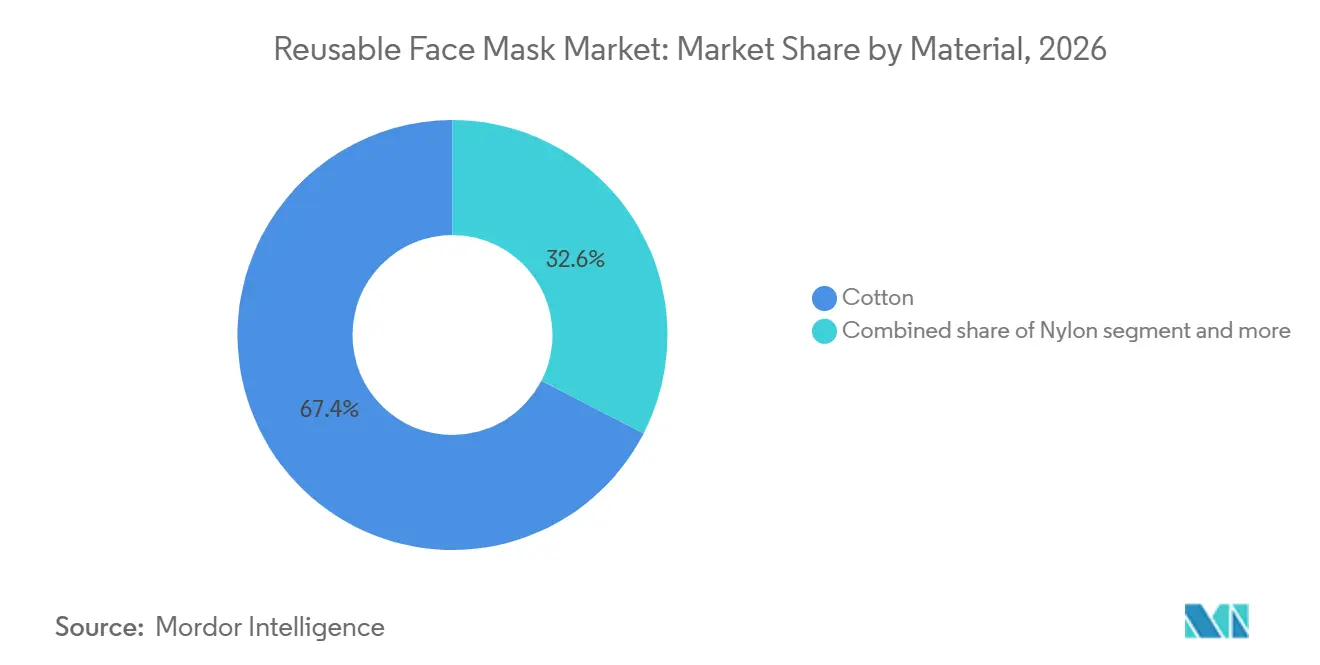
- By material, cotton led the reusable face mask market with a 67.43% share in 2026, while nylon is expected to grow at the fastest CAGR of 5.12% during 2027-2032.
- By filtration type, replaceable filters retained a 61.72% share in 2026, while non-replaceable filters are anticipated to expand at a 5.59% CAGR through 2032.
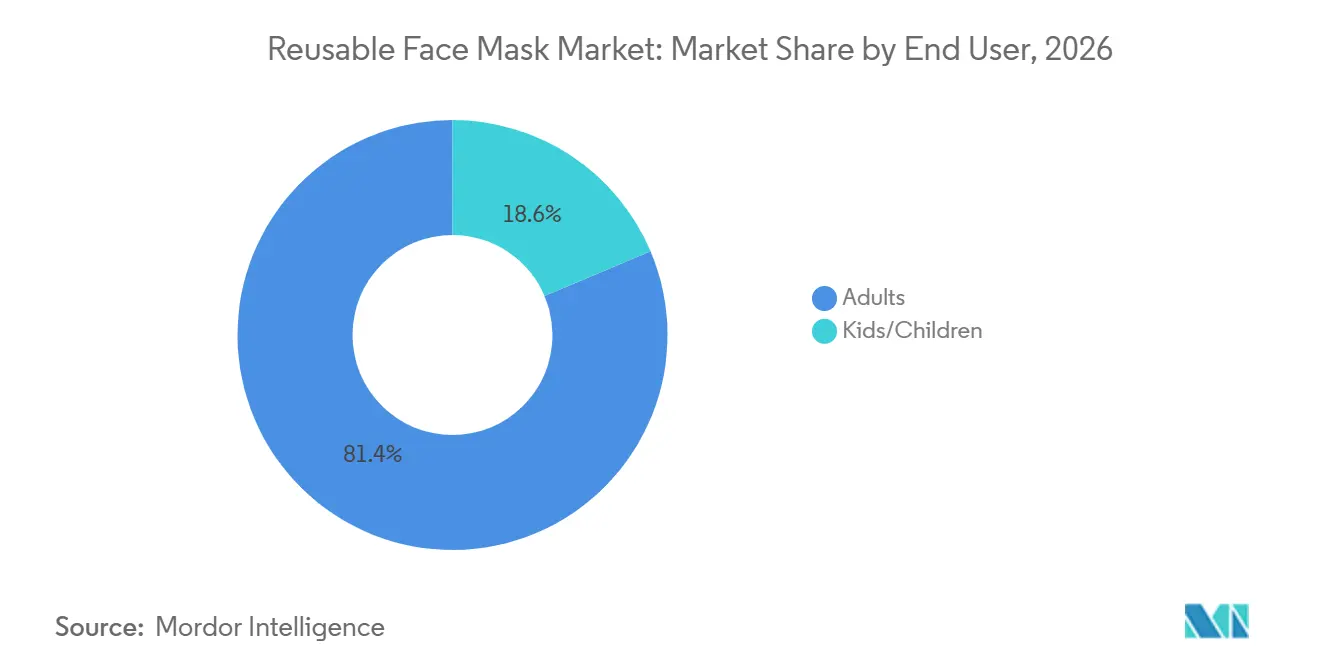
- By end user, adults retained an 81.36% share in 2026, while kids/children are anticipated to expand at a 5.91% CAGR through 2032.
- By distribution channel, online retail stores led the market with a share of 37.69% in 2026, while pharmacies and drugstores are anticipated to register the fastest CAGR of 5.43% during 2027-2032.
- By geography, North America led the reusable face mask market in 2026 with a 41.02% share, while Asia-Pacific is expected to advance at a 5.82% CAGR through 2032.
Note: Market numbers in this report are based on Mordor Intelligence's proprietary estimation framework, which combines nine months of actuals with Q4 projections for base year 2026.
Market Trends and Insights
Drivers Impact Analysis of Reusable Face Mask Market*
| Driver | (~) % Impact on CAGR Forecast | Geographic Relevance | Impact Timeline |
|---|---|---|---|
| Rising awareness of respiratory infection prevention | +0.6% | Global, strongest in North America and Europe | Medium term (2-4 years) |
| Expansion of healthcare infection-control practice | +0.5% | North America and Europe, with spillover to Asia-Pacific | Medium term (2-4 years) |
| Increasing concern about air pollution and airborne particulates | +0.9% | Asia-Pacific, with spillover to the Middle East, Africa, and South America | Long term (≥ 4 years) |
| Long-term cost advantages of reusable products | +0.4% | Global, strongest in price-sensitive Asia-Pacific and South America | Short term (≤ 2 years) |
| Technological advancements in filtration, comfort, and durability | +0.5% | Global, with innovation activity in North America, Europe, and East Asia | Long term (≥ 4 years) |
| Environmental concerns over single-use mask waste | +0.7% | Europe and North America, with accelerating relevance in Asia-Pacific | Medium term (2-4 years) |
| Source: Mordor Intelligence | |||
Increasing Concern About Air Pollution and Airborne Particulates
The reusable face mask market benefits from air quality concerns, which make respiratory protection a regular purchase rather than an occasional one. The World Health Organization (WHO) reported in December 2025 that 2.1 billion people cook using open fires or inefficient stoves, exposing households to harmful fine-particle pollution[1]. In cities where particulate pollution repeatedly exceeds health guidelines, washable masks provide a practical option for frequent use. Real-time air quality information can also create more predictable demand periods for online sellers and retailers. At the World Health Organization Second Global Conference on Air Pollution and Health, in March 2025, participants committed to reducing the health effects of air pollution by 50% by 2040. This policy direction supported sustained attention to respiratory health in the reusable face mask market.
Environmental Concerns Over Single-Use Mask Waste
Environmental concerns surrounding the disposal of single-use face masks are creating opportunities for reusable alternatives. Disposable masks contribute to plastic waste and require resources for manufacturing, transportation, and waste management. In August 2025, the Government of India reported that authorities had seized approximately 1,985 tonnes of banned single-use plastic items between July 2022 and July 2025, reflecting continued efforts to curb plastic pollution[2]. It highlights the policy focus on reducing single-use plastic waste. Reusable masks made of cotton, nylon, and polyester can reduce the volume of discarded face coverings when consumers use and maintain them appropriately. This factor supports demand among environmentally conscious consumers and organizations.
Technological Advancements in Filtration, Comfort, and Durability
Filtration efficiency, breathability, facial fit, and durability during repeated use are key product differentiators in the reusable face mask market. In March 2025, the United States National Institute for Occupational Safety and Health (NIOSH) highlighted that approved N95 filtering facepiece respirators must achieve a minimum filtration efficiency of 95%, establishing an important performance benchmark for respiratory protection[3]. Additionally, the Easy2ReUse project in Europe is developing a reusable elastomeric half-mask for healthcare applications, with testing involving healthcare workers in Finland and Spain. These developments reflect ongoing efforts to enhance filtration systems, ergonomic design, and resistance to repeated cleaning. Such innovations may strengthen demand for reusable masks among healthcare professionals and other frequent users seeking effective protection, improved comfort, and longer product life.
Rising Awareness of Respiratory Infection Prevention
The reusable face mask market benefits from growing awareness of respiratory infection prevention and chronic respiratory diseases. A June 2025 report by WHO Europe and the European Respiratory Society stated that 81.7 million people in the European Region live with chronic respiratory diseases. The report also identified 6.8 million newly diagnosed cases annually and productivity losses exceeding USD 20 billion among the region’s working-age population. This disease burden encourages consumers to view respiratory protection as a component of routine health management rather than solely as an outbreak-response measure. In developing markets, digital health information can reach consumers before healthcare access expands at a comparable pace. Brands that provide clear guidance on fit, cleaning, and intended use can build stronger, long-term consumer trust.
Restraints Impact Analysis of Reusable Face Mask Market*
| Restraint | (~) % Impact on CAGR Forecast | Geographic Relevance | Impact Timeline |
|---|---|---|---|
| Limited filtration efficiency and inconsistent protection | -0.4% | Global, most acute where standardized testing is absent | Medium term (2-4 years) |
| Cleaning, maintenance, and hygiene requirements | -0.3% | Global, with greater effect in markets with limited care infrastructure | Short term (≤ 2 years) |
| Competition from disposable masks and respirators | -0.5% | Global, strongest in North American and Asia-Pacific institutional channels | Medium term (2-4 years) |
| Regulatory compliance and product certification challenges | -0.2% | Europe, North America, and markets with evolving personal protective equipment rules | Long term (≥ 4 years) |
| Source: Mordor Intelligence | |||
Competition From Disposable Masks and Respirators
Disposable N95, surgical, and KN95 products maintain a strong presence across institutional and consumer channels. Buyers widely associate NIOSH requirements and comparable standards in Europe and East Asia with disposable filtering facepiece respirators used in high-risk environments. Large institutional purchasers can secure volume-based pricing for certified disposable products, weakening the cost advantage of reusable designs in high-exposure settings. Therefore, manufacturers must position reusable products carefully, emphasizing appropriate use, documented performance, and lower lifecycle consumption. Certification pathways can help mitigate this challenge; however, they also increase time-to-market, costs, and ongoing compliance requirements.
Limited Filtration Efficiency and Inconsistent Protection
Limited filtration efficiency remains a key restraint in the reusable face mask market, as protective performance varies based on material composition, fabric density, mask construction, and facial fit. Standard washable masks may offer inadequate protection against fine airborne particles compared with specialized respiratory protection products. Repeated washing and prolonged use can also compromise material integrity, filtration performance, and the fit of certain mask designs. Additionally, gaps around the nose and cheeks can allow unfiltered air to bypass the mask, reducing overall effectiveness. These limitations may discourage adoption among healthcare professionals, industrial workers, and consumers who require higher levels of protection. Consequently, concerns over reliable protection may restrict demand for reusable masks in applications with stringent safety requirements.
*Our forecasts treat driver/restraint impacts as directional, not additive. The impact forecasts reflect baseline growth, mix effects, and variable interactions.
Reusable Face Mask Market Segment Analysis
By Material:
Cotton Leads While Nylon Gains MomentumCotton accounted for 67.43% of the reusable face mask market share in 2026, supported by its comfort, washability, and familiarity across value and premium products. It remains a practical option for consumers seeking a soft fabric contact surface and simple home care. Cotton-based masks are suitable for daily commuting, errands, and general personal use, where buyers prefer familiar materials. Its large user base also means that incremental improvements in fit, finishes, or filter integration can benefit a broad consumer group. Cotton’s established position makes it a key volume material in the reusable face mask market.
Nylon is projected to register a CAGR of 5.12% through 2032, making it the fastest-growing material category in the reusable face mask market. Its lighter weight at comparable thickness and resistance to deformation after repeated washing make it suitable for products that emphasize durability. Nylon also supports mask designs that require a stable structure and close fit to enhance the user experience. Polyester remains relevant for athletic and outdoor applications, as its moisture-management properties help maintain comfort during physical activity. Other materials include nanofiber composites, activated carbon blends, and electrospun membranes designed for higher-performance applications.

By Filtration Type:
Replaceable Filters Lead While Simple Washable Formats GrowReplaceable filters account for 61.72% of segment revenue in 2026, driven by demand from professional and institutional users who prefer to retain the mask housing. This format enables users to replace the filtration element without discarding the entire product. When the housing remains durable and users follow care instructions, the design can reduce material consumption over time. It also enables suppliers to maintain customer engagement through filter replacement purchases. Buyers considering repeat use can compare filter replenishment costs with the cost of frequently purchasing disposable respirators. Replaceable formats are particularly relevant for users seeking a more serviceable product and able to perform regular maintenance.
Non-replaceable filters are forecast to grow at a CAGR of 5.59% through 2032. These washable, single-piece products appeal to consumers who prioritize simple care over managing spare filters. A 2025 Lancet article challenges the view that medical masks must always be disposable, supporting further consideration of reusable models where appropriate. The simplicity of these products can reduce hesitation among everyday urban users who do not want to maintain separate mask components. Both filtration formats benefit from materials that enhance particle capture without increasing breathing resistance. This distinction also affects product packaging and after-sales communication: refill-based offerings require reliable replacement availability, while single-piece washable products require clear, credible guidance on cleaning, drying, and the intended usable life of the product.
By End User:
Adults Provide Volume While Kids/Children Grow FasterAdults account for 81.36% of segment revenue in 2026 across occupational, healthcare, and personal-use settings. This group includes workers requiring respiratory protection, consumers managing pollution exposure, and individuals choosing masks during periods of heightened infection concern. Adult demand supports a broad range of products that vary by fit, material, filtration, and appearance. It also supports distribution through online retailers, pharmacies, occupational suppliers, and institutional procurement channels. Adult buyers are likely to compare comfort, price, ease of care, and stated filtration performance before selecting a product.
The kids/children segment is forecast to grow at a CAGR of 5.91% through 2032, the highest among end-user groups. Parents in urban areas with high particulate exposure may place greater importance on proper fit and low breathing resistance for children. Children’s products must accommodate facial proportions, adjustable nose-wire designs, sensitivity to contact materials, and comfort during extended wear. Japan and South Korea demonstrate recurring mask use among school-age children, particularly during influenza and pollen seasons. The reusable face mask market also requires a clear distinction between children’s everyday-use products and products intended for environments requiring certified respirators. This distinction protects parents from overstated expectations and enables companies to communicate comfort, filtration, and care features responsibly, without implying that every reusable product provides the same level of protection in all settings.
By Distribution Channel:
Online Retail Leads While Pharmacies ExpandOnline retail stores accounted for 37.69% of total revenue in 2026. Online channels enable buyers to compare materials, review product descriptions, and access replacement filters and related accessories. They also allow brands to provide more detailed care instructions and filtration claims than standard retail shelves. Customer reviews can strengthen consumer trust, particularly among shoppers seeking reassurance about fit and comfort. Subscription and repeat-purchase programs for filters can further support ongoing engagement with replaceable-filter products. The strong position of online channels reflects the importance of convenience, broad product assortment, and access to detailed product information.
Pharmacies and drugstores are forecast to grow at a CAGR of 5.43% through 2032. Their growth positions reusable masks alongside health and wellness products, including cold remedies and allergy products. This retail setting can encourage buyers to consider respiratory protection at the point of need. Hypermarkets and supermarkets remain important for volume sales in price-sensitive regions of South America and the Middle East and Africa. While online product pages can provide detailed information on component selection and maintenance, pharmacy staff and product packaging must communicate clear, concise information without overstating performance or creating uncertainty about product suitability for the intended use.
Geography Analysis
North America Reusable Face Mask Market
North America accounts for 41.02% of the reusable face mask market share in 2026. The region benefits from high healthcare spending, established occupational safety requirements, and well-developed pharmacy and e-commerce channels. The Occupational Safety and Health Administration’s respiratory protection standard supports structured respiratory protection practices in workplaces where they are required. Major personal protective equipment suppliers maintain strong institutional distribution networks across the United States and Canada. Canada follows many U.S. demand patterns on a smaller scale, while Mexico is emerging as a developing corridor for certified respiratory products as formal employment and workplace safety requirements expand.
Europe Reusable Face Mask Market
Europe is the second-largest regional market, with Germany, the United Kingdom, France, and the Nordic countries serving as key demand centers. The region’s circular economy priorities and personal protective equipment regulations create a favorable environment for longer-life product designs. Validation of reusable products is particularly relevant in the region, as it could expand options for institutional procurement. Poland, Belgium, and the Netherlands are also demonstrating growing interest as air quality concerns and post-pandemic health awareness increase.
APAC Reusable Face Mask Market
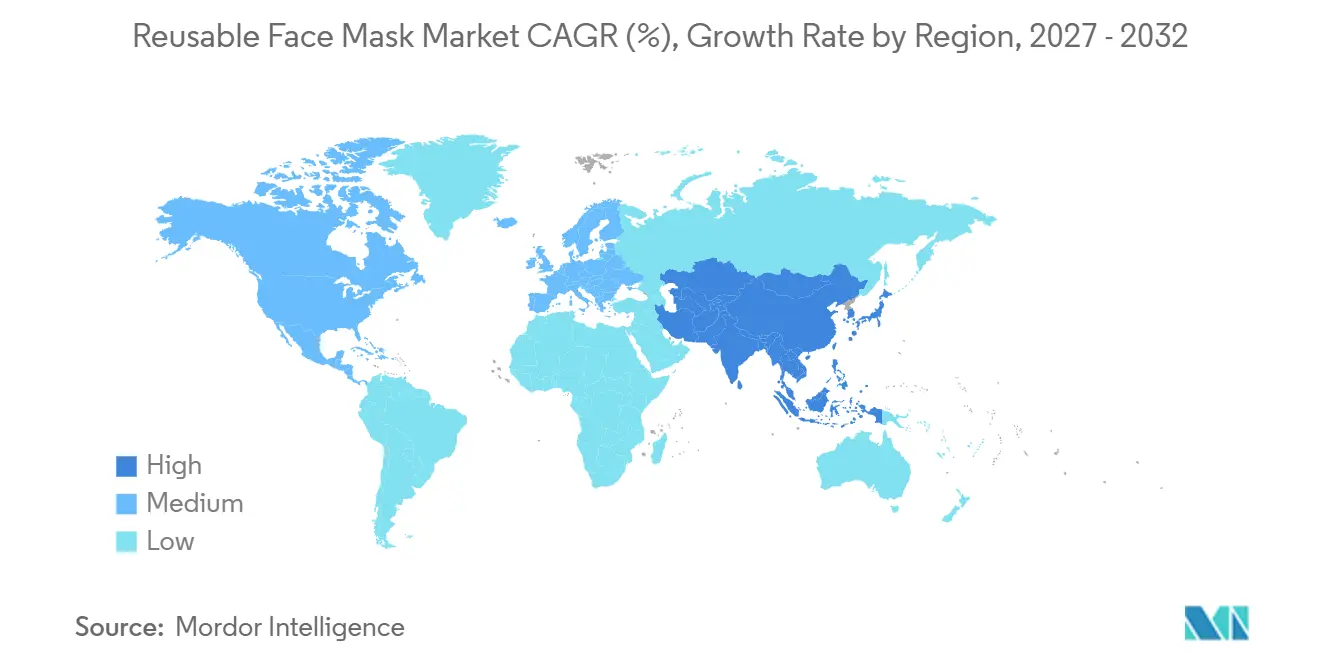
Asia-Pacific is projected to grow at a CAGR of 5.82% through 2032, the fastest growth rate among all geographic segments. Pollution exposure from industrial activity and vehicle emissions in China continues to support demand among urban consumers and industrial workers. India’s expanding tier-2 and tier-3 cities present a significant opportunity, as pollution exposure remains high while reusable mask adoption is relatively low. Japan emphasizes comfort-oriented daily wear, while South Korea has established mask-use patterns associated with pollen and fine-dust seasons. Therefore, the reusable face mask market benefits from localized product communication that reflects whether purchasing decisions are primarily driven by pollution exposure, seasonal habits, workplace requirements, or everyday comfort during travel and commuting.
Competitive Landscape
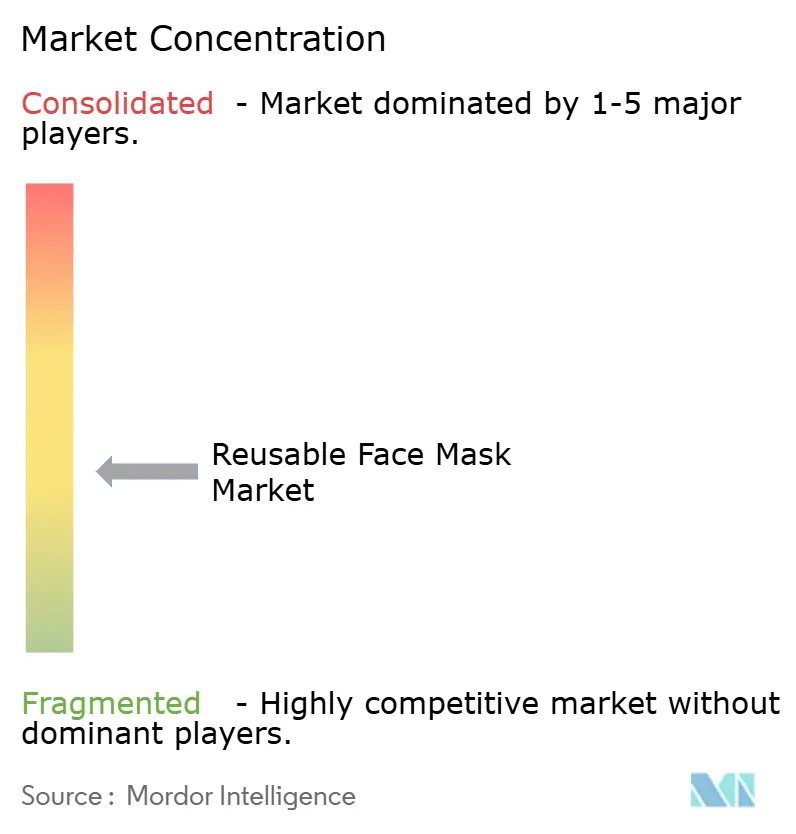
The reusable face mask market is moderately fragmented and comprises specialized mask manufacturers, respiratory protection companies, and consumer-focused brands. These companies compete based on filtration performance, material quality, comfort, durability, and product design. Key participants include 3M, Cambridge Mask Company, Moldex-Metric, Inc., and Totobobo. They target consumers seeking reusable protection against airborne particles and environmental pollutants, differentiating their offerings through filtration systems, fit, washability, and aesthetics.
Competition also includes established occupational safety and respiratory protection manufacturers, such as Airinum AB, Honeywell, Vogmask, and MSA Safety. These companies compete through product engineering, filtration performance, fit, durability, and compliance with relevant respiratory protection standards. Their reusable respirator portfolios serve workplace applications where consistent protection and replaceable filtration components are critical. However, certified reusable respirators represent a distinct category from standard washable fabric masks; therefore, their competitive positioning depends on the market’s product scope.
Product innovation, pricing, distribution reach, brand recognition, and the ability to meet diverse consumer and professional requirements shape market competition. Consumer-oriented brands emphasize lightweight construction, attractive designs, washable materials, and convenience. In contrast, occupational safety manufacturers prioritize protective performance, secure fit, and compatibility with replaceable filters or cartridges. Online retail channels enable specialist brands to reach international customers, while pharmacies, supermarkets, and industrial distributors provide access to broader consumer and institutional segments. Companies that balance credible protection claims with comfort, product longevity, and competitive pricing are better positioned to differentiate their reusable face masks across personal, healthcare, and workplace applications.
Reusable Face Mask Industry Leaders
-
3M Company
-
Honeywell International Inc.
-
Moldex-Metric, Inc.
-
Cambridge Mask Company
-
Airinum AB
- *Disclaimer: Major Players sorted in no particular order
Reusable Face Mask Market Companies Covered in this Report
- 3M Company
- Honeywell International Inc.
- Moldex-Metric, Inc.
- Vogmask
- Cambridge Mask Company
- Airinum AB
- RZ Industries, Inc.
- Respro-M Limited
- Totobobo Pte Ltd
- Livinguard Technologies AG
- Kimberly-Clark Corporation
- Alpha Pro Tech, Ltd.
- Ansell Limited
- MSA Safety Incorporated
- UVEX SAFETY UK LTD
- VBM Medizintechnik GmbH
- Venus Safety and Health Pvt. Ltd.
- Medline Industries, LP
- Cardinal Health, Inc.
- Armbrust American
Recent Industry Developments in Reusable Face Mask Market
- March 2026: Boody introduced its first reusable face mask, made from organically grown bamboo fabric. The mask features a triple-layer construction, adjustable ear straps, a contoured fit, and an internal pocket for optional filters. This launch demonstrates product differentiation through breathable materials, enhanced comfort, and the ability to accommodate additional filtration.
- October 2025: OCTO Safety Devices launched its X-Series respirator ahead of its planned demonstration at the A+A 2025 occupational safety exhibition in Düsseldorf, Germany. The respirator features a pleated filter system that improves airflow, a lightweight ergonomic design weighing less than 140 grams, and features designed to enhance speech clarity.
- May 2025: Rescue Global launched its Ultimate Facemask product series, comprising a reusable, washable Public Mask for general use and a Professional Mask with an FFP2 rating. The range addresses public, healthcare, and professional requirements, with products designed to provide varying levels of protection.
Global Reusable Face Mask Market Report Scope
Reusable face masks are protective face coverings made from durable materials such as cotton, nylon, and polyester, designed to be reused by washing or by replacing filter components.
The reusable face mask market is segmented by material, filtration type, end user, distribution channel, and geography. By material, the market is segmented into cotton, nylon, polyester, and other materials. By filtration type, the market is segmented into replaceable filters and non-replaceable filters. By end user, the market is segmented into adults and kids/children. By distribution channel, the market is segmented into hypermarkets and supermarkets, pharmacies and drugstores, online retail stores, and other distribution channels. Geographically, the market is classified into North America, Europe, South America, Asia-Pacific, and the Middle East and Africa. The market forecasts are provided in terms of value (USD).
Segmentation Overview
| Cotton |
| Nylon |
| Polyester |
| Other Materials |
| Replaceable Filters |
| Non-Replaceable Filters |
| Adults |
| Kids/Children |
| Hypermarkets and Supermarkets |
| Pharmacies and Drugstores |
| Online Retail Stores |
| Other Distribution Channels |
| North America | United States |
| Canada | |
| Mexico | |
| Rest of North America | |
| Europe | Germany |
| United Kingdom | |
| Italy | |
| France | |
| Spain | |
| Netherlands | |
| Poland | |
| Belgium | |
| Sweden | |
| Rest of Europe | |
| Asia-Pacific | China |
| India | |
| Japan | |
| Australia | |
| Indonesia | |
| South Korea | |
| Thailand | |
| Singapore | |
| Rest of Asia-Pacific | |
| South America | Brazil |
| Argentina | |
| Colombia | |
| Chile | |
| Peru | |
| Rest of South America | |
| Middle East and Africa | South Africa |
| Saudi Arabia | |
| United Arab Emirates | |
| Nigeria | |
| Egypt | |
| Morocco | |
| Turkey | |
| Rest of Middle East and Africa |
| By Material | Cotton | |
| Nylon | ||
| Polyester | ||
| Other Materials | ||
| By Filtration Type | Replaceable Filters | |
| Non-Replaceable Filters | ||
| By End User | Adults | |
| Kids/Children | ||
| By Distribution Channel | Hypermarkets and Supermarkets | |
| Pharmacies and Drugstores | ||
| Online Retail Stores | ||
| Other Distribution Channels | ||
| By Geography | North America | United States |
| Canada | ||
| Mexico | ||
| Rest of North America | ||
| Europe | Germany | |
| United Kingdom | ||
| Italy | ||
| France | ||
| Spain | ||
| Netherlands | ||
| Poland | ||
| Belgium | ||
| Sweden | ||
| Rest of Europe | ||
| Asia-Pacific | China | |
| India | ||
| Japan | ||
| Australia | ||
| Indonesia | ||
| South Korea | ||
| Thailand | ||
| Singapore | ||
| Rest of Asia-Pacific | ||
| South America | Brazil | |
| Argentina | ||
| Colombia | ||
| Chile | ||
| Peru | ||
| Rest of South America | ||
| Middle East and Africa | South Africa | |
| Saudi Arabia | ||
| United Arab Emirates | ||
| Nigeria | ||
| Egypt | ||
| Morocco | ||
| Turkey | ||
| Rest of Middle East and Africa | ||
Key Questions Answered in the Report
What is the projected size of the reusable face mask market by 2032?
The reusable face mask market is projected to grow from USD 5.31 billion in 2026 to USD 6.71 billion by 2032, registering a CAGR of 4.03% during 2027-2032.
Which material segment held the largest share of the reusable face mask market in 2026?
The cotton segment dominated the market in 2026, accounting for 67.43% of total market revenue.
Which filtration type accounted for the largest market share in 2026?
Replaceable filter face masks held the largest share of the reusable face mask market, capturing 61.72% of the market in 2026.
Which end-user segment led the reusable face mask market in 2026?
The adult segment was the leading end-user category, holding 81.36% of the market share in 2026.
Which distribution channel held the largest market share in 2026?
Online retail stores emerged as the largest distribution channel, accounting for 37.69% of the reusable face mask market in 2026.
Which region dominated the reusable face mask market in 2026?
North America led the reusable face mask market in 2026, representing 41.02% of total market revenue.