
Remote Terminal Unit (RTU) Market Size and Share
Market Overview
| Study Period | 2021 - 2032 |
|---|---|
| Market Size (2027) | USD 3.83 Billion |
| Market Size (2032) | USD 5.03 Billion |
| Growth Rate (2027 - 2032) | 5.59 % |
| Fastest Growing Market | Asia-Pacific |
| Largest Market | Asia-Pacific |
| Market Concentration | Medium |
Major Players *Disclaimer: Major Players sorted in no particular order Image © Mordor Intelligence. Reuse requires attribution under CC BY 4.0. | |
Remote Terminal Unit (RTU) Market Analysis by Mordor Intelligence
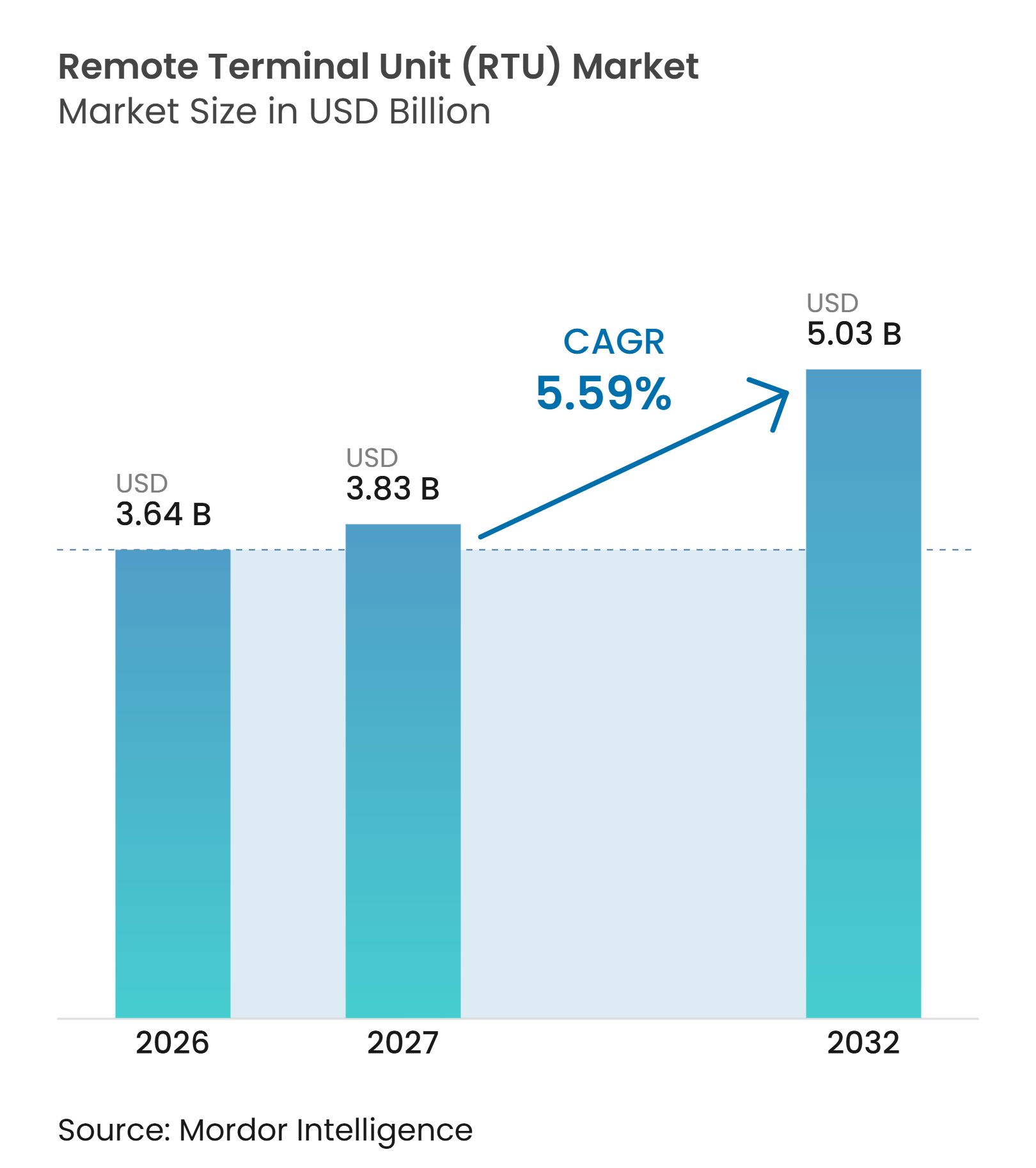
The Remote Terminal Unit (RTU) Market size is projected to expand from USD 3.64 billion in 2026 to USD 3.83 billion in 2027, and to USD 5.03 billion by 2032, registering a CAGR of 5.59% between 2027 and 2032. Grid modernization is driving renewed demand as utilities replace aging field equipment to connect distributed energy resources, battery storage, and advanced grid analytics. Renewable generation also requires consistent telemetry across dispersed solar, wind, storage, and grid assets. RTUs are increasingly used as local computing and security points rather than only as devices that send field data to a central supervisory system. Suppliers are responding with platforms that combine measurement, control, communications, and security functions. This has widened opportunities in utilities, pipelines, water systems, and remote industrial sites.
Key Report Takeaways
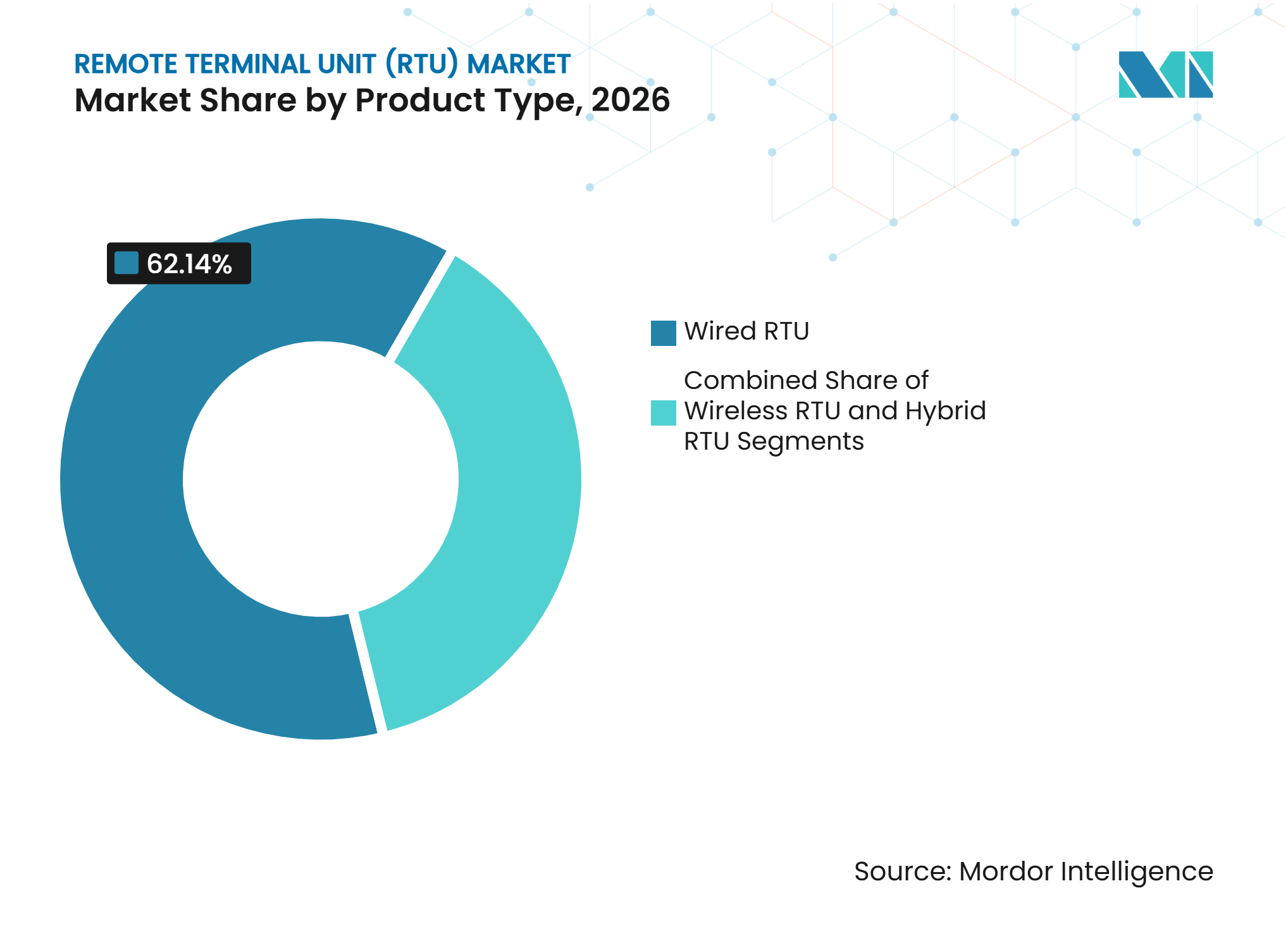
- By product type, Wired RTU held 62.14% of the Remote Terminal Unit (RTU) Market share in 2026, while Wireless RTU is projected to expand at a CAGR of 7.32% through 2032.
- By component, Hardware accounted for 66.15% of the Remote Terminal Unit (RTU) Market share in 2026, while Services is projected to expand at a CAGR of 7.02% through 2032.
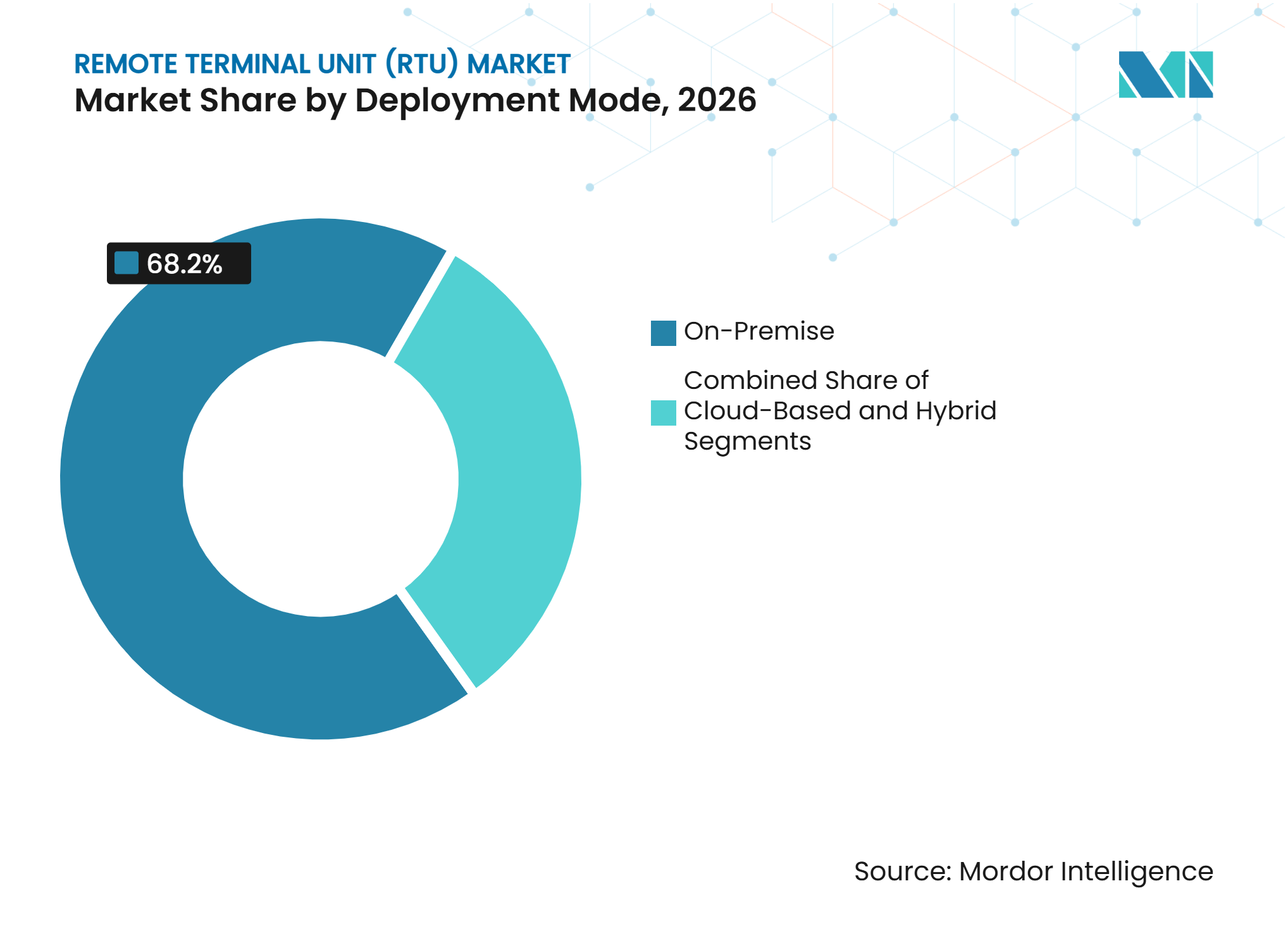
- By deployment mode, On-premise deployment held 68.20% of the Remote Terminal Unit (RTU) Market share in 2026, while Cloud-based deployment is projected to expand at a CAGR of 7.64% through 2032.
- By end-user industry, Oil and gas held 28.18% of the Remote Terminal Unit (RTU) Market share in 2026, while Water and Wastewater is projected to expand at a CAGR of 6.31% through 2032.
- By geography, Asia-Pacific held 37.89% of the Remote Terminal Unit (RTU) Market share in 2026 and is projected to expand at a CAGR of 6.68% through 2032.
Note: Market numbers in this report are based on Mordor Intelligence's proprietary estimation framework, which combines nine months of actuals with Q4 projections for base year 2026.
Market Trends and Insights
Drivers Impact Analysis of Remote Terminal Unit (RTU) Market*
| Driver | (~) % Impact on CAGR Forecast | Geographic Relevance | Impact Timeline |
|---|---|---|---|
| Smart Grid Modernization and Distribution Automation | +1.5% | North America, Europe, Asia-Pacific core markets including India, China, and Australia | Short term (≤ 2 years) |
| Industrial Automation and IIoT Expansion | +1.3% | Global, with leading adoption in Asia-Pacific and North America | Medium term (2-4 years) |
| Renewable Energy Integration and Distributed Generation | +1.0% | Europe, Asia-Pacific, North America, with spillover to the Middle East | Short term (≤ 2 years) |
| Remote Operations for Safety, Labor Productivity, and Asset Uptime | +0.8% | Middle East, Africa, South America, and remote Asia-Pacific | Short term (≤ 2 years) |
| Brownfield RTU Replacement Through Protocol-Convergent Platforms | +0.5% | North America, Europe, India, and China | Long term (≥ 4 years) |
| Solar-Powered Telemetry for Electrification and Water Networks | +0.3% | Sub-Saharan Africa, South and Southeast Asia, and Oceania | Medium term (2-4 years) |
| Source: Mordor Intelligence | |||
Smart Grid Modernization and Distribution Automation
Grid modernization programs are creating a substantial replacement cycle for installed RTUs. PG&E has begun upgrading aging substation RTUs in California to support distributed resources, storage, and newer grid applications. The company serves more than 16 million customers across 70,000 square miles, underscoring the scale of the infrastructure utilities must manage. In India, the RDSS sanctioned INR 2,627 crore for SCADA and distribution management works in 394 towns. The program increases demand for systems that collect real-time data and support distribution automation. The Remote Terminal Unit (RTU) Market benefits when utilities use replacements to introduce IEC 61850, time-synchronized event recording, and analytics-ready field infrastructure.
Industrial Automation and IIoT Expansion
Industrial operators are using RTUs for local processing as well as field communication. Current platforms can support Linux-based operating systems, containerized services, OPC UA interfaces, and local PID control functions. This reduces the need for separate controllers, gateways, and telemetry devices at some field locations. Local event handling and data aggregation can also reduce the workload on central supervisory systems. ABB implemented its SCADAvantage platform for IndianOil's more than 20,000 km cross-country pipeline network, with cloud-hosted cybersecurity and disaster recovery systems supporting centralized pipeline management. The project shows why the Remote Terminal Unit (RTU) Market is linked to operational diagnostics, alarm handling, and faster response across widely distributed assets.
Renewable Energy Integration and Distributed Generation
Renewable assets increase the need for RTUs that manage several protocols across remote locations. Siemens and Mescada deployed a cloud-based SCADA system for Global Power Generation Australia, connecting 8 renewable energy and storage sites via 300,000 data tags. The sites span 4 Australian states, making centralized, on-premises architecture less practical for the operator. RTUs at renewable sites may need to communicate with substation relays, inverters, and grid operator systems through different protocols. IEEE 1547-2018 and IEC 61400-25 increase reporting and interoperability requirements for distributed resources and wind facilities. The Remote Terminal Unit (RTU) Market, therefore, favors protocol-convergent products that can accommodate future grid code changes without replacing field hardware.
Remote Operations for Safety, Labor Productivity, and Asset Uptime
Remote monitoring is becoming more practical where sites lack grid power and fixed communications. Ovarro deployed TBox RTUs at Tasmania's Don Irrigation Scheme to monitor flow and pressure at remote agricultural outlets using solar-charged cellular units. The units supported DNP3 integration with the utility's central SCADA system. Wireless monitoring can reduce the manual inspection activity required at remote water and irrigation assets. It can also provide continuous equipment data that supports maintenance decisions. Lower-power equipment, solar charging, NB-IoT, and LTE-M make RTU deployment viable in agricultural, rural water, and small environmental monitoring applications.
Restraints Impact Analysis of Remote Terminal Unit (RTU) Market*
| Restraint | (~) % Impact on CAGR Forecast | Geographic Relevance | Impact Timeline |
|---|---|---|---|
| High Initial Investment and Integration Costs | -1.0% | Global, with the greatest pressure in emerging markets and municipal utilities | Short term (≤ 2 years) |
| Cybersecurity Exposure in Connected OT Environments | -0.8% | Global, with greater compliance friction in North America and Europe | Short term (≤ 2 years) |
| Legacy-System Interoperability and Specialist Engineering Requirements | -0.5% | Europe and North America, where older installed bases are concentrated | Long term (≥ 4 years) |
| Communications Reliability and Remote-Site Power Constraints | -0.4% | Africa, South America, remote Asia-Pacific, and inland Middle East | Medium term (2-4 years) |
| Source: Mordor Intelligence | |||
High Initial Investment and Integration Costs
Capital cost remains a barrier for municipal water utilities and smaller industrial operators. Hardware, licensing, labor, software, long-term parts availability, and integration engineering affect the total cost of ownership. PG&E evaluates modernization sites against system functionality, application usability, capital economics, and future scalability, and may retrofit an aging system rather than replace it. ABB introduced Automation Extended as a pathway for progressive modernization that maintains operational continuity while adding new automation capabilities. Phased modernization can reduce the size of a single capital commitment. Deferred replacement can still leave operators with end-of-support devices and a longer exposure to security risks.
Cybersecurity Exposure in Connected OT Environments
Connected RTUs can provide a route into critical infrastructure when remote access is not properly controlled. CISA reported that malicious actors compromised RTUs at Polish renewable plants and a combined heat and power facility in December 2025, damaging HMI data and corrupting firmware. The event showed that a compromised field device can disrupt live energy operations. Schneider Electric added role-based access control to SCADAPack 470i and 474i RTUs, integrating Active Directory, IP firewall, NAT, and DNP3 secure authentication functions. CISA, the UK NCSC, and the FBI published secure connectivity principles for operational technology in January 2026. Compliance with IEC 62443 can extend evaluation and delivery timelines, particularly in public infrastructure projects.
*Our forecasts treat driver/restraint impacts as directional, not additive. The impact forecasts reflect baseline growth, mix effects, and variable interactions.
Remote Terminal Unit (RTU) Market Segment Analysis
By Product Type:
Wired RTUs Maintain Scale While Wireless RTUs ExpandWired RTU held 62.14% of the Remote Terminal Unit (RTU) Market share in 2026. Its installed base remains strongest in substations, pipelines, and water treatment plants that require dependable communications, high input and output capacity, and established IEC 61850 or DNP3 functions. These applications typically depend on deterministic latency and established wired networks. Replacement demand is supported by IEC 61850 migration and cybersecurity improvements at utility sites. The remote terminal unit industry continues to use wired equipment where operational continuity matters more than rapid deployment. Hybrid RTUs occupy a transitional position, linking established wired infrastructure to new wireless sensors at expansion sites.
Wireless RTUs are projected to expand at a CAGR of 7.32% through 2032. Solar-charged designs support applications in water distribution, irrigation, and environmental monitoring where wired infrastructure is too costly. The Don Irrigation Scheme uses cellular TBox units for flow and pressure data at locations without mains power. This model allows operators to monitor assets that previously received limited instrumentation. Wireless systems can also support incremental additions to monitoring coverage rather than a full replacement of the field-device layer. Future 5G RedCap standardization is expected to lower costs and latency for certain remote monitoring uses.



By Component:
Hardware Retains the Largest Base While Services Gain MomentumHardware accounted for 66.15% of the Remote Terminal Unit (RTU) Market share in 2026. Each RTU deployment includes a chassis, processor module, communications cards, input and output modules, and power supply components. These systems are designed for industrial temperatures and electromagnetic conditions. Pipeline applications create predictable replacement activity because RTUs operate over long design lives and older systems reach end of support. ABB India upgraded automation and monitoring systems for BPCL's 935 km Vadinar-Bina Pipeline, replacing 35 RTUs at pumping, pigging, and sectionalizing valve stations. The work was completed without operational downtime and included new SCADA servers, centralized monitoring, and resilience features.
Services are projected to expand at a 7.02% CAGR through 2032, the highest rate among components. The segment benefits from cybersecurity lifecycle management, managed service models, and the specialized engineering required for multi-vendor installations. IEC 62443 and NERC CIP requirements make security maintenance more relevant throughout the operational life of connected systems. Emerson expanded the DeltaV FB3000 RTU for hydrocarbon liquids operations with integrated proving, batch management, and a cybersecure-by-design platform. The platform combines measurement, control, and communications functions on one chassis. This approach can increase the need for support across configuration, firmware, security, and remote diagnostics.
By Deployment Mode:
On-Premise Systems Lead While Cloud-Based Systems Gain UseOn-premises deployment held 68.20% of the Remote Terminal Unit (RTU) Market share in 2026. Data sovereignty, low-latency control, and the scale of established installations support this position. Operators of regulated electric systems often need long compliance reviews before moving SCADA data outside their own environments. Manufacturing and mining users also retain local systems where process-control latency is sensitive. Brownfield sites usually favor continuity over rapid architecture changes. Hybrid deployment is gaining use because time-critical processing can remain local while diagnostics and trend data are sent to cloud platforms.
Cloud-based deployment is projected to expand at a CAGR of 7.64% through 2032. Dispersed wind, solar, and storage sites create a practical case for centralized cloud management. Siemens' system for Global Power Generation Australia connects 8 sites across New South Wales, Victoria, Western Australia, and the Australian Capital Territory. It was designed to support the operator's planned expansion of installed capacity from 1.4 GW to 3 GW. Smaller water utilities can also opt for managed services to avoid the costs of dedicated server hardware, software licensing, and internal IT staffing. The Remote Terminal Unit (RTU) Market can therefore gain from subscription-based deployment models alongside traditional product sales.

By End-User Industry:
Oil and Gas Leads While Water and Wastewater AdvancesOil and gas held 28.18% of the Remote Terminal Unit (RTU) Market share in 2026. Its leading position reflects the need to monitor widely distributed assets, maintain continuous operations, and manage custody transfer requirements. RTUs are used at pump stations, pig traps, and sectionalizing valves across crude oil, refined products, natural gas liquids, and gas gathering infrastructure. Emerson expanded the DeltaV FB3000 for liquids custody transfer in November 2026, adding functions that had previously required separate measurement, control, and communications systems.[1] This reflects the demand for simpler field architectures in high-value hydrocarbon operations. Manufacturing, mining, chemicals, and transportation applications extend demand beyond the primary energy segment.
Water and Wastewater is projected to expand at a CAGR of 6.31% through 2032. Aging assets, asset-condition reporting, and declining costs for remote wireless systems support this outlook. Uisce Éireann selected Ovarro's SCOPE solution in January 2025 to monitor more than 2,000 water and wastewater assets that had operated on different legacy systems. The system was designed around IEC 62443 security controls and Water Industry Telemetry Standards communications protocols. Honeywell was selected to modernize facilities for Fitzroy River Water in Queensland, expanding service capacity from 50,000 to 75,000 equivalent persons. These programs combine larger utility modernization with smaller rural and irrigation deployments.
Geography Analysis
Asia-Pacific
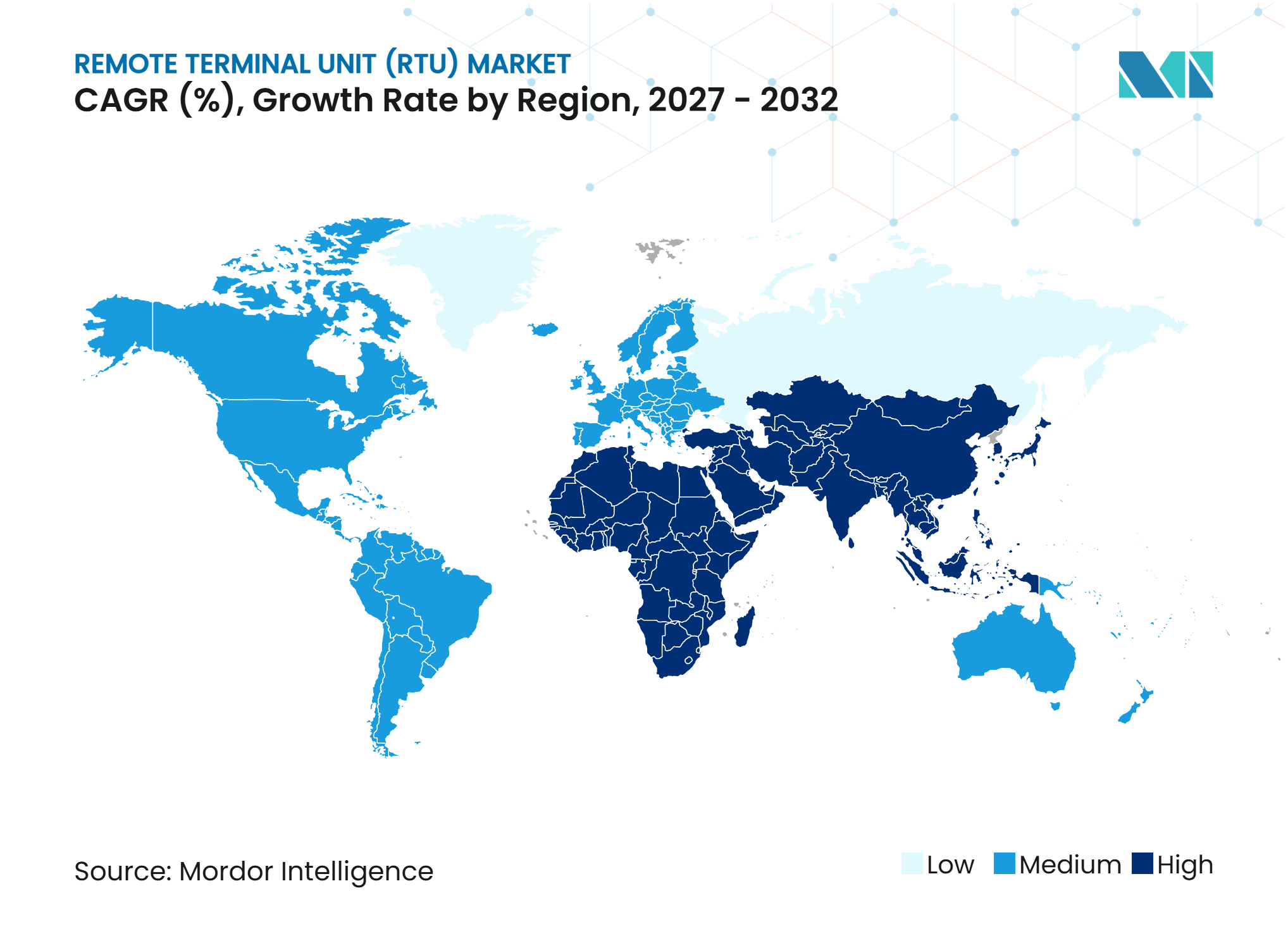
Asia-Pacific held 37.89% of the Remote Terminal Unit (RTU) Market share in 2026 and is projected to expand at a CAGR of 6.68% through 2032. India is a major contributor because the RDSS sanctioned a significant amount for SCADA and DMS works across 394 towns. A further significant amount was targeted for full smart-distribution upgrades in 7 cities, including SCADA and advanced automation. Regional demand combines grid investment with renewable integration and the digitization of distribution. China is pursuing broader grid telemetry coverage as it integrates renewable capacity in line with its dual-carbon policy. Domestic procurement and local validation requirements in India can create opportunities for domestic suppliers. The Remote Terminal Unit (RTU) Market size in Asia-Pacific is supported by the presence of both established infrastructure and large projects that need new field automation. Interoperability, security, and local certification remain important compliance factors for suppliers entering utility tenders.
North America
North American demand is shaped by a large population of aging RTUs and strict operational technology security requirements. PG&E's replacement program for equipment installed from the 1990s reflects broader modernization pressure among utilities that deferred capital spending. The company evaluates equipment based on system functionality, usability, capital economics, and future scalability. CISA, the UK NCSC, and the FBI issued secure connectivity principles for operational technology in January 2026. NERC CIP requirements also influence system design for regulated electric utilities. New wind, solar, and battery projects are driving greenfield demand, particularly for distributed sites that benefit from cloud-managed telemetry. Suppliers that provide secure remote access and support long equipment lifecycles are well positioned in this region.
Europe, the Middle East, South America, and Africa
Europe requires distribution grids to become more digital, real-time monitored, remotely controllable, and cybersecure, strengthening the case for RTU upgrades that support coexistence of IEC 60870-5-104 and IEC 61850. ABB received contracts in October 2025 to modernize automation systems at CNOOC's Buzzard offshore platform and ENGIE's 900 MW Maxima gas-fired power station in the Netherlands.[2] The Middle East continues to invest in energy automation, including ABB's work on ADNOC's Ruwais LNG facility in the UAE. Yokogawa and Aramco commissioned autonomous control agents at the Fadhili Gas Plant in Saudi Arabia during October 2025. South America relies on water infrastructure modernization, pipeline automation, and power expansion in Brazil and Argentina. Africa has lower current deployment but offers a relevant opportunity for solar-powered wireless RTUs where wired systems are not economical. The Remote Terminal Unit (RTU) Market share across these locations is shaped by the different balance between brownfield modernization and new remote infrastructure.
Competitive Landscape
Market Concentration
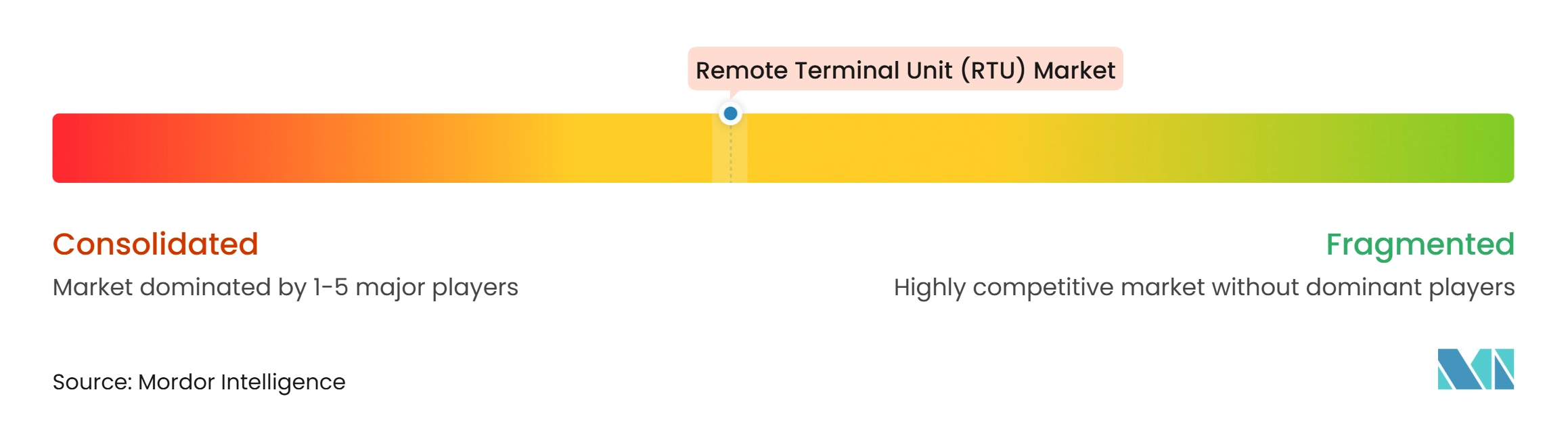
The Remote Terminal Unit (RTU) Market is moderately consolidated among global automation suppliers, while specialist vendors compete in particular verticals and regions. ABB, Emerson, Schneider Electric, and Siemens have strong positions because they combine field hardware with control, software, service, and security capabilities. Leading suppliers are moving from standalone RTUs to platforms that combine measurement, control, communications, and cybersecurity. Emerson expanded the DeltaV FB3000 RTU for hydrocarbon liquids to integrate proving, batch management, and cybersecurity-focused functionality on a common platform. This supports use in pipelines, terminals, storage, and production assets. It also addresses the operational complexity caused by separate systems for liquids measurement, control, and communications.
Schneider Electric added role-based access control to the SCADAPack 470i and 474i, which enables utilities and pipeline operators to apply standard identity and network controls at the RTU level.[3] Nozomi Networks and Schneider Electric also embedded the Nozomi Arc sensor in SCADAPack 47xi smart RTUs to provide process-level visibility and anomaly detection. ABB's Automation Extended offers a phased modernization model that lets operators add digital capabilities while preserving system continuity. These moves show that cybersecurity and gradual modernization have become central competitive features. They also increase the importance of lifecycle service capabilities.
Regional suppliers can gain ground where local procurement rules or domestic certification determine eligibility. India's RDSS framework and its interest in indigenous SCADA technologies can strengthen local reference projects. Similar domestic procurement dynamics can limit the addressable utility market for international suppliers in China. NERC CIP in North America, IEC 62443 in Europe, and emerging operational technology frameworks in Asia-Pacific and the Middle East raise the baseline for security readiness. Smaller water utilities in emerging markets remain a relevant opportunity for cloud-managed wireless services because they often lack large information technology teams and capital for conventional on-premise systems. The competitive environment therefore mixes installed-base advantages with demand for flexible deployment, protocol support, and security compliance.
Remote Terminal Unit (RTU) Industry Leaders
-
ABB Ltd
-
Schneider Electric SE
-
Siemens AG
-
Rockwell Automation, Inc.
-
Emerson Electric Co.
- *Disclaimer: Major Players sorted in no particular order
Remote Terminal Unit (RTU) Market Companies Covered in this Report
- ABB Ltd
- General Electric Company
- Schneider Electric SE
- Siemens AG
- Honeywell International Inc.
- Emerson Electric Co.
- Rockwell Automation, Inc.
- Motorola Solutions, Inc.
- Advantech Co., Ltd.
- Yokogawa Electric Corporation
- Red Lion Controls, LLC
- Schweitzer Engineering Laboratories, Inc.
- Arteche Lantegi Elkartea, S.A.
- Bausch Datacom NV
- RACO Manufacturing and Engineering Co.
- High Tide Technologies, LLC
- AccuDose, LLC
- eLynx Technologies, Inc.
- CSE-Semaphore
- Servelec Technologies Limited
Recent Industry Developments in Remote Terminal Unit (RTU) Market
- November 2026: Emerson announced enhancements to its DeltaV FB3000 RTU to support hydrocarbon liquids operations, adding integrated liquids proving through the Advanced Pulse Module, batch management, and measurement-control-communications on a single Zero Trust-centered, cybersecure-by-design platform. The release addresses a persistent gap in midstream custody transfer, historically requiring separate measurement, control, and communications systems, and standardizes liquids and gas operations on 1 scalable architecture across pipelines, terminals, storage, and production assets.
- August 2026: India's Central Electricity Authority committee issued a report recommending a phased roadmap to develop and deploy indigenous SCADA and Energy Management System technologies, including RTUs, workstations, and servers, for India's power grid. The committee proposed pilot projects at State and Regional Load Despatch Centres and the National Load Despatch Centre, with government-funded testing infrastructure and dedicated Grid India oversight, positioning domestic procurement channels as a structural growth driver for local RTU suppliers.
- February 2026: Siemens and Mescada announced deployment of 1 of Australia's largest AI-ready, cloud-based SCADA systems for Global Power Generation Australia, connecting 8 renewable energy generation and storage assets across New South Wales, Victoria, Western Australia, and the Australian Capital Territory through 300,000 data tags. The system is designed for horizontal scalability to support GPGA's planned expansion from 1.4 GW to 3 GW installed capacity, with planned direct integration with the Australian Energy Market Operator.
- February 2026: ABB launched its Automation Extended program, a strategic evolution of its distributed control system portfolio designed to let industries modernize automation infrastructure progressively, preserving system integrity while enabling AI, analytics, and IIoT integration, without operational disruption. The program addresses the brownfield RTU and DCS replacement challenge by separating control-core upgrades from digital capability additions, reducing single-event capital commitment for utility and industrial operators.
Global Remote Terminal Unit (RTU) Market Report Scope
The Remote Terminal Unit RTU) market covers microprocessor-based electronic controllers that connect physical field equipment, such as sensors, valves, and switches, to supervisory control and data acquisition SCADA or distributed control systems through wired or wireless networks. RTUs include processors, input and output modules, communication ports, power supplies, enclosures, and data logging functions. Designed for rugged, remote, and low-power environments, RTUs collect telemetry data, execute local control logic, monitor alarms, and transmit operating data to central control systems. They use communication protocols such as Distributed Network Protocol 3 DNP3, Modbus, International Electrotechnical Commission 61850 IEC 61850, and Message Queuing Telemetry Transport MQTT. RTUs support remote monitoring and control across utilities, oil and gas pipelines, water treatment facilities, and infrastructure applications.
The Remote Terminal Unit (RTU) Market Report is Segmented by Product Type (Wired RTU, Wireless RTU, and Hybrid RTU), Component (Hardware, Software, and Services), Deployment Mode (On-Premise, Cloud-Based, and Hybrid), End-User Industry (Oil and Gas, Manufacturing, Mining and Metals, Water and Wastewater, Chemical and Petrochemical, Transportation and Logistics, and Other End-User Industries), and Geography (North America, South America, Europe, Asia-Pacific, Middle East, and Africa). The Market Forecasts are Provided in Terms of Value (USD).
Segmentation Overview
| Wired RTU |
| Wireless RTU |
| Hybrid RTU |
| Hardware |
| Software |
| Services |
| On-Premise |
| Cloud-Based |
| Hybrid |
| Oil and Gas |
| Manufacturing |
| Mining and Metals |
| Water and Wastewater |
| Chemical and Petrochemical |
| Transportation and Logistics |
| Other End-User Industries |
| North America | United States |
| Canada | |
| Mexico | |
| South America | Brazil |
| Argentina | |
| Rest of South America | |
| Europe | Germany |
| United Kingdom | |
| France | |
| Italy | |
| Spain | |
| Rest of Europe | |
| Asia-Pacific | China |
| India | |
| Japan | |
| South Korea | |
| Rest of Asia-Pacific | |
| Middle East | Saudi Arabia |
| United Arab Emirates | |
| Turkey | |
| Rest of Middle East | |
| Africa | South Africa |
| Rest of Africa |
| By Product Type | Wired RTU | |
| Wireless RTU | ||
| Hybrid RTU | ||
| By Component | Hardware | |
| Software | ||
| Services | ||
| By Deployment Mode | On-Premise | |
| Cloud-Based | ||
| Hybrid | ||
| By End-User Industry | Oil and Gas | |
| Manufacturing | ||
| Mining and Metals | ||
| Water and Wastewater | ||
| Chemical and Petrochemical | ||
| Transportation and Logistics | ||
| Other End-User Industries | ||
| By Geography | North America | United States |
| Canada | ||
| Mexico | ||
| South America | Brazil | |
| Argentina | ||
| Rest of South America | ||
| Europe | Germany | |
| United Kingdom | ||
| France | ||
| Italy | ||
| Spain | ||
| Rest of Europe | ||
| Asia-Pacific | China | |
| India | ||
| Japan | ||
| South Korea | ||
| Rest of Asia-Pacific | ||
| Middle East | Saudi Arabia | |
| United Arab Emirates | ||
| Turkey | ||
| Rest of Middle East | ||
| Africa | South Africa | |
| Rest of Africa | ||
Key Questions Answered in the Report
What is the Remote Terminal Unit (RTU) market size?
The Remote Terminal Unit (RTU) market is projected to expand from USD 3.64 billion in 2026 and USD 3.83 billion in 2027 to USD 5.03 billion by 2032, at a CAGR of 5.59%.
Which product type leads remote terminal unit adoption?
Wired RTUs led product demand with 62.14% share in 2026 because substations, pipelines, and water facilities require dependable communications and established protocol support.
Which deployment model is advancing fastest for RTUs?
Cloud-based deployment is projected to expand at a CAGR of 7.64% through 2032, supported by dispersed renewable and water assets.
Why are water and wastewater operators adopting RTUs?
Water and Wastewater is projected to expand at a CAGR of 6.31% through 2032 because utilities are replacing aging assets and extending monitoring to remote locations.
Which region has the strongest RTU outlook?
Asia-Pacific held 37.89% share in 2026 and is projected to expand at a CAGR of 6.68% through 2032, supported by grid modernization and renewable integration.
What security requirements affect RTU procurement?
IEC 62443, NERC CIP, and secure connectivity principles influence product selection, remote access design, and lifecycle service needs.