
Remote Patient Monitoring Software Market Size and Share
Market Overview
| Study Period | 2020 - 2031 |
|---|---|
| Market Size (2026) | USD 20.73 Billion |
| Market Size (2031) | USD 84.17 Billion |
| Growth Rate (2026 - 2031) | 32.35 % |
| Fastest Growing Market | Asia-Pacific |
| Largest Market | North America |
| Market Concentration | Medium |
Major Players *Disclaimer: Major Players sorted in no particular order Image © Mordor Intelligence. Reuse requires attribution under CC BY 4.0. | |
Remote Patient Monitoring Software Market Analysis by Mordor Intelligence
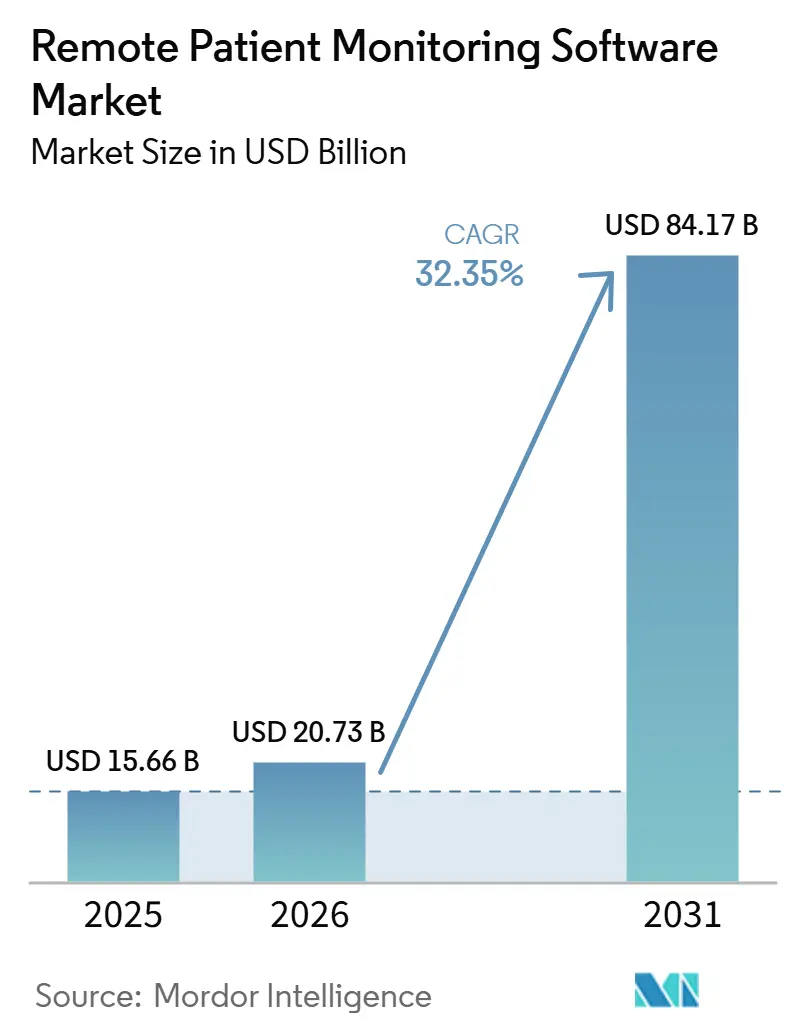
The Remote Patient Monitoring Software Market size was valued at USD 15.66 billion in 2025 and is estimated to grow from USD 20.73 billion in 2026 to reach USD 84.17 billion by 2031, at a CAGR of 32.35% during the forecast period (2026-2031).
The remote patient monitoring software market is shifting toward care models that use continuous patient data to support outcome-based payments. CMS launched the 10-year ACCESS Model on July 5, 2026, linking payments to measurable improvements across chronic conditions and increasing demand for reliable patient monitoring systems.[1]Centers for Medicare & Medicaid Services, “CMS Launches ACCESS Model,” CMS Innovation Center, cms.gov. Providers need software that documents outcomes over time, not just collects readings. Data security, clinical workflow integration, reimbursement rules, and operating models that combine technology, clinical oversight, device management, and patient escalation will determine platform scalability across health systems and countries.
Key Report Takeaways
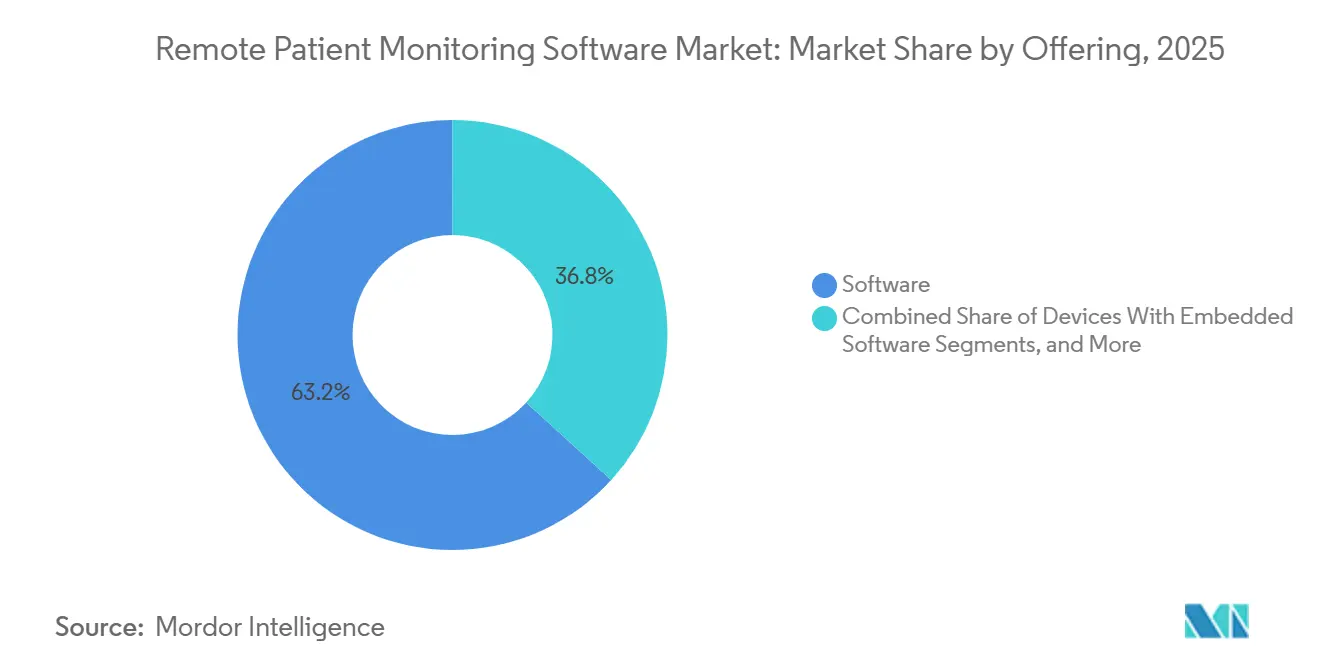
- By offering, software held 63.22% revenue share in 2025, while services are projected to grow at a 33.93% CAGR through 2031.
- By software deployment, cloud-based systems held 58.77% revenue share in 2025, while hybrid deployment is projected to grow at a 34.86% CAGR through 2031.
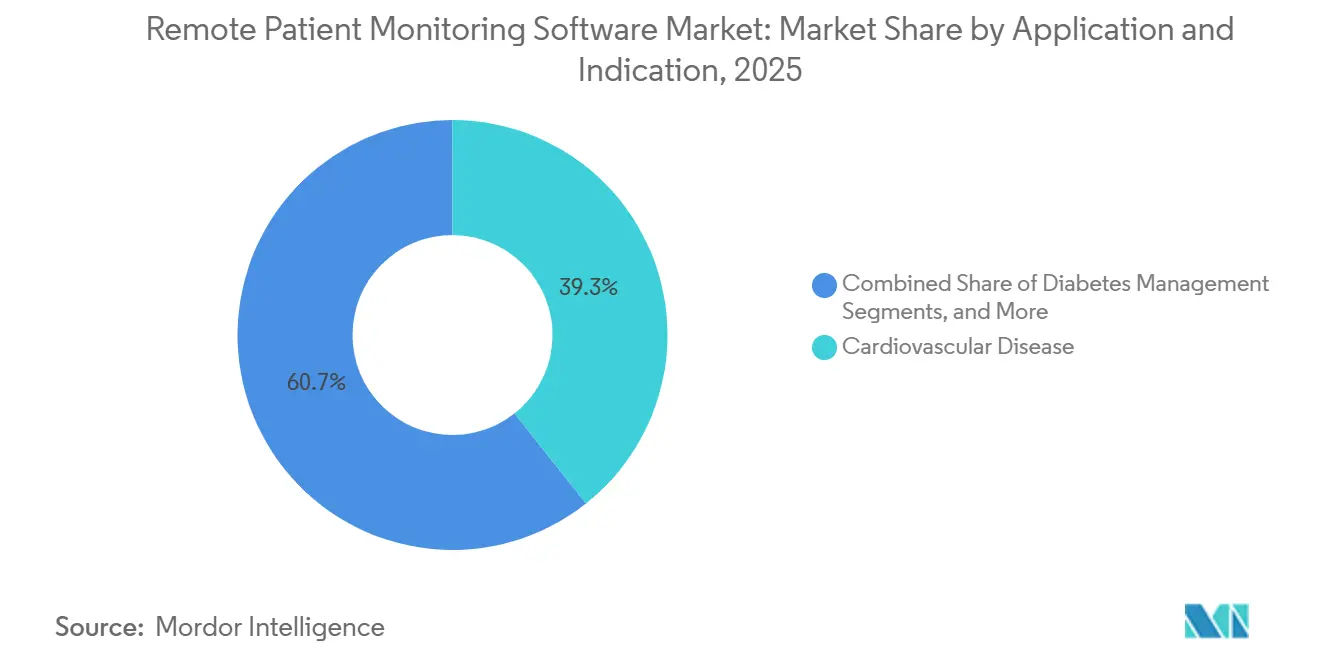
- By application and indication, cardiovascular disease held 39.34% revenue share in 2025, while respiratory and pulmonary disorders are projected to grow at a 35.98% CAGR through 2031.
- By data type, blood pressure held 32.88% revenue share in 2025, while heart rate and electrocardiogram data are projected to grow at a 34.34% CAGR through 2031.
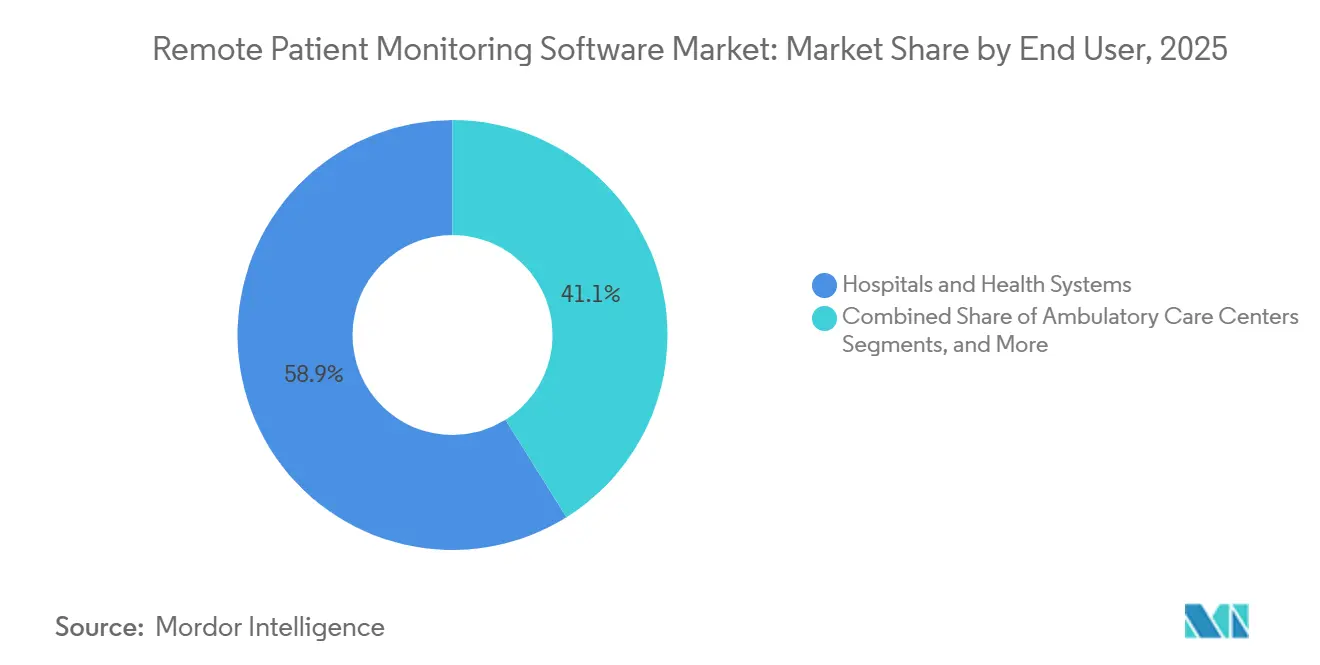
- By end user, hospitals and health systems held 58.89% revenue share in 2025, while home healthcare providers are projected to grow at a 33.45% CAGR through 2031.
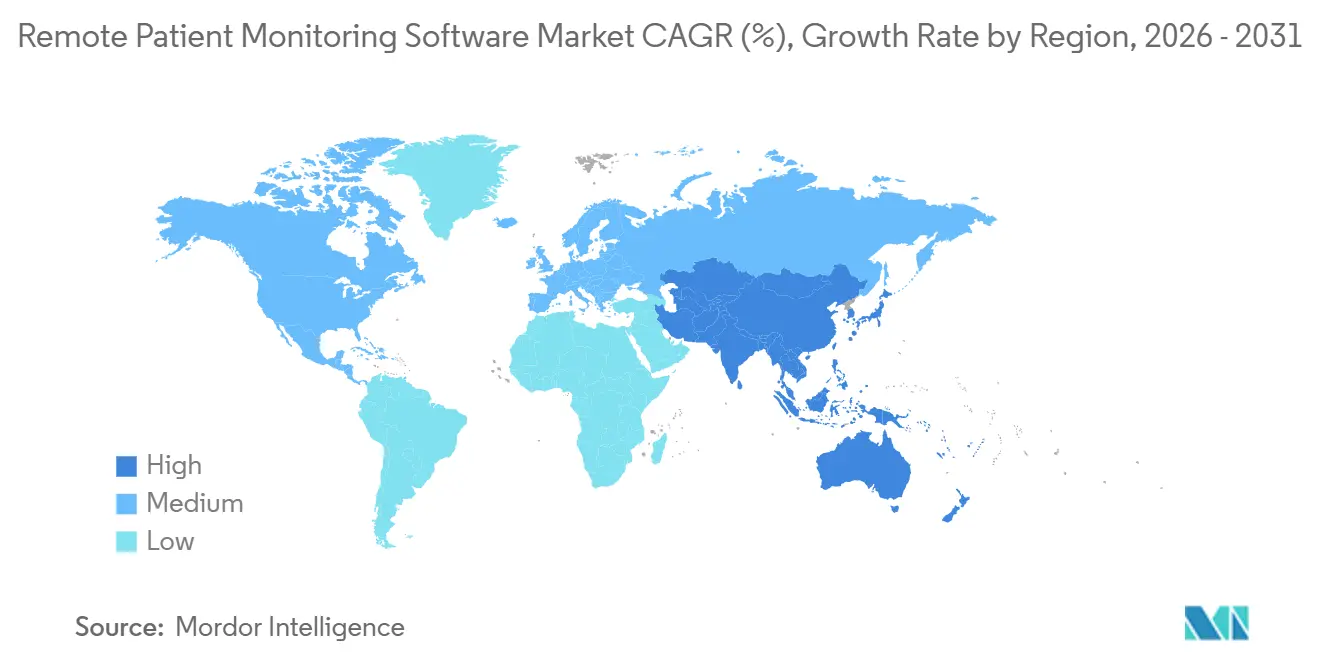
- By geography, North America held 42.76% revenue share in 2025, while Asia-Pacific is projected to grow at a 34.56% CAGR through 2031.
Note: Market size and forecast figures in this report are generated using Mordor Intelligence’s proprietary estimation framework, updated with the latest available data and insights as of January 2026.
Market Trends and Insights
Drivers Impact Analysis of Remote Patient Monitoring Software Market*
| DRIVER | (~) % IMPACT ON CAGR FORECAST | GEOGRAPHIC RELEVANCE | IMPACT TIMELINE |
|---|---|---|---|
| Value-based care adoption | +5.2% | North America, Western Europe, Australia | Medium term (2-4 years) |
| Home-based and hospital-at-home care expansion | +4.8% | Global, concentrated in North America and APAC | Medium term (2-4 years) |
| Chronic disease burden and population aging | +4.2% | Global, accelerated impact in APAC and MEA | Long term (≥ 4 years) |
| Connected sensors and AI risk stratification | +3.8% | North America, APAC core, spillover to Europe | Long term (≥ 4 years) |
| Patient data interoperability | +3% | North America and EU | Medium term (2-4 years) |
| Shorter-interval monitoring reimbursement | +2.6% | United States, early gains in Canada and Germany | Short term (≤ 2 years) |
| Source: Mordor Intelligence | |||
Rising Adoption of Value-Based Care
Value-based payment models increased the need for continuous patient data, as providers had to demonstrate outcomes rather than only document activity. CMS launched the ACCESS Model on July 5, 2026, as a voluntary 10-year program for chronic-condition care. Outcome-Aligned Payments required providers to meet guideline-based targets for enrolled patients, increasing the value of software that tracked health measures over time. The model positioned the remote patient monitoring software market closer to a core care-management function within participating organizations, while the 2026 ACO REACH cycle also supported virtual and remote monitoring for quality performance.
Shorter-Interval Monitoring Enabling New Reimbursement Pathways
The CMS CY 2026 Physician Fee Schedule final rule expanded the reimbursement structure for the remote patient monitoring software market. The rule introduced CPT 99445 for device supply with 2 to 15 days of data transmission and CPT 99470 for the first 10 minutes of treatment management. CPT 99445 paid USD 52.11 per month, while CPT 99470 paid USD 26.05 per month, removing the prior 16-day threshold that excluded many older, cognitively impaired, post-acute, and less adherent patients.[2]Centers for Medicare & Medicaid Services, “Medicare and Medicaid Programs, CY 2026 Payment Policies Under the Physician Fee Schedule,” Federal Register, federalregister.gov. A practice enrolling 500 newly eligible patients could generate USD 39,000 in monthly revenue from these two codes, while Germany had 64 approved DiGA applications by the end of 2025, with more than EUR 125 million in statutory insurance reimbursements, equal to USD 137 million at the 2025 average exchange rate.
Increasing Chronic Disease Burden and Aging Population
Cardiovascular disease, diabetes, and respiratory conditions created sustained demand for remote care tools across the remote patient monitoring software market. Japan’s population aged 65 and older represented 32% of residents in 2024, supporting demand for care models across hospitals and homes. A 2025 study found that remote monitoring improved glycemic control for people with diabetes and could reduce the need for face-to-face appointments. China’s digital health pilot zones in Shanghai and Hangzhou supported localized data processing for connected platforms, while patients with multiple chronic conditions increased the need to combine readings, clinical context, and patient follow-up in a single care process.[3]A Successful Remote Patient Monitoring Program for Diabetes,” Frontiers in Endocrinology, frontiersin.org.
Advances in Connected Sensors and AI-Based Risk Stratification
Smaller medical sensors and improved clinical decision support changed how the remote patient monitoring software market managed continuous data. A 2026 study reported that multimodal large language models used with wearable ECG data could support early ischemia warning and reperfusion risk assessment.[4]Digital Alert Fatigue and Escalation Behaviours in Nurse-Led Remote Postoperative Care,” BMC Nursing, springer.com. The FDA’s March 2026 guidance on secure product development for medical devices raised cybersecurity expectations throughout the product life cycle. OMRON Healthcare reported that remotely monitored vital signs supported early medical intervention in more than 33% of heart failure study participants, favoring platforms that converted high-frequency readings into clinically useful follow-up.
Restraints Impact Analysis of Remote Patient Monitoring Software Market*
| RESTRAINT | (~) % IMPACT ON CAGR FORECAST | GEOGRAPHIC RELEVANCE | IMPACT TIMELINE |
|---|---|---|---|
| Fragmented reimbursement and billing requirements | -2.8% | Global, concentrated in Europe and South America | Medium term (2-4 years) |
| Cybersecurity, privacy, and data localization exposure | -1.9% | Global | Short term (≤ 2 years) |
| Alert fatigue and clinician workflow burden | -1.4% | Global | Short term (≤ 2 years) |
| Inconsistent clinical evidence across patient groups | -1% | Global, acute in European payer markets | Long term (≥ 4 years) |
| Source: Mordor Intelligence | |||
Cybersecurity, Privacy, and Data-Localization Exposure
Remote monitoring systems create broad exposure because they continuously transmit and store patient data. HHS proposed major updates to the HIPAA Security Rule on January 6, 2025, including multifactor authentication, encryption, network segmentation, and vulnerability scans at least twice a year. These requirements can increase operating costs for smaller vendors that lack established security capabilities. European health data portability rules and country-level hosting requirements add complexity, and platforms designed for the U.S. cloud environment may require substantial redesign to serve Germany or France, extending entry timelines by 12 to 24 months and reducing global deployment efficiency.
Alert Fatigue and Clinician Workflow Burden
Alert fatigue remains a direct operational challenge for the remote patient monitoring software market because it affects clinicians at the point of care. A 2026 study on home monitoring found that continuous vital-sign systems can generate more alerts than clinical teams can process when they use simple threshold-based designs. A 2025 review reported false-positive rates of 80% to 90% in clinical monitoring settings, while a 2026 nursing study linked digital alert fatigue with lower proactive escalation behavior in nurse-led remote care. This can create patient safety concerns and lead remote patient monitoring software market buyers to delay program rollouts, while systems that assess patient-specific trends before notifying clinicians can reduce unnecessary alerts and support staff acceptance.
*Our forecasts treat driver/restraint impacts as directional, not additive. The impact forecasts reflect baseline growth, mix effects, and variable interactions.
Remote Patient Monitoring Software Market Segment Analysis
By Offering:
Services Gain Ground in Program OperationsSoftware held 63.22% of the remote patient monitoring software market size in 2025, supported by earlier investments in platform infrastructure across U.S. hospitals, payer programs, and European reimbursement pilots. Services are projected to grow at a CAGR of 33.93% through 2031. Growth in the remote patient monitoring software market is shifting toward managed-service contracts, where vendors operate programs for health systems.
A software-only contract generally follows a per-patient subscription model, while managed-service arrangements combine licensing with clinical and operational support. This structure can increase total contract value by 2 to 3 times. Providers adopting outcome-based care models may prefer vendors that can deliver round-the-clock clinical support. As a result, the remote patient monitoring software industry is seeing stronger demand for integrated operating capabilities than for stand-alone licenses.



By Software Deployment:
Hybrid Systems Balance Scale and Data ControlCloud-based deployment held 58.77% of the remote patient monitoring software market size in 2025. Hospitals use cloud systems to scale capacity, receive regular updates, and manage large data volumes. Hybrid deployment is projected to grow at a CAGR of 34.86% through 2031, as health systems seek cloud flexibility while maintaining control over sensitive patient information.
Oracle Health ended support for FHIR DSTU2 in Cerner by December 2025 and moved customers toward FHIR R4. This shift supports hybrid models for hospitals that still operate on-premises HL7 v2 systems while using modern APIs for remote monitoring data. On-premises systems continue to serve high-security government and military settings and remain relevant where real-time cardiac monitoring cannot tolerate network delays. France’s 2026-2028 telemedicine roadmap required integration with the national electronic health record environment, supporting modular systems that combine edge processing, cloud analysis, and local storage.
By Application and Indication:
Respiratory Care Broadens the Clinical MixCardiovascular disease accounted for 39.34% of the remote patient monitoring software market share in 2025. Cardiac monitoring benefits from established clinical evidence and mature reimbursement pathways. Diabetes management uses continuous glucose-monitoring data that meets CMS eligibility criteria under CPT 99454, while oncology teams use activity, sleep, and weight information to identify possible toxicity between infusion appointments.
Respiratory and pulmonary disorders are forecast to grow at a CAGR of 35.98% through 2031. Withings acquired Biosency in June 2026, adding a medically certified COPD exacerbation detection algorithm to its respiratory monitoring portfolio. Home spirometry, nighttime oxygen-saturation data, and smart inhaler sensors are supporting broader COPD and asthma monitoring. Cardiovascular care is likely to retain the largest revenue base, while respiratory coverage reduces its share lead over time.
By Data Type:
ECG Data Supports More Detailed Risk AssessmentBlood pressure accounted for 32.88% of the data-type share in 2025. Hypertension remains widespread, and Bluetooth-enabled cuffs reduce device acquisition costs to below USD 30 per patient. Heart rate and electrocardiogram data are forecast to grow at a CAGR of 34.34% through 2031, supported by wider access to patch-based ECG sensors after multiple FDA 510(k) clearances in 2024 and 2025.
A 2026 study found that Apple Watch-based algorithms could monitor heart failure exacerbations in a near-continuous manner. This finding supports the use of consumer wearables in clinical monitoring programs. Blood glucose remains important, especially where continuous glucose-monitoring streams are integrated into multi-parameter platforms. Platforms that combine ECG, oxygen saturation, and mobility data may reduce false alerts compared with single-measurement systems.
By End User:
Home Healthcare Providers Extend Monitoring Beyond HospitalsHospitals and health systems held 58.89% of the end-user segment in 2025, supported by established patient relationships, billing operations, and clinical infrastructure. The CMS 2026 payment rule widened the eligible population for hospital-affiliated programs by reducing monitoring thresholds. Ambulatory care centers and physician practices remain important users, while CPT 99470 provides USD 26.05 for the first 10 minutes of treatment management.
Home healthcare providers are forecast to grow at a CAGR of 33.45% through 2031. This growth reflects the shift of post-acute and chronic monitoring in the remote patient monitoring software market from institutions to patients’ homes. Health Recovery Solutions acquired Rimidi in March 2026 to combine remote monitoring with diabetes and cardiometabolic care capabilities. Long-term care and assisted-living facilities also use monitoring for fall risk, cognitive decline, and medication adherence.
Geography Analysis
North America Remote Patient Monitoring Software Market
North America held 42.76% of the remote patient monitoring software market share in 2025, supported by Medicare coverage, integrated delivery networks, and established billing structures. The United States remained the largest regional contributor, backed by the 10-year ACCESS Model for chronic-condition care. Canada developed provincial telehealth reimbursement programs, although coverage varied by province. Mexico remained at an earlier stage, with private hospital networks in Monterrey and Mexico City deploying remote monitoring through employer-sponsored insurance offerings.
Europe and APAC Remote Patient Monitoring Software Market
Europe relied on country-specific reimbursement systems, which made deployment more complex. Germany began rolling out its opt-out electronic patient record in January 2025, creating a national health-data framework to improve data exchange. The Hospital Future Fund supported cybersecurity and interoperability improvements across 1,900 German hospitals. France adopted its 2026 Social Security Finance Act in December 2025, linking some digital health financing to documented savings for Assurance Maladie. Asia-Pacific is forecast to grow at a CAGR of 34.56% through 2031, led by digital health activity in China, India, Japan, and South Korea.
MEA and South America Remote Patient Monitoring Software Market
The Middle East and Africa developed from a smaller base, supported by smart-hospital investments in the Gulf states and the UAE’s digital health strategy. South Africa and selected francophone African countries emerged as users of hybrid systems operating through mobile networks. Brazil and Argentina led South America, where private health operators were key purchasers. Brazil’s ANVISA framework and Argentina’s private insurance groups served as central entry points for suppliers, while reimbursement precedent, infrastructure investment, and regulatory maturity will determine adoption through 2031.

Competitive Landscape
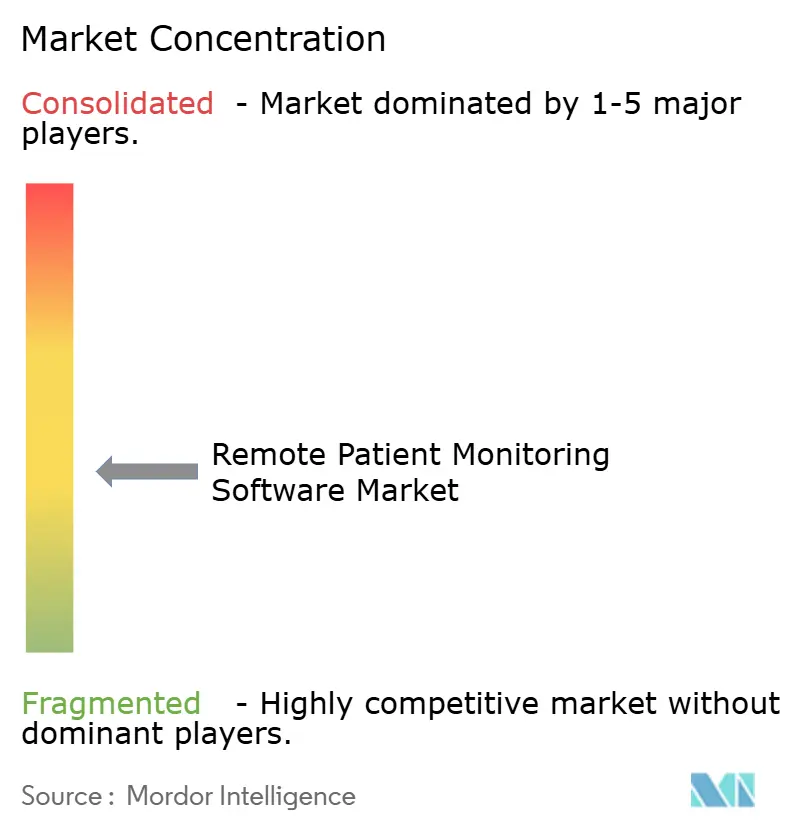
The remote patient monitoring software market is moderately fragmented at the platform level. Medtronic, Philips, GE HealthCare, and Abbott leverage device distribution relationships and clinical credibility to bundle software with hardware. Platform-focused suppliers differentiate through interoperability and total cost of ownership. Alert quality remains a key purchasing criterion, as clinical teams must act on received alerts. Vendors that validate low false-positive alert rates can strengthen their position in enterprise procurement. Cardioline acquired Cardios in Brazil in April 2026, adding local Holter monitoring and ambulatory blood pressure capabilities to its telecardiology footprint.
Opportunities remain in pediatric monitoring, multi-condition management, and rural Asia-Pacific settings. Pediatric use cases require stronger clinical evidence and regulatory support. Multi-condition systems can integrate cardiovascular, metabolic, and respiratory readings into a single clinical workflow. Mobile-first designs can reach communities with limited access to specialists or fixed broadband. ISO 13485 quality system compliance and national medical device rules remain meaningful entry barriers, supporting vendors with regulatory clearances across multiple markets.
Competition also reflects a shift toward integrated care management platforms. ChartSpan acquired Validic in June 2026, combining chronic care management services with health data APIs and device logistics. Withings added Biosency in June 2026 to expand its respiratory monitoring capabilities. Health Recovery Solutions added Rimidi to strengthen its diabetes and cardiometabolic care offering. The supplied material does not report the combined share of the top players in the remote patient monitoring software industry; therefore, a market concentration score cannot be calculated using the specified share-based method.
Remote Patient Monitoring Software Industry Leaders
GE HealthCare Technologies Inc.
Koninklijke Philips N.V.
Medtronic plc
Siemens Healthineers AG
Teladoc Health, Inc.
- *Disclaimer: Major Players sorted in no particular order
Remote Patient Monitoring Software Market Companies Covered in this Report
- Abbott Laboratories
- American Well
- Baxter
- BioIntelliSense, Inc.
- Boston Scientific
- CareSimple Inc.
- Dexcom
- GE HealthCare Technologies Inc.
- Health Recovery Solutions, Inc.
- Koninklijke Philips
- Medtronic
- Nihon Kohden
- OMRON Healthcare, Inc.
- Optum
- Oracle
- Siemens Healthineers
- Teladoc Health
- Validic Inc.
- VitalConnect, Inc.
- VivaLNK, Inc.

Recent Industry Developments in Remote Patient Monitoring Software Market
- June 2026: Withings acquired Biosency, strengthening its remote monitoring capabilities for respiratory insufficiency and COPD exacerbation detection.
- June 2026: Cardioline acquired Cardios in São Paulo, Brazil, from Halma, combining its telecardiology presence across more than 85 countries with Cardios’ Holter monitoring and ambulatory blood-pressure expertise.
- March 2026: Health Recovery Solutions acquired Rimidi, adding diabetes and cardiometabolic clinical algorithms to its remote monitoring platform.
- July 2025: Cardiosense received FDA 510(k) clearance for CardioTag, a wearable sensor that captures ECG, PPG, and seismocardiogram signals.


Global Remote Patient Monitoring Software Market Report Scope
As per the scope of the report, Remote patient monitoring (RPM) software is a digital platform that collects physical health data from patients at home using connected medical tools, sends it safely to doctors, and turns it into care and billing. Key elements include connected devices, secure data sharing, and automated alerts.
The remote patient monitoring software market is segmented by offering, software deployment, application and indication, data type, end user, and geography. By offering, the market includes software, devices with embedded software, and services. By software deployment, the market is segmented into cloud-based, on-premises, and hybrid. By application and indication, the market is categorized into cardiovascular disease, diabetes management, respiratory and pulmonary disorders, chronic obstructive pulmonary disease, asthma, oncology, and others. By data type, the market includes blood pressure, blood glucose, weight, oxygen saturation, heart rate and electrocardiogram, temperature, respiratory rate, activity, mobility, and sleep data, and others. By end user, the market is segmented into healthcare providers, hospitals and health systems, ambulatory care centers, physician practices, home healthcare providers, long-term care and assisted living facilities, and others. By geography, the market is analyzed across North America, Europe, Asia-Pacific, the Middle East and Africa, and South America. The report also covers the estimated market sizes and trends for 17 countries across major regions globally. The report offers the market sizes and forecasts in terms of value (USD) for the above segments.
| Software |
| Devices With Embedded Software |
| Services |
| Cloud-Based |
| On-Premises |
| Hybrid |
| Cardiovascular Disease |
| Diabetes Management |
| Respiratory and Pulmonary Disorders |
| Chronic Obstructive Pulmonary Disease |
| Asthma |
| Oncology |
| Others |
| Blood Pressure |
| Blood Glucose |
| Weight |
| Oxygen Saturation |
| Heart Rate and Electrocardiogram |
| Temperature |
| Respiratory Rate |
| Activity, Mobility and Sleep Data |
| Others |
| Healthcare Providers |
| Hospitals and Health Systems |
| Ambulatory Care Centers |
| Physician Practices |
| Home Healthcare Providers |
| Long-Term Care and Assisted Living Facilities |
| Others |
| North America | United States |
| Canada | |
| Mexico | |
| Europe | Germany |
| United Kingdom | |
| France | |
| Italy | |
| Spain | |
| Rest of Europe | |
| Asia-Pacific | China |
| India | |
| Japan | |
| Australia | |
| South Korea | |
| Rest of Asia-Pacific | |
| Middle East and Africa | GCC |
| South Africa | |
| Rest of Middle East and Africa | |
| South America | Brazil |
| Argentina | |
| Rest of South America |
| By Offering | Software | |
| Devices With Embedded Software | ||
| Services | ||
| By Software Deployment | Cloud-Based | |
| On-Premises | ||
| Hybrid | ||
| By Application and Indication | Cardiovascular Disease | |
| Diabetes Management | ||
| Respiratory and Pulmonary Disorders | ||
| Chronic Obstructive Pulmonary Disease | ||
| Asthma | ||
| Oncology | ||
| Others | ||
| By Data Type | Blood Pressure | |
| Blood Glucose | ||
| Weight | ||
| Oxygen Saturation | ||
| Heart Rate and Electrocardiogram | ||
| Temperature | ||
| Respiratory Rate | ||
| Activity, Mobility and Sleep Data | ||
| Others | ||
| By End User | Healthcare Providers | |
| Hospitals and Health Systems | ||
| Ambulatory Care Centers | ||
| Physician Practices | ||
| Home Healthcare Providers | ||
| Long-Term Care and Assisted Living Facilities | ||
| Others | ||
| By Geography | North America | United States |
| Canada | ||
| Mexico | ||
| Europe | Germany | |
| United Kingdom | ||
| France | ||
| Italy | ||
| Spain | ||
| Rest of Europe | ||
| Asia-Pacific | China | |
| India | ||
| Japan | ||
| Australia | ||
| South Korea | ||
| Rest of Asia-Pacific | ||
| Middle East and Africa | GCC | |
| South Africa | ||
| Rest of Middle East and Africa | ||
| South America | Brazil | |
| Argentina | ||
| Rest of South America | ||


Key Questions Answered in the Report
What is driving demand for remote patient monitoring software?
Outcome-based reimbursement, home-based care, chronic disease management, connected sensors, and clinical decision support are supporting adoption.
How large is the remote patient monitoring software market?
The remote patient monitoring software market size is USD 20.73 billion in 2026 and is projected to reach USD 84.17 billion by 2031 at a 32.35% CAGR.
Which remote patient monitoring offering is growing fastest?
Services are forecast to grow at a 33.93% CAGR through 2031 as providers seek clinical oversight and program operations alongside software.
Which clinical use is expanding fastest?
Respiratory and pulmonary disorders are forecast to grow at a 35.98% CAGR through 2031.
Which region is growing fastest for remote patient monitoring software?
Asia-Pacific is forecast to grow at a 34.56% CAGR through 2031, supported by digital-health programs and expanding care needs.
What challenges affect remote monitoring adoption?
Security requirements, data-localization rules, fragmented reimbursement, and alert fatigue can raise costs and slow clinical implementation.
Page last updated on:


 Your data is secure and never sold or shared.


