
Remote Inspection Platforms Market Size and Share
Market Overview
| Study Period | 2020 - 2031 |
|---|---|
| Market Size (2026) | USD 2.56 Billion |
| Market Size (2031) | USD 4.24 Billion |
| Growth Rate (2026 - 2031) | 10.62 % |
| Fastest Growing Market | Asia-Pacific |
| Largest Market | North America |
| Market Concentration | Medium |
Major Players *Disclaimer: Major Players sorted in no particular order Image © Mordor Intelligence. Reuse requires attribution under CC BY 4.0. | |
Remote Inspection Platforms Market Analysis by Mordor Intelligence
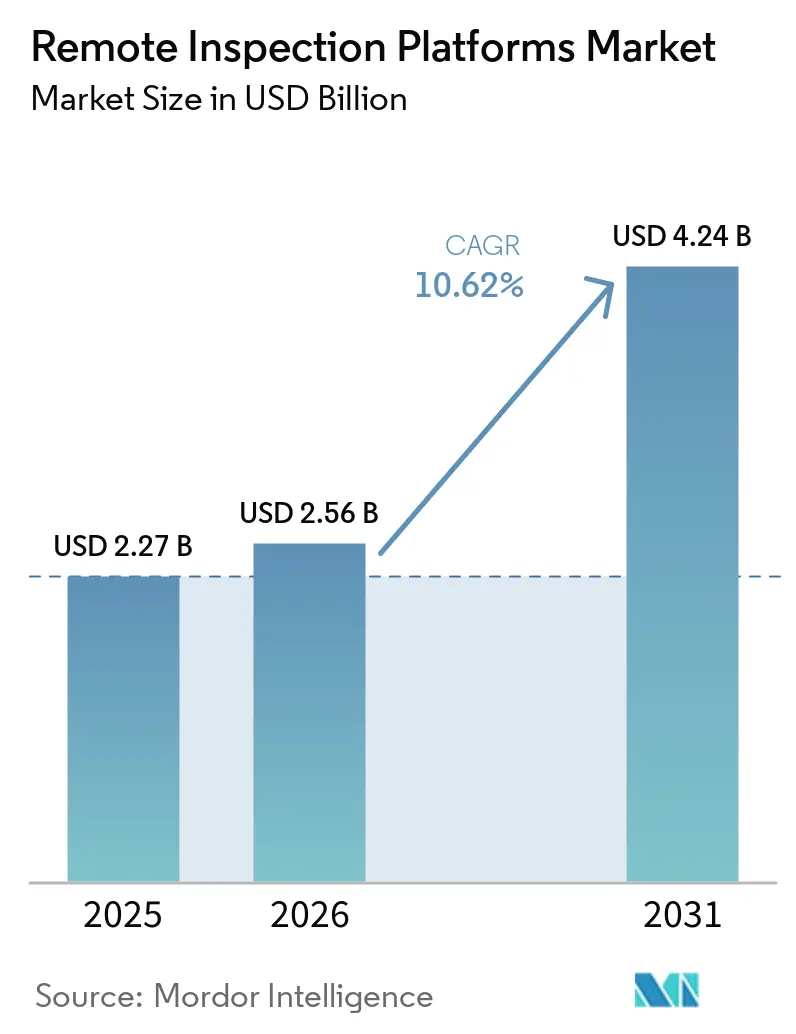
The remote inspection platforms market size was valued at USD 2.27 billion in 2025 and estimated to grow from USD 2.56 billion in 2026 to reach USD 4.24 billion by 2031, at a CAGR of 10.62% during the forecast period (2026-2031). Demand is moving from periodic, manual inspections toward continuous digital records that support maintenance and safety decisions. Lower-cost drones and robots are shifting more value toward software that organizes images, identifies defects, and produces reports. Broader acceptance of beyond visual line of sight operations can extend inspection coverage across linear and hard-to-reach assets. Buyers are also assessing these platforms through maintenance costs, asset life, and operational risk, rather than safety compliance alone. The remote inspection platforms market, therefore, serves construction, energy, manufacturing, real estate, and insurance users who need faster evidence from distributed sites.
Key Report Takeaways
- By component, software held 62.48% of the remote inspection platforms market share in 2025, and is projected to expand at a 11.74% CAGR through 2031.
- By deployment mode, cloud-based platforms held 69.87% of 2025 revenue and are projected to expand at a 12.63% CAGR through 2031.
- By application, construction and infrastructure accounted for 18.07% of 2025 revenue, while insurance and claims assessment is projected to expand at a 13.02% CAGR through 2031 in the remote inspection platforms market.
- By enterprise size, large enterprises held 65.47% of 2025 revenue, while SMEs are projected to expand at a 12.17% CAGR through 2031.
- By end user, contractors and inspection service providers held 28.47% of 2025 revenue, while facility and asset managers are projected to expand at a 12.48% CAGR through 2031.
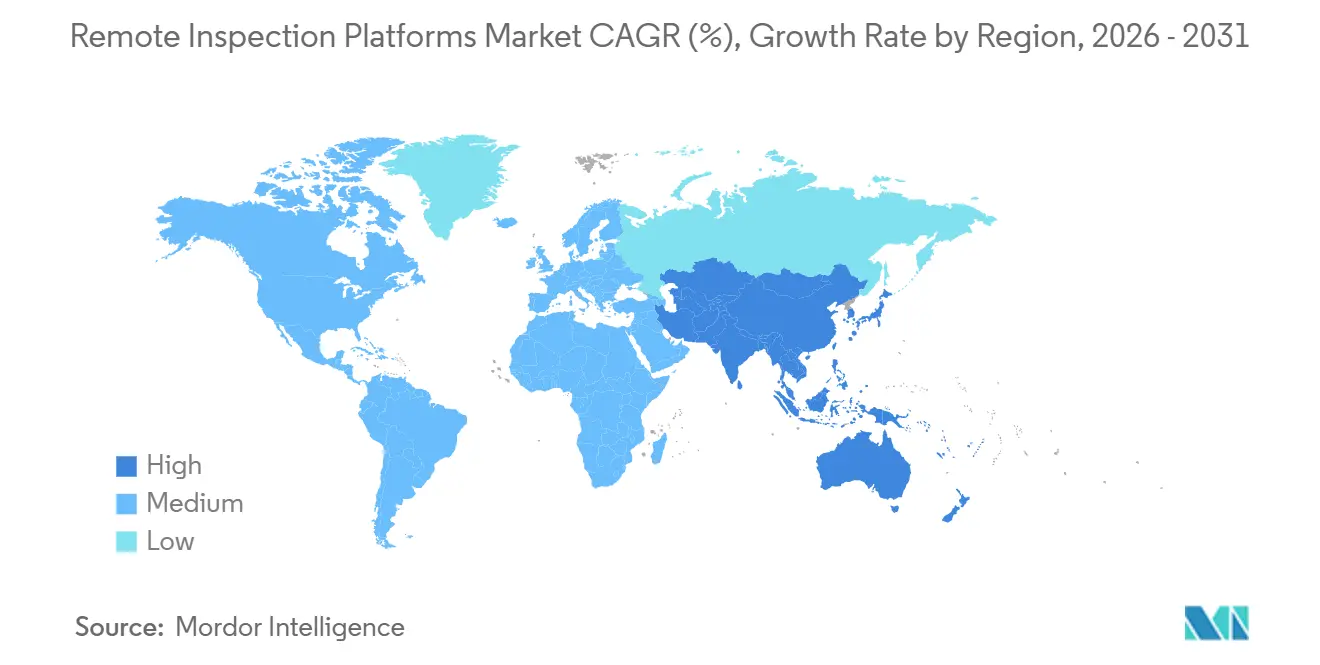
- By geography, North America held 34.12% of 2025 revenue, while Asia-Pacific is projected to expand at a 13.06% CAGR through 2031 in the remote inspection platforms market.
Note: Market size and forecast figures in this report are generated using Mordor Intelligence’s proprietary estimation framework, updated with the latest available data and insights as of January 2026.
Market Trends and Insights
Drivers Impact Analysis of Remote Inspection Platforms Market*
| DRIVER | (~) % IMPACT ON CAGR FORECAST | GEOGRAPHIC RELEVANCE | IMPACT TIMELINE |
|---|---|---|---|
| Integration of AI, Drones, Robotics, and 5G Connectivity | +2.5% | Global | Short term (≤ 2 years) |
| Aging Industrial and Infrastructure Assets | +2.1% | North America, Europe, Asia-Pacific | Medium term (2-4 years) |
| Demand for Safer Inspection of Hazardous and Inaccessible Assets | +1.7% | Global, concentrated in Middle East and North America | Short term (≤ 2 years) |
| Expansion of Digital Twin-Based Inspection | +1.4% | North America, Europe, Asia-Pacific | Medium term (2-4 years) |
| Shift From Shutdown-Based Inspection to Live Asset Monitoring | +1.0% | North America, Europe | Medium term (2-4 years) |
| Acceptance of Tethered and BVLOS Inspection Operations | +0.6% | North America, Europe | Long term (≥ 4 years) |
| Source: Mordor Intelligence | |||
Integration of AI, Drones, Robotics, and 5G Connectivity
The remote inspection platforms market is benefiting from the closer integration of computer vision, aerial platforms, ground robots, and faster network connections. These tools can reduce inspection cycles from weeks to hours by capturing and reviewing visual information more quickly across routine surveillance, planned maintenance, and condition-assessment activities. This supports wider use of the remote inspection platforms market in asset-intensive work. The main competitive issue is increasingly the ability to connect inspection outputs with enterprise asset management and computerized maintenance systems, where findings can be converted into follow-up work and documented decisions. DroneDeploy introduced Inspection AI in October 2025 for oil and gas, rail, renewable energy, and utility assets, using AI agents to review visual data and rank defect severity for asset teams.[1] Amazon Web Services described the use of drones and on-device computer vision for wind turbines, pipelines, and telecom towers, showing that cloud providers are participating in inspection workflows. Toshiba reported in September 2025 that its image anomaly detection approach could halve false positives in infrastructure and plant inspections, which supports more dependable visual analysis across physical assets.
Aging Industrial and Infrastructure Assets
Aging bridges, plants, and other infrastructure are making the remote inspection platforms market more relevant to maintenance planning. Asset owners face a growing need to identify cracks, spalling, and corrosion before a repair becomes more difficult or expensive, particularly where assets are older and replacement budgets remain limited. A 2025 review of autonomous robotic systems found that manual bridge inspections can be subjective, offer limited coverage, and cannot readily access key structural elements.[2] The same limitations create a clear role for drones and robots that collect consistent visual records over time. National Grid deployed centralized autonomous BVLOS drone inspections across its England and Wales transmission network in September 2025 after a 4-year innovation program. That implementation shows that major asset operators can adopt digital inspection at network scale when operational rules and the commercial case are clear.
Demand for Safer Inspection of Hazardous and Inaccessible Assets
The remote inspection platforms market is supported by the need to inspect confined spaces, high-voltage areas, subsea locations, and other difficult sites without putting people in harm’s way. Drone and robotic platforms can capture data where routine physical entry would require more training, protective measures, and operational downtime. A 2026 review found that UAV infrared thermography can provide noncontact thermal diagnostics across large built assets, although the results are often not connected to interoperable digital asset records. Software platforms can address this gap by linking image data to building information models and digital asset records. Flyability completed a SOC 2 Type II examination for its Inspector Online cloud platform in March 2026, reflecting the importance of security and audit controls for nuclear, petrochemical, and regulated infrastructure users. These requirements mean that safety gains alone are not enough, because providers also need to support governance and traceability. This requirement shapes purchasing across the remote inspection platforms market.
Expansion of Digital Twin-Based Inspection
Digital twin adoption is strengthening the remote inspection platforms market by turning inspection data into a continuing view of asset condition. When visual, sensor, and maintenance data are linked to a digital model, operators can schedule work based on condition rather than fixed calendars. A 2026 study stated that digital twins of in-service engineering infrastructure can support maintenance schedules, future designs, and longer asset life. This model favors platforms that can manage data ingestion as well as the asset model itself. Tata Consulting Engineers launched a Cognitive Digital Twin and Industrial AI platform in February 2026 for safety monitoring, quality inspection, and predictive maintenance. Hitachi Energy launched HMAX Energy in March 2026 and reported that its IdentiQ digital twin reduced on-site inspection time by 35% at ERG, while continuous monitoring reduced incident response time by up to 90%.
Restraints Impact Analysis of Remote Inspection Platforms Market*
| RESTRAINT | (~) % IMPACT ON CAGR FORECAST | GEOGRAPHIC RELEVANCE | IMPACT TIMELINE |
|---|---|---|---|
| Shortage of Certified Inspection and Data-Analytics Personnel | -1.8% | Global, most acute in Europe and North America | Long term (≥ 4 years) |
| Cybersecurity and Data-Residency Risks | -1.4% | Global, with regulatory concentration in EU and Asia-Pacific | Medium term (2-4 years) |
| High Deployment Costs for Sensors, Robotics, and Connectivity | -1.1% | Emerging markets, SME segment globally | Short term (≤ 2 years) |
| Fragmented Data Standards Across Inspection Ecosystems | -0.6% | Global | Long term (≥ 4 years) |
| Source: Mordor Intelligence | |||
Shortage of Certified Inspection and Data-Analytics Personnel
The remote inspection platforms market faces a shortage of people who can validate data quality, interpret unusual findings, and meet certification requirements. Automation can reduce routine effort, but many maintenance actions and permit processes still require an accredited inspector to approve the result and provide the necessary professional accountability. The shortage is especially important when experienced inspectors retire faster than organizations can train replacements. A semi-autonomous workflow also requires skilled staff to plan missions, assess exceptions, and manage compliance. This need is creating demand for personnel who combine inspection qualifications, drone operating skills, and data analysis capability. Guided workflows and AI-supported interpretation can help, but they do not fully remove the need for human certification during the forecast period.
Cybersecurity and Data-Residency Risks
Cybersecurity and data residency concerns can slow adoption in the remote inspection platforms market, particularly for critical infrastructure. Inspection imagery can reveal plant layouts, pipeline routes, and structural weaknesses that require careful control. Regional rules may also limit where an organization can process or store operational images, requiring providers to account for local contractual and technical controls. DroneDeploy’s data residency policy provides regional processing arrangements for customers in South Korea, the United Kingdom, and Australia with localized contracts. CERT-IN published 2025 good practices for protecting unmanned aircraft systems against cyber threats, underlining the operational importance of secure platforms.[3] Formal security controls are becoming a basic procurement requirement rather than a point of product differentiation in the remote inspection platforms market.
*Our forecasts treat driver/restraint impacts as directional, not additive. The impact forecasts reflect baseline growth, mix effects, and variable interactions.
Remote Inspection Platforms Market Segment Analysis
By Component:
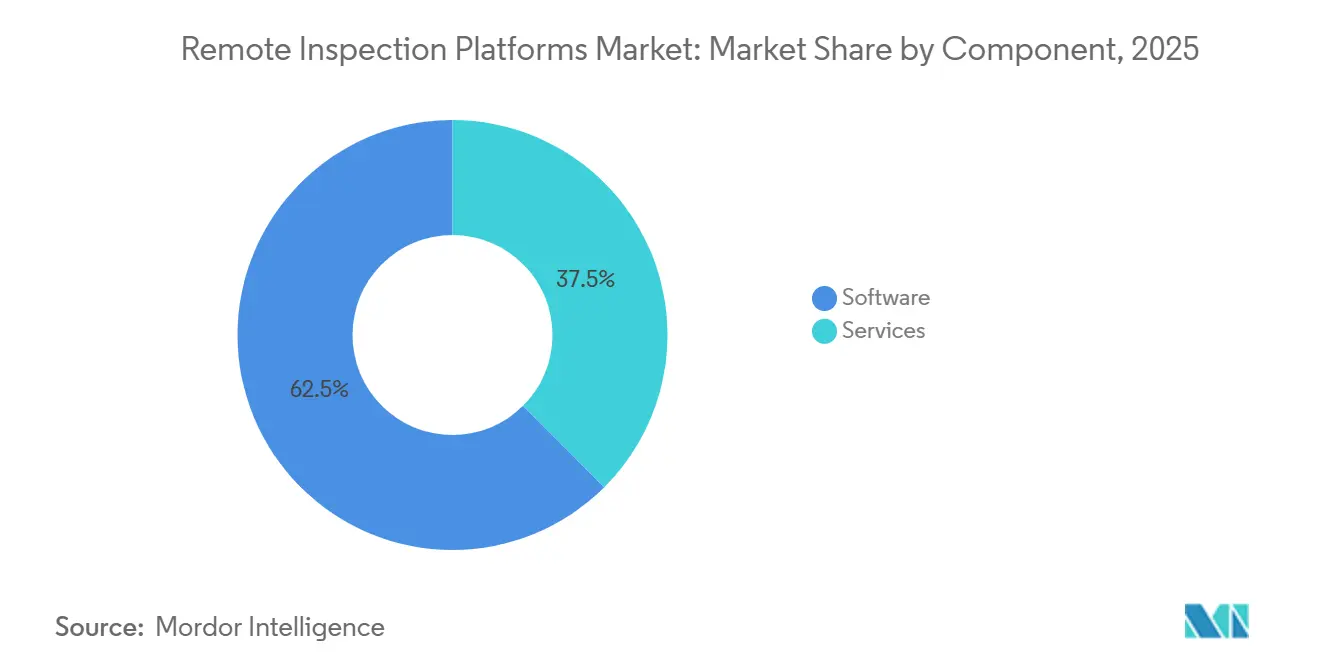
Software Leads Revenue While Services Support DeploymentSoftware held 62.48% of the overall market revenue in 2025. This result reflected a move away from perpetual licenses toward subscriptions that include data processing, model training, and report generation. Software bundles can also include work that clients once purchased as separate professional services. As a result, the recorded software portion can understate the value transferred from services into subscription pricing. This shift gives providers more recurring revenue and gives customers a more unified procurement model for data processing, training, reporting, and ongoing platform access.
Services remain important for implementation, calibration, training, and managed inspection programs. They are particularly relevant when a client does not have an internal analytics capability or established field processes. Bureau Veritas reported FY2025 revenue of EUR 6,466.4 million, equivalent to USD 7,152 million at the stated average 2025 EUR/USD rate of 1.106, and 6.5% organic growth.[4] Its managed inspection contracts illustrate how TIC providers can combine proprietary tools with longer service relationships. A 2026 study of digital twins for welded assemblies found that many surveyed implementations remained at the conceptual stage, which indicates an ongoing need for configuration and deployment services.
By Deployment Mode:
Cloud-Based Platforms Lead AdoptionCloud-based deployment accounted for 69.87% of the remote inspection platforms market in 2025 and is projected to expand at a 12.63% CAGR through 2031. Distributed field teams value the ability to access inspection records, maps, and reports across devices and sites, including remote locations where field and office staff must work from the same visual record. Cloud capacity also supports processing of larger image sets and more frequent analysis, which is useful when imagery is collected repeatedly across several facilities or project locations. These benefits have made cloud delivery the standard option for many construction, insurance, and asset-management users that need shared workflows without managing a separate local environment. Cloud architecture also makes software updates and shared workflows easier to manage when inspections involve multiple users, locations, devices, and stages of review.
On-premises systems remain relevant in oil and gas, critical infrastructure, and other settings with strict data residency requirements. Some buyers are using private or edge environments for sensitive data while connecting to cloud layers for reporting and analytics. DroneDeploy’s regional data-residency arrangements show why providers must support more than a single global cloud model. SGS reported 19.2% growth in its Digital Trust business in 2025 while continuing to integrate AI capabilities into inspection-related services. The remote inspection software industry therefore has room for providers that can combine cloud usability with controlled deployment options.
By Application:
Insurance and Claims Assessment Gains PaceConstruction and infrastructure held 18.07% of 2025 revenue, the largest application position in the remote inspection platforms market. Contractors use digital records to document milestones, identify structural issues, and create a consistent record of site conditions for project teams, owners, and related service providers. Reality-capture platforms can bring drone, 360-degree camera, and ground-robot data into one project record. This capability helps project teams compare site conditions across time, maintain context around recorded images, and manage documentation demands that arise during construction activity. The segment remains closely tied to the need for faster, better-organized field evidence that can be reviewed by dispersed project stakeholders and retained for later reference.
Insurance and claims assessment is projected to expand at a 13.02% CAGR through 2031. Property insurers are using aerial imagery and AI-supported analysis for underwriting and post-event claims triage. Evidence standards such as image metadata, pilot records, and chain-of-custody logs matter because they affect whether information can support a claim decision. OpenSpace introduced OpenSpace Field in February 2026 and said initial users reduced inspection documentation time from 3-4 hours to 30 minutes.[5] EagleView expanded its drone solution for U.S. carriers in March 2025 by adding AI-generated property repair estimates to roof-damage detection.
By Enterprise Size:
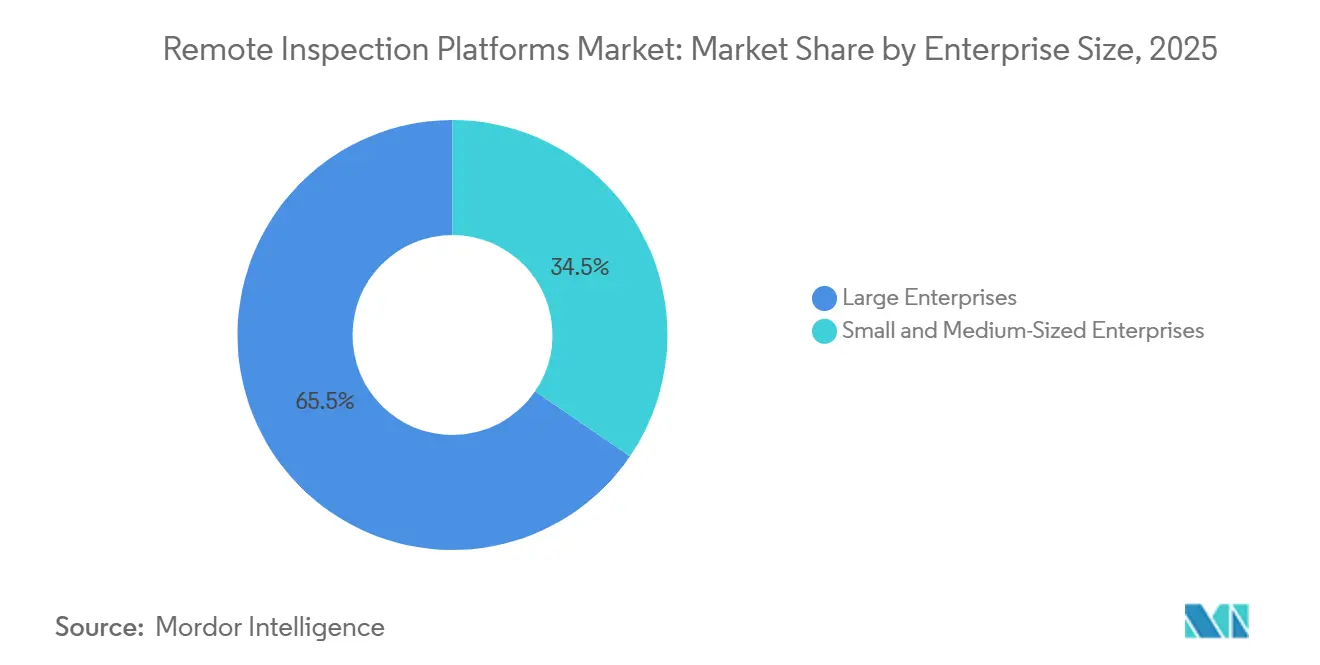
Large Enterprises Lead While SMEs Increase AdoptionLarge enterprises held 65.47% of 2025 revenue in the remote inspection platforms market. These organizations can more readily fund connections with enterprise asset management systems, computerized maintenance platforms, and data-governance processes that need dedicated information technology support and established internal controls. Multi-site operations also offer the scale needed to train AI models with more varied inspection data. Vendors that secure these deployments can improve defect-recognition performance through larger labeled datasets. This can raise the barrier for smaller providers that do not have comparable customer data, broad site coverage, or established access to complex enterprise workflows.
SMEs are projected to expand at a 12.17% CAGR through 2031. Mobile-first platforms, low-code tools, and usage-based subscriptions can reduce the need for complex enterprise integration, allowing smaller organizations to begin with a more focused field workflow. These products emphasize practical field use and allow smaller operators to start with limited workflows. Subscription pricing can also reduce the initial platform cost that previously restricted access to advanced inspection tools. The remote inspection platforms market can therefore broaden as smaller firms adopt digital workflows without replacing their existing systems. This growth supports demand for products that balance analytical capability with simple deployment, practical mobile use, and pricing that does not require a large initial commitment.
By End User:
Facility and Asset Managers Increase Their RoleContractors and inspection service providers held 28.47% of 2025 revenue in the remote inspection platforms market. Asset-intensive sectors have historically relied on specialist intermediaries for inspection work and related software purchases, particularly when a site needs certified expertise, specialized equipment, or formal reporting. These providers continue to supply field knowledge, certified personnel, and structured reporting for complex sites. Their role is particularly important where the asset owner has limited in-house inspection capability. Outsourced relationships therefore remain a major route to adoption for asset owners that require specialist support before building internal digital inspection capability.
Facility and asset managers are projected to expand at a 12.48% CAGR through 2031. More intuitive platforms are allowing operations teams to operate inspection workflows that were previously outsourced. This can shift inspection capability closer to the building owner or plant operator. Architects, engineers, and project managers are also using these platforms for as-built verification and defect documentation. Hitachi Energy reported a 35% reduction in on-site inspection time at ERG through digital-twin-driven operations. Government and regulatory bodies are also increasing the use of digital records for bridges, tunnels, and public facilities.
Geography Analysis
North America Remote Inspection Platforms Market
North America held 34.12% of remote inspection platforms market share in 2025. The region combines early cloud adoption in construction and energy with recurring demand from U.S. insurance claims processes. The U.S. Department of Transportation documented that manual bridge inspections can underreport concrete cracking, spalling, and steel corrosion, which supports the use of robotic and drone inspection systems. The Federal Aviation Administration proposed a rule in August 2025 to normalize BVLOS operations, creating a performance-based route for more viable inspection of pipelines and power lines.[6] Canada’s energy infrastructure and Mexico’s manufacturing export base provide additional demand opportunities as cloud inspection adoption increases.
Europe Remote Inspection Platforms Market
Europe remained the second-largest regional market, led by Germany, the United Kingdom, France, and Italy. Manufacturing, energy, and built infrastructure are central sources of demand across the region. National Grid rolled out centralized autonomous drone inspection for its electricity network in England and Wales in September 2025. The deployment followed the United Kingdom’s BVLOS infrastructure policy and provides an enterprise-scale example for other operators. EASA revised its Easy Access Rules for Unmanned Aircraft Systems in June 2026, including the SORA 2.5 operational risk assessment package. Russia faces technology-access constraints, while other European markets benefit from energy infrastructure renewal linked to renewable energy objectives and wider requirements for documented asset oversight.
APAC, MEA and South America Remote Inspection Platforms Market
Asia-Pacific is projected to expand at a 13.06% CAGR through 2031, the fastest regional rate in the remote inspection platforms market. China is supported by industrial digitization and smart-factory programs, while India has demand from roads, metro systems, and power networks that require more frequent asset documentation and maintenance oversight. Southeast Asia combines new industrial development with evolving inspection compliance practices. Toshiba’s September 2025 work on anomaly detection demonstrated lower false positives for infrastructure and plant inspection applications. The Middle East offers opportunities from large construction programs and oil and gas assets. Africa is at an earlier stage, led by South Africa and Nigeria, while South America has potential in Brazil’s energy and mining sectors and Argentina’s industrial base, subject to macroeconomic variation.
Competitive Landscape
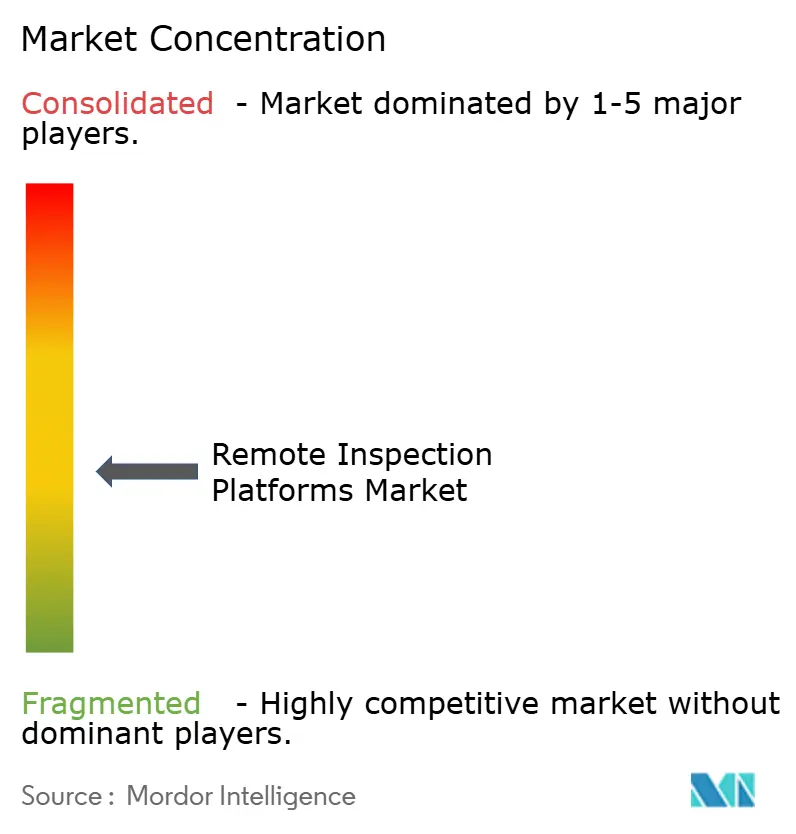
The remote inspection platforms market has a moderately fragmented structure, with no single provider leading every application and region. Competition includes pure-play inspection and reality-capture platforms, TIC companies with proprietary tools in managed service contracts, and enterprise software firms expanding through acquisitions to bring inspection records into wider operational workflows. Pure-play providers compete on AI accuracy, data networks, and field workflow integration. TIC providers such as Bureau Veritas, SGS, and Intertek can retain customers through multi-year service relationships and proprietary data layers. Enterprise platforms can add inspection capability to broader project or asset workflows.
Procore announced a definitive agreement to acquire DroneDeploy for USD 845 million in July 2026. The proposed transaction combines Procore’s nearly 400 million photos and 10 million RFIs with DroneDeploy’s visual record spanning 20 trillion square feet across 3 million jobsites. This combined data base can improve AI models in ways that smaller providers may find difficult to match. OpenSpace launched OpenSpace Field in February 2026 with AI Voice Notes and AI Autolocation for field teams. The product’s reported reduction in documentation time sets a clear usability benchmark for routine field work.
Intertek acquired Aerial PV Inspection GmbH in February 2026 to strengthen solar quality assurance and drone-based inspection capability in Europe. Flyability’s SOC 2 Type II examination shows that governance controls are also becoming a competitive requirement in confined-space inspection. Mid-market buyers remain important because they seek analytical depth without the integration burden of larger platforms, especially where users need practical tools for site teams rather than extensive enterprise configuration. Regulated settings such as nuclear, subsea, and critical infrastructure create additional openings for providers with strong data controls and audit trails. Hardware firms are also moving into the software layer as capture equipment becomes more widely available, increasing pressure on providers that rely only on specialized field equipment. The remote inspection platforms market will continue to reward providers that combine dependable analytics, system integration, and secure delivery. The remote inspection platforms market remains shaped by data quality, access controls, and practical field workflows.
Remote Inspection Platforms Industry Leaders
-
Matterport, Inc.
-
OpenSpace Technologies, Inc.
-
DroneDeploy, Inc.
-
Procore Technologies, Inc.
-
Trimble Inc.
- *Disclaimer: Major Players sorted in no particular order
Remote Inspection Platforms Market Companies Covered in this Report
- Matterport, Inc.
- OpenSpace Technologies, Inc.
- DroneDeploy, Inc.
- Procore Technologies, Inc.
- Trimble Inc.
- Autodesk, Inc.
- Boston Dynamics, Inc.
- Optelos, Inc.
- TEAM, Inc.
- MISTRAS Group, Inc.
- Bureau Veritas SA
- Applus Services SA
- SGS SA
- Intertek Group plc
- Waygate Technologies GmbH
- Eddyfi Technologies
- Oceaneering International, Inc.
- Cyberhawk Innovations Limited
- Invert Robotics Limited
- SkySpecs, Inc.
- ScoutDI AS
- Capgemini SE
- Microsoft Corporation
- Pix4D SA
- PlanRadar GmbH
Recent Industry Developments in Remote Inspection Platforms Market
- July 2026: Procore Technologies announced a definitive agreement to acquire DroneDeploy for approximately USD 845 million in cash, combining Procore's construction management dataset of nearly 400 million photos with DroneDeploy's visual record spanning approximately 20 trillion square feet of built-world data across 3 million jobsites in 180+ countries; the transaction is expected to close later in 2026 and will create a unified platform that replaces manual jobsite inspections with autonomous, multi-modal perception.
- March 2026: SGS and CertX expanded their Digital Trust services for AI and autonomous systems, building on CertX's July 2025 participation in the NVIDIA Halos AI Systems Inspection Lab ecosystem to deliver inspection certification aligned with emerging AI governance standards.
- February 2026: Intertek Group acquired Aerial PV Inspection GmbH (AePVI), a Germany-based provider of high-speed drone inspection and diagnostic solutions for solar PV systems across Europe, strengthening Intertek's end-to-end solar quality assurance capability from factory to field and expanding its drone-based inspection portfolio.
- February 2026: OpenSpace announced general availability of OpenSpace Field, an AI-powered field inspection tool featuring AI Voice Notes and AI Autolocation, which reduced inspection documentation time from 3-4 hours to 30 minutes at initial deployments, with native two-way sync to Procore and Autodesk Construction Cloud.
Global Remote Inspection Platforms Market Report Scope
The Remote Inspection Platforms Market encompasses digital solutions that enable organizations to conduct inspections, audits, assessments, and compliance verification remotely. These platforms leverage technologies such as video streaming, drones, IoT sensors, augmented reality, digital twins, and AI-powered analytics. They help reduce travel requirements, enhance inspection efficiency, and facilitate real-time collaboration between inspectors and field personnel. The market caters to industries including construction, utilities, oil and gas, manufacturing, transportation, energy, and insurance.
The Remote Inspection Platforms Market Report is Segmented by Component (Software, and Services), Deployment Mode (Cloud-Based, and On-Premises), Application (Construction and Infrastructure, Real Estate and Property Management, Oil and Gas, Manufacturing and Heavy Engineering, Energy and Utilities, Transportation and Logistics, Insurance and Claims Assessment, and Other Applications), Enterprise Size (Large Enterprises, and Small and Medium-Sized Enterprises), End User (Contractors and Inspection Service Providers, Architects, Engineers, and Project Managers, Facility and Asset Managers, Government and Regulatory Bodies, and Other End Users), and Geography (North America, South America, Europe, Asia-Pacific, Middle East, and Africa). The Market Sizes and Forecasts are Provided in Terms of Value in (USD).
Segmentation Overview
| Software |
| Services |
| Cloud-Based |
| On-Premises |
| Construction and Infrastructure |
| Real Estate and Property Management |
| Oil and Gas |
| Manufacturing and Heavy Engineering |
| Energy and Utilities |
| Transportation and Logistics |
| Insurance and Claims Assessment |
| Other Applications |
| Large Enterprises |
| Small and Medium-Sized Enterprises |
| Contractors and Inspection Service Providers |
| Architects, Engineers, and Project Managers |
| Facility and Asset Managers |
| Government and Regulatory Bodies |
| Other End Users |
| North America | United States |
| Canada | |
| Mexico | |
| South America | Brazil |
| Argentina | |
| Rest of South America | |
| Europe | Germany |
| United Kingdom | |
| France | |
| Italy | |
| Spain | |
| Russia | |
| Rest of Europe | |
| Asia-Pacific | China |
| Japan | |
| India | |
| South Korea | |
| Southeast Asia | |
| Rest of Asia-Pacific | |
| Middle East | Saudi Arabia |
| United Arab Emirates | |
| Turkey | |
| Rest of Middle East | |
| Africa | South Africa |
| Nigeria | |
| Rest of Africa |
| By Component | Software | |
| Services | ||
| By Deployment Mode | Cloud-Based | |
| On-Premises | ||
| By Application | Construction and Infrastructure | |
| Real Estate and Property Management | ||
| Oil and Gas | ||
| Manufacturing and Heavy Engineering | ||
| Energy and Utilities | ||
| Transportation and Logistics | ||
| Insurance and Claims Assessment | ||
| Other Applications | ||
| By Enterprise Size | Large Enterprises | |
| Small and Medium-Sized Enterprises | ||
| By End User | Contractors and Inspection Service Providers | |
| Architects, Engineers, and Project Managers | ||
| Facility and Asset Managers | ||
| Government and Regulatory Bodies | ||
| Other End Users | ||
| By Geography | North America | United States |
| Canada | ||
| Mexico | ||
| South America | Brazil | |
| Argentina | ||
| Rest of South America | ||
| Europe | Germany | |
| United Kingdom | ||
| France | ||
| Italy | ||
| Spain | ||
| Russia | ||
| Rest of Europe | ||
| Asia-Pacific | China | |
| Japan | ||
| India | ||
| South Korea | ||
| Southeast Asia | ||
| Rest of Asia-Pacific | ||
| Middle East | Saudi Arabia | |
| United Arab Emirates | ||
| Turkey | ||
| Rest of Middle East | ||
| Africa | South Africa | |
| Nigeria | ||
| Rest of Africa | ||
Key Questions Answered in the Report
What is the remote inspection platforms market size?
The remote inspection platforms market size was valued at USD 2.27 billion in 2025 and estimated to grow from USD 2.56 billion in 2026 to reach USD 4.24 billion by 2031, at a CAGR of 10.62% during the forecast period (2026-2031).
Which deployment model leads remote inspection software adoption?
Cloud-based deployment led with 69.87% of 2025 revenue. It is projected to expand at a 12.63% CAGR through 2031 because field teams need access across sites and devices.
Which application is growing fastest for remote inspection platforms?
Insurance and claims assessment is projected to be the fastest-growing application at a 13.02% CAGR through 2031. It uses aerial imagery and AI-supported analysis for underwriting and post-event claims review.
Why are companies adopting remote inspection tools?
Companies use these tools to speed data collection, reduce exposure at hazardous sites, and support maintenance planning. They also create more consistent records for project, operational, and insurance decisions.
Which region is growing fastest for remote inspection software?
Asia-Pacific is projected to expand at a 13.06% CAGR through 2031. Industrial digitization in China, Indian infrastructure projects, and Southeast Asian industrial development support this position.
What is limiting wider use of inspection software?
Key constraints include shortages of certified inspection and data-analytics personnel, cybersecurity requirements, deployment costs, and fragmented data standards. These issues can delay deployment, particularly in regulated environments.