
Quantum Software Toolchain Market Size and Share
Market Overview
| Study Period | 2020 - 2031 |
|---|---|
| Market Size (2026) | USD 1.46 Billion |
| Market Size (2031) | USD 3.88 Billion |
| Growth Rate (2026 - 2031) | 21.59% CAGR |
| Fastest Growing Market | Asia-Pacific |
| Largest Market | North America |
| Market Concentration | Medium |
Major Players *Disclaimer: Major Players sorted in no particular order Image © Mordor Intelligence. Reuse requires attribution under CC BY 4.0. | |
Quantum Software Toolchain Market Analysis by Mordor Intelligence
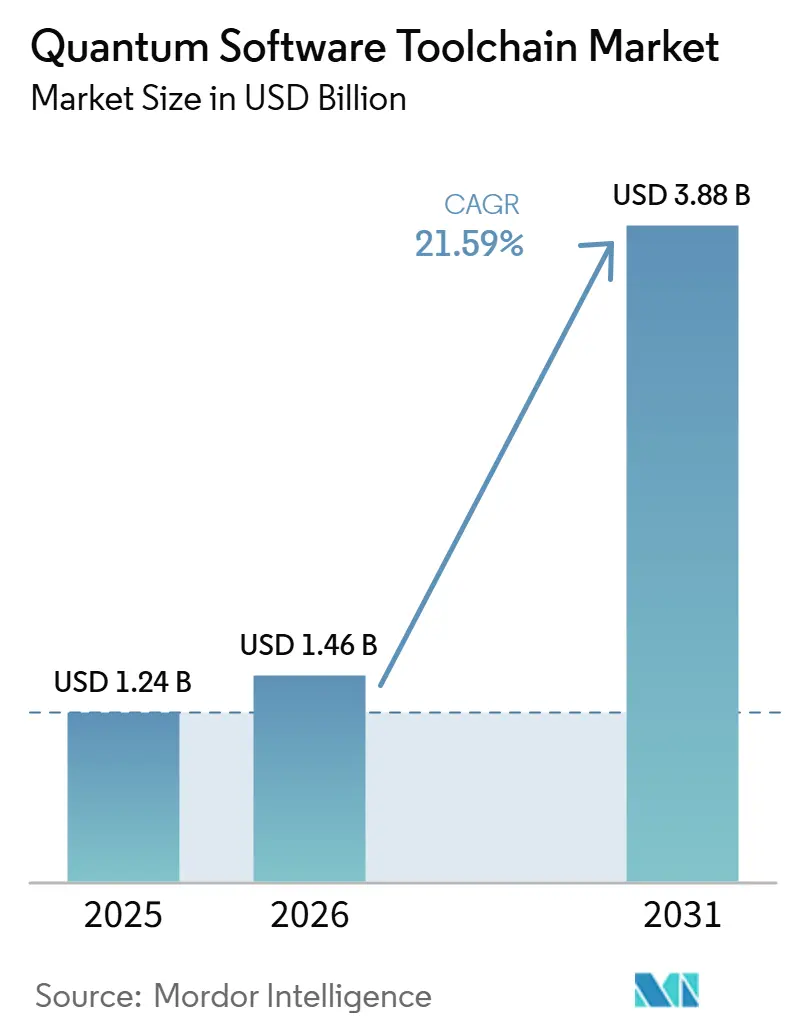
The Quantum Software Toolchain Market size was valued at USD 1.24 billion in 2025 and is estimated to grow from USD 1.46 billion in 2026 to reach USD 3.88 billion by 2031, at a CAGR of 21.59% during the forecast period (2026-2031). The Quantum Software Toolchain Market is expanding as enterprises move from early access to building usable quantum workflows. Most buyers still need software that connects quantum systems with their existing computing, data, and security environments. Cloud access has lowered the entry barrier, while hybrid requirements are increasing demand for orchestration and integration tools. Public programs, cryptographic migration, and work on error correction are also supporting development activity. Competition is increasingly shaped by the quality of developer environments, middleware, and software support rather than hardware access alone.
Key Report Takeaways
- By toolchain component, Software Solutions held 74.18% of the Quantum Software Toolchain Market share in 2025, while Services is projected to expand at a 24.82% CAGR through 2031.
- By deployment mode, Cloud-Based solutions held 71.24% of the Quantum Software Toolchain Market share in 2025, while Hybrid deployment is projected to expand at a 23.69% CAGR through 2031.
- By application, Simulation accounted for 24.86% of the Quantum Software Toolchain Market in 2025, while Drug Discovery and Life Sciences are projected to expand at a 26.43% CAGR through 2031.
- By end user, Education and Research Institutions held 22.41% of the Quantum Software Toolchain Market size in 2025, while Healthcare and Life Sciences are projected to expand at a 25.18% CAGR through 2031.
- By geography, North America held 34.62% of the Quantum Software Toolchain Market share in 2025, while Asia-Pacific is projected to expand at a 24.91% CAGR through 2031.
Note: Market size and forecast figures in this report are generated using Mordor Intelligence’s proprietary estimation framework, updated with the latest available data and insights as of January 2026.
Global Quantum Software Toolchain Market Trends and Insights
Drivers Impact Analysis*
| Driver | (~) % Impact on CAGR Forecast | Geographic Relevance | Impact Timeline |
|---|---|---|---|
| Enterprise Access Through Quantum Cloud Marketplaces | +5.5% | Global, with primary concentration in North America and Asia-Pacific | Short term (≤ 2 years) |
| Government-Funded Quantum Programs and Procurement | +4.8% | North America, Europe, and Asia-Pacific core, spillover to Middle East | Medium term (2-4 years) |
| Hybrid Classical-Quantum Workflow Adoption | +4.2% | Global, with early gains in North America, Japan, and Germany | Medium term (2-4 years) |
| Rising Demand for Quantum Error Suppression and Correction | +2.8% | Global, strongest in North America and Europe | Medium term (2-4 years) |
| Quantum-Ready Cybersecurity and Cryptographic Migration | +2.1% | North America and Europe, with Asia-Pacific and Gulf early movers | Short term (≤ 2 years) |
| Open-Source and High-Level Developer Toolchain Expansion | +1.6% | Global, strongest in Asia-Pacific and Europe | Long term (≥ 4 years) |
| Source: Mordor Intelligence | |||
Enterprise Access Through Quantum Cloud Marketplaces
Cloud marketplaces are changing how organizations obtain quantum development tools by placing specialist products inside purchasing channels that information technology teams already use and understand. Buyers can use existing cloud accounts, identity controls, billing arrangements, and governance processes. Classiq became available through AWS Marketplace in 2025, allowing enterprises to use AWS credits for its software development platform.[1]Classiq, “Classiq Now Available on AWS Marketplace, Accelerating Quantum Adoption for Enterprises,” Classiq, classiq.io This route can remove a procurement obstacle for teams working within annual budgets, especially where a separate vendor review would delay a limited pilot or an initial proof of value. The Quantum Software Toolchain Market, therefore, favors vendors that can reach customers through established cloud environments. Vendors without a presence in a major cloud ecosystem may face a weaker position in enterprise pilots, as buyers may favor tools that align with their existing access, cost-control, and security processes.
Government-Funded Quantum Programs and Procurement
Government programs are supporting software stacks and common interfaces, not only quantum hardware, because public users need systems that researchers, developers, and commercial partners can connect to and use consistently. Germany launched QC Next in December 2025 to support a modular quantum software reference architecture with open interfaces.[2]Federal Ministry for Digital and Transport, “QC Next, Development of a Modular Software Stack for the Commercial Application of Quantum Computing,” Digitale Technologien, digitale-technologien.de The United Kingdom announced a GBP 2 billion package in March 2026, equivalent to USD 2.54 billion, including support for ProQure and the Quantum Software Lab in Edinburgh. Japan's IPA selected 10 quantum software projects under its 2026 Mitou Target Program. These programs support local developers and give research groups and suppliers clearer procurement paths, while the resulting reference designs can make it easier for later users to select compatible tools. They also reduce some of the commercial risk facing organizations that are testing new quantum applications, since public commitments can validate technical priorities before a private buyer makes a larger deployment decision.
Hybrid Classical-Quantum Workflow Adoption
Hybrid workflows are becoming the main approach for applications that combine quantum processing with classical computing, since most practical workloads still require conventional systems for data preparation, control, and result analysis. They require scheduling, data movement, and resource management across different systems, including careful coordination of jobs that may run at different speeds and under different technical constraints. IBM demonstrated hybrid scheduling at Supercomputing 2025 by using IBM LSF with IBM Quantum systems and classical x86 infrastructure.[3]IBM, “Orchestrating Hybrid Quantum-Classical Workflows With IBM LSF,” IBM Community, ibm.com RIKEN and IBM also demonstrated a closed-loop workflow linking Fugaku with IBM Quantum processors in October 2025. These projects show why organizations need middleware that manages exchange between quantum and classical resources without creating avoidable delays, operational complexity, or manual work for development teams. The Quantum Software Toolchain Market has room for specialized orchestration providers, as cloud companies and hardware vendors do not fully control this software layer.
Rising Demand for Quantum Error Suppression and Correction
Software-based error suppression is gaining importance because fault-tolerant hardware is not yet broadly available, leaving developers to improve useful results on systems that still have meaningful operating limitations. IBM released Qiskit Paulice in June 2026 to add spacetime error-detection loops to quantum circuits with limited gate and qubit overhead. NVIDIA released an open-source Ising Decoder in July 2026 that reported a 347.7-fold reduction in logical error rates and 7.3x faster decoding in its benchmark conditions.[4]NVIDIA, “NVIDIA Ising Decoding Cuts Color Code Logical Error Rates by Over 300X,” NVIDIA Developer, nvidia.com Research published in Nature in 2026 also examined reinforcement learning control for quantum error correction at distance-15 surface codes. These tools help users work with noisy systems while hardware developers pursue fault tolerance, and they give software teams practical ways to test applications before more capable machines arrive. They also make error management a clearer software category within the Quantum Software Toolchain Market.
Restraints Impact Analysis*
| Restraint | (~) % Impact on CAGR Forecast | Geographic Relevance | Impact Timeline |
|---|---|---|---|
| Quantum Hardware Error Rates and Limited Fault-Tolerant Availability | -3.2% | Global, most constraining in North America and Europe | Medium term (2-4 years) |
| Shortage of Quantum Software and Systems Talent | -2.8% | Global, most acute in North America and Europe | Long term (≥ 4 years) |
| Fragmented Toolchains and Limited Interoperability Standards | -1.9% | Global, most pronounced in multi-vendor enterprise environments | Medium term (2-4 years) |
| Uncertain Near-Term Return on Enterprise Quantum Investment | -1.4% | Global, most intense in BFSI, retail, and industrial sectors | Short term (≤ 2 years) |
| Source: Mordor Intelligence | |||
Quantum Hardware Error Rates and Limited Fault-Tolerant Availability
Hardware errors remain a basic limit on software commercialization because they affect the reliability of results, the cost of execution, and the range of tasks that users can confidently run. Each added mitigation step can increase latency, circuit depth, and sampling requirements. Current tools must work with noisy intermediate-scale quantum systems, shallow circuits, and limited coherence times. This creates a difficult design choice between optimizing for current hardware and preparing for future fault-tolerant environments, particularly when a tool must remain useful across multiple generations of evolving devices. IBM and NVIDIA have introduced software responses to this problem, but these approaches do not replace the need for higher physical qubit fidelity. Regulated users may delay critical workloads until they can show dependable fault tolerance in the Quantum Software Toolchain Market applications.
Shortage of Quantum Software and Systems Talent
The shortage is especially pronounced in quantum error correction, compiler design, and hardware-software optimization, where technical work requires an uncommon combination of physics, mathematics, computing, and application knowledge. A 2026 peer-reviewed review of 3,641 job postings found that quantum technology roles remained concentrated among large United States companies and commonly required doctoral qualifications. This limits the number of organizations that can build and operate sophisticated quantum workflows internally, making external specialists and software that reduces the learning burden more important to many early users. Universities and public programs are expanding training, but the available workforce does not yet match the expected breadth of deployment. The shortage can encourage the adoption of accessible open-source tools and managed services. It can also reduce the scope for vendors to differentiate basic tools when customers need lower barriers to entry, clear documentation, reusable workflows, and access to practical implementation support.
*Our forecasts treat driver/restraint impacts as directional, not additive. The impact forecasts reflect baseline growth, mix effects, and variable interactions.
Segment Analysis
By Toolchain Component: Software Solutions Lead Platform Development
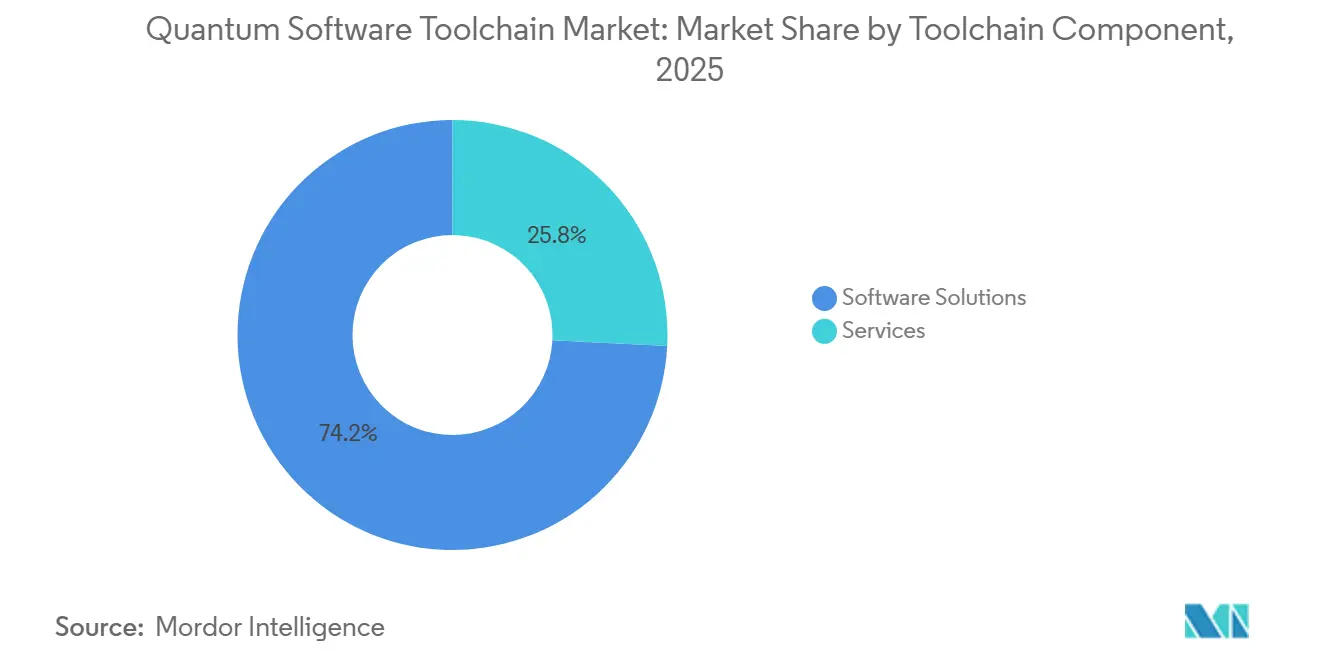
Software Solutions held 74.18% of the toolchain component segment in 2025. The category includes development platforms, compilers, transpilers, middleware, runtime software, simulators, error management tools, and algorithm libraries used across the Quantum Software Toolchain Market. Its position reflects the value placed on software that makes quantum systems easier to program and integrate with existing workflows, rather than requiring users to work directly with the detailed controls and limitations of each hardware platform. For many buyers, this abstraction is necessary before a quantum experiment can become a repeatable development process. Each category addresses a separate part of the user journey, from circuit design to execution and error handling. Development teams may use several of these components together, which makes the quality of their integration as important as the capabilities of individual products. The Quantum Software Toolchain Market depends on these layers because hardware access alone does not, by itself, create a usable enterprise workflow.
Services are projected to grow at a 24.82% CAGR through 2031, making it the fastest-growing component. Organizations without internal quantum teams often need integration support, custom algorithms, and workflow design before they can use licenses effectively. They may also need help selecting suitable problems, preparing data, and measuring whether a trial can be expanded into a durable program. Fujitsu, Osaka University, SEC, and TIS open-sourced the Open Quantum Toolchain for Operators and Users in March 2025 and integrated it with Osaka University's quantum cloud service. Open releases can make basic development components more accessible to a wider audience. This shifts supplier attention toward specialized services, domain optimization, and support for complex deployments. Software license revenue can still grow, but service-led engagement is becoming more important where users need direct expertise.


By Deployment Mode: Cloud Access Leads While Hybrid Requirements Increase
Cloud-based solutions accounted for 71.24% of the deployment mode segment in 2025. Cloud access enabled organizations to experiment without buying or operating quantum hardware. It allowed teams to begin with limited commitments and to test several systems without making a long-term decision on a single provider. It also supported faster provisioning and alignment with existing cloud governance practices. These benefits remain important where business units need to start research work through approved technology processes rather than create a separate access arrangement. This model remains useful for research teams and enterprises assessing potential use cases. The Quantum Software Toolchain Market continues to benefit from this accessible route to early adoption.
Hybrid deployment in the Quantum Software Toolchain Market is projected to grow at a 23.69% CAGR through 2031. Organizations that first tested quantum tools in public cloud settings are increasingly considering on-premises links for sensitive data, sovereignty needs, and workloads where latency matters. The change does not eliminate cloud use, but it increases the need for an architecture that can support both access models. IQM reported that 46% of buyers expected on-premises infrastructure to be part of their access model within 3 years, compared with 24% that favored public cloud alone. On-Premises deployment remains relevant for aerospace and defense and government users with data residency restrictions. Vendors must therefore support workload movement between cloud and local environments. That requirement raises the importance of middleware that can handle hardware differences without reducing circuit performance.
By Application: Simulation Remains Established While Life Sciences Accelerate
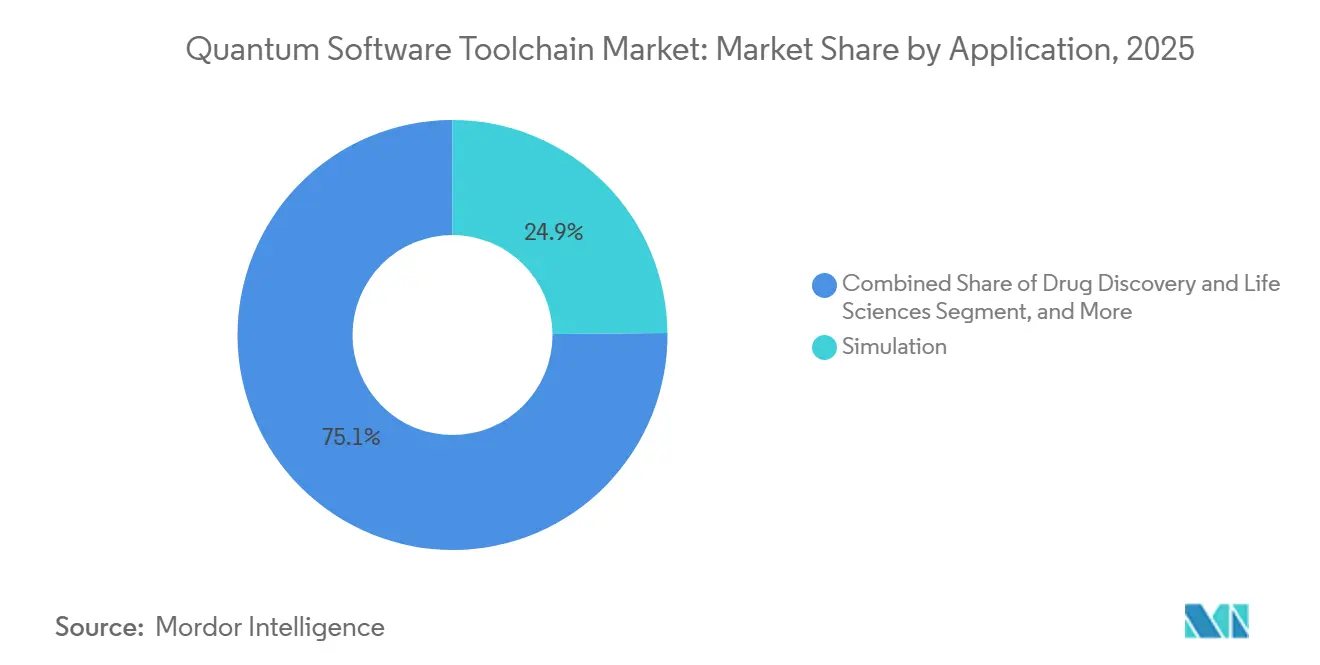
Simulation held 24.86% of the application segment in 2025. Its leading position builds on long-standing investment in classical simulation and the potential for quantum systems to extend these calculations. Users can relate these tools to established scientific processes, which makes simulation a practical starting point for application development. IBM, Cleveland Clinic, and RIKEN modeled a protein complex with 12,635 atoms in May 2026 using IBM Quantum Heron processors and the Fugaku and Miyabi-G supercomputers. The work linked quantum and classical resources in a single workflow. It also showed that progress in this use case depends on coordinated software, specialized processors, and powerful classical computing resources rather than on any single element. Such demonstrations support continued demand for simulation tools, integration software, and computational libraries.
Drug Discovery and Life Sciences is projected to grow at a 26.43% CAGR through 2031. The use case brings together quantum chemistry tools and machine learning-supported molecular screening. This combination makes software workflow design important because researchers need to prepare data, select calculations, and interpret results within their existing research processes. A 2025 scientific review covered quantum computing across molecular simulation, drug-target prediction, and clinical trial optimization. Optimization and machine learning remain major application areas, while cryptography and post-quantum security are gaining importance as organizations prepare migration plans. NIST finalized FIPS 203, FIPS 204, and FIPS 205 in August 2024, creating a formal basis for post-quantum cryptographic work. Materials science is also developing through longer-term enterprise relationships, including Quantinuum's expanded collaboration with BMW Group.

By End User: Research Institutions Lead While Healthcare Grows Fastest
Education and Research Institutions held 22.41% of the end-user segment in 2025. These users have historically adopted development platforms, algorithm libraries, and simulation tools ahead of most commercial sectors. Their work helps establish technical methods and reusable code that companies can later adapt to more application-focused settings. Universities and national laboratories also receive a large share of public program funding. Japan's 2026 Mitou Target Program selected 10 projects that included quantum chemistry, circuit automation, and other software applications. This research base supports skills development and early testing across the Quantum Software Toolchain Market.
Healthcare and Life Sciences are projected to grow at a 25.18% CAGR through 2031. Molecular simulation results are helping research organizations consider more sustained spending on software and related services. Healthcare users also need tools that fit established research standards and can work alongside the classical resources used in biomedical studies. IT and Telecommunication users are also responding to post-quantum security requirements that affect network cryptography. BFSI users are examining portfolio optimization and fraud detection, though near-term returns remain uncertain, keeping many programs at the pilot stage. Sovereign programs, classified simulation needs, and cryptographic migration support users across aerospace and defense and government. Manufacturing, chemicals, materials, energy, and utilities are still at an early stage, but they are beginning to seek domain-specific algorithms and simulation integrations. Their progress depends on whether providers can translate general quantum capabilities into workflows that address defined scientific or operational tasks in the Quantum Software Toolchain Market.
Geography Analysis
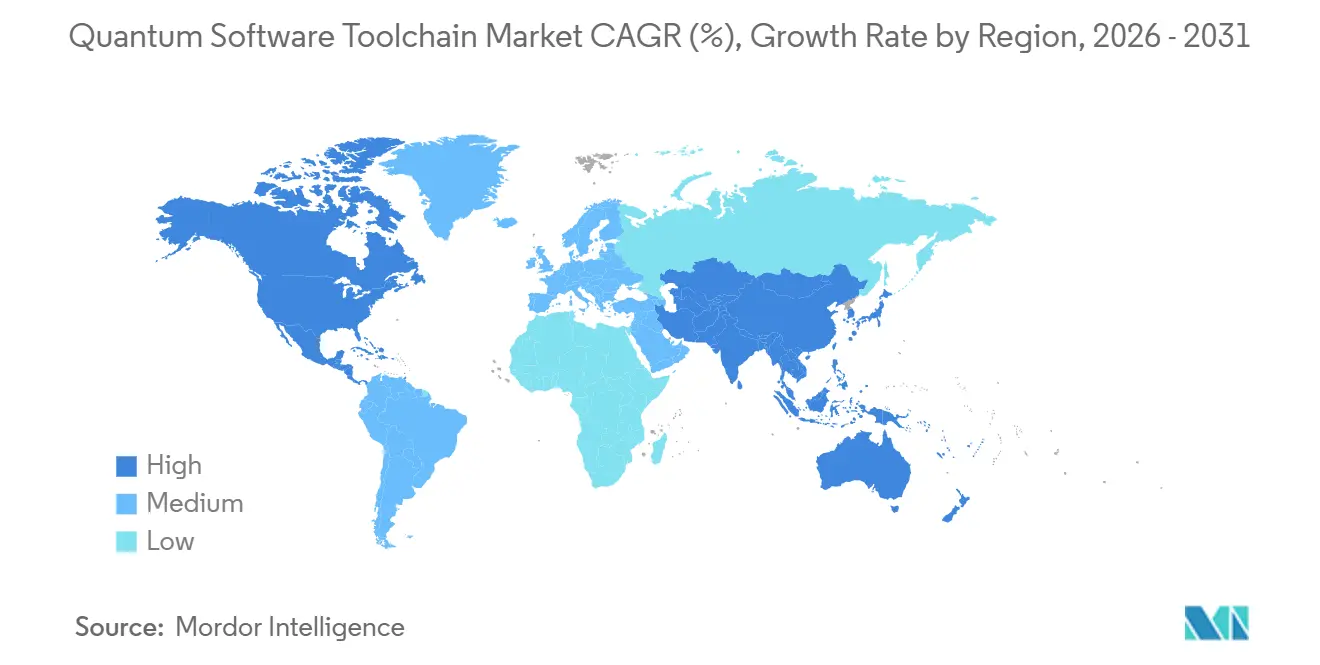
North America held 34.62% of the Quantum Software Toolchain Market share in 2025. The region benefits from a high concentration of quantum hardware, software talent, and cloud platforms. The Quantum Software Toolchain Market in North America also benefits from the United States' post-quantum cryptography program, which is driving demand beyond traditional commercial return calculations. OMB Memorandum M-26-15, issued in June 2026, requires federal agencies to submit post-quantum cryptography migration plans by October 2026 and sets a 5-phase migration through 2035. This requirement supports demand for cryptographic auditing, ML-KEM implementation, and digital signature migration tools.
Asia-Pacific is projected to grow at a 24.91% CAGR through 2031 in the Quantum Software Toolchain Market. Japan, China, and South Korea are combining public investment with domestic platform development and public-sector demand. RIKEN began operating the Ei-II quantum computer in March 2026 and expanded cloud access for quantum-classical research. Origin Quantum completed a CNY 3 billion (USD 419 million) funding round in June 2026 as it prepared for an initial public offering. China issued its first national standard for the architecture of quantum computing service platforms in 2025, establishing a 5-layer interoperability framework. IonQ and KISTI also signed a March 2026 memorandum to develop quantum-HPC hybrid technologies in South Korea.
Europe is developing hardware-agnostic software capabilities for the Quantum Software Toolchain Market through Horizon Europe initiatives, QC Next, and the FullStaQD program. The region's approach favors open interfaces and collaboration among academic and industrial partners. The United Kingdom's GBP 2 billion (USD 2.54 billion) package includes support for the Quantum Software Lab in Edinburgh. South America remains focused on research, with Brazil leading regional efforts through collaborations with IBM and European institutions. The Middle East and Africa are gaining attention through technology diversification programs in the UAE and Saudi Arabia. Its revenue contribution remains modest in the near term, but public technology commitments are laying the groundwork for future toolchain procurement.

Competitive Landscape
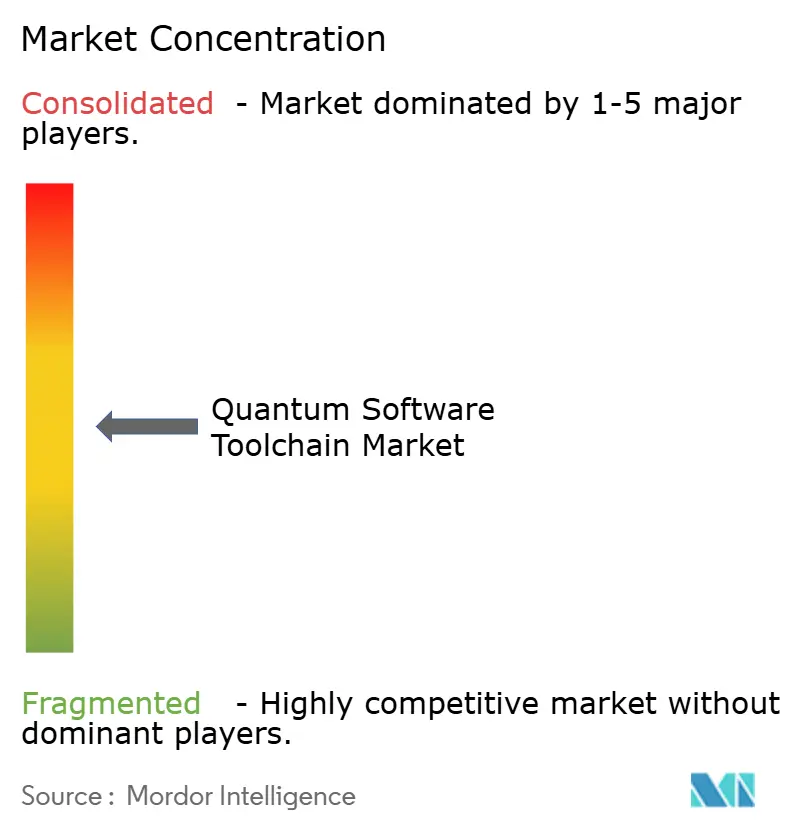
The Quantum Software Toolchain Market is moderately fragmented. IBM, Microsoft, Alphabet, and NVIDIA have a broad developer reach through their established platforms. Quantinuum, IonQ, Classiq, Q-CTRL, and Riverlane focus on specialized capabilities such as error correction, algorithm design, and hardware-specific optimization. IBM's Qiskit supports research and enterprise workflows, while NVIDIA's CUDA-Q is building a position in GPU-supported simulation and error decoding. These companies compete on the depth of their software environments as well as on their hardware relationships.
No supplier offers fully mature portability across superconducting, trapped-ion, neutral-atom, and photonic systems. This leaves an opportunity for middleware to coordinate work across different hardware types. Classiq's high-level circuit synthesis and automatic compilation patents provide an asset as circuit complexity increases. Quantinuum has also filed patent applications related to post-quantum cryptography as it pursues its hardware roadmap. Microsoft Azure Quantum provides access to IonQ, Quantinuum, Rigetti, and other backends. That multi-vendor approach competes with IBM's more vertically integrated Qiskit environment.
Specialist suppliers are pursuing narrower positions in areas where large platforms have less depth. Riverlane is developing error correction decoder software as a separate product layer. Q-CTRL distributes error suppression software through cloud marketplaces without requiring customers to commit to hardware. QunaSys and 1QB Information Technologies focus on chemistry and optimization algorithm libraries. Strangeworks and QC Ware add competition in orchestration and domain-focused services. The Quantum Software Toolchain Market is likely to remain competitive as users seek tools that reduce integration work and fit their chosen hardware access model.
Quantum Software Toolchain Industry Leaders
International Business Machines Corporation
Microsoft Corporation
Alphabet Inc.
Amazon Web Services, Inc.
Quantinuum Ltd.
- *Disclaimer: Major Players sorted in no particular order

Recent Industry Developments
- July 2026: NVIDIA released an open-source AI-powered quantum error correction decoder, the Ising Decoder ColorCode 1 Fast, that achieved a 347.7-fold reduction in logical error rates and 7.3x faster decoding runtime compared to state-of-the-art benchmarks at code distance 31, making color codes a viable alternative to surface-code architectures for fault-tolerant quantum computing.
- May 2026: Scientists at IBM, Cleveland Clinic, and RIKEN modeled a 12,635-atom protein complex, the largest biologically meaningful molecular simulation performed with quantum hardware, using IBM Quantum Heron processors integrated with the Fugaku and Miyabi-G supercomputers in a hybrid quantum-classical workflow, achieving up to 210x simulation accuracy improvement over 6 months. The work was funded by Japan's NEDO under the Post-5G and Quantum-Supercomputer Hybrid Platform programs.
- March 2026: IonQ and the University of Cambridge established the IonQ Quantum Innovation Centre, deploying IonQ's most advanced 256-qubit system on campus to support research commercialization across quantum computing, networking, sensing, and security. The agreement includes shared intellectual property licensing and workforce development programs aligned with the United Kingdom's GBP 2 billion (USD 2.54 billion) quantum investment package.
- March 2026: RIKEN launched its upgraded Ei-II quantum computer cloud service, expanding access from joint hardware and software development partners to a broader community of algorithm and social-application researchers, in collaboration with Osaka University's Quantum Information and Quantum Biology Institute.


Global Quantum Software Toolchain Market Report Scope
The quantum software toolchain market refers to the comprehensive ecosystem of interconnected software solutions and services that facilitate the complete lifecycle of quantum computing program development, execution, and management. Unlike standalone development kits, a quantum toolchain provides an end-to-end integrated pipeline that includes development platforms, compilers, and transpilers (which translate high-level code into physical quantum gate operations), middleware for workflow orchestration, runtime software for executing jobs on quantum processing units (QPUs) or simulators, and error correction and mitigation software to counteract quantum noise. Deployed via cloud-based, on-premises, or hybrid models, these toolchains cater to a wide range of end users, including IT firms, BFSI, healthcare, aerospace and defense, and academic institutions. By abstracting the deep underlying complexities of quantum hardware and physics, the quantum software toolchain empowers researchers, data scientists, and enterprise developers to seamlessly build, optimize, test, and deploy advanced quantum algorithms for highly complex computational applications, such as molecular simulation, optimization, and quantum machine learning, thereby accelerating the practical commercialization of quantum computing.
The Quantum Software Toolchain Market Report is Segmented by Toolchain Component (Software Solutions, (Quantum Development Platforms, Quantum Compilers and Transpilers, Quantum Middleware and Workflow Orchestration, Quantum Runtime Software, Quantum Simulation Software, Quantum Error Correction and Mitigation Software, and Quantum Algorithm Libraries and Domain-Specific Software) and Services), Deployment Mode (Cloud-Based, On-Premises, and Hybrid), Application (Optimization, Simulation, Machine Learning, Cryptography and Post-Quantum Security, Drug Discovery and Life Sciences, Materials Science, and Others), End User (IT and Telecommunication, BFSI, Healthcare and Life Sciences, Retail and E-Commerce, Aerospace and Defense, Chemical and Materials Industries, Industrial Manufacturing, Education and Research Institutions, Media and Entertainment, Government and Administration, Energy and Utilities, and Other End-User Industries), and Geography (North America, South America, Europe, Asia-Pacific, and Middle East and Africa). The Market Forecasts are Provided in Terms of Value (USD).
| Software Solutions | Quantum Development Platforms |
| Quantum Compilers and Transpilers | |
| Quantum Middleware and Workflow Orchestration | |
| Quantum Runtime Software | |
| Quantum Simulation Software | |
| Quantum Error Correction and Mitigation Software | |
| Quantum Algorithm Libraries and Domain-Specific Software | |
| Services |
| Cloud-Based |
| On-Premises |
| Hybrid |
| Optimization |
| Simulation |
| Machine Learning |
| Cryptography and Post-Quantum Security |
| Drug Discovery and Life Sciences |
| Materials Science |
| Other Applications |
| IT and Telecommunication |
| BFSI |
| Healthcare and Life Sciences |
| Retail and E-Commerce |
| Aerospace and Defense |
| Chemical and Materials Industries |
| Industrial Manufacturing |
| Education and Research Institutions |
| Media and Entertainment |
| Government and Administration |
| Energy and Utilities |
| Other End Users |
| North America | United States | |
| Canada | ||
| Mexico | ||
| South America | Brazil | |
| Argentina | ||
| Rest of South America | ||
| Europe | Germany | |
| United Kingdom | ||
| France | ||
| Russia | ||
| Spain | ||
| Rest of Europe | ||
| Asia-Pacific | China | |
| Japan | ||
| India | ||
| South Korea | ||
| Southeast Asia | ||
| Rest of Asia-Pacific | ||
| Middle East and Africa | Middle East | Saudi Arabia |
| United Arab Emirates | ||
| Rest of Middle East | ||
| Africa | South Africa | |
| Nigeria | ||
| Rest of Africa | ||
| By Toolchain Component | Software Solutions | Quantum Development Platforms | |
| Quantum Compilers and Transpilers | |||
| Quantum Middleware and Workflow Orchestration | |||
| Quantum Runtime Software | |||
| Quantum Simulation Software | |||
| Quantum Error Correction and Mitigation Software | |||
| Quantum Algorithm Libraries and Domain-Specific Software | |||
| Services | |||
| By Deployment Mode | Cloud-Based | ||
| On-Premises | |||
| Hybrid | |||
| By Application | Optimization | ||
| Simulation | |||
| Machine Learning | |||
| Cryptography and Post-Quantum Security | |||
| Drug Discovery and Life Sciences | |||
| Materials Science | |||
| Other Applications | |||
| By End User | IT and Telecommunication | ||
| BFSI | |||
| Healthcare and Life Sciences | |||
| Retail and E-Commerce | |||
| Aerospace and Defense | |||
| Chemical and Materials Industries | |||
| Industrial Manufacturing | |||
| Education and Research Institutions | |||
| Media and Entertainment | |||
| Government and Administration | |||
| Energy and Utilities | |||
| Other End Users | |||
| By Geography | North America | United States | |
| Canada | |||
| Mexico | |||
| South America | Brazil | ||
| Argentina | |||
| Rest of South America | |||
| Europe | Germany | ||
| United Kingdom | |||
| France | |||
| Russia | |||
| Spain | |||
| Rest of Europe | |||
| Asia-Pacific | China | ||
| Japan | |||
| India | |||
| South Korea | |||
| Southeast Asia | |||
| Rest of Asia-Pacific | |||
| Middle East and Africa | Middle East | Saudi Arabia | |
| United Arab Emirates | |||
| Rest of Middle East | |||
| Africa | South Africa | ||
| Nigeria | |||
| Rest of Africa | |||


Key Questions Answered in the Report
What is the Quantum Software Toolchain Market size?
The Quantum Software Toolchain Market is estimated at USD 1.46 billion in 2026 and is projected to reach USD 3.88 billion by 2031, at a 21.59% CAGR.
Which toolchain component leads quantum software spending?
Software Solutions led the component segment with a 74.18% share in 2025. Services is projected to grow faster, at a 24.82% CAGR through 2031.
Why are hybrid quantum workflows becoming more important?
Organizations need to connect quantum processors with classical data, scheduling, and computing resources while meeting data control and latency requirements.
Which application is expected to grow the fastest?
Drug Discovery and Life Sciences is projected to grow at a 26.43% CAGR through 2031, supported by quantum chemistry and molecular screening work.
Which region is growing fastest for quantum toolchain providers?
Asia-Pacific is projected to grow at a 24.91% CAGR through 2031, supported by programs in Japan, China, and South Korea.
What limits wider enterprise adoption of quantum software tools?
Hardware error rates, limited fault-tolerant availability, scarce specialized talent, weak interoperability, and uncertain near-term returns remain key barriers.
Page last updated on:






