
Quantum Random Number Generation Software Market Size and Share
Market Overview
| Study Period | 2020 - 2031 |
|---|---|
| Market Size (2026) | USD 278.64 Million |
| Market Size (2031) | USD 777.95 Million |
| Growth Rate (2026 - 2031) | 22.80% CAGR |
| Fastest Growing Market | Asia-Pacific |
| Largest Market | North America |
| Market Concentration | Medium |
Major Players *Disclaimer: Major Players sorted in no particular order Image © Mordor Intelligence. Reuse requires attribution under CC BY 4.0. | |
Quantum Random Number Generation Software Market Analysis by Mordor Intelligence
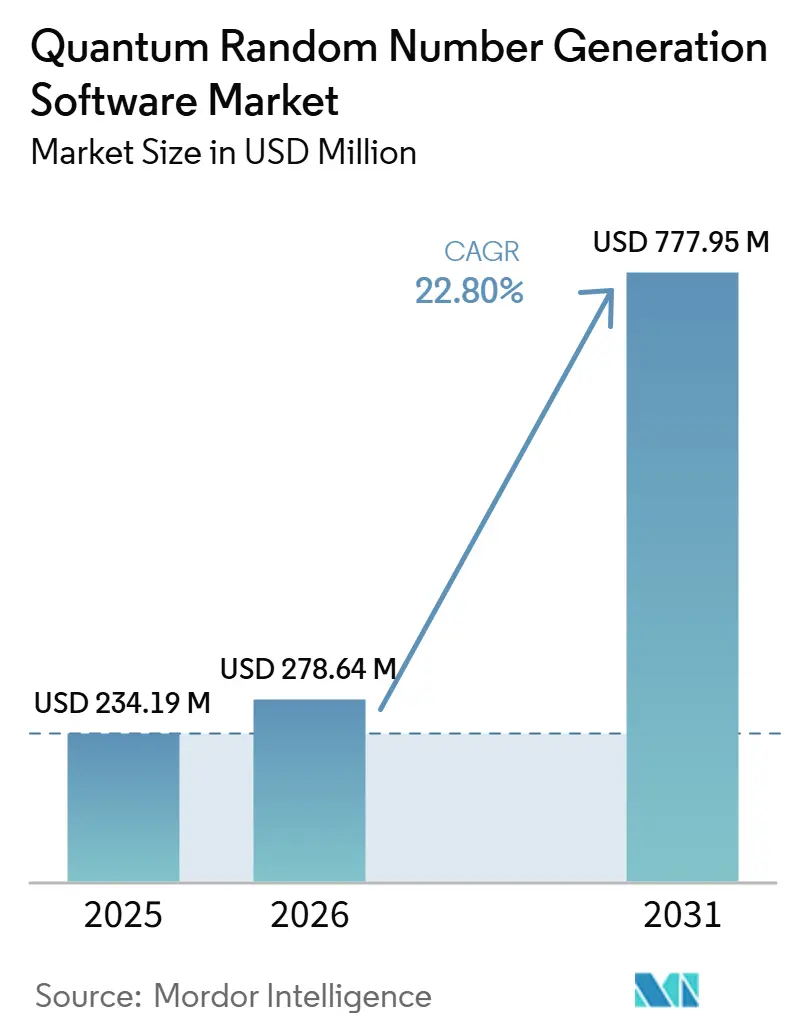
The Quantum random number generation software market size was valued at USD 234.19 million in 2025 and is forecast to reach USD 777.95 million by 2031, at a CAGR of 22.80% during 2026-2031. The adoption of post-quantum cryptography, stronger security requirements, and the replacement of deterministic pseudo-random number generators in sensitive systems is shaping the Quantum random number generation software market. Federal and financial-sector migration programs are increasing the need for high-quality randomness in key generation, signatures, and identity systems. Software delivery supports deployment across cloud environments without the hardware procurement cycle associated with dedicated devices. The Quantum random number generation software market also benefits from demand for auditable randomness in financial services, gaming, healthcare, and critical infrastructure. Integration with legacy cryptographic systems and the established cost advantage of classical generators remain important limits on adoption.
Key Report Takeaways
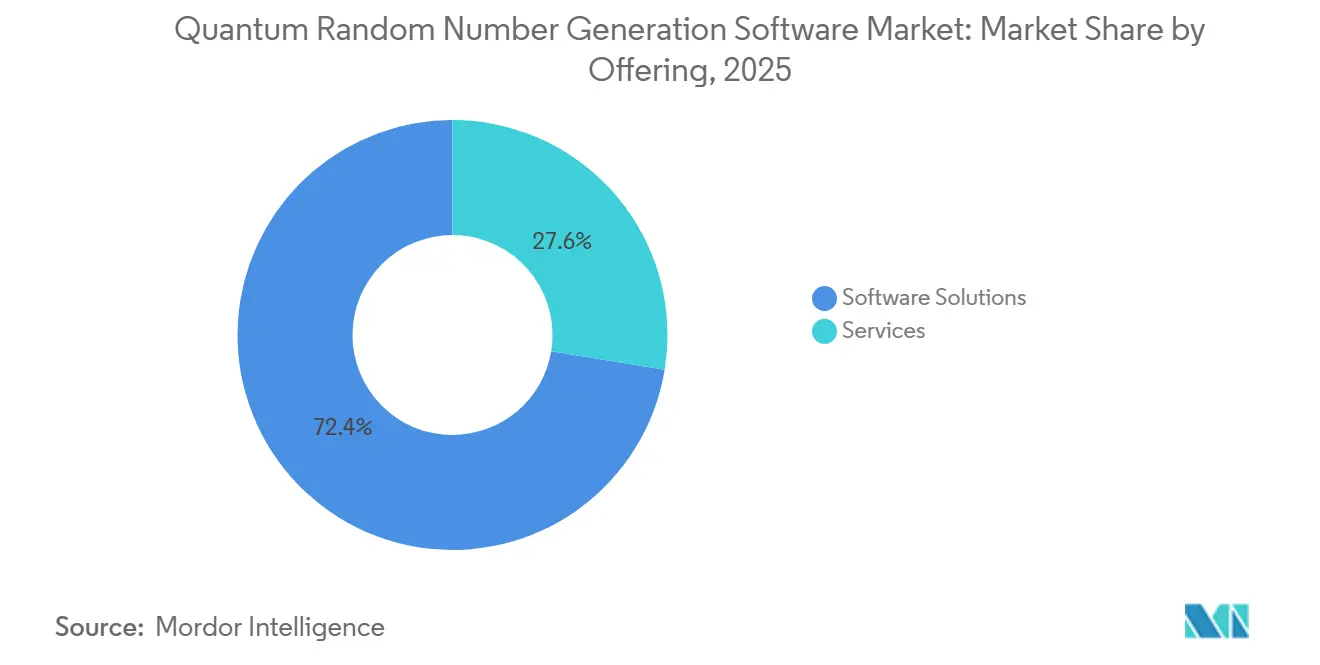
- By offering, Software Solutions held 72.41% of the Quantum random number generation software market share in 2025, while Services is projected to expand at a 25.83% CAGR through 2031.
- By deployment mode, Cloud-Based deployment accounted for 68.19% of revenue in the Quantum random number generation software market in 2025, while Hybrid deployment is projected to grow at a 24.43% CAGR through 2031.
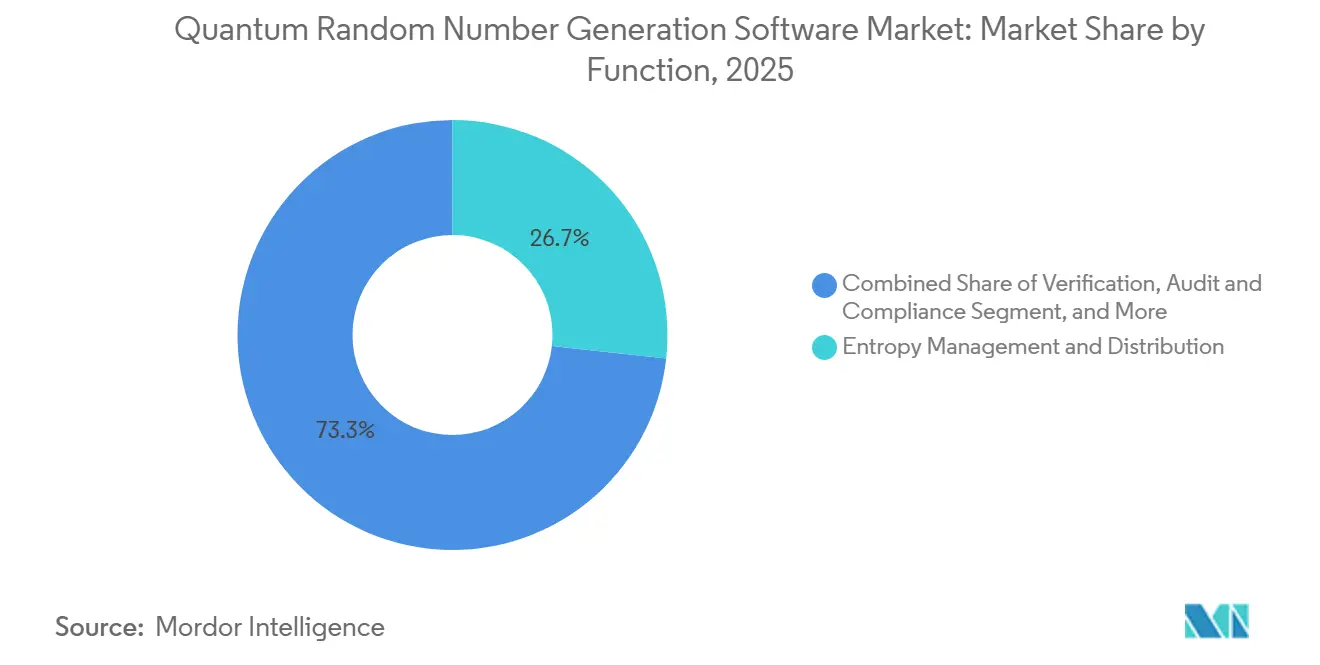
- By function, Entropy Management and Distribution accounted for 26.74% of revenue in the Quantum random number generation software market in 2025, while Verification, Audit, and Compliance is projected to expand at a 27.18% CAGR through 2031.
- By end user, BFSI held 24.36% of revenue in 2025, while Healthcare and Life Sciences are projected to grow at a 26.42% CAGR through 2031.
- By geography, North America accounted for 34.62% of revenue in the Quantum random number generation software market in 2025, while Asia-Pacific is projected to grow at a 25.91% CAGR through 2031.
Note: Market size and forecast figures in this report are generated using Mordor Intelligence’s proprietary estimation framework, updated with the latest available data and insights as of January 2026.
Global Quantum Random Number Generation Software Market Trends and Insights
Drivers Impact Analysis*
| Driver | (~) % Impact on CAGR Forecast | Geographic Relevance | Impact Timeline |
|---|---|---|---|
| Escalating Cybersecurity Threats and Encryption Requirements | +5.5% | Global | Short term (≤ 2 years) |
| Post-Quantum Cryptography Migration and Entropy Modernization | +4.8% | North America and Europe | Medium term (2-4 years) |
| Cloud and Edge Expansion Creating Entropy-Starved Workloads | +3.6% | Global | Medium term (2-4 years) |
| Growth of Embedded Security Across IoT, Mobile, and Connected Vehicles | +2.8% | Global, with Asia-Pacific as a core area and spillover to Middle East and Africa | Medium term (2-4 years) |
| Regulated Demand for Verifiable Randomness in Gaming and Financial Services | +2.2% | North America, Europe, and Asia-Pacific | Short term (≤ 2 years) |
| Quantum-Computing Access Expanding Software QRNG Availability | +1.6% | North America and Asia-Pacific | Long term (≥ 4 years) |
| Source: Mordor Intelligence | |||
Escalating Cybersecurity Threats and Encryption Requirements
Harvest-now-decrypt-later attacks have changed how organizations assess the lifespan of encrypted information. Attackers can retain encrypted data now and seek to decrypt it after capable quantum computing becomes available. Records and communications that must remain confidential for more than 10 years therefore require earlier action on cryptographic agility and entropy quality. Banking, healthcare, defense, and intelligence organizations are treating entropy as a security input that needs planning, monitoring, and governance. The Quantum random number generation software market benefits because software-based entropy can be connected to existing key management systems without a separate hardware procurement process. ETSI guidance issued in March 2026 set expectations for continuous health monitoring and hardware root-of-trust attestation in regulated QRNG deployments.[1]European Telecommunications Standards Institute, “Cyber Security Implementation Guidelines for Quantum Random Number Generators,” ETSI, etsi.org
Post-Quantum Cryptography Migration and Entropy Modernization
NIST approved FIPS 203, FIPS 204, and FIPS 205 in August 2024, placing post-quantum cryptography on a path to implementation for federal systems and related suppliers.[2]National Institute of Standards and Technology, “Announcing Approval of Three Federal Information Processing Standards for Post-Quantum Cryptography,” NIST, nist.gov The standards cover ML-KEM, ML-DSA, and SLH-DSA, all of which require strong-seeded randomness for key generation and signing. Software QRNG products can be introduced as library and service-layer changes, reducing disruption to certified cryptographic environments. Quantinuum's Quantum Origin received NIST SP 800-90B validation as a Validated Entropy Source in April 2025, creating a software-focused compliance reference for buyers.[3]Quantinuum, “Quantinuum's Quantum Origin Becomes First Software Quantum Random Number Generator to Achieve NIST Validation,” Quantinuum, quantinuum.com Large financial networks must also address entropy across high-volume HSM operations rather than only at the point of key creation. The Quantum random number generation software market, therefore, has an opportunity to develop service models that abstract entropy delivery across existing cryptographic operations.
Cloud and Edge Expansion Creating Entropy-Starved Workloads
Virtual machines and edge nodes do not always have the physical randomness sources available to dedicated hardware. This can leave cloud-hosted key management systems, token services, and IoT gateways with limited entropy for frequent cryptographic activity. Cloud-based deployment accounted for 68.19% of revenue in 2025, indicating that enterprise delivery is already moving alongside cloud security workloads. Hybrid deployment is projected to grow faster because organizations need cloud distribution while retaining local control where residency or isolation rules apply. Quantropi's QiSpace service shows this approach by distributing quantum entropy over IP networks while supporting customer-hosted and air-gapped configurations. The Quantum random number generation software market can gain from the growing overlap between entropy-as-a-service and key-management-as-a-service.
Growth of Embedded Security Across IoT, Mobile, and Connected Vehicles
IoT sensors, mobile devices, and connected vehicles must support stronger security while operating with limited processing resources. These endpoints can struggle to meet the entropy requirements imposed by post-quantum key generation and frequent credential refreshes. Remote quantum-entropy services can eliminate the need to install a QRNG device at every endpoint. Quantum Dice has described a quantum entropy-as-a-service model for endpoints that would otherwise rely on weaker pseudo-random seeds. Automotive cybersecurity requirements under ISO/SAE 21434 are also bringing cryptographic design decisions into vehicle development earlier in the lifecycle. The Quantum random number generation software market is supported by a shift toward treating entropy delivery as a network service rather than a device-specific feature.
Restraints Impact Analysis*
| Restraint | (~) % Impact on CAGR Forecast | Geographic Relevance | Impact Timeline |
|---|---|---|---|
| Integration Complexity Across Legacy Cryptographic Stacks | -2.5% | Global | Medium term (2-4 years) |
| Price and Familiarity Advantages of Classical PRNGs | -1.8% | South America, Middle East and Africa, and Southeast Asia | Medium term (2-4 years) |
| Evidence and Audit Burden for Remote Quantum Entropy Provenance | -1.2% | North America and Europe | Long term (≥ 4 years) |
| Latency, Availability, and Data-Residency Friction in Cross-Border Entropy Services | -0.8% | Europe and Asia-Pacific | Long term (≥ 4 years) |
| Source: Mordor Intelligence | |||
Integration Complexity Across Legacy Cryptographic Stacks
Organizations with legacy HSMs, PKIX infrastructure, and older cryptographic libraries can face material integration work when changing entropy sources. The work can affect HSM firmware, application programming interfaces, and entropy-pool management. ETSI notes that QRNG implementation must align with assurance requirements, including FIPS 140-3 considerations in higher-security settings. A common QRNG interface and control-plane standard has not yet been adopted across quantum cryptography technologies. This creates more work for buyers with mixed vendor environments and several generations of security equipment. The Quantum random number generation software market faces slower adoption among mid-sized financial institutions and healthcare networks that need compliance but have limited engineering capacity.
Price and Familiarity Advantages of Classical PRNGs
Classical PRNGs and hardware true-random-number generators are embedded in operating systems, HSM firmware, and established cryptographic toolkits. NIST SP 800-90A deterministic random bit generators can remain within existing FIPS 140-3 validated environments, which reduces the immediate need for replacement. Buyers outside direct post-quantum compliance requirements may not see a near-term financial reason to move from these familiar tools. The proof and monitoring requirements for remote quantum entropy can also raise the cost of a new deployment. ETSI's zero-trust model calls for layered assurance, continuous health monitoring, and root-of-trust attestation. Vendors are responding with hybrid seeding models that combine quantum entropy and classical DRBG outputs to preserve compatibility during migration.
*Our forecasts treat driver/restraint impacts as directional, not additive. The impact forecasts reflect baseline growth, mix effects, and variable interactions.
Segment Analysis
By Offering: Services Gain Pace While Software Solutions Retain the Revenue Base
Software Solutions held 72.41% of the Quantum random number generation software market share in 2025, making it the leading offering category. Buyers prefer software when they need to deploy across multiple cloud environments without per-seat hardware costs. The category is moving beyond entropy generation toward platforms that combine delivery, key management, health monitoring, and post-quantum cryptography libraries. Palo Alto Networks and its QRNG technology partners introduced the QRNG Open API framework in January 2025 to improve interoperability in security platforms. A common interface can make basic entropy delivery less distinctive over time. It can also increase the importance of certification coverage, integration depth, and managed services.[4]Palo Alto Networks and ID Quantique, “Palo Alto Networks Prepares Organizations for Quantum Security With QRNG Open API,” ID Quantique, idquantique.com
Services are projected to record a 25.83% CAGR from 2026 to 2031, the fastest rate within this segmentation. Managed entropy delivery, integration support, and compliance services appeal to organizations that do not want to operate an internal quantum security function. BFSI and healthcare buyers need support for monitoring, audit logs, failover, and evidence of entropy provenance. Gaming operators also need random number generation systems that can support certification and audit requirements under RTS 7. The Quantum random number generation software market can therefore shift toward recurring service relationships instead of one-time software deployments. Providers with continuous verification reports and tamper-evident audit trails are positioned to serve the most demanding programs.


By Deployment Mode: Cloud Delivery Leads While Hybrid Models Address Residency Needs
Cloud-Based deployment accounted for 68.19% of the Quantum random number generation software market size in 2025. This position reflects the close fit between cloud-native security workloads and entropy-as-a-service delivery. Cloud resources often need frequent key refreshes, transaction signing, and protected identity processes. AWS Marketplace offered an example of cloud-oriented QRNG delivery that combines entropy sources for use with EC2 resources. On-premises systems still matter for defense agencies, financial institutions, and data centers with strict network isolation rules. These buyers may continue to prefer local or air-gapped entropy equipment.
Hybrid deployment is projected to grow at a 24.43% CAGR through 2031. The model combines local entropy generation or control with cloud-based distribution and application access. It is relevant where organizations must document cryptographic key lifecycles and manage data residency requirements. Quantropi's QiSpace service uses a multi-vendor entropy supply and also allows customer-hosted configurations for isolated deployments. Hybrid arrangements require coordination across local appliances, cloud services, and access controls. This complexity creates a professional services opportunity for providers that can deliver certified support across multiple regions. The Quantum random number generation software market may favor suppliers with both cloud integration and on-premises deployment capability.
By Function: Entropy Management Leads Revenue While Audit Functions Grow Faster
Entropy Management and Distribution held 26.74% of the Quantum random number generation software market share in 2025. This function receives raw entropy, applies post-processing, and distributes output to cryptographic applications through authenticated channels. It remains essential for production key management, transaction signing, and other high-volume security processes. Quside states that its Entropy Core supports more than 10,000 entropy requests per second. Development platforms support organizations building QRNG-enabled applications. Post-processing and conditioning are also needed because raw sources can require bias management before cryptographic use.
Verification, Audit, and Compliance is projected to grow at a 27.18% CAGR through 2031. Regulators and security teams increasingly require live testing and traceable evidence, rather than a one-time demonstration of randomness quality. NIST and the University of Colorado Boulder reported a public quantum randomness service with a 99.7% success rate during its first 40 days. This work supports interest in systems where the provenance of output can be examined independently. Financial services have particularly strong audit requirements for key-generation events and related controls. The Quantum random number generation software market is likely to reward products that build audit logging, attestation certificates, and reporting tools into entropy workflows.

By End User: BFSI Provides the Revenue Base While Healthcare and Life Sciences Expands Faster
BFSI accounted for 24.36% of the Quantum random number generation software market size in 2025. The segment leverages stronger randomness across core banking, secure messaging, digital identity, and key management upgrades. Long-established financial controls also make the sector a natural early buyer of auditable cryptographic services. Erste Group completed a commercial pilot of entanglement-based quantum key distribution in its Vienna banking infrastructure in February 2026. IT and Telecommunication, Aerospace and Defense, and Government and Administration form stable mid-sized demand areas. Their purchasing decisions are often linked to national security requirements and sovereign technology programs.
Healthcare and Life Sciences are projected to grow at a 26.42% CAGR through 2031. Electronic health records must often remain secure for long periods, while AI-assisted diagnostics add more sensitive data to existing systems. A 2026 study presented CITADEL, a post-quantum framework for electronic health records that combined NIST-standardized algorithms with verifiable randomness generation. Retail and E-Commerce, Industrial Manufacturing, Media and Entertainment, Energy and Utilities, and Education and Research Institutions add a broader base of future demand. Their adoption is expected to follow wider post-quantum migration schedules rather than an immediate sector-specific trigger. The Quantum random number generation software market is therefore expanding beyond its initial focus on banking and high-security government use cases.
Geography Analysis
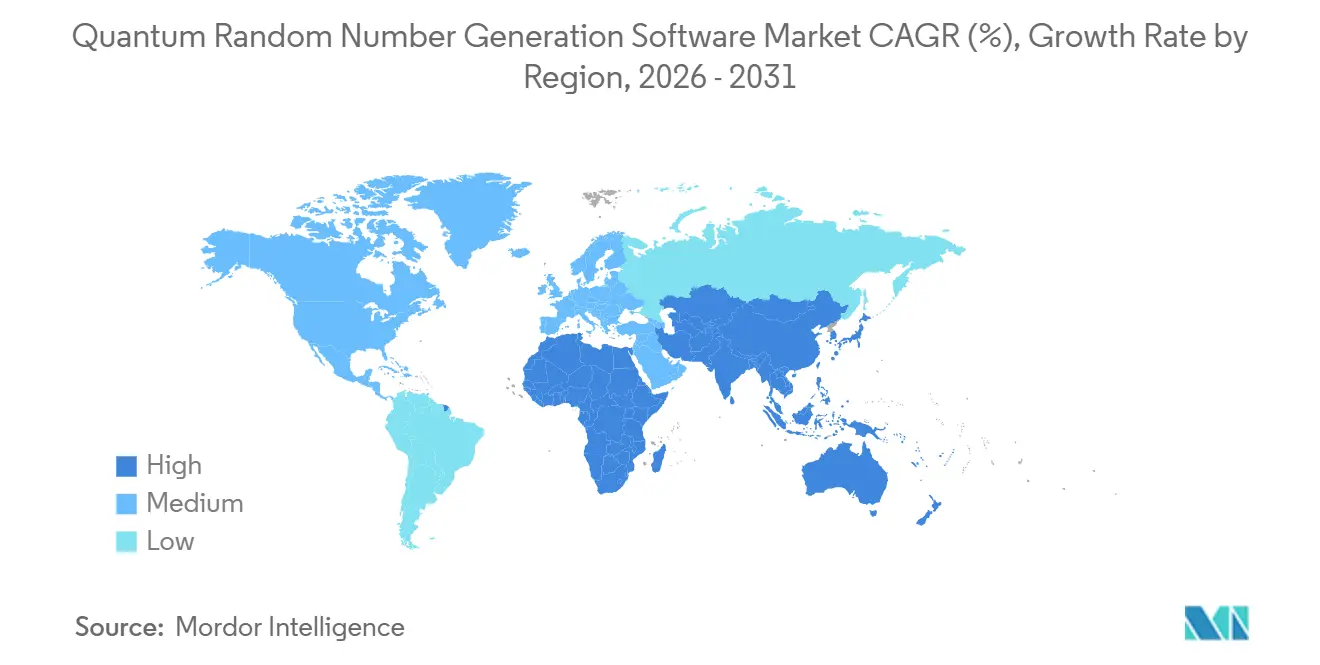
North America held 34.62% of the Quantum random number generation software market share in 2025. The region has a developed federal cybersecurity procurement system and a high concentration of QRNG software providers. U.S. migration requirements based on NIST-approved post-quantum standards support demand among agencies, contractors, and suppliers. Quantinuum's April 2025 NIST SP 800-90B validation established a recognized path for software-based entropy in government procurement. Canada and Mexico add secondary demand through financial-sector and government readiness programs. The CURBy public quantum randomness service also strengthened the region's research base for verifiable randomness.
Asia-Pacific is projected to grow at a 25.91% CAGR from 2026 to 2031. National quantum programs in China, Japan, and South Korea support the adoption of quantum security capabilities. Regional telecom and financial infrastructure provide practical settings for QRNG integration. South Korea's work to integrate QRNG into 5G equipment shows the role of telecommunications in bringing the technology into commercial environments. India is an emerging contributor as domestic companies build international research and commercial relationships. Southeast Asia and the rest of Asia-Pacific remain earlier-stage markets, with progress linked to financial digitalization and government cybersecurity modernization.
Europe followed North America as the third-largest revenue region, with Germany, the United Kingdom, and France forming the core. Financial institutions must manage operational resilience and document cryptographic controls, which support attention to entropy provenance. ETSI's March 2026 QRNG implementation guidance covered FIPS 140-3, NIST SP 800-90B, BSI AIS 20/31, and ISO/IEC 19790 pathways. South America, the Middle East, and Africa represent smaller but developing areas for the Quantum random number generation software market. Brazil and Gulf states are making early investments in quantum security infrastructure. South Africa and Saudi Arabia have also begun sovereign cybersecurity programs that can build institutional demand.

Competitive Landscape
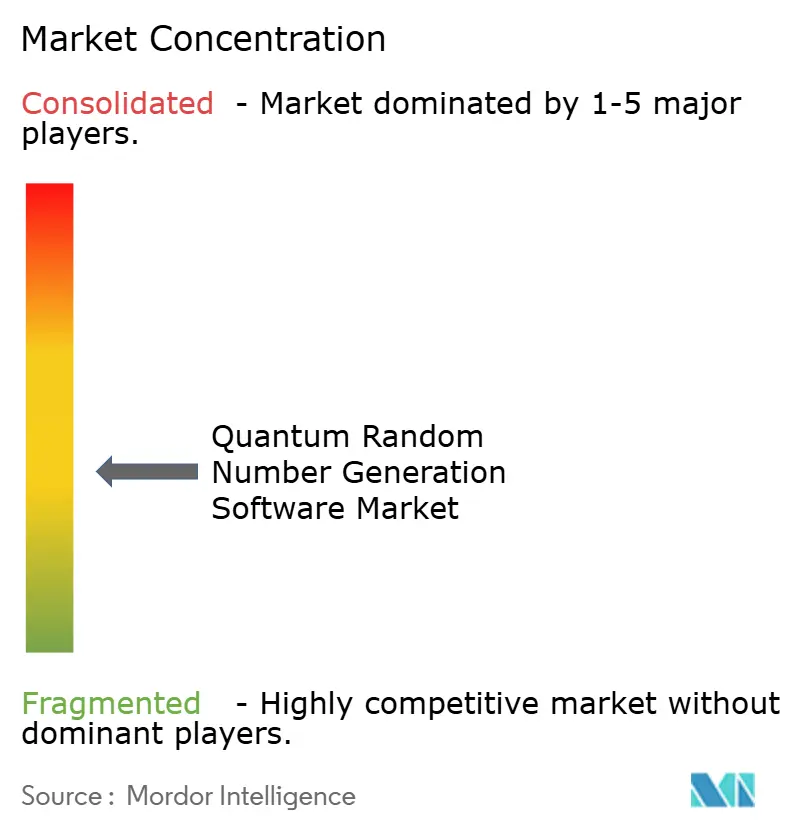
The Quantum random number generation software market is moderately fragmented. Purpose-built QRNG software providers compete with quantum computing platforms and cybersecurity vendors that have added entropy products to wider security portfolios. Competition is strongest in cloud delivery, where several providers offer API-accessible entropy services. ID Quantique, Quantropi, Quside, and QuintessenceLabs compete through certification, latency commitments, regional coverage, and integration support. The QRNG Open API framework introduced in January 2025 brought together Palo Alto Networks and several QRNG technology partners around a common integration approach. This initiative can make basic delivery more comparable and raise the value of compliance and operational capabilities.
Quside has pursued differentiation through entropy observability, metrology, and hardware-software integration. Coherent and Quside demonstrated a mass-manufacturable quantum entropy source in January 2026 for uses including data centers, critical infrastructure, space systems, and defense. Quantinuum differentiated its Quantum Origin offering through the April 2025 NIST validation. Luxquanta coordinated the QUARTERNEXT consortium, launched in July 2026, to advance quantum-safe communications and industrial certification in European environments. These actions show that certification, manufacturing readiness, and ecosystem participation are important competitive tools. They also indicate that QRNG providers are seeking stronger positions within broader quantum-security deployments.
A meaningful opportunity in the Quantum random number generation software market remains among healthcare networks, mid-sized financial institutions, and regional utilities. These buyers need compliance-grade products but may not have the teams to handle a complex cryptographic migration. Pre-integrated modules for HSMs, key management systems, and cryptographic libraries can reduce adoption barriers. Providers are also adding anomaly detection to entropy monitoring to enable health checks to operate at scale. The Quantum random number generation software market is likely to favor companies that combine clear integration paths with evidence for security and compliance. A fragmented supplier base leaves room for both specialist providers and partnerships with established cybersecurity platforms.
Quantum Random Number Generation Software Industry Leaders
ID Quantique SA
QuintessenceLabs Pty Ltd
Quside Technologies S.L.
Qrypt Inc.
QNu Labs Private Limited
- *Disclaimer: Major Players sorted in no particular order

Recent Industry Developments
- July 2026: The QUARTERNEXT European consortium launched as a 4-year EU-funded project coordinated by Luxquanta, with Quside, Chilas, fragmentiX, Telefónica, and the Austrian Institute of Technology. The project aims to advance next-generation quantum-safe communications, including high-performance QRNG integration, toward industrial certification under European standards and in support of the EU EuroQCI program.
- February 2026: Erste Group, with zerothird and A1, completed a commercial pilot of entanglement-based quantum key distribution integrated into a live banking fiber-optic infrastructure in Vienna. The pilot maintained a secure key rate above 63 kilobits per second for 4 months across 22 km of fiber.
- January 2026: Coherent Corp. and Quside demonstrated production of a mass-manufacturable quantum entropy source. The companies stated that the source can be embedded across security architectures for data centers, critical infrastructure, space systems, and defense applications.
- April 2025: Quantinuum's Quantum Origin became the first software QRNG to achieve NIST SP 800-90B validation for a Validated Entropy Source.


Global Quantum Random Number Generation Software Market Report Scope
The quantum random number generation (QRNG) software market comprises the ecosystem of software solutions and associated services that process, manage, and distribute true, unpredictable randomness derived from quantum physical processes. Unlike classical pseudo-random number generators (PRNGs) that use mathematical algorithms, QRNG software extracts raw entropy from inherently unpredictable quantum phenomena, such as photon arrival times, quantum phase noise, or vacuum fluctuations, and applies post-processing and entropy-conditioning algorithms to ensure the output meets strict statistical and cryptographic standards. The market encompasses development platforms, entropy management and distribution systems, real-time health monitoring tools, and software for verifying compliance with global cybersecurity standards. Deployed via cloud, on-premises, or hybrid models, these solutions cater to organizations across highly regulated, security-sensitive industries, including BFSI, aerospace and defense, government, and IT. By providing provably unpredictable and tamper-resistant random numbers, QRNG software is critical for securing high-stakes cryptographic key generation, secure communications, advanced simulations, and protecting sensitive data against both classical and future quantum computing threats.
The Quantum Random Number Generation Software Market Report is Segmented by Offering (Software Solutions, and Services), Deployment Mode (Cloud-Based, On-Premises, and Hybrid), Function (QRNG Development Platforms, Entropy Management and Distribution, Randomness Validation and Health Monitoring, Post-Processing and Entropy Conditioning, and Verification, Audit and Compliance), End User (IT and Telecommunication, BFSI, Healthcare and Life Sciences, Retail and E-Commerce, Aerospace and Defense, Industrial Manufacturing, Education and Research Institutions, Media and Entertainment, Government and Administration, Energy and Utilities, and Other End-User Industries), and Geography (North America, South America, Europe, Asia-Pacific, and Middle East and Africa). The Market Forecasts are Provided in Terms of Value (USD).
| Software Solutions |
| Services |
| Cloud-Based |
| On-Premises |
| Hybrid |
| QRNG Development Platforms |
| Entropy Management and Distribution |
| Randomness Validation and Health Monitoring |
| Post-Processing and Entropy Conditioning |
| Verification, Audit and Compliance |
| IT and Telecommunication |
| BFSI |
| Healthcare and Life Sciences |
| Retail and E-Commerce |
| Aerospace and Defense |
| Industrial Manufacturing |
| Education and Research Institutions |
| Media and Entertainment |
| Government and Administration |
| Energy and Utilities |
| Other End-Users |
| North America | United States | |
| Canada | ||
| Mexico | ||
| South America | Brazil | |
| Argentina | ||
| Rest of South America | ||
| Europe | Germany | |
| United Kingdom | ||
| France | ||
| Russia | ||
| Spain | ||
| Rest of Europe | ||
| Asia-Pacific | China | |
| Japan | ||
| India | ||
| South Korea | ||
| Southeast Asia | ||
| Rest of Asia-Pacific | ||
| Middle East and Africa | Middle East | Saudi Arabia |
| United Arab Emirates | ||
| Rest of Middle East | ||
| Africa | South Africa | |
| Nigeria | ||
| Rest of Africa | ||
| By Offering | Software Solutions | ||
| Services | |||
| By Deployment Mode | Cloud-Based | ||
| On-Premises | |||
| Hybrid | |||
| By Function | QRNG Development Platforms | ||
| Entropy Management and Distribution | |||
| Randomness Validation and Health Monitoring | |||
| Post-Processing and Entropy Conditioning | |||
| Verification, Audit and Compliance | |||
| By End User | IT and Telecommunication | ||
| BFSI | |||
| Healthcare and Life Sciences | |||
| Retail and E-Commerce | |||
| Aerospace and Defense | |||
| Industrial Manufacturing | |||
| Education and Research Institutions | |||
| Media and Entertainment | |||
| Government and Administration | |||
| Energy and Utilities | |||
| Other End-Users | |||
| By Geography | North America | United States | |
| Canada | |||
| Mexico | |||
| South America | Brazil | ||
| Argentina | |||
| Rest of South America | |||
| Europe | Germany | ||
| United Kingdom | |||
| France | |||
| Russia | |||
| Spain | |||
| Rest of Europe | |||
| Asia-Pacific | China | ||
| Japan | |||
| India | |||
| South Korea | |||
| Southeast Asia | |||
| Rest of Asia-Pacific | |||
| Middle East and Africa | Middle East | Saudi Arabia | |
| United Arab Emirates | |||
| Rest of Middle East | |||
| Africa | South Africa | ||
| Nigeria | |||
| Rest of Africa | |||


Key Questions Answered in the Report
What is the size of the Quantum random number generation software market?
The Quantum random number generation software market was valued at USD 234.19 million in 2025 and is forecast to reach USD 777.95 million by 2031 at a 22.80% CAGR.
What is driving demand for quantum random number generation software?
Post-quantum cryptography migration, stronger encryption requirements, cloud security workloads, and demand for auditable randomness are supporting adoption.
Which offering category leads quantum random number generation software revenue?
Software Solutions led with 72.41% of revenue in 2025, while Services is projected to grow faster at a 25.83% CAGR through 2031.
Which deployment approach is growing fastest?
Hybrid deployment is projected to grow at a 24.43% CAGR through 2031 because it can combine local control with cloud-based delivery.
Which end-user segment is expected to grow fastest?
Healthcare and Life Sciences is projected to record a 26.42% CAGR through 2031, supported by the need to protect long-lived health information.
Which region is expanding fastest for QRNG software?
Asia-Pacific is projected to grow at a 25.91% CAGR from 2026 to 2031, supported by national quantum programs and telecom integration.
Page last updated on:






