
Quantum Machine Learning (QML) Software Market Size and Share
Market Overview
| Study Period | 2020 - 2031 |
|---|---|
| Market Size (2026) | USD 0.62 Billion |
| Market Size (2031) | USD 2.49 Billion |
| Growth Rate (2026 - 2031) | 32.06 % |
| Fastest Growing Market | Asia-Pacific |
| Largest Market | North America |
| Market Concentration | Medium |
Major Players *Disclaimer: Major Players sorted in no particular order Image © Mordor Intelligence. Reuse requires attribution under CC BY 4.0. | |
Quantum Machine Learning (QML) Software Market Analysis by Mordor Intelligence
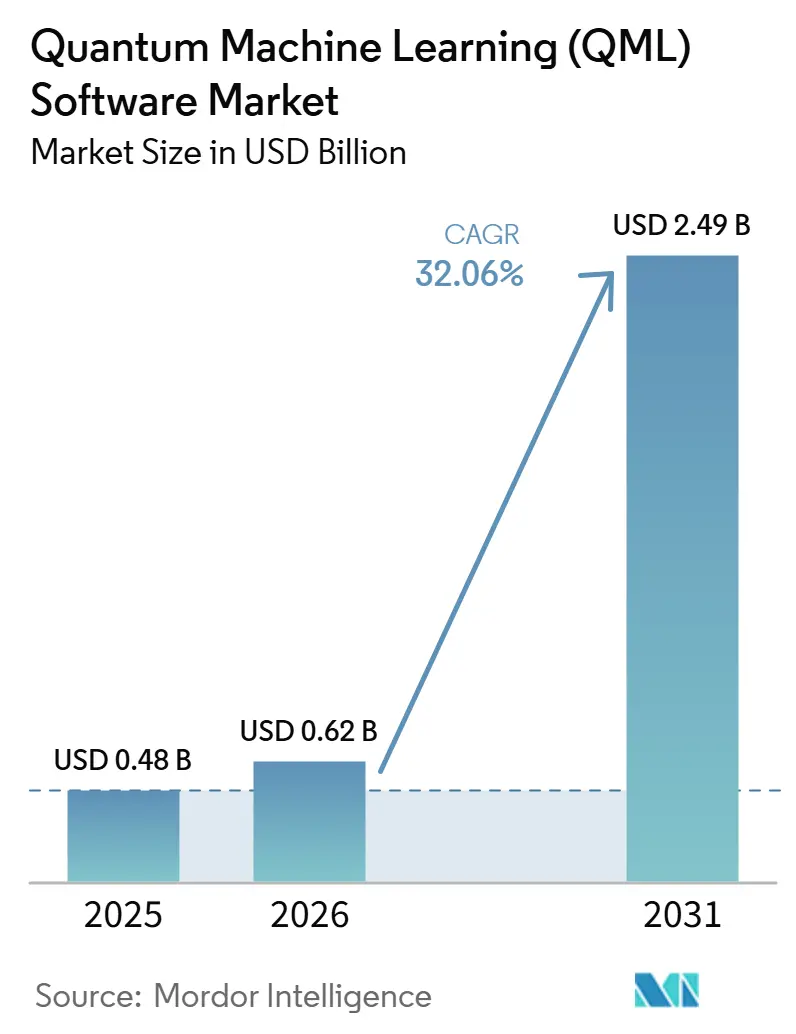
The Quantum Machine Learning (QML) Software Market size was valued at USD 0.48 billion in 2025 and estimated to grow from USD 0.62 billion in 2026 to reach USD 2.49 billion by 2031, at a CAGR of 32.06% during the forecast period 2026-2031. The Quantum Machine Learning (QML) Software Market is expanding because enterprise buyers are committing budget to software layers, development environments, and workflow tools before fault-tolerant quantum hardware reaches broad commercial readiness. This pattern is supporting steady demand for algorithm design software, simulation tools, middleware, and managed services that help organizations connect quantum workloads with existing artificial intelligence and research systems. Another important shift in the Quantum Machine Learning (QML) Software Market is the move toward hybrid execution, where enterprises assign different stages of a workflow to classical and quantum resources based on latency, security, and compute efficiency. Competitive positioning in the Quantum Machine Learning (QML) Software Market is increasingly shaped by a vendor's ability to integrate with established cloud platforms, developer toolchains, and industry-specific use cases, rather than by hardware access alone. The Quantum Machine Learning (QML) Software Market still faces caution from buyers seeking clearer proof of repeatable commercial value, but that same caution is creating room for vendors that can demonstrate measurable integration benefits, practical deployment support, and stronger workflow reliability.
Key Report Takeaways
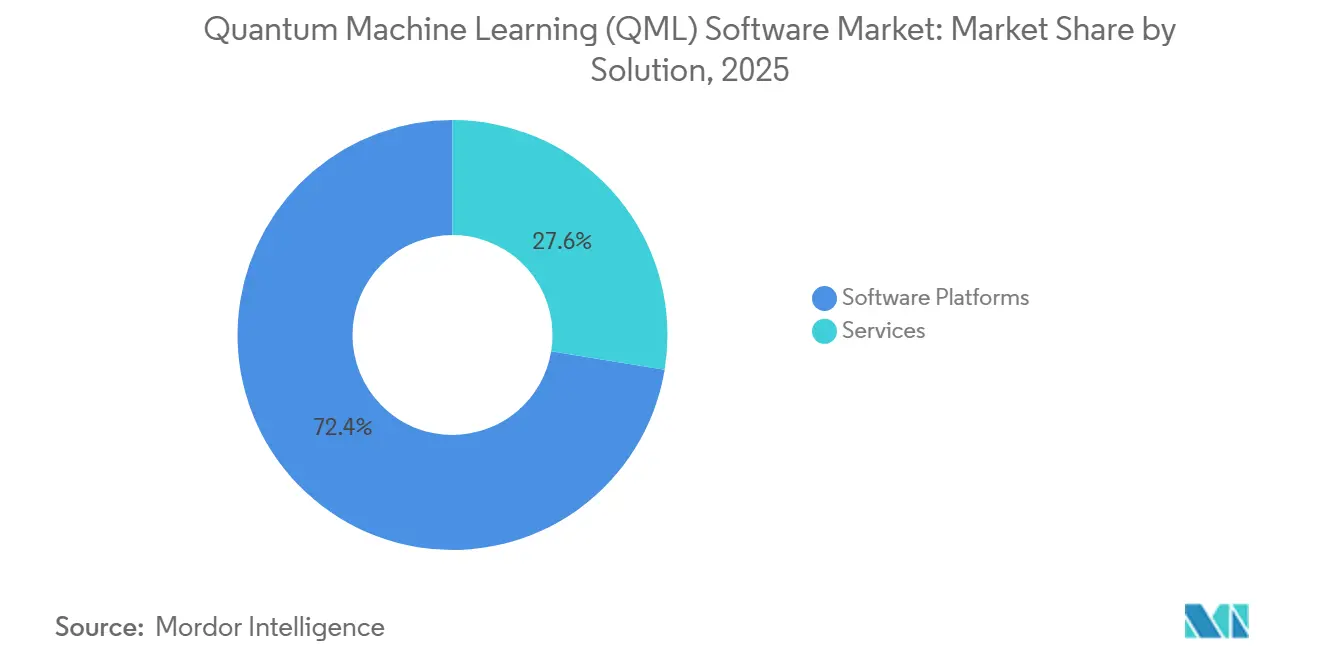
- By solution, software platforms held 72.41% share in Quantum Machine Learning (QML) Software Market in 2025, while services are projected to expand at a 35.82% CAGR through 2031.
- By deployment, cloud-based delivery accounted for 68.24% share in the Quantum Machine Learning (QML) Software Market in 2025, while hybrid deployment is projected to grow at a 34.19% CAGR through 2031.
- By organization size, large enterprises held 64.83% share in 2025, while small and medium enterprises are projected to grow at a 36.42% CAGR through 2031.
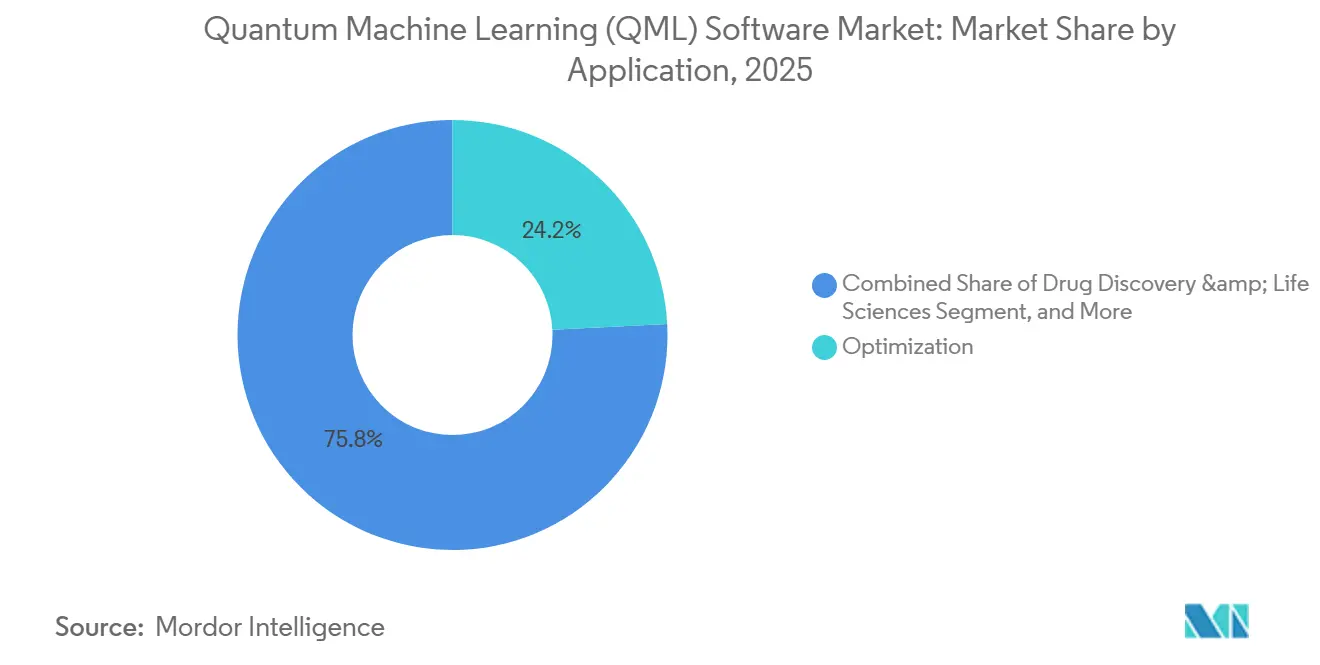
- By application, optimization accounted for 24.18% share in 2025, while drug discovery and life sciences are projected to expand at a 38.74% CAGR through 2031.
- By end-user industry, IT and telecommunications held a 26.73% share of the of the Quantum Machine Learning (QML) Software Market in 2025, while healthcare and life sciences are projected to grow at a 37.91% CAGR through 2031.
Note: Market size and forecast figures in this report are generated using Mordor Intelligence’s proprietary estimation framework, updated with the latest available data and insights as of January 2026.
Market Trends and Insights
Drivers Impact Analysis of Quantum Machine Learning (QML) Software Market*
| Driver | (~) % Impact on CAGR Forecast | Geographic Relevance | Impact Timeline |
|---|---|---|---|
| Enterprise Demand for Hybrid Quantum-Classical Workflows | +7.5% | Global | Medium term (2-4 years) |
| Rising Need for Quantum-Safe Optimization in High-Complexity Use Cases | +6.2% | North America and Europe | Medium term (2-4 years) |
| Rapid Expansion of Cloud Access to Quantum Development Environments | +5.8% | Global | Short term (≤ 2 years) |
| Regulatory and Public Funding Support for Quantum Software Ecosystems | +4.6% | North America, EU, Asia-Pacific core | Long term (≥ 4 years) |
| Algorithm Portability Across Hardware Backends | +2.4% | Global | Medium term (2-4 years) |
| Quantum Readiness Benchmarking in Procurement | +1.6% | North America and Europe | Long term (≥ 4 years) |
| Source: Mordor Intelligence | |||
Enterprise Demand for Hybrid Quantum-Classical Workflows
The Quantum Machine Learning (QML) Software Market is benefiting from stronger enterprise demand for hybrid workflows, as software orchestration determines whether a quantum task can be used in a real production environment. Most near-term machine learning and optimization use cases still need repeated classical processing before and after the quantum step, which makes workflow design more important than raw qubit counts at this stage. Quantinuum’s commercial launch of Helios in November 2025 clearly demonstrated this, as the system was introduced alongside Guppy, a Python-based programming language, and the Nexus cloud platform for hybrid computing, with early customer use cases in drug discovery, materials research, and financial analytics.[1]Quantinuum Staff, “Quantinuum Announces Commercial Launch Of New Helios Quantum Computer That Offers Unprecedented Accuracy To Enable Generative Quantum AI (GenQAI),” Quantinuum, quantinuum.com This pattern is creating a larger role for middleware vendors that can translate existing data structures, model logic, and process flows into quantum-compatible formats without forcing a full redesign of enterprise systems. As a result, the Quantum Machine Learning (QML) Software Market is moving toward products that connect quantum experimentation with standard artificial intelligence, analytics, and research operations, rather than treating quantum computing as a stand-alone environment. Vendors that make this connection easier are likely to stay better positioned as buyers look for repeatable value rather than isolated demonstrations.
Rising Need for Quantum-Safe Optimization in High-Complexity Use Cases
The Quantum Machine Learning (QML) Software Market is also supported by demand from sectors where large-scale optimization problems are becoming harder to solve within practical business time frames using only classical methods. Logistics planning, financial portfolio design, derivative pricing, and pharmaceutical screening all require decision structures that become more difficult as the number of variables, constraints, and possible outcomes increases. D-Wave stated in its first-quarter 2026 results that its Stride hybrid solver now supports surrogate machine learning integration, indicating that customers are already moving toward more adaptive industrial optimization workflows.[2]Amazon Web Services Staff, “Amazon Braket Introduces Program Sets Enabling Customers To Run Quantum Programs Up To 24x Faster,” Amazon Web Services, aws.amazon.com A second factor is that mathematically structured optimization pathways are easier to review and explain than black-box prediction models, which matters in banking, healthcare, and other regulated settings. This is helping the Quantum Machine Learning (QML) Software Market because quantum-assisted optimization is being evaluated not only as a performance tool, but also as a way to improve traceability and decision accountability. That broader value proposition is making software adoption more relevant in sectors that must balance computational performance with oversight requirements.
Rapid Expansion of Cloud Access to Quantum Development Environments
The Quantum Machine Learning (QML) Software Market has expanded faster because cloud access shifted quantum experimentation from a hardware-ownership decision to a usage-based software-and-services model. This has allowed enterprises, research institutions, and software teams to test models through application programming interfaces and cloud consoles without paying for cryogenic infrastructure or specialized facility support. Amazon Braket introduced program sets in August 2025, and that release reduced workload execution time by 3x to 24x on compatible hardware by minimizing inter-circuit overhead, which directly supports the repeated execution patterns common in model training and benchmarking.[3]D-Wave Quantum Staff, “D-Wave Reports First Quarter 2026 Results,” D-Wave Quantum, dwavequantum.com PASQAL also introduced NVIDIA CUDA-Q integration in March 2026, making it easier to schedule quantum resources within standard high-performance computing workflows rather than treating them as isolated systems. The result is that the Quantum Machine Learning (QML) Software Market is becoming more accessible to organizations that already understand cloud and HPC operations, even if they do not have deep in-house quantum engineering teams. Easier access is also widening the buyer base because testing a use case now requires less upfront commitment and less specialized infrastructure planning.
Regulatory and Public Funding Support for Quantum Software Ecosystems
The Quantum Machine Learning (QML) Software Market is also benefiting from public policy support that now extends beyond small research grants into larger commercialization and ecosystem-building programs. In May 2026, the U.S. Department of Commerce announced letters of intent to provide USD 2.013 billion in incentives to 9 quantum companies under the CHIPS and Science Act, including support for IBM, D-Wave, Quantinuum, and Rigetti.[4]National Institute Of Standards And Technology Staff, “Department Of Commerce Announces Letters Of Intent With 9 Companies For 2 Billion To Accelerate U.S. Leadership In Quantum Computing,” National Institute of Standards and Technology, nist.gov In June 2026, the White House issued Executive Order 14413, which directed federal action on scientific discovery, quantum performance assessment, and a long-term commercialization strategy. These actions matter for the Quantum Machine Learning (QML) Software Market because software vendors need stable funding visibility, benchmark frameworks, and procurement pathways to justify multi-year product roadmaps. Public programs in the United States and Europe are also helping define how future enterprise and public buyers will judge performance, portability, and interoperability. That gives the software layer a stronger structural foundation, even before fault-tolerant systems arrive at scale.
Restraints Impact Analysis of Quantum Machine Learning (QML) Software Market*
| Restraint | (~) % Impact on CAGR Forecast | Geographic Relevance | Impact Timeline |
|---|---|---|---|
| Limited Commercial Scale of Fault-Tolerant Quantum Hardware | -4.8% | Global | Long term (≥ 4 years) |
| High Integration Cost with Legacy Enterprise Data and MLOps Stacks | -3.7% | North America and Europe | Medium term (2-4 years) |
| Talent Shortage in Quantum Algorithms and Quantum DevOps | -2.9% | Global | Long term (≥ 4 years) |
| Validation Gaps for Quantum Advantage Claims | -2.1% | Global | Medium term (2-4 years) |
| Source: Mordor Intelligence | |||
Limited Commercial Scale of Fault-Tolerant Quantum Hardware
The Quantum Machine Learning (QML) Software Market still faces a major restraint because commercially meaningful fault-tolerant quantum hardware is not yet available at the scale needed for broad enterprise use. That keeps software vendors tied to noisy intermediate-scale systems, where products must be designed around error rates, limited coherence windows, and narrow performance conditions rather than around the full theoretical benefits of error-corrected computing. IBM stated that it expects quantum advantage by the end of 2026 and fault tolerance by 2029, while Microsoft has pointed to 2029 as a path toward scalable systems through its Majorana 2 work. This delay shifts competition in the Quantum Machine Learning (QML) Software Market, as vendors that manage noise, compilation, and hardware-aware execution gain greater relevance than those that focus solely on algorithmic theory. It also erodes buyer confidence because many organizations still want proof that software can generate value before the supporting hardware reaches a more mature, stable phase. Until that gap narrows, the software layer will continue growing, but it will do so with more testing, benchmarking, and caution than a fully mature hardware environment would allow.
High Integration Cost With Legacy Enterprise Data and MLOps Stacks
The Quantum Machine Learning (QML) Software Market also faces a persistent restraint: the cost of integrating quantum workflows into enterprise data systems and machine learning operations stacks built for classical computing. Many organizations already depend on Python-led pipelines, containerized deployment, relational databases, flat files, and analytics warehouses, and those environments are not naturally designed for quantum data encoding or repeated hardware calibration steps. Research published in the Journal of Supercomputing in April 2025 showed that quantum kernel estimation workflows on IBM’s 127-qubit Eagle processors needed hardware-calibrated noise modeling to reach classification parity with classical baselines. This means the burden is not limited to onboarding, because preprocessing, data translation, and workflow tuning can continue to be an ongoing cost even after the first pilot has been completed. The Quantum Machine Learning (QML) Software Market, therefore, remains concentrated among users that can support specialized teams, longer testing cycles, and more complex integration work. Broader adoption will depend on vendors improving data transformation layers, automated preprocessing tools, and easier connections with established machine learning operations environments.
*Our forecasts treat driver/restraint impacts as directional, not additive. The impact forecasts reflect baseline growth, mix effects, and variable interactions.
Quantum Machine Learning (QML) Software Market Segment Analysis
By Solution:
Software Platforms Anchored Revenue While Services Scaled FasterSoftware platforms commanded 72.41% of the Quantum Machine Learning (QML) Software Market share in 2025, which reflected enterprise preference for integrated development toolkits, simulation environments, and algorithm design software over narrower point products. Buyers favored these platforms because they could manage code development, workflow testing, benchmarking, and backend access in a single environment, reducing friction during the early shift from proof-of-concept work to limited production use. IBM strengthened this platform pattern in July 2026 when it released Qiskit v2.5 with a multi-representation compiler framework and dedicated fault-tolerant compilation pipelines, which made it easier for developers to work across near-term and future architectures in the same codebase. Simulation software also gained strategic value as enterprise teams increasingly sought side-by-side comparisons of quantum and classical performance before expanding budgets. Algorithm design environments added another layer of demand by enabling users to explore problem formulation without requiring deep expertise in quantum physics or low-level circuit design.
Services is the fastest-growing solution segment, with the Quantum Machine Learning (QML) Software Market size for services projected to expand at a 35.82% CAGR between 2026 and 2031. This growth shows that many buyers still lack the internal talent to handle model design, workflow integration, benchmarking, and in-house deployment support. Advisory, implementation, and managed deployment work is becoming more valuable as organizations move from initial experimentation to projects tied to business outcomes or scientific targets. Service demand is especially strong in pharmaceuticals and financial services, where engagements are often linked to molecular simulation, portfolio construction, fraud detection, or optimization quality rather than open-ended testing. A related shift is the move toward outcome-based contracts, as buyers increasingly want providers to stand behind measurable improvements in optimization or modeling gains rather than billing only by time spent. That change gives an edge to firms with greater domain depth, because the Quantum Machine Learning (QML) Software Market rewards service providers that can combine technical delivery with industry-specific application knowledge.


By Deployment:
Cloud-Based Access Led While Hybrid Architecture AdvancedCloud-based deployment held a 68.24% share in 2025, indicating that the Quantum Machine Learning (QML) Software Market still relied mainly on remote access models that allow users to reach quantum backends via large cloud environments. This model stayed attractive because it removed the need for capital spending on specialized systems and gave enterprises an easier way to compare tools, providers, and hardware types before making larger commitments. Amazon Braket’s August 2025 program, which supported this position by reducing execution time on compatible workloads, improved the handling of repeated circuit runs, often required in training and optimization workflows. Cloud-based delivery also gave vendors a more practical way to distribute updates, benchmarking features, and managed access to multiple processors. That combination kept cloud delivery ahead because immediate availability and lower entry barriers mattered more to most buyers than direct local control.
Hybrid deployment is projected to grow at a 34.19% CAGR through 2031, making it the fastest-growing deployment mode in the Quantum Machine Learning (QML) Software Market. This shift reflects a more deliberate architecture in which enterprises route different workflow steps across classical central processing units, graphics processing units, and quantum processors based on latency tolerance, data sensitivity, and cost efficiency. PASQAL’s March 2026 CUDA-Q integration demonstrated that quantum processing can fit within standard high-performance computing scheduling patterns rather than sitting outside existing compute operations. Hybrid design is gaining relevance because most practical use cases still rely on repeated classical optimization, parameter updates, and data preparation around the quantum portion of the task. On-premises deployment remains smaller, but it still has a role in government and regulated financial settings where security rules, sovereignty concerns, or network restrictions limit cloud usage. Over time, the Quantum Machine Learning (QML) Software Market is likely to treat hybrid architecture as a standard operating model rather than as a temporary transition stage.
By Organization Size:
Large Enterprises Led While SMEs Entered FasterLarge enterprises held a 64.83% share in 2025, accounting for the largest share of the Quantum Machine Learning (QML) Software Market because they could absorb the costs of integration, testing, specialist hiring, and longer return horizons. These buyers were mainly concentrated in financial services, pharmaceuticals, advanced manufacturing, and other sectors where high-complexity decision problems can justify early investment even before the technology reaches broad maturity. Quantinuum’s Helios customer list in November 2025, which included Amgen, BMW Group, JPMorganChase, and SoftBank Corp., reflected this pattern because each organization had a clear use case and the budget to support early deployment work. Large enterprises also had an advantage because they already maintained cloud, analytics, and machine learning teams that could support hybrid experimentation without having to build every capability from the ground up. That made them the natural first customers for vendors looking to place new software tools into production-adjacent environments.
Small and medium enterprises are projected to grow at a 36.42% CAGR through 2031, which makes them the fastest-growing buyer group in the Quantum Machine Learning (QML) Software Market. This trend shows that easier interfaces, pre-configured pipelines, and usage-based cloud access are lowering some of the early barriers that once limited participation to the largest organizations. Smaller firms in biotech, specialty chemicals, and algorithmic trading can justify adoption when a narrow but high-value modeling improvement has a direct commercial payoff. The rise of simpler tooling also matters because it reduces dependence on dedicated quantum engineering teams, which have been difficult and expensive to build. As software vendors continue to simplify workflow design, more small- and medium-sized users are likely to move from observation to active testing. That shift does not remove the enterprise lead in the near term, but it broadens the future demand base for the Quantum Machine Learning (QML) Software Market and reduces customer concentration over time.
By Application:
Optimization Led While Drug Discovery And Life Sciences AcceleratedOptimization accounted for 24.18% of the Quantum Machine Learning (QML) Software Market in 2025, making it the largest application area. This lead came from scheduling, supply chain planning, logistics design, and financial portfolio tasks where quantum annealing and variational approaches can already be tested against practical business objectives. Optimization also has a strong commercial advantage because buyers can often define success in direct operational terms, such as time, throughput, routing quality, or portfolio efficiency, which makes evaluation easier than in less mature use cases. D-Wave’s 2026 update on hybrid solver capabilities supported this direction by showing that industrial customers are already integrating machine learning models and quantum optimization routines within the same workflow. The breadth of optimization demand helps explain why this segment stayed in the lead even while more advanced scientific applications attracted greater attention. It remained the most practical entry point because it combined clear use cases, measurable outcomes, and relatively direct ties to business decisions.
Drug discovery and life sciences are projected to grow at a 38.74% CAGR through 2031, which makes it the fastest-growing application in the Quantum Machine Learning (QML) Software Market. Growth in this area is supported by both scientific momentum and strong buyer willingness to fund promising computational approaches in high-value research environments. A January 2026 study in EPJ Quantum Technology reported that a quantum long short-term memory model achieved higher prediction accuracy and faster convergence than classical long short-term memory baselines across several molecular screening datasets. In May 2026, the Cleveland Clinic, RIKEN, and IBM simulated a 12,635-atom protein on IBM’s 156-qubit Heron processors, which was the largest known quantum-enabled molecular simulation at that time and a major step for biochemical modeling. These developments matter because they move the application from general promise toward more credible scientific execution with direct pharmaceutical relevance. That is why the Quantum Machine Learning (QML) Software Market is seeing life sciences become one of the clearest growth engines over the forecast period.

By End-User Industry:
IT And Telecommunication Led While Healthcare And Life Sciences Expanded FasterIT and telecommunications held a 26.73% share in 2025, giving this segment the largest position in the Quantum Machine Learning (QML) Software Market, as it had stronger digital infrastructure and closer ties to cloud-based computing environments. Organizations in this segment already operated with application programming interface-led integration, development operations discipline, and software deployment habits that made early quantum adoption easier than in many other industries. Demand here centered on network optimization, secure communications, and advanced model experimentation, where hybrid algorithms could be integrated into existing digital architectures. The segment also benefited from its proximity to major cloud and software vendors, which reduced the distance between new feature release and practical testing. That combination helped IT and telecommunication stay ahead because it could absorb evolving tools with less operational disruption than more traditional industries.
The healthcare and life sciences segment is projected to grow at a 37.91% CAGR through 2031, making it the fastest-growing end-user segment in the Quantum Machine Learning (QML) Software Market. Pharmaceutical companies and biomedical organizations are funding this expansion because even modest improvements in molecular simulation, biomarker discovery, or trial optimization can carry substantial commercial value. The May 2026 protein simulation milestone achieved by Cleveland Clinic, RIKEN, and IBM gave this segment a visible demonstration of scientific progress tied directly to life sciences use cases. Industrial manufacturing is also gaining traction through scheduling and quality optimization, while education, government, and energy continue to support demand for simulation, benchmarking, and exploratory software tools. Even so, healthcare and life sciences stand out because it combines a high-value application base with a stronger willingness to invest before broad hardware maturity is reached. That pattern keeps it on track to be one of the most important demand centers in the Quantum Machine Learning (QML) Software Market during the forecast period.
Geography Analysis
North America Quantum Machine Learning (QML) Software Market
North America held 38.62% of the Quantum Machine Learning (QML) Software Market share in 2025, making it the largest regional center for software adoption, platform development, and enterprise procurement. The region benefited from a dense mix of hyperscaler cloud infrastructure, specialist vendors, venture activity, and enterprise users that were already prepared to test advanced computational tools. Public funding also reinforced that lead in 2026 through the U.S. Department of Commerce incentive package and the White House executive order on quantum commercialization and performance assessment. These actions matter because they support hardware, software, benchmarking, and procurement structures simultaneously. Canada added meaningful activity through companies such as Xanadu Quantum Technologies and 1QBit, while Mexico remained at an earlier stage of enterprise adoption. Taken together, these factors gave North America the most complete commercial environment in the Quantum Machine Learning (QML) Software Market during 2025 and 2026.
Europe Quantum Machine Learning (QML) Software Market
Europe held the second-largest regional position in the Quantum Machine Learning (QML) Software Market, supported by Germany, the United Kingdom, and France through structured ecosystem development and public collaboration programs. The region’s strength came less from a single dominant company and more from coordinated work on standards, interoperability, and research-to-commercialization pathways. The EU Quantum Flagship framework and the EuroHPC Joint Undertaking’s QEC4QEA initiative are helping create shared infrastructure and a clearer software pathway for quantum-enhanced applications across borders. Germany’s FullStaQD initiative added another layer by developing a reference software architecture for quantum computing stacks, which supports component interoperability across the domestic ecosystem. Spain also remained relevant through Multiverse Computing, one of the region’s more commercially active optimization-focused software vendors. This structure gave Europe a stable regional role in the Quantum Machine Learning (QML) Software Market, even without the same level of hyperscaler concentration seen in North America.
APAC, South America and MEA Quantum Machine Learning (QML) Software Market
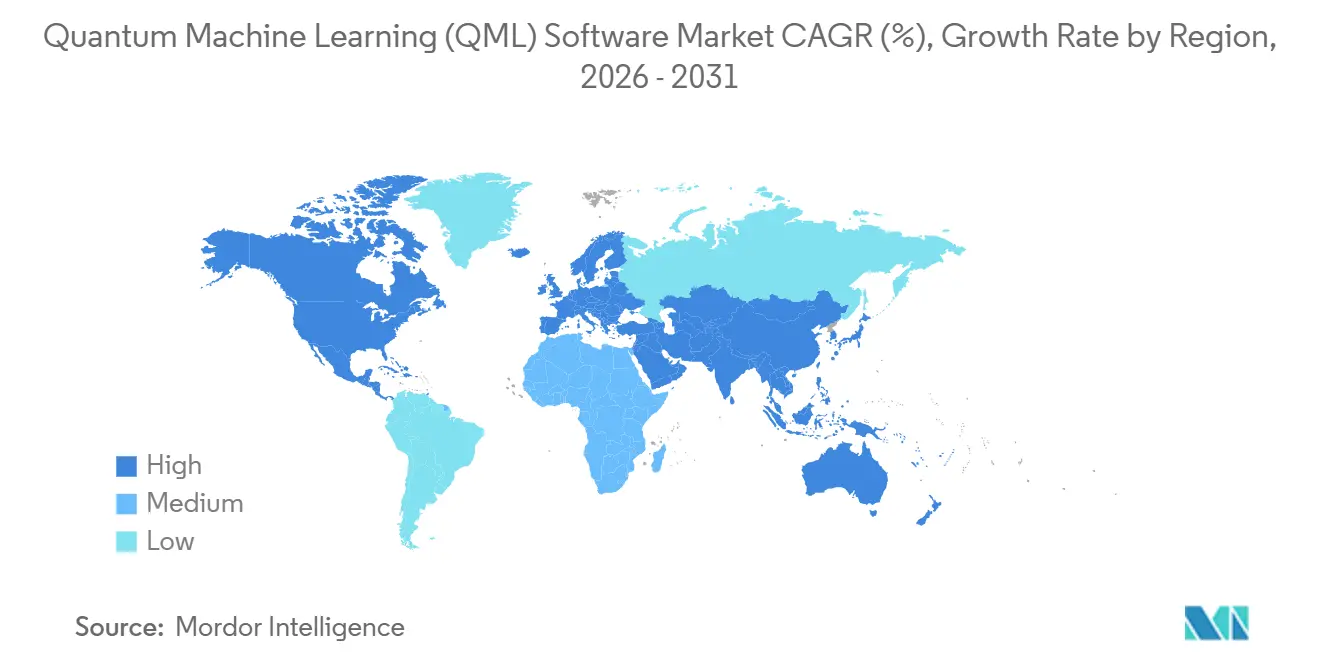
Asia-Pacific is projected to grow at a 35.28% CAGR through 2031, which makes it the fastest-growing regional block in the Quantum Machine Learning (QML) Software Market. Growth in the region reflects national commercialization programs, broader cloud access, and rising interest in life sciences and research applications. Japan stood out in May 2026 with the collaboration among RIKEN, the Cleveland Clinic, and IBM on the 12,635-atom protein simulation milestone, which represented one of the clearest applications in the region. South America accounted for a modest revenue share in 2025, with Brazil remaining the region’s most active base for early research and enterprise pilots, while the Middle East and Africa remained at an emerging stage driven more by talent development and cloud access than by direct hardware investment. This means regional expansion outside the largest markets is still being shaped by ecosystem building rather than by mature commercial deployment.

Competitive Landscape
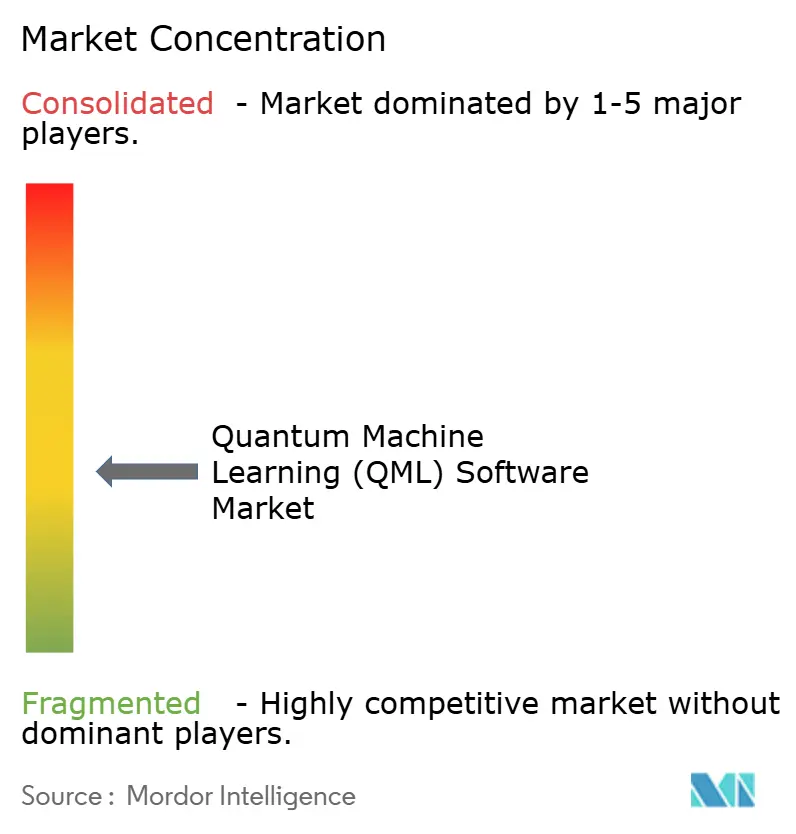
The Quantum Machine Learning (QML) Software Market operated with a two-level competitive structure in 2026. A concentrated upper tier included IBM, Google, Microsoft, and Amazon Web Services, each of which embedded quantum tools within larger cloud, developer, and artificial intelligence environments. Below that group sat a broader field of specialist vendors that competed through domain expertise, hardware-agnostic workflow design, or deeper application focus in areas such as optimization and scientific computing. This made the Quantum Machine Learning (QML) Software Market moderately fragmented at the software layer, with customer access concentrated but solution depth and use-case specialization spread across many firms. The main advantage held by the largest companies came from distribution and installed developer relationships rather than from hardware capability alone.
IBM strengthened its position in the Quantum Machine Learning (QML) Software Market with the July 2026 release of Qiskit v2.5, which added a multi-representation compiler framework and fault-tolerant preparation features, extending the platform’s appeal to developers planning across different hardware stages. Quantinuum followed a full-stack strategy when it commercially launched Helios in November 2025, together with Guppy and the Nexus platform, which combined hardware, software, and cloud access into a single operating environment. D-Wave adopted a more application-led approach by integrating machine learning models into its Stride hybrid solver, making its optimization offering more practical for industrial users. PASQAL strengthened its position by integrating CUDA-Q into its hybrid quantum environment, thereby making its processors easier to schedule within established HPC workflows. These moves show that competition is being shaped by workflow fit, ecosystem access, and practical usability more than by stand-alone algorithm claims.
Specialist vendors still had room to grow, as many buyers sought software that could translate business and scientific problems into executable quantum workflows without requiring users to work directly at the circuit level. That created white space for middleware, benchmarking, orchestration, and domain-library providers that could sit between general cloud access and specific enterprise use cases. The Quantum Machine Learning (QML) Software Market also favored hardware-agnostic design because enterprises wanted the flexibility to compare cost, fidelity, and performance across multiple backends before settling on a longer-term provider mix. At the same time, switching costs remained meaningful at the development platform layer because buyers already using a major cloud or software stack had fewer reasons to change tools unless a specialist vendor offered a clearly superior workflow. This balance between scale advantage and niche opportunity is likely to remain a defining feature of competition as the software layer matures.
Quantum Machine Learning (QML) Software Industry Leaders
IBM Corporation
Microsoft Corporation
Amazon Web Services
Google LLC
Quantinuum Ltd
- *Disclaimer: Major Players sorted in no particular order
Quantum Machine Learning (QML) Software Market Companies Covered in this Report
- Xanadu Quantum Technologies Inc.
- Zapata Computing Holdings Inc.
- Classiq Technologies Ltd.
- QC Ware Corp.
- 1QBit Canada Ltd.
- QunaSys Inc.
- Quantinuum Ltd.
- Riverlane Ltd.
- Terra Quantum AG
- Multiverse Computing S.L.
- PASQAL SAS
- SEEQC, Inc.
- Algorithmiq Oy
- ProteinQure Inc.
- Atos SE
- D-Wave Quantum Inc.
- Rigetti Computing, Inc.
- IBM Corporation
- Microsoft Corporation
- Amazon Web Services, Inc.
- Google LLC
- IonQ Inc.
- Intel Corporation
- Fujitsu Limited
- QuEra Computing Inc.

Recent Industry Developments in Quantum Machine Learning (QML) Software Market
- July 2026: IBM released Qiskit SDK v2.5, introducing a multi-representation compiler framework with dedicated fault-tolerant compilation pipelines for Pauli-based computation and Clifford+T gate sets, faster transpilation via algorithmic improvements to circuit routing, and rebranded its Qiskit Runtime Service as IBM Quantum Compute Service.
- June 2026: The White House issued Executive Order 14413, directing the Department of Energy to deliver a fault-tolerant quantum computer for scientific discovery, establish a national quantum performance assessment center, and coordinate a whole-of-government quantum commercialization strategy extending through the next decade.
- May 2026: The US Department of Commerce signed letters of intent to provide USD 2.013 billion in CHIPS and Science Act incentives to 9 quantum companies, including USD 1 billion to IBM, USD 100 million each to D-Wave, Quantinuum, Rigetti, and Infleqtion, to accelerate development of utility-scale fault-tolerant quantum systems.
- May 2026: Cleveland Clinic, RIKEN, and IBM used IBM's 156-qubit Heron processors and two classical supercomputers (Fugaku and Miyabi-G) to simulate a 12,635-atom protein, the largest quantum-enabled molecular simulation on record, 40 times larger than what was achievable six months prior and offering a direct path toward quantum-accelerated drug-protein interaction modeling.


Global Quantum Machine Learning (QML) Software Market Report Scope
The quantum machine learning (QML) software market comprises specialized software platforms and associated services that integrate quantum computing principles with machine learning algorithms to process and analyze complex datasets. This market includes development tools, software development kits (SDKs), simulation and benchmarking software, and algorithm design platforms that enable organizations to build, test, and deploy QML models without requiring deep, low-level quantum physics expertise. Deployed across cloud-based, hybrid, and on-premises environments, these solutions cater to organizations ranging from small and medium enterprises to large corporations across sectors such as IT, BFSI, healthcare, and manufacturing. By leveraging the unique capabilities of quantum computing, such as superposition and entanglement, QML software allows organizations to tackle computationally intensive applications, including complex optimization, drug discovery, materials science, financial risk modeling, and advanced cryptography, achieving faster processing speeds and identifying complex patterns that are unattainable for traditional classical machine learning systems.
The Quantum Machine Learning (QML) Software Market Report is Segmented by Solution (Software Platforms (Development Tools And SDKs, Simulation And Benchmarking Software, and Algorithm Design And Optimization Software) and Services), Deployment (Cloud-Based, Hybrid, and On-Premises), Organization Size (Large Enterprises, and Small and Medium Enterprises), Application (Optimization, Drug Discovery and Life Sciences, Materials Science and Quantum Chemistry, Financial Analytics and Risk Modeling, Cryptography and Cybersecurity, and Other Applications), End-User Industry (IT and Telecommunication, BFSI, Healthcare and Life Sciences, Industrial Manufacturing, Education and Research Institutions, Government and Administration, Energy and Utilities, and Other End-User Industries), and Geography (North America, South America, Europe, Asia-Pacific, and Middle East and Africa). The Market Forecasts are Provided in Terms of Value (USD).
| Software Platforms | Development Tools And SDKs |
| Simulation And Benchmarking Software | |
| Algorithm Design And Optimization Software | |
| Services |
| Cloud-Based |
| Hybrid |
| On-Premises |
| Large Enterprises |
| Small and Medium Enterprises |
| Optimization |
| Drug Discovery and Life Sciences |
| Materials Science and Quantum Chemistry |
| Financial Analytics and Risk Modeling |
| Cryptography and Cybersecurity |
| Other Applications |
| IT and Telecommunication |
| BFSI |
| Healthcare and Life Sciences |
| Industrial Manufacturing |
| Education and Research Institutions |
| Government and administration |
| Energy and Utilities |
| Other End-User Industries |
| North America | United States | |
| Canada | ||
| Mexico | ||
| South America | Brazil | |
| Argentina | ||
| Rest of South America | ||
| Europe | Germany | |
| United Kingdom | ||
| France | ||
| Russia | ||
| Spain | ||
| Rest of Europe | ||
| Asia-Pacific | China | |
| Japan | ||
| India | ||
| South Korea | ||
| Southeast Asia | ||
| Rest of Asia-Pacific | ||
| Middle East and Africa | Middle East | Saudi Arabia |
| United Arab Emirates | ||
| Turkey | ||
| Rest of Middle East | ||
| Africa | South Africa | |
| Nigeria | ||
| Egypt | ||
| Rest of Africa | ||
| By Solution | Software Platforms | Development Tools And SDKs | |
| Simulation And Benchmarking Software | |||
| Algorithm Design And Optimization Software | |||
| Services | |||
| By Deployment | Cloud-Based | ||
| Hybrid | |||
| On-Premises | |||
| By Organization Size | Large Enterprises | ||
| Small and Medium Enterprises | |||
| By Application | Optimization | ||
| Drug Discovery and Life Sciences | |||
| Materials Science and Quantum Chemistry | |||
| Financial Analytics and Risk Modeling | |||
| Cryptography and Cybersecurity | |||
| Other Applications | |||
| By End-User Industry | IT and Telecommunication | ||
| BFSI | |||
| Healthcare and Life Sciences | |||
| Industrial Manufacturing | |||
| Education and Research Institutions | |||
| Government and administration | |||
| Energy and Utilities | |||
| Other End-User Industries | |||
| By Geography | North America | United States | |
| Canada | |||
| Mexico | |||
| South America | Brazil | ||
| Argentina | |||
| Rest of South America | |||
| Europe | Germany | ||
| United Kingdom | |||
| France | |||
| Russia | |||
| Spain | |||
| Rest of Europe | |||
| Asia-Pacific | China | ||
| Japan | |||
| India | |||
| South Korea | |||
| Southeast Asia | |||
| Rest of Asia-Pacific | |||
| Middle East and Africa | Middle East | Saudi Arabia | |
| United Arab Emirates | |||
| Turkey | |||
| Rest of Middle East | |||
| Africa | South Africa | ||
| Nigeria | |||
| Egypt | |||
| Rest of Africa | |||


Key Questions Answered in the Report
What is the current and forecast size of the Quantum Machine Learning (QML) Software Market?
The Quantum Machine Learning (QML) Software Market stood at USD 0.62 billion in 2026 and is forecast to reach USD 2.49 billion by 2031 at a 32.06% CAGR.
Which solution category leads revenue in the Quantum Machine Learning (QML) Software Market?
Software platforms led with 72.41% share in 2025 because buyers preferred integrated development, simulation, and algorithm design environments.
Why is hybrid deployment growing faster in the Quantum Machine Learning (QML) Software Market?
Hybrid deployment is projected to grow at a 34.19% CAGR because organizations are routing workloads across classical and quantum resources based on latency, security, and compute efficiency.
Which application area is expanding the fastest in the Quantum Machine Learning (QML) Software Market?
Drug discovery and life sciences is the fastest-growing application, with a projected 38.74% CAGR through 2031, supported by stronger molecular simulation progress.
Which end-user group is creating the strongest growth opportunity?
Healthcare and life sciences is projected to grow at a 37.91% CAGR through 2031 because biomedical and pharmaceutical users continue funding high-value computational research.
Which region is advancing the fastest in the Quantum Machine Learning (QML) Software Market?
Asia-Pacific is projected to post the fastest regional growth at a 35.28% CAGR, while North America remained the largest regional market in 2025.
Page last updated on:


 Your data is secure and never sold or shared.


