
Quantum Integrated Development Environment Software Market Size and Share
Market Overview
| Study Period | 2020 - 2031 |
|---|---|
| Market Size (2026) | USD 0.59 Billion |
| Market Size (2031) | USD 2.92 Billion |
| Growth Rate (2026 - 2031) | 37.65 % |
| Fastest Growing Market | Asia-Pacific |
| Largest Market | North America |
| Market Concentration | Medium |
Major Players *Disclaimer: Major Players sorted in no particular order Image © Mordor Intelligence. Reuse requires attribution under CC BY 4.0. | |
Quantum Integrated Development Environment Software Market Analysis by Mordor Intelligence
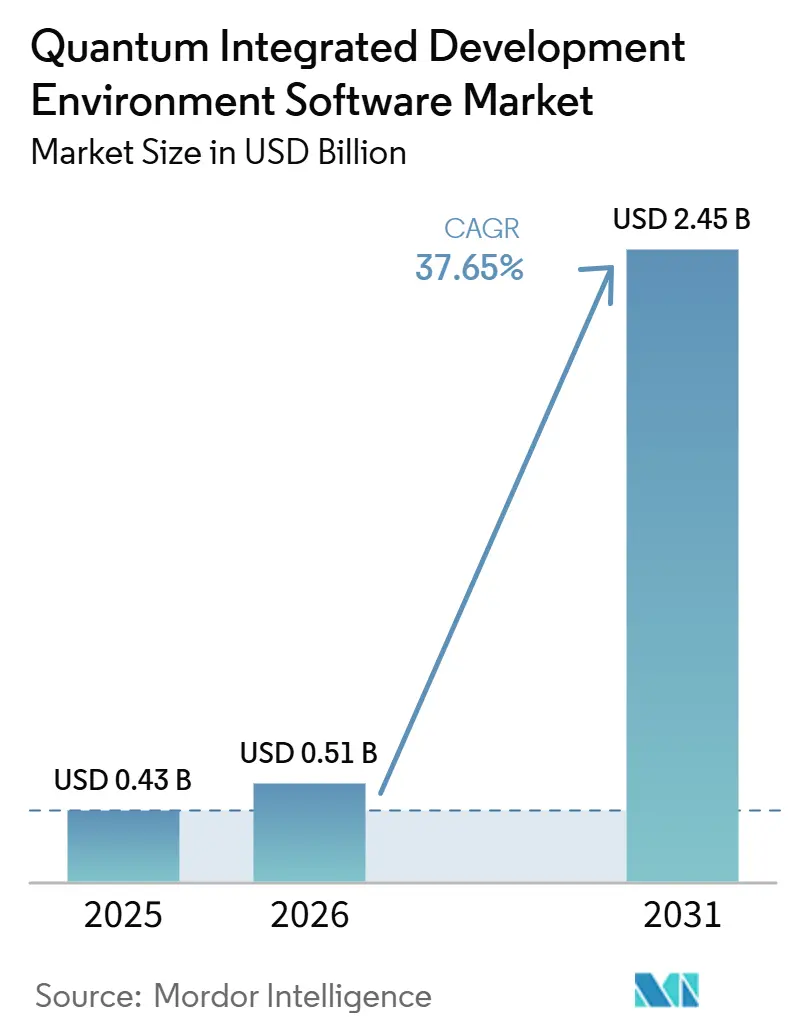
The quantum integrated development environment software market size was valued at USD 0.43 billion in 2025 and is projected to reach USD 2.45 billion by 2031, growing at a CAGR of 37.65% over 2026-2031. Hardware progress and public funding are increasing the need for software that lets developers design, test, and run quantum programs across different systems. Federal initiatives in the United States, the United Kingdom, Canada, and Japan are creating more institutional users and procurement programs for quantum development tools. Cloud access is widening participation because developers can work with quantum systems without owning specialized hardware. Vendors are therefore competing on abstraction, workflow automation, interoperability, and enterprise controls rather than on circuit editing alone. The quantum integrated development environment software market also faces constraints from a shortage of technical talent, inconsistent software stacks, and the difficulty of demonstrating business value in early enterprise projects.
Key Report Takeaways
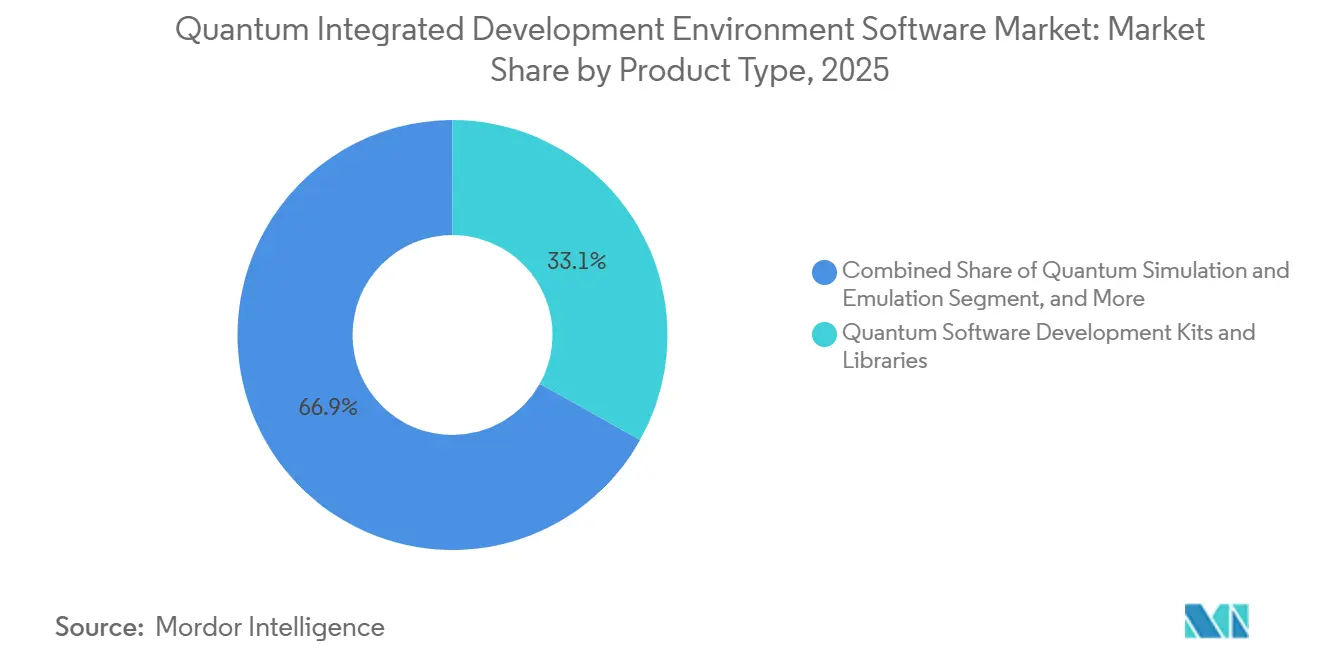
- By product type, Quantum Software Development Kits and Libraries held 33.12% of the quantum integrated development environment software market share in 2025, while Quantum Compilation, Transpilation, and Optimization Software is projected to expand at a 38.63% CAGR through 2031.
- By deployment mode, Cloud-Based deployment accounted for 71.30% of the quantum integrated development environment software market size in 2025, while Hybrid deployment is projected to grow at a 39.70% CAGR through 2031.
- By programming abstraction, Intermediate-Level and Gate-Based Programming held 66.18% share in 2025, while Natural-Language and AI-Assisted Quantum Programming is projected to advance at a 39.41% CAGR through 2031.
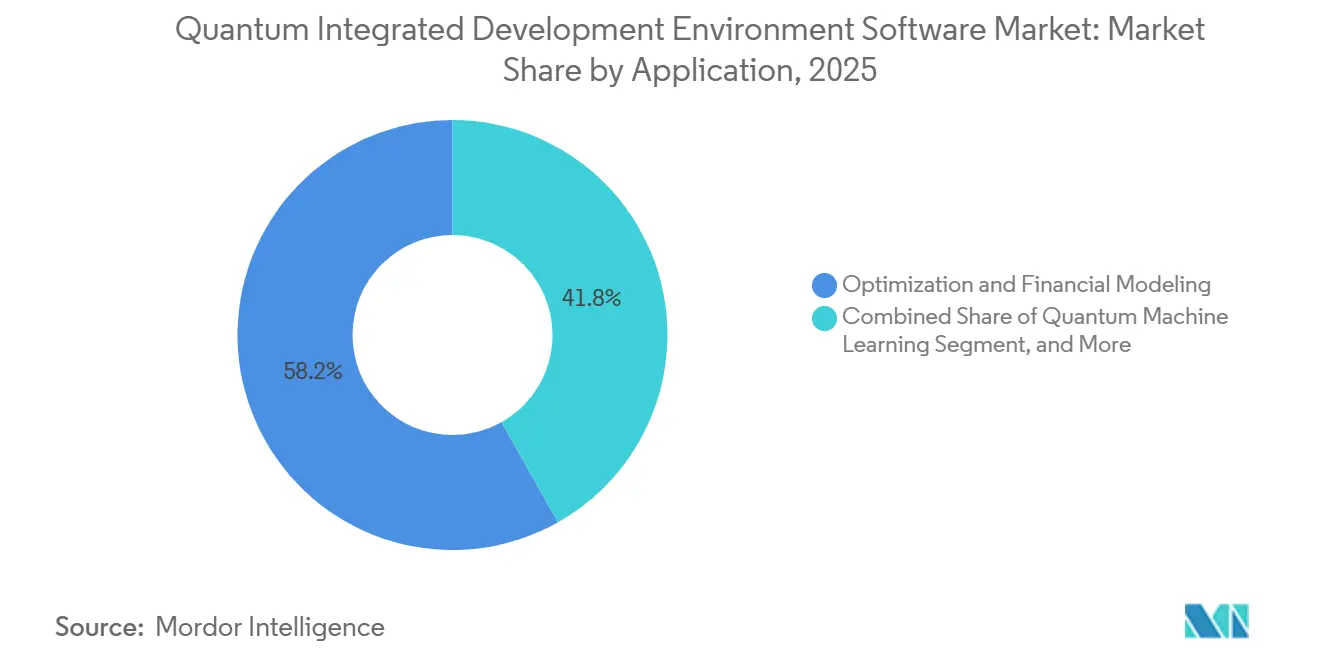
- By application, Optimization and Financial Modeling held 58.16% of the quantum integrated development environment software market share in 2025, while Quantum Machine Learning is projected to expand at a 39.12% CAGR through 2031.
- By end-user industry, Banking, Financial Services, and Insurance held 24.19% of the quantum integrated development environment software market share in 2025, while Pharmaceutical and Biotechnology is projected to grow at a 38.45% CAGR through 2031.
- By geography, North America held 37.41% of the quantum integrated development environment software market share in 2025, while Asia-Pacific is projected to grow at a 38.91% CAGR through 2031.
Note: Market size and forecast figures in this report are generated using Mordor Intelligence’s proprietary estimation framework, updated with the latest available data and insights as of January 2026.
Market Trends and Insights
Drivers Impact Analysis of Quantum Integrated Development Environment Software Market*
| Driver | (~) % Impact on CAGR Forecast | Geographic Relevance | Impact Timeline |
|---|---|---|---|
| Government Funding and National Quantum Strategies | +3.8% | Global, concentrated in North America, Europe, and Asia-Pacific | Medium term (2-4 years) |
| Expansion of Cloud-Accessible Quantum Computing | +3.2% | Global, strongest in North America and Asia-Pacific | Short term (≤ 2 years) |
| AI-Assisted Quantum Programming and Workflow Automation | +2.9% | Global, with early adoption in North America and Europe | Short term (≤ 2 years) |
| Growth of Quantum Algorithm Development in Financial Services | +2.4% | North America and Europe core, spillover to Asia-Pacific | Medium term (2-4 years) |
| Demand for Hardware-Agnostic Quantum Development | +1.8% | Global | Long term (≥ 4 years) |
| Increasing Need for Post-Quantum Cryptography Development Tools | +1.4% | Global, with regulatory push in North America and Europe | Medium term (2-4 years) |
| Source: Mordor Intelligence | |||
Government Funding and National Quantum Strategies Drive Procurement at Scale
Public investment is creating a broader base of buyers for the quantum integrated development environment software market. In May 2026, the U.S. Department of Commerce announced letters of intent with 9 companies for USD 2.01 billion in CHIPS Act incentives, including USD 1 billion for IBM’s Anderon quantum foundry subsidiary.[1] In June 2026, Executive Order 14413 directed agencies to coordinate quantum information science and technology commercialization and to update the National Quantum Strategy. The order also called for workforce institutes and support for quantum user facilities, which can become long-term users of development environments. Canada allocated CAD 334.3 million (USD 246 million) over 5 years for its national quantum ecosystem, including CAD 92 million (USD 68 million) for the Canadian Quantum Champions Program Phase 1. These programs favor tools that can operate across hardware types and meet public-sector requirements for standards, controls, and repeatable workflows.
Expansion of Cloud-Accessible Quantum Computing Broadens the Developer Base
Cloud delivery is making quantum software accessible to users who do not operate quantum hardware. IBM expanded its Quantum Data Center in Poughkeepsie, New York, in April 2026 and planned another facility in Ehningen, Germany. The expanded infrastructure gives developers more opportunities to test workloads through remote access. These developments expand the quantum integrated development environment software market, as cloud services reduce the cost and time required to begin development. They also increase the value of tools that manage hardware selection, execution, simulation, and results within one workflow.
AI-Assisted Quantum Programming Reshapes IDE Feature Priorities
AI-assisted programming is changing the features users expect from quantum software platforms. Classiq introduced quantum engineering agents in 2026 that let developers describe problems in natural language and receive synthesized circuits through an IDE or its platform. Research in Reports on Progress in Physics described a multi-agent system that automated quantum simulation tasks from state preparation through resource estimation using a natural-language interface. A July 2026 study also reported that a language model generated shuttling compilers for trapped-ion systems with up to 76% fewer required shuttling timesteps than hand-crafted solutions. These capabilities reduce some of the specialized knowledge required to create and revise circuits. For the quantum integrated development environment software market, product competition is moving toward intelligent orchestration, reusable algorithm libraries, and workflow support. Vendors with stronger automation and data assets can offer a more practical route from problem definition to hardware-ready code.
Growth of Quantum Algorithm Development in Financial Services Drives Production-Grade Tool Demand
Financial institutions are building quantum programs around portfolio design, risk assessment, and settlement processes. Crédit Agricole CIB and Pasqal expanded their partnership in June 2026 to move quantum computing toward operational capital-markets use cases, including counterparty credit default risk and portfolio optimization. A Scientific Reports study in February 2026 validated a Dicke-state ansatz variational quantum eigensolver for multiclass portfolio optimization under several constraints. Another study reported a best Sharpe ratio of 0.588 for a quantum approximate optimization approach, compared with 0.575 for a classical approach, and a 44.5% reduction in transaction costs. Such work increases requirements for version control, testing, audit trails, and repeatable resource estimates. The quantum integrated development environment software market can benefit as finance teams require tools that support controlled development rather than isolated research experiments.
Restraints Impact Analysis of Quantum Integrated Development Environment Software Market*
| Restraint | (~) % Impact on CAGR Forecast | Geographic Relevance | Impact Timeline |
|---|---|---|---|
| Shortage of Quantum Software Engineering Talent | -3.6% | Global, most acute outside North America | Long term (≥ 4 years) |
| Fragmentation Across Quantum Hardware Architectures and Programming Stacks | -2.8% | Global | Medium term (2-4 years) |
| Limited Demonstrable Return on Investment from Enterprise Pilots | -2.1% | Global | Short term (≤ 2 years) |
| High Complexity of Error Mitigation, Debugging, and Production Deployment | -1.5% | Global | Medium term (2-4 years) |
| Source: Mordor Intelligence | |||
Shortage of Quantum Software Engineering Talent Constrains Enterprise Adoption
The supply of quantum software talent remains insufficient to meet the needs of developers, system operators, and enterprise users. Research in Nature Reviews Physics found that quantum hiring in the United Kingdom did not fully align with the skills required by its national quantum missions. The study showed that job advertisements focused more on computing and communications than on some sensing capabilities identified by the strategy. U.S. postings requesting quantum skills had tripled as a share of all postings between 2011 and mid-2024, while the number of available domestic workers remained limited. The European Commission’s Digital Europe program allocated EUR 10 million (USD 11.3 million) for a Quantum Digital Skills Academy in 2025-2027. The shortage slows adoption in the quantum integrated development environment software market because organizations need people who can translate business problems into quantum workflows, assess results, and maintain code.
Fragmentation Across Quantum Hardware Architectures and Programming Stacks Limits Portability
Software fragmentation raises development costs when organizations need to work across several quantum backends. An April 2026 survey of 9 quantum high-performance computing software stacks identified gaps in runtime abstraction, resource management, and observability. The survey identified OpenQASM 3 as a comparatively convergent layer, but many stack interfaces remained immature. A 2026 case study showed that the Quantum Device Management Interface could connect with Amazon Braket for device discovery and job execution, although broad multi-vendor use was incomplete. Separate research found vendor lock-in across frameworks, hardware, and data encoding for quantum machine-learning workloads. This fragmentation limits portability and makes it harder for buyers to choose a single development platform. At the same time, it leaves room for hardware-agnostic tools that can reduce integration effort as standards mature.
*Our forecasts treat driver/restraint impacts as directional, not additive. The impact forecasts reflect baseline growth, mix effects, and variable interactions.
Quantum Integrated Development Environment Software Market Segment Analysis
By Product Type:
SDKs Hold the Largest Position While Compilation Tools Set the Growth PaceQuantum Software Development Kits and Libraries held 33.12% of the quantum integrated development environment software market share in 2025. This position reflects the role of SDKs as the usual entry point for developers learning quantum programming and testing algorithms. Open-source frameworks such as Qiskit and PennyLane help vendors build developer communities before users require enterprise support or cloud capacity. IBM continued to develop its software stack in 2026 as it expanded quantum infrastructure and services.[2] Integrated development environment platforms serve enterprise teams that need circuit design, simulation, optimization, and project management in a more unified setting. Horizon Quantum reported combined funding of USD 137 million after an oversubscribed private investment round that included IonQ and a Fortune 50 technology company. Simulation, emulation, debugging, testing, and resource-estimation tools remain necessary before code is deployed to limited and costly quantum hardware. The product mix, therefore, spans low-cost community tools and higher-value enterprise tools that support verification and operational use.
Quantum Compilation, Transpilation, and Optimization Software is projected to grow at a 38.63% CAGR through 2031. The segment expands because high-level algorithms must be translated into instructions that work across different qubit architectures, gate sets, and error tolerances. Zapata Quantum and NVIDIA collaborated in June 2026 on agentic AI workflows for quantum resource estimation. These workflows address the time needed to evaluate whether an algorithm can run on future fault-tolerant systems. The quantum integrated development environment software industry depends on compilation tools because more hardware options create more translation and optimization work. Demand is strongest where organizations need a realistic view of resources before investing in algorithm development. This gives compilers a more important role as projects move beyond simple circuit experiments.

By Deployment Mode:
Cloud Delivery Leads While Hybrid Architecture Gains ImportanceCloud-based deployment accounted for 71.30% of the quantum-integrated development environment software market in 2025. Cloud access lets organizations explore quantum algorithms without buying or managing a quantum processor. IBM reported a network of more than 340 clients and partners, showing the broad reach of remote-access programs. Amazon Braket’s multi-vendor model also provides developers with access to different backends through a common cloud service. Cloud delivery supports recurring revenue and lets vendors update software without requiring local installation. It is especially useful for research groups and enterprises still comparing systems and use cases. The model also gives vendors data on how tools are used, which can guide future platform design.
Hybrid deployment is projected to grow at a 39.70% CAGR through 2031. Complex workloads require classical processors, accelerators, and quantum processors to work together rather than operate as separate systems. Qilimanjaro released QiliSDK 0.2.0 in June 2026 with NVIDIA CUDA-Q integration and a backend-agnostic Python interface for digital, analog, and GPU-accelerated execution. A 2026 study on layer models for modular quantum computers described the need for orchestration across classical and quantum layers. Hybrid designs are relevant for companies that need to protect data, keep classical systems close to internal records, or combine local computation with cloud quantum services. The quantum integrated development environment software market gains from this model because it requires coordination, scheduling, monitoring, and backend selection. These needs make hybrid platforms more complex than simple remote-access services. They also raise the importance of tools that make infrastructure details less visible to application teams.
By Programming Abstraction:
Gate-Based Tools Lead While AI-Assisted Programming Grows FastestIntermediate-Level and Gate-Based Programming held 66.18% share in 2025. Gate-based tools remain widely used because they provide an established way to express circuits, inspect operations, and work with current quantum hardware. OpenQASM 3 was one of the more consolidated interface layers identified in the openQSE software-stack survey. This language support helps developers preserve some portability while hardware stacks remain different. Circuit-level programming stays important for hardware specialists and compiler developers who need direct control over qubits and operations. High-level programming tools provide a bridge for domain experts who do not need to manage every gate. Together, these layers allow teams to choose the level of control that suits their technical expertise and application needs. Gate-based programming is likely to remain central while quantum hardware is still evolving and developers need close visibility into circuit behavior.
Natural-Language and AI-Assisted Quantum Programming is projected to grow at a 39.41% CAGR through 2031. Classiq’s quantum engineering agents allow developers to describe problems in natural language or upload images and then receive synthesized circuits. The El Agente Cuántico research described end-to-end automation of simulation tasks, including preparation, error correction, and resource estimation. The July 2026 trapped-ion compiler study further showed that language-model outputs could be refined into useful implementation code. These tools can make quantum development more accessible to teams with strong domain knowledge but limited circuit-design experience. They do not remove the need for technical review, especially for performance, correctness, and hardware constraints. However, the quantum integrated development environment software market can expand when tools shorten the path from an applied problem to a testable program. The segment’s growth depends on vendors proving that the workflows they generate are reliable, understandable, and suitable for enterprise governance.
By Application:
Financial Optimization Leads While Quantum Machine Learning Gains Momentum in Drug DiscoveryOptimization and Financial Modeling held 58.16% share in 2025. The segment addresses portfolio construction, risk management, transaction settlement, and related tasks, for which many possible combinations must be evaluated. A 2026 study used Quantinuum’s 98-qubit Helios system for end-to-end portfolio optimization on real data from 4 major market indices with up to 78 qubits in QAOA circuits. Research in the Journal of Economic Dynamics and Control also examined securities settlement optimization on superconducting quantum devices using real transactional data batches. These examples support the use of development tools that can test algorithms, track runs, and estimate resources in controlled financial workflows. Quantum simulation and scientific computing are used in materials, energy, and aerospace research. Cryptography and security are also gaining attention following NIST's May 2026 move to advance 9 additional digital-signature candidates to the third round of its post-quantum standardization process. Each application requires different libraries, validation methods, and interfaces, which increases the value of adaptable platforms.
Quantum Machine Learning is projected to grow at a 39.12% CAGR through 2031. A 2025 Chemical Reviews article documented the use of quantum machine learning across molecular simulation, drug-target interaction prediction, and clinical-trial optimization. In March 2026, the Q-CaDD framework tested quantum kernel-based learners within an ensemble architecture on a 20-qubit superconducting processor under NISQ-era constraints. Drug discovery provides the segment with a clear research setting, as molecular problems can require significant computational resources. The quantum integrated development environment software market supports this work through tools for data preparation, model design, simulation, and hardware execution. Progress will depend on demonstrating that quantum-enhanced workflows can produce useful results within practical hardware constraints. Pharmaceutical users will also require reproducible workflows and integration with existing computational chemistry systems.
By End-User Industry:
BFSI Supports Current Demand while Pharmaceutical and Biotechnology Grows FastestBanking, Financial Services, and Insurance held 24.19% share in 2025. Financial firms have spent years exploring quantum algorithms for derivative pricing, credit assessment, portfolio optimization, and settlement systems. The June 2026 partnership between Crédit Agricole CIB and Pasqal followed 5 years of joint benchmarking and focused on moving selected finance use cases toward operations. This group requires development platforms with access controls, traceability, testing, and links to existing data processes. Information technology and telecommunications companies also need software for preparing for post-quantum cryptography. Aerospace and defense organizations often need on-premises solutions due to data sovereignty and access requirements. The group’s current share shows that business cases tied to financial modeling remain the clearest near-term source of software spending. It also shows why vendors are adding enterprise features alongside open-source developer tools.
Pharmaceutical and biotechnology are projected to grow at a 38.45% CAGR through 2031. This focus reflects the need to model molecular behavior, screen compounds, and improve computational workflows. Quemix and Nissan began joint research in June 2026 on quantum aerodynamic simulation software for next-generation vehicle development. The work shows that quantum simulation methods developed for scientific applications can be applied to automotive engineering. Energy, utilities, and government users remain earlier in their adoption paths and largely focus on optimization. The quantum integrated development environment software market can grow across these groups as public procurement becomes more structured and as domain-specific libraries improve. Adoption will still depend on teams finding use cases that can be tested against existing classical methods.
Geography Analysis
North America Quantum Integrated Development Environment Software Market
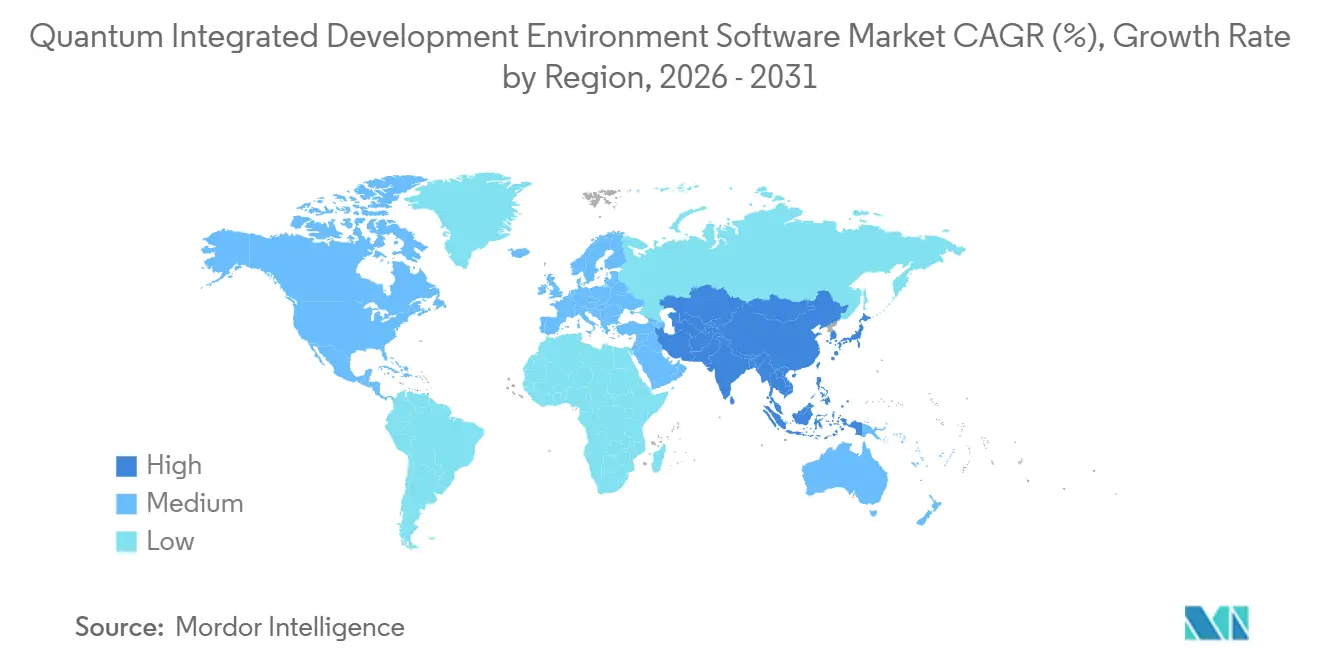
North America held 37.41% share in 2025. The quantum integrated development environment software market in the region benefits from a high concentration of quantum hardware companies, cloud providers, enterprise users, research institutions, and public funding programs. Executive Order 14413 established a coordinated federal approach to commercialization in June 2026. The May 2026 CHIPS Act letters of intent added USD 2.01 billion in incentives for 9 companies, including support for quantum foundry capacity. IBM announced more than USD 10 billion in planned quantum investment over 5 years in June 2026, covering research, capital expenditure, manufacturing, and partnerships. Canada’s funding adds another public source of demand for software, infrastructure, and skills. Mexico’s role remains focused on academic partnerships. The region combines a deep customer base with direct competition from large technology companies that bundle quantum tools with cloud services.
APAC Quantum Integrated Development Environment Software Market
Asia-Pacific is projected to grow at a 38.91% CAGR through 2031. The quantum integrated development environment software market is developing through collaborations that link universities, telecommunications providers, and government-backed programs. KDDI, Waseda University, and Keio University worked on a quantum-AI integrated development environment through a NEDO program, including generative-AI-informed APIs and load balancing for quantum workloads. Osaka University, Fujitsu, TIS, and SUCC released OQTOPUS as open-source software in March 2025 and used it on Osaka University’s quantum cloud service. Japan’s public programs strengthen local tools while keeping links to broader cloud and hardware ecosystems. China is expanding its own quantum software environment, but source-quality requirements prevent reliance on claims from non-authoritative media reports. India is an important future activation area following IBM’s stated interest in quantum computing and cloud infrastructure. South Korea’s financial participation in quantum software funding also aligns with the regional interest in financial applications. These varied national approaches create opportunities for platforms that can support local needs without limiting cross-border interoperability.
EMEA and South America Quantum Integrated Development Environment Software Market
Europe has a substantial position in the quantum integrated development environment software market, supported by activity in the United Kingdom, Germany, France, and Spain. The United Kingdom committed GBP 2 billion (USD 2.5 billion) to quantum technology in March 2026 and launched the ProQure procurement program.[3] The announcement included a partnership involving IonQ and the University of Cambridge for a 256-qubit system. Riverlane, Quantinuum, Rolls-Royce, and the University of Edinburgh signed an agreement in July 2026 to explore industrial design and simulation applications. Multiverse Computing announced a USD 570 million Series C in July 2026 at a USD 1.7 billion pre-money valuation. The Middle East is entering through sovereign investment participation and targeted infrastructure projects. South America and Africa remain at an earlier stage, with activity centered on academic and research partnerships in countries such as Brazil and South Africa.
Competitive Landscape
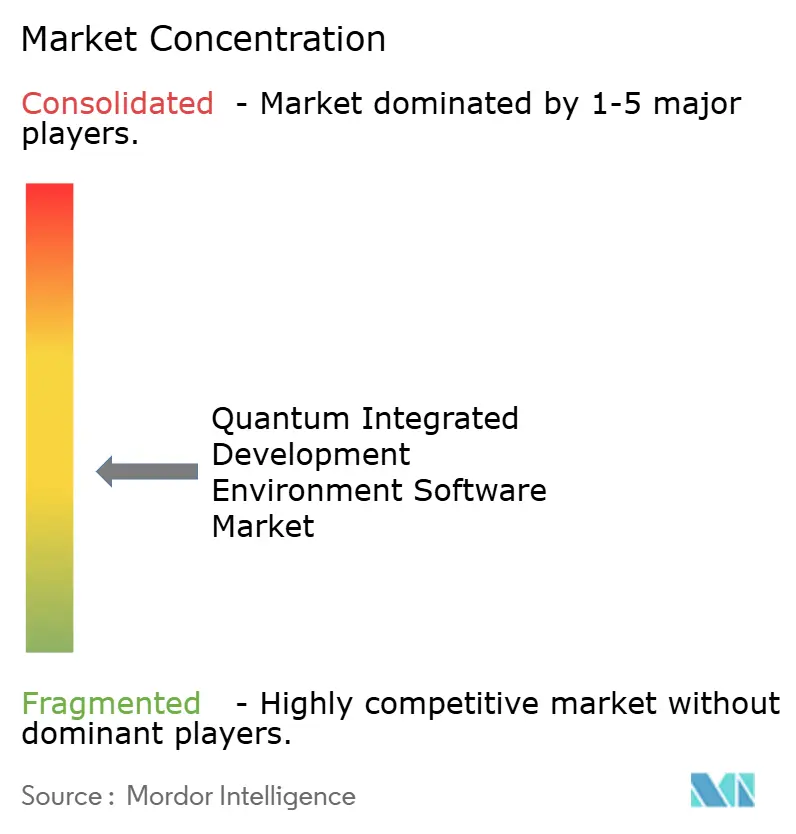
The quantum integrated development environment software market is moderately fragmented. Competition includes focused quantum software companies such as Classiq, Horizon Quantum, Multiverse Computing, Zapata Quantum, Riverlane, and QunaSys, as well as cloud and hardware providers that include software in broader quantum services. Classiq raised USD 110 million in a Series C in May 2025 and later reported cumulative funding above USD 200 million. These companies compete with incumbents that can bundle development tools, cloud access, hardware, support, and research partnerships. Open-source distribution is a common route to developer adoption. Qiskit, PennyLane, Deltakit, and QpiAI’s SDK use accessible tooling to build community interest while vendors seek enterprise revenue through compute, support, and managed services. The broad range of participants makes it difficult for any one vendor to define the complete software stack.
Strategic activity in the quantum integrated development environment software market has focused on automation and vertical specialization. Zapata Quantum worked with NVIDIA in June 2026 to automate resource-estimation workflows using agentic AI for pharmaceutical discovery, energy, and materials applications. Classiq added quantum engineering agents to its IDE and platform in 2026, using natural-language interaction to turn user requirements into circuits.[4] Horizon Quantum is positioning its Triple Alpha product as a hardware-agnostic development environment for enterprise users. QunaSys is concentrating on chemistry simulation and launched its QSCI Technical Portal and Official Partner Program in March 2026. These approaches aim to provide more useful workflows for particular developer groups rather than a general-purpose coding environment alone. The differences in strategy reflect the early stage of commercial demand and the range of possible quantum applications.
Standards and industrial partnerships are also shaping the quantum integrated development environment software market. NIST’s additional digital-signature process moved 9 candidates to its third round in May 2026, adding a compliance-related reason for government and financial organizations to evaluate cryptography tools. The agreement between The Quantinuum, Rolls-Royce, Riverlane, and the University of Edinburgh in July 2026 focused on industrial design and simulation, including gas-turbine analysis. These partnerships connect software development to defined industrial use cases and may support longer purchasing cycles. IBM also announced its planned acquisition of HRL Laboratories in July 2026 to advance silicon spin-qubit quantum computing. Large providers can use their hardware, research, and cloud assets to offer integrated services. Focused vendors can respond by emphasizing backend independence, rapid software development, and specialized applications. The competitive balance will depend on which tools make quantum work easier to evaluate, govern, and deploy.
Quantum Integrated Development Environment Software Industry Leaders
-
Classiq Technologies Ltd.
-
Horizon Quantum Holdings Ltd.
-
Q-CTRL Pty Ltd
-
QC Ware Corp.
-
Riverlane Limited
- *Disclaimer: Major Players sorted in no particular order
Quantum Integrated Development Environment Software Market Companies Covered in this Report
- Classiq Technologies Ltd.
- Horizon Quantum Holdings Ltd.
- Q-CTRL Pty Ltd
- QC Ware Corp.
- Riverlane Limited
- Zapata Computing Holdings Inc.
- 1QB Information Technologies Inc.
- Xanadu Quantum Technologies Inc.
- Strangeworks, Inc.
- Aliro Technologies, Inc.
- QunaSys Inc.
- Multiverse Computing S.L.
- Phasecraft Limited
- BlueQubit, Inc.
- Haiqu, Inc.
- Quantum Machines Ltd.
- SoftQuantus, Inc.
- aQuantum Technologies S.L.
- Qbraid, Inc.
- Quantum Inspire B.V.
Recent Industry Developments in Quantum Integrated Development Environment Software Market
- July 2026: Multiverse Computing announced a USD 570 million Series C funding round at a pre-money valuation of USD 1.7 billion. The round was co-led by Forgepoint Capital International, BNPP SIVF, and Bullhound Capital, with HP Inc., Orange Ventures, Santander Alternative Investments, and Qatar Development Bank participating. Capital will accelerate CompactifAI's expansion and the deployment of sovereign AI software.
- July 2026: IBM announced the acquisition of HRL Laboratories to advance silicon spin-qubit quantum computing, strengthening its hardware and software roadmap toward fault-tolerant systems and complementing the planned Anderon quantum foundry subsidiary.
- July 2026: Quantinuum, Rolls-Royce, Riverlane, and the University of Edinburgh signed a consortium agreement to explore quantum computing capabilities for industrial design and simulation, including gas-turbine analysis. The collaboration advances the development of fault-tolerant quantum algorithms for aerospace engineering and expands the addressable market for quantum development tools in industry.
- June 2026: Zapata Quantum partnered with NVIDIA to apply agentic AI to quantum resource-estimation workflows. The collaboration targets pharmaceutical drug discovery, energy-grid optimization, and advanced materials, and shortens historically multiyear benchmarking processes through scalable automated systems.
Global Quantum Integrated Development Environment Software Market Report Scope
The Quantum Integrated Development Environment Software Market comprises software platforms that provide integrated environments for developing, testing, debugging, simulating, compiling, managing, and deploying quantum applications and quantum algorithms. These solutions combine development tools such as quantum software development kits (SDKs), simulators, compilers, transpilers, debugging frameworks, workflow orchestration tools, and AI-assisted programming environments. Organizations use these platforms to simplify quantum software engineering, accelerate application development, and support hybrid classical-quantum computing workflows across research, enterprise, and commercial quantum computing environments.
The Quantum Integrated Development Environment Software Market Report is Segmented by Product Type (Quantum Integrated Development Environment Platforms, Quantum Software Development Kits and Libraries, Quantum Simulation and Emulation Software, Quantum Compilation, Transpilation and Optimization Software, Quantum Debugging, Testing and Resource Estimation Tools, and Other Product Types), Deployment Mode (Cloud-Based, On-Premises, and Hybrid), Programming Abstraction (Circuit-Level Programming, Intermediate-Level/Gate-Based Programming, High-Level Algorithmic Programming, and Natural-Language and AI-Assisted Quantum Programming), Application (Optimization and Financial Modeling, Quantum Simulation and Scientific Computing, Quantum Machine Learning, Cryptography and Security, and Other Applications), End-User Industry (Banking, Financial Services, and Insurance [BFSI], Pharmaceutical and Biotechnology, Information Technology and Telecommunication, Aerospace and Defense, Energy and Utilities, Automotive and Mobility, Government and Public Administration, and Other End-User Industries), and Geography (North America, South America, Europe, Asia-Pacific, Middle East, and Africa). The Market Forecasts are Provided in Terms of Value (USD).
Segmentation Overview
| Quantum Integrated Development Environment Platforms |
| Quantum Software Development Kits and Libraries |
| Quantum Simulation and Emulation Software |
| Quantum Compilation, Transpilation and Optimization Software |
| Quantum Debugging, Testing and Resource Estimation Tools |
| Other Product Types |
| Cloud-Based |
| On-Premises |
| Hybrid |
| Circuit-Level Programming |
| Intermediate-Level / Gate-Based Programming |
| High-Level Algorithmic Programming |
| Natural-Language and AI-Assisted Quantum Programming |
| Optimization and Financial Modeling |
| Quantum Simulation and Scientific Computing |
| Quantum Machine Learning |
| Cryptography and Security |
| Other Applications |
| Banking, Financial Services, and Insurance (BFSI) |
| Pharmaceutical and Biotechnology |
| Information Technology and Telecommunication |
| Aerospace and Defense |
| Energy and Utilities |
| Automotive and Mobility |
| Government and Public Administration |
| Other End-User Industries |
| North America | United States |
| Canada | |
| Mexico | |
| South America | Brazil |
| Argentina | |
| Rest of South America | |
| Europe | Germany |
| United Kingdom | |
| France | |
| Italy | |
| Spain | |
| Russia | |
| Rest of Europe | |
| Asia-Pacific | China |
| Japan | |
| India | |
| South Korea | |
| Australia and New Zealand | |
| Rest of Asia-Pacific | |
| Middle East | Saudi Arabia |
| United Arab Emirates | |
| Turkey | |
| Rest of Middle East | |
| Africa | South Africa |
| Nigeria | |
| Rest of Africa |
| By Product Type | Quantum Integrated Development Environment Platforms | |
| Quantum Software Development Kits and Libraries | ||
| Quantum Simulation and Emulation Software | ||
| Quantum Compilation, Transpilation and Optimization Software | ||
| Quantum Debugging, Testing and Resource Estimation Tools | ||
| Other Product Types | ||
| By Deployment Mode | Cloud-Based | |
| On-Premises | ||
| Hybrid | ||
| By Programming Abstraction | Circuit-Level Programming | |
| Intermediate-Level / Gate-Based Programming | ||
| High-Level Algorithmic Programming | ||
| Natural-Language and AI-Assisted Quantum Programming | ||
| By Application | Optimization and Financial Modeling | |
| Quantum Simulation and Scientific Computing | ||
| Quantum Machine Learning | ||
| Cryptography and Security | ||
| Other Applications | ||
| By End-User Industry | Banking, Financial Services, and Insurance (BFSI) | |
| Pharmaceutical and Biotechnology | ||
| Information Technology and Telecommunication | ||
| Aerospace and Defense | ||
| Energy and Utilities | ||
| Automotive and Mobility | ||
| Government and Public Administration | ||
| Other End-User Industries | ||
| By Geography | North America | United States |
| Canada | ||
| Mexico | ||
| South America | Brazil | |
| Argentina | ||
| Rest of South America | ||
| Europe | Germany | |
| United Kingdom | ||
| France | ||
| Italy | ||
| Spain | ||
| Russia | ||
| Rest of Europe | ||
| Asia-Pacific | China | |
| Japan | ||
| India | ||
| South Korea | ||
| Australia and New Zealand | ||
| Rest of Asia-Pacific | ||
| Middle East | Saudi Arabia | |
| United Arab Emirates | ||
| Turkey | ||
| Rest of Middle East | ||
| Africa | South Africa | |
| Nigeria | ||
| Rest of Africa | ||
Key Questions Answered in the Report
What is the size of the quantum integrated development environment software market?
The quantum integrated development environment software market was valued at USD 0.43 billion in 2025 and is projected to reach USD 2.92 billion by 2031, at a 37.65% CAGR over 2026-2031.
Which product category led quantum development software demand?
Quantum Software Development Kits and Libraries led with 33.12% share in 2025 because they are the main entry point for developers building and testing quantum programs.
Why is cloud deployment important for quantum developers?
Cloud-Based deployment held 71.30% share in 2025 because it gives users remote access to quantum systems without the expense of operating specialized hardware.
Which application has the largest use of quantum development environments?
Optimization and Financial Modeling held 58.16% share in 2025, supported by use cases in portfolio optimization, risk management, and settlement processes.
What is limiting enterprise adoption of quantum software platforms?
Talent shortages, fragmented software stacks, uncertain returns from pilots, and complex error mitigation and deployment processes continue to slow wider adoption.
Which region is growing fastest for quantum development tools?
Asia-Pacific is projected to grow at a 38.91% CAGR through 2031, supported by quantum software initiatives in Japan and broader regional investment.