
Quantum Error Correction Software Market Size and Share
Market Overview
| Study Period | 2020 - 2031 |
|---|---|
| Market Size (2026) | USD 208.93 Million |
| Market Size (2031) | USD 915.68 Million |
| Growth Rate (2026 - 2031) | 34.37% CAGR |
| Fastest Growing Market | Asia-Pacific |
| Largest Market | North America |
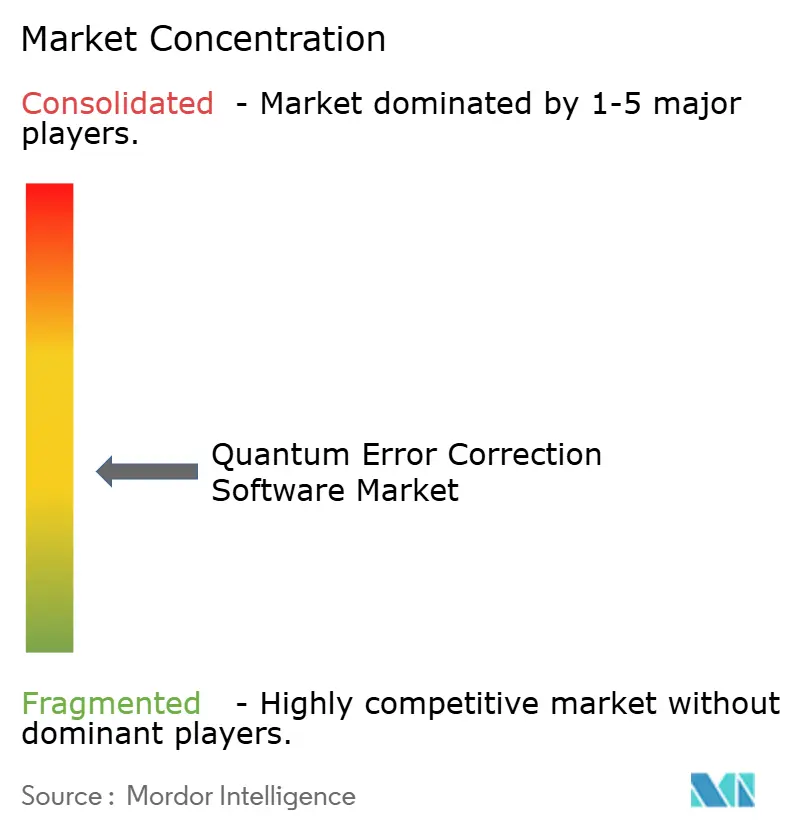
| Market Concentration | Medium |
Major Players *Disclaimer: Major Players sorted in no particular order Image © Mordor Intelligence. Reuse requires attribution under CC BY 4.0. | |
Quantum Error Correction Software Market Analysis by Mordor Intelligence
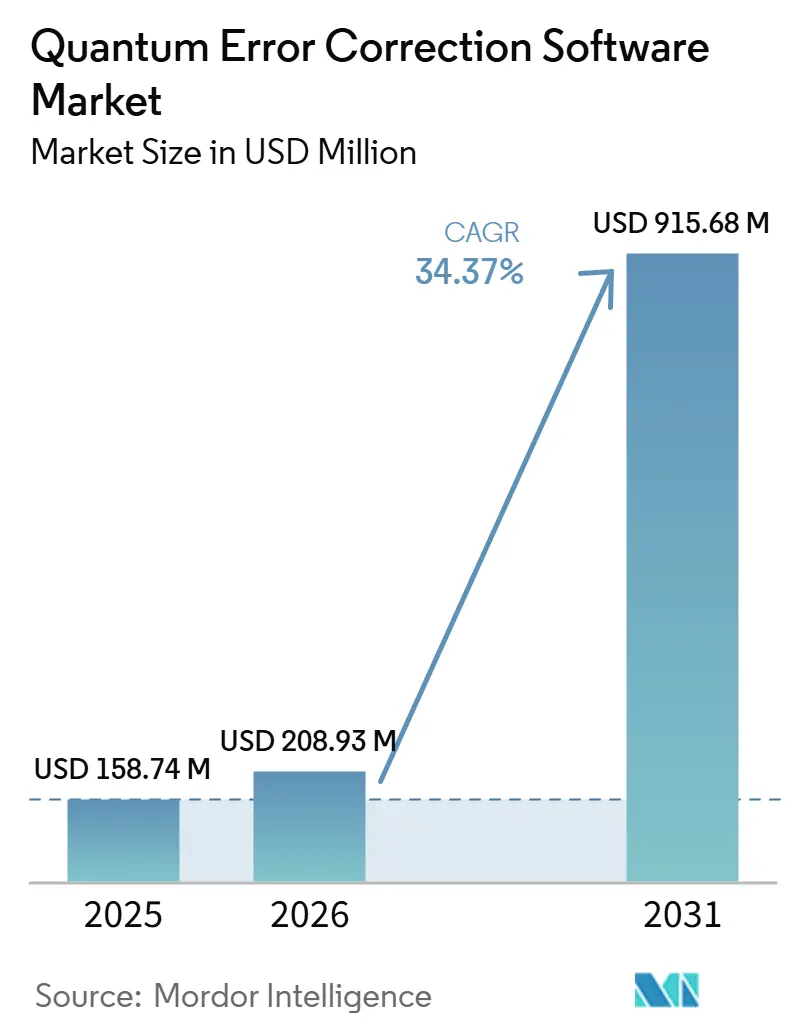
The quantum error correction software market size is projected to expand from USD 158.74 million in 2025 and USD 208.93 million in 2026 to USD 915.68 million by 2031, registering a CAGR of 34.37% between 2026 to 2031. Growth is being shaped by a clear shift in buyer focus from isolated qubit performance to stable logical operations that can run across larger and more complex quantum systems. This is pushing decoder software, compilers, syndrome-processing tools, and hardware-aware optimizers into a more central role in commercial quantum programs. Public funding is also widening the addressable base, because national quantum programs are supporting multiple hardware paths instead of allowing a single design approach to define software demand. Cloud platforms are shortening adoption cycles by giving enterprises earlier access to quantum development environments without requiring direct hardware ownership. Competitive activity is therefore moving toward software stacks that can support fault-tolerant roadmaps, fit regulated enterprise needs, and serve region-specific procurement priorities as sovereign quantum programs expand.
Key Report Takeaways
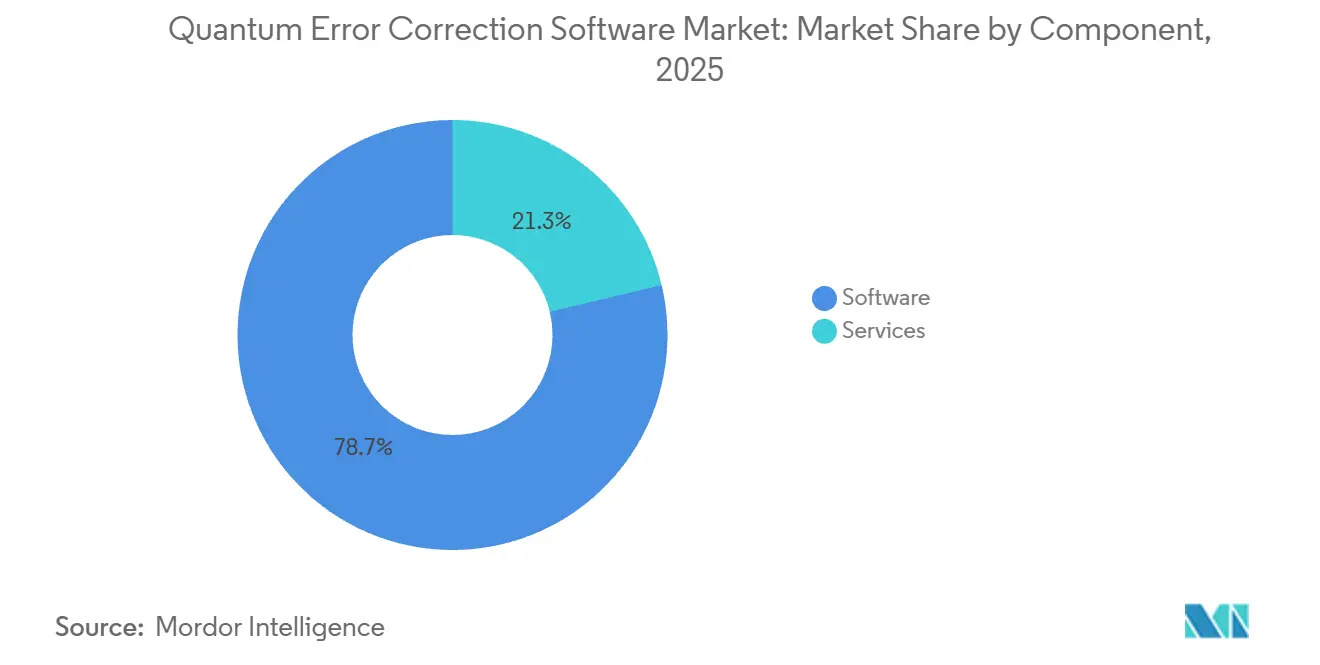
- By component, software led with 78.73% share in 2025, while services is projected to expand at a 36.78% CAGR through 2031.
- By deployment mode, cloud held 68.46% share share of the quantum error correction software market in 2025 and is also projected to record the highest CAGR at 35.36% through 2031.
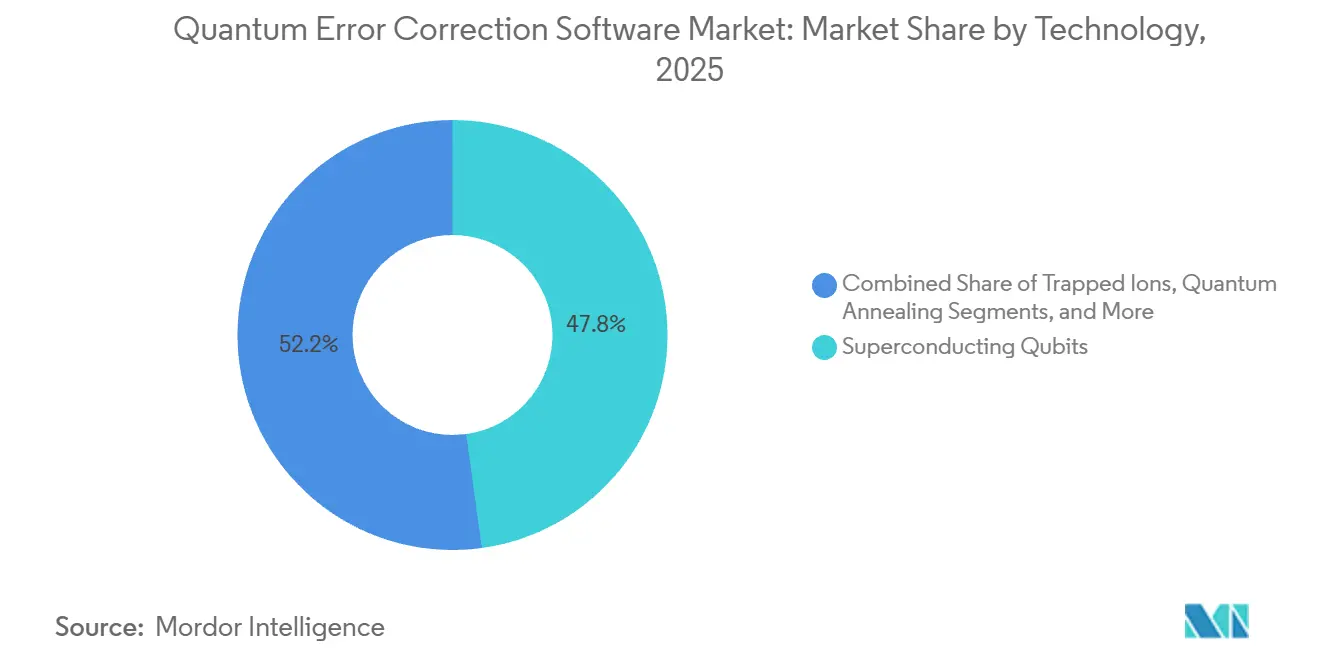
- By technology, superconducting qubits accounted for 47.82% share in 2025, while trapped ions is forecast to advance at a 38.49% CAGR through 2031.
- By end-user industry, BFSI held 22.37% share of the quantum error correction software market in 2025, while healthcare and life sciences is projected to grow at a 37.18% CAGR through 2031.
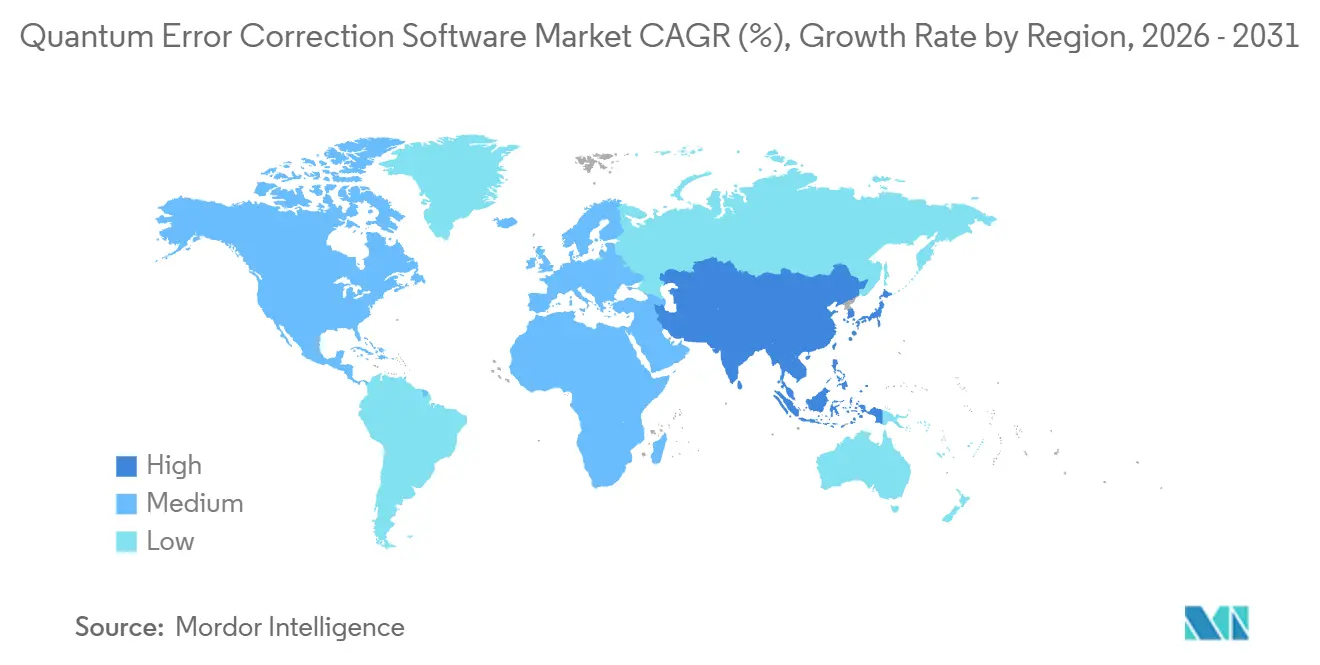
- By geography, North America accounted for 43.24% of revenue in 2025, while Asia-Pacific is projected to advance at a 37.94% CAGR through 2031.
Note: Market size and forecast figures in this report are generated using Mordor Intelligence’s proprietary estimation framework, updated with the latest available data and insights as of January 2026.
Global Quantum Error Correction Software Market Trends and Insights
Drivers Impact Analysis*
| Driver | (~) % Impact on CAGR Forecast | Geographic Relevance | Impact Timeline |
|---|---|---|---|
| Rising Commercial Readiness of Fault-Tolerant Quantum Roadmaps | +8.5% | Global, with near-term concentration in North America and Western Europe | Long term (≥ 4 years) |
| Expanding Demand for Quantum-Safe Security Workflows | +6.2% | Global, regulatory compliance pressure concentrated in Europe and North America | Medium term (2-4 years) |
| Open-Source Compiler and SDK Ecosystem Maturation | +5.8% | Global, developer activity concentrated in North America, Europe, and East Asia | Medium term (2-4 years) |
| Increase in Cloud-Delivered Quantum Development Environments | +5.1% | North America and Europe, with spillover to Asia-Pacific | Short term (≤ 2 years) |
| Demand for Hardware-Aware Logical Qubit Optimization | +3.4% | Global, highest near-term impact in North America | Medium term (2-4 years) |
| Early Enterprise Budgeting for Error-Mitigation Migration | +2.7% | North America, Europe, and East Asia | Short term (≤ 2 years) |
| Source: Mordor Intelligence | |||
Rising Commercial Readiness of Fault-Tolerant Quantum Roadmaps
Concrete hardware schedules have moved the quantum error correction software market from research planning into near-term enterprise budgeting. IBM set a visible benchmark in June 2025 when it outlined its Starling roadmap, targeting 200 logical qubits and 100 million quantum gates by 2029 through a bivariate bicycle qLDPC architecture.[1]IBM Quantum, “IBM Lays Out Clear Path to Fault-Tolerant Quantum Computing,” IBM Quantum Blog, ibm.com That code choice matters because it changes the decoder and compiler requirements that the quantum error correction software market must support across future production systems. IBM also introduced Relay-BP as a compact decoder that can run on FPGAs or ASICs, which raised expectations for lower-latency and more hardware-aware software stacks. D-Wave widened the technology base in June 2026 with a gate-model roadmap that targets 100 logical qubits capable of more than 1 million operations by 2032. The U.S. Department of Commerce then spread USD 2.013 billion across nine quantum companies in May 2026, which reduced the chance that one hardware modality will dominate future demand in the quantum error correction software market.
Expanding Demand for Quantum-Safe Security Workflows
The quantum error correction software market is also gaining relevance because quantum security work is moving into mainstream enterprise planning. NIST stated in its FY2025 National Quantum Initiative supplement that improvements in quantum error correction are vital to achieving practical large-scale quantum computing. In Europe, ESMA reported that the post-quantum transition path already requires planning and pilot activity for higher-risk use cases, while DORA requires financial entities to address quantum-related cyber risks in operational resilience programs. Erste Group took that shift into live infrastructure in February 2026 by deploying entangled quantum key distribution into its Vienna banking fiber network. This raises the value of software vendors that can document logical error behavior as part of security certification and compliance workflows, not only as part of raw compute performance. As a result, the quantum error correction software market is drawing demand from buyers that need both computational readiness and stronger audit support.
Open-Source Compiler and SDK Ecosystem Maturation
The open-source layer is making the quantum error correction software market broader, but it is also making undifferentiated tools harder to monetize. IBM stated that Qiskit had more than 700,000 users globally by 2026, which gave the platform the largest developer base in the field. That scale gives the quantum error correction software market a larger testing and adoption pool for compilers, decoders, and workflow tools built around existing developer habits. It also means basic circuit assembly features can become easier to access, which reduces pricing power for vendors that do not offer deeper hardware or decoder specialization. PennyLane and Cirq continue to pull distinct user groups around hybrid workflows and hardware-specific development paths, which keep the software landscape active across several ecosystems. Providers in the quantum error correction software market, therefore, gain more protection when they compete on decoder speed, hardware-specific tuning, and integration quality rather than on broad feature lists alone.
Increase In Cloud-Delivered Quantum Development Environments
Cloud access is expanding the buyer base for the quantum error correction software market by eliminating the need for direct ownership of cryogenic hardware. AWS added Rigetti's Cepheus-1-108Q to Amazon Braket in April 2026, giving users access to the first 100-plus-qubit superconducting device on that platform. AWS also deepened its work with QuEra in 2026 to bring fault-tolerant quantum computing to Braket and to support tools such as Qiskit, PennyLane, and CUDA-Q in one cloud setting. This gives the quantum error correction software market a faster route into enterprise evaluations, because buyers can compare software behavior across more than one hardware type through the same commercial channel. Microsoft Azure Quantum also keeps that pattern in place by aggregating multiple hardware providers behind a unified access layer, which encourages cross-platform testing rather than single-vendor lock-in. The result is a quantum error correction software market where adoption can move ahead of full hardware maturity, because software teams can build usage through cloud-based testing, optimization, and migration work.
Restraints Impact Analysis*
| Restraint | (~) % Impact on CAGR Forecast | Geographic Relevance | Impact Timeline |
|---|---|---|---|
| Limited Installed Base of Fault-Tolerant-Ready Quantum Hardware | -3.8% | Global, most acute in regions without dedicated national quantum hardware programs | Long term (≥ 4 years) |
| Scarcity of Specialized Quantum Error Correction Talent | -2.9% | Global, highest severity in Asia-Pacific and South America | Medium term (2-4 years) |
| Interoperability Gaps Across Quantum Hardware Stacks | -2.1% | Global | Medium term (2-4 years) |
| High Verification Cost for Production-Grade Logical Circuits | -1.6% | Most acute in North America and Europe, where enterprise compliance requirements are strictest | Long term (≥ 4 years) |
| Source: Mordor Intelligence | |||
Limited Installed Base of Fault-Tolerant-Ready Quantum Hardware
The quantum error correction software market still relies on a hardware base that remains limited in the commercial market. As of 2026, only a small number of systems have shown sustained error suppression at levels that matter for logical-qubit operation, and production workloads are still not widely available to enterprise users. IQM reported a milestone in June 2026 with directional tile codes on its Crystal processors, showing up to a 1,000-times reduction in per-logical per-round error rate versus surface codes at a comparable footprint.[2]IQM Quantum Computers, “IQM Achieves Milestone in Quantum Error Correction, Enabling Fault-Tolerant Computing in the Near-Term,” Press Release, iqm.tech Even so, the gap between proof-of-concept progress and broad commercial deployment keeps many enterprise budgets in pilot mode rather than recurring software license mode. This leaves the quantum error correction software market with strong technical momentum, but a narrower current customer base than long-term demand suggests.
Scarcity Of Specialized Quantum Error Correction Talent
The quantum error correction software market also faces a labor bottleneck that cloud access alone cannot solve. A 2026 peer-reviewed study in EPJ Quantum Technology, based on 3,641 job postings, found that the field remains heavily weighted toward PhD-level hiring and offers limited mid-career entry points. That matters because production-grade quantum error correction software needs people who can combine noise modeling, code design, hardware behavior, and enterprise software integration in one workflow. The shortage slows deployment at both vendors and customers, even when tool quality and hardware access are improving. As long as this talent gap remains, the quantum error correction software market is likely to scale more slowly than raw interest or funding levels would otherwise allow.
*Our forecasts treat driver/restraint impacts as directional, not additive. The impact forecasts reflect baseline growth, mix effects, and variable interactions.
Segment Analysis
By Component: Software Retains Structural Dominance as Services Accelerate
Software commanded 78.73% of the quantum error correction software market in 2025, which reflected the premium value of specialized compilers, decoders, simulators, and optimizer tools. This lead is structural because each change in code family, processor architecture, or module design creates a fresh need for updated software logic. The quantum error correction software market, therefore, keeps adding development demand even before hardware reaches large-scale commercial maturity. That pattern also favors vendors with deep co-design access to hardware roadmaps, because they can align tools earlier with emerging logical-qubit requirements.
Services, while smaller in current revenue, is projected to grow at a 36.78% CAGR through 2031 as first-time buyers need integration support, custom decoder work, and managed deployment help. Across the quantum error correction software industry, this service pull is rising because many enterprise teams do not yet have in-house capability to validate code performance on live or cloud-connected systems. Consulting demand is also increasing, where buyers want to map hardware options to sector-specific use cases without locking into one architecture too early. Managed offerings are gaining room because software product boundaries are less rigid when deployment, performance tuning, and testing are delivered through subscription-based environments. As a result, the quantum error correction software market is keeping software at the center of value capture while allowing services to expand as an onboarding and operational layer.


By Deployment Mode: Cloud Leads Across Scale and Growth
Cloud accounted for 68.46% of the quantum error correction software market size in 2025 and is projected to expand at a 35.36% CAGR through 2031. That dual position as the largest and fastest-growing deployment mode shows that the market is scaling through accessibility rather than through on-site infrastructure ownership. Enterprises can test decoder behavior, compiler paths, and hardware compatibility across several systems without making large upfront capital commitments. The quantum error correction software market benefits from this setup because software evaluation cycles can start earlier than hardware procurement cycles.
AWS strengthened this route in April 2026 by adding a 100-plus-qubit superconducting device from Rigetti to Amazon Braket. Multi-provider access through AWS and Azure also gives buyers a more practical way to benchmark software performance across superconducting, trapped-ion, and neutral-atom environments. That helps specialist vendors reach customers that would otherwise never operate their own hardware. On-premises deployment still matters in defense, intelligence, and highly regulated financial settings where workload control and data sovereignty remain central purchase conditions. This means the quantum error correction software market will stay cloud-led, while a smaller on-premises segment keeps importance through higher-security and longer-cycle contracts.
By Technology: Superconducting Qubits Hold Scale While Trapped Ions Drive Growth
Superconducting qubits held 47.82% of the quantum error correction software market share in 2025, supported by their larger installed base, platform familiarity, and stronger developer ecosystem. IBM stated that Qiskit had more than 700,000 users by 2026, which reinforces the position of superconducting-linked software stacks in daily development work. The U.S. Department of Commerce also included GlobalFoundries in its May 2026 incentive package, which supports the wider supply chain behind domestic quantum hardware development.[3]U.S. Department of Commerce and NIST, “Department of Commerce Announces Letters of Intent With 9 Companies for $2 Billion to Accelerate U.S. Leadership in Quantum Computing,” NIST News, nist.gov In practical terms, the quantum error correction software market still leans on superconducting systems because they provide the broadest current base for tools, testing, and commercial engagement.
Trapped ions is projected to grow at a 38.49% CAGR through 2031, making it the fastest-moving technology segment in the period. The draft links that growth to strong logical-qubit encoding efficiency, including a reported milestone of 48 logical qubits from 98 physical qubits, which lowers some software overhead per logical operation. Lower overhead matters because it can reduce decoder complexity, latency pressure, and the classical processing burden around each logical step. D-Wave's roadmap also shows that the technology race is widening rather than narrowing, which keeps the quantum error correction software market open to more than one hardware path. Quantum annealing remains more niche and application-specific, while other modalities such as neutral atoms, photonics, and silicon spin are adding new targets for hardware-agnostic software stacks.

By End-User Industry: BFSI Anchors Demand While Healthcare and Life Sciences Accelerates
BFSI held 22.37% of the quantum error correction software market share in 2025, which kept it as the largest end-user segment. The segment had an early lead because portfolio optimization, derivative pricing, Monte Carlo simulation, and fraud-related workloads fit the type of deep circuit execution that fault-tolerant systems are expected to support. The World Economic Forum stated in 2025 that financial services quantum use cases could create up to USD 622 billion in value by 2035, with risk modeling and portfolio optimization among the most likely early applications. ESMA added a regulatory layer in May 2026 by linking quantum-related cyber exposure to DORA compliance expectations for financial entities.
Healthcare and life sciences is projected to grow at a 37.18% CAGR through 2031, which places it ahead of all other end-user categories in growth. The segment is moving faster because molecular simulation, drug-target modeling, and genome-scale chemistry require long and stable circuit execution. That gives the quantum error correction software market a strong future buyer group that values logical-qubit reliability more than near-term experimentation. Pasqal stated in 2026 that its work with Crédit Agricole CIB was moving toward initial production use cases in quantum-assisted finance by 2028, which shows how leading users are extending commercial timelines beyond pilot programs. IT and telecom, industrial manufacturing, energy and utilities, and government and public administration continue to build adoption through cloud pilots, with broader deployment likely to strengthen as logical-qubit counts rise.
Geography Analysis
North America accounted for 43.24% of the quantum error correction software market size in 2025, which made it the largest regional segment. The region benefits from the concentration of cloud quantum platforms, national laboratory systems, and federal procurement channels that directly support commercial software adoption. The U.S. Department of Energy launched the Quantum Genesis initiative in 2026 to deploy scientifically relevant fault-tolerant quantum computers by 2028. The White House also issued an executive order in June 2026 to update the National Quantum Strategy and to promote commercialization, deployment, and industry partnerships across quantum technologies.
Asia-Pacific is projected to grow at a 37.94% CAGR during 2026-2031, which makes it the fastest-growing regional market. The quantum error correction software market in the region is supported by large public funding commitments, expanding startup activity, and the gradual buildout of domestic quantum programs. ESMA reported that China's cumulative public quantum funding exceeded USD 15 billion as of April 2025, which gives the region strong financial depth even before the broader commercial rollout. The regional pipeline is also being shaped by planned hardware deployment in India, startup activity in Japan, and partnership-led capacity building in South Korea, all of which widen future demand for compilers, decoders, and integration tools. This leaves Asia-Pacific with a strong medium-term position in the quantum error correction software market, even though the present installed base still trails North America.
Europe held a solid share of the quantum error correction software market, supported by public funding, regional technology programs, and government-backed commercialization goals. France added EUR 1 billion (USD 1.12 billion) in June 2026 to its national quantum strategy through 2030, and it identified software middleware and compilers as a dedicated investment area.[4]French Government, “Souveraineté Technologique, La France Investit 1 Milliard d'Euros Supplémentaire Dans La Stratégie Nationale Quantique,” Gouvernement de la République Française, info.gouv.fr The European Commission stated in 2025 that European providers should target systems with around 100 error-corrected qubits by 2030, which creates a direct demand-side signal for regional software suppliers. South America, the Middle East, and Africa remain earlier-stage markets, with activity centered on strategic planning, academic partnerships, and cloud-based pilot access rather than broad commercial deployment.

Competitive Landscape
The quantum error correction software market is moderately fragmented, with large platform companies and specialist vendors competing from different starting points. IBM, Microsoft, Google LLC, and Amazon.com embed quantum error correction capabilities inside broader quantum ecosystems, while firms such as Riverlane, Q-CTRL, Classiq, Alice and Bob, and Quantinuum compete through focused technical depth. This split keeps the quantum error correction software market open, because no single vendor model yet controls distribution, software standards, and hardware alignment at the same time. It also means buyers often evaluate platform reach and specialist performance together rather than treating them as separate purchase paths.
IBM strengthened its competitive position when it linked its Starling roadmap to a specific decoder and code architecture in June 2025, which gave customers a clearer view of how its software stack fits future fault-tolerant hardware. D-Wave made a different move in June 2026 by extending its presence beyond annealing and presenting a gate-model roadmap with a visible logical-qubit target, which broadened its relevance to future software buyers. AWS continues to matter as a distribution layer because it expands access to third-party hardware and software environments through Braket rather than through a single proprietary stack. Alice and Bob also showed in March 2026 that classical acceleration is becoming a competitive lever when it announced CUDA-Q integration that reduced quantum error correction decoding simulation time by a factor of 9.25 for its cat-qubit architectures. These moves show that competitive advantage is being built through code design, decoder speed, access models, and classical co-processing rather than through hardware claims alone.
Regulation is adding another layer to competition in the quantum error correction software market. NIST has kept quantum error correction central to the path toward practical large-scale quantum computing, which increases the value of vendors that can show stable technical roadmaps and clear documentation. ESMA's 2026 analysis also makes compliance support more relevant in financial services, especially where buyers need evidence that quantum-related risks are being addressed within broader cyber and resilience frameworks. Sovereign funding in North America and Europe further increases the chance that regionally aligned software providers will gain an edge in public procurement and strategic national programs. For that reason, the competitive balance in the quantum error correction software market is likely to remain broad, with leadership shaped by ecosystem fit, compliance readiness, and deployment execution rather than by scale alone.
Quantum Error Correction Software Industry Leaders
IBM Corporation
Microsoft Corporation
Google LLC (Alphabet Inc.)
Amazon.com, Inc.
Quantinuum Ltd.
- *Disclaimer: Major Players sorted in no particular order

Recent Industry Developments
- June 2026: IQM Quantum Computers reported a QEC milestone using directional tile codes on its Crystal processors, achieving up to a 1,000-times reduction in per-logical per-round error rate compared to surface codes at a comparable hardware footprint. IQM's roadmap targets fault-tolerant quantum computing by 2030 and a path to scaling to 1 million qubits.
- June 2026: D-Wave Quantum announced a gate-model roadmap targeting 100 logical qubits capable of over 1 million operations by 2032, with a 2026 milestone of delivering a 17-physical-qubit system at logical error rates 2 times lower than physical error rates. The announcement makes D-Wave the only dual-platform quantum company providing both annealing and gate-model systems with active QEC roadmaps.
- May 2026: The US Department of Commerce announced USD 2.013 billion in quantum computing incentives under the CHIPS and Science Act for nine companies spanning superconducting, trapped-ion, photonic, topological, and silicon spin modalities. Companies receiving incentives include IBM, Quantinuum, Rigetti, Atom Computing, PsiQuantum, Infleqtion, D-Wave, Diraq, and GlobalFoundries
- April 2026: Amazon Braket launched Rigetti's Cepheus-1-108Q, the first 100-plus-qubit superconducting QPU on the platform, using a modular 3x4 array of twelve 9-qubit chiplets with tunable and intermodule couplers. The launch expanded enterprise access to superconducting QEC workloads on a pay-per-use basis.


Global Quantum Error Correction Software Market Report Scope
The quantum error correction software market comprises software platforms, middleware, libraries, compilers, decoders, and orchestration tools designed to detect, mitigate, and correct errors arising from decoherence, gate imperfections, and environmental noise in quantum computers. These solutions enable the creation and management of logical qubits, syndrome decoding, error-aware circuit optimization, and fault-tolerant quantum execution across multiple quantum hardware architectures. The market includes commercial software licenses, cloud-based QEC platforms, and associated implementation and support services, while excluding quantum hardware, cryogenic control systems, and general-purpose quantum software that does not provide dedicated error correction or fault-tolerance capabilities.
The Quantum Error Correction Software Market Report is Segmented by Component (Software, and Services), Deployment Mode (Cloud, and On-Premises), Technology (Superconducting Qubits, Trapped Ions, Quantum Annealing, and Other Technologies), End-User Industry (BFSI, Healthcare and Life Sciences, Retail and E-Commerce, IT and Telecom, Media and Entertainment, Industrial Manufacturing, Energy and Utilities, Government and Public Administration, and Other End-User Industries), and Geography (North America, South America, Europe, Asia-Pacific, Middle East, and Africa). The Market Forecasts are Provided in Terms of Value (USD).
| Software |
| Services |
| Cloud |
| On-Premises |
| Superconducting Qubits |
| Trapped Ions |
| Quantum Annealing |
| Other Technologies |
| BFSI |
| Healthcare and Life Sciences |
| Retail and E-Commerce |
| IT and Telecom |
| Media and Entertainment |
| Industrial Manufacturing |
| Energy and Utilities |
| Government and Public Administration |
| Other End-User Industries |
| North America | United States |
| Canada | |
| Mexico | |
| South America | Brazil |
| Argentina | |
| Rest of South America | |
| Europe | Germany |
| United Kingdom | |
| France | |
| Spain | |
| Italy | |
| Russia | |
| Rest of Europe | |
| Asia-Pacific | China |
| India | |
| Japan | |
| South Korea | |
| Australia and New Zealand | |
| Rest of Asia-Pacific | |
| Middle East | Saudi Arabia |
| United Arab Emirates | |
| Turkey | |
| Rest of Middle East | |
| Africa | South Africa |
| Nigeria | |
| Egypt | |
| Rest of Africa |
| By Component | Software | |
| Services | ||
| By Deployment Mode | Cloud | |
| On-Premises | ||
| By Technology | Superconducting Qubits | |
| Trapped Ions | ||
| Quantum Annealing | ||
| Other Technologies | ||
| By End-User Industry | BFSI | |
| Healthcare and Life Sciences | ||
| Retail and E-Commerce | ||
| IT and Telecom | ||
| Media and Entertainment | ||
| Industrial Manufacturing | ||
| Energy and Utilities | ||
| Government and Public Administration | ||
| Other End-User Industries | ||
| By Geography | North America | United States |
| Canada | ||
| Mexico | ||
| South America | Brazil | |
| Argentina | ||
| Rest of South America | ||
| Europe | Germany | |
| United Kingdom | ||
| France | ||
| Spain | ||
| Italy | ||
| Russia | ||
| Rest of Europe | ||
| Asia-Pacific | China | |
| India | ||
| Japan | ||
| South Korea | ||
| Australia and New Zealand | ||
| Rest of Asia-Pacific | ||
| Middle East | Saudi Arabia | |
| United Arab Emirates | ||
| Turkey | ||
| Rest of Middle East | ||
| Africa | South Africa | |
| Nigeria | ||
| Egypt | ||
| Rest of Africa | ||


Key Questions Answered in the Report
What is the current and forecast size of the quantum error correction software space?
The quantum error correction software market size was USD 158.74 million in 2025, reached USD 208.93 million in 2026, and is projected to reach USD 915.68 million by 2031 at a 34.37% CAGR.
Which deployment model leads adoption in quantum error correction software?
Cloud leads adoption with a 68.46% share in 2025 and is also the fastest-growing deployment mode with a 35.36% CAGR through 2031.
Why is BFSI the largest end-user group for quantum error correction software?
BFSI led with a 22.37% share in 2025 because financial use cases such as portfolio optimization, risk modeling, and fraud analysis align well with future fault-tolerant quantum workloads.
Which technology segment is growing the fastest through 2031?
Trapped ions is the fastest-growing technology segment, with a projected 38.49% CAGR through 2031, supported by strong logical-qubit efficiency gains.
Which region offers the strongest growth outlook through 2031?
Asia-Pacific has the strongest regional growth outlook, with a projected 37.94% CAGR during 2026-2031, supported by public funding, startup activity, and domestic quantum programs.
What is pushing enterprises to buy these tools before hardware is fully mature?
Enterprises are moving early because cloud access, security planning, regulatory requirements, and hardware roadmaps are creating demand for testing, optimization, and migration support before large-scale production systems are fully available.
Page last updated on:






