
Quantum Computing Software Platform Market Size and Share
Market Overview
| Study Period | 2020 - 2031 |
|---|---|
| Market Size (2026) | USD 1.22 Billion |
| Market Size (2031) | USD 3.97 Billion |
| Growth Rate (2026 - 2031) | 26.62 % |
| Fastest Growing Market | Asia-Pacific |
| Largest Market | North America |
| Market Concentration | Medium |
Major Players *Disclaimer: Major Players sorted in no particular order Image © Mordor Intelligence. Reuse requires attribution under CC BY 4.0. | |
Quantum Computing Software Platform Market Analysis by Mordor Intelligence
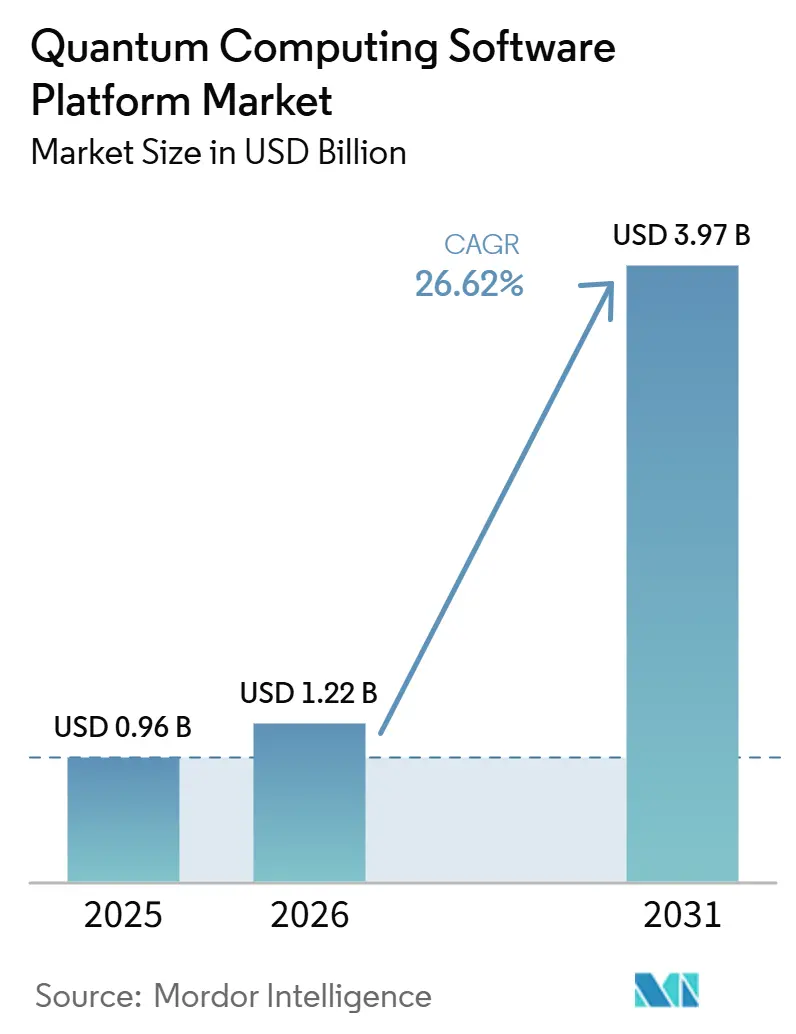
The quantum computing software platform market size is projected to expand from USD 0.96 billion in 2025 and USD 1.22 billion in 2026 to USD 3.97 billion by 2031, registering a CAGR of 26.62% between 2026 to 2031. The quantum computing software platform market is growing because national quantum programs are moving from research grants into direct procurement, lab infrastructure, and public-private commitments that support software demand as hardware ecosystems mature. The quantum computing software platform market is also widening through cloud access models that let enterprise developers test workflows across multiple hardware back ends without building internal quantum infrastructure. Post-quantum cryptography standards published since 2024 have added a compliance case for software spending, especially in security-sensitive sectors that now need migration planning before fault-tolerant machines arrive. Competition in the quantum computing software platform market is centered on development ecosystems, interoperability, and the ability to connect quantum workloads with classical high-performance computing environments. Even with this momentum, limited fault-tolerant qubit availability and shortages in specialized talent still keep much of the quantum computing software platform market in simulation, emulation, and pilot-stage deployment rather than full production use.
Key Report Takeaways
- By platform type, development kits held a 39.23% share in 2025, while middleware and orchestration was the fastest-growing segment, projected to record a 27.18% CAGR through 2031 in the quantum computing software platform market.
- By deployment model, cloud-based deployment accounted for 63.81% of the market in 2025, while the hybrid segment was the fastest-growing deployment path, projected to record a 29.52% CAGR through 2031.
- By application, optimization accounted for 26.54% share in 2025, while drug discovery and materials science are projected to expand at a 31.48% CAGR through 2031.
- By end user, BFSI accounted for 26.47% share in 2025, while government and defense are projected to expand at a 28.67% CAGR through 2031.
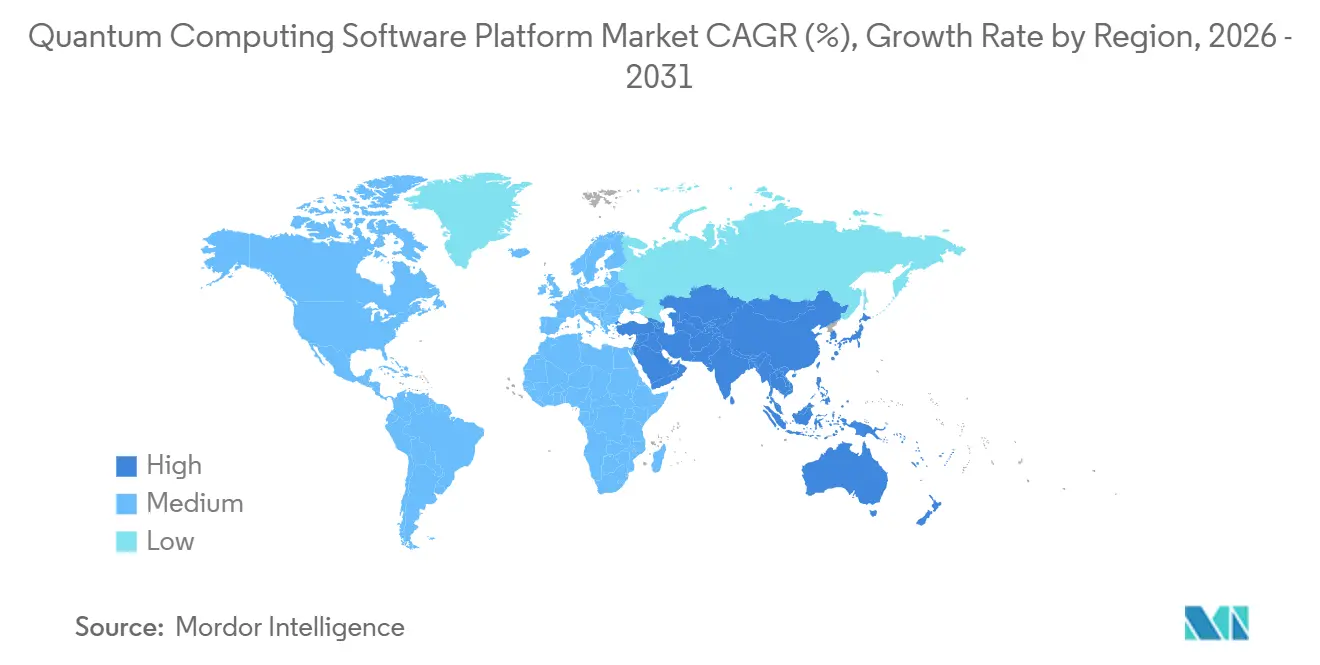
- By geography, North America held 37.26% share in 2025, while Asia-Pacific is projected to expand at a 31.71% CAGR through 2031.
Note: Market size and forecast figures in this report are generated using Mordor Intelligence’s proprietary estimation framework, updated with the latest available data and insights as of January 2026.
Market Trends and Insights
Drivers Impact Analysis of Quantum Computing Software Platform Market*
| DRIVER | (~) % IMPACT ON CAGR FORECAST | GEOGRAPHIC RELEVANCE | IMPACT TIMELINE |
|---|---|---|---|
| Enterprise Migration to Quantum-as-a-Service Development Stacks | +4.5% | Global | Medium term (2-4 years) |
| Government-Funded Quantum Software Procurement and National Programs | +3.8% | North America and EU core, spill-over to APAC and Middle East and Africa | Medium term (2-4 years) |
| Quantum Cloud Provider Ecosystem Expansion and SDK Integration | +3.2% | Global | Short term (≤ 2 years) |
| Rising Demand for Quantum Error Mitigation and Benchmarking Tools | +2.8% | North America and EU | Medium term (2-4 years) |
| Fragmented Toolchains Creating Demand for Interoperability Layers | +2.2% | Global | Medium term (2-4 years) |
| Early Commercialization of Domain-Specific Quantum Applications in Finance, Chemistry, and Logistics | +1.9% | North America core, spill-over to EU and APAC | Long term (≥ 4 years) |
| Source: Mordor Intelligence | |||
Enterprise Migration to Quantum-As-A-Service Development Stacks
Enterprise teams are moving quantum work onto managed development stacks because fragmented proof-of-concept environments are harder to govern, scale, and maintain over time in the quantum computing software platform market. This shift fits existing software governance models better, which makes it easier for large organizations to connect quantum experimentation with mainstream development and validation processes. IBM’s Qiskit SDK v2.5 release in 2026 added custom compiler pipelines, a C API, and LightSabre routing improvements that reduced transpiration time on circuits of 100 or more qubits, which shows how enterprise tooling is becoming more practical for larger technical teams. As these managed stacks improve, switching costs move toward the software workflow and compiler layer rather than the underlying hardware layer in the quantum computing software platform market. That dynamic gives platform orchestrators more control over long-term customer relationships, especially when they become the default interface for hybrid quantum and classical development environments.[1]IBM Quantum, “Release News, Qiskit V2.3 Is Here!,” IBM Quantum Computing Blog, ibm.com
Government-Funded Quantum Software Procurement and National Programs
Direct public procurement remains one of the clearest demand signals for the quantum computing software platform market because it turns long-horizon research goals into funded software, benchmarking, and integration work. In May 2026, the U.S. Department of Commerce signed letters of intent for USD 2.013 billion in CHIPS and Science Act incentives to 9 quantum companies, including IBM, Quantinuum, D-Wave, and Rigetti, which strengthens the hardware base that enterprise software depends on. The U.S. Department of Energy also renewed 5 National Quantum Information Science Research Centers with USD 625 million, including an Oak Ridge mandate tied to open-source quantum-classical workflow software, which supports middleware and orchestration demand. The White House Executive Order signed on June 22, 2026, created the QC-ADDS program, while the National Quantum Initiative Reauthorization Act of 2026 authorized USD 85 million per year for NIST quantum activities through 2030, reinforcing standards and performance assessment work that shapes commercial architecture choices. Japan’s JHPC-quantum program, a 5-year JPY 10 billion program running through 2027, or USD 67 million at 2025 average exchange rates, is building the software foundation for quantum-HPC hybrid workflows and shows that procurement-led demand is not limited to North America.[2]Japan External Trade Organization, “Japan’s RandD Capabilities in Advancing Quantum Technology,” JETRO, jetro.go.jp
Quantum Cloud Provider Ecosystem Expansion and SDK Integration
Cloud-native access is pulling more developers into the quantum computing software platform market because users can work through managed interfaces instead of directly negotiating with hardware providers for every experiment. This matters because enterprises can test multiple hardware approaches inside the same broader workflow, which lowers trial costs and shortens evaluation cycles for technical teams. In March 2026, Classiq showed that integrating its modeling platform with NVIDIA CUDA-Q reduced execution time for a 31-qubit financial options-pricing benchmark from 67 minutes to 2.5 minutes on a single NVIDIA A100 GPU, which gave practical support to hybrid quantum-GPU execution models. NVIDIA also supported Japan’s ABCI-Q system, which reflects how GPU acceleration, simulation, and orchestration are converging into a more unified software layer for the quantum computing software platform market. As hardware-agnostic layers become more useful, buyers gain more freedom to compare back ends without committing too early to a single hardware stack, which weakens lock-in as the main commercial defense.
Rising Demand for Quantum Error Mitigation and Benchmarking Tools
Error mitigation is commercially important because it helps current noisy systems produce more useful outputs before fault-tolerant hardware becomes widely available in the quantum computing software platform market. Riverlane’s Deltaflow 2 quantum error correction decoder, connected to Oak Ridge National Laboratory’s Frontier supercomputer, demonstrated sub-shot latency and reduced decoding latency to more than 10 times faster than Google’s published results as of April 2026. IBM also reported that recent Qiskit releases introduced HPC-accelerated error-mitigation capabilities that reduced the cost of obtaining accurate results by more than 100 times, expanding the set of workloads that could be tested economically. This creates a split between open tools used mainly by research teams and managed software layers that can charge for workflow control, accuracy, and service quality in the quantum computing software platform market. Vendors that turn mitigation and benchmarking into dependable platform features are likely to capture some of the highest-value software spending before production-scale fault tolerance is available.
Restraints Impact Analysis of Quantum Computing Software Platform Market*
| RESTRAINT | (~) % IMPACT ON CAGR FORECAST | GEOGRAPHIC RELEVANCE | IMPACT TIMELINE |
|---|---|---|---|
| Limited Fault-Tolerant Qubit Availability Slows Production-Grade Software Value Capture | -3.5% | Global | Medium term (2-4 years) |
| High Talent Scarcity in Quantum Algorithms, Compilers, and Control Software | -2.8% | Global | Long term (≥ 4 years) |
| Vendor Lock-In Fears Around Proprietary Quantum SDKs and Closed Ecosystems | -1.9% | Global | Medium term (2-4 years) |
| Unclear ROI for Most Enterprise Workloads Beyond Pilot Use Cases | -1.7% | Global | Short term (≤ 2 years) |
| Source: Mordor Intelligence | |||
Limited Fault-Tolerant Qubit Availability Slows Production-Grade Software Value Capture
The lack of commercially available fault-tolerant hardware still limits the range and depth of workloads that vendors can sell at scale in the quantum computing software platform market. Quantinuum’s 98-qubit Helios processor, published in Nature in July 2026, marked a major technical step, but it still supports research and pilot-stage use more than full production enterprise deployment. Software developers also have to support very different hardware approaches, including superconducting, trapped-ion, neutral atom, photonic, and other architectures, which raises compiler and mitigation complexity across the quantum computing software platform market. IBM and Quantinuum have both pointed to 2029 as a meaningful target for scalable fault tolerance, which means the software layer will remain tied to hybrid and pre-production use cases through much of the forecast window. Until then, vendors must justify subscriptions through simulation quality, workflow integration, and benchmarking support rather than hardware-native quantum advantage.
High Talent Scarcity in Quantum Algorithms, Compilers, and Control Software
Talent scarcity remains a structural drag because the quantum computing software platform market depends on users who can write, test, and operationalize specialized algorithms rather than only buy access to tools. The shortage is especially visible in enterprise settings where interest in experimentation has grown faster than the supply of teams that can sustain production-grade development and integration work. This gap slows implementation because organizations can access cloud tools and external partners, yet still struggle to build internal ownership across algorithms, compiler choices, and control software decisions. Some vendors are simplifying interfaces and reducing the technical burden on end users, but that does not eliminate the need for deep mathematical and domain expertise in high-value workflows. The constraint is likely to persist for longer because it depends on university training, cross-disciplinary upskilling, and larger workforce pipelines rather than a single product release in the quantum computing software platform market.[3]World Economic Forum, “Quantum Technologies, Key Strategies and Opportunities for Financial Services Leaders,” World Economic Forum, weforum.org
*Our forecasts treat driver/restraint impacts as directional, not additive. The impact forecasts reflect baseline growth, mix effects, and variable interactions.
Quantum Computing Software Platform Market Segment Analysis
By Platform Type:
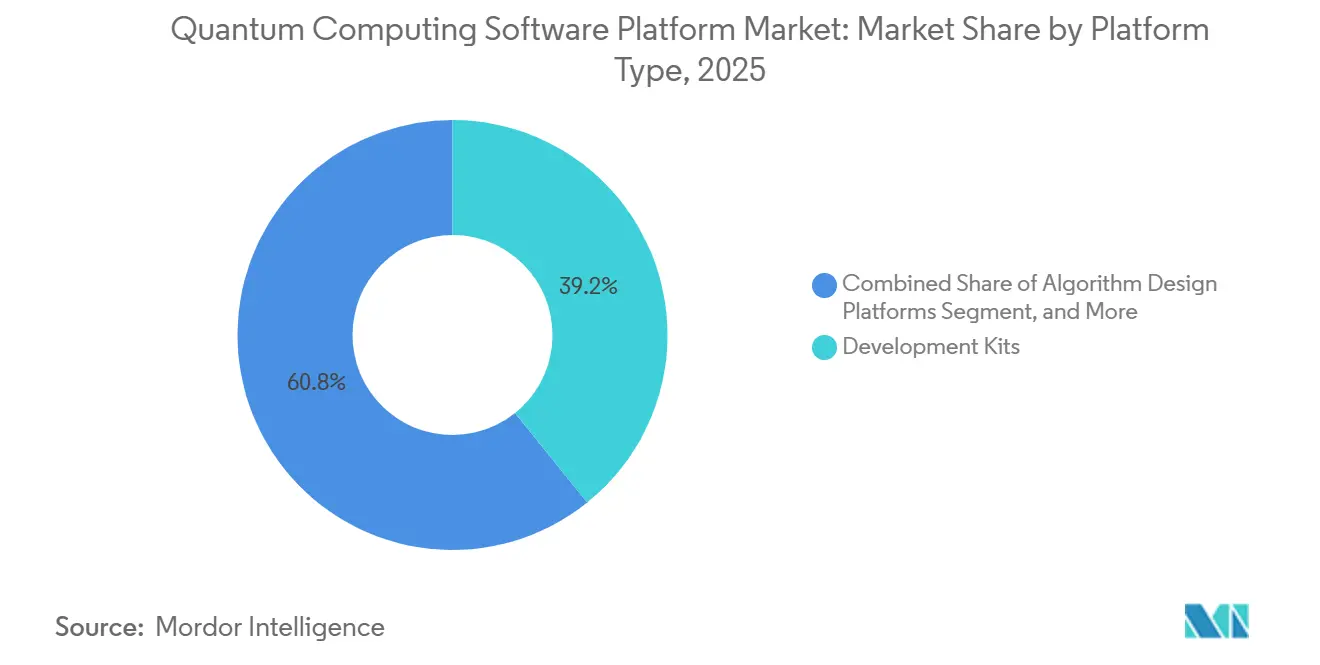
Development Kits Anchor a Fragmented Toolchain MarketDevelopment Kits accounted for 39.23% of platform revenue in 2025, representing the largest slice of the quantum computing software platform market share by platform type. This leadership shows that enterprise spending is still concentrated in programming infrastructure, compiler access, and testing layers rather than higher-order orchestration. Buyers are still building foundational capability, which includes validating circuit compilation, checking emulator behavior, and establishing repeatable development workflows before wider production deployment in the quantum computing software platform market. IBM strengthened this layer through consecutive Qiskit releases in 2026 that expanded C API support and improved compiler functionality for larger circuits. That pattern supports a market structure where the first tool a developer learns often becomes the foundation for later integration choices across the quantum computing software platform market.
Middleware and orchestration was the fastest-growing segment, projected to record a 27.18% CAGR through 2031, which points to a gradual shift in value creation as hybrid workflows become more central. As hardware matures, enterprises will need stronger scheduling, routing, and job management layers to connect quantum processors with CPUs and GPUs in practical operating environments. Algorithm Design Platforms and Quantum Emulators and Simulators remain important because they help users validate logic and resource requirements before moving work onto live hardware queues. Quantum Control Software is still a smaller revenue layer, yet it is gaining importance as larger systems require tighter calibration, timing control, and error feedback loops. NVIDIA’s CUDA-Q deployment within Japan’s large-scale research infrastructure shows how simulation, orchestration, and control are moving closer together inside the quantum computing software platform market.[4]NVIDIA Newsroom, “NVIDIA Powers World’s Largest Quantum Research Supercomputer,” NVIDIA Newsroom, nvidia.com



By Deployment Model:
Cloud Dominance Reshapes Access EconomicsCloud-Based deployment held 63.81% share in 2025, making it the leading access model in the quantum computing software platform market. This lead reflects the cost and complexity of hardware ownership, since most enterprises do not want to build or lease specialized systems just to begin testing quantum workflows. Cloud deployment also helps buyers compare different hardware modalities through software interfaces that are easier to adopt than direct infrastructure management.[5]Classiq, “Classiq Dramatically Accelerates Hybrid Quantum Application Development and Execution With NVIDIA CUDA-Q,” Classiq Insights, classiq.io That approach speeds up evaluation cycles and makes developer participation less dependent on a physics-heavy internal team. The strength of cloud access is one reason the quantum computing software platform market is reaching users outside research-led institutions.
On-Premises deployment remains strategically relevant for government, defense, and certain research environments where security, latency, and system control carry more weight than broad accessibility. The Hybrid segment is the fastest-growing deployment path, projected to record a 29.52% CAGR through 2031, as many users now need tight integration between local classical infrastructure and remote quantum processing for iterative workloads. This becomes more important when round-trip latency can slow optimization loops or when regulated users want part of the workflow to remain inside controlled environments. Japan’s ROQUO platform illustrates how hybrid design is becoming operational, because it links quantum systems with the Fugaku supercomputer in a working production environment. Regulatory pressure in areas such as data residency will keep non-public deployment models relevant even as cloud remains the main entry point for the quantum computing software platform market.
By Application:
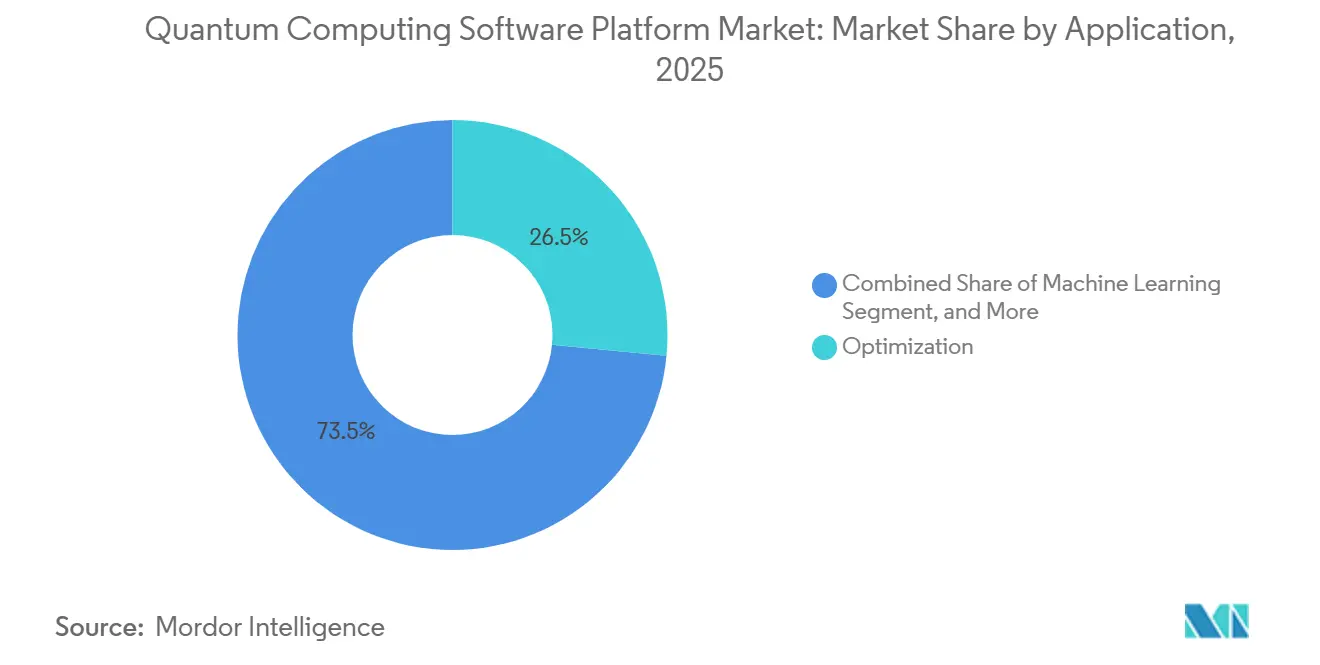
Optimization Leads as Drug Discovery Gains MomentumOptimization accounted for a 26.54% share in 2025, making it the largest application area in the quantum computing software platform market. This position reflects the fact that optimization workloads often require lower circuit depth than demanding chemistry or cryptography use cases, which makes them more practical on current hardware. Problems in scheduling, logistics, portfolio construction, and risk analysis match the present technical limits of many near-term systems more closely than deeper scientific simulations do. That fit has kept optimization at the front of commercial experimentation in the quantum computing software platform market. It also explains why finance and operations-led use cases appear earlier in enterprise programs than some of the more ambitious scientific workflows.
Drug discovery and materials science are projected to expand at a 31.48% CAGR through 2031, which makes it the fastest-growing application area. In July 2026, IBM, Oak Ridge National Laboratory, and the Cleveland Clinic announced the first-known computations of fusion material molecular configurations on a quantum computer, extending validated quantum chemistry work to larger and more commercially relevant problem classes. IonQ’s collaboration with AstraZeneca, AWS, and NVIDIA improved end-to-end time-to-solution by more than 20 times and reduced runtimes from months to days in a drug synthesis workflow, which shows why this application is gaining strategic attention. Machine Learning and Cryptography and Cybersecurity also remain structurally important, with security demand strengthened by the NIST post-quantum cryptography standards finalized in August 2024 and the HQC selection announced in March 2025.[6]National Institute of Standards and Technology, “NIST PQC Standardization Process, HQC Announced as a 4th Round Selection,” NIST News, nist.gov As a result, the quantum computing software platform market is expanding through both near-term optimization use cases and longer-horizon scientific computing workloads.
By End User:
BFSI Commands the Largest Share as Government Scales InvestmentBFSI accounted for 26.47% share in 2025, which made it the leading end-user group in the quantum computing software platform market. Financial institutions have a dense set of relevant problems, including portfolio optimization, stochastic modeling, fraud analysis, and credit risk evaluation, which makes the sector one of the earliest commercial adopters. The World Economic Forum’s 2025 work on financial services highlighted portfolio optimization, stochastic modeling, and quantum machine learning as leading near-term use cases for the sector. ESMA’s May 2026 risk analysis also treated post-quantum cryptography migration as a compliance priority for financial market participants in Europe, which adds a regulatory layer to software demand. Crédit Agricole CIB and Pasqal advanced a strategic partnership in June 2026 to deploy quantum computing in finance, including risk-weighted asset monitoring, which shows that parts of the quantum computing software platform market are moving past research-only activity.
Government and Defense is projected to expand at a 28.67% CAGR through 2031, making it the fastest-growing end-user group. Sovereign capability programs, national security workloads, and compliance needs in encryption and simulation are all reinforcing public-sector demand for the quantum computing software platform market. In April 2026, Infleqtion secured a USD 2 million DARPA contract under the HARQ program to develop Multistaq for heterogeneous multi-modality quantum systems, which shows how defense agencies are directly funding software infrastructure. Healthcare and Life Sciences, Energy and Utilities, and Automotive and Transportation are growing from a smaller base, yet they are becoming more active as hybrid workflows improve. Quantinuum and BMW Group expanded their multi-year collaboration in May 2026 to work on advanced materials science for future mobility, which signals that the quantum computing software platform market is drawing more committed industrial users beyond finance and government.
Geography Analysis
North America Quantum Computing Software Platform Market
North America held 37.26% of the quantum computing software platform market share in 2025, which kept the region in the leading position by revenue. The region benefits from the concentration of major cloud players, specialist software vendors, national labs, and policy support mechanisms that fund standards and integration work in the quantum computing software platform market. The May 2026 CHIPS Act letters of intent, the June 2026 White House Executive Order on quantum innovation, and the National Quantum Initiative Reauthorization Act of 2026 all reinforced the United States as the most resource-intensive policy environment for this field. Canada supports regional depth through its research base and specialist company presence, while Mexico remains earlier in adoption and is more tied to cloud access than domestic platform creation.
APAC Quantum Computing Software Platform Market
Asia-Pacific is projected to expand at a 31.71% CAGR through 2031, which makes it the fastest-growing regional cluster in the quantum computing software platform market. Japan is a major driver because RIKEN launched the ROQUO quantum-HPC hybrid supercomputer in June 2026, connecting Quantinuum and IBM systems with the Fugaku supercomputer in an operational environment. Fujitsu and the University of Osaka also announced STAR Architecture ver. 3 in March 2026, improving computational accuracy by more than 10 times for molecular energy calculations on early fault-tolerant quantum computers. Fujitsu and RIKEN had already made Japan’s 256-qubit superconducting quantum computer available to external users in 2025, which strengthens the region’s software demand base for materials and scientific applications. Singapore is also building commercialization capacity through a dedicated accelerator backed by QAI Ventures, which shows that the quantum computing software platform market is broadening beyond the largest national programs in Asia.
EMEA and South America Quantum Computing Software Platform Market
Europe remains an important region in the quantum computing software platform market, with the United Kingdom and Germany standing out as research and commercialization hubs. The United Kingdom has strengthened its position in error correction software through Riverlane’s Deltakit activity and its Deltaflow 2 integration with Oak Ridge’s Frontier supercomputer. Germany-based ParityQC and Israel-based Classiq announced a partnership in July 2026 to integrate hardware optimization and higher-level software engineering, which reflects Europe’s emphasis on interoperability rather than pure hardware concentration. South America and the Middle East and Africa remain earlier-stage regions, with adoption still centered on selective research and specialized financial or public-sector use cases rather than broad commercial scale.

Competitive Landscape
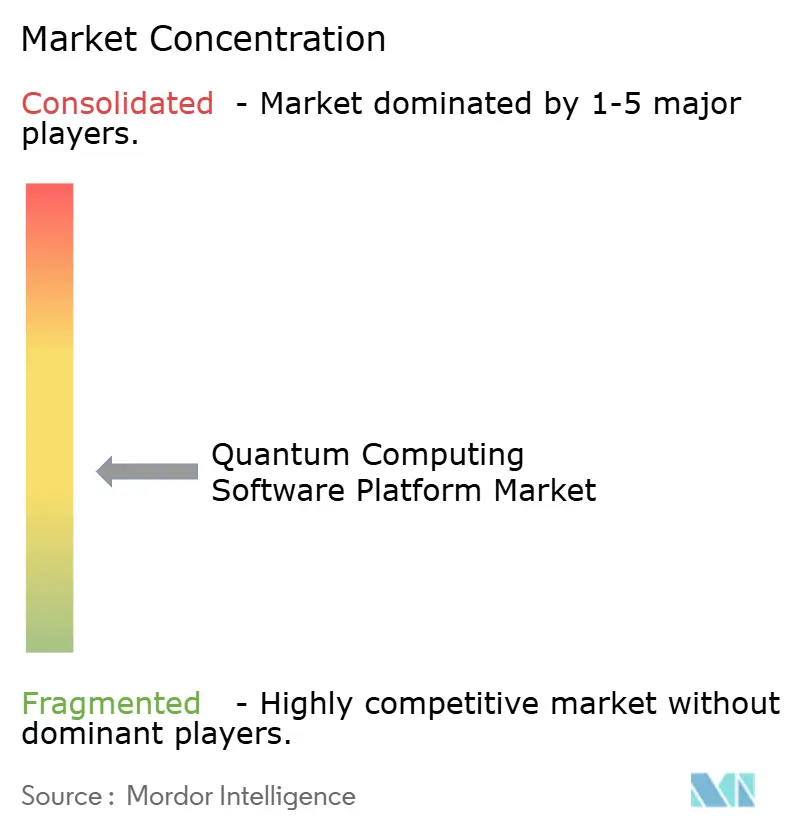
The quantum computing software platform market is moderately fragmented, with a small group of large platform ecosystems holding the strongest developer reach and a broader tier of specialists competing on algorithms, interoperability, and sector-specific workflow design. Large incumbents benefit because developers can access quantum capabilities through familiar cloud and software environments, which reduces friction in billing, identity management, and API administration. Specialist vendors compete by offering hardware-agnostic design layers, deeper application knowledge, and integration paths that fit finance, scientific computing, and industrial modeling more closely. This leaves the quantum computing software platform market open enough for new entrants, but it also rewards vendors that can turn developer adoption into durable workflow dependence over time.
Strategic moves since 2025 show that competition is shifting toward ecosystem depth rather than simple feature breadth in the quantum computing software platform market. IBM’s Qiskit releases in 2026 expanded compiler, C API, and performance capabilities, reinforcing its effort to stay embedded in enterprise and research development pipelines. Classiq and ParityQC partnered in July 2026 to combine higher-level software engineering with hardware optimization, which directly targets the interoperability gap between algorithm design and execution. Crédit Agricole CIB and Pasqal advanced their partnership in June 2026 to deploy quantum applications in capital markets, which shows how specialist players are using domain-led partnerships to secure long-cycle enterprise relationships. Quantinuum and BMW also expanded their collaboration in May 2026, illustrating how industrial partnerships are becoming a practical route to anchor software demand while hardware capabilities continue to mature.
Open opportunity areas still include middleware that can manage quantum-HPC job flows, software that lowers the skill barrier for non-specialist teams, and private or controlled deployment models for regulated users in the quantum computing software platform market. The strongest vendors are those that can bridge current noisy hardware with classical infrastructure, because that is where customer value can be demonstrated today rather than only promised for later. Error mitigation, benchmarking, and orchestration are therefore becoming important competitive layers, especially when they improve workflow reliability without requiring customers to wait for fault-tolerant hardware. Until hardware constraints ease, the quantum computing software platform market will continue to reward vendors that combine flexible software stacks with credible partnerships, trusted developer tools, and measurable hybrid performance gains.
Quantum Computing Software Platform Industry Leaders
IBM Corporation
Microsoft Corporation
Alphabet Inc.
Amazon Web Services, Inc.
D‑Wave Quantum Inc.
- *Disclaimer: Major Players sorted in no particular order
Quantum Computing Software Platform Market Companies Covered in this Report
- IBM Corporation
- Microsoft Corporation
- Alphabet Inc.
- Amazon Web Services, Inc.
- D-Wave Quantum Inc.
- Quantinuum Ltd.
- QC Ware Corporation
- Classiq Technologies Ltd.
- Zapata Computing Holdings Inc.
- 1QBit Information Technologies Inc.
- Riverlane Ltd.
- Q-CTRL Pty Ltd.
- Xanadu Quantum Technologies Inc.
- Pasqal S.A.
- Aliro Technologies, Inc.
- QuandCo B.V.
- Horizon Quantum Computing Pte. Ltd.
- Rigetti Computing, Inc.
- IonQ, Inc.
- Fujitsu Limited
- Toshiba Corporation
- Hitachi, Ltd.
- NVIDIA Corporation

Recent Industry Developments in Quantum Computing Software Platform Market
- July 2026: Classiq and ParityQC announced a partnership to integrate Parity Twine optimization technology with Classiq's quantum software engineering platform, targeting hardware-agnostic execution across current noisy and future fault-tolerant quantum systems in a Germany-Israel cross-border initiative. The collaboration directly addresses the interoperability gap between high-level algorithm design and hardware-specific circuit execution.
- July 2026: IBM, Oak Ridge National Laboratory, and Cleveland Clinic announced the first-known computations of fusion material molecular configurations on a quantum computer, using 12,635-atom protein simulation techniques. The demonstration extends the validated problem scale for quantum chemistry software into commercially and scientifically significant territory.
- June 2026: Crédit Agricole CIB and Pasqal signed a strategic partnership to industrialize quantum computing applications in capital markets, with initial production use cases in risk-weighted asset monitoring targeted as early as 2028. The agreement marks a transition from research-phase quantum finance to operational deployment commitments.
- June 2026: RIKEN launched the ROQUO quantum-HPC hybrid supercomputer as part of the JHPC-quantum project, operationally connecting Quantinuum and IBM quantum computers with the Fugaku supercomputer. ROQUO entered production in June 2026 as the world's first operational quantum-HPC hybrid platform integrated with a national supercomputer.


Global Quantum Computing Software Platform Market Report Scope
The quantum computing software platform market comprises tools, frameworks, and environments that enable developers, researchers, and enterprises to design, simulate, and execute quantum algorithms. These platforms typically include development kits, compilers, simulators, middleware, and orchestration tools that integrate classical computing with quantum hardware.
The Quantum Computing Software Platform Market Report is Segmented by Platform Type (Development Kits, Algorithm Design Platforms, Quantum Emulators and Simulators, Middleware and Orchestration, and Quantum Control Software), Deployment Model (Cloud-Based, On-Premises, and Hybrid), Application (Optimization, Simulation and Modeling, Machine Learning, Cryptography and Cybersecurity, Drug Discovery and Materials Science, and Supply Chain and Logistics Optimization), End User Industry (Banking, Financial Services, and Insurance (BFSI), Government and Defense, Healthcare and Life Sciences, Energy and Utilities, Automotive and Transportation, IT and Telecommunication, Chemical and Materials, and Other End User Industries), and Geography (North America, South America, Europe, Asia-Pacific, and Middle East and Africa). The Market Forecasts are Provided in Terms of Value (USD).
| Development Kits |
| Algorithm Design Platforms |
| Quantum Emulators and Simulators |
| Middleware and Orchestration |
| Quantum Control Software |
| Cloud-Based |
| On-Premises |
| Hybrid |
| Optimization |
| Simulation and Modeling |
| Machine Learning |
| Cryptography and Cybersecurity |
| Drug Discovery and Materials Science |
| Supply Chain and Logistics Optimization |
| Banking, Financial Services, and Insurance (BFSI) |
| Government and Defense |
| Healthcare and Life Sciences |
| Energy and Utilities |
| Automotive and Transportation |
| IT and Telecommunication |
| Chemical and Materials |
| Other End User Industries |
| North America | United States | |
| Canada | ||
| Mexico | ||
| South America | Brazil | |
| Argentina | ||
| Rest of South America | ||
| Europe | United Kingdom | |
| Germany | ||
| France | ||
| Rest of Europe | ||
| Asia-Pacific | China | |
| Japan | ||
| India | ||
| South Korea | ||
| Australia | ||
| Rest of Asia-Pacific | ||
| Middle East and Africa | Middle East | United Arab Emirates |
| Saudi Arabia | ||
| Rest of Middle East | ||
| Africa | South Africa | |
| Kenya | ||
| Rest of Africa | ||
| By Platform Type | Development Kits | ||
| Algorithm Design Platforms | |||
| Quantum Emulators and Simulators | |||
| Middleware and Orchestration | |||
| Quantum Control Software | |||
| By Deployment Model | Cloud-Based | ||
| On-Premises | |||
| Hybrid | |||
| By Application | Optimization | ||
| Simulation and Modeling | |||
| Machine Learning | |||
| Cryptography and Cybersecurity | |||
| Drug Discovery and Materials Science | |||
| Supply Chain and Logistics Optimization | |||
| By End User Industry | Banking, Financial Services, and Insurance (BFSI) | ||
| Government and Defense | |||
| Healthcare and Life Sciences | |||
| Energy and Utilities | |||
| Automotive and Transportation | |||
| IT and Telecommunication | |||
| Chemical and Materials | |||
| Other End User Industries | |||
| By Geography | North America | United States | |
| Canada | |||
| Mexico | |||
| South America | Brazil | ||
| Argentina | |||
| Rest of South America | |||
| Europe | United Kingdom | ||
| Germany | |||
| France | |||
| Rest of Europe | |||
| Asia-Pacific | China | ||
| Japan | |||
| India | |||
| South Korea | |||
| Australia | |||
| Rest of Asia-Pacific | |||
| Middle East and Africa | Middle East | United Arab Emirates | |
| Saudi Arabia | |||
| Rest of Middle East | |||
| Africa | South Africa | ||
| Kenya | |||
| Rest of Africa | |||


Key Questions Answered in the Report
What is the current and forecast value of the quantum computing software platform space?
The quantum computing software platform market size was USD 0.96 billion in 2025, is USD 1.22 billion in 2026, and is forecast to reach USD 3.97 billion by 2031 at a 26.62% CAGR.
Which platform type currently leads spending?
Development Kits led platform spending with a 39.23% share in 2025, showing that most buyers are still focused on foundational programming and testing tools.
Which deployment model is most widely used?
Cloud-Based deployment led with a 63.81% share in 2025 because it lowers access costs and lets enterprises test multiple hardware back ends without owning infrastructure.
Which application area is growing the fastest?
Drug Discovery and Materials Science is the fastest-growing application segment, with a projected 31.48% CAGR through 2031.
Which end-user group is adopting these platforms most strongly?
BFSI led in 2025 with a 26.47% share, while Government and Defense is growing the fastest with a projected 28.67% CAGR through 2031.
Which region is expected to expand the fastest through 2031?
Asia-Pacific is the fastest-growing region with a projected 31.71% CAGR, supported by government-backed hybrid infrastructure and commercialization programs.
Page last updated on:


 Your data is secure and never sold or shared.


