
Quantum Communication Market Size and Share
Market Overview
| Study Period | 2020 - 2031 |
|---|---|
| Market Size (2026) | USD 1.8 Billion |
| Market Size (2031) | USD 6.37 Billion |
| Growth Rate (2026 - 2031) | 28.76 % |
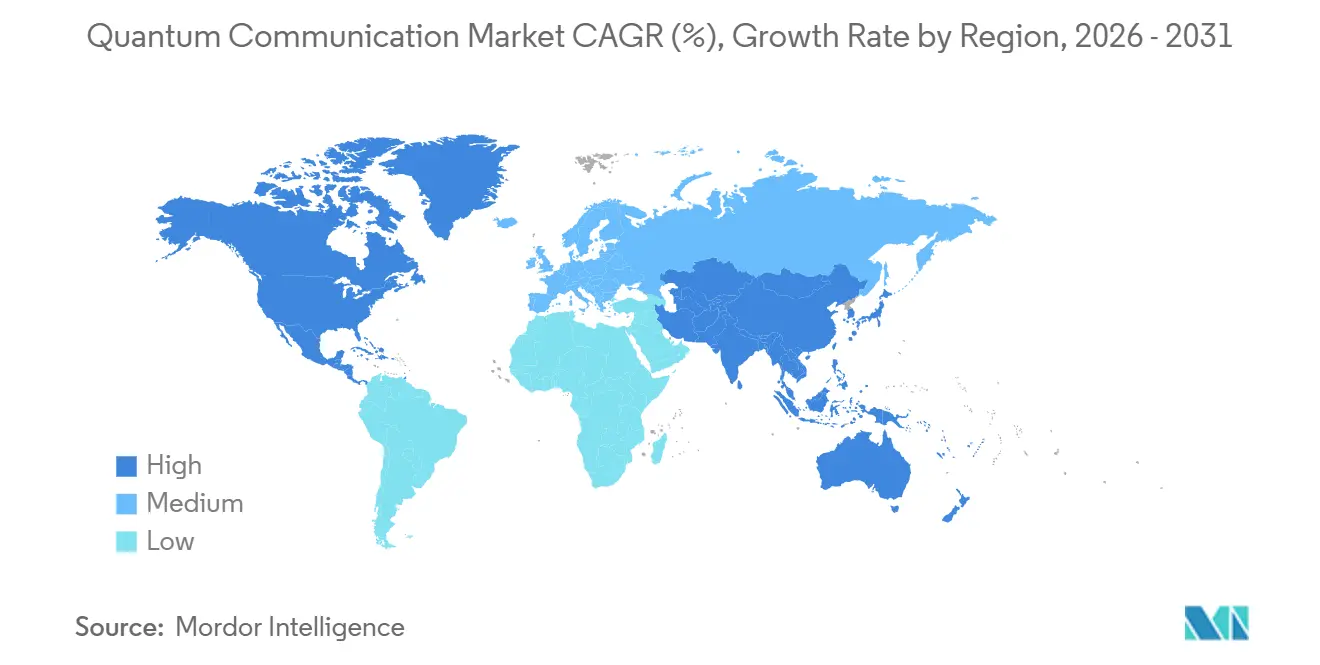
| Fastest Growing Market | Asia-Pacific |
| Largest Market | North America |
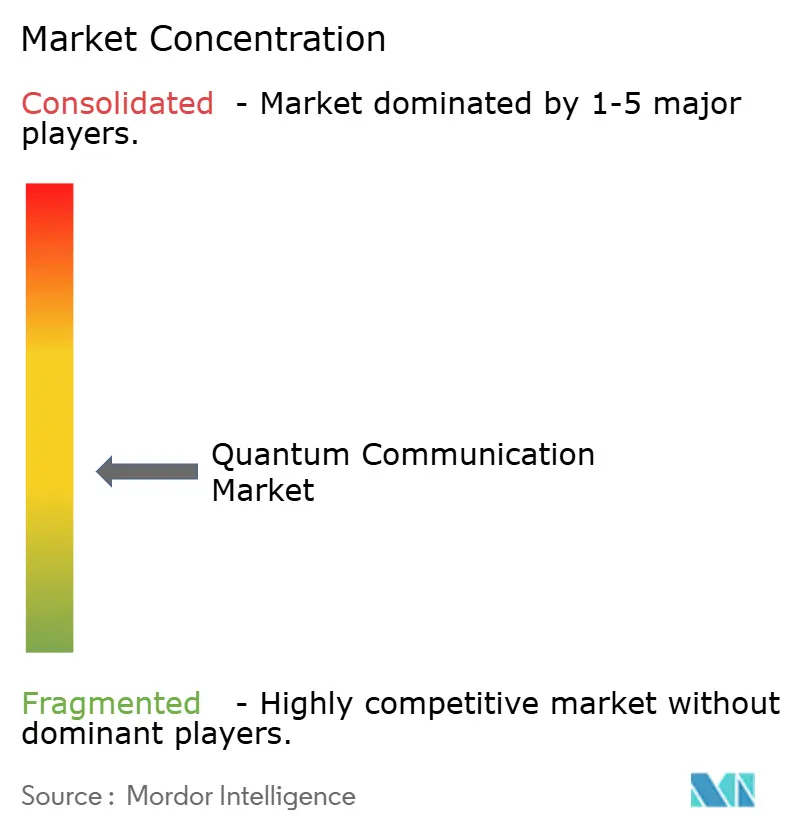
| Market Concentration | Medium |
Major Players *Disclaimer: Major Players sorted in no particular order Image © Mordor Intelligence. Reuse requires attribution under CC BY 4.0. | |
Quantum Communication Market Analysis by Mordor Intelligence
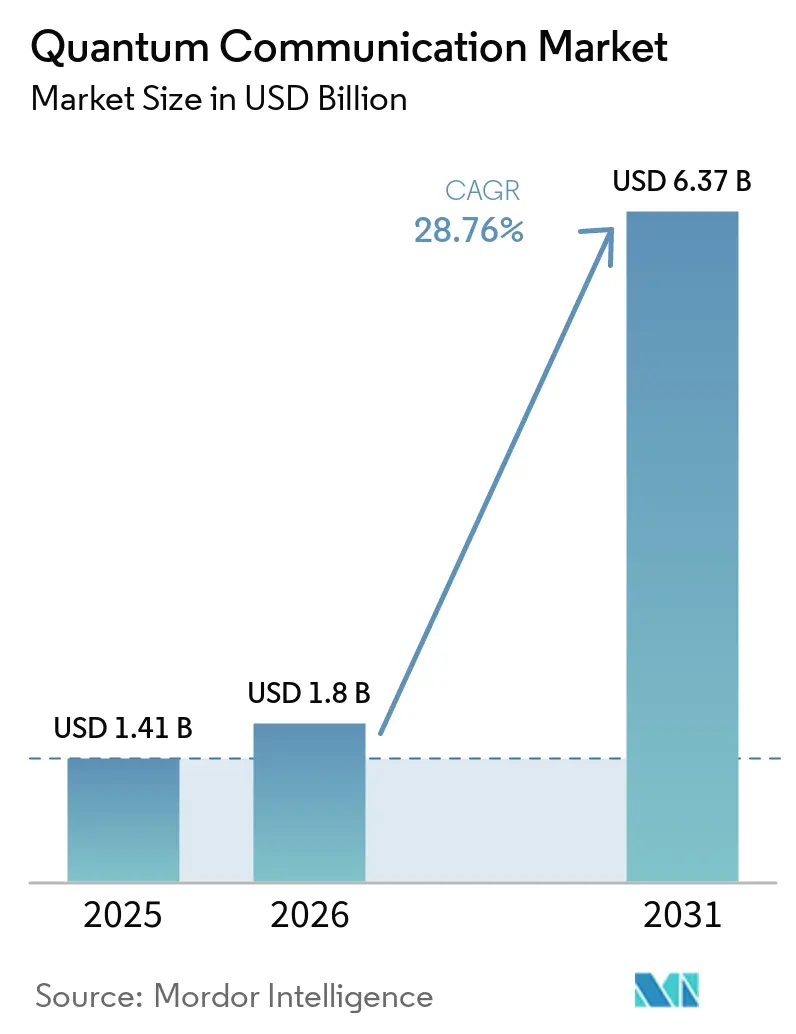
The quantum communication market size is projected to expand from USD 1.41 billion in 2025 and USD 1.80 billion in 2026 to USD 6.37 billion by 2031, registering a CAGR of 28.76% between 2026 to 2031. The quantum communication market is moving forward because migration deadlines for post-quantum cryptography are no longer distant planning markers; they now affect current procurement cycles. The quantum communication market is also gaining support from defense and public-sector programs seeking sovereign control over secure communications infrastructure. Another important shift in the quantum communication market is the rise of carrier-led managed services, which gives buyers a way to adopt quantum-safe networking without treating every deployment as a hardware project. The quantum communication market is also being shaped by a split between photonics-led suppliers and software-led vendors, which is changing pricing, packaging, and integration models. The strongest near-term opportunity in the quantum communication market lies with vendors that can reduce deployment complexity while helping customers address compliance, certification, and interoperability.
Key Report Takeaways
- By offering, solutions held 58.97% of revenue in 2025 and is projected to expand at a 30.34% CAGR through 2031 in the quantum communication market.
- By deployment mode, on-premises accounted for 67.32% of revenue in 2025, while cloud is expected to record the highest CAGR at 29.21% through 2031 in the quantum communication market.
- By organization size, large enterprises held 72.32% of revenue in 2025, while SMEs are projected to grow at a 30.92% CAGR through 2031.
- By vertical, BFSI captured 24.56% of revenue in 2025, while academia and research are expected to expand at a 29.62% CAGR through 2031 in the quantum communication market.
- By geography, North America captured 23.98% of revenue in 2025, while Asia-Pacific is expected to expand at a 29.11% CAGR through 2031.
Note: Market size and forecast figures in this report are generated using Mordor Intelligence’s proprietary estimation framework, updated with the latest available data and insights as of January 2026.
Market Trends and Insights
Drivers Impact Analysis of Quantum Communication Market*
| DRIVER | (~) % IMPACT ON CAGR FORECAST | GEOGRAPHIC RELEVANCE | IMPACT TIMELINE |
|---|---|---|---|
| Rising quantum-safe migration pressure from harvest-now, decrypt-later risk | +6.5% | Global | Short term (≤ 2 years) |
| Defense and national security procurement for sovereign secure links | +5.2% | Global, with core demand in North America, Europe, and the Asia-Pacific | Short term (≤ 2 years) |
| Fiber and satellite hybridization is expanding deployable use cases | +4.8% | Asia-Pacific core, Europe, and spill-over to the Middle East and Africa | Medium term (2-4 years) |
| Enterprise crypto-agility and zero-trust program alignment | +4.1% | North America and Europe | Medium term (2-4 years) |
| Interoperability demand across multi-vendor quantum security stacks | +3.9% | Global | Medium term (2-4 years) |
| Specialized demand from critical infrastructure and high-value transaction networks | +3.6% | North America, Europe, Asia-Pacific core | Medium term (2-4 years) |
| Source: Mordor Intelligence | |||
Rising Quantum-Safe Migration Pressure from Harvest-Now, Decrypt-Later Risk
The quantum communication market is benefiting from a threat model that has become urgent for data with long confidentiality lives. NIST finalized core post-quantum standards in 2024 and selected HQC as a backup key encapsulation mechanism in 2025, providing buyers with a clearer migration path for long-term planning. The White House then set firm federal deadlines in June 2026 for post-quantum key establishment by December 31, 2030, and digital signature migration by December 31, 2031.[1] NIST also framed post-quantum migration as a current risk-management issue rather than a future-only concern, which matters for sectors that retain records for decades. That pressure supports earlier budget approvals in the quantum communication market, especially where delayed action could expose sensitive archives, signing systems, and long-life encrypted records. The result is that the quantum communication market is being pulled forward by compliance calendars as much as by technology readiness.
Defense And National Security Procurement for Sovereign Secure Links
The quantum communication market is also being driven by defense buyers who value sovereign control and can absorb higher deployment costs. The White House order in June 2026 widened the federal push for quantum-safe migration and made the issue relevant across agencies and contractors that support sensitive systems. NSA guidance under CNSA 2.0 requires new national security system acquisitions to support post-quantum algorithms starting January 1, 2027, creating a clear procurement cutoff for future buys.[2] Government network activity in Europe also shows that sovereign secure communications are moving from concept work into operational environments, as Denmark activated a quantum-secure network across 10 ministry sites in 2025. These programs matter for the quantum communication market because defense-grade procurement often sets technical standards that later influence financial, telecom, and infrastructure deployments. They also favor vendors that can meet strict certification, control, and integration requirements rather than selling stand-alone hardware.
Fiber And Satellite Hybridization Expanding Deployable Use Cases
The quantum communication market is expanding its deployment scope as hybrid architectures overcome the limitations of QKD at long distances. A peer-reviewed report in 2025 documented a carrier-grade quantum communication network spanning more than 10,000 km, linking backbone fiber with satellite ground stations across multiple cities.[3] Toshiba Europe then demonstrated in 2026 that geographically separated QKD networks could be interconnected via a software bridge using post-quantum cryptography, enabling long-distance service expansion without requiring new hardware at every link. Integrated photonics progress also points to broader scalability, with IEEE SiPhotonics 2026 highlighting a twin-field QKD network across 20 users at 370 km each. These advances matter for the quantum communication market because they move the addressable opportunity from city networks toward national and cross-border infrastructure. They also improve the case for carriers and governments that want layered terrestrial and non-terrestrial quantum-safe links over time.
Enterprise Crypto-Agility and Zero-Trust Program Alignment
The quantum communication market is gaining enterprise relevance because quantum-safe networking is being tied to broader crypto-agility and zero-trust programs. ETSI published a quantum-safe hybrid key exchange standard in February 2026, providing enterprise buyers with a more concrete framework for balancing security, access control, and future migration needs.[4] ITU-T also published Y.3831 in December 2025 to define the functional architecture for integrating QKD networks with end-to-end modern cryptography services.[5] Those standards help the quantum communication market by enabling buyers to use systems that fit existing security models rather than forcing isolated deployments. White House and NSA deadlines further reinforce the need for early cryptographic inventory work, because delayed planning will compress hardware certification and integration windows. This is making the quantum communication market more attractive for vendors that can present QKD and PQC as part of a broader enterprise security architecture.
Restraints Impact Analysis of Quantum Communication Market*
| RESTRAINT | (~) % IMPACT ON CAGR FORECAST | GEOGRAPHIC RELEVANCE | IMPACT TIMELINE |
|---|---|---|---|
| High capital intensity for quantum-grade hardware and network integration | -3.8% | Global | Short term (≤ 2 years) |
| Limited standardization across protocols, test methods, and certification | -3.2% | Global | Medium term (2-4 years) |
| Shortage of quantum optics and photonics deployment talent | -2.8% | Global | Medium term (2-4 years) |
| Export controls and sovereignty rules are fragmenting cross-border rollouts | -2.4% | Global | Medium term (2-4 years) |
| Source: Mordor Intelligence | |||
High Capital Intensity for Quantum-Grade Hardware and Network Integration
The quantum communication market continues to face a significant cost barrier, particularly when deployments require specialized hardware, precise optical design, and network adaptation. This challenge is most evident in projects that require dedicated fiber conditions, strict physical control, and deep integration with legacy security environments. Vendors are working to reduce redesign requirements. For instance, ID Quantique and IonQ are expected to introduce Clavis XG Multiplex in 2025, enabling quantum and classical traffic to coexist on existing metropolitan fiber infrastructure. Carrier-led models are also supporting this transition. Orange Business is expected to launch Quantum Defender with Toshiba in 2025 as a commercial service rather than a pure equipment sale. Quantropi is expected to further advance this shift in 2026 by making its D-QKD platform generally available with Nokia integration, supporting hardware-agnostic deployment paths for carriers and enterprises. Despite these developments, the quantum communication market is likely to remain more accessible to large buyers than to mid-sized organizations until lower-cost packaging becomes more widely available.
Limited Standardization Across Protocols, Test Methods, And Certification
The quantum communication market also faces delays because standards development is advancing across several institutions simultaneously. ETSI is expected to advance its QKD work in 2026 through GS QKD 020 and GR QKD 007, while ITU-T is expected to publish Y.3831 in late 2025 for integration between QKD networks and end-user cryptography services. This expanding standards base supports market development, but it also requires vendors to map products across overlapping frameworks, vocabularies, and certification pathways. LuxQuanta’s QUARTERNEXT program, expected to launch in July 2026, directly addresses this issue through a multi-country certification effort for CV-QKD under the Digital Europe framework. Until clearer alignment emerges, the quantum communication market is likely to continue facing longer evaluation cycles and more rigorous due diligence from buyers that require interoperability across multiple jurisdictions. This environment creates an advantage for vendors that can clearly document compliance and support multiple procurement environments without major redesign.
*Our forecasts treat driver/restraint impacts as directional, not additive. The impact forecasts reflect baseline growth, mix effects, and variable interactions.
Quantum Communication Market Segment Analysis
By Offering:
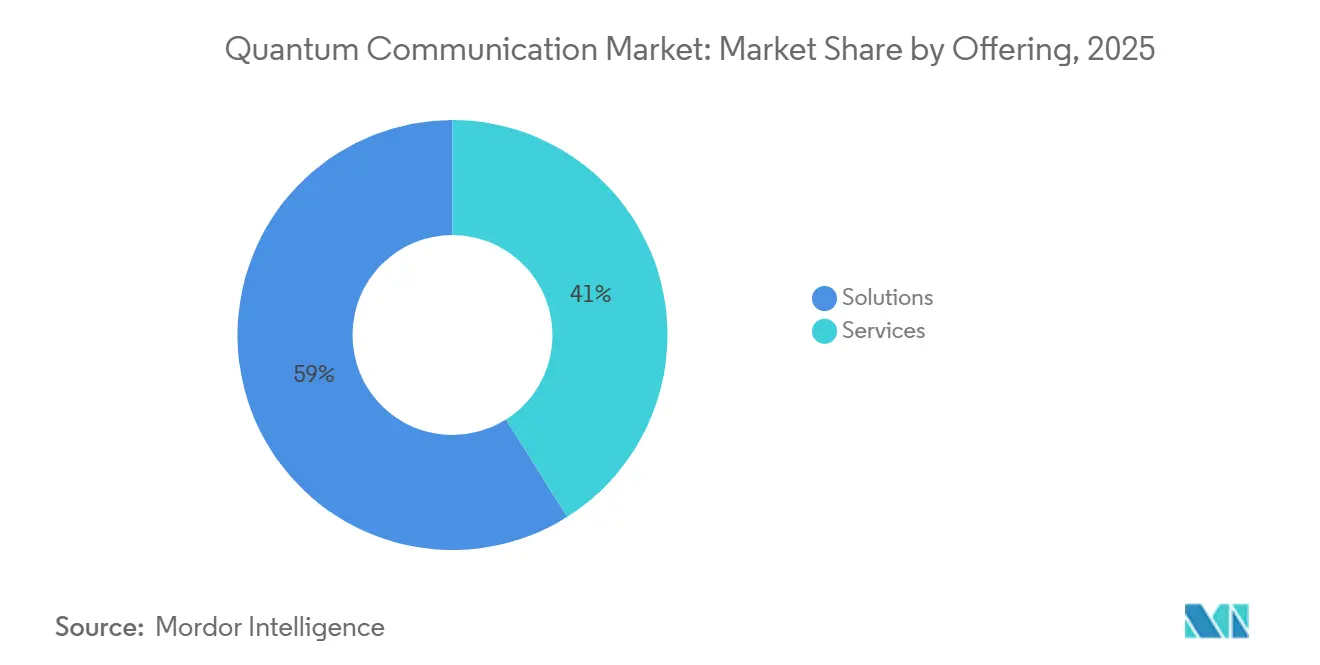
Solutions Anchor Revenue While Integration Services ScaleThe Solutions segment is expected to account for 58.97% of the quantum communication market revenue in 2025, and it is projected to expand at a 30.34% CAGR through 2031, as enterprises and government agencies favor direct ownership of cryptographic hardware. This preference reflects the need to retain control over key generation in critical infrastructure settings. Quantum Key Distribution systems are expected to remain the primary revenue contributor within solutions. In June 2025, Orange Business and Toshiba are expected to launch France’s first commercial quantum-safe network service, combining Quantum Key Distribution and post-quantum cryptography across the greater Paris area. Quantum Random Number Generators are also expected to move beyond specialized security applications. Palo Alto Networks is expected to introduce its QRNG Open API framework in January 2025 to support interoperability across vendors, while OVHcloud is expected to use QRNG-generated entropy to secure SSL certificates for nearly 5 million hosted websites by September 2025.
Quantum communication components, including single-photon detectors, quantum memories, and photonic integrated circuits, are expected to remain supply-constrained and command high margins. This concentration of specialist suppliers supports their pricing position. Other solutions, including post-quantum key management software and crypto-agile middleware, are expected to receive greater procurement attention as enterprises seek tools to manage hybrid quantum-classical environments. The Services segment is expected to represent a smaller share of the quantum communication market in 2025, although deployment and integration are likely to generate substantial billing opportunities. In May 2026, Terra Quantum and Merqury Cybersecurity are expected to deploy a Quantum Key Distribution link on Melita’s active telecom fiber network in Malta, processing tens of thousands of key requests through an ETSI-aligned REST API. Professional services, training, support, and managed key provisioning are expected to expand as BFSI and defense organizations address crypto-agility requirements, limited specialist skills, and the cost of operating on-premises infrastructure.
By Deployment Mode:
On-Premises Holds the Base While Cloud Gains SpeedOn-premises deployment is expected to account for 67.32% of revenue in 2025, showing that the quantum communication market still leans toward physically controlled environments. This pattern is strongest in defense, government, and financial clearing networks, where custody, visibility, and operational isolation remain central requirements. In many of these settings, QKD’s security promise depends on tight control over the key distribution environment, making shared infrastructure a difficult fit. The quantum communication market has therefore built much of its installed base around on-premises models, where operators can directly manage network conditions. This installed base is expected to remain important through the forecast period because many regulated systems cannot shift their trust boundaries quickly.
The quantum communication market size for cloud deployment is projected to expand at a 29.21% CAGR from 2026 to 2031, making it the fastest-growing deployment mode. This growth reflects rising demand for software-defined and subscription-based models that reduce the complexity barrier for smaller buyers in photonics. Quantropi’s D-QKD platform is expected to reach general availability in 2026 with integration into Nokia’s Security Management Server, supporting a hardware-agnostic approach for carrier and enterprise deployments. Orange Business also commercialized Quantum Defender in the greater Paris area in 2025 with Toshiba, showing how telecom operators can package quantum-safe networking as a managed service. As a result, the quantum communication market is creating a second adoption path that does not require every customer to begin with heavy capital spending.
By Organization Size:
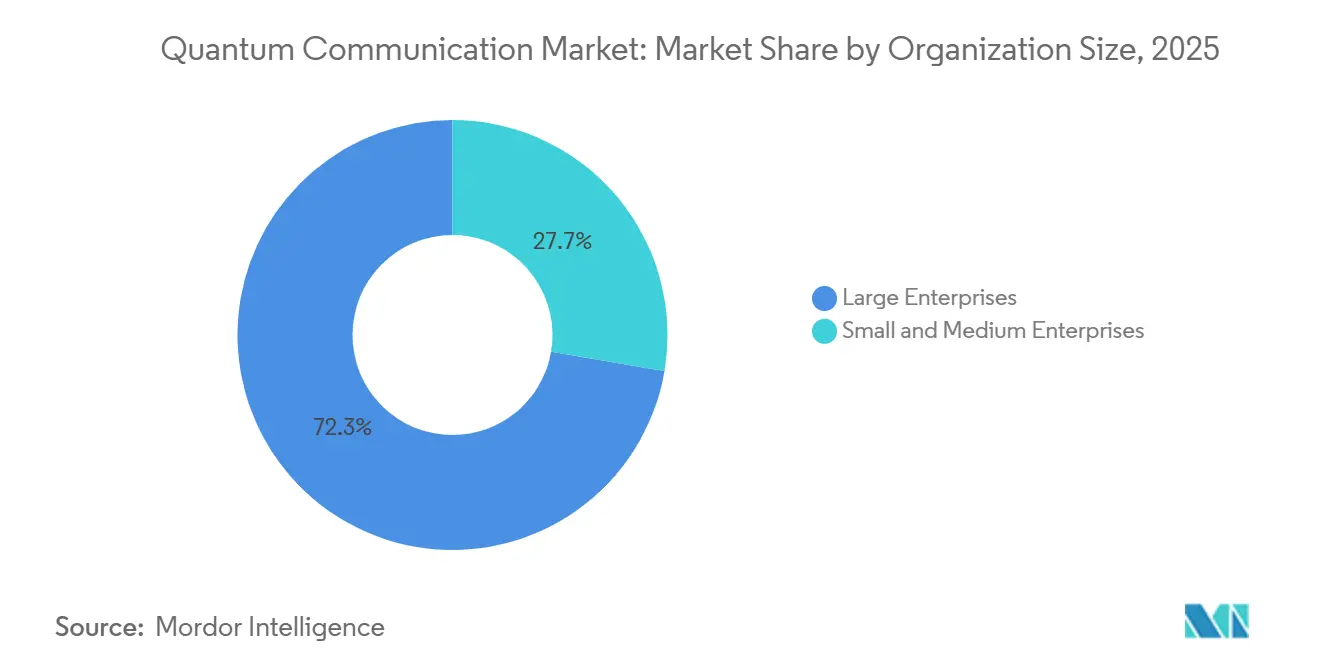
Large Enterprises Drive Revenue While SMEs Open a New Adoption LayerLarge enterprises are expected to account for 72.32% of revenue in 2025, indicating that the quantum communication market still depends on buyers with deep budgets and specialized technical teams. Banks, defense contractors, large telecom operators, and major utilities fit this pattern because they can fund multi-site security upgrades and manage complex integration work. The quantum communication market also benefits from the fact that these organizations typically hold long-lived sensitive data and maintain large cryptographic estates, making early migration more urgent. Their transition from pilot projects to operational deployment is important because it creates reference projects for the broader customer base. This keeps large enterprises at the center of current revenue, even as the buyer mix widens.
SMEs are projected to grow at a 30.92% CAGR from 2026 to 2031, indicating a gradual broadening of demand in the quantum communication market. This acceleration reflects the arrival of software-defined and cloud-native quantum-safe tools that reduce the need for in-house optics expertise. Erste Group’s 2026 deployment in Vienna is expected to demonstrate that live financial infrastructure can support entanglement-based QKD, with an average key generation rate of 63.8 kilobits per second and 93.7% uptime over four months, providing a practical benchmark for peer institutions. The White House order also matters because future rulemaking for federal contractors could draw smaller suppliers into active quantum-safe procurement during the next few years. This means the quantum communication market is expanding beyond elite early adopters, even though large enterprises still anchor most current revenue.
By Vertical:
BFSI Anchors Spend While Academia and Research Lead GrowthBFSI is expected to account for 24.56% of revenue in 2025, making it the largest vertical in the quantum communication market. Financial institutions face strong exposure because transaction records, payment flows, and digital signing systems often require confidentiality and integrity over long retention periods. The quantum communication market also aligns with the sector’s need for high key generation performance and tolerance for premium security spending. Government and defense remain another major buyer group because procurement is increasingly tied to national security obligations rather than optional technology upgrades. This keeps the quantum communication market closely tied to sectors where encryption failure has both operational and regulatory consequences.
Academia and research are projected to grow at a 29.62% CAGR from 2026 to 2031, making it the fastest-growing vertical in the quantum communication market. National quantum programs are a major driver because they channel public capital into university-linked testbeds and research deployments that later support commercial scale-up. QNu Labs reported in April 2026 that it achieved a 1,000-km secure QKD network under India’s National Quantum Mission, showing how research-linked infrastructure is moving toward national backbone ambitions. The quantum communication industry is also seeing broader relevance across healthcare, aerospace, IT and telecommunications, and energy and utilities, where long-life records and operational command traffic raise the value of stronger cryptographic protection. QNu Labs also launched Q-Shield in April 2025 to combine QKD, QRNG, a quantum hardware security module, and NIST-compliant PQC into a single management layer, reflecting the push toward easier adoption across multiple end-user groups.
Geography Analysis
North America Quantum Communication Market
North America is expected to hold 23.98% of the quantum communication market share in 2025, making it the largest regional contributor. The United States leads the region, as federal mandates and contractor obligations are accelerating migration planning across public agencies and defense-linked supply chains. The White House order issued in June 2026 is expected to set firm federal deadlines for post-quantum migration, strengthening the compliance case for earlier deployment decisions. Canada also supports the region’s position, with federal planning requirements expected by April 2026 and CAD 334 million (USD 243 million) directed to selected quantum companies in 2025.
APAC and Europe Quantum Communication Market
Asia-Pacific is projected to expand at a CAGR of 29.11% from 2026 to 2031, making it the fastest-growing region in the quantum communication market. China’s carrier-grade network is expected to exceed 10,000 km by 2025 and to combine terrestrial fiber with satellite ground stations, providing the region with a deployed national-scale reference model. India is expected to reach a 1,000-km QKD milestone in April 2026 under the National Quantum Mission and target a 2,000-km backbone with satellite integration by 2031. Japan, South Korea, and Singapore are also advancing secure communications programs for government and financial applications, supporting broader regional demand. Europe remains competitive through EuroQCI and related national programs. Denmark is expected to activate a quantum-secure network across 10 ministry sites in 2025, while ETSI is expected to continue strengthening the regional standards base in 2026.
MEA and South America Quantum Communication Market
South America, the Middle East, and Africa remain earlier-stage parts of the quantum communication market, with activity focused on policy work, selective pilots, and critical infrastructure planning. Brazil is the most active early market in South America, with interest focused on secure interbank communication and financial-sector use cases. The Middle East is linking quantum-safe programs to sovereign cloud agendas and critical infrastructure protection, which should support future procurement as operational requirements mature. Africa remains at an earlier awareness stage, but participation in broader standards frameworks should help regional programs align with the interoperability direction now forming across the quantum communication market.
Competitive Landscape
The quantum communication market is moderately fragmented, with a small group of photonics-led and telecom-adjacent vendors holding strong positions in government and critical infrastructure projects. Toshiba, Thales, ID Quantique, QuantumCTek, and QuintessenceLabs remain prominent because of their credibility in secure networking, optical systems, and regulated deployments. At the same time, the quantum communication market is attracting software-led entrants that approach customers through cryptographic discovery, inventory, and orchestration rather than optical hardware. This divide has created two competitive clusters: one focused on sovereign secure links and another focused on simpler enterprise migration paths.
The next shift in the quantum communication market is expected to come from telecom operators that package quantum-safe networking as a service. Orange Business is expected to launch Quantum Defender with Toshiba in France in June 2025, showing how a carrier can convert QKD and PQC into a subscription-led offering for enterprise users. Toshiba Europe is expected to demonstrate in March 2026 that geographically separated QKD networks can be interconnected via a post-quantum software bridge, reducing the need for new hardware at each expansion point. Arqit is expected to strengthen its software position in January 2026 by launching Encryption Intelligence, a tool for cryptographic discovery and migration planning. It is also expected to expand its commercial reach through the Tomorrow Street portfolio and a sovereign cloud proof-of-concept with nLighten. Quantropi is also expected to shift the competitive landscape by integrating D-QKD with Nokia’s Security Management Server in 2026, supporting a software-defined model for carriers and enterprises.
White-space opportunities in the quantum communication market remain strongest in managed services for mid-sized financial institutions, quantum-safe orchestration middleware, and future cross-border secure connectivity models. Vendors that can package QKD, QRNG, PQC, and centralized management into one deployable stack should gain an advantage, as customers increasingly seek simpler procurement and lower integration risk. QNu Labs is expected to address this need with Q-Shield in 2025 by combining multiple quantum-safe building blocks into a single management layer. The competitive balance in the quantum communication market should therefore continue to favor providers that pair compliance-readiness with practical deployment models, rather than relying solely on specialized hardware differentiation.
Quantum Communication Industry Leaders
-
Toshiba Corporation
-
Thales S.A.
-
ID Quantique SA
-
QuintessenceLabs Pty Ltd
-
QuantumCTek Co., Ltd.
- *Disclaimer: Major Players sorted in no particular order
Quantum Communication Market Companies Covered in this Report
- Toshiba Corporation
- Thales S.A.
- ID Quantique SA
- QuintessenceLabs Pty Ltd
- QuantumCTek Co., Ltd.
- Qubitekk, Inc.
- Quantum Xchange, Inc.
- MagiQ Technologies, Inc.
- Arqit Quantum Inc.
- Aliro Quantum, Inc.
- HEQA Security B.V.
- Crypta Labs Limited
- SpeQtral Pte. Ltd.
- QNu Labs Private Limited
- QphoX B.V.
- Qunnect, Inc.
- LuxQuanta Technologies S.L.
- Quantropi Inc.
Recent Industry Developments in Quantum Communication Market
- July 2026: nLighten and Arqit completed a proof of concept combining nLighten's European sovereign edge data center infrastructure with Arqit's quantum-safe encryption and Intel Trust Domain Extensions confidential computing, demonstrating a model for organizations to use public cloud workloads without surrendering cryptographic asset control; the POC was executed between nLighten's Geneva data center and a major hyperscale cloud provider.
- July 2026: QUARTERNEXT, a multinational European consortium coordinated by LuxQuanta, launched a 48-month EU CV-QKD certification program across Spain, Austria, and the Netherlands, funded under the Digital Europe Program's IRIS² Quantum Communication Infrastructure framework, targeting industrial-grade, regulatory-compliant CV-QKD deployment over existing classical fiber.
- June 2026: US President Trump signed Executive Order 14412, "Securing the Nation Against Advanced Cryptographic Attacks," and Executive Order 14413, "Ushering in the Next Frontier of Quantum Innovation," mandating federal PQC key establishment migration by December 31, 2030, and committing the Department of Commerce to take equity stakes in nine leading US quantum companies amounting to approximately USD 2 billion.
- April 2026: QNu Labs achieved the 1,000-km QKD network milestone under India's National Quantum Mission, setting a foundation for the country's targeted 2,000-km secure backbone with satellite QKD integration by 2031.
Global Quantum Communication Market Report Scope
The Quantum Communication Market Report is Segmented by Offering (Solutions [Quantum Communication Components, Quantum Key Distribution Solutions, Quantum Random Number Generator, and Other Solutions], and Services [Professional Services, Training and Consulting, Deployment and Integration, Support and Maintenance, and Other Services]), Deployment Mode (On-Premises, and Cloud), Organization Size (Large Enterprises, and SMEs), Vertical (BFSI, Government and Defense, Healthcare, Aerospace, IT and Telecommunications, Energy and Utilities, Academia and Research, and Other Verticals), and Geography (North America, South America, Europe, Asia-Pacific, and Middle East, Africa). The Market Forecasts are Provided in Terms of Value (USD).
Segmentation Overview
| Solutions | Quantum Communication Components |
| Quantum Key Distribution Solutions | |
| Quantum Random Number Generator | |
| Other Solutions | |
| Services | Professional Services |
| Training and Consulting | |
| Deployment and Integration | |
| Support and Maintenance | |
| Other Services |
| On-Premises |
| Cloud |
| Large Enterprises |
| Small and Medium Enterprises |
| BFSI |
| Government and Defense |
| Healthcare |
| Aerospace |
| IT and Telecommunications |
| Energy and Utilities |
| Academia and Research |
| Other Verticals |
| North America | United States |
| Canada | |
| Mexico | |
| South America | Brazil |
| Argentina | |
| Rest of South America | |
| Europe | Germany |
| United Kingdom | |
| France | |
| Rest of Europe | |
| Asia-Pacific | China |
| Japan | |
| India | |
| South Korea | |
| Rest of Asia-Pacific | |
| Middle East | Saudi Arabia |
| United Arab Emirates | |
| Rest of the Middle East | |
| Africa | South Africa |
| Nigeria | |
| Rest of Africa |
| By Offering | Solutions | Quantum Communication Components |
| Quantum Key Distribution Solutions | ||
| Quantum Random Number Generator | ||
| Other Solutions | ||
| Services | Professional Services | |
| Training and Consulting | ||
| Deployment and Integration | ||
| Support and Maintenance | ||
| Other Services | ||
| By Deployment Mode | On-Premises | |
| Cloud | ||
| By Organization Size | Large Enterprises | |
| Small and Medium Enterprises | ||
| By Vertical | BFSI | |
| Government and Defense | ||
| Healthcare | ||
| Aerospace | ||
| IT and Telecommunications | ||
| Energy and Utilities | ||
| Academia and Research | ||
| Other Verticals | ||
| By Geography | North America | United States |
| Canada | ||
| Mexico | ||
| South America | Brazil | |
| Argentina | ||
| Rest of South America | ||
| Europe | Germany | |
| United Kingdom | ||
| France | ||
| Rest of Europe | ||
| Asia-Pacific | China | |
| Japan | ||
| India | ||
| South Korea | ||
| Rest of Asia-Pacific | ||
| Middle East | Saudi Arabia | |
| United Arab Emirates | ||
| Rest of the Middle East | ||
| Africa | South Africa | |
| Nigeria | ||
| Rest of Africa | ||
Key Questions Answered in the Report
What is the current and future size of the quantum communication space?
The quantum communication market size is USD 1.80 billion in 2026 and is forecast to reach USD 6.37 billion by 2031, with a 28.76% CAGR.
Which deployment model is growing the fastest?
Cloud is the fastest-growing deployment mode, with a projected 29.21% CAGR from 2026 to 2031 as managed and software-defined models gain traction.
Which end-user group is spending the most?
BFSI leads by vertical, accounting for 24.56% of revenue in 2025, as long-life transaction data and signing systems heighten the need for stronger security.
Which region is growing the quickest?
Asia-Pacific is the fastest-growing region, with a projected 29.11% CAGR through 2031, supported by large state-backed backbone programs.
Why are enterprises accelerating quantum-safe adoption now?
Federal deadlines, national security procurement rules, and the risk of long-life encrypted data being harvested today are pushing organizations to start migration earlier.