
Quantum Algorithm Development Software Market Size and Share
Market Overview
| Study Period | 2020 - 2031 |
|---|---|
| Market Size (2026) | USD 0.94 Billion |
| Market Size (2031) | USD 4.61 Billion |
| Growth Rate (2026 - 2031) | 37.38 % |
| Fastest Growing Market | Asia-Pacific |
| Largest Market | North America |
| Market Concentration | Medium |
Major Players *Disclaimer: Major Players sorted in no particular order Image © Mordor Intelligence. Reuse requires attribution under CC BY 4.0. | |
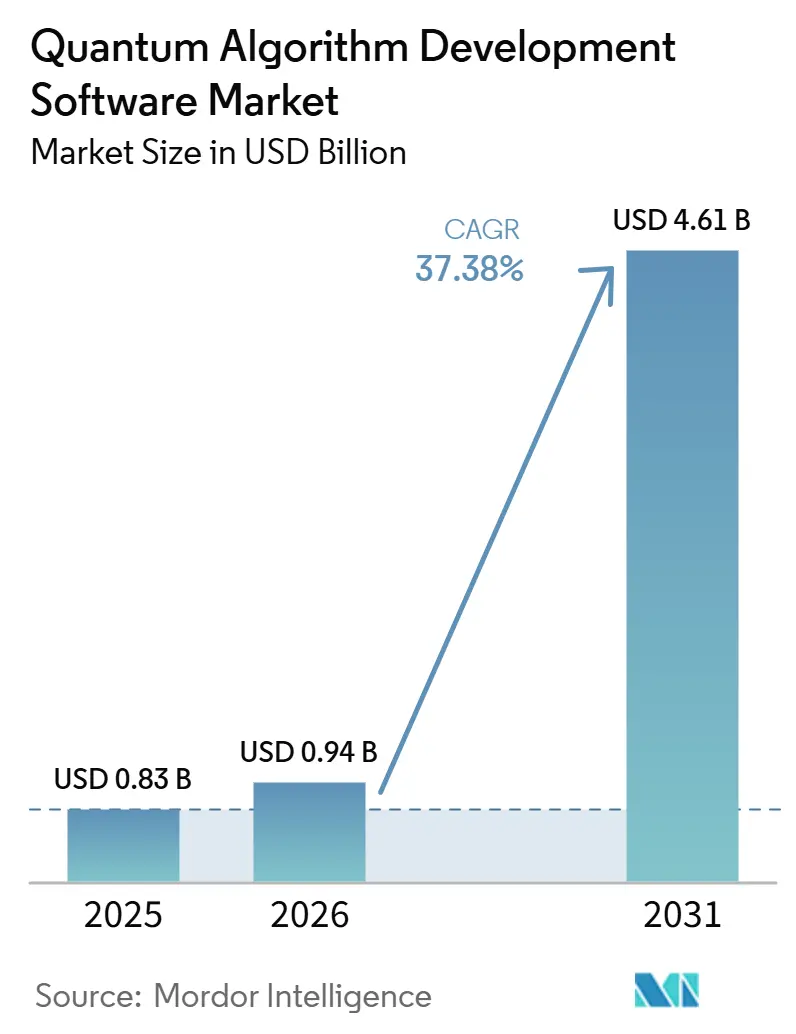
Quantum Algorithm Development Software Market Analysis by Mordor Intelligence
The quantum algorithm development software market size is projected to expand from USD 0.83 billion in 2025 and USD 0.94 billion in 2026 to USD 4.61 billion by 2031, registering a CAGR of 37.38% between 2026 and 2031. Growth does not depend only on the broad adoption of fault-tolerant quantum computers. Buyers are funding tools for noisy intermediate-scale quantum systems, hybrid workflows, and early fault-tolerant compilation under separate budgets. Cloud access has reduced the need for customers to own specialized hardware before developing or testing algorithms. This structure gives vendors opportunities to sell software while hardware roadmaps continue to evolve. It also favors providers that can support multiple hardware backends, reducing the need for scarce quantum programming skills.
Key Report Takeaways
- By product type, Quantum Algorithm Development Platforms and SDKs accounted for 56.77% of revenue in 2025, while Quantum Error Mitigation and Error Correction Software is projected to expand at a 38.45% CAGR through 2031.
- By deployment mode, Cloud held 72.49% of the quantum algorithm development software market revenue in 2025, while Hybrid is projected to record the highest CAGR of 39.07% through 2031.
- By application, Optimization represented 58.12% of the quantum algorithm development software market revenue in 2025, while Quantum Machine Learning is projected to grow at a 38.81% CAGR through 2031.
- By end-user industry, BFSI accounted for 26.41% of the quantum algorithm development software market revenue in 2025, while the Pharmaceutical and Biotechnology industry is projected to expand at a 37.74% CAGR through 2031.
- By geography, North America held 37.11% of the quantum algorithm development software market share in 2025, while Asia-Pacific is projected to grow at a 38.10% CAGR through 2031.
Note: Market size and forecast figures in this report are generated using Mordor Intelligence’s proprietary estimation framework, updated with the latest available data and insights as of January 2026.
Market Trends and Insights
Drivers Impact Analysis of Quantum Algorithm Development Software Market*
| Driver | (~) % Impact on CAGR Forecast | Geographic Relevance | Impact Timeline |
|---|---|---|---|
| Public and Private Quantum Investment Expansion | +8.2% | Global, led by North America and Asia-Pacific | Medium term (2-4 years) |
| Cloud-Native Access to Quantum Hardware | +7.0% | North America and Europe, with Asia-Pacific emerging | Short term (≤ 2 years) |
| Industry Demand for Optimization and Simulation | +6.1% | North America and Europe, with Asia-Pacific as a core market | Medium term (2-4 years) |
| Post-Quantum Cryptography Migration Requirements | +5.0% | Global, including North American federal agencies and financial institutions in Europe and Asia-Pacific | Short term (≤ 2 years) |
| Hybrid Quantum-Classical Workflow Adoption | +4.3% | Global | Medium term (2-4 years) |
| Hardware-Aware Software Innovation for NISQ and Fault-Tolerant Systems | +3.5% | North America, Europe, and Japan | Long term (≥ 4 years) |
| Source: Mordor Intelligence | |||
Public and Private Quantum Investment Expansion
Public and private funding are changing the priorities of the quantum algorithm development software market. In May 2026, the U.S. Department of Commerce announced USD 2.01 billion in letters of intent for 9 quantum companies under the CHIPS and Science Act. The package included USD 1 billion for IBM and USD 100 million each for Atom Computing, D-Wave, Quantinuum, Rigetti, and PsiQuantum. The commitments tied hardware targets to software integration milestones, which support development across the quantum technology stack. IBM also committed more than USD 10 billion to quantum computing over 5 years in June 2026. The company stated that Qiskit was used by nearly 70% of quantum developers and had executed more than 4 trillion circuits, showing why developer tools remain central to the quantum algorithm development software market.[1]International Business Machines, “Qiskit 2.5 Release Summary,” IBM Quantum Blog, ibm.com The Department of Commerce program also gives software suppliers a clearer set of integration partners and funded customer programs.
Cloud-Native Access to Quantum Hardware
Cloud delivery lets developers run quantum programs without buying cryogenic systems or maintaining specialized equipment. IBM, Amazon Web Services, and Microsoft offered commercial quantum cloud access by mid-2026. This model enables customers to test algorithms on production hardware through software development kits and service interfaces. Cloud accounted for 72.49% of 2025 revenue, indicating that remote access was already the preferred deployment route. Qiskit v2.5 added preset pass managers for fault-tolerant compilation and expanded multithreaded transpiler execution in 2026. These changes reduced compilation time for larger circuits and batch workloads, improving the practical value of the quantum algorithm development software market’s cloud-based development environments.
Industry Demand for Optimization and Simulation
Optimization and simulation are the application areas with the clearest early commercial use cases for the quantum algorithm development software market. The World Economic Forum estimated that quantum use cases in financial services could create up to USD 622 billion in value by 2035. It identified portfolio optimization, trading strategies, and risk modeling as early applications for the sector. In June 2026, Crédit Agricole CIB and Pasqal advanced work on portfolio optimization and counterparty credit risk algorithms for capital markets operations. Their partnership showed that some financial institutions were moving from research toward operational planning. Molecular simulation also gives pharmaceutical users a route to test quantum workloads on near-term machines. Qunova Computing listed its HI-VQE molecular simulation algorithm in the IBM Qiskit Functions Catalog in early 2025 and served global clients, indicating commercial activity beyond North America and Europe.
Post-Quantum Cryptography Migration Requirements
Post-quantum cryptography migration is creating demand that is independent of when large-scale quantum hardware arrives. In June 2026, the White House issued Executive Order 14412 and OMB Memorandum M-26-15 for U.S. federal agencies. Agencies must submit migration plans by October 22, 2026, and prioritize high-value assets for migration by December 31, 2030. The policy relies on NIST standards FIPS 203, FIPS 204, and FIPS 205, which increases the need for quantum algorithm development software market products that can work with the approved algorithms. NIST selected HQC in March 2025 as an additional algorithm for standardization, extending the set of cryptographic tools that software vendors must support. Financial institutions also face growing preparation requirements, including the Bank of Israel’s January 2025 direction on quantum cyber-risk planning and G7 guidance issued in November 2024.
Restraints Impact Analysis of Quantum Algorithm Development Software Market*
| Restraint | (~) % Impact on CAGR Forecast | Geographic Relevance | Impact Timeline |
|---|---|---|---|
| Uncertain Timing of Demonstrable Quantum Advantage | -4.2% | Global | Long term (≥ 4 years) |
| Hardware Architecture Fragmentation and Limited Portability | -3.1% | Global, particularly multi-cloud deployments in North America and Europe | Medium term (2-4 years) |
| Quantum Talent Scarcity and High Training Costs | -2.4% | Global, most acute in Asia-Pacific and emerging markets | Medium term (2-4 years) |
| Benchmarking Difficulty and Unclear Return on Investment | -1.8% | North America and Europe, especially among enterprise buyers | Short term (≤ 2 years) |
| Source: Mordor Intelligence | |||
Uncertain Timing of Demonstrable Quantum Advantage
The lack of a reproducible quantum advantage on commercially meaningful problems continues to delay enterprise buying decisions in the quantum algorithm development software market. Large organizations often require proof of value before approving budgets for wider deployment. Yet credible proof-of-value pilots require sufficient software capabilities and technical resources to run meaningful tests. This creates a cycle that favors early adopters with larger research budgets. DARPA’s Quantum Benchmarking Initiative is intended to support more rigorous evaluation of quantum utility. PsiQuantum received an expanded USD 125 million agreement to assess commercial routes to utility-scale quantum computing, but independent validation remains necessary for wider adoption. Until benchmarks confirm results on relevant problem classes, the quantum algorithm development software market will rely more heavily on technology leaders than on broad enterprise procurement.
Hardware Architecture Fragmentation and Limited Portability
The quantum algorithm development software market must operate across superconducting, trapped-ion, neutral-atom, and photonic hardware systems. An algorithm optimized for one modality can require substantial rework before it performs well on another. This raises development costs and makes it harder for customers to preserve the value of their software investments. The issue is especially significant for multi-cloud users of Amazon Web Services Braket, Microsoft Azure Quantum, and IBM Quantum. Those services provide access to different backends, topologies, and native gate sets. Multi-backend abstraction platforms can limit this exposure by compiling programs across several hardware systems. ISO/IEC discussions on quantum computing interfaces may also strengthen expectations for portability and common application programming interfaces.
*Our forecasts treat driver/restraint impacts as directional, not additive. The impact forecasts reflect baseline growth, mix effects, and variable interactions.
Quantum Algorithm Development Software Market Segment Analysis
By Product Type:
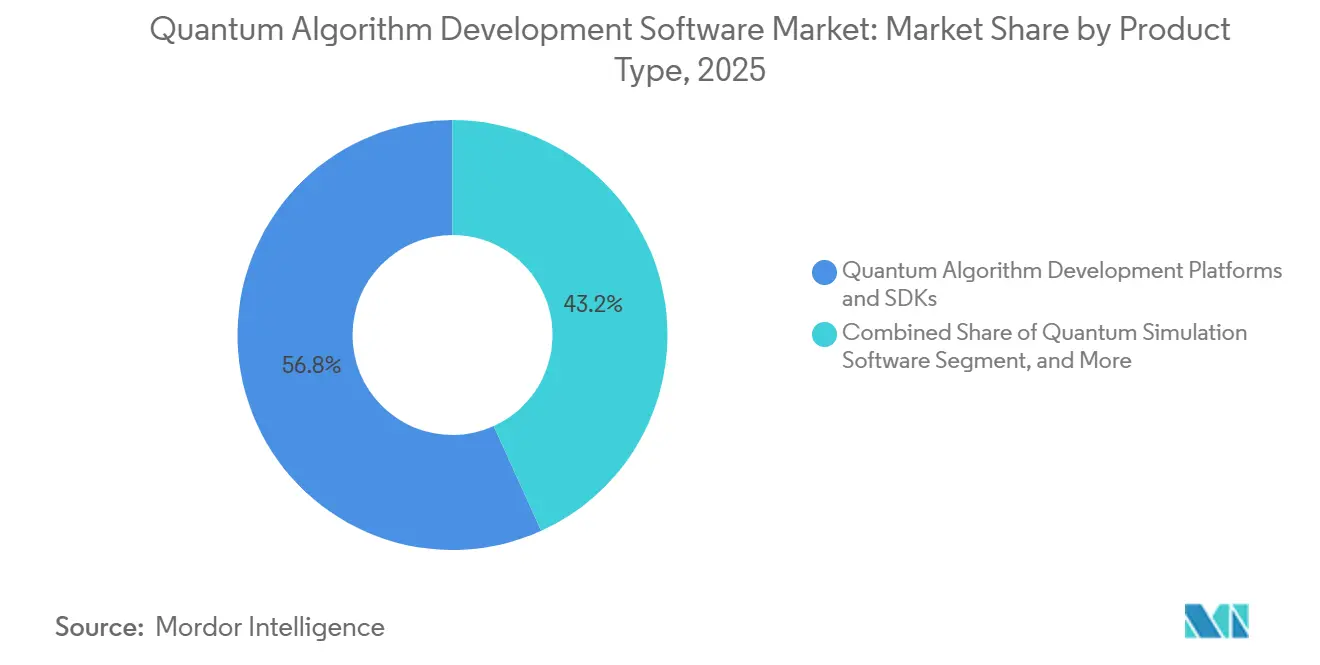
Platforms Lead While Error Correction Gains ImportanceQuantum Algorithm Development Platforms and SDKs accounted for 56.77% of the quantum algorithm development software market revenue in 2025. This share showed that developer-facing software was the main commercial entry point for the quantum algorithm development software market. Qiskit, PennyLane, TKET, and Cirq provide the programming, compilation, and execution functions developers need to evaluate hardware performance. Their role is not limited to writing circuits because they also shape how users select devices, manage workloads, and interpret results. Quantum simulation software, optimization software, and compilation tools serve research-intensive enterprise and academic teams that need more targeted capabilities.
Quantum Error Mitigation and Error Correction Software is projected to grow at a 38.45% CAGR through 2031. The quantum algorithm development software market size for this product group is linked to the need for usable circuit results on hardware with meaningful noise and limited fidelity. NVIDIA reported in 2026 that its Ising Decoder delivered more than 347.7x improvement in logical error rates for color codes.[2]NVIDIA, “NVIDIA Ising Decoding Cuts Color Code Logical Error Rates by Over 300x,” NVIDIA Technical Blog, nvidia.com IBM also released Qiskit Paulice, a NISQ-compatible tool that automatically adds hardware-efficient error-detection loops to circuits. These developments show why error management is becoming a core part of a platform rather than an optional feature. Qunova Computing in South Korea and Quemix in Japan are also building early export capabilities in fault-tolerant algorithms, giving the Asia-Pacific a role as a supplier of specialized products.



By Deployment Mode:
Cloud Leads While Hybrid Workflows ExpandCloud accounted for 72.49% of the revenue in the quantum algorithm development software market in 2025. The quantum algorithm development software market was therefore strongly shaped by the ability to access processors without buying cryogenic infrastructure or operating a dedicated physical system. Customers can subscribe to services and pay for circuit execution based on their usage. This approach reduces the financial commitment associated with early experimentation. It also allows research, development, and business teams to work with the same set of remotely accessible resources, even when they are located in different facilities.
Hybrid deployment is projected to grow at a 39.07% CAGR between 2026 and 2031. Current processors still rely on classical systems for data preparation, error post-selection, workflow control, and result interpretation. KQC launched Qubiteer in June 2026 as a quantum AI hybrid platform for problem modeling, solver selection, and execution across finance, materials, and logistics. The launch showed how suppliers are presenting hybrid operations as complete workflows rather than as a standalone quantum component. On-premises deployment remains a smaller option for government agencies and defense contractors with air-gap requirements. Hybrid growth does not necessarily reduce cloud use, as cloud systems increasingly serve as the execution backbone for these combined workflows.
By Application:
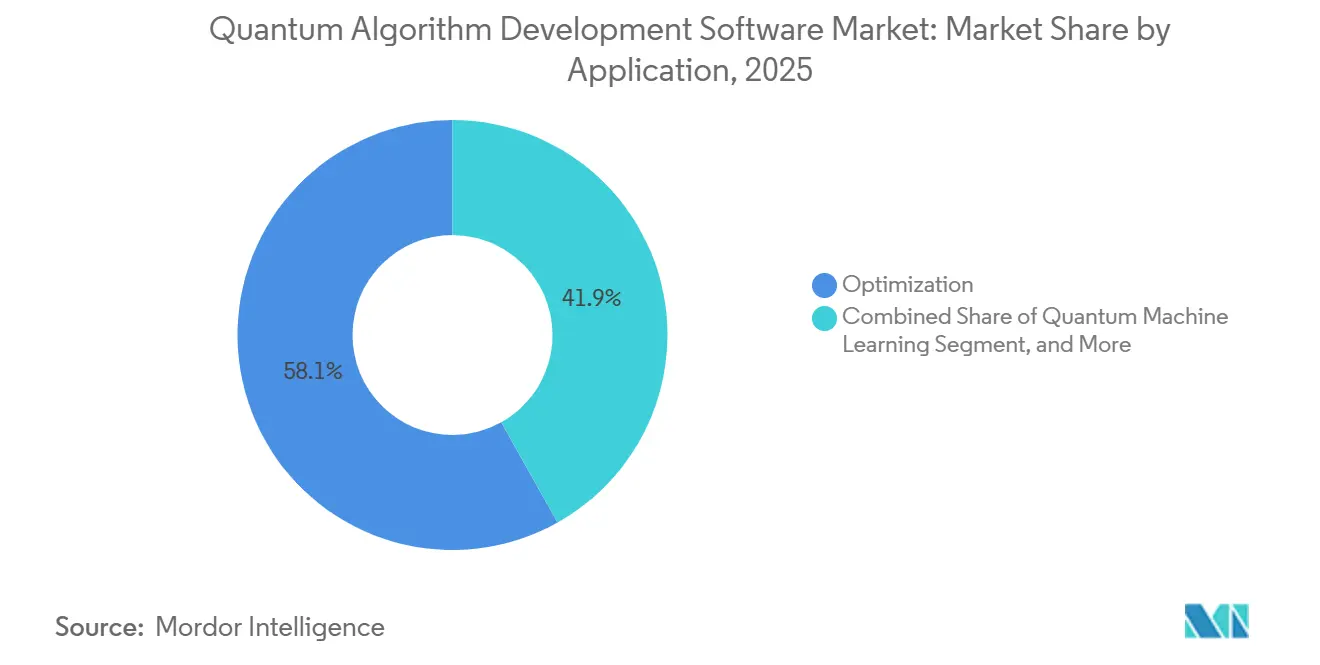
Optimization Leads While Quantum Machine Learning AdvancesOptimization accounted for 58.12% of the revenue from software applications for quantum algorithm development in 2025. This share of the quantum algorithm development software market came from portfolio construction, supply chain scheduling, and industrial process planning. These workloads fit quantum variational algorithms that can be executed on current NISQ hardware. Quantinuum’s Helios system was benchmarked against the S&P 100 and Nikkei 225 using a qReduMIS approach on 78-qubit circuits. The reported solution success probabilities were comparable to those of classical methods, supporting continued evaluation of optimization workflows.
Simulation and modeling were the second-largest applications and supported work in molecular simulation, materials discovery, and energy system modeling. Cryptography and security gained a more immediate role because post-quantum standards and migration requirements turned a future risk into a current software need. Quantum Machine Learning is projected to be the fastest-growing application at a 38.81% CAGR through 2031. IonQ and QuantumBasel reported in July 2026 that quantum-driven AI workloads could become more energy-efficient than classical GPU simulation at an energy crossover point of 34 qubits. This work brings enterprise AI infrastructure buyers into the addressable customer group for quantum machine learning tools. It also leaves optimization as the larger current revenue source while companies test a separate set of future AI-related workloads.
By End-User Industry:
BFSI Leads Revenue While Pharmaceutical and Biotechnology Grows FastestBFSI accounted for 26.41% of the revenue from quantum algorithm development software in 2025. The sector’s leading position reflected two different spending needs: optimization, development, and software for cryptography migration. Financial institutions are testing portfolio optimization, derivatives valuation, risk modeling, and security tools. The Bank of Israel’s January 2025 preparation requirement and G7 financial sector guidance increased the need for quantum cyber-risk planning. UOB began a July 2026 collaboration with the Center for Quantum Technologies to apply quantum methods to the valuation of complex derivatives.
Pharmaceutical and Biotechnology is projected to grow at a 37.74% CAGR through 2031. Molecular simulation is relatively well-suited to testing on available hardware, which can shorten the path from an experimental algorithm to a relevant user case. Security classifications and post-quantum cryptography requirements sustain government and defense demand. Automotive and aerospace, chemicals and materials, and energy and utilities are building pilots for materials discovery and route optimization. Education and research institutions continue to supply much of the specialist talent needed by the field. Platform abstraction can enable computational chemists and bioinformaticians to run workloads without depending on dedicated quantum programmers.
Geography Analysis
North America Quantum Algorithm Development Software Market
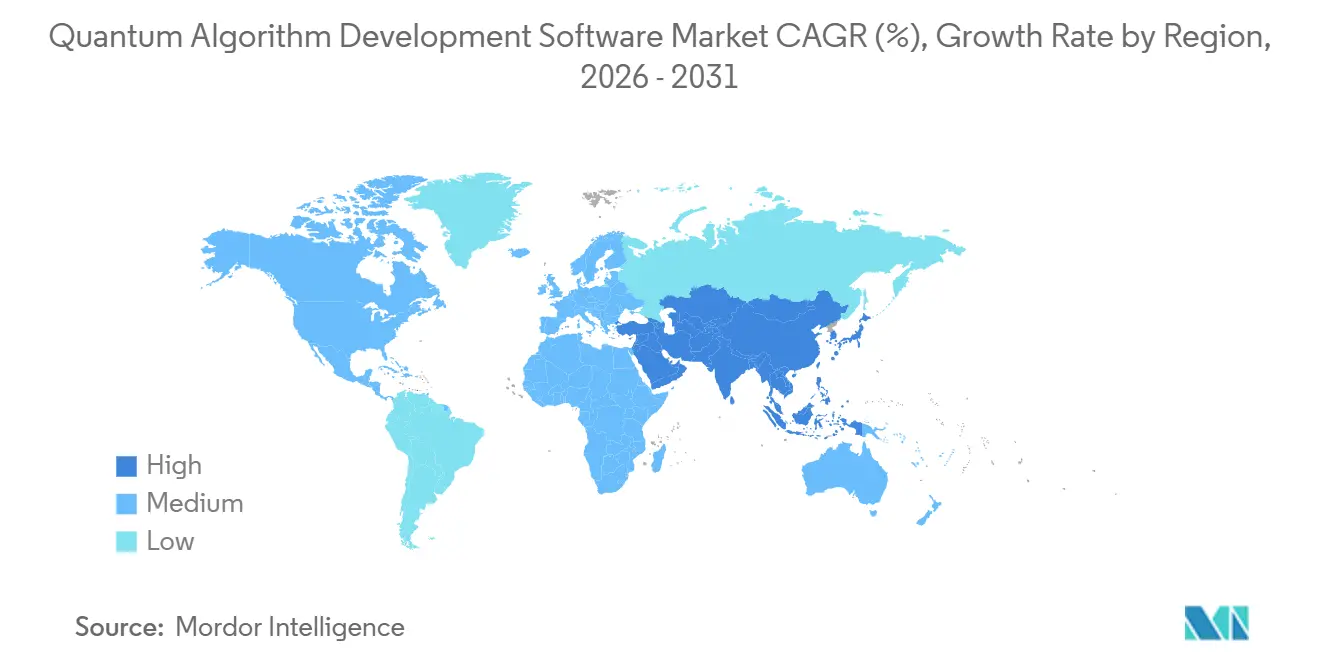
North America held 37.11% of the quantum algorithm development software market share in 2025. Federal programs, the concentration of cloud platforms, and early demand from financial services and government underpinned this position. The National Quantum Initiative Act and DARPA’s Quantum Benchmarking Initiative provided a continuing policy framework for regional activity. In May 2026, the Department of Commerce announced USD 2.01 billion in letters of intent for 9 quantum companies. The package included an intended USD 1 billion allocation for IBM and connected funding to software integration milestones.[3]National Institute of Standards and Technology, “Post-Quantum Cryptography,” Computer Security Resource Center, nist.gov IBM Quantum, Amazon Web Services Braket, and Microsoft Azure Quantum also gave users access to major cloud-based development environments. The United States was the largest single regional consumer, while Canada added software and hardware capabilities through Xanadu, 1QBit, Agnostiq, and Multiverse Computing.
Europe Quantum Algorithm Development Software Market
Europe held a meaningful secondary share in 2025. Germany, the United Kingdom, France, and Italy were major centers of activity in the region. Classiq and TEA TEK Group announced a multi-million-euro partnership in June 2026 to establish a quantum computing hub in Naples. The initiative targets quantum software research and services across the European Union. The United Kingdom committed GBP 121 million (USD 154 million) to quantum technology in April 2025. The funding targeted fraud detection and financial crime applications. The European Union’s April 2024 memorandum on coordinated quantum-safe digital infrastructure also increased attention on the procurement of cryptographic software.
APAC, MEA and South America Quantum Algorithm Development Software Market
Asia-Pacific is projected to expand at a 38.10% CAGR through 2031. This rate makes it the fastest-growing regional part of the quantum algorithm development software market. Japan is directing public funding and corporate capital toward specific industrial applications and domestic software capability. RIKEN relaunched the upgraded Ei-II quantum computer cloud service in March 2026 with Osaka University’s Quantum Information and Quantum Biology Institute. The service broadened access for industrial and academic algorithm research. Mizuho Lease invested in Quemix in April 2025 for research on fault-tolerant algorithms, while the IPA 2026 Mitou Target program supported quantum software development. Classiq and QAI established a local Quantum-as-a-Service offering in South Korea in July 2026. South America, the Middle East, and Africa remained early-stage regions, although Brazil led institutional interest and Saudi Arabia’s SAMA explored quantum optimization for central bank settlement systems with Multiverse Computing.

Competitive Landscape
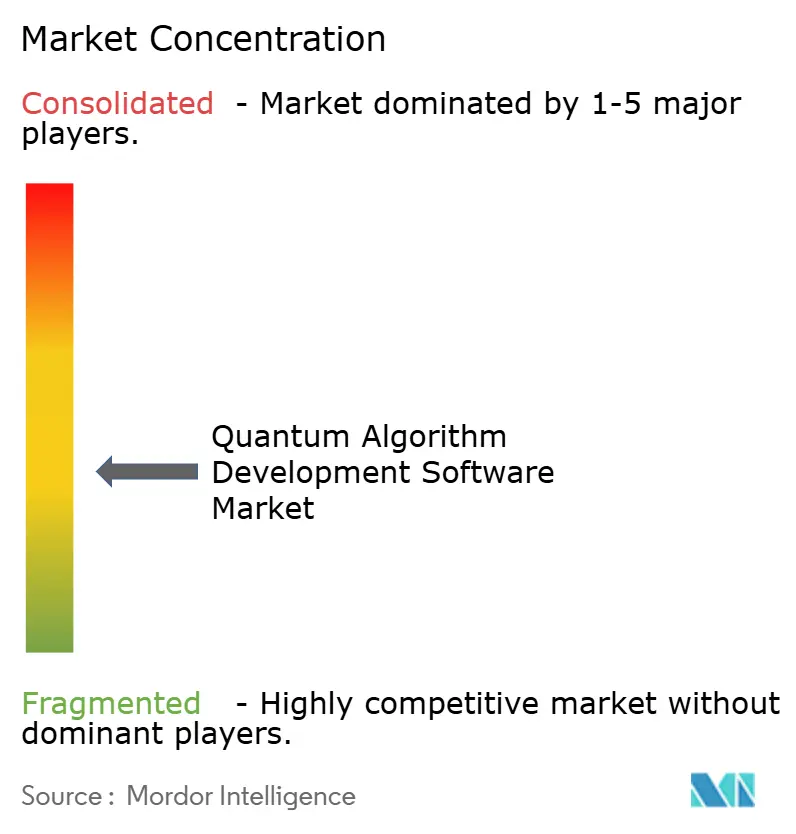
The quantum algorithm development software market is moderately fragmented. IBM, Google, Microsoft, and Amazon Web Services have broad platform reach and substantial developer ecosystems. IBM stated that Qiskit was used by nearly 70% of quantum developers in 2026. Their scale gives enterprise customers access to integrated development, cloud execution, and support resources. Specialist companies compete through more focused capabilities rather than the overall reach of a cloud platform. Quantinuum offers the TKET compiler, Classiq provides high-level algorithm synthesis, Q-CTRL supplies Fire Opal error suppression, and Riverlane develops quantum error correction software.
Classiq raised USD 110 million in a Series C round in May 2025. Its cumulative funding exceeded USD 200 million by November 2025, with strategic investors including AMD, Qualcomm, IonQ, SoftBank Vision Fund 2, and HSBC. The financing supported product development, global partnerships, and commercial expansion. In July 2026, Classiq and ParityQC announced a partnership that integrated Parity Twine with Classiq’s software engineering platform. The partnership aimed to improve the transition from algorithm design to hardware execution and reduce gate-count overhead for combinatorial optimization.[4]Classiq, “Classiq and ParityQC Partner to Optimize and Streamline Quantum Execution,” Classiq, classiq.io This type of collaboration supports customers who want to use hardware resources efficiently without committing their software to one device design.
NVIDIA open-sourced Ising model tools through CUDA-Q in April 2026. The release provided a cross-platform software foundation for IonQ, Rigetti, and open-source developers, while creating demand for CUDA-Q-compatible environments. Rigetti launched its Cepheus-1-108Q processor with 99.1% two-qubit gate fidelity in 2026. The release illustrated the closer link between hardware progress and software integration. IonQ and Q-CTRL also announced a partnership to use Fire Opal error suppression on IonQ’s Forte processors. Post-quantum cryptography standards create another area of competition, as suppliers that support the full NIST standard set can respond more quickly to federal procurement needs. The quantum algorithm development software market continues to favor products that lower portability risk, execution errors, and user skill requirements.
Quantum Algorithm Development Software Industry Leaders
IBM Corporation
Microsoft Corporation
Amazon Web Services, Inc.
NVIDIA Corporation
Google LLC
- *Disclaimer: Major Players sorted in no particular order
Quantum Algorithm Development Software Market Companies Covered in this Report
- IBM Corporation
- Google LLC
- Microsoft Corporation
- Amazon Web Services, Inc.
- NVIDIA Corporation
- Quantinuum Limited
- Xanadu Quantum Technologies Inc.
- IonQ, Inc.
- D-Wave Quantum Inc.
- Rigetti Computing, Inc.
- Q-CTRL Pty Ltd
- Riverlane Limited
- Classiq Technologies Ltd.
- QC Ware Corp.
- Zapata Computing Holdings Inc.
- 1QBit Information Technologies Inc.
- Algorithmiq Inc.
- Strangeworks, Inc.
- Phasecraft Limited
- Entropica Labs Pte. Ltd.
- ProteinQure Inc.
- Agnostiq Inc.
- Multiverse Computing S.L.
- Terra Quantum AG
- BlueQubit, Inc.

Recent Industry Developments in Quantum Algorithm Development Software Market
- July 2026: Classiq and ParityQC announced a partnership integrating ParityQC's Parity Twine technology with Classiq's quantum software engineering platform, enabling more efficient algorithm design-to-hardware-execution pathways and reducing gate-count overhead for combinatorial optimization workloads.
- July 2026: Classiq and QAI signed a commercial agreement to establish South Korea's first local Quantum-as-a-Service (QaaS) offering, combining Classiq's quantum software platform with QAI's domestic AI datacenter infrastructure to meet the data sovereignty requirements of Korean public agencies and enterprises.
- July 2026: UOB and Singapore's Center for Quantum Technologies at the National University of Singapore announced a collaboration to apply quantum computing methods to the valuation of complex financial derivatives, supported by Singapore's National Quantum Computing Hub.
- June 2026: Crédit Agricole CIB and Pasqal signed a strategic partnership to advance quantum computing from research to operational deployment in capital markets, covering counterparty credit risk algorithms and portfolio optimization use cases.


Global Quantum Algorithm Development Software Market Report Scope
The Quantum Algorithm Development Software Market comprises software platforms and tools that enable researchers, developers, enterprises, and academic institutions to design, develop, test, optimize, simulate, and deploy quantum algorithms for quantum computing systems. These solutions offer capabilities such as quantum circuit design, algorithm modeling, simulation, optimization, error mitigation, quantum machine learning development, cloud-based quantum execution, and hybrid classical-quantum workflow management. Users apply these tools to support quantum application development across optimization, simulation, cryptography, materials science, life sciences, and artificial intelligence.
The Quantum Algorithm Development Software Market Report is Segmented by Product Type (Quantum Algorithm Development Platforms and SDKs, Quantum Simulation Software, Quantum Algorithm Optimization and Compilation Software, Quantum Error Mitigation and Error Correction Software, and Other Product Types), Deployment Mode (On-Premises, Cloud, and Hybrid), Application (Optimization, Simulation and Modeling, Quantum Machine Learning, Cryptography and Security, and Other Applications), End-User Industry (Banking, Financial Services, and Insurance [BFSI], Pharmaceutical and Biotechnology, Government and Defense, Automotive and Aerospace, Chemicals and Materials, Energy and Utilities, Education and Research Institutions, and Other End-User Industries), and Geography (North America, South America, Europe, Asia-Pacific, Middle East, and Africa). The Market Forecasts are Provided in Terms of Value (USD).
| Quantum Algorithm Development Platforms and SDKs |
| Quantum Simulation Software |
| Quantum Algorithm Optimization and Compilation Software |
| Quantum Error Mitigation and Error Correction Software |
| Other Product Types |
| On-Premises |
| Cloud |
| Hybrid |
| Optimization |
| Simulation and Modeling |
| Quantum Machine Learning |
| Cryptography and Security |
| Other Applications |
| Banking, Financial Services, and Insurance (BFSI) |
| Pharmaceutical and Biotechnology |
| Government and Defense |
| Automotive and Aerospace |
| Chemicals and Materials |
| Energy and Utilities |
| Education and Research Institutions |
| Other End-User Industries |
| North America | United States |
| Canada | |
| Mexico | |
| South America | Brazil |
| Argentina | |
| Rest of South America | |
| Europe | Germany |
| United Kingdom | |
| France | |
| Italy | |
| Spain | |
| Russia | |
| Rest of Europe | |
| Asia-Pacific | China |
| Japan | |
| India | |
| South Korea | |
| Australia and New Zealand | |
| Rest of Asia-Pacific | |
| Middle East | Saudi Arabia |
| United Arab Emirates | |
| Turkey | |
| Rest of Middle East | |
| Africa | South Africa |
| Nigeria | |
| Rest of Africa |
| By Product Type | Quantum Algorithm Development Platforms and SDKs | |
| Quantum Simulation Software | ||
| Quantum Algorithm Optimization and Compilation Software | ||
| Quantum Error Mitigation and Error Correction Software | ||
| Other Product Types | ||
| By Deployment Mode | On-Premises | |
| Cloud | ||
| Hybrid | ||
| By Application | Optimization | |
| Simulation and Modeling | ||
| Quantum Machine Learning | ||
| Cryptography and Security | ||
| Other Applications | ||
| By End-User Industry | Banking, Financial Services, and Insurance (BFSI) | |
| Pharmaceutical and Biotechnology | ||
| Government and Defense | ||
| Automotive and Aerospace | ||
| Chemicals and Materials | ||
| Energy and Utilities | ||
| Education and Research Institutions | ||
| Other End-User Industries | ||
| By Geography | North America | United States |
| Canada | ||
| Mexico | ||
| South America | Brazil | |
| Argentina | ||
| Rest of South America | ||
| Europe | Germany | |
| United Kingdom | ||
| France | ||
| Italy | ||
| Spain | ||
| Russia | ||
| Rest of Europe | ||
| Asia-Pacific | China | |
| Japan | ||
| India | ||
| South Korea | ||
| Australia and New Zealand | ||
| Rest of Asia-Pacific | ||
| Middle East | Saudi Arabia | |
| United Arab Emirates | ||
| Turkey | ||
| Rest of Middle East | ||
| Africa | South Africa | |
| Nigeria | ||
| Rest of Africa | ||


Key Questions Answered in the Report
What is the quantum algorithm development software market size?
The quantum algorithm development software market size is projected to grow from USD 0.94 billion in 2026 to USD 4.61 billion by 2031 at a 37.38% CAGR.
Which product type generated the most revenue in 2025?
Quantum Algorithm Development Platforms and SDKs generated the most revenue, with a 56.77% share in 2025.
Which deployment model is expected to grow fastest?
Hybrid deployment is projected to grow at a 39.07% CAGR through 2031, supported by the need for classical processing around quantum workloads.
What application currently leads quantum software demand?
Optimization led application revenue with a 58.12% share in 2025, supported by financial, supply chain, and industrial planning use cases.
Which end-user group is expected to grow fastest?
Pharmaceutical and Biotechnology is projected to expand at a 37.74% CAGR through 2031 as molecular simulation becomes more accessible.
Which region is expected to grow fastest through 2031?
Asia-Pacific is projected to grow at a 38.10% CAGR through 2031, supported by programs in Japan, South Korea, China, and India.
Page last updated on:





