
Pulse Storage Protection Market Size and Share
Market Overview
| Study Period | 2022 - 2032 |
|---|---|
| Market Size (2027) | USD 1.25 Billion |
| Market Size (2032) | USD 1.69 Billion |
| Growth Rate (2027 - 2032) | 6.22 % |
| Fastest Growing Market | Africa |
| Largest Market | Asia-Pacific |
| Market Concentration | Medium |
Major Players *Disclaimer: Major Players sorted in no particular order Image © Mordor Intelligence. Reuse requires attribution under CC BY 4.0. | |
Pulse Storage Protection Market Analysis by Mordor Intelligence
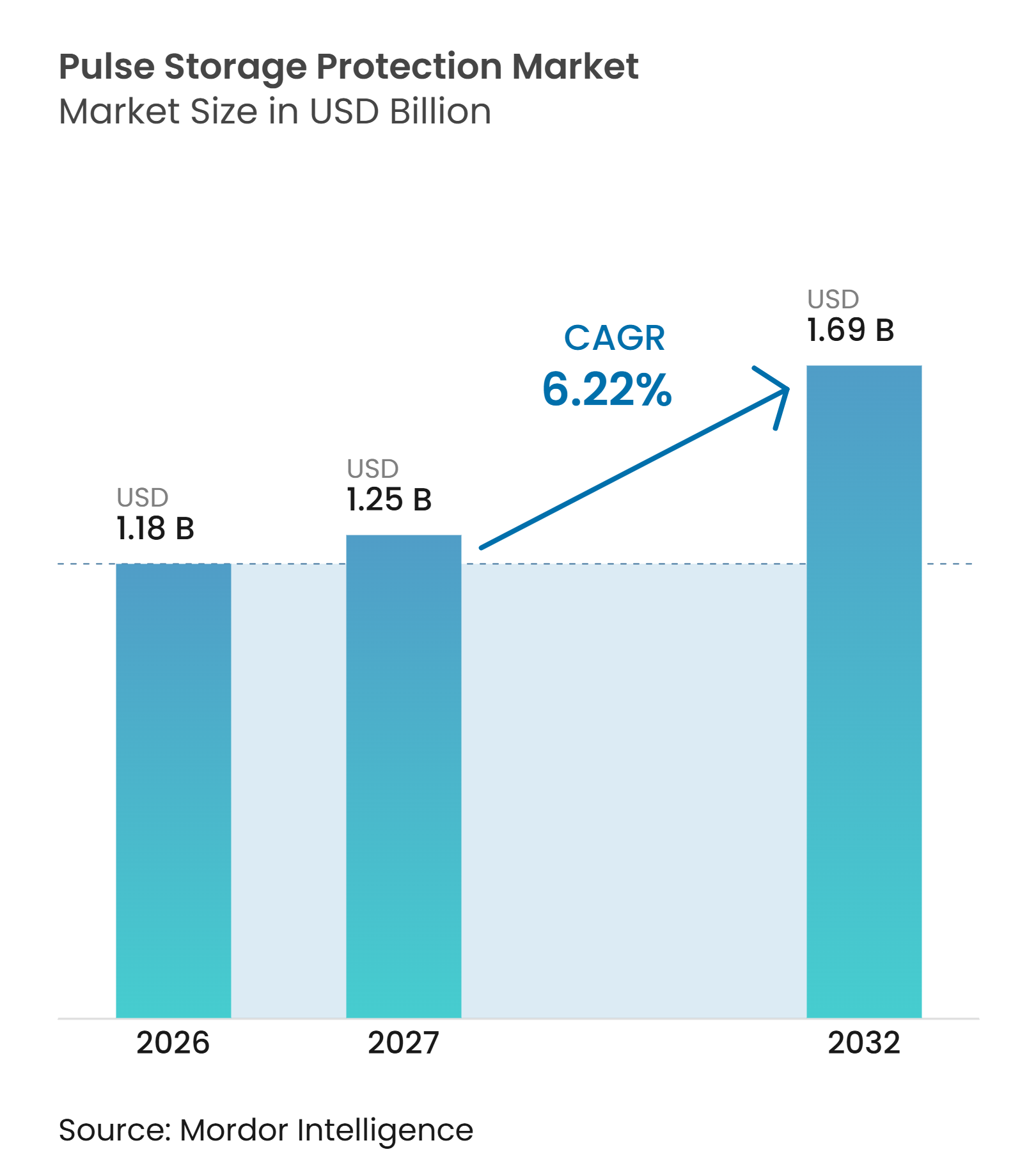
The pulse storage protection market size was valued at USD 1.18 billion in 2026 and is estimated to grow from USD 1.25 billion in 2027 to USD 1.69 billion by 2032. The market is projected to grow at a 6.22% CAGR during 2027–2032. Demand in the pulse storage protection market centers on products used after harvest to protect chickpeas, lentils, pigeon peas, cowpeas, mung beans, and other dry pulses before processing, retail packing, or export loading. Government procurement programs, export compliance, and longer holding periods are increasing the need for documented storage practices. The pulse storage protection market is also changing as resistance to phosphine and tighter residue requirements raise the value of hermetic storage, monitoring, and lower-residue alternatives. Suppliers therefore compete across chemical and non-chemical protection and condition verification rather than within a single product category.
Key Report Takeaways
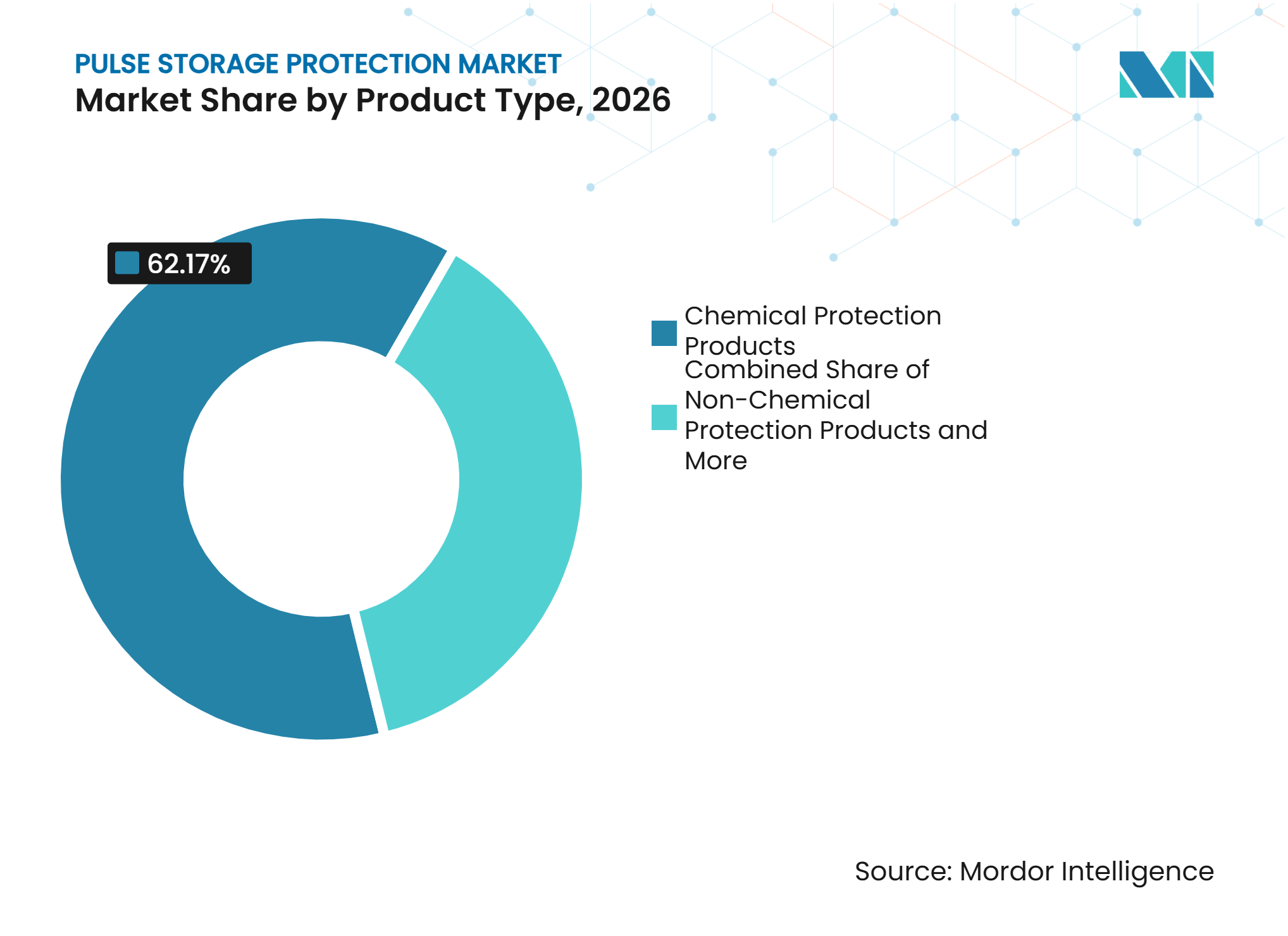
- By product type, chemical protection products held 62.17% of the pulse storage protection market share in 2026. Non-chemical protection products are projected to grow at a 7.4% CAGR during 2027–2032.
- By application, insect and mite control accounted for 68.37% of the pulse storage protection market share in 2026. Rodent control is projected to grow at a 9.9% CAGR during 2027–2032.
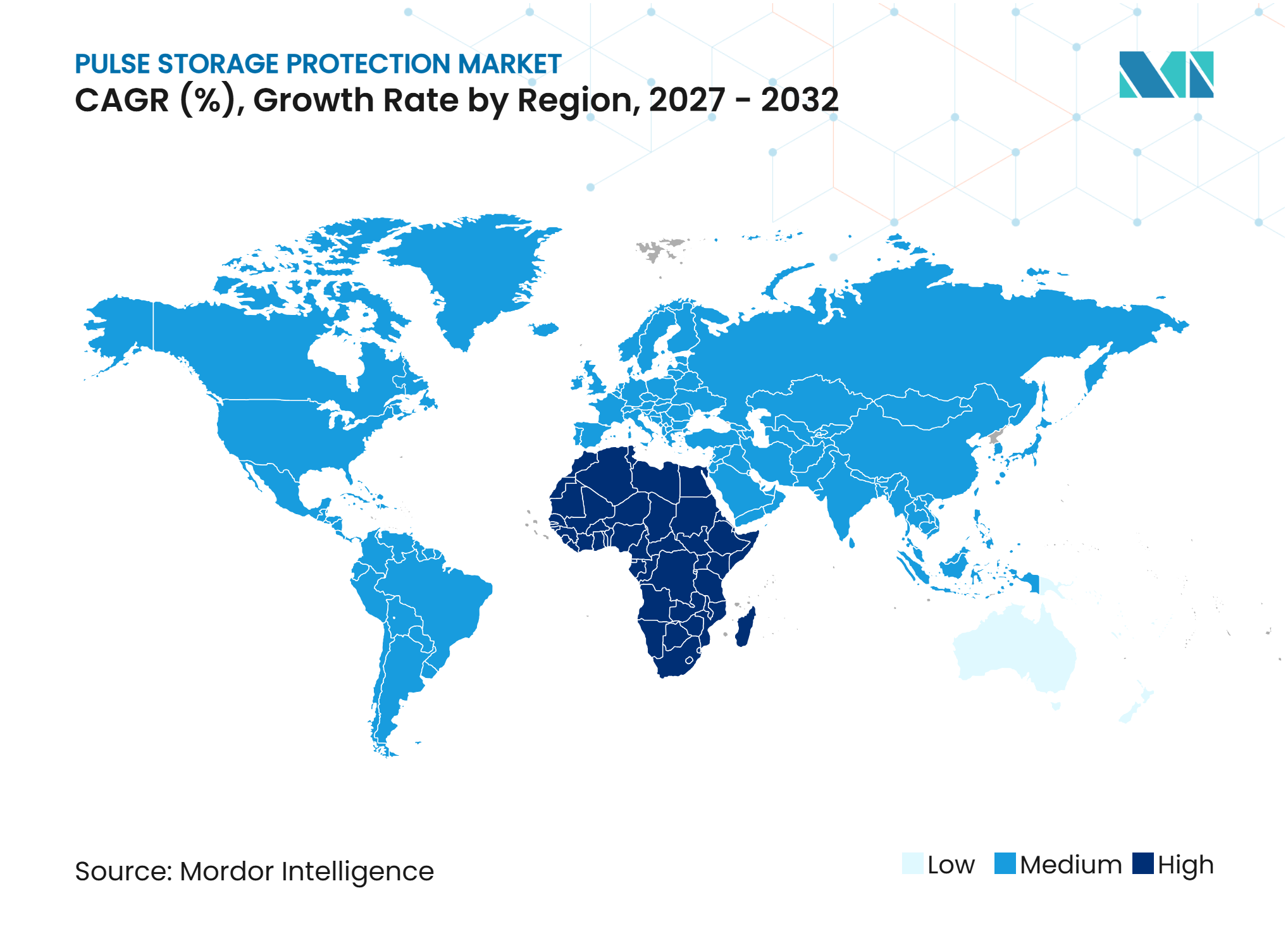
- By geography, Asia-Pacific held 34.21% of the pulse storage protection market share in 2026. Africa is projected to grow at a 10.8% CAGR during 2027–2032.
Note: Market numbers in this report are based on Mordor Intelligence's proprietary estimation framework, which combines nine months of actuals with Q4 projections for base year 2026.
Market Trends and Insights
Drivers Impact Analysis of Pulse Storage Protection Market*
| Driver | (~) % Impact on CAGR Forecast | Geographic Relevance | Impact Timeline |
|---|---|---|---|
| Persistent Insect and Fungal Losses in Stored Pulses | +2.5% | Global, with strongest effect in Africa, South Asia, and South America where warm, decentralized storage raises pest and moisture exposure | Long term (≥ 4 years) |
| Expansion of Pulse Storage and Cross-Border Trade | +2.1% | Global, especially India, Canada, Australia, Brazil, Russia, and East Africa | Medium term (2–4 years) |
| Food Safety and Residue-Compliance Requirements | +1.1% | Global, strongest in Europe, North America, Australia, and export-oriented supply chains | Medium term (2–4 years) |
| Adoption of Hermetic and Chemical-Free Storage | +0.8% | Africa, South Asia, Southeast Asia, and smallholder supply chains globally | Medium term (2–4 years) |
| Pulse-Specific Bruchid Protection in Vulnerable Crops | +0.6% | West and East Africa, India, and Southeast Asia | Short term (≤ 2 years) |
| Traceability and Quality Preservation in Decentralized Storage | +0.4% | Global, strongest in export corridors and fragmented aggregation systems | Long term (≥ 4 years) |
| Source: Mordor Intelligence | |||
Persistent Insect and Fungal Losses in Stored Pulses
Stored-pulse losses continue to create recurring demand for products that prevent insect damage, fungal growth, and quality deterioration. Bruchids are particularly damaging because their development occurs within the seed, so commercial damage may not become visible until infestation is established. A February 2025 study in Niger found that naturally infested cowpeas stored in plain woven bags lost 38.5% of their weight over six months, whereas hermetic bags and phosphine treatment prevented weight loss[1]. Such loss exposure supports recurring expenditure on fumigants, hermetic bags, pest traps, and moisture-control products. The pulse storage protection market benefits from buyers' need for protection across the farm, aggregation, warehouse, and export stages.
Expansion of Pulse Storage and Cross-Border Trade
Formal procurement and cross-border movement extend the reach of the pulse storage protection market and the time that pulses remain in storage and require active protection. In March 2025, India approved the procurement of 3.739 million metric tons of gram and lentils for the 2025 rabi marketing season through the National Agricultural Cooperative Marketing Federation of India and the National Cooperative Consumers' Federation of India. India's Union Cabinet also approved the Mission for Aatmanirbharta in Pulses in October 2025, which provides for full procurement of tur (pigeon pea), urad (black gram), and masoor (lentil) from registered farmers through 2028–29. Cross-border flows add further storage exposure, as The Indian Express reported that India imported a record 7.256 million metric tons of pulses in 2024–25, including yellow peas mainly from Canada and Russia, chana from Australia, and masoor from Canada, Australia, and the United States. Larger institutional and traded stocks require reliable treatment records and warehouse protection during their holding and transit periods. The pulse storage protection market, therefore, gains demand from both procurement channels and private trade.
Food Safety and Residue-Compliance Requirements
Export buyers increasingly require storage protection products that comply with destination markets' residue rules. In April 2025, Pulse Canada stated in its guidance for the 2025 Keep it Clean Product Advisory that each export market sets its own maximum residue limits (MRLs) and that exceeding an MRL or lacking one altogether can block shipments. In August 2025, Grain Trade Australia released its Chemical Usage Recommendations and Outturn Tolerances 2025/26, which changed European Union deltamethrin MRLs for various pulses and added Australian pyrethrin and methyl bromide MRLs for pulses. This makes application records, label compliance, and residue-aware protection products more relevant to exporters. Hermetic systems can meet some of this need by managing pests without leaving conventional pesticide residues. The pulse storage protection market is expanding as compliance costs drive buyers to add monitoring or adopt alternative protection methods.
Adoption of Hermetic and Chemical-Free Storage
Hermetic storage is becoming a commercial option within the pulse storage protection market for pulse producers and aggregators that cannot safely use conventional fumigants. Research on cowpea storage found that triple-layer hermetic bags maintained 87.6% germination after 10 months, compared with 41.7% in jute bags. A separate study published in December 2025 on canary beans stored in Peru reported 1.34% grain damage and 0.41% weight loss in hermetic bags after nine months, compared with 82.39% damage and 19.27% weight loss in woven polypropylene bags holding untreated beans. These results support use in food and export-oriented pulse chains where quality retention matters. For seed chains, the beans also need to be dried properly before sealing. Product adoption depends on correct drying, sealing, and bag handling, rather than on product purchase alone. The pulse storage protection market gains new buyers when retailers combine hermetic bags with moisture checks and practical handling guidance.
Restraints Impact Analysis of Pulse Storage Protection Market*
| Restraint | (~) % Impact on CAGR Forecast | Geographic Relevance | Impact Timeline |
|---|---|---|---|
| Phosphine Resistance and Tighter Fumigant Controls | -0.30% | Global, with documented pressure in Australia, Brazil, India, China, Turkey, Europe, and the United States | Long term (≥ 4 years) |
| Smallholder Affordability and Weak Storage Infrastructure | -0.20% | Africa, South Asia, and lower-income areas of Southeast Asia and South America | Short term (≤ 2 years) |
| Uncertain Pulse Allocation in Multi-Crop Product Sales | -0.10% | Global, strongest in mixed grain handling markets | Medium term (2–4 years) |
| Hermetic Bag Puncture and Moisture-Conditioning Failures | -0.10% | Africa, South Asia, and other decentralized or humid storage environments | Short term (≤ 2 years) |
| Source: Mordor Intelligence | |||
Phosphine Resistance and Tighter Fumigant Controls
Phosphine resistance reduces the reliability of chemical treatment, which remains important to the pulse storage protection market. Research published in July 2025 linked phosphine resistance in Tribolium castaneum and Rhyzopertha dominica populations in North America to the frequency of a strong-resistance gene, and found that resistance was more likely driven by selection pressure from frequent fumigation. Western Australia's Department of Primary Industries and Regional Development has monitored phosphine resistance since 1984, surveys bulk handlers and 100 farms each financial year, and works with property owners on eradication plans when strong resistance is detected[2]. Resistance can require better sealing, longer exposures, tighter operational control, and alternative treatment plans. Those requirements raise complexity for users and can reduce confidence in chemical-only strategies. The constraint also favors integrated protection but limits the straightforward expansion of conventional fumigant volumes.
Smallholder Affordability and Weak Storage Infrastructure
Smallholders may recognize the benefits of hermetic storage but still defer purchases when the first-cost difference from standard bags is material. A 2025 review of postharvest interventions across Sub-Saharan Africa and South Asia found that hermetic bags were widely studied for cereals and legumes, but few studies explored economic outcomes. A 2025 review of pea storage also noted that hermetic bags carry a higher initial cost than standard bags and that the choice of storage technology depends on product form and storage duration. Poor drying before storage can lead to moisture and mold problems, even when a bag is sealed correctly. Limited access to moisture meters, credit, and reliable drying facilities therefore restrains repeat purchases. The pulse storage protection market depends on product designs and distribution models that lower the initial adoption barrier.
*Our forecasts treat driver/restraint impacts as directional, not additive. The impact forecasts reflect baseline growth, mix effects, and variable interactions.
Pulse Storage Protection Market Segment Analysis
By Product Type:
Chemical Protection Products Remain the Largest CategoryChemical protection products held 62.17% of the pulse storage protection market revenue in 2026. Aluminum phosphide fumigation and contact grain protectants remain central to large warehouses, government stocks, and export terminals because professional users know them well. They work best where a facility can control gas tightness, exposure time, ventilation, and operator safety. Chemical treatments also provide time-sensitive protection for large volumes that cannot be handled by bag-by-bag systems. Category revenue remains substantial because commercial users often require rapid, scalable pest control. The category faces tighter technical requirements as resistance management and residue compliance influence product selection. National registrations and destination-market residue limits can determine which formulation is practical for a particular pulse shipment. A review first published in October 2025 in the Annual Review of Entomology highlighted the development of flavesone as a potential grain protectant in Australia and the continued use of spinosad in insecticide combinations to manage resistance[3]. This work indicates that chemical suppliers need more differentiated resistance-management options.
Non-chemical protection products are projected to grow at a 7.4% CAGR during 2027–2032. The category includes hermetic bags, inert and botanical protectants, traps, rodent-control devices, and moisture-monitoring tools. Its growth is tied to storage settings where chemical access is restricted, safety practices are difficult to maintain, or residue-free handling has commercial value. Hermetic bags limit oxygen availability when they are sealed and used with adequately dried grain. A review published in January 2025 in Heliyon compared systems that monitor temperature, moisture, and gas composition in modified-atmosphere grain storage and found a lack of monitoring solutions for grain stored in hermetic bags. Monitoring helps users identify whether moisture, bag damage, or pest activity is undermining intended protection. Products that pair a moisture check with a hermetic solution address a clear operational need before grain enters storage. The pulse storage protection market therefore has scope for non-chemical systems that combine physical protection with condition verification.



By Application:
Insect and Mite Control Leads and Rodent Control Grows FastestInsect and mite control accounted for 68.37% of the pulse storage protection market revenue in 2026. Bruchids, weevils, and flour beetles threaten marketable yield, seed viability, and product quality across both farm and commercial storage. Callosobruchus species are particularly relevant to the storage of cowpea, mung bean, pigeon pea, lentil, and chickpea. Fumigation provides one route for controlling large facilities, while hermetic storage provides another in decentralized chains. The application holds the largest position because insect control is a basic requirement wherever dry pulses are stored for extended periods. A study published in January 2025 in the Journal of Stored Products Research established efficacy data for phosphine against Callosobruchus maculatus in stored mung beans, including a silo-scale trial of the aluminum phosphide tablet rate registered in Australia. That evidence supports more targeted treatment protocols and better resistance-management decisions. Buyers are therefore choosing between or combining methods based on facility scale, compliance needs, and storage duration.
Rodent control is projected to grow at a 9.9% CAGR during 2027–2032. Longer government-held stocks and larger formal warehouses increase the need to prevent rodent damage, contamination, and product loss. The application includes baiting, trapping, activity monitoring, and related controls used around stored pulses. It is distinct from insect control because rodents can damage packaging and create sanitation risks even when grain is protected from insects. Digital monitoring is adding a verification layer to warehouse rodent management. Smart monitoring devices are being used in food-handling and agricultural storage settings to record rodent activity and improve the timing of control actions. These systems can create activity records that help facility managers target control actions. The pulse storage protection market is likely to see rodent-control products increasingly purchased alongside broader sanitation and monitoring plans.
Geography Analysis
Geography Analysis
Asia-Pacific held 34.21% of the pulse storage protection market revenue in 2026. India is the region's largest demand center because public procurement, buffer-stock management, and domestic pulse consumption bring substantial volumes into organized storage. In October 2025, India's Union Cabinet approved the Mission for Aatmanirbharta in Pulses, which includes full procurement of tur, urad, and masoor through 2028-29. Australia adds demand through export-focused fumigation and phytosanitary compliance. Version 3.0 of the Methyl Bromide Fumigation Methodology from Australia's Department of Agriculture, Fisheries and Forestry came into force on May 1, 2025, setting minimum requirements for quarantine and pre-shipment fumigations. China, Indonesia, Bangladesh, and Pakistan add demand from pulse import, consumption, and decentralized storage chains.
Africa is projected to grow at a 10.8% CAGR during 2027–2032. Cowpea storage losses and decentralized distribution create a practical need for products that can work outside large fumigation facilities. Research in Niger found that hermetic bags suppressed both common and emerging pests in naturally infested cowpeas sourced from a government warehouse in Maradi. South Africa, Kenya, and Nigeria provide more developed commercial outlets for branded protectants and monitoring products. Other African markets offer potential for hermetic bag suppliers where local retail networks can support training and replacement demand. The region's protection-product demand depends on the ability of suppliers to make correct drying and bag handling practical for smaller users.
North America remains an export-oriented part of the pulse storage protection market centered on Canada's pulse supply chain and the United States' specialist product base. Canadian handlers must manage destination-specific residue requirements, which supports documented treatment and storage practices. South America combines export demand with opportunities for hermetic storage, as shown by the 2025 Peru research on canary beans. Europe is shaped primarily by imported-pulse handling, food-safety controls, and traceable treatment records. The Middle East is import-led, with pre-export and in-transit treatment remaining relevant to shipments from Asia-Pacific and North America. These regions support a mix of professional fumigation, compliant grain protectants, and targeted monitoring rather than a uniform product model.
Competitive Landscape
Market Concentration
Competitive Landscape
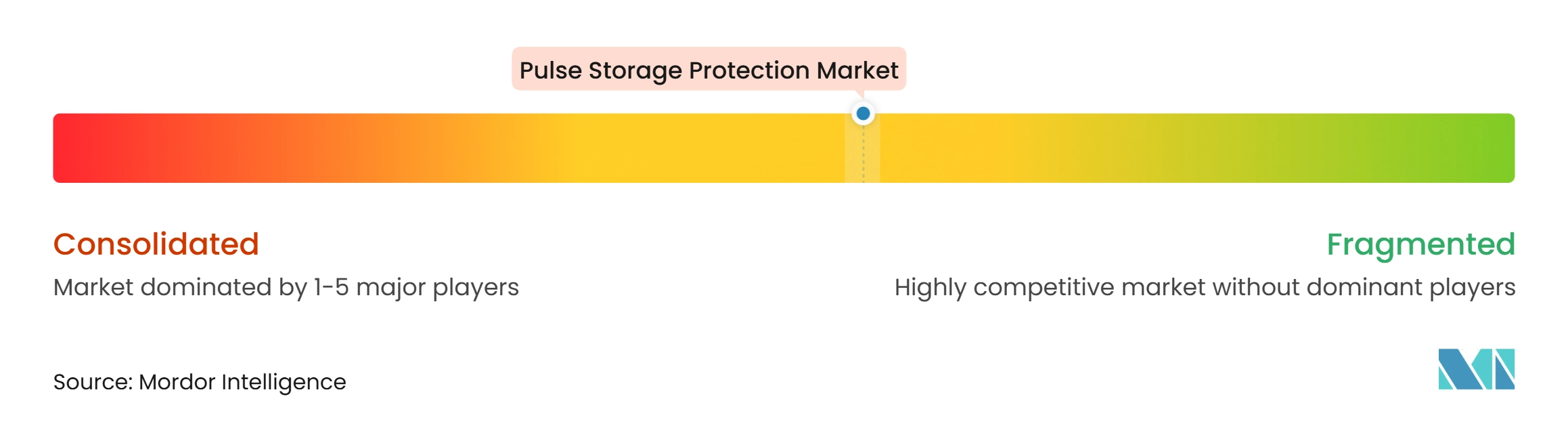
The pulse storage protection market is moderately consolidated, with established suppliers holding strong positions in their respective product categories and sales channels. Detia Degesch Group and Douglas Production Technologies, LLC are established suppliers of fumigation and grain-protection products for professional storage operations. GrainPro, Inc, Vestergaard S.A., and AtoZ Group Limited address hermetic and physical protection needs in smaller or decentralized chains. Bell Laboratories, INC. and OPIsystems add specialist control and monitoring capabilities. This structure creates competition based on the suitability of products for particular storage conditions rather than on a single supplier's broad dominance. The pulse storage protection market consequently rewards suppliers that match product design with local handling capacity.
Companies are using product development and capacity investments to protect their position. Degesch America, the United States arm of the Detia Degesch Group, has expanded its phosphine range beyond metal phosphides to include cylinderized products, including the ready-to-use U-Phos 2% formulation. OPIsystems launched its EPIQ grain-monitoring platform in June 2025, which measures temperature, moisture, and carbon dioxide without a conventional communication box. From October 30, 2025, Australia required controlled-atmosphere treatments at atmospheric pressure to be conducted by providers approved under its AusTreat scheme, which raises the value of documented treatment capability. These moves show that operational verification is becoming a stronger part of product differentiation.
UPL Ltd. and Nufarm Limited participate through crop-protection portfolios, while their relevance to stored pulses depends on qualifying product registrations and labels. Nufarm Americas announced United States Environmental Protection Agency registrations for its Naxypro and Naxypro Plus insecticides in October 2025, expanding its insecticide portfolio. Sesi Technologies links moisture measurement with hermetic-storage practices for smallholder users. AtoZ Group Limited's hermetic bag product design illustrates the importance of material performance in non-chemical protection.
Pulse Storage Protection Industry Leaders
-
UPL Ltd.
-
Detia Degesch Group
-
GrainPro, Inc
-
Vestergaard S.A.
-
Nufarm Limited
- *Disclaimer: Major Players sorted in no particular order
Pulse Storage Protection Market Companies Covered in this Report
- UPL Ltd.
- Detia Degesch Group
- Douglas Production Technologies, LLC
- Nufarm Limited
- GrainPro, Inc
- Vestergaard S.A.
- AtoZ Group Limited
- Sesi Technologies
- Bell Laboratories, INC.
- OPIsystems
- Pessl Instruments GmbH
Recent Industry Developments in Pulse Storage Protection Market
- June 2026: Detia Degesch Group bought the eFUME business from Draslovka Holding a.s. This adds to its post-harvest fumigation range, with a first focus on stopping quarantine pests in the fresh fruit trade.
- October 2025: Australia required controlled-atmosphere treatments at atmospheric pressure to be conducted by providers approved under its AusTreat scheme, effective October 30, 2025.
- June 2025: OPIsystems launched the EPIQ platform for remote measurement of grain temperature, moisture, and carbon dioxide.
Global Pulse Storage Protection Market Report Scope
The Pulse Storage Protection Market Report is Segmented by Product Type (Chemical Protection Products and Non-Chemical Protection Products), by Application (Insect and Mite Control Fungal and, Moisture Damage Prevention, Rodent Control, Other Application), and by Geography (North America, South America, Europe, Asia-Pacific, Middle East, and Africa). The Market Forecasts are Provided in Terms of Value (USD).
Segmentation Overview
| Chemical Protection Products |
| Non-Chemical Protection Products |
| Insect and Mite Control |
| Fungal and Moisture Damage Prevention |
| Rodent Control |
| Other Application |
| North America | United States |
| Canada | |
| Mexico | |
| Rest of North America | |
| South America | Brazil |
| Argentina | |
| Chile | |
| Colombia | |
| Peru | |
| Rest of South America | |
| Europe | Germany |
| United Kingdom | |
| France | |
| Spain | |
| Italy | |
| Russia | |
| Rest of Europe | |
| Asia-Pacific | China |
| Japan | |
| India | |
| Australia | |
| Singapore | |
| South Korea | |
| Rest of Asia-Pacific | |
| Middle East | Saudi Arabia |
| United Arab Emirates | |
| Turkey | |
| Rest of Middle East | |
| Africa | South Africa |
| Kenya | |
| Nigeria | |
| Rest of Africa |
| By Product Type | Chemical Protection Products | |
| Non-Chemical Protection Products | ||
| By Application | Insect and Mite Control | |
| Fungal and Moisture Damage Prevention | ||
| Rodent Control | ||
| Other Application | ||
| By Geography | North America | United States |
| Canada | ||
| Mexico | ||
| Rest of North America | ||
| South America | Brazil | |
| Argentina | ||
| Chile | ||
| Colombia | ||
| Peru | ||
| Rest of South America | ||
| Europe | Germany | |
| United Kingdom | ||
| France | ||
| Spain | ||
| Italy | ||
| Russia | ||
| Rest of Europe | ||
| Asia-Pacific | China | |
| Japan | ||
| India | ||
| Australia | ||
| Singapore | ||
| South Korea | ||
| Rest of Asia-Pacific | ||
| Middle East | Saudi Arabia | |
| United Arab Emirates | ||
| Turkey | ||
| Rest of Middle East | ||
| Africa | South Africa | |
| Kenya | ||
| Nigeria | ||
| Rest of Africa | ||
Key Questions Answered in the Report
What is driving demand for pulse storage protection products?
Insect losses, public procurement, export compliance, and longer storage periods are supporting demand for fumigants, hermetic bags, and monitoring products.
How large is the pulse storage protection market?
The pulse storage protection market is valued at USD 1.18 billion in 2026 and is anticipated to reach USD 1.69 billion by 2032. It is projected to grow at a CAGR of 6.22% from 2027 to 2032.
Which product category leads stored-pulse protection sales?
Chemical protection products hold 62.17% of revenue in 2026, supported by their use in professional warehouse and export operations.
Which application is growing fastest in pulse storage?
Rodent control is projected to grow at a CAGR of 9.9% from 2027 to 2032 because formal storage networks need stronger sanitation and monitoring.