
Propellant Market Size and Share
Market Overview
| Study Period | 2021 - 2031 |
|---|---|
| Market Size (2026) | USD 17.86 Billion |
| Market Size (2031) | USD 23.78 Billion |
| Growth Rate (2026 - 2031) | 5.89 % |
| Fastest Growing Market | Asia-Pacific |
| Largest Market | North America |
| Market Concentration | Medium |
Major Players *Disclaimer: Major Players sorted in no particular order Image © Mordor Intelligence. Reuse requires attribution under CC BY 4.0. | |
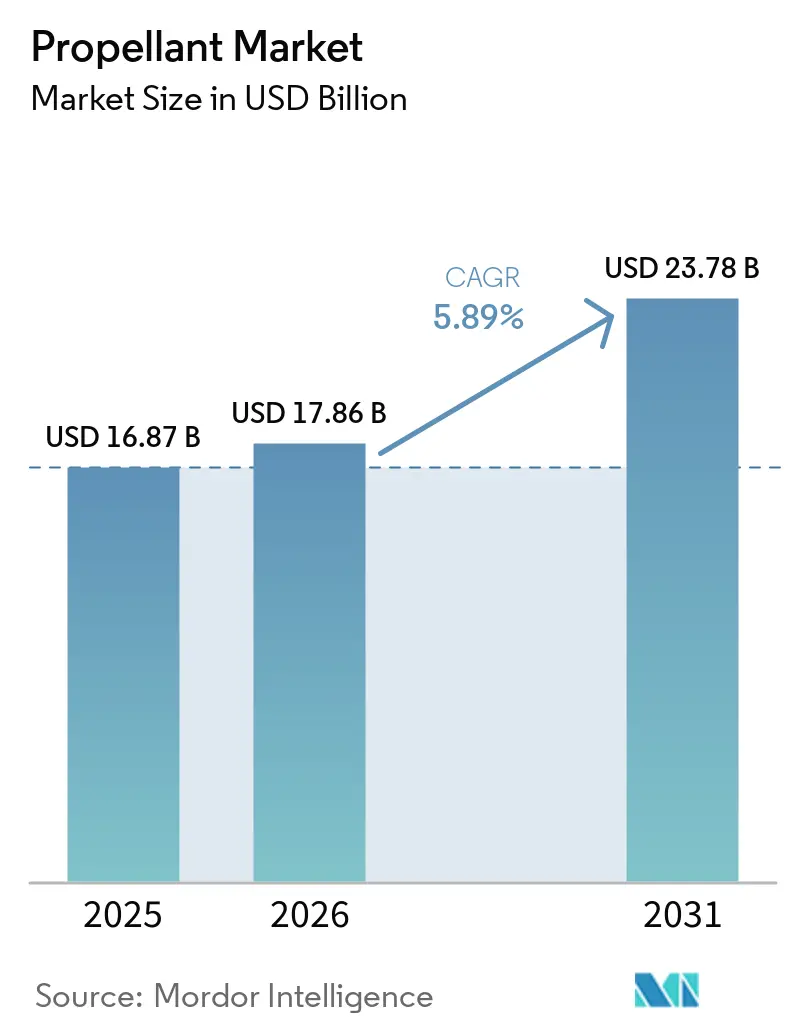
Propellant Market Analysis by Mordor Intelligence
The Propellant Market size was valued at USD 16.87 billion in 2025 and is estimated to grow from USD 17.86 billion in 2026 to reach USD 23.78 billion by 2031, at a CAGR of 5.89% during the forecast period (2026-2031). Commercial satellite constellations, missile modernization programs, and the shift toward lower-toxicity formulations support demand across the propellant market. Launch operators require dependable supplies near launch sites as mission frequency rises, which increases the importance of storage, transport, and on-site production. Defense procurement also supports demand for solid and liquid systems, while automotive airbags and aerosol products provide demand outside aerospace. Established suppliers benefit from qualification records and tested manufacturing capacity, although additive manufacturing and electric propulsion suppliers are changing some purchasing decisions. Export controls, ammonium perchlorate supply concentration, and limited cryogenic infrastructure may constrain delivery schedules even as demand continues to grow.
Key Report Takeaways
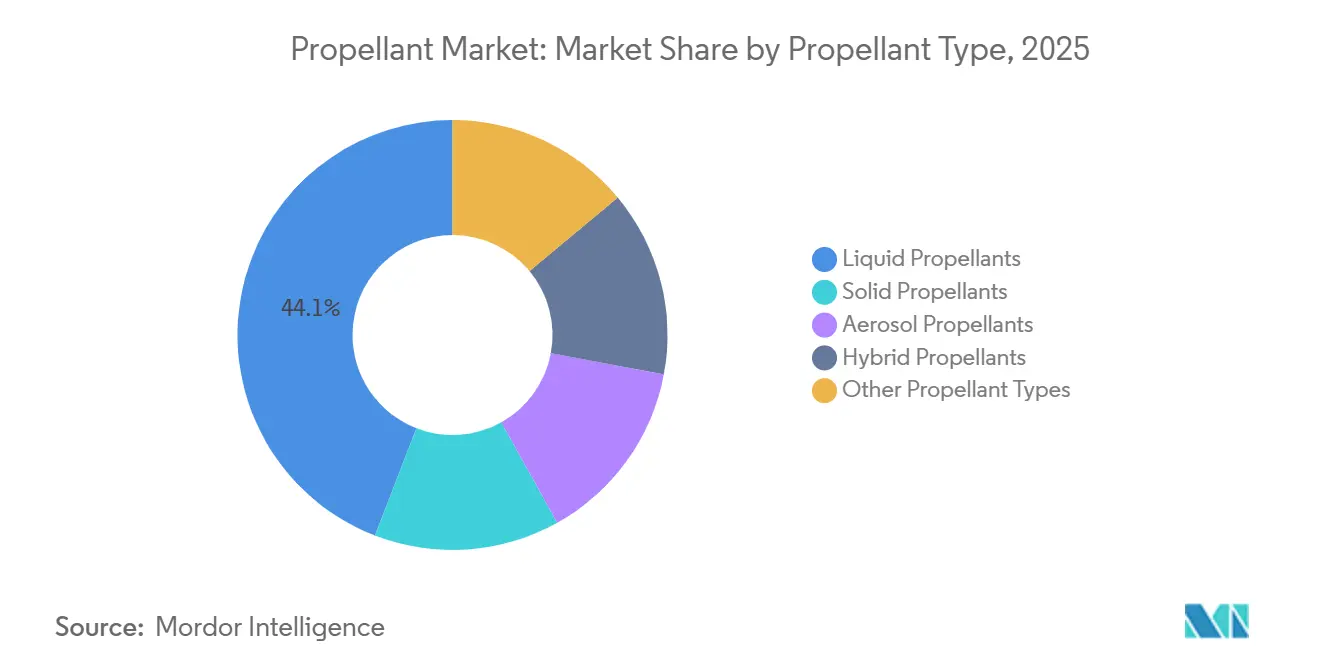
- By propellant type, liquid propellants held 44.13% of the propellant market share in 2025, while hybrid propellants are projected to advance at a 6.73% CAGR through 2031.
- By application, space launch vehicles held 41.38% of the propellant market share in 2025, while satellite propulsion is projected to advance at a 7.05% CAGR through 2031.
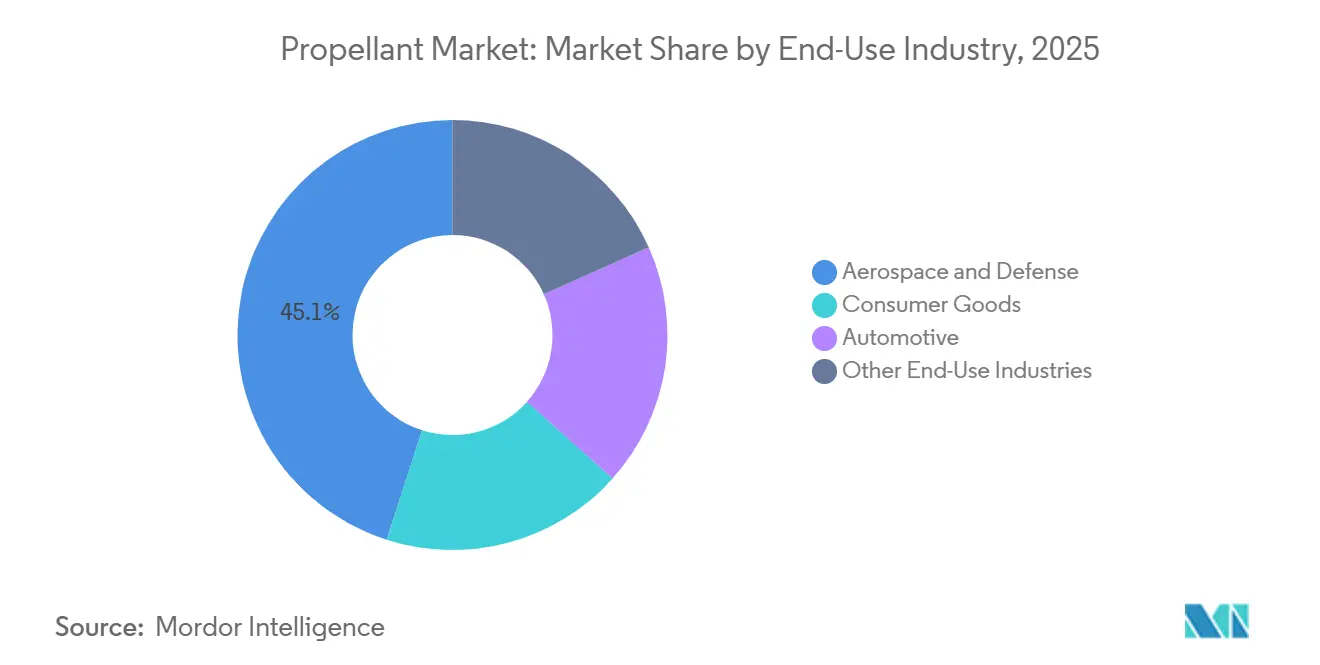
- By end-use industry, aerospace and defense held 45.05% of the propellant market share in 2025 and is projected to advance at a 7.15% CAGR through 2031.
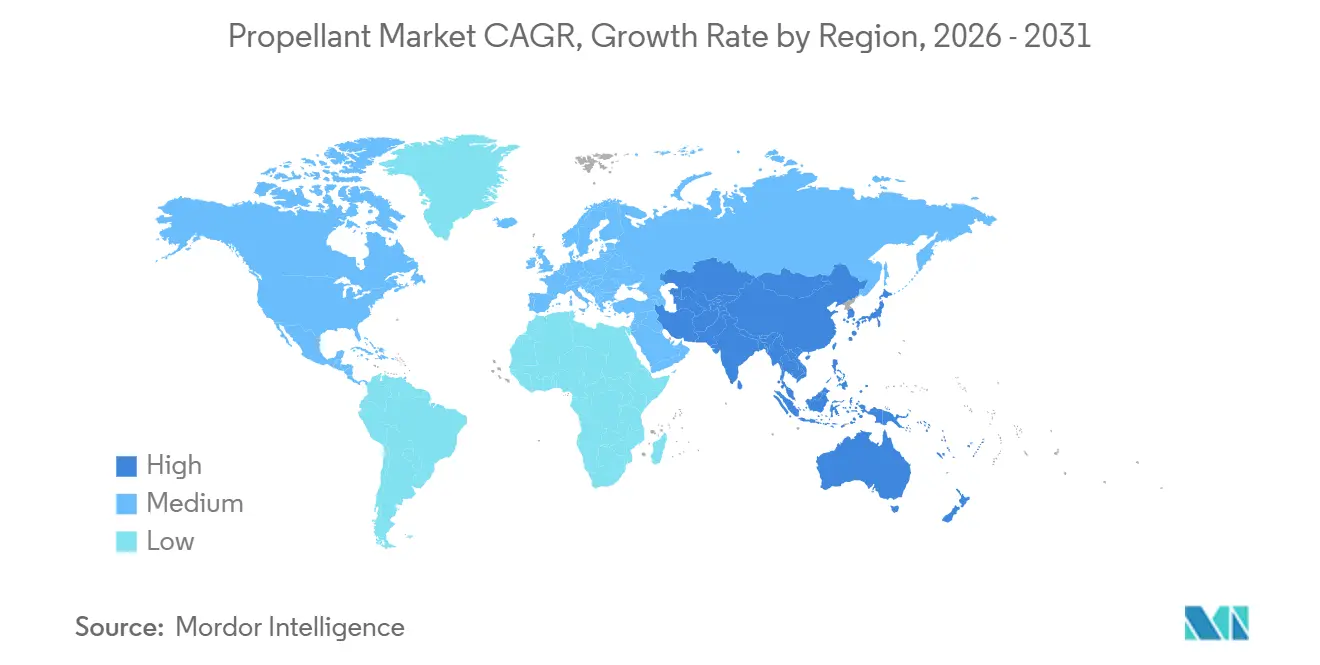
- By geography, North America held 38.27% of the propellant market share in 2025, while Asia-Pacific is projected to advance at a 6.87% CAGR through 2031.
Note: Market size and forecast figures in this report are generated using Mordor Intelligence’s proprietary estimation framework, updated with the latest available data and insights as of January 2026.
Market Trends and Insights
Drivers Impact Analysis of Propellant Market*
| Driver | (~) % Impact on CAGR Forecast | Geographic Relevance | Impact Timeline |
|---|---|---|---|
| Expansion of Commercial Launch and Satellite Constellation Programs | +1.8% | Global | Short term (≤ 2 years) |
| Adoption of Reusable Launch Vehicles and Rapid-Turnaround Operations | +1.3% | Global, led by North America and Asia-Pacific | Medium term (2-4 years) |
| Government-Funded Missile Modernization and Hypersonic Systems | +1.0% | North America, Europe, APAC core | Medium term (2-4 years) |
| Transition Toward Green and Lower-Toxicity Propellants | +0.7% | Global, early gains in North America and Europe | Long term (≥ 4 years) |
| Responsive Spacecraft Maneuvering and In-Orbit Servicing | +0.5% | Global | Medium term (2-4 years) |
| Domestic Propulsion Capacity and Additive Manufacturing Investments | +0.4% | North America, Europe, Asia-Pacific | Long term (≥ 4 years) |
| Source: Mordor Intelligence | |||
Expansion of Commercial Launch and Satellite Constellation Programs
Commercial satellite constellations are increasing launch frequency and creating a more sustained demand base for the propellant market. Amazon Leo secured contracts for more than 100 launches and plans to exceed 20 missions in its second deployment year to meet Federal Communications Commission requirements. China’s Guowang and Qianfan programs target more than 28,000 satellites combined, which has increased the need for launch services and related propellant supply. Launch providers also face greater pressure to secure storage, transport, and processing capacity close to launch sites. Higher launch cadence can make propellant resupply a limiting operational factor, particularly for heavy-lift systems that use large volumes of cryogenic fluids. This need favors suppliers that can integrate production and logistics with launch infrastructure.
Adoption of Reusable Launch Vehicles and Rapid-Turnaround Operations
Reusable launch vehicles can increase propellant throughput because each vehicle can support more frequent missions. SpaceX achieved a 9-day Falcon 9 booster turnaround in 2025, and its commercial operations used 20-30-day turnaround intervals as a regular operating pattern. SpaceX invested more than USD 15 billion in Starship by 2025 and announced a further minimum USD 1.8 billion investment in Florida launchpads, processing facilities, and propellant infrastructure. This investment shows how vehicle reuse can move spending toward high-capacity ground systems and dependable supply arrangements. Linde announced a USD 100 million liquid oxygen and nitrogen facility in Brownsville, Texas, to support Starbase operations. The propellant market, therefore, benefits not only from more launches but also from the infrastructure required to support short turnaround times.
Government-Funded Missile Modernization and Hypersonic Systems
Government investment in hypersonic and precision-strike weapons is supporting multi-year demand for energetic materials. The U.S. Department of Defense requested USD 13.4 billion for procurement and research and development for hypersonic warfare programs in fiscal year 2026. The budget also committed more than USD 7 billion to the Multi-service Advanced Capability Hypersonic Test Bed (MACH-TB) 2.0 hypersonic test infrastructure program over fiscal years 2026-2031. Northrop Grumman entered more than USD 3 billion in framework agreements in August 2026 to accelerate PAC-3 MSE solid rocket motor production and Terminal High Altitude Area Defense (THAAD) component output. Higher solid rocket motor output increases the strategic importance of domestic ammonium perchlorate capacity. The propellant market is also affected because governments seek suppliers that can maintain secure capacity during periods of increased procurement.
Transition Toward Green and Lower-Toxicity Propellants
The cost and handling burden of hydrazine are driving interest in lower-toxicity formulations across commercial and government programs. The National Aeronautics and Space Administration’s Advanced Spacecraft Energetic Non-Toxic propellant delivers a 50% increase in specific impulse density compared with hydrazine. The Green Propulsion Dual Mode mission is planned for launch in late 2026 and will test one Advanced Spacecraft Energetic Non-Toxic propellant tank with catalytic chemical and electrospray electric thrusters on a CubeSat[1]. ArianeGroup and AVIO SPA advanced the GRETA engine, which uses hydrogen peroxide and ethanol, through a first-fire campaign between July and November 2025. Lower hazard classifications can reduce exclusion-zone requirements and allow factory fueling for some ionic-liquid and hydrogen-peroxide-based systems. These operating benefits support reformulation activity in the propellant market as manufacturers develop alternatives to legacy materials.
Restraints Impact Analysis of Propellant Market*
| Restraint | (~) % Impact on CAGR Forecast | Geographic Relevance | Impact Timeline |
|---|---|---|---|
| High Qualification, Safety Testing, and Certification Costs | -1.2% | Global | Short term (≤ 2 years) |
| Cryogenic Infrastructure and Energetic-Material Supply Bottlenecks | -0.9% | Global, most acute in North America | Short term (≤ 2 years) |
| Export Controls and Technology-Transfer Restrictions | -0.6% | Global, most acute for cross-border programs | Medium term (2-4 years) |
| Limited Flight Heritage and Material Compatibility of Alternative Propellants | -0.4% | Global | Long term (≥ 4 years) |
| Source: Mordor Intelligence | |||
High Qualification, Safety Testing, and Certification Costs
Energetic material qualification remains a durable cost barrier in the propellant market. New formulations usually require component testing, system integration validation, and flight heritage before commercial or government programs accept operational risk. The Advanced Spacecraft Energetic Non-Toxic program is targeting Technology Readiness Level 7 through the Green Propulsion Dual Mode mission after earlier work at the U.S. Air Force Research Laboratory. Safety testing also requires specialized facilities, trained personnel, exclusion zones, and extensive hazard documentation. Northrop Grumman and L3Harris Technologies, Inc. retain an advantage because their established qualification portfolios can reduce recertification requirements for new programs. Additive manufacturing entrants may use prior qualification data, but acceptance of 3D-printed propellant geometries remains technically and procedurally demanding.
Cryogenic Infrastructure and Energetic-Material Supply Bottlenecks
High-cadence launch operations are exposing weaknesses in cryogenic logistics and energetic-material supply. SpaceX required more than 200 tanker trucks of liquid oxygen, liquid methane, and liquid nitrogen for a Starship launch, demonstrating the scale of ground supply required for large reusable launch systems. ArianeGroup is expanding ammonium perchlorate production at its Toulouse facility from 5,000 to 8,000 metric tons per year to support European launcher self-sufficiency. National Aeronautics and Space Administration research found that large-scale operational storage of cryogenic propellants in space beyond a single day has not yet been demonstrated. This gap may delay in-space refueling and satellite servicing activity that would otherwise produce recurring demand. Supply resilience is therefore becoming a procurement and national-security consideration for the propellant market.
*Our forecasts treat driver/restraint impacts as directional, not additive. The impact forecasts reflect baseline growth, mix effects, and variable interactions.
Propellant Market Segment Analysis
By Propellant Type:
Liquid Propellants Hold Structural Lead, Hybrid Propellants Gaining AltitudeLiquid propellants held 44.13% of the propellant market share in 2025 because orbital launch vehicles require controllable thrust, restart capability, and high specific impulse. These characteristics support their use in upper stages and in-space propulsion, where mission control requirements are demanding. Solid propellants are used in first-stage boosters, tactical missiles, and airbag inflators. AVIO SPA and ArianeGroup introduced the P160C operationally on Ariane 64 in June 2026, and the booster set carries 156 metric tons of propellant. Aerosol propellants also support consumer goods and pharmaceutical applications, which gives the propellant market demand beyond launch and defense programs.
Hybrid propellants are projected to advance at a 6.73% CAGR through 2031. The National Aeronautics and Space Administration’s Marshall Space Flight Center conducted more than 30 hot-fire tests of a 3D-printed hybrid rocket motor in 2025 for lunar landing plume studies. Firehawk Aerospace also completed a flight test of an additively manufactured Guided Multiple Launch Rocket System-class hybrid engine system under U.S. Army Applications Laboratory support. Ionic-liquid and hydrogen-peroxide-based systems can receive lower hazard classifications than hydrazine under U.S. Air Force Range Safety and Military Standard 882E requirements. Cold-gas, gas-generator, and pyrotechnic formulations continue to support attitude control, automotive safety, and industrial gas-generation uses.

By Application:
Space Launch Vehicles Dominate, While Satellite Propulsion Gains MomentumSpace launch vehicles held 41.38% of the propellant market share in 2025 because orbital missions require substantial propellant mass, especially on heavy-lift vehicles. China’s Long March 10B used domestically sourced liquefied natural gas-derived methane at 98.7% purity in July 2026. The development showed that national supply chains can support liquid oxygen-methane propulsion systems. Missiles and defense systems also require substantial volumes through long-term stockpile and modernization programs. Automotive airbags and safety systems use propellant formulations that include sodium azide alternatives, while aerosol products support personal care, household, and pharmaceutical dispensing.
Satellite propulsion is projected to advance at a 7.05% CAGR through 2031. Exotrail signed supply contracts with Pixxel, Dhruva Space, and XDLINX Space Labs in February 2026 for several dozen spaceware Hall-effect electric propulsion systems. Military customers are also considering spacecraft maneuverability for missions in which satellites change orbit instead of maintaining fixed positions. Busek Co. Inc.’s Dense Orbital Transfer System uses a hybrid engine in a compact package to provide greater thrust than typical electric systems. These requirements support compact chemical propulsion as well as electric systems for satellite operations.
By End-Use Industry:
Aerospace and Defense Dominates Both Share and GrowthAerospace and defense held 45.05% of the propellant market share in 2025 and is projected to advance at a 7.15% CAGR through 2031. Procurement specifications in this end-use industry support the development of green monopropellants, high-energy solid composites, and liquid oxygen-methane systems before they reach adjacent applications. Northrop Grumman plans to triple tactical solid rocket motor production capacity by 2027 and has invested more than USD 2 billion in munitions technologies and manufacturing since 2019. This investment supports the segment’s role in the propellant market as a source of both demand and technical qualification. Government orders can also affect the availability of key energetic materials for commercial customers.
Consumer goods primarily use aerosol propellants such as hydrocarbons, carbon dioxide, and hydrofluoroolefins in personal care, cleaning, and pharmaceutical dispensing. The automotive end-use segment relies on airbag inflators that are moving from sodium azide toward guanidine nitrate and phase-stabilized ammonium nitrate-based propellants. This change reflects vehicle safety requirements and pressure to replace legacy chemistries. Industrial, research, mining, and energy activities use gas generators and pyrotechnic propellants in seismic exploration, oilfield perforating, and emergency safety devices. York Space Systems acquired Orbion Space Technology, and Voyager Technologies acquired ExoTerra Resource, showing that propulsion capability is being treated as a mission-critical asset for future satellite operations.
Geography Analysis
North America Propellant Market
North America held 38.27% of the propellant market share in 2025, supported by the United States defense budget and its high-frequency commercial launch ecosystem. Northrop Grumman plans to triple tactical solid rocket motor production capacity at the Allegany Ballistics Laboratory in West Virginia by 2027. SpaceX’s USD 1.8 billion Florida expansion and Linde’s USD 100 million Brownsville facility indicate the scale of launch-related infrastructure investment. Canada contributes through North Atlantic Treaty Organization commitments and aerospace activity focused on cleaner formulations. Mexico is an emerging downstream manufacturing location for the propellant market.
APAC Propellant Market
Asia-Pacific is projected to advance at a 6.87% CAGR through 2031, the highest regional growth rate in the propellant market. China completed 92 orbital launches in 2025 and is expanding commercial spaceport infrastructure at Hainan. The country expects 2 additional launch pads to become launch-capable by the end of 2026, which may increase liquid-propellant demand. China’s Fifteenth Five-Year Plan for 2026-2030 identifies reusable heavy lift launch vehicles as a national development priority. India’s private space sector is also expanding, with Astrobase Space Technologies unveiling a full-flow staged-combustion liquid oxygen-methane engine producing 800 kilonewtons of thrust.
EMEA and South America Propellant Market
Europe’s propellant market is supported by the Ariane 6 program and its industrial ecosystem. Europropulsion, a 50-50 joint venture of ArianeGroup and AVIO SPA, qualified the P160C in December 2025 and introduced it operationally in June 2026. ArianeGroup is expanding Toulouse ammonium perchlorate capacity by more than 60% as launch rates rise. South America is associated with Brazil’s commercial space plans and Argentina’s defense modernization activity. The Middle-East and Africa are supported by Saudi Arabia’s Vision 2030 aerospace investments and South Africa’s defense industrial base.
Competitive Landscape
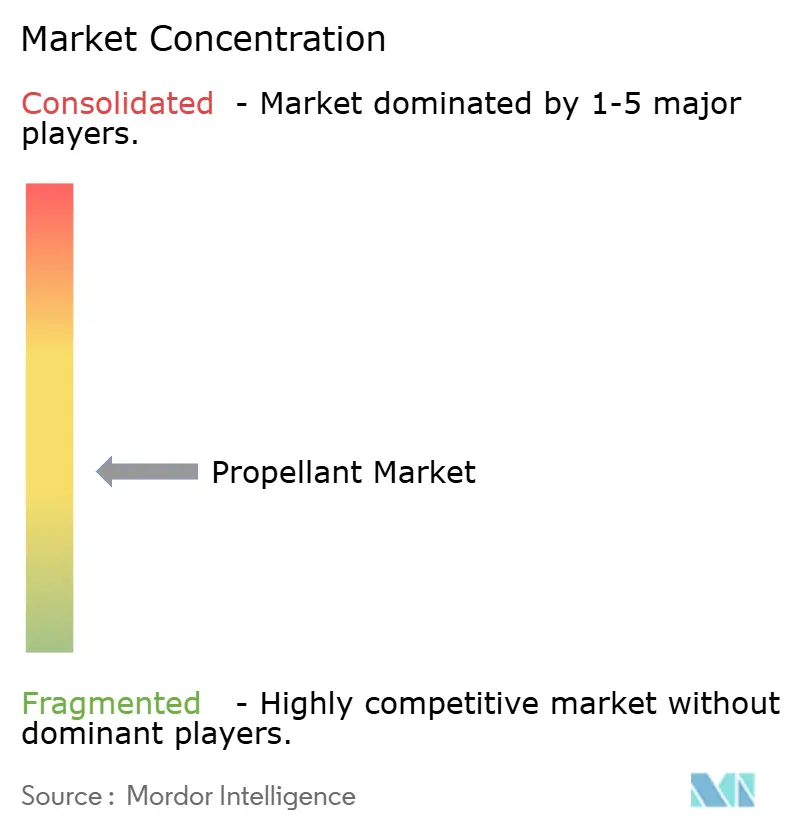
The propellant market is moderately concentrated, with the top five players including Northrop Grumman, L3Harris Technologies, Inc., Safran S.A., Nammo AS, and Avio S.p.A. Propulsion acquisitions by satellite prime contractors show that propulsion is becoming a strategic capability in constellation bids. York Space Systems acquired Orbion Space Technology, while Voyager Technologies acquired ExoTerra Resource. Northrop Grumman’s August 2026 agreements to expand PAC-3 MSE and THAAD production show how large contractors are adding capacity around established missile programs. Firehawk Aerospace also received strategic investment from Hanwha Defense USA in November 2025 to advance solid rocket motor technology and full-rate production[2].
Satellite propulsion remains more fragmented because customers evaluate chemical and electric systems for different mission requirements. Moog Inc. offers chemical monopropellant, bipropellant, and electric propulsion systems. Exotrail had a backlog of more than 150 spaceware propulsion units and opened a 1,300-square-meter industrial facility in 2025. Nammo AS received a Raytheon development contract for the MK 72 solid rocket motor in April 2025, reflecting dual-sourcing efforts in U.S. Navy missile supply chains. These arrangements give governments additional supply options while maintaining high qualification requirements. The propellant market is, therefore, shaped by supplier resilience as well as price and performance.
Propellant Industry Leaders
-
Northrop Grumman
-
L3Harris Technologies, Inc.
-
Safran S.A.
-
Nammo AS
-
AVIO SPA
- *Disclaimer: Major Players sorted in no particular order
Propellant Market Companies Covered in this Report
- ArianeGroup
- AVIO SPA
- Blue Origin Enterprises, L.P.
- Busek Co. Inc.
- Exotrail
- IHI AEROSPACE Co., Ltd.
- L3Harris Technologies, Inc.
- Lockheed Martin Corporation
- Moog Inc.
- Nammo AS
- Northrop Grumman
- Safran S.A.
- SpaceX
- Ursa Major Technologies, Inc.
Recent Industry Developments in Propellant Market
- August 2026: India-based Astrobase Space Technologies unveiled EVEREST, an 800 kN vacuum thrust full-flow staged combustion methalox engine that routes 100% of both liquid oxygen and methane through dual pre-burners. This development made India the fourth nation, after the United States, Russia, and China, to develop this architecture, with methane chosen as the propellant due to its compatibility with reusable systems.
- August 2026: Northrop Grumman signed two 7-year framework agreements with the U.S. Department of Defense and Lockheed Martin. The deals included a USD 2 billion contract to serve as a second production source for PAC-3 MSE solid rocket motors and a USD 1 billion pact to quadruple Terminal High Altitude Area Defense (THAAD) component manufacturing, driving demand for propellants.
Global Propellant Market Report Scope
Propellants are energy-releasing substances that produce gases or thrust through controlled chemical reactions, enabling propulsion, pressure generation, and rapid gas release. They are used in applications ranging from space and defense systems to automotive safety, consumer products, and industrial processes.
The Propellant Market is segmented by propellant type, application, end-use industry, and geography. By propellant type, the market is segmented into liquid propellants, solid propellants, aerosol propellants, hybrid propellants, and other propellant types (cold-gas propellants, gas-generator and pyrotechnic propellants). By application, the market is segmented into space launch vehicles, missiles and defense systems, satellite propulsion, automotive airbags and safety systems, aerosol products, and other applications (industrial gas generators and pyrotechnics). By end-use industry, the market is segmented into aerospace and defense, consumer goods, automotive, and other end-use industries (industrial, research, mining and energy). The report also covers the market size and forecasts for propellants in 16 countries across major regions. For each segment, the market sizing and forecasts have been done on the basis of value (USD).
Segmentation Overview
| Liquid Propellants |
| Solid Propellants |
| Aerosol Propellants |
| Hybrid Propellants |
| Other Propellant Types (Cold-Gas Propellants, Gas-Generator and Pyrotechnic Propellants) |
| Space Launch Vehicles |
| Missiles and Defense Systems |
| Satellite Propulsion |
| Automotive Airbags and Safety Systems |
| Aerosol Products |
| Other Applications (Industrial Gas Generators and Pyrotechnics) |
| Aerospace and Defense |
| Consumer Goods |
| Automotive |
| Other End-Use Industries (Industrial, Research, Mining and Energy) |
| Asia-Pacific | China |
| India | |
| Japan | |
| South Korea | |
| ASEAN Countries | |
| Rest of Asia-Pacific | |
| North America | United States |
| Canada | |
| Mexico | |
| Europe | Germany |
| United Kingdom | |
| France | |
| Italy | |
| NORDIC Countries | |
| Russia | |
| Rest of Europe | |
| South America | Brazil |
| Argentina | |
| Rest of South America | |
| Middle-East and Africa | Saudi Arabia |
| South Africa | |
| Rest of Middle-East and Africa |
| By Propellant Type | Liquid Propellants | |
| Solid Propellants | ||
| Aerosol Propellants | ||
| Hybrid Propellants | ||
| Other Propellant Types (Cold-Gas Propellants, Gas-Generator and Pyrotechnic Propellants) | ||
| By Application | Space Launch Vehicles | |
| Missiles and Defense Systems | ||
| Satellite Propulsion | ||
| Automotive Airbags and Safety Systems | ||
| Aerosol Products | ||
| Other Applications (Industrial Gas Generators and Pyrotechnics) | ||
| By End-Use Industry | Aerospace and Defense | |
| Consumer Goods | ||
| Automotive | ||
| Other End-Use Industries (Industrial, Research, Mining and Energy) | ||
| By Geography | Asia-Pacific | China |
| India | ||
| Japan | ||
| South Korea | ||
| ASEAN Countries | ||
| Rest of Asia-Pacific | ||
| North America | United States | |
| Canada | ||
| Mexico | ||
| Europe | Germany | |
| United Kingdom | ||
| France | ||
| Italy | ||
| NORDIC Countries | ||
| Russia | ||
| Rest of Europe | ||
| South America | Brazil | |
| Argentina | ||
| Rest of South America | ||
| Middle-East and Africa | Saudi Arabia | |
| South Africa | ||
| Rest of Middle-East and Africa | ||
Key Questions Answered in the Report
What is the size of the propellant market?
The propellant market stands at USD 17.86 billion in 2026 and is projected to reach USD 23.78 billion by 2031.
What is driving demand for propellants?
Commercial satellite constellations, reusable launch operations, missile modernization, and lower-toxicity formulations are supporting demand.
Which propellant type held the largest share in 2025?
Liquid propellants held 44.13% of the propellant market share in 2025 because of their role in orbital launch vehicles and in-space propulsion.
Which application is expected to grow the fastest through 2031?
Satellite propulsion is projected to advance at a 7.05% CAGR through 2031 as constellation operators and military customers invest in maneuverability.