
Professional Indemnity Insurance Market Size and Share
Market Overview
| Study Period | 2020 - 2031 |
|---|---|
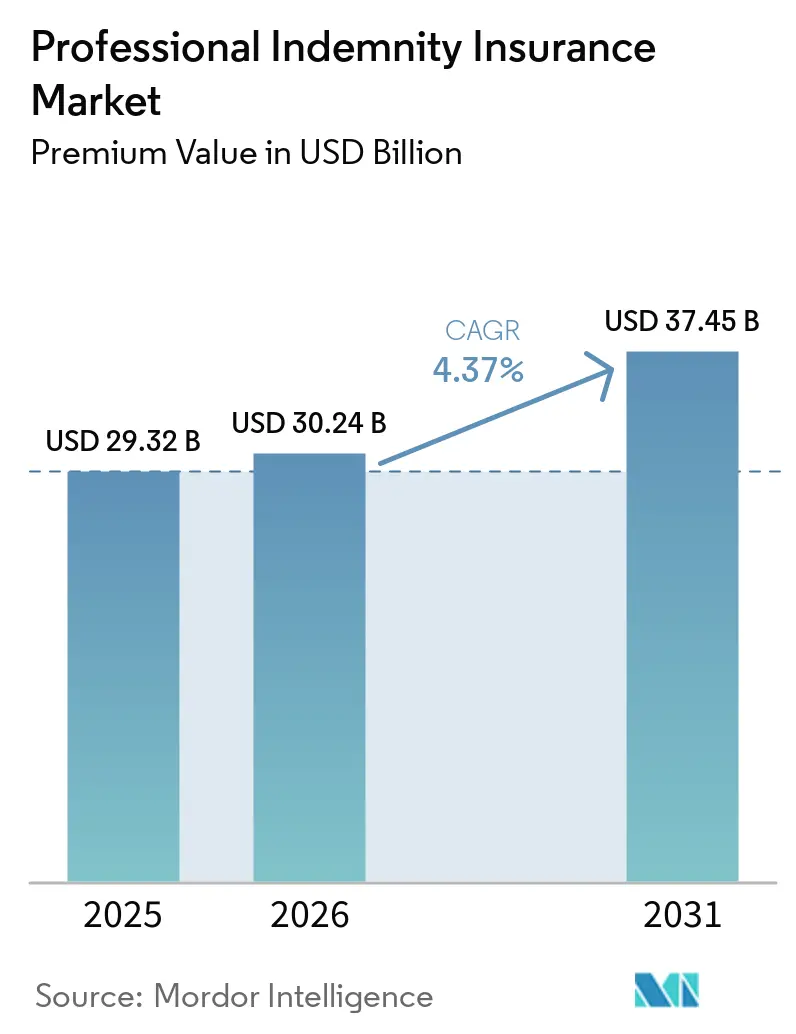
| Market Size (2026) | USD 30.24 Billion |
| Market Size (2031) | USD 37.45 Billion |
| Growth Rate (2026 - 2031) | 4.37 % |
| Fastest Growing Market | Asia-Pacific |
| Largest Market | North America |
| Market Concentration | High |
Major Players *Disclaimer: Major Players sorted in no particular order Image © Mordor Intelligence. Reuse requires attribution under CC BY 4.0. | |
Professional Indemnity Insurance Market Analysis by Mordor Intelligence
The professional indemnity insurance market size is projected to expand from USD 29.3 billion in 2025 and USD 30.2 billion in 2026 to USD 37.5 billion by 2031, registering a CAGR of 4.4% between 2026 and 2031. Statutory coverage requirements, a larger professional-services base, and a wider range of liability exposures support the professional indemnity insurance market. Technology errors and omissions, cyber-related professional claims, and advisory work supported by AI are adding demand beyond established lines. Rate declines in mature classes reduce premium growth even where the insured exposure base is increasing. This setting favors insurers that can define coverage clearly, protect long-tail reserves, and reach smaller firms through lower-cost digital distribution.
Key Report Takeaways
- By product type, miscellaneous or general professional indemnity held 47.9% of the professional indemnity insurance market share in 2025, while technology professional indemnity is projected to grow at a 6% CAGR through 2031.
- By profession of the insured, legal services held 21.8% of the professional indemnity insurance market share in 2025, while IT, software, SaaS, and managed services are projected to grow at a 6.1% CAGR through 2031.
- By insured-firm size, SMEs held 54.7% of the professional indemnity insurance market share in 2025 and are projected to grow at a 4.8% CAGR through 2031.
- By distribution channel, insurance brokers held 65% of the professional indemnity insurance market share in 2025, while direct insurer distribution is projected to grow at a 7.2% CAGR through 2031.
- By policy structure, annual practice claims-made policies held 87.6% of the professional indemnity insurance market share in 2025, while project-specific professional indemnity is projected to grow at a 5.6% CAGR through 2031.
- By geography, North America held 46.1% of the professional indemnity insurance market share in 2025, while Asia-Pacific is projected to grow at a 6.4% CAGR through 2031.
Note: Market size and forecast figures in this report are generated using Mordor Intelligence’s proprietary estimation framework, updated with the latest available data and insights as of January 2026.
Market Trends and Insights
Drivers Impact Analysis of Professional Indemnity Insurance Market*
| Driver | (~) % Impact on CAGR Forecast | Geographic Relevance | Impact Timeline |
|---|---|---|---|
| Statutory, Regulatory, and Contractual Requirements | +0.9% | Global, with pressure in the United Kingdom, Australia, Singapore, India, the EU, and China | Medium term (2-4 years) |
| Claims, Client Expectations, and Litigation Complexity | +0.8% | North America and Europe, with expansion into Asia-Pacific | Long term (≥ 4 years) |
| AI, Digitalization, and Technology Liability | +0.7% | Global, with early activity in North America and the United Kingdom | Short term (≤ 2 years) |
| Expansion of Professional Services and Liability Exposures | +0.6% | Asia-Pacific and the Middle East and Africa | Long term (≥ 4 years) |
| Convergence of Cyber, Privacy, and Liability Risks | +0.5% | Global, shaped by European and Asia-Pacific data rules | Medium term (2-4 years) |
| Outsourcing and External Service Providers | +0.4% | Asia-Pacific, with spillover into the Middle East and Africa | Medium term (2-4 years) |
| Source: Mordor Intelligence | |||
Statutory and Contractual Mandates Create Structurally Inelastic Demand
Professional indemnity requirements in licensing rules create demand that is less sensitive to normal pricing cycles. The Solicitors Regulation Authority requires qualifying insurance of GBP 3 million (USD 4 million) per claim for incorporated practices and GBP 2 million (USD 2.7 million) for unincorporated practices[1]. Its minimum terms framework gives policyholders extensive protection and keeps insurance central to legal-practice compliance. ASIC identifies PI insurance as the primary compensation arrangement for Australian Financial Services License holders, while AHPRA links compliant indemnity arrangements to health-practitioner registration. Australia extended anti-money-laundering obligations to accountants, lawyers, and real estate professionals from July 1, 2026, which brings more professional groups into regulated activity. China also increased the maximum aggregate liability ceiling for qualifying accounting firms from CNY 50 million (USD 7 million) to CNY 100 million (USD 14 million), effective January 1, 2027, which raises the coverage requirement for affected audit firms.
Rising Claims and Litigation Complexity Reprice Long-Tail Reserves
Claims frequency across several professional indemnity classes remained broadly stable in 2026; however, increasing claim severity and higher loss amounts continued to place pressure on insurers’ overall loss costs. This divergence between relatively stable claim volumes and rising individual claim costs can result in loss costs increasing faster than renewal pricing, particularly for long-tail claims that remain open for extended periods. In Australia, professional indemnity insurance recorded a loss ratio of 62.4% and a net combined ratio of 87.8% as of May 2026, despite continued competitive pricing conditions. In the United States, the legal professional liability segment recorded a combined ratio of 107% in 2025, with loss-adjustment expenses also exceeding those observed in the broader commercial casualty segment. In addition, litigation financing can contribute to prolonged disputes and higher settlement expectations, increasing uncertainty around reserve development for legal, advisory, construction, and other long-tail professional risks. Consequently, the professional indemnity insurance market increasingly requires pricing and reserving strategies that reflect claim severity and loss-cost trends, rather than relying solely on changes in claim frequency.
AI and Digitalization Introduce New Liability Triggers
Generative AI can create a professional-liability trigger when unverified output is used in a client deliverable. In 2025, the High Court of England and Wales considered submissions that included fictitious legal authorities generated with AI, and referred the relevant barrister and solicitors to their regulators[2]. CFC introduced affirmative AI wording across 7 policy lines in June 2026, including wording on model hallucination, AI-generated content, and model drift. This approach replaces uncertainty over silent coverage with stated terms that policyholders and insurers can assess before a claim. Other policy forms exclude AI-related exposures, which leaves a clear difference between policies that affirm coverage and policies that do not. Professional firms using AI agents may also be assessed as technology risks where financial loss arises from a technology service failure instead of a professional judgment error.
Professional Services Expansion Creates New Liability Verticals
Growth in ESG advisory, outsourced compliance, and independent contracting creates exposures that general liability coverage may not address. Manufacturers that add advisory services can take on professional obligations that sit outside traditional casualty arrangements. CFC reported that 1 in 3 of its professional-liability clients also bought cyber coverage, showing the overlap between advice, technology, and data risks[3]. In Australia, advisers involved in sustainability reporting and financial disclosure appeared in PI claim notifications during the first half of 2026. The notifications were connected to IFRS S1 and S2 implementation errors and ESG data misrepresentation. Economic pressure can also lead clients to seek recovery for business losses through PI policies, which requires careful assessment of the policy trigger and available evidence.
Restraints Impact Analysis of Professional Indemnity Insurance Market*
| Restraint | (~) % Impact on CAGR Forecast | Geographic Relevance | Impact Timeline |
|---|---|---|---|
| Softening Rates and Specialty Capacity | -0.7% | Global, especially the United Kingdom, Australia, and United States specialty lines | Short term (≤ 2 years) |
| Claims Severity, Legal-Cost Inflation, and Social Inflation | -0.6% | North America, followed by the United Kingdom and Australia | Long term (≥ 4 years) |
| Coverage Ambiguity and Silent Cyber or AI Exposure | -0.4% | Global, particularly jurisdictions with evolving AI rules | Medium term (2-4 years) |
| Limited AI Loss Data and Pricing Uncertainty | -0.3% | Global, with emphasis on technology-intensive markets | Medium term (2-4 years) |
| Source: Mordor Intelligence | |||
Softening Rates and Abundant Specialty Capacity Compress Premium Growth
Rate softening limits written-premium growth even when the number and complexity of insured exposures are increasing. United Kingdom reported professional indemnity rate reductions of 25% to 30% in the fourth quarter of 2025 for well-managed risks, as new capacity widened terms and lowered deductibles. Australian PI gross written premium also fell as rate reductions exceeded new-business growth. The United States professional E&O market in the second quarter of 2026 included new MGA entrants, competitive pricing from established insurers, and broader terms for standard risks. Ambiguous cyber and AI exposures make this cycle harder to manage because insurers may price a policy before the full scope of its technology exposure is clear. Limited loss history for emerging AI risks adds another constraint because underwriters have less evidence for rating, wording, and reserve decisions.
Social Inflation and Legal-Cost Escalation Burden Underwriting Profitability
Rising claim severity is placing sustained pressure on reserve adequacy and pricing within the professional indemnity insurance market, particularly given the long-tail nature of professional liability exposures. Increasing litigation costs, legal-system abuse, and the growing prevalence of high-value jury awards are contributing to higher ultimate claim costs, with severity increasingly emerging as a more significant driver of loss development than claim frequency. Larger verdicts can also influence settlement expectations, increasing insurers’ costs even where claims are resolved before trial and creating greater uncertainty around the adequacy of existing reserves. Consequently, insurers need to maintain disciplined underwriting, prudent reserving, and risk-reflective pricing to account for evolving litigation trends and loss-cost inflation, particularly in a market where abundant capacity may otherwise intensify competitive pricing pressure.
*Our forecasts treat driver/restraint impacts as directional, not additive. The impact forecasts reflect baseline growth, mix effects, and variable interactions.
Professional Indemnity Insurance Market Segment Analysis
By Product Type:
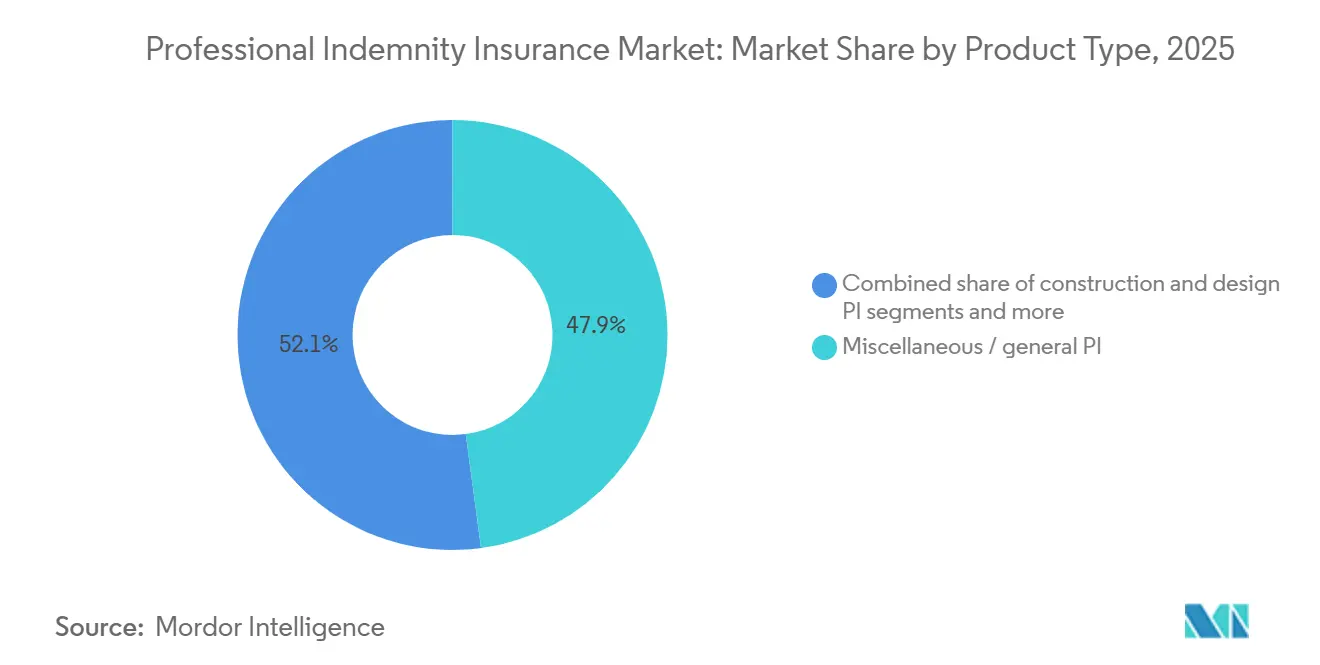
Technology E&O Changes Miscellaneous Policy ArchitectureMiscellaneous/general professional indemnity held 47.9% of the professional indemnity insurance market share in 2025 by product type, giving it the largest professional indemnity insurance market share in the category. Its scale reflects policy forms that historically served many professions under broadly similar wording and contributed significantly to the overall professional indemnity insurance market size. That structure faces pressure as the risks attached to each profession become more distinct. Technology professional indemnity is projected to grow at a 6% CAGR through 2031. The professional indemnity insurance market size for this product is supported by AI-assisted legal research, agentic software, and language-model-enabled financial analysis. These services can create loss scenarios that older technology E&O forms did not anticipate.
Construction and design PI and financial professionals also retain material positions within the product mix. Construction claims in 2026 remain linked to design defects, water ingress, cladding liability, and structural certification disputes. Those matters can develop over extended periods and can make reserve outcomes less predictable. As technology PI is written on more dedicated forms, the residual miscellaneous category may contain a higher proportion of unusual or difficult risks. That shift can reduce the predictability that once supported its loss experience. Insurers in the professional indemnity insurance market are therefore separating risks by service type, technology use, contractual commitments, and expected claim pathway. The result is a more specialized product mix, even when the broad miscellaneous form remains the largest source of premium.

By Profession of the Insured:
IT and SaaS Firms Outpace Other Professional CohortsLegal services held 21.8% of the professional indemnity insurance market share in 2025 by profession, which was the largest professional indemnity insurance market share in this segmentation. Mandatory insurance across the United Kingdom, Singapore, Australia, and major European Union markets supports the segment's premium base. Legal practices also need continuous cover because claims can arise after the underlying work has been completed. IT, software, SaaS, and managed services are projected to grow at a 6.1% CAGR through 2031. The category combines technology delivery with professional advice in managed-service contracts, software agreements, and AI-enabled consulting. This combination increases demand for policies that address both service errors and technology-related financial loss and supports the professional indemnity insurance market size.
Architecture, engineering, surveying, and accountancy retain substantial participation in the professional indemnity insurance market. Accounting firms face added coverage pressure from financial-disclosure requirements and ESG audit work. Australian notifications related to sustainability reporting errors during the first half of 2026 show how new reporting duties can become a source of claims. Real estate and property management, media, advertising, public relations, education, and training also face changing exposures. Technology-supported delivery and ESG-related advice can create allegations outside traditional errors-and-omissions patterns. Firms using AI agents for client work may move from a professional-service classification into a technology-company classification. In that case, Tech E&O rather than standard PI may become the principal policy response, and profession data may not fully show that premium migration.
By Insured-Firm Size:
SME Digital Access Reshapes Coverage EconomicsSMEs held 54.7% of the professional indemnity insurance market share in 2025 by firm size, which was the leading professional indemnity insurance market share for this segmentation. They are also projected to grow at a 4.8% CAGR through 2031. Digital acquisition is the main factor behind this combination of scale and growth. Online placement can reduce the cost of selling standardized coverage to smaller businesses. Policies below USD 7,500 in premium can become economically practical for carriers when the acquisition process is automated. The underlying opportunity is therefore linked to transaction efficiency rather than only larger policy limits and contributes to the professional indemnity insurance market size.
Sole practitioners still have a meaningful coverage gap. Many work under client contracts that require PI, but non-regulated professions do not always face mandatory insurance standards. Large firms hold higher individual policy limits and operate more complex multiyear programs. This is particularly relevant to legal and financial services, where excess layers above USD 100 million are actively competed for in the current capacity cycle. Major insurers have moved into digital SME placement through platforms, reflecting an effort to capture volume at a lower acquisition cost. The professional indemnity insurance industry is adapting its underwriting and distribution model to support this smaller-business demand. The shift may widen access to insurance while leaving specialist, high-limit placements dependent on more tailored underwriting.
By Distribution Channel:
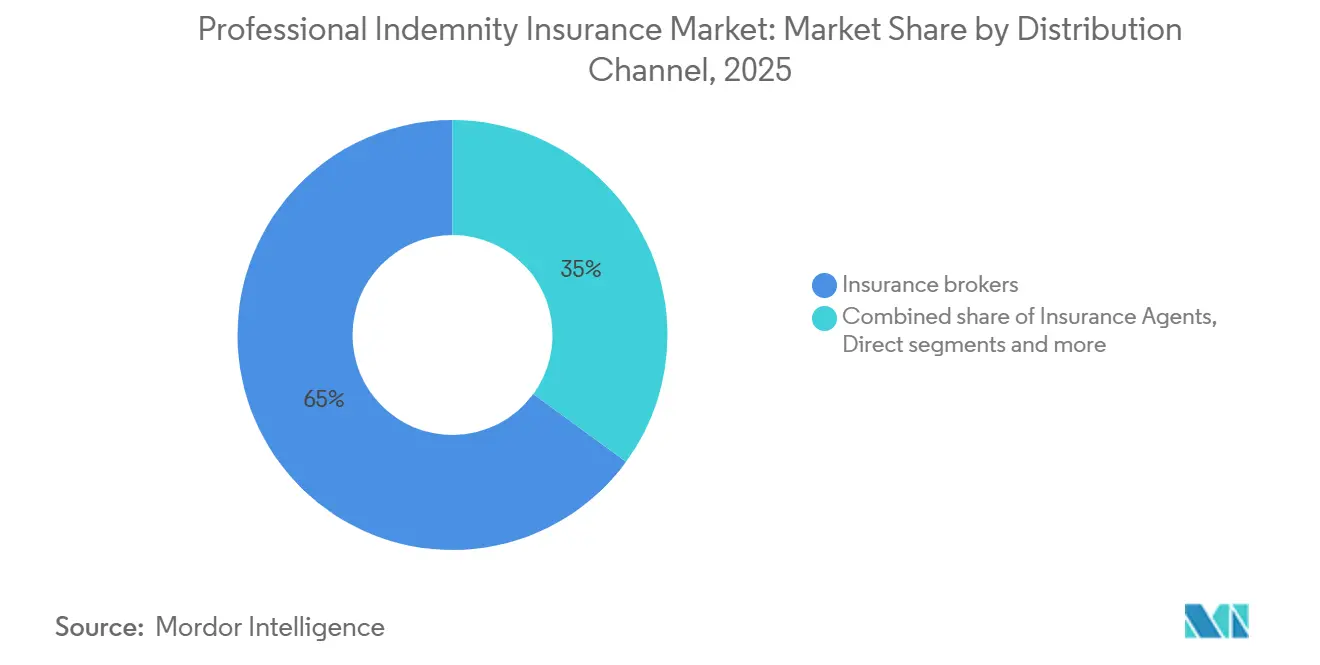
Direct Digital Placement Changes Broker-Led DistributionInsurance brokers held 65% of the professional indemnity insurance market share in 2025 by distribution channel, making them the largest route to market. Their position is strongest in higher-limit and more complex placements for mid-market and large professional-services clients. These policies require attention to wording, exclusions, aggregate structures, and specialist advice. Direct insurer distribution is projected to grow at a 7.2% CAGR through 2031. Standardized SME policies are moving to digital-first platforms where quoting and binding can be completed with less manual work. This makes direct and direct-adjacent channels more attractive for simpler risks and supports the professional indemnity insurance market size.
Digital placement does not remove the need for brokers in complicated risks. Instead, electronic trading tools can shorten placement cycles and reduce the administrative portion of broker work. That can change the commission value attached to routine SME placements. The input described carrier launches on e-trade systems that serve a broad broker base, showing that insurers are using digital routes alongside broker relationships. Lloyds-backed programs also offer small firms direct professional liability cover with rapid binding. The professional indemnity insurance market is becoming more accessible for smaller buyers through these arrangements. Broker expertise remains important where clients need higher limits, negotiated terms, or advice on gaps between PI, cyber, and technology coverage.
By Policy Structure:
Project-Specific PI Meets Defined Engagement DemandAnnual practice claims-made policies held 87.6% of the professional indemnity insurance market share in 2025 by policy structure, making them the standard form of continuous coverage. Professional bodies and regulators often treat annual cover as the expected arrangement for regulated professions. The structure fits practices that need ongoing protection across a changing book of client work. Project-specific PI is projected to grow at a 5.6% CAGR through 2031. It is used in construction, infrastructure, and specialist advisory work where coverage must match a defined engagement. This approach can give clients greater confidence that the relevant project period and contractual requirements are addressed and support the professional indemnity insurance market size.
Run-off and extended-reporting-period policies retain a stable role. They support retirement and wind-down situations in legal and accountancy practices, where claims can be reported after work stops. Insurers are developing more standardized run-off approaches for these needs. Project-specific cover also reflects growing professional requirements in Southeast Asia and the Gulf. Engineering and consulting firms working on cross-border infrastructure can need PI to meet project-finance conditions. The professional indemnity insurance market size for project-specific cover is therefore supported by both construction activity and contractual risk transfer. Annual practice cover remains the main format, but defined engagements are creating a distinct area of coverage demand.
Geography Analysis
North America Professional Indemnity Insurance Market
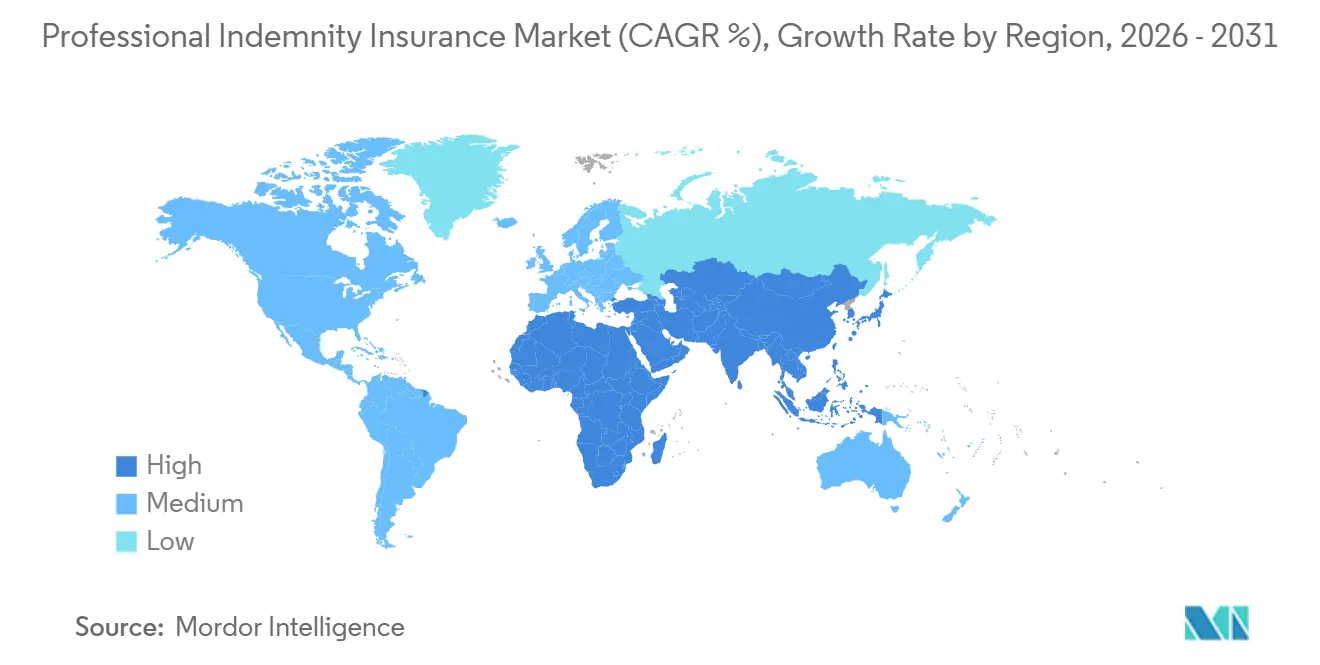
North America held 46.1% of the professional indemnity insurance market share in 2025, giving the region the largest professional indemnity insurance market share. The United States is the dominant national market because of its litigation environment and sector-specific requirements for healthcare, financial services, and legal practice. New MGA entrants intensified competition and pricing pressure for standard professional E&O risks in the second quarter of 2026. Established carriers also matched prices and broadened terms in several classes. Canada is supported by professional-body insurance schemes for legal, engineering, and financial advisory work. Mexico remains less developed because professional licensing and litigation incentives are less extensive. The region's scale contributes significantly to the professional indemnity insurance market size.
United States Professional Indemnity Insurance Market
North America's scale also creates exposure to social inflation. United States awards above USD 10 million increased sharply between 2020 and 2024, alongside more than 130 nuclear verdicts worldwide. Higher severity can put pressure on PI reserve adequacy even when primary pricing remains soft. That pressure could lead to firmer pricing after 2026 if insurers become more selective in higher-exposure classes. The professional indemnity insurance market in the region consequently combines strong premium depth with a material long-tail profitability risk.
Europe Professional Indemnity Insurance Market
Europe is the second-largest regional bloc, and the United Kingdom remains its most developed PI market. United Kingdom rate reductions of 25% to 30% in the fourth quarter of 2025 show the effect of increased MGA and insurer capacity for well-managed risks. Germany, France, and Italy maintain profession-specific PI requirements for legal, medical, and financial advisers, which supports continuing demand. The United Kingdom Renters Rights Act 2025 took effect on May 1, 2026, and is linked to PI notifications involving letting agents and property managers.
APAC, South America and MEA Professional Indemnity Insurance Market
Asia-Pacific is the fastest-growing geography at a 6.4% CAGR through 2031. China's revised accounting-firm rules will increase the maximum qualifying aggregate coverage from CNY 50 million (USD 7 million) to CNY 100 million (USD 14 million) in 2027.[4] India is changing distribution rules. South America, the Middle East, and Africa remain smaller contributors, but legal, engineering, audit, and financial-advisory requirements are creating supported demand in Brazil, Saudi Arabia, and the UAE.
Competitive Landscape
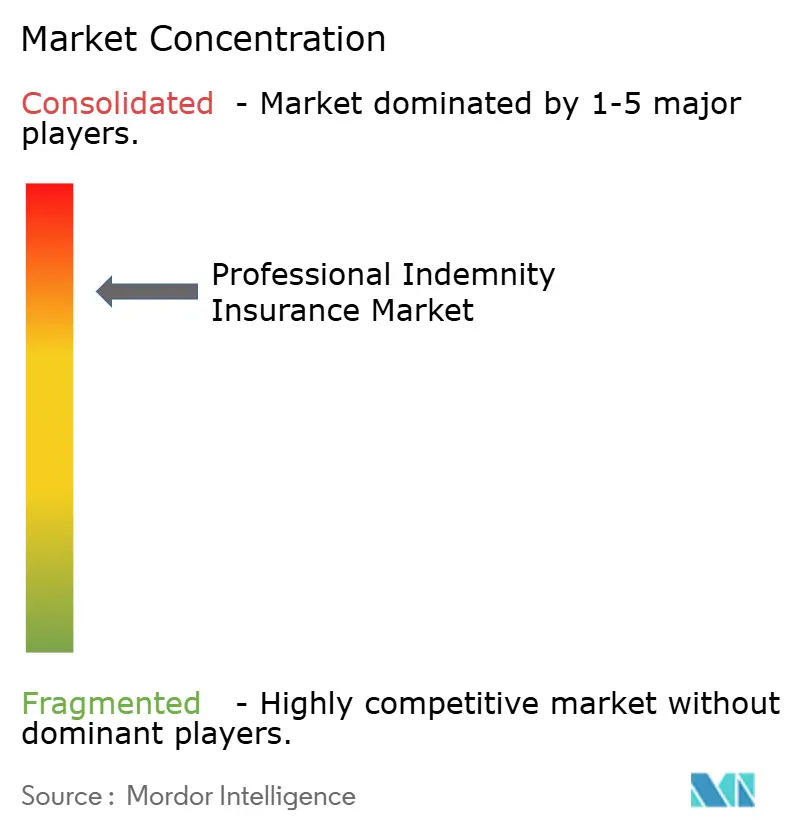
The professional indemnity insurance market is concentrated among leading global specialty writers, while the remainder is fragmented across Lloyd's syndicates, MGAs, and regional carriers. Chubb, AIG, Allianz Commercial, AXA XL, and Zurich compete strongly for large accounts and regulated professions. Smaller specialists compete through niche underwriting, product design, and distribution access. Competition is based on underwriting expertise, policy wording, capacity, specialist claims handling, and the ability to serve both large and smaller professional firms.
Zurich agreed to acquire Beazley for GBP 8.1 billion (USD 10.8 billion) in March 2026. The combined platform is expected to write USD 15 billion in pro forma specialty gross written premiums, and Zurich identified USD 1 billion in potential revenue synergies from cross-selling. This transaction shows the use of consolidation to build specialty scale while pricing remains competitive. AIG completed a 35% stake acquisition in Convex Group for USD 2.1 billion in February 2026 and entered a whole-account quota share for Convex's specialty book. This approach adds underwriting capacity through a partnership rather than a full acquisition. These moves show different ways that large insurers can add specialty capabilities and distribution reach.
Technology is also changing how participants compete in the Professional indemnity insurance market. CFC introduced affirmative AI wording across 7 lines in June 2026, covering model hallucination, AI-generated content, and model drift. Clear wording can help distinguish a policy where clients face uncertainty over AI-related claims. Digital systems also support faster placement for standardized business, while specialists continue to focus on underserved financial planning, private-credit, and advisory risks. This creates a divided competitive model, with automated distribution for simpler placements and specialist underwriting for more complex exposures. The Professional indemnity insurance industry retains room for MGAs and regional writers because many risks need narrow expertise rather than only balance-sheet scale. No concentration score is assigned because the supplied material does not quantify combined shares for the leading insurers.
Professional Indemnity Insurance Industry Leaders
-
AIG
-
Allianz
-
AXA XL
-
Beazley
-
Chubb
- *Disclaimer: Major Players sorted in no particular order
Professional Indemnity Insurance Market Companies Covered in this Report
- AIG
- Allianz
- AXA XL
- Beazley
- Chubb
- CNA Financial
- Zurich Insurance Group
- Travelers
- Liberty Mutual
- QBE Insurance Group
- Swiss Re Corporate Solutions
- W. R. Berkley Corporation
- Everest Insurance
- Hiscox
- Markel
- Canopius
- CFC
- Tokio Marine HCC
- Sompo
- SCOR
Recent Industry Developments in Professional Indemnity Insurance Market
- August 2026: China's Ministry of Finance and NFRA jointly issued the Implementation Rules for Professional Liability Insurance for Accounting Firms, doubling the mandatory aggregate coverage ceiling for securities-service and public-interest-entity audit firms from CNY 50 million (USD 7 million) to CNY 100 million (USD 14 million). The rules take effect January 1, 2027, introduce a claims-history-linked premium rate mechanism, and mandate a Professional Liability Insurance Expert Committee.
- June 2026: CFC announced affirmative AI coverage across 7 policies, including Technology E&O, Professional Liability E&O, eHealth, Intellectual Property, Management Liability, Media, and Cyber Proactive Response. The wording addresses model hallucination, AI-generated content, and model drift.
- March 2026: Zurich and Beazley agreed to a recommended all-cash acquisition of Beazley for GBP 8.1 billion, or USD 10.8 billion. Zurich stated that the combined platform would write USD 15 billion in pro forma specialty gross written premiums, subject to closing and regulatory approvals.
- February 2026: AIG completed its acquisition of a 35% stake in Convex Group for USD 2.1 billion and entered a whole-account quota share of Convex's specialty book effective January 2026.
Global Professional Indemnity Insurance Market Report Scope
The professional indemnity insurance market refers to the insurance sector that provides financial protection to professionals and businesses against claims arising from errors, omissions, negligence, breaches of professional duty, or inadequate advice provided in the course of their professional services. Coverage typically protects against legal defence costs, settlements, and compensation payments, helping insured professionals manage the financial risks associated with professional liability and client claims.
The Global Professional Indemnity Insurance Report is Segmented by Product Type (Miscellaneous/General Professional Indemnity, and More), Profession (Legal Services, and More), Firm Size (Sole Practitioners, SMEs, Large Firms), Distribution Channel (Brokers, Agents, Direct, Other), Policy Structure (Annual Claims-Made, Project-Specific, Run-Off), and Geography. The Market Forecasts are Provided in Terms of Value (USD).
Segmentation Overview
| Miscellaneous/General Professional Indemnity |
| Construction and Design Professional Indemnity |
| Financial Professionals and Intermediaries E&O |
| Technology Professional Indemnity |
| Legal Services |
| Architecture, Engineering and Surveying |
| Accountancy and Corporate Secretarial Services |
| Financial Advisory, Fund Management and Insurance Broking |
| Management, Strategy and Human-Resources Consulting |
| Information Technology, Software, SaaS and Managed Services |
| Real Estate and Property Management |
| Media, Advertising, Public Relations and Events |
| Education, Training and Teaching Organisations |
| Travel, Recruitment and Employment Services |
| Other Professional Services |
| Sole Practitioners |
| Small and Medium-Sized Enterprises |
| Large Firms |
| Insurance Brokers |
| Insurance Agents |
| Direct Insurer Distribution |
| Other Channels |
| Annual Practice Claims-Made Policies |
| Project-Specific Professional Indemnity |
| Run-Off and Extended Reporting Period |
| North America | United States |
| Canada | |
| Mexico | |
| South America | Brazil |
| Argentina | |
| Rest of South America | |
| Europe | United Kingdom |
| Germany | |
| France | |
| Italy | |
| Spain | |
| Rest of Europe | |
| Asia-Pacific | China |
| Japan | |
| India | |
| South Korea | |
| Australia | |
| Indonesia | |
| Thailand | |
| Malaysia | |
| Singapore | |
| Vietnam | |
| Rest of Asia-Pacific | |
| Middle East and Africa | Saudi Arabia |
| United Arab Emirates | |
| Turkey | |
| South Africa | |
| Egypt | |
| Rest of Middle East and Africa |
| By Product Type | Miscellaneous/General Professional Indemnity | |
| Construction and Design Professional Indemnity | ||
| Financial Professionals and Intermediaries E&O | ||
| Technology Professional Indemnity | ||
| By Profession of the Insured | Legal Services | |
| Architecture, Engineering and Surveying | ||
| Accountancy and Corporate Secretarial Services | ||
| Financial Advisory, Fund Management and Insurance Broking | ||
| Management, Strategy and Human-Resources Consulting | ||
| Information Technology, Software, SaaS and Managed Services | ||
| Real Estate and Property Management | ||
| Media, Advertising, Public Relations and Events | ||
| Education, Training and Teaching Organisations | ||
| Travel, Recruitment and Employment Services | ||
| Other Professional Services | ||
| By insured-firm Size | Sole Practitioners | |
| Small and Medium-Sized Enterprises | ||
| Large Firms | ||
| By Distribution Channel | Insurance Brokers | |
| Insurance Agents | ||
| Direct Insurer Distribution | ||
| Other Channels | ||
| By Policy Structure | Annual Practice Claims-Made Policies | |
| Project-Specific Professional Indemnity | ||
| Run-Off and Extended Reporting Period | ||
| By Geography | North America | United States |
| Canada | ||
| Mexico | ||
| South America | Brazil | |
| Argentina | ||
| Rest of South America | ||
| Europe | United Kingdom | |
| Germany | ||
| France | ||
| Italy | ||
| Spain | ||
| Rest of Europe | ||
| Asia-Pacific | China | |
| Japan | ||
| India | ||
| South Korea | ||
| Australia | ||
| Indonesia | ||
| Thailand | ||
| Malaysia | ||
| Singapore | ||
| Vietnam | ||
| Rest of Asia-Pacific | ||
| Middle East and Africa | Saudi Arabia | |
| United Arab Emirates | ||
| Turkey | ||
| South Africa | ||
| Egypt | ||
| Rest of Middle East and Africa | ||
Key Questions Answered in the Report
What is driving professional indemnity insurance demand?
Licensing rules, contractual requirements, expanding professional services, and AI-related liability exposures support demand.
How large is professional indemnity insurance in 2026?
The sector is valued at USD 30.2 billion in 2026 and is projected to reach USD 37.5 billion by 2031 at a 4.4% CAGR.
Which professional group is growing fastest?
IT, software, SaaS, and Managed Services is projected to grow at a 6.1% CAGR through 2031.
Which distribution route is expanding most quickly?
Direct insurer distribution is projected to grow at a 7.2% CAGR through 2031 as SME placement becomes more digital.
Why does AI matter for professional liability coverage?
AI output used in client work can create errors, omissions, and coverage questions, encouraging insurers to state their AI terms clearly.
Which region has the fastest growth outlook?
Asia-Pacific is projected to grow at a 6.4% CAGR through 2031, supported by regulatory reform and expanding professional services.