
Private Networks For Mining Market Size and Share
Market Overview
| Study Period | 2020 - 2031 |
|---|---|
| Market Size (2026) | USD 0.69 Billion |
| Market Size (2031) | USD 2.08 Billion |
| Growth Rate (2026 - 2031) | 24.69 % |
| Fastest Growing Market | Asia-Pacific |
| Largest Market | Europe |
| Market Concentration | High |
Major Players *Disclaimer: Major Players sorted in no particular order Image © Mordor Intelligence. Reuse requires attribution under CC BY 4.0. | |
Private Networks For Mining Market Analysis by Mordor Intelligence
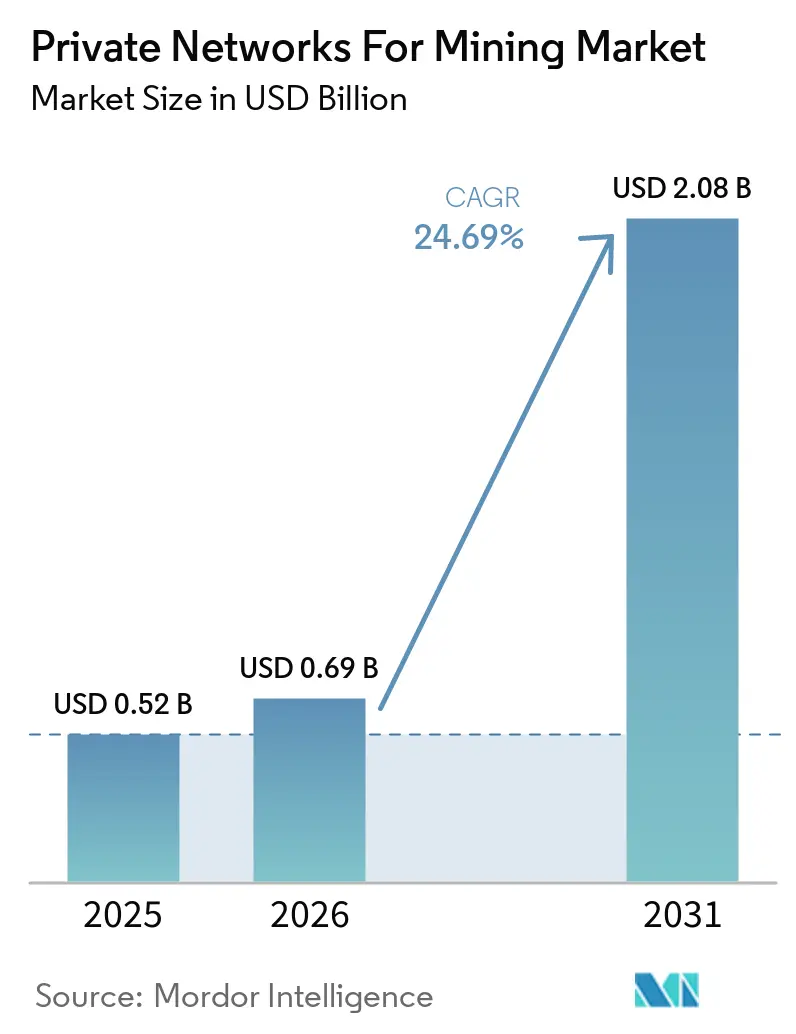
The Private Networks for Mining Market size is projected to expand from USD 0.52 billion in 2025 to USD 0.69 billion in 2026, and to USD 2.08 billion by 2031, registering a CAGR of 24.69% between 2026 and 2031. Mine operators are replacing best-effort Wi-Fi overlays with dedicated cellular systems for machine control, safety, and on-site data processing. The main demand base comes from remote operations that need consistent coverage, low latency, and reliable links for autonomous equipment. Labor constraints, wider use of autonomous haulage, and improved access to industrial spectrum are supporting capital commitments. Edge computing is also raising network requirements because local applications need frequent, reliable data exchange. The Private Networks for Mining Market, therefore, offers opportunities for vendors that combine connectivity, systems integration, and ongoing operations support.
Key Report Takeaways
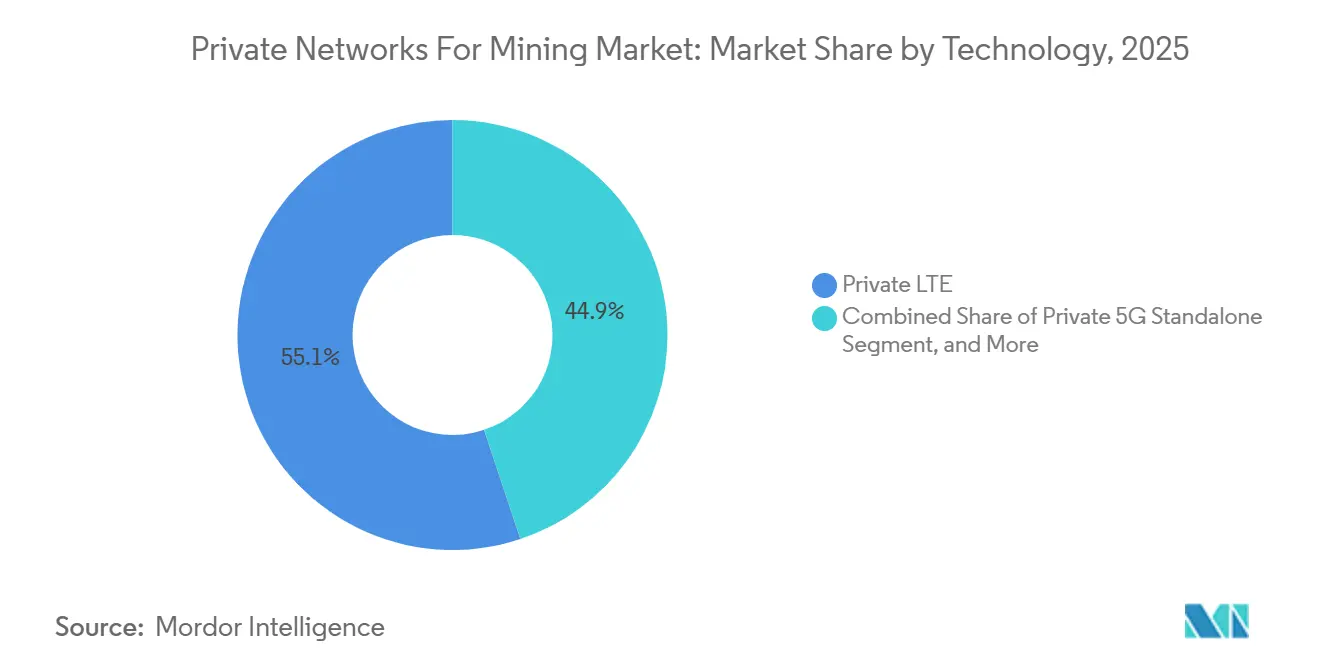
- By technology, Private LTE held 55.12% of the Private Networks for Mining Market share in 2025, while Private 5G Standalone recorded the highest projected CAGR at 26.66% through 2031.
- By component, hardware accounted for 51.79% of revenue in the Private Networks for Mining Market in 2025, while managed services are projected to expand at a 25.12% CAGR through 2031.
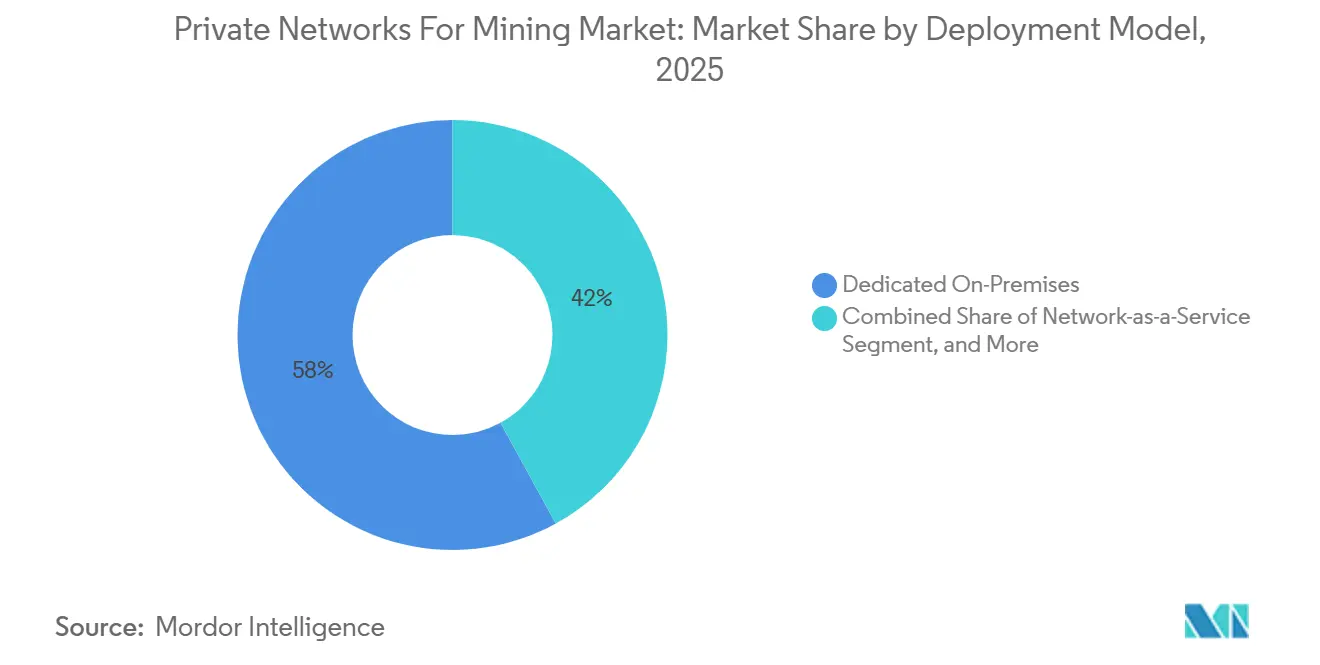
- By deployment model, dedicated on-premises deployments held 57.98% of Private Networks for Mining Market revenue in 2025, while Network-as-a-Service is forecast to grow at a 25.78% CAGR through 2031.
- By frequency band, Sub-6 GHz accounted for 76.61% of Private Networks for Mining Market revenue in 2025, while millimeter wave is projected to grow at a 24.98% CAGR through 2031.
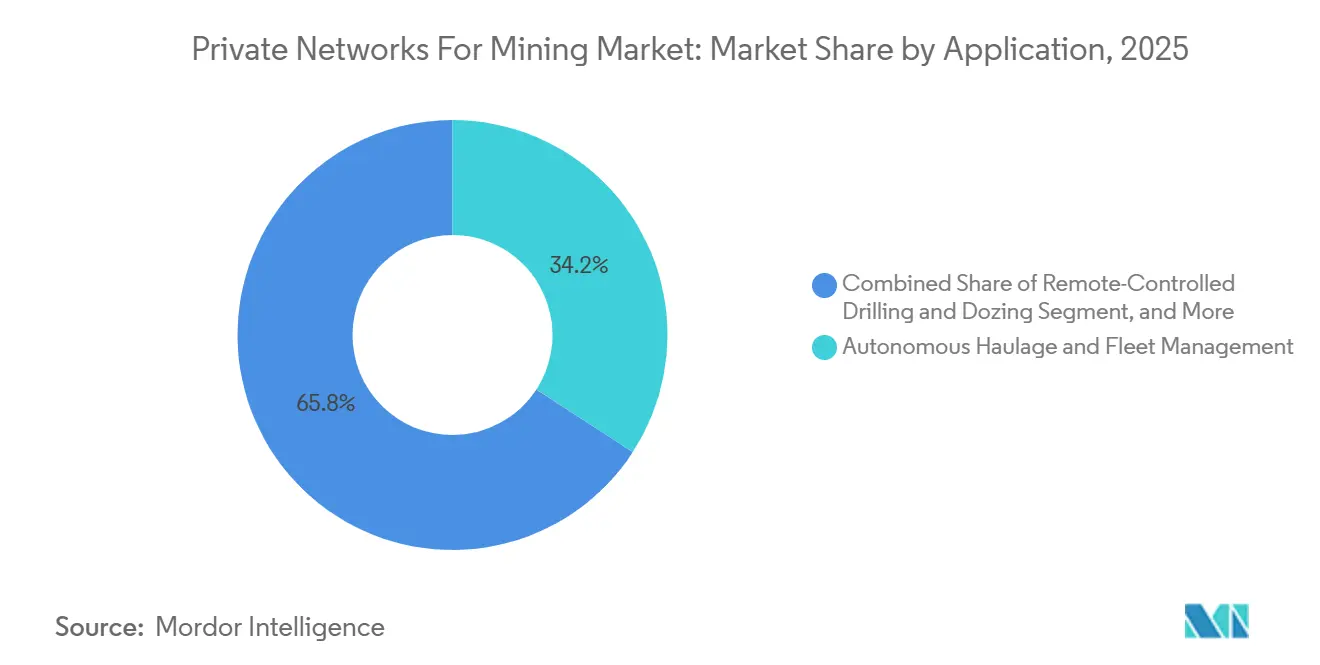
- By application, autonomous haulage and fleet management held 34.16% of Private Networks for Mining Market revenue in 2025, while remote-controlled drilling and dozing are forecast to grow at a 25.59% CAGR through 2031.
- By organization size, large mining enterprises accounted for 79.43% of revenue in the Private Networks for Mining Market in 2025, while mid-sized mining enterprises are projected to grow at a 25.93% CAGR through 2031.
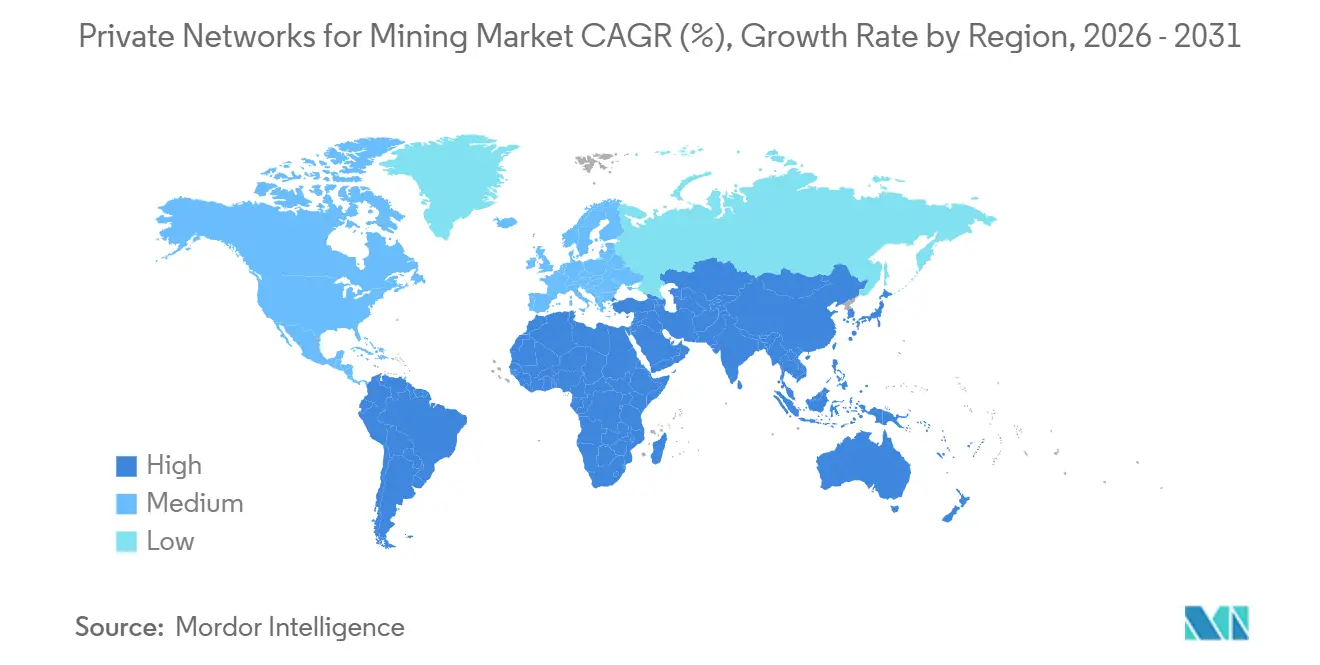
- By region, Europe accounted for 34.23% of revenue in 2025, while Asia-Pacific is forecast to grow at a CAGR of 25.43% between 2026 and 2031
Note: Market size and forecast figures in this report are generated using Mordor Intelligence’s proprietary estimation framework, updated with the latest available data and insights as of January 2026.
Market Trends and Insights
Drivers Impact Analysis of Private Networks For Mining Market*
| Driver | (~) % Impact on CAGR Forecast | Geographic Relevance | Impact Timeline |
|---|---|---|---|
| Rising Automation of Remote and Autonomous Mining Equipment | +2.8% | Global, with the highest concentration in Australia, the United States, Canada, and Chile | Short term (≤ 2 years) |
| Mission-Critical Connectivity for Safety and Productivity | +2.1% | Global, with the greatest regulatory urgency in Europe, Australia, and North America | Short term (≤ 2 years) |
| Convergence of Private Networks, Edge Computing, and Industrial AI | +1.8% | Global, with strong adoption in North America, Europe, and Australia | Medium term (2-4 years) |
| Expansion of Industrial Spectrum and Shared-Spectrum Access | +1.2% | North America and Europe | Medium term (2-4 years) |
| Relocatable Connectivity for Dynamic Open-Pit and Underground Workfaces | +0.8% | Australia, Chile, Peru, and sub-Saharan Africa | Medium term (2-4 years) |
| Brownfield Retrofit Demand from Mixed Legacy Mine Fleets | +0.6% | Global, with high urgency in South Africa, South America, and Southeast Asia | Long term (≥ 4 years) |
| Source: Mordor Intelligence | |||
Rising Automation of Remote and Autonomous Mining Equipment
Autonomous haulage requires reliable, low-latency links, steady uplink capacity, and dependable handovers across large operating areas. ISO 23725:2024 defined communication interface requirements between autonomous systems and fleet management systems, making interoperability a clearer technical requirement for deployments.[1] Private cellular networks can support the controlled movement of vehicles, drills, and dozers where conventional Wi-Fi coverage is limited. Newmont and Ericsson reported that a private 5G deployment at Cadia supported 12 remotely controlled dozers across a 2.5-kilometer area using a single radio unit. Epiroc reported that its LinkOA system enabled autonomous operations across mixed-truck fleets at Roy Hill, reinforcing the need for networks that support equipment from multiple manufacturers. The Private Networks for Mining Market benefits as network capability becomes part of automation planning rather than a separate site upgrade.
Mission-Critical Connectivity for Safety and Productivity
Underground operations need dependable voice and data coverage for emergency response, worker location, and daily coordination. Private cellular systems can provide a more consistent replacement path for aging leaky-feeder and Wi-Fi systems in difficult mine layouts. IAMGOLD and Ambra Solutions completed a private 4G and 5G deployment at the Côté Gold Mine in March 2026 using Nokia Modular Private Wireless technology.[2] The installation supports autonomous and remote applications across the surface pit, underground workings, and processing plant. Connected-worker tools such as distress alerts, gas-monitoring links, and push-to-talk services can serve as an initial use case before a site commits to full automation. The Private Networks for Mining Market also benefits from the operational value of faster response times and reduced idle time during safety-related interruptions.
Convergence of Private Networks, Edge Computing, and Industrial AI
On-site computing is becoming increasingly important as mining applications require immediate decisions rather than delayed cloud processing. Collision avoidance, predictive maintenance, and blast analysis depend on reliable local data flows between equipment, sensors, and computing systems. Existing Wi-Fi and narrowband systems can struggle to support the frequent data updates needed by these applications. This creates a network upgrade requirement even for mines that have not set a formal autonomous haulage timetable. Vendors increasingly offer connectivity, edge hardware, and software integration together because buyers want fewer interfaces across a complex operating environment. The Private Networks for Mining Market consequently supports a larger role for software and managed services as customers move from network construction to day-to-day optimization.
Expansion of Industrial Spectrum and Shared-Spectrum Access
Industrial spectrum availability is a major barrier to private LTE and 5G deployment. The U.S. Citizens Broadband Radio Service framework allows access to the 3.5 GHz band under rules set out in 47 CFR Part 96.[3] The European Commission adopted Implementing Decision 2025/2425 in December 2025 to harmonize technical conditions for the 3.8-4.2 GHz band. These frameworks give mine operators a clearer path to interference-managed local spectrum. They also allow providers to bundle spectrum access into managed connectivity contracts. The Private Networks for Mining Market can therefore reach operators without internal spectrum management expertise.[4]
Restraints Impact Analysis of Private Networks For Mining Market*
| Restraint | (~) % Impact on CAGR Forecast | Geographic Relevance | Impact Timeline |
|---|---|---|---|
| High Upfront Deployment Cost and Uncertain Mine-Level ROI | -3.2% | Global, most acute for junior and single-asset operators in developing economies | Short term (≤ 2 years) |
| Systems-Integration Complexity Across OT, IT, and OEM Platforms | -2.1% | Global, with highest severity in multi-OEM fleet operations | Medium term (2-4 years) |
| Underground Propagation, Electromagnetic Interference, and Rapid Topology Change | -1.4% | Global, most acute in deep hard-rock underground operations | Medium term (2-4 years) |
| Scarcity of Multi-Band Devices and Mine-Qualified Integration Talent | -0.9% | Global, most severe in Africa and South America | Long term (≥ 4 years) |
| Source: Mordor Intelligence | |||
High Upfront Deployment Cost and Uncertain Mine-Level ROI
A private LTE or 5G build requires radio equipment, backhaul, ruggedized devices, civil work, and specialist integration. These costs can be difficult to approve when mining revenues depend on commodity cycles and site life. Benefits such as safer work, reduced downtime, and shorter truck cycles are spread across different functions, which complicates a single financial case. Network-as-a-Service can shift design, deployment, and operations into a recurring contract instead of a large upfront purchase. Epiroc offers Network-as-a-Service for mining customers that need connectivity as part of an operational service model. Smaller operators remain harder to serve because vendors must manage deployment scale, closure risk, and uncertain demand at each site.
Systems-Integration Complexity Across OT, IT, and OEM Platforms
A mine network must connect operational systems, such as trucks, drill rigs, blast systems, and controllers, with enterprise platforms for dispatch, safety, and video. These systems often use different equipment suppliers, data formats, and communications methods. Integrators must ensure the availability and safety requirements of operational technology are met when connecting it to IP-based network services. Radio research in an underground mine found that vehicle blockage affects propagation at Sub-6 GHz and millimeter-wave frequencies, highlighting the need for careful design. Projects, therefore, need site surveys, equipment coordination, and staged commissioning before operators can rely on the network for production-critical work. Equipment suppliers are adding cellular options, but full compatibility across mixed fleets remains an active implementation challenge.
*Our forecasts treat driver/restraint impacts as directional, not additive. The impact forecasts reflect baseline growth, mix effects, and variable interactions.
Private Networks For Mining Market Segment Analysis
By Technology:
Private LTE Retains the Installed Base While 5G Standalone ExpandsPrivate LTE held 55.12% of revenue in 2025 because it has an established base of mine-tested devices and operating practices. Its installed presence reflects years of use in fleet activity, shift changes, and emergency communications. Operators value LTE where the network design must work in underground settings with complex coverage conditions. It remains a practical option for sites that need reliable connectivity without an immediate need for the advanced functions of standalone 5G. Its broad device base also allows mines to add connected-worker tools, cameras, and equipment telemetry without replacing every endpoint simultaneously.
Private 5G Standalone is forecast to grow at a CAGR of 26.66% from 2026 to 2031. Its network slicing capabilities can separate critical automation traffic from lower-priority video and sensor traffic. Nokia and Ericsson have focused their industrial portfolios on private 5G systems and ruggedized radio equipment. Private 5G Non-Standalone and hybrid LTE-and-5 G configurations offer a transition path for mines that want to retain LTE investments. Epiroc and Ericsson formalized a 2026 agreement to make LTE and 5G connectivity available at Epiroc customer centers, expanding access via a mining-focused sales channel.

By Component:
Hardware Leads Current Revenue While Managed Services Grow FasterHardware accounted for 51.79% of revenue in 2025 because each mine network needs radios, core equipment, transport links, and ruggedized edge devices. Mine conditions require equipment that can withstand dust, vibration, temperature variation, and interference from heavy machinery. Hardware will remain necessary as new mine sites deploy private cellular coverage. Its revenue mix may decline as installed networks need more software, monitoring, and lifecycle services. Procurement decisions also cover spare units, power protection, fiber routes, and mounting arrangements that are specific to each mine layout.
Managed services are projected to grow at a CAGR of 25.12% through 2031 as operators seek to transfer network operations to specialized providers. The model can include spectrum, radio access equipment, core software, monitoring, and technical support in 1 contract. Vodafone Australia offers mobile private network services for enterprise customers, combining secure connectivity with managed delivery. Network management software is becoming increasingly important as it connects wireless infrastructure to fleet management and enterprise systems. Professional services will remain important at brownfield mines where planning and integration work must precede commissioning.
By Deployment Model:
On-Premises Systems Lead While Network-as-a-Service Builds DemandDedicated on-premises deployments held 57.98% of revenue in 2025, reflecting large operators’ preference for local control, data management, and availability. The model is especially relevant underground, where critical applications cannot depend on surface backhaul alone. On-site cores can support machine-control functions during interruptions to external connections. The safety and operational requirements of deep underground mines support the Private Networks for Mining Market size for dedicated on-premises deployments. This approach also gives operating teams direct control over maintenance schedules, user policies, and the timing of network extensions.
Network-as-a-Service is forecast to grow at a CAGR of 25.78% from 2026 to 2031. Providers package infrastructure, operations, and support into a recurring service that reduces initial capital requirements. CID Group has described a zero-capex private 5G service model in Australia, illustrating the interest in subscription-based deployment options. Hybrid public-private systems can reserve private coverage for critical areas while using public networks for lower-priority surface activity. Portable networks also support exploration, short-lived projects, and changing workforces where permanent infrastructure is not justified.
By Frequency Band:
Sub-6 GHz Supports Coverage While Millimeter Wave Targets Dense Data NeedsSub-6 GHz accounted for 76.61% of revenue in 2025 because it provides useful propagation through mine tunnels and broad surface coverage. The low-band spectrum can support voice, safety devices, and telemetry in areas that require robust reach. Mid-band spectrum adds capacity for data-intensive operations. Together, these bands form the coverage layer for many mine network designs. Engineers can use overlapping cells and repeaters to preserve coverage when vehicles, bends, and changing work areas affect the radio path.
Millimeter wave is projected to grow at a CAGR of 24.98% through 2031, driven by high-bandwidth applications such as video inspection, drone telemetry, and sensor data streams. A Durham University study examined millimeter-wave multi-user performance in underground mine communications and identified its potential in controlled mine environments. Structured primary drives and dense surface zones are better suited to its shorter-range coverage cells. Irregular stopes and development headings remain more suited to Sub-6 GHz coverage. Operators are therefore likely to use a layered design rather than rely on a single frequency band.
By Application:
Haulage and Fleet Management Is the Core Use Case While Remote Operations ScaleAutonomous haulage and fleet management accounted for 34.16% of revenue in 2025, making it the largest application in the Private Networks for Mining Market. Large iron ore, copper, and gold mines can justify the supporting network because fleet scale increases the value of automation. The application links vehicle operations, dispatch information, and continuous safety controls. Its prominence indicates that reliable machine control remains a primary driver of private network investment. It also requires a common communications layer that can serve vehicles, control rooms, maintenance teams, and site safety processes.
Remote-controlled drilling and dozing is forecast to grow at a CAGR of 25.59% from 2026 to 2031. Newmont and Ericsson reported that their Cadia deployment supported remote dozer operations with private 5G connectivity. Connected-worker applications provide a broader safety-focused demand base across mine types. Video inspection, drones, blasting telemetry, tailings monitoring, and water management add further demand as mines connect more processes. Remote drilling can also provide a staged route toward more extensive automation programs.
By Organization Size:
Large Enterprises Lead Spending While Mid-Sized Mines Gain AccessLarge mining enterprises accounted for 79.43% of revenue in 2025 because they have the capital, fleet scale, and operating footprint needed for multi-site private network programs. Large producers also have established automation roadmaps that can support the business case for dedicated connectivity. Newmont stated that its Cadia program forms part of plans to expand private 5G across 14 mines on 4 continents. Repeat deployments can reduce planning uncertainty after an operator has proven the design at its first site. These buyers can also coordinate common technology standards across sites, which makes supplier support and device management more consistent.
Mid-sized mining enterprises are projected to grow at a CAGR of 25.93% through 2031. Managed services and Network-as-a-Service models can reduce the specialized staffing and upfront capital barriers for this group. Coal India deployed a commercial private 5G network at the Amlohri Open Cast Coal Mines facility in Madhya Pradesh in 2025, in partnership with Druid Software, Tidal Wave, and BSNL. Standardized designs from large deployments can also shorten commissioning at less complex sites. The Private Networks for Mining Market may broaden as providers develop smaller, repeatable offers for mid-sized operations.
Geography Analysis
Europe Private Networks for Mining Market
Europe accounted for 34.23% of revenue in 2025, supported by the digitalization of underground mining and local spectrum policy. Nokia and Boldyn Networks deployed a private 5G network at the Callio FutureMINE site in Finland in September 2025, extending 1.5 kilometers underground across several tunnel levels. The project showed how European mine sites can serve as technology validation locations before wider commercial use. Digita and Outokumpu also announced a private 5G deployment at the Kemi underground mine in Finland during December 2025. The European spectrum framework gives mine operators a clearer path to local-band access.
APAC Private Networks for Mining Market
Asia-Pacific is forecast to grow at a CAGR of 25.43% between 2026 and 2031. Australia has advanced private LTE and 5G deployments closely linked to autonomous fleet programs. Epiroc reported that Roy Hill completed the conversion of 78 haul trucks from Caterpillar and Hitachi for autonomous operation in October 2025. India offers a different route to adoption through state-linked telecommunications and mining initiatives. Coal India’s Amlohri deployment illustrates the role of private 5G in a major emerging mining economy.
South America and Africa Private Networks for Mining Market
South America has demand centered on Chilean copper, Peruvian polymetallic operations, and Brazilian iron ore and lithium projects. The Private Networks for Mining Market in the region benefits from large open-pit operations that can support fleet management and surface automation use cases. Suppliers must adapt designs to remote locations, high-altitude operations, and mixed equipment fleets. Africa is developing demand for worker safety systems in deep mines and fleet connectivity in open-pit operations.
Competitive Landscape
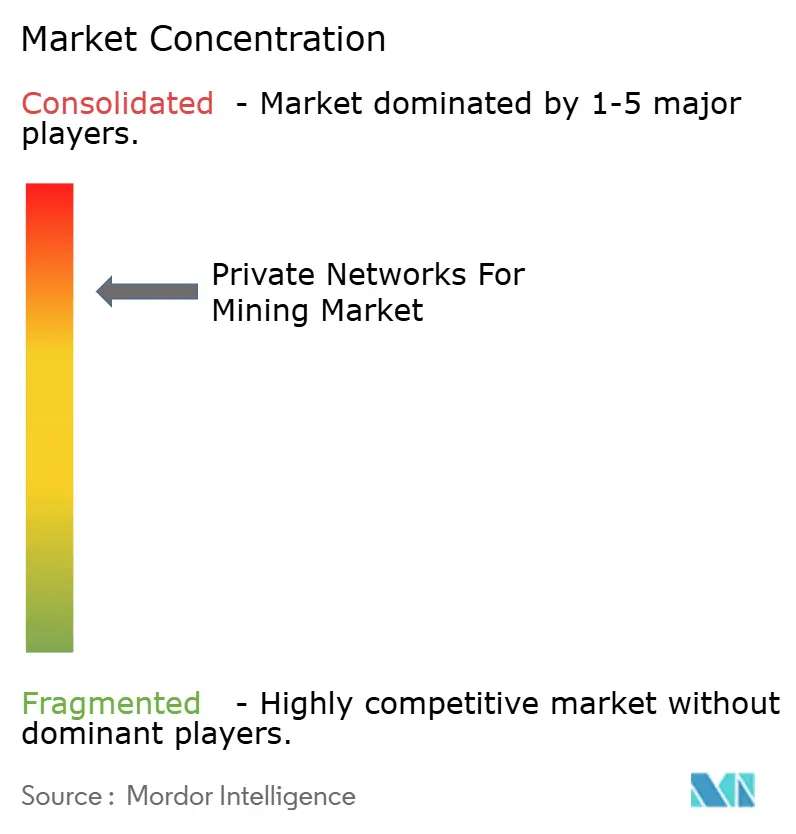
The Private Networks for Mining Market is consolidated in mine-specific wireless infrastructure. Nokia and Ericsson lead many high-profile private cellular projects through early market presence, industrial product portfolios, and relationships with large mining groups. Ericsson’s work with Newmont at Cadia demonstrates a strategy that connects network deployment with autonomous and remote equipment use cases. Nokia’s work at Callio and Côté Gold reflects its focus on underground private wireless deployments. Huawei, ZTE, and Samsung compete through regional presence and pricing.
Mining equipment manufacturers are becoming more important channel partners in the Private Networks for Mining Market. Epiroc and Ericsson formalized a global 2026 agreement to expand LTE and 5G connectivity through Epiroc’s customer centers. This model allows connectivity to be sold alongside automation and digital solutions rather than as a separate telecommunications purchase. Epiroc’s LinkOA deployment at Roy Hill also shows how an equipment-oriented provider can work across fleets from different manufacturers. Cisco has a complementary role in industrial networking and integration rather than mine radio infrastructure.
Specialists such as Rajant and Celona address cases where mobile equipment, rapidly changing work areas, or enterprise-grade local 5G needs require a more focused architecture. Managed providers are also competing to serve buyers who do not want to own and operate the full network. Epiroc’s Network-as-a-Service offer reflects this shift toward recurring delivery models. The Private Networks for Mining Market still has room for growth in brownfield retrofit projects and smaller operations without dedicated network teams.
Private Networks For Mining Industry Leaders
-
Nokia Corporation
-
Telefonaktiebolaget LM Ericsson
-
Huawei Technologies Co., Ltd.
-
Rajant Corporation
-
Samsung Electronics Co., Ltd.
- *Disclaimer: Major Players sorted in no particular order
Private Networks For Mining Market Companies Covered in this Report
- Nokia Corporation
- Telefonaktiebolaget LM Ericsson
- Huawei Technologies Co., Ltd.
- Samsung Electronics Co., Ltd.
- Cisco Systems, Inc.
- Rajant Corporation
- Motorola Solutions, Inc.
- ZTE Corporation
- NEC Corporation
- Qualcomm Incorporated
- Siemens AG
- ABB Ltd.
- Epiroc AB
- Sandvik AB
- Newmont Corporation
- AngloGold Ashanti plc
- Komatsu Ltd.
- Caterpillar Inc.
- Hitachi Construction Machinery Co., Ltd.
- Wenco International Mining Systems Ltd.
- Celona, Inc.
Recent Industry Developments in Private Networks For Mining Market
- April 2026: Epiroc and Ericsson formalized a global agreement to scale LTE and 5G connectivity across Epiroc's worldwide customer centers, enabling Epiroc to bundle Ericsson network infrastructure into its automation and digital solutions portfolio for both underground and surface mining customers. The agreement expands on a cooperation framework established in 2018 and represents a significant channel-model shift that accelerates private network access for mine operators without direct telecom vendor relationships.
- March 2026: IAMGOLD and Ambra Solutions completed deployment of a private 4G/5G network at the Côté Gold Mine between Timmins and Sudbury, Ontario, built using Nokia Modular Private Wireless technology. The network supports autonomous haul trucks and drills, real-time communications, and mission-critical applications across surface pit, underground workings, and the process plant without reliance on public carrier infrastructure.
- December 2025: Digita and Outokumpu announced a collaboration to deploy a private 5G network at the Kemi underground mine in Finland, designed to validate 5G connectivity under active production conditions as a foundation for broader digitalization across Outokumpu's mining operations.
- October 2025: Epiroc and Hancock Iron Ore reached a milestone at Roy Hill mine in the Pilbara, Western Australia, converting all 78 haul trucks, comprising Caterpillar 793F and Hitachi EH5000 models, for autonomous operation using Epiroc's OEM-agnostic LinkOA system. The completion established Roy Hill as the world's largest fully agnostic autonomous mine, with 60 trucks actively running autonomously and the remainder on track by December 2025.
Global Private Networks For Mining Market Report Scope
The private networks for the mining market are dedicated, localized wireless networks (primarily LTE and 5G) designed to provide secure, ultra-reliable, low-latency connectivity in harsh, remote mining environments. These networks support critical applications such as autonomous haulage, remote-controlled drilling, connected worker safety, and real-time video monitoring. Deployed via on-premises, hybrid, or portable models, these solutions enable mining enterprises of all sizes to enhance operational efficiency, eliminate gaps in public network connectivity, and safely scale automation across surface and underground operations.
The Private Networks for Mining Market Report is Segmented by Technology (Private LTE, Private 5G Non-Standalone, Private 5G Standalone, and Hybrid LTE and 5G), Component (Radio Access Network, Core Network, Backhaul and Transport, Edge Computing Infrastructure, Network Management Software, Professional Services, and Managed Services), Deployment Model (Dedicated On-Premises, Hybrid Public-Private, Network-as-a-Service, and Portable and Rapid-Deployment Networks), Frequency Band (Low Band, Below 1 GHz, Mid Band, 1-6 GHz, and Millimeter Wave, Above 24 GHz), Application (Autonomous Haulage and Fleet Management, Remote-Controlled Drilling and Dozing, Connected Worker and Mission-Critical Communications, Real-Time Video, Inspection, and Drone Monitoring, and Other Applications), Organization Size (Large Mining Enterprises, and Mid-Sized Mining Enterprises), and Geography (North America, South America, Europe, Asia-Pacific, Middle East, and Africa). The Market Forecasts are Provided in Terms of Value (USD).
Segmentation Overview
| Private LTE |
| Private 5G Non-Standalone |
| Private 5G Standalone |
| Hybrid LTE and 5G |
| Radio Access Network |
| Core Network |
| Backhaul and Transport |
| Edge Computing Infrastructure |
| Network Management Software |
| Professional Services |
| Managed Services |
| Dedicated On-Premises |
| Hybrid Public-Private |
| Network-as-a-Service |
| Portable and Rapid-Deployment Networks |
| Low Band, Below 1 GHz |
| Mid Band, 1-6 GHz |
| Millimeter Wave, Above 24 GHz |
| Autonomous Haulage and Fleet Management |
| Remote-Controlled Drilling and Dozing |
| Connected Worker and Mission-Critical Communications |
| Real-Time Video, Inspection, and Drone Monitoring |
| Other Applications |
| Large Mining Enterprises |
| Mid-Sized Mining Enterprises |
| North America | United States |
| Canada | |
| Mexico | |
| South America | Brazil |
| Argentina | |
| Chile | |
| Rest of South America | |
| Europe | Germany |
| United Kingdom | |
| France | |
| Italy | |
| Spain | |
| Rest of Europe | |
| Asia-Pacific | China |
| Japan | |
| India | |
| South Korea | |
| Australia | |
| Rest of Asia-Pacific | |
| Middle East | United Arab Emirates |
| Saudi Arabia | |
| Qatar | |
| Rest of Middle East | |
| Africa | South Africa |
| Egypt | |
| Nigeria | |
| Rest of Africa |
| By Technology | Private LTE | |
| Private 5G Non-Standalone | ||
| Private 5G Standalone | ||
| Hybrid LTE and 5G | ||
| By Component | Radio Access Network | |
| Core Network | ||
| Backhaul and Transport | ||
| Edge Computing Infrastructure | ||
| Network Management Software | ||
| Professional Services | ||
| Managed Services | ||
| By Deployment Model | Dedicated On-Premises | |
| Hybrid Public-Private | ||
| Network-as-a-Service | ||
| Portable and Rapid-Deployment Networks | ||
| By Frequency Band | Low Band, Below 1 GHz | |
| Mid Band, 1-6 GHz | ||
| Millimeter Wave, Above 24 GHz | ||
| By Application | Autonomous Haulage and Fleet Management | |
| Remote-Controlled Drilling and Dozing | ||
| Connected Worker and Mission-Critical Communications | ||
| Real-Time Video, Inspection, and Drone Monitoring | ||
| Other Applications | ||
| By Organization Size | Large Mining Enterprises | |
| Mid-Sized Mining Enterprises | ||
| By Geography | North America | United States |
| Canada | ||
| Mexico | ||
| South America | Brazil | |
| Argentina | ||
| Chile | ||
| Rest of South America | ||
| Europe | Germany | |
| United Kingdom | ||
| France | ||
| Italy | ||
| Spain | ||
| Rest of Europe | ||
| Asia-Pacific | China | |
| Japan | ||
| India | ||
| South Korea | ||
| Australia | ||
| Rest of Asia-Pacific | ||
| Middle East | United Arab Emirates | |
| Saudi Arabia | ||
| Qatar | ||
| Rest of Middle East | ||
| Africa | South Africa | |
| Egypt | ||
| Nigeria | ||
| Rest of Africa | ||
Key Questions Answered in the Report
What is the projected value of private networks for mining by 2031?
The Private Networks for Mining Market is forecast to reach USD 2.08 billion by 2031, expanding at a 24.69% CAGR from 2026 to 2031.
Why do mines deploy private LTE and 5G systems?
The Private Networks for Mining Market supports autonomous equipment, worker safety tools, fleet management, and local data applications.
Which technology currently leads mining private networks?
In the Private Networks for Mining Market, Private LTE led with 55.12% of revenue in 2025, while Private 5G Standalone is projected to grow fastest at a 26.66% CAGR.
Which mining application has the largest private network demand?
The Private Networks for Mining Market was led by autonomous haulage and fleet management, which held 34.16% of revenue in 2025.
Which region is growing fastest for private mine connectivity?
Asia-Pacific is the fastest-growing area in the Private Networks for Mining Market at a 25.43% CAGR from 2026 to 2031.
How can mid-sized miners adopt private cellular systems?
The Private Networks for Mining Market can become more accessible through Network-as-a-Service and managed-service models that reduce upfront capital needs.