
Premium Jeans Market Size and Share
Market Overview
| Study Period | 2022 - 2032 |
|---|---|
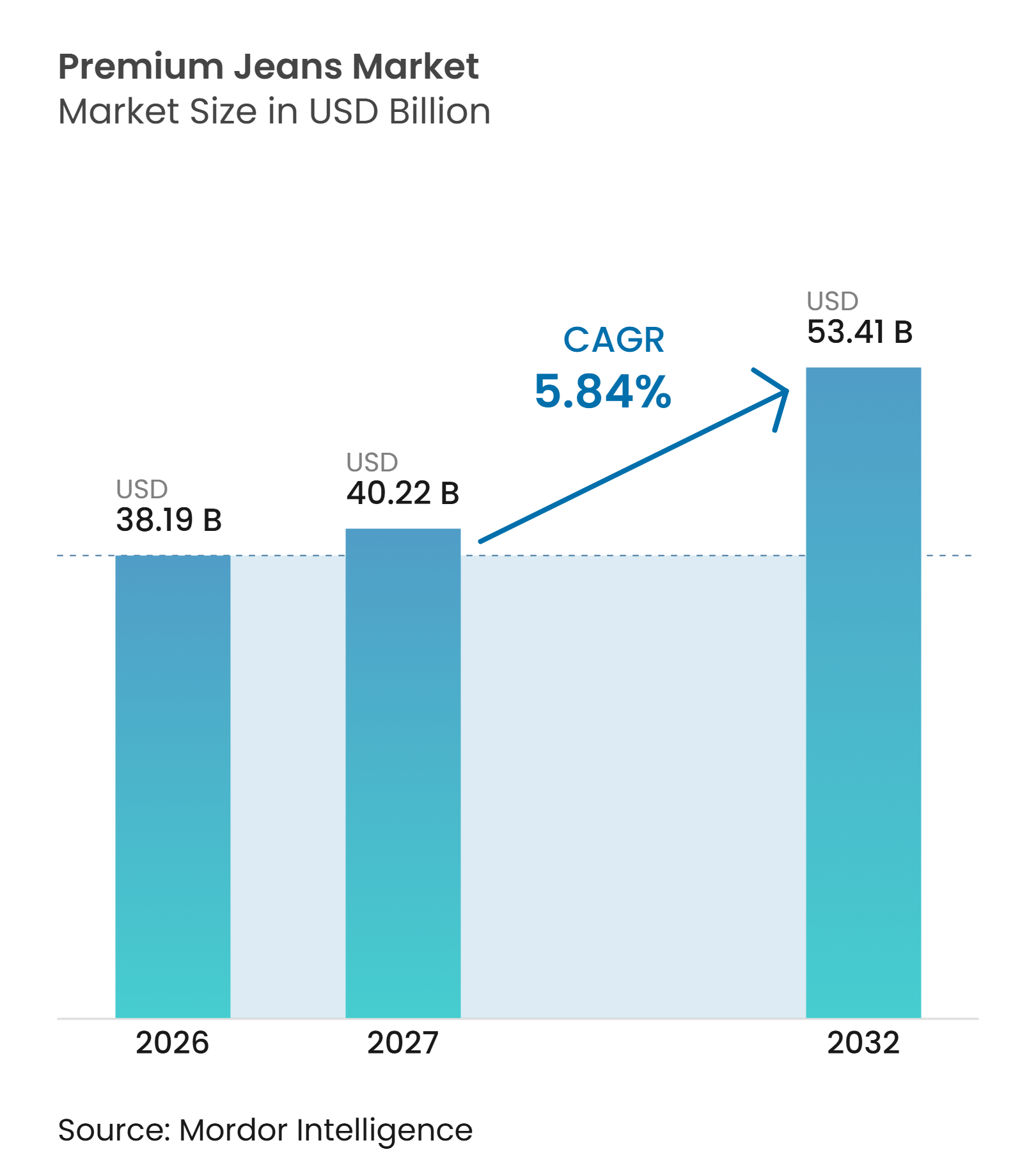
| Market Size (2027) | USD 40.22 Billion |
| Market Size (2032) | USD 53.41 Billion |
| Growth Rate (2027 - 2032) | 5.84 % |
| Fastest Growing Market | Asia-Pacific |
| Largest Market | North America |
| Market Concentration | Low |
Major Players *Disclaimer: Major Players sorted in no particular order Image © Mordor Intelligence. Reuse requires attribution under CC BY 4.0. | |
Premium Jeans Market Analysis by Mordor Intelligence
The premium jeans market size was valued at USD 38.19 billion in 2026 and is estimated to grow from USD 40.22 billion in 2027 to reach USD 53.41 billion by 2032, at a CAGR of 5.84% during the forecast period (2027-2032). Consumers are increasingly prioritizing fewer garments with superior fit, construction, and expected wear life across everyday and occasion-based wardrobes. This trend supports premium pricing for brands that demonstrate consistent quality, recognizable design, reliable sizing, and a clear product story across physical and digital points of sale. Direct-to-consumer sales, in-store service, and online reach are becoming increasingly important, as premium purchases often require fit confidence, product education, and a reassuring brand experience before checkout. Supply conditions also influence market performance, as tariff changes and limited capacity for specialist fabrics can affect lead times and product availability. Brands are increasingly using authentication, lower-impact dyeing, and repair services to protect product value and encourage repeat purchases.
Key Report Takeaways
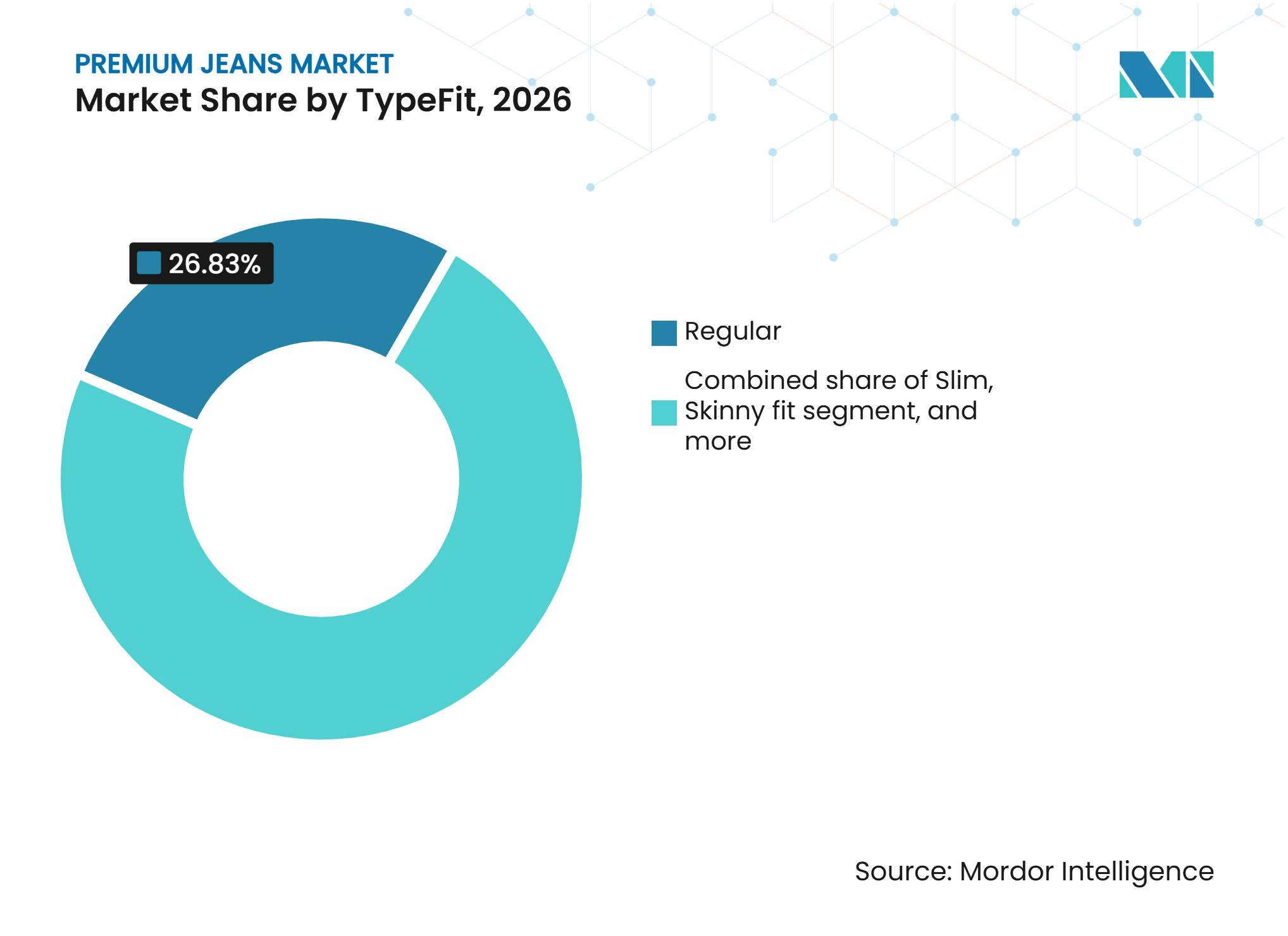
- By type/fit, regular-fit jeans dominated the premium jeans market with a share of 26.83% in 2026, while slim-fit jeans are anticipated to register the fastest CAGR of 6.98% during 2027-2032.
- By end user, women's premium jeans dominated the market with a share of 54.91% in 2026, while men's premium jeans are anticipated to register the fastest CAGR of 7.22% during 2027-2032.
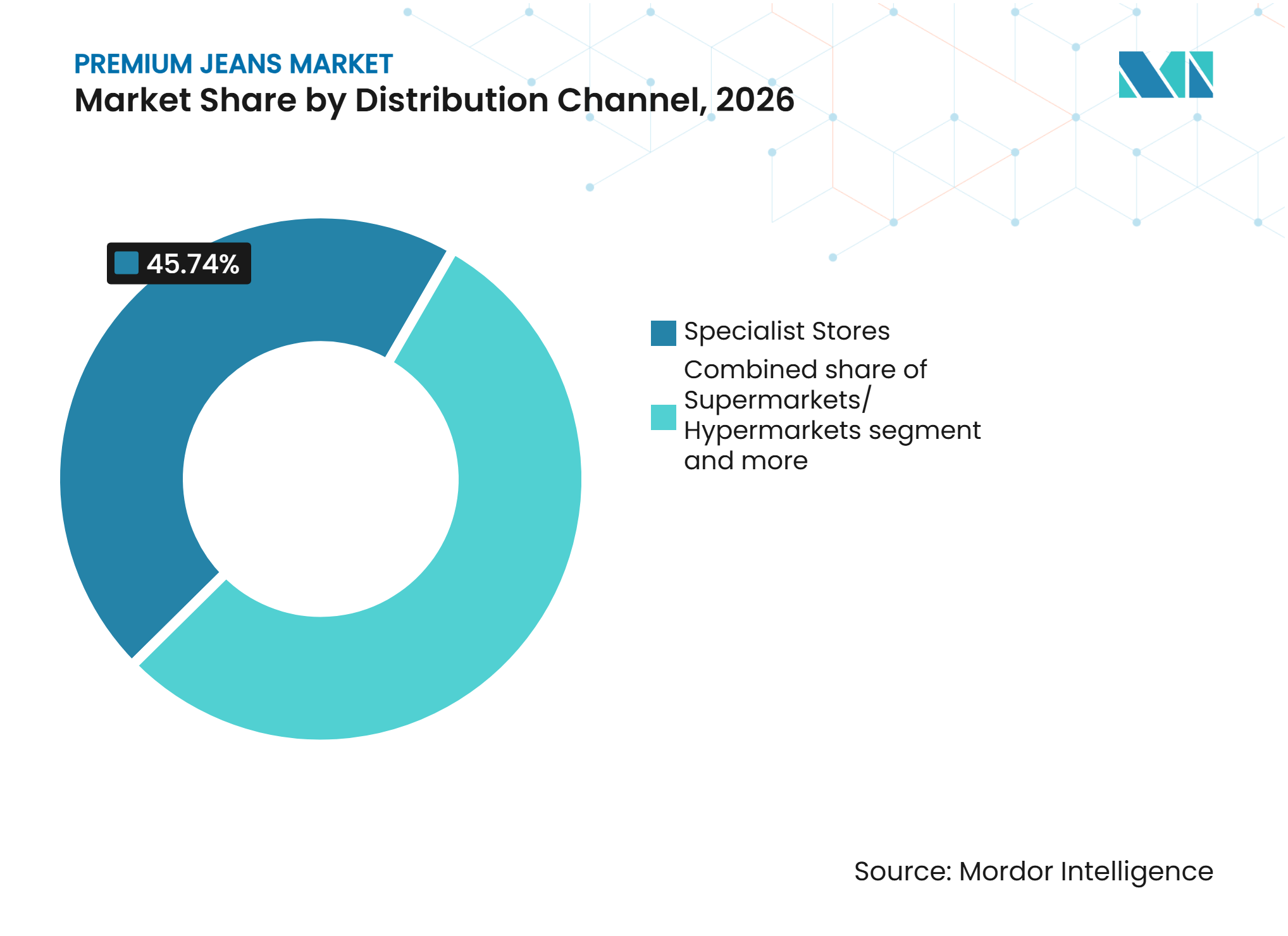
- By distribution channel, specialist stores dominated the market with a share of 45.74% in 2026, while online retail stores are anticipated to register the fastest CAGR of 7.56% during 2027-2032.
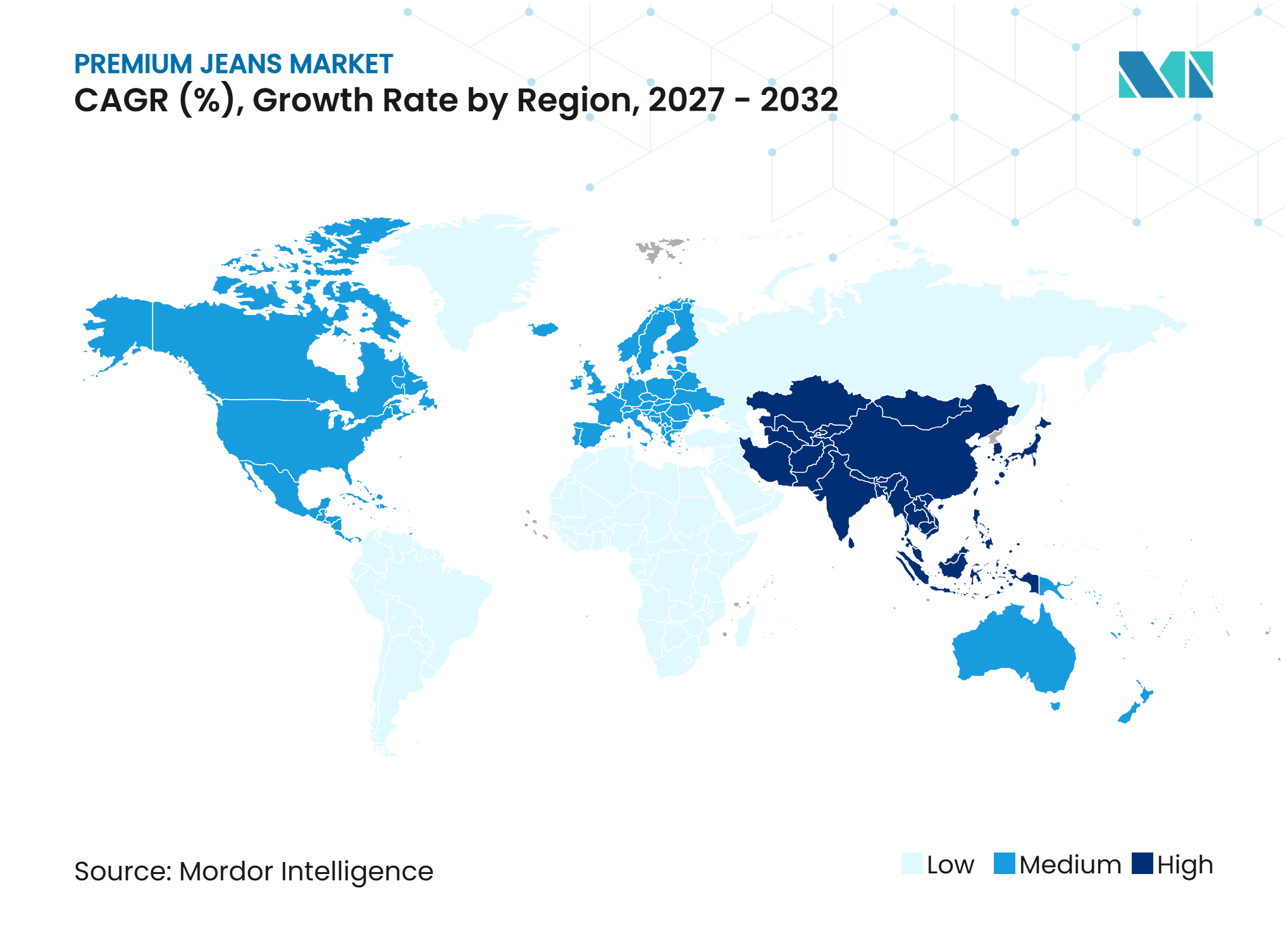
- By geography, North America dominated the premium jeans market with a share of 38.12% in 2026, while Asia-Pacific is anticipated to register the fastest CAGR of 7.73% during 2027-2032.
Note: Market numbers in this report are based on Mordor Intelligence's proprietary estimation framework, which combines nine months of actuals with Q4 projections for base year 2026.
Market Trends and Insights
Drivers Impact Analysis of Premium Jeans Market*
| Driver | (~) % Impact on CAGR Forecast | Geographic Relevance | Impact Timeline |
|---|---|---|---|
| Rising preference for high-quality and durable denim | +1.2% | Global, strongest in North America and Europe | Long term (≥ 4 years) |
| Increasing consumer spending on premium and branded apparel | +1.0% | North America, Europe, East Asia | Medium term (2-4 years) |
| Technological advancements in denim fabric and product innovation | +0.8% | Global, with manufacturing hubs in Japan, Turkey, and Italy | Long term (≥ 4 years) |
| Growing demand for sustainable manufactured denim | +0.6% | Europe, North America, and early gains in Asia-Pacific | Medium term (2-4 years) |
| Increasing influence of celebrity collaborations and fashion branding | +0.9% | North America, Europe, East Asia | Short term (≤ 2 years) |
| Expansion of online retail and omnichannel fashion shopping | +0.7% | Global, with fastest growth in Asia-Pacific | Medium term (2-4 years) |
| Source: Mordor Intelligence | |||
Rising Preference for High-Quality and Durable Denim
Consumers increasingly prioritize denim products that offer superior fabric quality, durability, comfort, and long-term wearability, supporting demand for premium jeans over lower-priced alternatives. Premium denim brands benefit from this preference by offering higher-quality cotton fabrics, reinforced stitching, improved color retention, and advanced finishing techniques. According to consumer research cited by the European Commission’s Joint Research Centre (JRC) in its textile preparatory study in December 2025, approximately 90% of consumers believe that apparel should last longer[1]. The study also identifies durability as a key factor influencing apparel purchasing decisions and highlights fabric composition and processing techniques as important contributors to denim strength and abrasion resistance. This preference for longer-lasting clothing strengthens the positioning of premium jeans as durable, high-quality wardrobe investments.
Invreasing Consumer Spending on Premium and Branded Apparel
Consumers increasingly prioritize product quality, brand value, craftsmanship, and the overall purchase experience when selecting apparel, creating opportunities for premium jeans manufacturers. According to a survey released by Cotton Council International and Cotton Incorporated in October 2025, 79% of consumers plan to buy higher-quality, longer-lasting clothing, while 57% intend to buy clothing in the latest styles over the following year[2]. Additionally, 83% plan to conduct more research to secure the best value from their clothing purchases. These preferences show consumers are willing to evaluate apparel beyond its initial price, supporting demand for premium denim products with superior materials, contemporary designs, and longer product life.
Technological Advancements in Denim Fabric and Product Innovation
Technological advancements in textile manufacturing enable premium denim manufacturers to improve fabric strength, stretchability, color retention, comfort, and overall garment performance. Innovations in advanced weaving, laser finishing, digital printing, and moisture-management fabrics help brands develop differentiated jeans with enhanced functional and aesthetic attributes. According to the Ministry of Textiles, Government of India, in its Year-End Review 2025, published in December 2025, the National Technical Textiles Mission supported 168 research and development projects spanning specialty fibers, alternative materials, composites, and advanced textile applications[3]. These initiatives strengthen the technological capabilities of the broader textile industry and create opportunities for denim manufacturers to adopt advanced materials and production techniques. Such developments support product differentiation and strengthen the premium positioning of jeans.
Increasing Influence of Celebrity Collaborations and Fashion Branding
Celebrity collaborations, fashion endorsements, and influencer-led campaigns are increasing brand visibility and shaping consumer preferences in the premium jeans market. Premium denim brands increasingly partner with celebrities, musicians, fashion designers, and social media influencers to launch exclusive collections and attract fashion-conscious consumers. These collaborations enable brands to establish distinctive identities, create aspirational appeal, and differentiate their products from conventional denim offerings. Social media platforms further expand the reach of celebrity-endorsed collections through fashion campaigns, styling content, and product showcases, influencing consumer perceptions and purchase preferences. In addition, limited-edition collaborations and designer-led collections create exclusivity around premium denim products, strengthen brand loyalty, and help manufacturers reinforce their positioning in the premium apparel market.
Restraints Impact Analysis of Premium Jeans Market*
| Restraint | (~) % Impact on CAGR Forecast | Geographic Relevance | Impact Timeline |
|---|---|---|---|
| Counterfeit products and brand reputation risks | -0.6% | Global, highest in Asia-Pacific and online channels | Medium term (2-4 years) |
| Competition from fast-fashion and mass-market denim brands | -0.9% | Global | Short term (≤ 2 years) |
| Fluctuations in raw material and manufacturing costs | -0.7% | Global, especially South and Southeast Asia sourcing hubs | Short term (≤ 2 years) |
| Limited availability of skilled denim processing and finishing capabilities | -0.5% | Japan, Italy, and specialist manufacturing regions | Long term (≥ 4 years) |
| Source: Mordor Intelligence | |||
Counterfeit Products and Brand ReputationRrisks
Counterfeit products can erode trust in premium labels and create uncertainty regarding resale value. In May 2025, the Organisation for Economic Co-operation and Development (OECD) reported that counterfeit production is increasingly localized near end markets, making enforcement and border controls more challenging. This trend particularly affects brands that sell through international online channels, where customers cannot physically inspect product details before placing orders. Digital Product Passports and item-level authentication can verify product provenance, distinguish authorized products from counterfeits, and preserve product information after resale. These systems can also support resale, repair, warranty activities, and access to product information throughout a garment’s lifecycle. However, smaller brands may face greater implementation challenges due to limited technology budgets, fewer supply chain resources, and reduced capacity to coordinate data across vendors.
Competition from Fast-Fashion and Mass-Market Denim Brands
Fast-fashion retailers and mass-market denim brands create significant competitive pressure for premium jeans manufacturers. These players attract consumers through affordable prices, frequent product launches, and collections that quickly reflect evolving fashion trends. Their ability to offer multiple styles, fits, and washes at accessible price points appeals to price-conscious shoppers who might otherwise consider premium denim products. Additionally, extensive retail networks, promotional campaigns, and convenient online shopping options expand the reach of mass-market brands. This advantage in price and accessibility makes it challenging for premium denim companies to attract new customers, particularly younger consumers and budget-conscious buyers. Consequently, premium brands must continuously differentiate their offerings through superior fabric quality, durability, design, brand positioning, and customer experience to maintain their competitive position.
*Our forecasts treat driver/restraint impacts as directional, not additive. The impact forecasts reflect baseline growth, mix effects, and variable interactions.
Premium Jeans Market Segment Analysis
By Type/Fit:
Regular Fit Retains a Broad Base While Slim Fit Expands Its Use CasesRegular Fit held a 26.83% share of the premium jeans market in 2026, making it the largest fit category. Its appeal stems from a familiar silhouette that suits various age groups, purchase occasions, and both men’s and women’s wardrobes. The fit maintains a stable position in North American and European wholesale assortments, where repeat purchases, reliable sell-through, straightforward merchandising, and predictable size runs remain important. It also provides a practical foundation for brands seeking to offer multiple washes, fabric weights, and seasonal details without altering the core pattern. Regular Fit can support a full-price proposition because shoppers already understand its use and fit expectations.
Slim Fit is expected to register a CAGR of 6.98% through 2032, the fastest growth rate among fit categories. Its adoption across casual and business-casual settings supports the premium jeans market, as its narrower profile can remain both appropriate and comfortable. Stretch fabrics, jersey-denim blends, and improved shape recovery enable the style to provide comfort while maintaining a structured appearance during extended daily wear. Bootcut is also expected to gain renewed relevance through country and Western styling, which is projected to receive greater attention in 2025.



By End User:
Women Lead Revenue While Men Add New Premium DemandWomen hold 54.91% of the premium jeans market share in 2026. This leading position reflects their higher purchase frequency and the widespread use of denim across casual, work, travel, and social occasions. Brands have invested in fit, size inclusivity, rise options, inseam lengths, and style variety within women’s collections to address diverse consumer needs. This demand encourages retailers to stock multiple rises, inseams, and silhouettes. The availability of varied designs, washes, and fits also drives repeat purchases and enables brands to cater to different fashion preferences and age groups.
The men’s segment is forecast to grow at a CAGR of 7.22% through 2032. This growth is driven by the increasing use of premium denim as an alternative to formal trousers in business-casual and hybrid-work wardrobes. Although the unisex category remains smaller, it holds relevance in markets where gender-neutral fashion has a strong following among younger urban consumers and socially connected style communities. A shared design approach can simplify certain stock-keeping requirements while preserving design variety. Premium denim brands can also capture men’s demand by offering versatile fits, refined finishes, and comfortable fabrics suitable for everyday wear and semi-formal occasions.
By Distribution Channel:
Specialist Stores Preserve Fit Service While Online Retail Adds ReachSpecialist stores accounted for 45.74% of the premium jeans market in 2026. Denim remains a category where customers often compare rise, inseam, fabric weight, stretch, and wash effects before making a purchase. Trained staff and a broader size range make specialist stores more suitable than general merchandise outlets for this fit-driven purchase. In August 2026, Frame opened its 24th store globally in Charleston, South Carolina, expanding its retail network in the Southeast. These stores also provide opportunities for customers to assess fabric quality, receive personalised fit recommendations, and explore premium collections before purchasing.
Online retail stores are projected to grow at a CAGR of 7.56% through 2032. They enable premium labels to reach customers beyond major shopping districts without establishing an extensive physical store network or assuming significant lease commitments. Tools that explain fit, compare cuts, display fabric details, and simplify repeat purchases for existing customers support the premium jeans market through online retail stores. Online retail also enables brands to test new categories and target smaller regional audiences with lower fixed costs. Additionally, personalised product recommendations, customer reviews, and flexible delivery and return options can improve the online shopping experience and encourage repeat purchases.

Geography Analysis
North America
North America held 38.12% of the premium jeans market share in 2026. The region holds a prominent position in the premium jeans market, supported by the strong presence of established denim brands, well-developed retail infrastructure, and widespread consumer familiarity with branded apparel. Consumers across the region can access a wide range of premium denim products through specialty stores, department stores, brand-owned outlets, and online platforms. Established brands leverage longstanding customer relationships, distinctive brand identities, and extensive product portfolios that include various fits, washes, and price points. The region's fashion-conscious consumers also value denim for its versatility, allowing premium jeans to be incorporated into casual, everyday, and smart-casual wardrobes.
Asia-Pacific
Asia-Pacific is projected to expand at a CAGR of 7.73% through 2032, representing the fastest growth among regions. Urbanization, rising brand awareness, and greater internet access are expanding the customer base beyond major cities and established luxury shopping districts. E-commerce provides brands with a cost-effective route to smaller cities; however, it also increases the need for efficient return processes, clear sizing guidance, and product authentication. Brands that align products with local fit preferences and provide reliable online services are better positioned to expand across the region.
Europe, South America, and Middle East and Africa
Europe remains a key region, combining mature fashion markets with a strong preference for durable, lower-impact textiles. European consumers often place greater emphasis on chemical management, traceability, and repair options, making guidelines and the European Union’s sustainable textiles policy important considerations in supplier selection. Brands operating in the region can strengthen their market positioning through responsible production practices, transparent sourcing, and durable denim collections. In South America, the Middle East, and Africa, company-owned stores, multi-brand retail partnerships, licensing arrangements, and mall-based retail formats are creating initial market-entry opportunities. The expansion of these retail networks enables premium denim brands to improve product accessibility, increase local brand awareness, and reach emerging consumer segments.
Competitive Landscape
Market Concentration
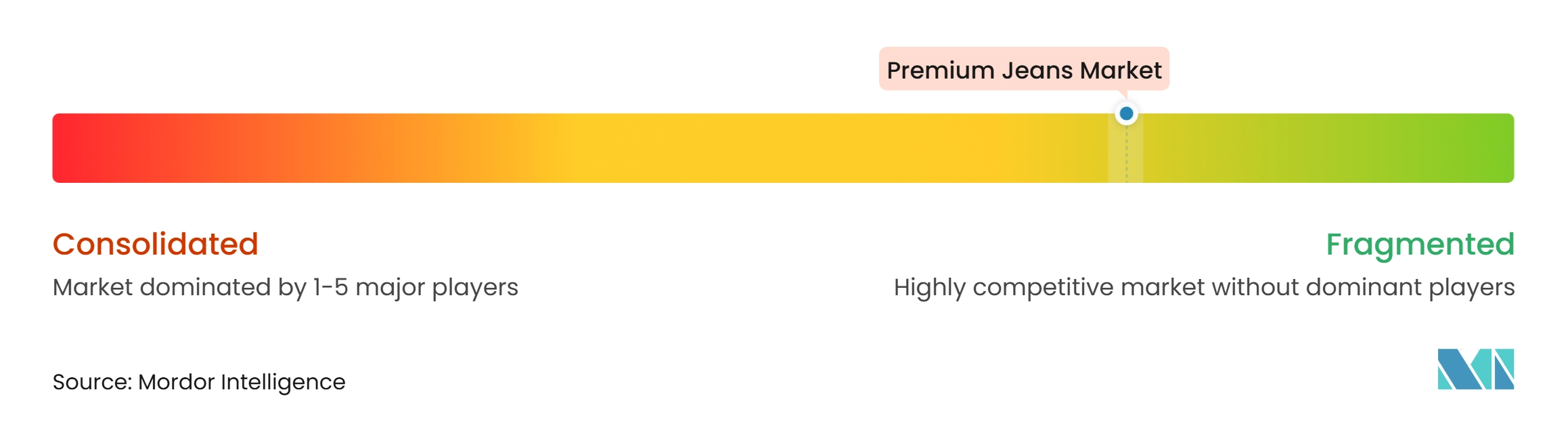
The premium jeans market is fragmented, with global leaders competing alongside regional and niche specialists. PVH, OTB Group, and Kontoor Brands occupy distinct positions across heritage, fashion, and value-premium offerings, catering to different price points and customer expectations. This positioning limits direct substitution while maintaining active rivalry across channels and price tiers. Companies compete not only on price but also on brand heritage, product quality, design differentiation, and their ability to sustain customer engagement.
Leading companies are investing in direct-to-consumer channels and e-commerce to strengthen customer relationships and protect product margins. Levi's used its collaboration with Beyoncé to connect a heritage product with broader cultural attention. For its Spring 2025 collections, Citizens of Humanity Group introduced Eco-Indigo, developed with Pili and Orta, adding a bio-based dye option to its product platform. Nudie Jeans continues to combine store expansion with free lifetime repairs, creating a service model that supports customer retention and circular consumption. These initiatives enable established companies to differentiate their collections through brand storytelling, product innovation, and services that extend beyond the initial purchase.
Smaller brands compete through specialized fit expertise, controlled distribution, transparent product information, and closer relationships with defined customer communities. Digital authentication is becoming increasingly relevant, as it can protect brand trust, support resale activities, and provide customers with a clearer record of product provenance. Fit recommendation technologies and limited customization options may help direct-to-consumer brands reduce their reliance on an extensive physical retail footprint while maintaining personalized product guidance. Although these approaches do not eliminate the advantages of scale, they enable specialized companies to build loyalty among selected customer groups.
Premium Jeans Industry Leaders
-
Levi Strauss & Co.
-
Kontoor Brands, Inc.
-
PVH Corp.
-
American Eagle Outfitters, Inc.
-
Pepe Jeans London
- *Disclaimer: Major Players sorted in no particular order
Premium Jeans Market Companies Covered in this Report
- Levi Strauss & Co.
- Kontoor Brands, Inc.
- PVH Corp.
- OTB Group
- The Gap, Inc
- American Eagle Outfitters, Inc.
- Mavi
- Pepe Jeans London
- Fashion Box
- True Religion Apparel, Inc.
- Citizens of Humanity, LLC
- 7 For All Mankind
- Nudie Jeans Marketing AB
- Paige Premium Denim, LLC
- Rag & Bone
- Hudson Jeans
- Mother Denim
- Khaite
- Frame Denim
- Guess?, Inc.
Recent Industry Developments in Premium Jeans Market
- September 2026: Pepe Jeans introduced an Italian Selvedge capsule for its Fall/Winter 2026 collection in collaboration with Candiani, an Italian denim mill. The collection features premium selvedge denim across men’s and women’s ranges, including the Dalston straight-fit jeans for men and the Eden high-rise straight jeans for women.
- August 2026: Frame Denim announced the opening of its 24th global store in Charleston, South Carolina, expanding its physical retail network into the United States Southeast—a region historically underserved by premium denim specialists.
- November 2025: Levi Strauss & Co. expanded the rollout of its Blue Tab premium denim line in 2026, following strong early performance in Asia, the United States, and Europe. The line is priced at more than USD 300 per pair.
Global Premium Jeans Market Report Scope
Premium jeans are high-quality denim trousers made using superior fabrics, refined construction, and distinctive designs. They offer enhanced comfort, durability, fit, and style compared with mass-market jeans.
The premium jeans market is segmented by type/fit, end user, distribution channel, and geography. By type/fit, the market is segmented into regular, slim, skinny fit, bootcut, and other types. By end user, the market is segmented into men, women, and unisex. By distribution channel, the market is segmented into supermarkets/hypermarkets, specialist stores, online retail stores, and other distribution channels. Based on geography, the market is classified into North America, Europe, South America, Asia-Pacific, and the Middle East and Africa. The market forecasts are provided in terms of value (USD).
Segmentation Overview
| Regular |
| Slim |
| Skinny Fit |
| Bootcut |
| Other Types |
| Men |
| Women |
| Unisex |
| Supermarkets/Hypermarkets |
| Specialist Stores |
| Online Retail Stores |
| Other Distribution Channels |
| North America | United States |
| Canada | |
| Mexico | |
| Rest of North America | |
| Europe | Germany |
| United Kingdom | |
| Italy | |
| France | |
| Spain | |
| Poland | |
| Belgium | |
| Netherlands | |
| Rest of Europe | |
| Asia-Pacific | China |
| India | |
| Japan | |
| Australia | |
| Indonesia | |
| Thailand | |
| Singapore | |
| Rest of Asia-Pacific | |
| South America | Brazil |
| Argentina | |
| Peru | |
| Colombia | |
| Rest of South America | |
| Middle East and Africa | South Africa |
| Saudi Arabia | |
| United Arab Emirates | |
| Egypt | |
| Turkey | |
| Rest of Middle East and Africa |
| By Type/Fit | Regular | |
| Slim | ||
| Skinny Fit | ||
| Bootcut | ||
| Other Types | ||
| By End User | Men | |
| Women | ||
| Unisex | ||
| By Distribution Channel | Supermarkets/Hypermarkets | |
| Specialist Stores | ||
| Online Retail Stores | ||
| Other Distribution Channels | ||
| By Geography | North America | United States |
| Canada | ||
| Mexico | ||
| Rest of North America | ||
| Europe | Germany | |
| United Kingdom | ||
| Italy | ||
| France | ||
| Spain | ||
| Poland | ||
| Belgium | ||
| Netherlands | ||
| Rest of Europe | ||
| Asia-Pacific | China | |
| India | ||
| Japan | ||
| Australia | ||
| Indonesia | ||
| Thailand | ||
| Singapore | ||
| Rest of Asia-Pacific | ||
| South America | Brazil | |
| Argentina | ||
| Peru | ||
| Colombia | ||
| Rest of South America | ||
| Middle East and Africa | South Africa | |
| Saudi Arabia | ||
| United Arab Emirates | ||
| Egypt | ||
| Turkey | ||
| Rest of Middle East and Africa | ||
Key Questions Answered in the Report
What is the current and projected size of the premium jeans market?
The premium jeans market was valued at USD 38.19 billion in 2026 and is expected to grow to USD 53.41 billion by 2032 from USD 40.22 billion in 2027, registering a CAGR of 5.84% during 2027-2032.
Which type/fit segment held the largest share of the premium jeans market in 2026?
The regular fit segment dominated the market in 2026, accounting for 26.83% of total market revenue.
Which end-user segment accounted for the largest share of the market in 2026?
The women segment held the largest market share in 2026, representing 54.91% of the premium jeans market.
Which distribution channel led the premium jeans market in 2026?
Specialist stores were the leading distribution channel, capturing 45.74% of the market in 2026.
Which region held the largest share of the premium jeans market in 2026?
North America accounted for the largest regional share, contributing 38.12% of market in 2026.